Green organic kiwifruit is now under recall in 14 states due to a potentially deadly listeria contamination, according to an announcement posted on the U.S. Food and Drug Administration (FDA) website.
David Oppenheimer and Company said it is voluntarily recalling some of its clamshell packages of kiwi after testing found Listeria monocytogenes in some of the products, according to the notice. The bacteria can cause listeriosis, a sometimes severe and fatal infection.
The company traced the contamination back to two grower lots in New Zealand. The recalled kiwi, repackaged locally for sale in 1-pound clear plastic clamshells has the Zespri brand and UPC code 8 18849 02009 3, and it has fruit with a sticker featuring a GTIN bar code of 9400 9552.
The recalled products were shipped between June 14, 2023, and July 7, 2023, and were sold in Florida, Georgia, Illinois, Indiana, Kentucky, Minnesota, North Carolina, New York, Ohio, Pennsylvania, Tennessee, Texas, Virginia, and Wisconsin.
No illnesses have been reported to date in connection to the products, according to the notice. No other products from David Oppenheimer and Company are subject to the recall.
What Is Listeria?
Federal health officials say that listeria is a bacteria that can cause severe or fatal illness in children, the elderly, or individuals with compromised immune systems. Healthy people can suffer short-term problems including a high fever, nausea, stiffness, diarrhea, abdominal pain, and headaches. Among pregnant women, the organism can cause stillbirths and miscarriages.
Individuals who are infected with the bacteria may see symptoms within a few hours to three days after eating contaminated food, according to the FDA’s website. More severe forms can take three days to three months to develop.
“L. monocytogenes is generally transmitted when food is harvested, processed, prepared, packed, transported or stored in environments contaminated with L. monocytogenes. Environments can be contaminated by raw materials, water, soil, and incoming air. Pets can also spread the bacteria in the home environment if they eat food contaminated with L. monocytogenes,” says the FDA’s website.
Despite the warnings, the bacteria appears to be rare. An estimated 1,600 Americans develop listeriosis each year, while about 260 die, according to the Center for Disease Control and Prevention’s (CDC) data.
“Listeria bacteria can survive refrigeration and even freezing. So people who are at higher risk of serious infections should avoid eating the types of food most likely to contain listeria bacteria,” according to the Mayo Clinic’s website. That includes “improperly processed” deli meat products and unpasteurized milk products, it says, while also listing raw vegetables that have been contaminated from manure or soil as a source of infection.
“Doom Loop Walking Tour” Of San Francisco Sells Out
There’s a new entertainment option for people morbidly fascinated with San Francisco’s relentless decline: a “Downtown Doom Loop Walking Tour.”
The, anonymous, dry-witted host invites tourists to “discover the policy choices that made America’s wealthiest city the nation’s innovative leader of housing crisis, addiction crisis, mental-health crisis, & unrepentant crime crisis.” It’s not clear if this will be an ongoing offering, but the maiden tour — set for Saturday, August 26 — is already sold out.
More liberal perks in San Francisco Bay Area. Crime in California is at highest level ever!!! pic.twitter.com/Hg6OuUBiK2
“You will find no better expert,” reads the tour’s promotional page. “Your guide is an urban policy professional, card-carrying City Commissioner overseeing a municipal department with an annual budget over $500m, and cofounder of San Francisco’s largest neighborhood association. He has spent hundreds of hours on both sides of the government dais, shouting into the opposite abyss.”
Due to rampant crime and uncontrollable drug addiction & homelessness, Downtown San Francisco is a ghost town pic.twitter.com/gM5bpAiDIR
“The tour will start at City Hall, and continue through Mid-Market, the Tenderloin, and Union Square. We will view the open-air drug markets, the abandoned tech offices, the outposts of the non-profit industrial complex, and the deserted department stores.“
This is what the people of San Francisco voted for.
A Crime wave and homelessness wave.
Their liberal laws are now backfiring on them, and they are seeing why law and order is needed. pic.twitter.com/59GtaN4c9S
San Francisco has deteriorated so much that federal officials are now advising hundreds of Health and Human Services employees to work remotely for the foreseeable future, rather than wade through “one of the city’s most brazen open-air drug markets” that’s just outside the Nancy Pelosi Federal Building on Seventh Street.
🚨🇺🇸 San Francisco – Federal Offices
Government Bureaucrats instructed to work from home where Federal Office is now unsafe to access.
Homelessness, Crime & Fentanyl usage are simply out of control in many US Democratic run cities that they are now unsafe for civilians to even… pic.twitter.com/PNYie16VWl
Instead of profit, the tour guide is apparently seeking an outlet for his policy frustrations. He says the tour “is the result of his own mental-health crisis,” and that he’ll donate proceeds to “a non-profit that does not actively degrade its community.”
Just a common everyday occurrence in San Francisco. The police do nothing. The city does nothing. Crime is just out of control. pic.twitter.com/adWuZMDra4
The 90-minute,1.5 mile tour promises to tackle a number of questions:
“How can a city with a $14.6 billion annual budget be a model of urban decay? How can it spend $776.8 million per year on police and have no rule of law to show for it? How can it spend $690 million on homeless services and receive an official United Nations condemnation for its treatment of the homeless (‘cruel and inhuman’; ‘violation of multiple human rights’)?”
This woman might be close to figuring it out:
💥 Biden voters now complaining about rising crime in cities like San Francisco.
The board suspended Dr. Sherri Tenpenny’s license and fined her $3,000 because she allegedly refused to respond properly to complaints that poured in after she testified to state lawmakers.
The suspension is for an indefinite period.
“In short, Dr. Tenpenny did not simply fail to cooperate with a Board investigation, she refused to cooperate. And that refusal was based on her unsupported and subjective belief regarding the Board’s motive for the investigation,” Kimberly Lee, a state official, said in the suspension order.
“Licensees of the Board cannot simply refuse to cooperate in investigations because they decide they do not like what they assume is the reason for the investigation,” Ms. Lee said.
State law enables the board to discipline medical professionals for “failure to cooperate in an investigation conducted by the board.”
Dr. Tenpenny said in a video after the suspension that she had cooperated with the board.
“We cooperated at every level. We looked at the letters; we responded appropriately and legally,” Dr. Tenpenny said.
“My lawyers … drafted responses appropriately and sent it back, and they go, ‘nope, you didn’t cooperate with us.’ Well, I guess that just simply means that they didn’t like the answers. But it didn’t mean that I failed to cooperate.”
Dr. Tenpenny graduated from Kirksville College of Osteopathic Medicine in 1984 and has been practicing medicine since then. The Ohio license is for osteopathic medicine and surgery.
Testimony
The board said that it began investigating Dr. Tenpenny after receiving approximately 350 complaints following her June 2021 testimony to the Ohio House of Representatives Health Committee. The testimony included claims that the COVID-19 vaccines were causing people to become magnetized.
“They can put a key on their forehead, and it sticks,” Dr. Tenpenny said at the time.
The doctor also raised concerns about side effects, including heart inflammation, that U.S. officials have since acknowledged are caused by the shots.
The board said it was investigating whether Dr. Tenpenny violated the state’s Medical Practices Act.
The law says that the board “shall investigate evidence that appears to show that a person has violated any provision of this chapter,” including making a false or misleading statement in relation to the practice of medicine.
Marcie Pastrick, a board attorney, said the complaints included allegations that, if true, would be violations of the law.
However, the suspension was because of Dr. Tenpenny’s alleged refusal to cooperate as opposed to the allegations in those complaints.
Thomas Renz, a lawyer representing Dr. Tenpenny, was cited as telling the board that Dr. Tenpenny was declining to cooperate with what he described as “the board’s bad faith and unjustified assault on her licensure, livelihood, and constitutional rights.” He said that Dr. Tenpenny’s testimony was based on “factual reports by third parties,” including peer-reviewed studies.
Dr. Tenpenny later told the board that it was investigating without any evidence that she violated state law, but the board noted the volume of complaints and how the law says that the “board shall investigate evidence that appears to show that a person has violated any provision of this chapter.”
Dr. Tenpenny must submit an application for reinstatement, pay the fine, and cooperate with the board if she wants it to consider lifting the suspension.
Mr. Renz said that Dr. Tenpenny and her lawyers will fight the suspension in court.
“The board was mad because when they sent her things, we did what they said,” he said in a video. “So if, for example, when the board sends out a questionnaire, and it says, ‘you can either answer this or you can object, and if you object we can compel’—which means going to court to compel—we objected. Well, they didn’t want to go to court to compel, because that would be very inconvenient.”
Mr. Renz noted that the Ohio Attorney General’s Office said that the process for such investigations would “break down” if authorities had to go to the courts each time to compel.
“This is one of the most shocking things I have ever heard,” he said. “We need reform. We need political reform. We need to pass laws now.”
“I think we’re all a little bit blindsided by it, but we’re resilient and we’re going to move forward,” said Ellen Anderson, mayor of the small town located in the southeastern part of the state.
“I want to reiterate that we will have police coverage in the city of Goodhue,” Anderson promised, adding “That is not an issue.”
Police Chief Josh Smith, who will continue to serve until Aug. 24, told city officials he’s been unable to find anyone to join the force.
“This has been three weeks now, we have zero applicants, and I have zero prospects,” he said on July 26, adding “I’ve called every PD around for the youngest guys out there, getting into the game. There’s nobody getting into the game.”
“If you want to keep the PD, and this is something we want to continue going with, something needs to change dramatically and drastically, and it’s got to happen now,” he continued.
Smith told the Goodhue city council that the dismal recruitment numbers was due to low pay and competition from larger cities, the NY Post reports.
The largest city in Minnesota, Minneapolis, is the site of one of the most important policing stories of the last decade.
The last ex-Minneapolis police officer to be convicted following the death of George Floyd received a sentence of 4 years and 9 months on Aug. 7.
Who wouldn’t want to be an underpaid public servant that’s hated by half the population?
Last month, National Defense University professor Donald Stoker wrote a thought-provoking article for Real Clear Defense that examined China’s actions in the Korean and Vietnam Wars and concluded that it will be “exceedingly difficult to deter China in regard to Taiwan,” and that a successful American strategy of deterrence “requires strength, capability, credibility, and will.” A grand strategy of deterrence affects the mind of the enemy–in this case, the mind of Chinese President Xi Jinping and the minds of Xi’s top advisers. The United States and its allies, Stoker writes, must “produce overwhelming doubt in the minds of China’s leaders” that they can take control of Taiwan “at an acceptable cost.”
China under Mao Zedong in the early 1950s in Korea was not deterred from fighting U.S. forces there even though the United States possessed atomic weapons and China did not, and even though America had a much stronger and technologically advanced military than China did at the time. China, Stoker explains, was willing to “endure the risks of escalation, and pay enormous costs in blood and treasure” to protect what its leaders perceived as threats to their security. China also had the advantage of geographical proximity to the conflict. In short, China was willing to risk atomic attack and to expend countless lives and treasure to ensure that the northern half of the Korean peninsula was ruled by a regime friendly to China’s interests.
Stoker notes that China was much less involved in the fighting in Vietnam than in Korea, but attributes that to the U.S. decision not to invade North Vietnam. Stoker writes that Mao told Hanoi’s leaders that his armies would fight the Americans if they invaded northern territory. If Mao was serious–and we have no reason to doubt that–Chinese forces would have intervened in North Vietnam, just as they did in Korea, had American forces crossed into northern territory with the express purpose (as in Korea) of uniting the country under non-communist, pro-American rule.
In both Korea and Vietnam, China had the same political goal–to maintain a friendly regime on its southern border. America’s atomic weapons and its superior military power were insufficient to deter China from achieving its political aims. China’s political goal with regard to Taiwan is to reunify the island under communist party rule. It is the unfinished business of the Chinese Civil War. China’s leaders have been unambiguous about that goal. What will it take, Stoker asks, to deter China from achieving that political goal?
Stoker is not confident that China can be deterred regarding Taiwan. China views Taiwan as a “lost province.” Its value to China’s leaders, Stoker writes, “is exceedingly high,” higher in fact than the independence of North Korea and North Vietnam. The only object that China values more than Taiwan, Stoker writes, is “regime survival.” Which means that to deter China from taking Taiwan the United States must hold at risk the survival of Chinese Communist Party (CCP) rule on the mainland. We must convince Chinese leaders that if they attempt to conquer Taiwan, we will not only successfully defend Taiwan but will force the CCP from power in China–regime change.
One aspect of U.S.-China history that Stoker did not examine was the two Taiwan Strait crises of the 1950s. In the first crisis in 1954-55, China took control of offshore islands, shelled Quemoy and Matsu, and publicly called for the “liberation” of Formosa (Taiwan). President Eisenhower persuaded Congress to pass a resolution authorizing him to employ the armed forces to protect Taiwan–the so-called Formosa Resolution. Secretary of State John Foster Dulles warned China that the U.S. was prepared to use atomic weapons to defend Taiwan. By mid-1955, the crisis was over. Deterrence had worked.
Three years later, China again shelled Quemoy and Matsu, sent warplanes to bomb the islands, and imposed a naval blockade. Eisenhower dispatched the Seventh Fleet to the Taiwan Strait, increased the number of aircraft carriers and warplanes in the region, and let Chinese leaders know that he was prepared to use nuclear weapons to defend Taiwan. Once again, deterrence worked.
Why did deterrence work in the mid-to-late 1950s, but not in Korea and Vietnam? The answer is provided by Stoker at the end of his article: “a deterrent strategy requires strength, capability, credibility, and will.” Under President Eisenhower, the United States exuded “strength, capability, credibility, and will.” We had overwhelming nuclear dominance over China (which had no nuclear weapons then) and significant nuclear superiority over China’s Soviet ally. We also had naval predominance in the western Pacific and a huge technological edge vis-a-vis China. In Eisenhower and John Foster Dulles, we had two statesmen whose will was unquestioned.
The situation today is much different. We no longer have significant nuclear superiority over China, especially in theater nuclear weapons. We no longer have naval predominance in the western Pacific. Unlike the 1950s when we projected strategic clarity on defending Taiwan, today we continue to adhere to a policy of “strategic ambiguity” that has long since outlived its purposes. Finally, one suspects that even partisan Democrats will acknowledge that when it comes to assessing credibility and will, Joe Biden and Antony Blinken are no match for Eisenhower and Dulles, and Biden and Blinken are playing with a much weaker hand than Eisenhower and Dulles had in the 1950s.
China’s top leaders have not hidden their belief that China will replace the United States as the word’s leading power in the not so distant future. This is part of Xi’s “China Dream” that will put the final nail in the coffin of China’s century of humiliation. China, unlike in the 1950s, is a peer competitor of the United States both economically and militarily. China is modernizing the PLA Navy and its nuclear weapons force. It has also formed a “strategic partnership” with a Russia that deploys a nuclear force that is at least equal to that of the United States. President Xi exudes confidence, while an aging President Biden exudes confusion.
Perhaps a better historical analogy than the Korean or Vietnam Wars is West Berlin during the Cold War. West Berlin was an “island” of freedom surrounded by the East German state and Soviet forces. The United States and its European allies could not have defended West Berlin in the event of a Soviet conventional assault. Yet West Berlin survived. It survived because Soviet leaders believed that the United States would sacrifice Washington and New York for West Berlin. Presidents from Truman through Reagan projected strategic clarity about that, and in Reagan’s case added to that clarity by the deployment of intermediate range nuclear weapons and cruise missiles in West Germany in the 1980s in the face of massive protests in the U.S. and the West, and a significant propaganda effort on the part of the Soviets to cancel the deployment of the missiles.
China will be successfully deterred from attacking Taiwan only if it believes that U.S. leaders are willing to sacrifice Washington and New York for Taiwan. Strategic ambiguity must give way to strategic clarity. But strategic clarity must include more than words. Which brings us back to Stoker’s requirements: strength, capability, credibility, and will.
Francis P. Sempa writes on foreign policy and geopolitics. His Best Defense columns appear at the beginning of each month.
In April, Vornado Realty Trust, an office, retail, and residential building owner, suspended its dividend and authorized a stock buyback while shares plunged to levels not seen since 1996. The billionaire head of Vornado in May warned the company was “going to take a breath” in the redevelopment around Manhattan’s Penn Station amid CRE turmoil. Now reports suggest Vornado is exploring options to sell a massive office building to raise cash.
Bloomberg spoke with people familiar with Vornado’s move to “explore options” for the Farley Building, an iconic civic building that features 740,000 square feet of office and 120,000 square feet of retail. Sources said Vornado could sell the building or mortgage the asset to “shore up liquidity during a commercial-property downturn.”
They said the billionaire head of Vornado, Steven Roth, has contacted Newmark Group Inc.’s co-heads of US capital markets, Adam Spies and Douglas Harmon, to review the best strategic options. They added discussions are still ongoing.
What’s alarming is that Roth said the Farley Building is “arguably one of the best buildings of its type and kind in the city.” He then noted: The Farley Building “could be an important source of liquidity.”
This leaves us to believe that Vornado might be experiencing liquidity issues after it has been battered by high borrowing costs and falling office tower prices.
“The Manhattan-based company has been active in selling assets in a bid to boost liquidity. Earlier this year, the firm announced deals to offload four retail properties in Manhattan and the Armory Show,” Bloomberg said.
CRE pains come as the Federal Reserve has aggressively hiked interest rates to 22-year highs.
Vornado shares crashed below GFC levels.
And the overall office REIT space is at GFC crash levels.
Remember last month, Starwood Capital Group’s Barry Sternlicht warned CRE is in a “Category 5 hurricane.” And John Fish, who heads construction firm Suffolk, chair of the Real Estate Roundtable think tank, and former chairman of the board of the Federal Reserve Bank of Boston, warned in a recent What Goes Up podcast: “Nobody understands where the bottom is” for CRE markets.
Brain fog, the struggle to recall words, and forgetting why you entered a room may be more than mere annoyances. They could be lingering symptoms of COVID-19.
Researchers in the UK found that individuals reporting long-lasting COVID-19 symptoms—persisting for at least three months post-infection—exhibited diminished capabilities in areas such as memory, reasoning, and motor control. The findings were recently published in The Lancet’s eClinicalMedicine journal.
“The fact remains that two years on from their first infection, some people don’t feel fully recovered, and their lives continue to be impacted by the long-term effects of the coronavirus,” Claire Steves, co-author of the study and a professor at King’s College London, wrote.
The participants, including both those who tested positive for SARS-CoV-2 and and those who tested negative, were assessed across 12 different tasks. These tasks were designed to test cognitive functions such as working memory, attention, reasoning, processing speed, and motor control.
The analysis specifically examined the effects of COVID-19 exposure on cognitive accuracy and reaction time. It also looked into the role of ongoing symptoms after infection with the aim to provide valuable insights into the impact of the virus on mental functions.
Researchers found notable cognitive deficits in individuals who tested positive for SARS-CoV-2 and experienced symptoms for 12 weeks or more. These deficits—detected in areas such as visual memory and attention—were comparable in scale to the effect of aging by 10 years or being hospitalized during the illness. Notably, the deficits persisted almost two years after the infection in some cases, which raised concerns about the lasting impact of COVID-19 on cognitive function.
When asked about the daily implications of cognitive deficits as compared with approximately 10 years of aging, Ms. Steves offered a sobering perspective to The Epoch Times.
“The effects are tangible, and although they are relatively small, they are probably noticeable in everyday life,” she explained.
Ms. Steves said that the data represent an average across varying cases. “The changes we report are average changes across groups of people, and some people will experience more or less,” she said.
Self-Perception of Illness and Recovery
The study also sheds new light on how people’s self-perception of their recovery from COVID-19 correlates with their actual ongoing symptoms. The research divided individuals who had developed COVID-19 into groups based on their responses to the question, “Thinking about the last or only episode of COVID-19 you have had, have you now recovered and are back to normal?”
Those who answered “Yes, I am back to normal” didn’t show cognitive deficits. “Importantly, we found no detectable impairment among people who reported as feeling recovered and ‘back to normal’ after their COVID-19 illness, even among individuals who experience long-term symptoms [for as long as or longer than] 12 weeks,” the authors noted.
On the other hand, those who answered “No, I still have some or all of my symptoms” revealed an increase in cognitive impairment. The study found that psychological distress and fatigue partially mediated these deficits.
According to the study’s authors, self-perceived recovery was “highly correlated with symptom duration.” This discovery aligns with smaller studies that have examined recovery self-assessment.
However, caution in interpretation is advised. Dr. Armen Nikogosian, a medical and functional physician treating long-COVID-19 patients, spoke about the complexity of the issue.
“Patients who suffer from the effects of long COVID are typically sidelined in conventional medicine,” he told Epoch Times. “It’s entirely possible that these patients continue to have symptoms not identified or validated by their healthcare providers.”
The relationship between self-perception, symptoms, and recovery appears multifaceted, and this study illuminates some aspects of that complexity.
Cognitive Decline Following COVID-19
Cognitive impairments following infections with viruses such as SARS-CoV-2 are well documented, but the experience of living with the resulting “brain fog” is a complex and distressing reality for many.
Dr. Katherine Pannel, a psychiatrist and medical director of Right Track Medical Group in Oxford, Mississippi, experienced brain fog after contracting COVID-19 and describes the frustration of the condition. “I was hesitant to do any kind of public speaking because I knew what I wanted to say, but I could not find the words. It was so frustrating,” she shared on AMA’s What Doctors Wish Patients Knew.
In January 2021, Jill, a respiratory therapist from Boston, experienced a mild case of COVID-19, marked only by a loss of smell and taste. As the year progressed, symptoms such as fatigue, forgetfulness, and getting lost while driving emerged. Jill’s physician husband helped her to investigate, leading to a diagnosis of mild cognitive decline, believed to be related to COVID-19. They embarked on a regimen of supplements, anticoagulants, red-light therapy, dietary changes, and at-home rehabilitation.
Despite facing setbacks that included microclotting and cognitive impairment, Jill’s continual efforts in rehabilitation—guided by medical professionals—have yielded improvement. Through perseverance and a regimented daily routine focused on diet, exercise, and cognitive training, she has seen progress in her recovery, although challenges remain.
The frustration extends beyond the symptoms themselves, as many sufferers face skepticism and disbelief about their condition, Dr. Pannel said.
“As a psychiatrist, I’m used to stigma surrounding mental health with depression and anxiety, but I’m even starting to see stigma surrounding long-COVID brain fog where a lot of people aren’t believing that it exists,” she said. “And patients are frustrated because they have all these symptoms, but there’s not a lab test or imaging to prove this is what’s going on.”
Solid data backs this anecdotal evidence. A 2022 meta-analysis published in Alzheimer’s and Dementia analyzed 27 studies and found that adults recovering from COVID-19 displayed noticeable deficits in executive functions, attention, and memory up to seven months after infection.
This systematic review, including 2,049 people, shed light on a marked decrease in cognitive scores among those with no prior history of impairment. Determining the underlying causes of cognitive decline following COVID-19 remains a complex and unfolding area of study.
“Often underlying their cognitive decline is chronic inflammatory response syndrome, a complex illness in which individuals process biotoxins differently,” Dr. Nikogosian said.
“Biotoxins from a variety of sources, like mold, pathological gut microbes, Lyme disease, and chronic infections, can lead to chronic inflammation for some individuals.”
This presents a challenge, he said, “when these individuals contract COVID, they struggle to clear the virus, resulting in symptoms such as brain fog.”
Dr. Nikogosian said that treating long COVID isn’t as simple as finding a quick-fix solution. Instead, the underlying health issues must be addressed with care and consideration, reflecting the multifaceted nature of the disease.
Cognitive Decline: Virus or Vaccine?
The intersection of cognitive decline and COVID-19 extends beyond the virus, touching on a growing concern: the potential relationship between cognitive decline and COVID-19 vaccinations. Multiple case studies have identified cognitive decline in individuals following receipt of the COVID-19 vaccine. This phenomenon, labeled functional neurological disorder, has created a parallel dialogue about the cognitive impacts of both the virus and the vaccine.
Russia Destroys Grain Silos Along Danube As US Pushes For ‘Alternative’ Ukraine Shipping Routes
The United States is actively pursuing ways for Ukraine to boost its grain exports via alternative routes after Russia pulled out of the Black Sea Grain Initiative deal this summer. This involves NATO-member Romania, and presents the increasingly dangerous prospect of Russia and a NATO country entering potential clashes.
The Wall Street Journal reported Tuesday that the US has been holding talks with Turkey, Ukraine, and its neighbors about exporting up to four million tons of grain a month by October, using the Danube River route.
“Much of the grain would be sent down the river and via the Black Sea to nearby ports in Romania and shipped onward to other destinations,” wrote the WSJ. “Though slower and more expensive, the route would work as an alternative to a Black Sea shipping corridor established last year under an agreement with Russia, Turkey and the United Nations.”
Ukraine has also been having to rely on slower and much more expensive, logistically challenging overland routes for more and more of its foodstuff exports, while some 50% of its exports must still flow through Black Sea routes.
But any attempt to ramp up sea routes is more dangerous, given Russia has over several weeks increased its attacks on Ukrainian ports and event sent commandos to board a shipping vessel in the Black Sea which was headed toward Romania…
🇷🇺Russians fire warning shots and board cargo ship MV Sukra Okan heading for Romanian port in the Black Sea.
Video shows the boarding party being recovered by Ka-29 helicopter (based on OPV RFS Vasily Bykov)
An unnamed US official said the Biden administration “is considering all potential options, including military solutions” to ensure the safety of ships entering Ukraine’s ports on the Danube. As part of the mulled plan, vessels would leave Ukrainian ports and enter Romanian ones and from there be shipped to outside destinations.
However, the Russian naval intercept incident of an allegedly ‘unauthorized’ Turkish vessel bound for Romania and Ukraine highlights that Moscow’s readiness to crackdown on any ‘alternate’ routes for Ukrainian grain. Its forces have even bombed grain silos on the Danube, provocatively close to NATO-member Romania’s territory.
There has been yet another attack Wednesday, per the AP: “Russian drones pounded grain storage facilities and ports along the Danube River that Ukraine has increasingly relied on as an alternative transport route to Europe, after Moscow broke off a key wartime shipping agreement using the Black Sea,” the report says.
“At the same time, a loaded container ship stranded at the Black Sea port of Odesa since Russia’s full-scale invasion more than 17 months ago set sail along a temporary corridor established by Ukraine for merchant shipping,” it added. Thus it appears there are some early attempts in motion at freeing up an alternate corridor. But Russia’s military is continuing to bring the pressure.
The most destructive natural disasters are never 100 percent natural. Human choices, land use, and government policies play a big role in how harmful hurricanes, tornadoes, earthquakes, flash floods, and wildfires are to the affected communities.
And after catastrophes like the wildfire that destroyed much of the historic Hawaiian city of Lahaina last week, it’s worth taking stock of how much of the disaster was the result not of natural or accidental factors, but of policies and institutions that can be changed.
Though details are still emerging, it’s becoming clear that government failure did much to make this disaster worse – and possibly even started it.
While the so-called experts are blaming climate change—and in the process demanding that government grab even more power and authority ostensibly to someday give us better weather—the destructiveness this fire was the product of an all-powerful and all-incompetent régime.
The specific origins of the fire are still being investigated, but there is much we already know. The city of Lahaina sits on the west coast of Maui, Hawaii’s second-largest island. It is surrounded by grassland, much of which the state owns.
Nearly a decade ago the Hawaii Wildfire Management Organization, a research nonprofit, warned the Hawaiian government that the area around Lahaina was extremely fire-prone due to frequent downslope winds, steep terrain, and dry grass. Little was done to address these risks. A subsequent report in 2020 added that an invasive species of exceptionally flammable grass was prevalent in the surrounding fields and that passing hurricanes created strong winds known to fuel wildfires on the islands.
Early last week, Hurricane Dora crossed the ocean south of Hawaii. By early Tuesday morning, August 8, winds as fast as sixty miles per hour were blowing down the slopes of the West Maui Mountains into Lahaina. Around sunrise, a large fault was detected in the power grid, indicating a downed power line. Twenty minutes later, the first reports of fire came in from the area around Lahainaluna Road, uphill and upwind from the city.
The area where flames were first spotted is full of electrical infrastructure, mostly operated by Hawaiian Electric, the state’s monopoly electricity supplier. This included a substation and a multitude of power lines. Most of the land in the area is owned by the State of Hawaii except for a parcel belonging to the estate of one of Hawaii’s last princesses. This parcel housed a solar farm supplying electricity to the Hawaiian Electric substation. Early last year, NPR published a glowing article about the solar project, praising it the direct result of government regulation crafted to help transition Hawaii to 100 percent renewable power by 2045.
But on the morning of August 8, as winds hammered the old wooden utility poles, this highly electrified area in the dry grasses above Lahaina was quickly becoming dangerous. Yet no formal procedure was in place to shut off sections of the grid in the face of severe fire risks. As a result, twenty-nine fully energized poles fell across West Maui that day.
But even with downed poles in the way, the first firefighters on the scene met with some early success. Around 9 a.m., the county fire department declared the fire “100 percent contained.” But the message to residents included an ominous request. The county’s water pumps were powered by electricity, much of which was frantically being turned off to deactivate the downed lines. Officials asked the public to conserve water to preserve water pressure.
But by midafternoon, a flare-up brought the fire back to life on the Lahaina Bypass, a major road that heads straight into town.
The flames moved swiftly into Lahaina at 4:46 p.m., one minute after the county government finally sent out an alert to warn the city’s population, largely without power, about the flare-up that had occurred over an hour before.
To make matters worse, county officials failed to activate emergency sirens, leaving residents unaware of the danger bearing down on them.
And as firefighters heroically rushed toward the flames to try and save their community, they found that there was little to no water pressure in the fire hydrants, which quickly ran dry.
With a single backed-up highway leading out of the city, many residents of Lahaina had nowhere to go. Some scrambled into the ocean to escape the smoke and flames. But in the end, many couldn’t get out. At least ninety-nine people have been confirmed dead at this writing, making this the deadliest American wildfire in over a century. In addition, 2,207 buildings were destroyed, with property damages expected to reach $5.5 billion.
To review, a power company shielded from competition by the state placed electrical infrastructure among highly flammable state-owned grass fields above the historic city of Lahaina, which the government was twice warned were highly susceptible to fire. And once a fire broke out, a combination of defective water infrastructure, terrible communication by government officials, and only one escape route doomed the people of Lahaina to the worst wildfire experienced in this country in over a hundred years.
This was government failure through and through. In Human Action, Ludwig von Mises explains that on the market, the ultimate source of profits is foresight—the ability to anticipate future conditions. And economic loss occurs when market actors fail to anticipate the future. This possibility of riches if one succeeds, and the guarantee of painful failures if one doesn’t, forces producers and service providers on the market to constantly weigh risks and opportunities.
Government immunizes itself from the profit and loss system, and therefore from much of the need to weigh risk. Sure, some county officials may resign because of this. And the share price of Hawaiian Electric may dip. But the people of Maui will be forced to keep compensating the very organizations that have failed them. And there’s nothing natural about that disaster.
Stocks, Bonds, & Commodities Crumble As Dollar Rips On Hawkish Fed Minutes
Better than expected industrial production and a bigger than expected rise in housing starts lifted the Atlanta Fed’s GDPNOW forecast for Q3 growth to 5.8% (but the St.Louis Fed’s GDPNOWCast is not at all impressed)…
Source: Bloomberg
Is that what The Fed is hoping for from its tightening? While September odds were unchanged today, the market’s expectations for year-end are hawkishly on the rise…
Source: Bloomberg
The Fed’s Minutes were decidedly hawkish (with the most hawkish sentences since January according to Bloomberg’s NLP model)…
Source: Bloomberg
And that weighed on everything with stocks, bonds, and commodities lower while the dollar rallied.
Nasdaq and Small Caps were the day’s biggest laggards but all the US majors were ugly with the market’s negative gamma very evident into the close…
The Nasdaq 100 broke below 15,000 to its lowest since June (almost 7% off the highs)…
The S&P, Nasdaq, and Russell 2000 all closed below their 50DMAs (The Dow remains above its)…
Cyclicals continued to underperform Defensives as the ‘overshoot’ in growth expectations is reversing fast (but has a long way to go)…
Source: Bloomberg
Regional bank stocks extended their recent losses…
Is it catch down time for stocks to credit…
Source: Bloomberg
Treasury yields were higher on the day across the curve with the longer-end underperforming (2Y +2bps, 10Y +6bps)…
Source: Bloomberg
The 30Y Yield closed at its highest since Oct ’22…
Source: Bloomberg
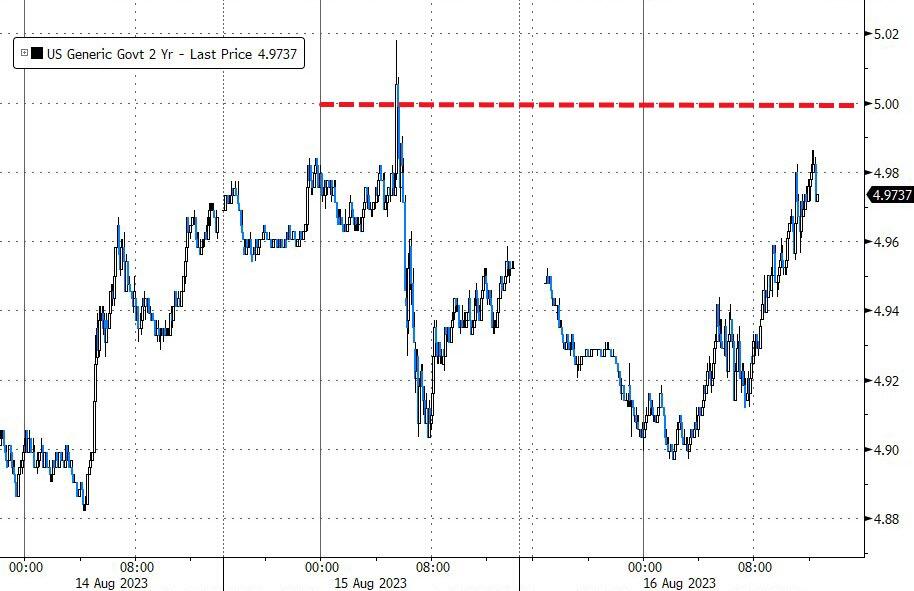
The 2Y yield pushed up towards 5.00% today…
Source: Bloomberg
The dollar extended its recent gains today (the 5th straight day higher) to its highest close since May 2023…
Source: Bloomberg
Bitcoin puked back below $29k intraday but found support and got back above…
Source: Bloomberg
Oil (WTI) fell back below $80 to two-week lows, but remains well off the June lows…
Gold (spot) broke below $1900 to its lowest close since March….