68.8 F
Chicago
Sunday, August 30, 2026
Home Blog Page 3425

Mark Meadows Wants To Move Georgia Indictment To Federal Court – And Legal Experts Say He’ll Succeed

0
Mark Meadows Wants To Move Georgia Indictment To Federal Court – And Legal Experts Say He’ll Succeed

Former Trump chief of staff Mark Meadows has asked to move charges against him to federal court, after he was charged this week in Georgia alongside the former president and 17 other individuals.

Mr. Meadows is entitled to remove this action to federal court because the charges against him plausibly give rise to a federal defense based on his role at all relevant times as the White House Chief of Staff to the President of the United States,” said attorney Timothy Parlatore in a Tuesday filing.

Meadows was charged by a grand jury on Monday with violating the state’s Racketeer Influenced and Corrupt Organizations (RICO) Act.

Mr. Meadows has the right to remove this matter. The conduct giving rise to the charges in the indictment all occurred during his tenure and as part of his service as Chief of Staff,” his lawyers wrote.

Trump was also charged with “unlawfully soliciting, requesting, and importuning” Georgia Secretary of State Brad Raffensperger by asking him to ‘find’ votes for him – a comment construed by the left to suggest Trump was asking him to break the law, however Trump’s attorneys will likely argue that the former president, in context, was referring to the general ballot-counting malarkey and other oddities surrounding the 2020 US election (covering up windows, kicking out observers, overnight ballot drops, major cities stopping their counts at 9pm for the first time in anyone’s lifetime, broken water pipe, suitcases under desk, that chart showing the overnight jump, etc.).

Meadows likely to succeed?

As Just the News notes

Although Trump’s New York case was not upgraded to federal court, Parlatore said that the decision from federal Judge Alvin Hellerstein of New York’s Southern District “perfectly laid the groundwork” for moving the Georgia case.

What distinguishes the Georgia from the New York case is the nature of the alleged criminal acts. The New York case involved payments made by then-Trump attorney Michael Cohen to adult film actress Stormy Daniels. Judge Hellerstein said that “Hush money paid to an adult film star is not related to a President’s official acts. It does not reflect in any way the color of the President’s official duties.”

“I think that it’s going to be almost impossible to avoid removal. Removal is important because when you have a federal official that is being charged by a state in violation of state law, that’s something that you want to have removed to the federal courts so the federal judge can decide, you know, do the federal authorities have some type of ability to do this?” Parlatore told JTN Tuesday evening.

It’s going to significantly expand the jury pool so you’re not just going to have Fulton County jurors, but more importantly, when they go on to the next round, where they’re going to be fighting about the sufficiency of this indictment, I’ve read it, and the RICO count is completely legally incompetent, in my opinion,” he added – suggesting that the RICO charge should be heard before a federal judge.

“I think it’s important to get that in front of a federal judge so they can apply the standards set by the Supreme Court on these types of RICO cases, even though it’s a state statute, as opposed to the federal statute,” he said, adding “One of the things that really jumped out at me is something they call continuity, where the enterprise has to have some continuous purpose as opposed to just being an isolated incident. And here it is an isolated incident because it all centers around the election and so it’s the type of thing that in federal court, RICO gets dismissed.

Parlatore, who has previously represented NY Police Commissioner Bernie Kerik, slammed the Fulton County court for leaking the indictment early, calling it “emblematic of the larger sloppiness” of the case, and said that the indictment contained spelling errors.

Fulton County DA, Fani Willis

“It’s clearly something that was rushed. They didn’t do it carefully,” he said, adding “As much as they are not careful with the simple administrative aspects of it, to a lawyer like me that’s tried RICO cases before, it is really emblematic of, you know, they were careless with the law. They were careless with the entire structure of this thing.”

Another attorney, Buddy Parker of Maloy Jenkins Parker – a RICO expert, told Straight Arrow News that the case will likely be moved to federal court.

“As an officer of the United States being charged with a violation of the law of the state of Georgia, under concepts of federalism, a officer of the United States can, on motion, require the case to be transferred to the United States District Court,” he said (via JTN).

More on Acts of Racketeering via the Epoch Times.

“Nothing Mr. Meadows is alleged in the indictment to have done is criminal per se: arranging Oval Office meetings, contacting state officials on the President’s behalf, visiting a state government building, and setting up a phone call for the President,” Mr. Meadows’s attorney wrote in the filing. “One would expect a Chief of Staff to the President of the United States to do these sorts of things.”

The indictment lists (pdf) several of Mr. Meadows’s actions as chief of staff as acts of racketeering, including a Nov. 20, 2020, meeting with Michigan state legislators in the White House during which President Trump “made false statements concerning fraud in the November 3, 2020, presidential election in Michigan,” and sending a text to Rep. Scott Perry (R-Penn.) the next day asking for the contact information of state legislators.

Can you send me the number for the speaker and the leader of PA Legislature. POTUS wants to chat with them,” the text read.

The indictment claims, “This was an overt act in futherance of the conspiracy.”

It lists the following Nov. 25, 2020, meeting with Pennsylvania state legislators as a continuance of the alleged conspiracy, as well as Mr. Meadows’s participation in meetings with political adviser John McEntee in December 2020, when Mr. McEntee was asked to draw up plans to delay Congress’s joint session on Jan. 6, 2021.

In relation to Georgia, it cites Mr. Meadows’s trip to Cobb County Civic Center on Dec. 22, 2020, in order to try to observe the signature match audit, but was prevented from entering. The following day, the president made a call to Georgia Secretary of State Chief Investigator Frances Watson, and the indictment notes that Mr. Meadows had arranged the call. Days later, Mr. Meadows sent a text to Ms. Watson asking if there was any way the signature verification could be sped up, offering financial assistance.

Tyler Durden
Wed, 08/16/2023 – 12:05

NYC Mayor Calls On Biden Admin To Expedite Work Permits For Illegal Immigrants

0
NYC Mayor Calls On Biden Admin To Expedite Work Permits For Illegal Immigrants

Authored by Frank Fang via The Epoch Times,

Mayor Eric Adams once again implored the Biden administration to speed up work permits for illegal immigrants in New York City, arguing that the delays are “anti-American” amid the immigration crisis engulfing his city.

“It’s unfair as the city continues to evolve at a national crisis and humanitarian crisis of a level that has never been experienced before is now dropped into the lap of this city with no support that we deserve,” Mr. Adams said at a rally in support of asylum seekers outside of Brooklyn Borough Hall on Aug. 15.

“What is more anti-American than not allowing someone to work? What is more anti-American than that?” the mayor added. “So what is wrong with them having the right to work? There’s no reason the national government is not staying true to the basic principle of the American experience to allow you the right to work. It is unacceptable.”

According to federal law, illegal aliens must wait roughly six months after filing their asylum applications before applying for a work permit.

“This city needs workers,” Mr. Adams said.

“We need workers. We need people contributing in our society. We need people making this the melting pot that it is. That is how our city has become the greatest city on the globe by opening our doors.”

The mayor, a Democrat, also said the city is coping with over 100,000 illegal immigrants, and reiterated his previous comments that the cost of providing shelter and other services to them could top $12 billion over the next three years.

“This is not a New York City problem. This is a national problem,” Mr. Adams said.

“This is the greatest challenge our city has faced in decades. We got to get it right.”

New York Mayor Eric Adams addresses the media at a rally in support of asylum seekers in New York City on Aug. 15, 2023. (Spencer Platt/Getty Images)

‘Please Step Up’

The rally was joined by several elected officials, including Brooklyn Borough President Anthony Reynoso and New York City Public Advocate Jumaane Williams.

“President [Joe] Biden, please step up. Provide the resources that are needed so we can match this humanitarian crisis with a real humanitarian response. We’re begging you, we’re pleading to you, united as a voice,” Mr. Williams said.

“I have asked, and I will ask again, that President Biden himself come and visit. Maybe if he saw with his own two eyes, what was going on, he will step up from the sidelines,” Mr. Williams added.

Mr. Williams, a former New York City Council member, lost to Kathy Hochul in the Democratic primary for governor of New York in June last year.

Mr. Reynoso praised the mayor for his efforts to tackle the immigration crisis but criticized the Biden administration for being “completely absent.”

“There are only so many things we could do legally at the state and city level. We can only pass so many laws that tinker at the margins of this problem. But the federal government could deal with the core problem. And they are not,” Mr. Reynoso said.

“The mayor is doing the best he can under the circumstances to solve for [sic] this problem the best he can.”

The Brooklyn borough president warned that the crisis could dampen Democrats’ chances in upcoming elections.

“We need those seats,” Mr. Reynoso said. “I want to be very clear that this can be used against the Democratic Party during these congressional races.”

New York State Assembly Member Robert Carroll and New York City Council Member Alexa Avilés were also at the rally.

“It is time for the state and the federal government to provide direct resources for New York City so that we can do the right thing,” Mr. Carroll said.

“We can do the humane thing because New York City is and has always been a city of immigrants.”

“’I’m here again with my colleagues saying to the federal government, to the Biden administration, you must put forward a national strategy, fix this immigration system,” Ms. Avilés said. “We need comprehensive immigration reform; you can advance work authorization and all the other tools that we have been demanding for months, if not years.”

Tyler Durden
Wed, 08/16/2023 – 11:45

WTI Extends Losses As Crude Production Nears Pre-COVID Highs, SPR Build

0
WTI Extends Losses As Crude Production Nears Pre-COVID Highs, SPR Build

Oil prices are modestly lower this morning, having given up overnight gains amid weakish US data which followed dismal China data.

“We continue to believe oil demand headwinds will outweigh supply cuts in the near term,” warned Bloomberg’s Joseph Richter

API

  • Crude -6.195mm (-1.7mm exp)

  • Cushing -1.00mm

  • Gasoline +700k (-1.2mm exp)

  • Distillates -800k (-100k exp)

DOE

  • Crude -5.96mm (-1.7mm exp)

  • Cushing -837k

  • Gasoline -262k (-1.2mm exp)

  • Distillates +296k (-100k exp)

The official DOE data confirmed API’s reporting of a major Crude inventory draw last week (down around 6mm barrels – notably more than expected). Stocks at the Cushing hub fell for the 6th of the last 7 weeks…

Source: Bloomberg

US Crude inventories are at their lowest since January…

Source: Bloomberg

For the second week in a row, the Biden administration ‘refilled’ the SPR (adding a mere 600k barrels)…

Source: Bloomberg

US Crude production surged again last week – despite the decline in the rig count – up to near pre-COVID levels…

Source: Bloomberg

WTI was hovering around $80.80 ahead of the official data and extended losses after the print…

Finally, we note that retail gas (pump-prices) are at 10-month highs, and set to go further given where wholesale gasoline and crude prices are…

Get back to work Mr.Biden.

Tyler Durden
Wed, 08/16/2023 – 10:38

Furious Investors Protest Outside China’s Insolvent Shadow Banking Giant After It Misses Payments, Warns “Liquidity Has Suddenly Dried Up”

0
Furious Investors Protest Outside China’s Insolvent Shadow Banking Giant After It Misses Payments, Warns “Liquidity Has Suddenly Dried Up”

Things are getting very ugly for both the so-called “China’s Blackstone“, and China in general.

Just days after we reported that the “secretive” shadow-banking giant, Zhongrong, also called “China’s Blackstone” as it manages (or rather managed) 1 trillion in AUM, had missed payments on “multiple shadow banking (i.e. high-yield investment) products”, stoking fresh worries about contagion amid China’s deflationary pressures and, of course, a tottering real estate sector, which as a reminder is the largest asset class on earth…

… overnight Bloomberg reported that Zhongrong’s troubles have accelerated and the asset manager not only missed payments on dozens of products – adding to delays on at least 10 others since late July – but “has no immediate plan to make clients whole, indicating troubles at the embattled Chinese shadow bank are deeper than previously known.”

The troubles are so deep in fact, that Zhongrong – which is one of the largest players in China’s $3 trillion shadow banking industry – appears to be effectively insolvent: “the company doesn’t have an immediate plan to cover the payments since its short-term liquidity has suddenly dried up”, said Wang Qiang, board secretary of the firm partly owned by financial giant Zhongzhi Enterprise Group.

The Zhongrong International Trust offices in Beijing

He added that the number of products with missed payments has risen and the company is facing a “tsunami” of questions from investors and their own wealth managers, according to the people familiar, who asked not to be identified because the meeting was private. Wang asked for patience as the firm seeks to recoup the value of its investments.

Unfortunately, investor patience has dried up and from a separate Bloomberg report we learn that furious Chinese investors protested outside the office of Zhongrong in “a rare show of public outrage after the firm skipped payments on dozens of investment products.”

Videos of the incident showed about two dozen protesters at Zhongrong International Trust Co., demanding payment on high-yield products that were pitched as safe investments. In one of the clips posted on Wechat seen by Bloomberg News, a woman angrily asks: “Why doesn’t the company pay us back?” she says. “It has already matured. Your financial statements said there is a profit.”

The company isn’t paying you back for one simple reason: it’s broke

The protesters in Beijing were met by about 10 police and security officers, while a company official tried to keep the peace. One woman is heard shouting: “Give us the money back, or we will die here.” Another says: “Why you don’t give us a clear explanation?”

A reporter who visited the Zhongrong office Wednesday afternoon didn’t see any protesters but there was an unusually heavy police presence around the building.

Officers were seen sitting in several police vans and cars parked inside and outside the office compound, and other police vehicles were placed on roads nearby.  Officers were also watching the area from inside one of the several city buses that were parked at the main gate or nearby. Workers were erecting extra fencing around the building.

The protests – not to mention the admission of insolvency – indicates that troubles at the embattled Chinese shadow bank are deeper than previously known, and underscore how the fallout from the real estate slump is spreading to the financial sector. Many trust products sold by Zhongrong and others are backed by housing projects run by troubled developers such as China Evergrande Group, which of course, is also broke.

And since at least 30 products are now overdue and Zhongrong has also halted redemptions on some short-term instruments, the investor fury will only grow.

Zhongrong is among the biggest firms in the country’s $2.9 trillion trust industry, which pools savings from wealthy households and corporate clients to make loans and invest in real estate, stocks, bonds and commodities. The firm has 270 high-yield products totaling 39.5 billion yuan ($5.4 billion) due this year, according to data provider Use Trust. Chinese authorities have already set up a task force to study any possible contagion from the shadow banking group, which manages about $138 billion. The firm said it has no immediate plans to make clients whole.

According to Bloomberg, the trust sector’s exposure to real estate is about 2.2 trillion yuan, or 10% of total assets as of the end of 2022. Zhongrong is the ninth-biggest trust, with about 600 billion yuan in assets.

“The big danger is that a negative feedback loop kicks in, with property stress causing strains in the financial system, undermining credit expansion and depressing growth, which, in turn, exacerbates the slump in the property sector,” Bloomberg Economics said in a note.

“The good news is that regulatory vigilance means a rerun of the 2008 U.S. crisis is unlikely,” Gavekal Dragonomics’ Xiaoxi Zhang wrote on Wednesday, unless of course a rerun of the 2008 crisis is imminent, especially if China doesn’t pursue helicopter money as a top PBOC banker has recommended.

“The bad news is that debt strains from property developers and local-government financing vehicles are spreading across China’s economy.”

Given the recent net asset value markdowns and redemptions, we expect growth in trust products to slow, which could result in tighter property financing conditions, and affect banks’ earnings and balance sheets,” Goldman analyst Shuo Yang wrote in a note. Not that China can afford any tighter financial conditions or even more property turmoil…

And speaking of property turmoil, overnight China reported that new home prices fell in July for the first time this year, the latest in a string of downbeat data that underlines the urgency for bolder policy support. Prices fell 0.2% month-on-month on a nationwide basis and 0.1% year-on-year, according to the National Bureau of Statistics (NBS).

But the picture is far worse outside of the country’s megacities like Shanghai and Beijing. Average new home prices in the 35 smallest cities surveyed by NBS fell for the 17th straight month in June on a year-on-year basis.

The worsening debt crisis at major developers including Country Garden, the country’s biggest private developer, has scared away many home buyers, with property investment, home sales and new construction contracting for more than a year.

Country Garden promised “five-star living” to the masses in less popular, smaller cities but focusing on those areas has come back to haunt it. Its plight has raised fears that its debt problems will ripple through the stalling economy. Given the property market has traditionally accounted for about a quarter of China’s economy, some analysts say the slump, combined with the shock from three years of strict COVID measures, has had an unprecedented impact on activity.

And speaking of Country Garden, which we also profiled last week, the distressed Chinese developer warned about “major uncertainties” in redemption of its bonds, as it said that trading in some of its local notes will remain suspended. The builder, whose cash crunch threatens even worse impact than defaulted peer China Evergrande Group given it has four times as many projects, made the comments in a filing with the Shanghai stock exchange.

As discussed previously, Country Garden, which was previously the nation’s biggest builder, is on the verge of default if it doesn’t make dollar bond interest payments missed earlier this month within a 30-day grace period. The crisis at the firm, helmed by one of China’s richest women, Yang Huiyan, has pushed its notes deeper into distress and weighed on China’s broader financial markets.  

It had suspended trading of 11 onshore notes issued by the company and subsidiaries earlier this week. The builder has been soliciting feedback on a proposal to extend payment of a 3.9 billion yuan ($535 million) note due Sept. 2, people familiar with the matter said earlier this week.

In any case, most analysts expect further falls in home prices and sales over coming months, not to mention the country’s GDP. Barclays and JPM are among a number of global banks to cut its forecasts for China’s 2023 growth after weak data on Tuesday, citing a faster-than-expected deterioration in the housing market. Barclays lowered its growth forecast to 4.5% from 4.9%, JPM also sees China’s GDP below the promise 5% minimum.

Some economists say many consumers and small businesses are already feeling economic pain as deep as during a recession, given youth unemployment at record rates above 21% and deflationary price pressures squeezing companies’ profit margins (going forward Beijing has decided to simply not report youth unemployment at all). Meanwhile, new bank loans fell to a 14-year low in July.

The central bank’s surprise interest rate cuts on the same day will not be enough to arrest the economy’s downward spiral, several analysts said.

Highlighting the difficulties facing policymakers, China’s property sector continues to struggle despite an extension of financial support for developers and incentives for first-time home buyers and upgraders.

Last month, China’s top leaders in a Politburo meeting vowed to adjust property policies. The housing regulator has also urged efforts to prop up the sector such as lower home mortgage rates and down payment ratios for first-time homebuyers and easing mortgage curbs for people who want to upgrade their homes.

Some cities including Zhengzhou have already relaxed a handful of property curbs. Provincial capitals like Xian and Fuzhou are considering reductions in downpayment ratios for residents who buy second flats.

“We continue to expect more housing easing measures in coming months, including further reduction in down-payment ratios and more relaxation of home purchase restrictions in large cities, among others,” economists at Goldman Sachs said in a note to clients.

However, most economists expect the property slump to drag on for some time.

“High-frequency data in early August does not suggest any meaningful improvement in the property market,” said Wang Tao, Head of Asia Economics and Chief China Economist at UBS Investment Bank.

“Without additional major policy easing and/or fiscal support, property sales and investment may weaken further or stay at the bottom for longer than assumed in our baseline,” said Wang.

Tyler Durden
Wed, 08/16/2023 – 10:09

The Unforgivable Ivermectin Swindle

0
The Unforgivable Ivermectin Swindle

Submitted by QTR’s Fringe Finance

This month, lawyers for the Food and Drug Administration admitted in a U.S. court that doctors “do have the authority to prescribe ivermectin to treat COVID”, an admission that stands at stark odds with a multiple year campaign to misinform, misalign and tarnish the reputation of one of the world’s most successful drugs, which could have been used to save hundreds of thousands of lives during the pandemic.

“FDA is clearly acknowledging that doctors have the authority to prescribe human ivermectin to treat COVID. So they are not interfering with the authority of doctors to prescribe drugs or to practice medicine,” Ashley Cheung Honold, lawyer representing the FDA said this month.

I know this likely isn’t the case for my regular readers, but if you’re new to the blog and you happen to be one of those people who still doesn’t quite understand that you are routinely lied to by the media and the billionaires that run our country, I can think of no better indoctrination than the travesty of a fraud that was just perpetrated on the American people regarding ivermectin.

For those who haven’t followed the story, during the course of the Covid pandemic, it was revealed that ivermectin – a drug that has been administered billions of times to humans and is on the World Health Organization’s list of Essential Medicines – was found in numerous clinical trials to have efficacy in early treatment of Covid-19. If you’re looking for a primer on this, here is a website that aggregates all of the clinical trials and here is a discussion with Bret Weinstein and Dr. Pierre Kory that serves as a great introduction to the topic.

If you’ve been at least semiconscious over the last two years, you’ve noticed that early means of treating Covid outside of the vaccines (like Vitamin D, hydroxychloroquine and ivermectin) were routinely shunned by “the science” and then, by proxy, the useful idiots in the mainstream media.

Out of all of the early treatments, ivermectin got the shortest end of the stick. Not only was it likely the most efficacious of all the early treatments, it was also routinely subject to bastardization and a berating by the media.

The disinformation campaign about ivermectin, spearheaded by mainstream media (“brought to you by Pfizer!”) reached its fever pitch when the media and government agencies alike appeared to knowingly and maliciously juxtapose the human dosage of the drug with the coincidental and mostly unrelated fact that it was also used in a veterinary dosage to deworm horses.

Rather than distinguish one ivermectin use from the other clearly, these bad actors instead willingly chose to perpetuate the brazen lie that ivermectin was only horse medicine.

The media fostered this lie because their sponsorship and advertising revenue depended on it. The lie was then used as a weapon against anyone who discussed the legitimate usage of the human drug and its storied history of success.

But the most noxious example of media dishonesty came from coverage of Joe Rogan, who took ivermectin after getting Covid. CNN took footage that Rogan posted on his personal Instagram, edited the color scheme to make Rogan look worse than he originally appeared, and then proclaimed that Rogan was taking “horse dewormer”.

CNN’s version of the video is on the left, with Rogan’s original on the right:

In short, the coverage of the drug was maliciously and purposefully skewed to present a false narrative to viewers. Behold, this incredible asshole:

This is why, back in 2021, I wrote an article called “The Hysterical Joe Rogan Ivermectin Coverage Is Why People Don’t Trust Media Anymore”.

Rogan responded to the coverage in 2021, stating:

“They’re making shit up! They keep saying I’m taking horse dewormer. I literally got it from a doctor. It’s an American company. They won the Nobel Prize in 2015 for use in human beings and CNN is saying I’m taking horse dewormer. They must know that’s a lie.”

“If the internet says it, who cares. But CNN is saying it. Jim Acosta!”

“CNN was saying I am a distributor of misinformation. I don’t know what’s going on, man. You know, there is a lot of speculation. One of the speculations involves the emergency use authorization for the vaccines. That, in order for there to be an emergency use authorization, there has to be no treatment for a disease.”

“The grand conspiracy is that the pharmaceutical companies are in cahoots to try and make anybody who takes this stuff look crazy. But what’s crazy is look how better I got [sic]! I got better pretty quick, bitch.”

Rogan then had a chance to confront someone from the network when he played host for Dr. Sanjay Gupta, who appeared on The Joe Rogan Experience to chat about public health, Covid, the nation’s distrust in scientists and his network.

Joe Rogan and CNN's Sanjay Gupta Argue Over COVID Vaccine

Source: The Joe Rogan Experience

Rogan wasted no time in calling out Gupta, and his network, for lying about him.

“They lied and said I was taking horse dewormer,” Rogan said to Gupta.

While Gupta starts trying to change the subject, Rogan eventually backs him into a corner. “If you got a human pill, it shouldn’t be called that,” Gupta is forced to concede.

Rogan then asked Gupta: “Does it bother you that the news network you work for out and out lied? They outright lied about me taking horse dewormer.”

“They shouldn’t have said that,” Gupta blurted out in response.

“Why did they do it?” Rogan asks.

“I don’t know,” a defeated Gupta says.

Gupta then took to his home field, CNN, to have a laugh with Don Lemon, who was running damage control about the entire interview. Amidst Lemon’s snide and dismissive attitude toward many of Rogan’s valid points, he also denied ever calling ivermectin horse dewormer.

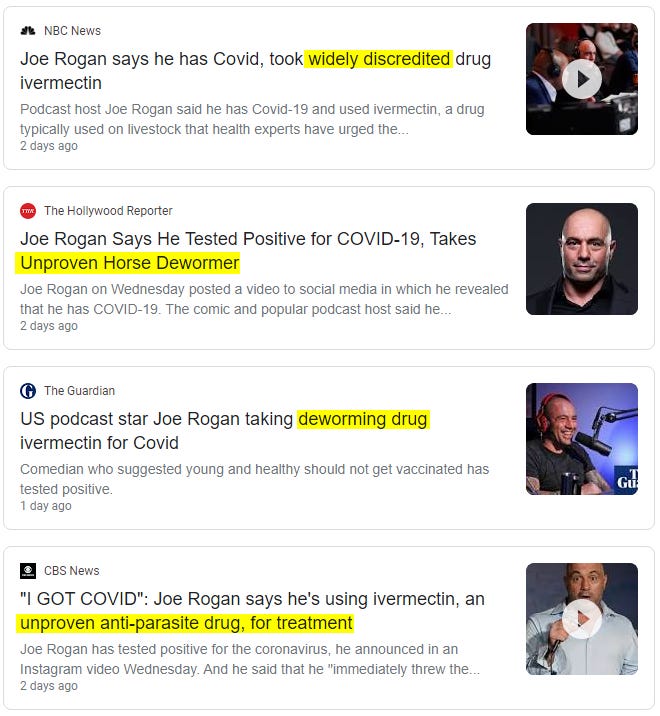
And it wasn’t just CNN. NBC News called ivermectin “widely discredited” without any qualifiers. When the Rogan story dropped in late 2021, I did a search throughout the mainstream media and here’s the first four results that popped up:


50% OFF ALL SUBSCRIPTIONS: Subscribe and get 50% off and no price hikes for as long as you wish to be a subscriber.


Government agencies also played along, with the U.S. Food and Drug Administration even Tweeting out: “You are not a horse. You are not a cow. Seriously, y’all. Stop it.” with a link to an article called “Why You Should Not Use Ivermectin To Treat or Prevent Covid-19”.

The Tweet as it reads above makes it seem as though the FDA only knew about ivermectin the veterinary medicine and not the human dosage. For a drug that’s been around for decades and administered to humans billions of times, this simply cannot be the truth. This misinformation goes beyond gross negligence and clearly moves into malice, in my opinion.

At the time Dr. Pierre Kory responded to this Tweet and said it best: “This adds to the incredibly sad and injurious actions taken by Health Agencies against US citizens. I hope for a historic reckoning someday. As an expert on IVM in COVID, if interested in becoming an educated citizen, I offer a short evidence summary.”

Kory and others throughout the pandemic who advocated for ivermectin were routinely shunned as conspiracy theorists and kooks. People who pointed out that the drug may have been able to save hundreds of thousands of lives – as real world usage in India was proving to us in real time – were disregarded and ridiculed.

Many of us noted during the course of the pandemic that ivermectin’s efficacy was being ignored because it would have stopped Pfizer and Moderna’s vaccines in their tracks – they couldn’t have sold the vaccines under Emergency Use Authorization if there were other efficacious medicines available. And if Pfizer and Moderna were stopped in their tracks, how could the “giant sucking sound” of billions of dollars in treasury cash making their way to the pharmaceutical industry have taken place?

Those of us who followed the obvious money trail and pointed out what can only be described as the glaringly obvious were ignored and ridiculed. In fact, many of us were banned from our social media accounts.

And the “grand conspiracy” narrative at the time, as Joe Rogan correctly referred to it as in September 2021, was:

“One speculation involves the EUA for the vaccines. In order for their to be EUA there has to be no treatment for a disease. Because there is this treatment, there’s a lot of pushback against potential treatments in pretending they don’t work or that they’re conspiracy theories. This is the the grand conspiracy…that the pharmaceutical companies are all in cahoots to try and make anybody who takes this stuff look crazy.”

Today it doesn’t look so crazy. Lo and behold, the truth finds a way to make its way out:

The United States’ top Covid experts during the pandemic cashed in to the tune of hundreds of millions of dollars during the pandemic, even as they were recommending measures that included “lockdowns.”

Records have unveiled that Dr. Francis Collins, previously the NIH Director, and Dr. Tony Fauci, former NIAID Director, made substantial profits from royalty checks during the Covid pandemic.

These documents prove that the former leaders of the National Institutes of Health (NIH) and the National Institute of Allergy and Infectious Diseases (NIAID) benefitted financially from the Covid pandemic.

And here are the stunning numbers from the pharmaceutical executives, courtesy of comrade Bernie Sanders.


And so, today, the purpose of this article is to finally set the record straight and put a bookend on my long string of articles about ivermectin. The conclusions should be obvious to anyone at this point.

  • Pfizer, Moderna and Astra Zeneca wanted to sell their experimental vaccines in the absence of long-term safety data.

  • They couldn’t do it under Emergency Use Authorization if ivermectin and other early treatments were found to have efficacy.

  • Ergo, the media, sponsored by these same pharma companies launched a malicious misinformation campaign in the face of demonstrable proof of both efficacy and safety for ivermectin.

  • This campaign knowingly mislabeled a drug with a decades-long history of success in humans as horse medicine. 

  • As this took place, additional “rigged” clinical studies, many of which with significant conflicts, tried to paint a picture of ivermectin not being efficacious through dishonest means (learn all about this here).

  • From there, government worked with social media to stifle and censor anyone who raised critical questions or told the inconvenient truth in the midst of the pandemic.

  • Finally, after all the damage was done and the vaccine grift ended, the FDA casually and cavalierly admitted that doctors “do have the authority to prescribe ivermectin to treat Covid.”

If your eyes aren’t open after understanding what just happened here, you are not paying attention.

50% OFF ALL SUBSCRIPTIONS: Subscribe and get 50% off and no price hikes for as long as you wish to be a subscriber.

QTR’s Disclaimer: I am not a guru or an expert. I am an idiot writing a blog and often get things wrong and lose money. I do not fact check contributor material that I aggregate from other sources. I may own or transact in any names mentioned in this piece at any time without warning and generally trade like a degenerate psychopath. This is not a recommendation to buy or sell any stocks or securities or any asset class – just my opinions of me and my guests. I often lose money on positions I trade/invest in and I’m sure have lost more than I’ve made in my time in markets. I may add any name mentioned in this article and sell any name mentioned in this piece at any time, without further warning. Positions can change immediately as soon as I publish this, with or without notice. You are on your own. Do not make decisions based on my blog. I exist on the fringe. The publisher does not guarantee the accuracy or completeness of the information provided in this page. These are not the opinions of any of my employers, partners, or associates. I did my best to be honest about my disclosures but can’t guarantee I am right; I write these posts after a couple beers sometimes. Also, I just straight up get shit wrong a lot. I mention it three times because it’s that important.

Tyler Durden
Wed, 08/16/2023 – 09:45

Despite Rebound, US Industrial Production Remains Lower Year-Over-Year

0
Despite Rebound, US Industrial Production Remains Lower Year-Over-Year

Thanks to some sizable downward revisions in prior months, US Industrial Production rebounded strongly in July, rising 1.0% MoM (considerably better than the 0.3% MoM expected). However, thanks to the downward revisions, industrial production remains down 0.25% YoY...

Source: Bloomberg

For the fifth straight month, US manufacturing output is lower year-over-year, despite a 0.5% MoM rebound in July…

Source: Bloomberg

So, Bidenomics is working? And a year on from the Inflation Reduction Act’s enactment, US manufacturing output is lower.

Tyler Durden
Wed, 08/16/2023 – 09:38

Ringing Hollow

0
Ringing Hollow

By Stefan Koopman, Senior Macro Strategist at Rabobank

The UK’s pivotal role in European finance means its economic data has a habit of punching above its weight in swaying sentiment. Tuesday’s labor market data jolted markets too, overshadowing the dovish Chinese numbers. Regular pay jumped to 7.8% year-over-year in the three months through June. Although part of the increase reflects prior months’ revisions, it did rekindle speculation of Bank of England tightening to as high as 6%, well beyond the one final hike to 5.50% we have pencilled in for September. With UK wages rising so rapidly, doubt was being cast on imminent Fed and ECB pauses as well.

However, we would caveat this. The other, timelier elements of the report suggest a cooling market, reassuring the BoE its historic pace of hikes does have an impact on demand. The goal is to return to the pre-pandemic climate with ideal labour market conditions: not too hot for employers or too cold for employees. Labour demand – which we proxy by adding vacancies to actual employment – is now down year-over-year to 33.96 million, while labour supply is up to 34.37 million. A margin between supply and demand of double this size, so around 750,000, is historically consistent with 3-4% wage growth, so things would probably have looked very different if there wasn’t a Of course, the price of this labour market rebalancing is paid by those who enter unemployment: the headline rate rose to 4.2% in the three months to June, with the single-month rate for June even at 4.7%. This is up from 3.5% in June 2022. So while pay checks are getting fatter on average, the swelling jobless ranks and rising illness mean higher wages ring hollow for some. On that note, this great tune right out of the Appalachian hollers is exploding on the internet, with 14 million views in a week, and should speak to many UK folks as well. Listen closely!

The UK inflation data that was out this morning was slightly hotter than expected. The slowing of the annual inflation rate in July 2023 to 6.8% from 7.9% was primarily due to lower regulated gas and electricity prices, which subtracted 0.64 percentage points from the rate, and notable downward impacts from food and non-alcoholic beverages, specifically milk, bread and cereals. However, core CPI steadied at 6.9% (vs. expected 6.8%), as falling costs of goods were offset by higher prices for services. Services inflation itself rose to 7.5% y/y from 7.2% y/y. This component matters most to the Bank of England, as it closely relates to domestic wages, exhibits persistent trends, and is less volatile than energy or goods prices. Our estimates of embedded inflation are around 6-7% y/y as well. All in all, there remains considerable evidence to support another interest rate hike in September, though there will be another labour market and inflation report that MPC meeting.

So even as global bond yields popped higher on the UK’s wage numbers, they have actually fallen a bit over a 24-hour view. This is despite very strong US retail sales data, which showed a better than expected 0.7% monthly increase in July. The usual caveat is that retail sales are presented in dollar values rather than volumes, but with goods prices under pressure, real retail sales likely rose around 1% month-over-month in July. Consequentially, the Atlanta Fed’s GDPNow model forecasts 5.0% instead of 4.1% GDP growth for Q3, which may be optimistic but still indicates solid growth despite significantly higher interest rates.

As expected, the Reserve Bank of New Zealand held interest rates steady at 5.50% this morning, after having paused its hiking cycle in May. However, the RBNZ signalled that rates would remain restrictive for a prolonged period, even showing a slightly higher path for the Official Cash Rate in its forecasts.

This indicates some possibility of a further hike to 5.75%, which arguably had the more important effect of pushing the pricing of rate cuts out to 2025. As an early leader in post-pandemic tightening, the RBNZ tends to be seen as the ‘kiwi’ in the coal mine. Though recent data points to softening economic momentum in New Zealand, there are also risks that it could take longer for inflation pressures to abate. The Bank of Canada nods in the background, having failed in pausing its hiking cycle and now seeing Canada’s inflation reaccelerating to 3.3% from 2.8% year-over-year. There was a modest slowing in the trimmed core CPI measure to 3.6%.

Tyler Durden
Wed, 08/16/2023 – 09:20

Is It Time To Ban Electric Vehicles?

0
Is It Time To Ban Electric Vehicles?

Authored by Stephen Moore via The Epoch Times (emphasis ours),

The New York Fire Department recently reported that so far this year there have been 108 lithium-ion battery fires in New York City, which have injured 66 people and killed 13. According to FDNY Commissioner Laura Kavanagh, “There is not a small amount of fire, it (the vehicle) literally explodes.” The resulting fire is “very difficult to extinguish and so it is particularly dangerous.”

(CHUTTERSNAP/Unsplash.com)

Last year there were more than 200 fires from batteries from e-bikes, EVs, and other devices.

A fire ignited at an e-bike shop and killed four people near midnight on the morning of June 20. Two individuals were left in critical condition. The fire commissioner has warned New Yorkers that such devices could be very dangerous and typically explode in such a way that renders escape impossible.

FDNY also reports that in just three years, lithium-ion battery fires have surpassed those started by cooking and smoking as the most common causes of fatal fires in New York City. It’s happening all over the country as these blazes have become commonplace. Cars and e-bikes are randomly blowing up in driveways and garages.

Now let’s be honest: 13 deaths in a city the size of New York with some 8 million people is hardly an epidemic. Regulations should always be based on a cost versus benefit calculation, or there would be no cars at all.

And yet the same scaremongers on the left who have zero tolerance and want bans for small risks when it comes to everything from swimming pool diving boards, gas stoves, plastic straws, vaping, fireworks, and so on, have a surprisingly high pain threshold when it comes to people dying or suffering critical injured from “green” electric battery fires.

Or consider this: In 1965, Ralph Nader almost single-handedly helped ban the popular Chevrolet Corvair—famous for its engine placed in the back trunk of the car. Nader’s bestselling shock book “Unsafe at Any Speed” declared the car was deadly. But there was no real evidence of that claim, and to this day there are no reliable statistics on how many passengers—if any—died in Corvairs from rear-end accidents.

What is indisputable is that EVs will cause far more deaths than Corvairs ever did.

One other example: There have been more fatalities in just one city in a single year from lithium-ion batteries in cars than all the people who died from the 1979 Three Mile Island nuclear plant accident—which was zero.

Yet, after the accident, thanks to the environmentalists’ fear campaign (with the help of the blockbuster anti-nuke movie “The China Syndrome”), no domestic nuclear plants were built for three decades. That is despite the fact that nuclear plants emit no greenhouse gases.

But with EVs, the greens are pushing aside any concerns about the collateral damage of deaths and injuries. Biden wants to mandate that nearly ALL new cars sold in the United States be EVs by 2032. If that happens, many thousands of Americans may die or will be injured from electric vehicle fires.

All this is especially hypocritical because once upon a time the left’s mantra was “no trading blood for oil.” Now they are willing to trade blood in exchange for getting Americans to stop using oil. An irony of all this is that because of all the energy needed to produce windmills, solar panels, and electric batteries, new studies are showing that the reduction in greenhouse gas emissions to this “net zero” transition is close to zero. It turns out, green energy causes some pollution, too.

For the record, I’m not in favor of the government banning EVs or e-bikes or just about anything. I just believe that we should make policy decisions based on real and factual risk assessments, not false scares and sensationalism.

As for the future of EVs, maybe it’s time for Ralph Nader to write a sequel to “Unsafe at Any Speed.”

Stephen Moore is a senior fellow at the Heritage Foundation, chief economist at FreedomWorks, and co-founder of the Committee to Unleash Prosperity. He served as a senior economic adviser to Donald Trump. His new book is titled “Govzilla: How the Relentless Growth of Government Is Impoverishing America.”

Tyler Durden
Wed, 08/16/2023 – 06:30

Germany Purchases Dozens Of Decommissioned Leopard 1 Tanks For Ukraine

0
Germany Purchases Dozens Of Decommissioned Leopard 1 Tanks For Ukraine

Via Remix News,

German defense contractor Rheinmetall has bought 49 second-hand Leopard-1 tanks from a Belgian arms dealer for use in Ukraine, a company spokesman said last week.

A spokesman for the German government said the tanks would be part of a military aid package announced by Defense Minister Oscar Pistorius at last month’s NATO summit in Lithuania.

Freddy Versluys, CEO of the private defense company OIP Land Systems, announced the sale of the tanks on Tuesday, telling several media outlets that they were bought by an unnamed European state for an undisclosed price.

The Belgian government had negotiated with Versluys earlier this year to buy the Leopards, but ultimately refused to pay the €500,000 per tank that was being asked for.

At the time, Belgian Defense Minister Ludivine Dedonder described the asking price as unreasonable, given that Versluys had bought the tanks as scrap metal.

Versluys bought the tanks for €37,000 each when the Belgian government decommissioned them in 2014.

Speaking to The Guardian newspaper earlier this year, he said the ageing vehicles were in poor condition and needed new engines, shock absorbers, fire control systems, radar stations, and the list goes on.

Although neither Rheinmetall nor Versluys would reveal the final price, Versluys wrote on LinkedIn that “we asked a fair market price and someone was more than happy to take them”.

The Leopard-1, manufactured by Krauss-Maffei in West Germany, entered service in 1965 and was gradually phased out of service from the 1990s onwards.

Kraus-Maffei originally built some 2,400 Leopard 1 tanks of different variants for the German army, some of which are currently in long-term storage, while others are marked for scrap, yet others held by private defense companies.

Tyler Durden
Wed, 08/16/2023 – 05:45

Russia And Ukraine Trade Blame Over Outages At Zaporizhzhya Nuclear Plant

0
Russia And Ukraine Trade Blame Over Outages At Zaporizhzhya Nuclear Plant

Authored by RFE/RL staff via OilPrice.com,

  • The main power line to the Zaporizhzhya nuclear power plant was disconnected twice, leading Ukraine’s energy minister to warn of a potential meltdown.

  • While experts acknowledge the plant’s vulnerability due to the war, they also note the facility’s robust design and contingency measures.

  • Tensions are further amplified by mutual accusations from Ukraine and Russia about potential sabotage of the nuclear facility.

The fate of the massive nuclear power plant in the crosshairs of Europe’s largest war in decades has made for worrisome headlines since Russia launched its large-scale invasion of Ukraine nearly 18 months ago. As fighting intensifies not far from the plant, fears of a disaster have not abated.

On August 10, the main power line delivering electricity to the Zaporizhzhya nuclear power plant was disconnected twice, forcing it to rely on its last remaining off-site power line.

The main line was reconnected by evening. In the meantime, though, Ukraine’s energy minister raised the prospect of a meltdown.

Is Russia’s invasion of Ukraine about to cause a nuclear catastrophe?

Steven Nesbit, a nuclear power industry veteran who was president of the American Nuclear Society in 2021-22, told RFE/RL that the Zaporizhzhya plant has been in a precarious position since the start of Russia’s full-scale invasion. But the failure of the off-site power line did not make his assessment of the situation any more dire than it had been.

“I don’t see anything really new right now that should have people extremely concerned relative to the already undesirable situation,” he said, adding that the plant’s offsite power sources have been interrupted before due to the war.

“I would not be surprised if it happens again, but simply losing one of the off-site power sources for a period of time is not a reason for undue concern,” said Nesbit, who now runs his own nuclear consulting company.

Enerhoatom, Ukraine’s state-owned nuclear power generating company, was the first to raise the alarm on August 10, saying that the plant was “on the verge of another blackout” after the main high-voltage line was disconnected, forcing operators to use the 330-kilovolt backup line.

In a statement the same day, the International Atomic Energy Agency (IAEA), said that the main 750-kilovolt line had disconnected twice since the early morning and remained disconnected as of the evening. The plant had to “rely on its only remaining off-site power line, the 330 kV backup line, to supply the electricity that is required, for example, to perform safety functions such as pumping cooling water for the plant.”

Energy Minister Herman Halushchenko said the plant was “one step away from a blackout — that is, the complete loss of external power,” and that this could lead to a “major catastrophe.”

The plant would resort to diesel generators if all external power was lost, but if the generators were damaged by a Russian attack, he said, “the cooling of the plant would stop and the irreversible process of heating and melting of nuclear fuel” would begin.

“I think that’s a little alarmist,” Nesbit said in a phone interview on August 11.

The same day, Enerhoatom said on Telegram that the main power line had been reconnected the previous evening after being knocked out by Russian fire.

The diesel generators are well protected and have enough fuel to provide power to keep the cooling system going for an extended period of time while external sources are being restored, Nesbit said.

“The six units can share power among them. It’s a flexible and safe system,” he said.

The Zaporizhzhya plant has lost all external power at least twice in the past year.

Last November, the diesel generators kicked in when the plant lost its connection to both the main and reserve off-site power lines, in what IAEA Director-General Rafael Grossi called “an extremely concerning development that again demonstrates the plant’s fragile and vulnerable situation.”

At the time, Enerhoatom said there was enough fuel to run the emergency generators for about 15 days.

Russia seized the Zaporizhzhya nuclear power plant, which supplied about a fifth of Ukraine’s power needs, shortly after the launch of its full-scale invasion on February 24, 2022.

The plant and the surrounding area are controlled by Russia, but it is being run by its Ukrainian engineers. In September 2022, Ukraine shut the station down to minimize risk of a catastrophe.

Five of the six reactors are in what is known as cold shutdown mode while one unit is being maintained at an elevated temperature — hot shutdown mode — to provide auxiliary steam and heating, the American Nuclear Society, which is monitoring information about the plant, said in July.

Breach In Ukraine

As a result, the level of heat production has been low and on-site equipment can provide enough of the water needed for cooling, the society, an international organization of engineers and scientists, said in a statement.

It called the threat of a large-scale release of radioactive material “speculative” but said that assessment does “not constitute an ‘all clear’ for safety risks at the plant site.”

Nesbit said it is of crucial importance that the reactors at the Zaporizhzhya plant have not been generating power for months, allowing the heating level associated with the reactor fuel to fall. The shutdown cuts by many orders of magnitude the amount of radioactivity that could potentially be released in the event of a major incident involving the reactors.

Still, tension is high.

The plant is located in the Zaporizhzhya region in southeastern Ukraine, where fighting is intense amid a counteroffensive that Kyiv launched in early June, seeking to push Russian forces back from territory they have taken and eventually expel them from the country altogether.

Zaporizhzhya is one of four regions of Ukraine that Moscow claimed last year had become part of Russia but does not hold in their entirety. The plant stands on the south bank of a wide stretch of the Dnieper River that was largely drained by the breach of the Kakhovka dam downstream, while Ukraine controls the north bank.

Ukraine and Russia have accused each other of planning to sabotage the plant, warning of the possibility of a nuclear disaster that could threaten millions of people and poison the environment.

Ukraine recently claimed that Russia mined the roofs of the Zaporizhzhya reactors. Last week, the IAEA said its experts found no mines on the two reactors it was allowed to inspect. IAEA has yet to receive Russian permission to visit the other reactors.

It did find antipersonnel mines on the “periphery” of the plant’s grounds, but such weapons are small and designed to pierce the human body, not one-meter-thick, steel-reinforced, concrete walls. Even a few mines on the roof would not be enough to cause a radioactive release, experts say.

Since it launched the full-scale invasion, Russia has repeatedly accused Ukraine of plotting set off a dirty bomb or cause a release of radioactivity and then blame it on Moscow. Russia asserted last week that Ukraine tried to attack the Zaporizhzhya plant with a drone.

Kyiv dismissed the claim as nonsense, and experts say it makes no sense for Ukraine to threaten a catastrophe on its own land.

Construction of the Zaporizhzhya plant began in 1980 as tensions between the Soviet Union and the West ratcheted up and concerns that the Cold War could turn hot increased.

The Zaporizhzhya plant “is designed to withstand a lot of challenges, both internal and external,” Nesbit said. “Nuclear power plants were not designed to necessarily be impervious to wartime, but the characteristics that they do have — the thick containment buildings around the reactor vessels — do offer substantial protection in the event of hostilities.”

He said, for example, that the hazard posed by a single, unmanned flying vehicle – a drone — is pretty low.

Nesbit also said that he does not believe either side is motivated to cause damage to the plant but that war is unpredictable.

“The concern that we all have is that because it’s wartime, you can’t always control what’s going to happen,” he said.

Tyler Durden
Wed, 08/16/2023 – 05:00