Mental Health & Social Media: What Message Prevails?
Mental health is a topic never far from the minds of girls as young as 11-15 years old in the United States, according to a recent study by Common Sense Media, an online parental guidance platform.
In real life, nearly seven in ten girls reported having had exposure to helpful mental health content and information in real life each month. But on the flip side, just under half (45 percent) said they heard or saw harmful content about suicide or self harm while just under four in ten (38 percent) said the same of harmful content on eating disorders.
Social media, in many ways an extension of daily life, appears to have the same contradiction. As Statista’s Anna Fleck shows in the following chart, girls aged 11-15 years old face a high risk of exposure to harmful content on social media in the United States, including on the topics of suicide, self-harm and eating disorders.
The report found that girls report that exposure to both topics is prevalent across TikTok, Instagram, YouTube, Snapchat and even messaging apps, with more than one in three girls reporting that they “hear or see things about suicide or self-harm that is upsetting to [them]” at least monthly on all platforms, with 15 percent of girls who use TikTok and Instagram saying they come across this type of content on the platforms on a daily basis.
The figures are even higher for those with depressive symptoms.
Some 75 percent of the girls who reported moderate to severe depressive symptoms who use Instagram said they come across harmful suicide-related content on the platform at least once a month. This is nearly three times the likelihood of the girls without depressive symptoms who come across the content at the same frequency (26 percent). According to the report, a similar pattern emerges for TikTok users (69 percent of girls with moderate to severe depressive symptoms see the harmful content versus 27 percent of girls without depressive symptoms) as well as for the other platforms.
However, social media is also a key resource for finding helpful information and content on mental health, whether that’s from established organizations and authorities or from those who have personal experience of mental illness. Here, we can see that the majority of girls on each of these platforms say that they come across helpful resources on social media each month. Girls with moderate or severe depressive symptoms who use social media were also more likely to see such helpful mental health content or resources at least monthly on these platforms TikTok (78 percent), Instagram (80 percent), YouTube (74 percent), and Snapchat (73 percent).
In my first explainer about the BRICS nations, you met the players and you know why their decisions affect the global economy. But why do their decisions affect us?
You need to understand that first – before the August 22nd Durban Accords will make any sense. (But once you do understand, you’ll be astonished…)
Professor Reagan’s class is now in session!
Global trade runs on U.S. dollars
Since World War II, the U.S. dollar has enjoyed the role of global reserve currency. You may have heard those words before – here’s what they mean…
Worldwide, when companies or nations transacting with one another don’t share a common currency, they use U.S. dollars. When a Chilean copper mine sells tons of raw ore to a Canadian refiner, they invoice (and get paid) in U.S. dollars.
Obviously, most nations don’t have a common currency (the exception is the Euro zone). So the use of dollars for international trade is simply huge, approximately 85% of the global total.
So the world relies on dollars to do business. That’s a great deal for us! That means, for example, that deficit spending and newly-printed money always have a home somewhere in the world. Simply because the world has to have dollars.
Like I said, that’s a great deal for the nation that exports dollars. It’s not such a great deal for everyone else…
“It’s our currency, but it’s your problem”
In 1971, President Nixon ended the convertibility of dollars to gold.
The rest of the world, to put it mildly, went nuts. The gold standard was supposed to prevent inflation – but it hadn’t (primarily because American citizens weren’t allowed to swap dollars for gold since 1933).
Absent a gold standard, how was the U.S. going to guarantee the value of the dollar? When challenged with this question by his counterparts at a G-10 meeting in Rome, U.S. Treasury Secretary John Connally astounded his audience by proclaiming:
“The dollar is ourcurrency, but it’s yourproblem.”
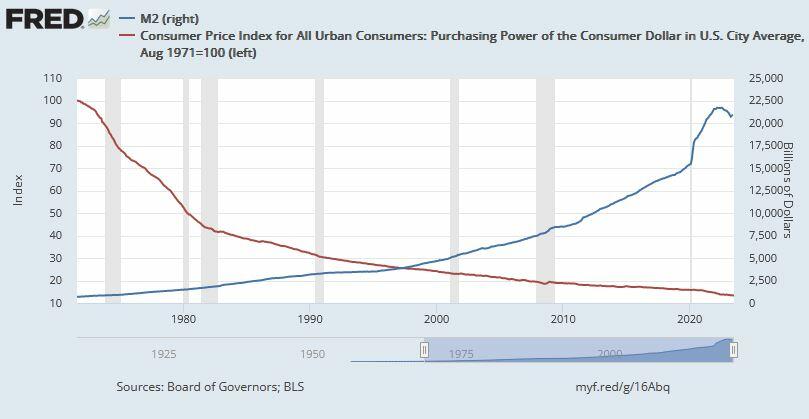
With no restraint on money-printing, the U.S. went on to make a whole lot more dollars… Take a look at this chart. The blue line indicates total dollars (M2, a measure of money supply) and the red line indicates purchasing power, which has declined 86.6% over the decades:
So, along with dollars, the current system exports inflation, too.
That’s what Connally meant when he said it was their problem.
Well, the rest of the world has just sucked it up for the last 50 years, right? Why are things different now?
Weaponizing the dollar
Whether it’s marketed as a “peacekeeping operation” or a “police action,” going to war is ruinously expensive at best. Therefore, the U.S. historically uses financial sanctions as a “non-kinetic” method of dissuading behavior not in line with U.S. interests.
Simply because the world has to have dollars, as I explained above, whoever controls the dollar also has an outsized impact on the global economy. When the U.S. uses financial sanctions against another nation, we call that “weaponizing the dollar.”
Now, this has been going on for decades. Cuba, for example, has been sanctioned for over 60 years! Iran, for more than 40 years. In some sense, weaponizing the dollar is business as usual for the U.S. So it came as no surprise when, in 2022, the U.S. did it again.
In response to the invasion of Ukraine, the White House froze the Russian central bank’s $300 billion in U.S. dollar assets. A stroke of Joe Biden’s pen rendered them completely worthless. In addition, the Russian economy was shut out of SWIFT, the international money transfer system.
The results of this “shock and awe” economic warfare were underwhelming. The Russian economy failed to collapse – instead, they kept up business as usual, taking payment in yuan or rupees or gold instead of dollars.
And there are other consequences. As Bloomberg columnist Matt Levine wrote back in March of 2022:
But every time the U.S. and its allies kick a country off this system, it goes and finds other [methods] to use to trade. And other countries, countries that have not been kicked off the main network but who are not necessarily aligned with the U.S. in every way, think that the main network looks a bit less attractive… For another thing, the main system is visibly a tool of political power, and if you are not aligned with the U.S. you might worry about one day being kicked off the system yourself. So you get more interested in trying out alternative systems now, before you need them. And so kicking Russia out of the dollar-based international financial system makes it more likely that that system will be replaced, over time, by something else.
…the system is weakened each time it exercises its power. [emphasis added]
That’s what the Durban Accords on August 22nd are about – Levine’s “something else.”
August 22nd may mark the beginning of the end of “business as usual”
You’ve seen that the BRICS nations cannot be ignored. Note that two of the five core members (Russia and China) are historically rivals of U.S. geopolitical dominance.
Both nations have been actively signing “bilateral trade agreements” with other nations – meaning they can buy and sell from one another in their own currencies, rather than using the dollar as an intermediary. But the whole reason a global reserve currency exists is to make international trade less cumbersome.
So the Durban Accords are an agreement, presumably to be announced on August 22nd, to launch a new, international currency backed by commodities. “Backed by commodities” is important – because it’s the easiest way for a new currency to gain credibility. Think about it – what currency in existence today derives its value from anything other than hope?
This new BRICS currency would allow participating nations to circumvent U.S. financial sanctions – and to avoid the problem of dollar inflation. (In other words, “our currency” is about to become “our problem”).
Initially, my sources indicate the BRICS currency could be backed by commodities produced and traded by BRICS nations – things like oil, industrial metals and grain – or, more likely, gold.
Backing their new currency with gold would be an obvious move for the BRICS. China and Russia are, respectively, the world’s #1 and #2 gold-mining nations (South Africa and Brazil are #13 and #14, respectively). Both China and Russia already have sizable official gold reserves (6th and 7th largest in the world).
That, in essence, is what the Durban Accords are all about:
An alternative to U.S. global financial dominance
A method of avoiding the weaponized U.S. dollar
A way of avoiding inflation caused by excessive dollar-printing
A means of simplifying and streamlining the bilateral trade agreements already in place
The Durban Accords may mean the first viable, useful alternativeto the U.S. dollar.
And that’s why this is a very big deal.
P.S. On July 7, the Russian state-run media outlet RT confirmed the goal of the Durban Accords was to launch a “new trading currency backed by gold.”
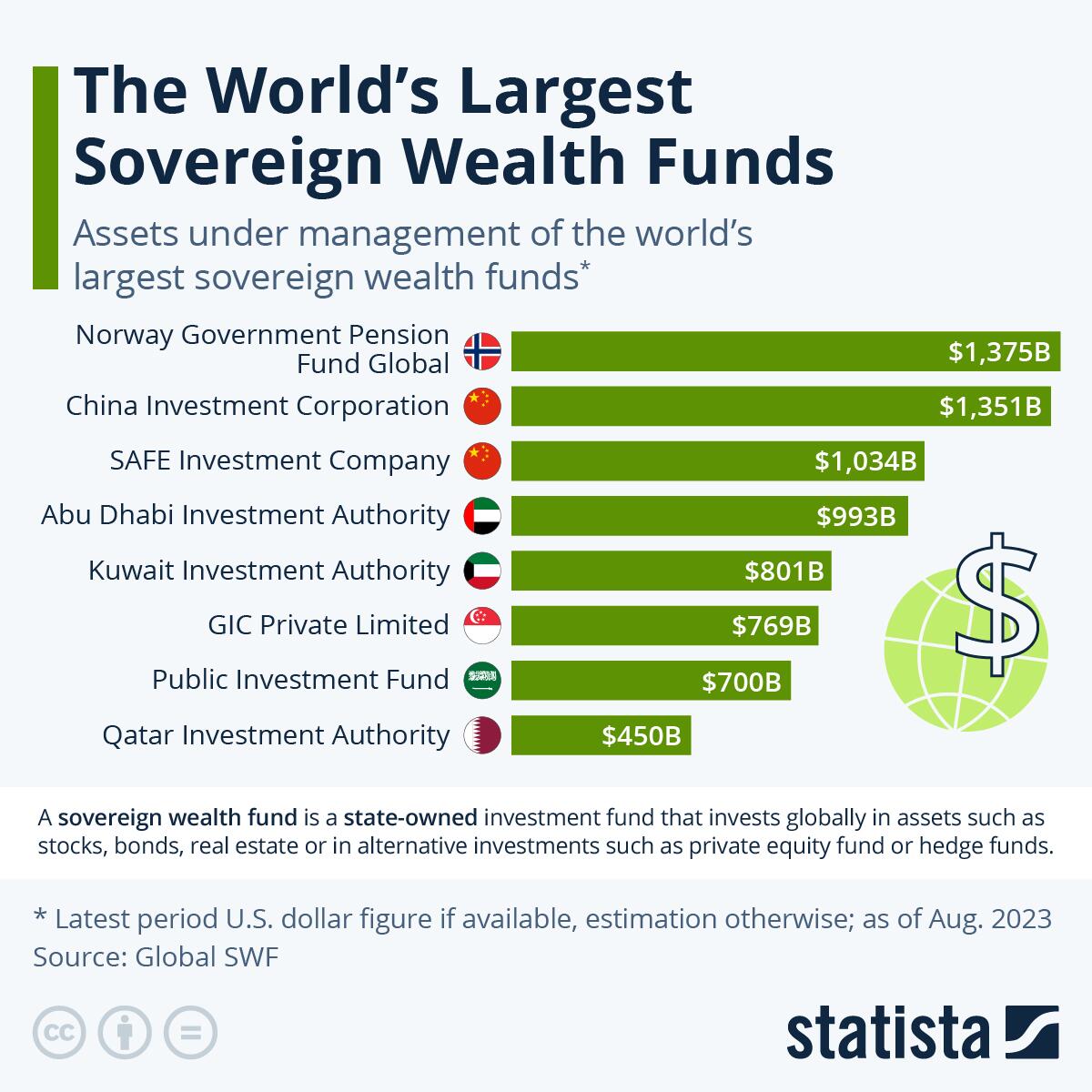
Saudi Arabia’s Public Investment Fund (PIF), which has made a lot of headlines recently due to its significant investments in golf and football, released its 2022 annual report on Sunday, providing the public with a glimpse into the operations of one of the world’s largest sovereign wealth funds. At the end of 2022, the PIF’s assets under management amounted to roughly $600 billion – a figure that has since grown to $700 billion according to Global SWF, a company tracking sovereign wealth funds.
While gaining more international attention due to its investments in sports, the PIF actually reduced its international strategic investments last year, with their share of total assets under management dropping from 20 to 10 percent, while domestic investments accounted for 77 percent of AuM at the end of the year.
Often accused of “sportswashing”, the PIF is very clear about the purpose of its international investments in its annual report. Among other things, the fund’s strategic international investments are meant to “establish strategic relationships and partnerships with innovative companies, investment managers, and influential investors to allow Saudi Arabia to extend its global reach and influence”, to “bolster Saudi Arabia’s position on the world stage as a leader and enabler of the future global economy” and to “support government-to-government relationships.”
Serving a totally different purpose, the Norwegian Government Pension Fund is still the largest sovereign wealth fund in the world. According to data from Global SFW, the fund’s assets under management amount to $1.38 trillion, narrowly exceeding the $1.35 trillion in assets under management from the Chinese Investment Corporation. As our chart shows, most of the world’s largest sovereign wealth funds are located in Asia and the Arab world, with Norway the only, albeit notable exception.
The unique Norwegian fund was set up to invest government revenues from its vast oil and natural gas reserves into sectors deemed more sustainable in order to provide for a future when the country can no longer rely on its income from fossil fuels. The Norwegian government is free to use up to three percent of the fund’s volume annually for social purposes – that number currently amounts to roughly $40 billion.
Türkiye on Aug. 3, made its most pointed renunciation of its ties to NATO.
President Reçep Tayyip Erdoğan, who was sworn into office again on June 2, re-structured his Armed Forces leadership, removing all leaders who had held NATO appointments.
Türkiye, as a result, has stopped attempting to balance its NATO membership off against its commitments to Russia. It has, de facto, now thrown in its lot with Eurasia.
The new appointments come amidst a crisis in the Turkish Armed Forces which have seen, in recent years, a marked decline in the professionalism of key officers. President Erdoğan has favored political loyalty to him over operational experience, often replacing professional military leaders with Gendarmerie (Jendarma) generals.
The Turkish Supreme Military Council (Yüksek Askerî Şûra: YAŞ) met on Aug. 3, at the Presidential Palace under the chairmanship of President Erdoğan, with the main focus on the annual reviews of the senior officers of the Turkish Armed Forces (Türk Silahlı Kuvvetleri: TSK). Before the meeting, and in accordance with protocol, the president accompanied members of the YAŞ to the mausoleum of Mustafa Kemal Atatürk, where he laid a wreath and signed the Official Book, in which, after praising the rôle of the Armed Forces, referred to the new strategic goal of the country as the “Century of Turkey,” promising “an increase in the strength of the army.”
The “Century of Turkey” plan, which includes the “Blue Homeland” doctrine, specifically targets the interests of Greece. Senior officers were promoted who were known for their anti-Western profile and who were involved in the contrived 2017 “Ergenekon” and 2013 “Varioupoula” purge scandals.
A new Chief of General Staff was appointed, along with a new Chief of Land Forces (GH) and a new Chief of Air Force (THK), while the Chief of Naval Forces (TDK) remained in his position. The new Chief of the General Staff was the former 2nd Army Commander, Gen. Metin Gürak, who replaced Gen. Yasar Güler, who was appointed Defense Minister in the new Government in June 2023.
Deputy Chief of General Staff Gen. Selçuk Bayraktaroğlu was named as commander of land forces. Chief of Air Force and Anti-Aircraft Missile Defence Gen. Ziya Cemal Kadoığlu was named commander of the Air Force (Türk Hava Kuvvetleri: THK). Adm. E. Tatlioğlu, the chief of the South-Western Command, remained in his position.
During the meeting, 32 senior officers were promoted and 63 officers of the rank of colonel or equivalent became senior officers. It was decided to increase the number of senior officers by 20 to reach 286, to fill administrative positions, as many new Brigade and especially commando-level formations had been created.
Gen. Gürak became the first Chief of General Staff to be appointed without prior service as a chief of a service branch. This requirement had been dropped by President Erdoğan to give him more flexibility in appointing loyalists to the top posts. None of the newly appointed chiefs have served in NATO or other Western countries’ posts or schools, despite the fact that, in the TSK, officers with NATO experience had been highly regarded.
The Chief of General Staff, Gen. Gürak, does have operational experience. From his service with the 2nd Armored Brigade of the 1st Army (Istanbul) and as Commander of the Army Air Force and the 4th Army Corps (Ankara), he is familiar with the operational plans concerning the Ægean and Thrace. He served as an adviser in Libya when Turkey established military bases and supported Islamist forces against Cairo-backed Gen. Khalifa Haftar.
Gen. Gürak speaks Arabic, considered important at a time when Erdoğan is investing in relations with the rich Arab countries of the Gulf. He took a controversial stance on the night of the July 15, 2016, “coup attempt” as commander of the 4th Army Corps and Ankara Fortress, and was appreciated by Erdoğan for the assistance of the 2nd Army units in the earthquakes of February 2023, since the affected regions were in his area of responsibility.
The new Air Force Chief has neither NATO nor any particular operational experience. He is, however, considered an extreme nationalist. He was also involved on the night of the “coup attempt,” at the Air Operations Center (in Eskişehir).
President Erdoğan also conducted another purge of the Police-Security Directorate in early August 2023, again favoring political loyalists over professional and operationally-experienced officers: 52 out of a total of 81 prefectural directors, who were considered loyal to former Interior Minister Süleyman Soylu, were removed.
Longtime readers of my work on the assassination of President John F. Kennedy know that I point to the evidence establishing the fraudulent autopsy that was conducted on JFK’s body to convict the U.S. military establishment of criminal complicity in the assassination itself. That’s because there is no innocent explanation for a fraudulent autopsy. Once one concludes that the autopsy that the military conducted on JFK’s body was fraudulent, one has automatically concluded that the military establishment was criminally complicit in the assassination itself. There is no way around that.
But what about the CIA? Is there evidence that convicts the CIA beyond a reasonable doubt of criminal complicity in the JFK assassination? Yes, there is. That evidence consists of the altered, fraudulent copy of the famous Zapruder film that the CIA secretly produced at its top-secret Hawkeyeworks photographic operation in Rochester, New York, on the weekend of the assassination.
Just as there is no innocent explanation for a fraudulent autopsy, there is also no innocent explanation for an altered, fraudulent copy of the film of the assassination. Once one concludes that the famous Zapruder film is an altered, fraudulent copy of the original Zapruder film, one has automatically concluded that the CIA was criminally complicit in the assassination of President Kennedy. There is no way around that.
Yes, I am thoroughly familiar with the CIA’s standard response: “Conspiracy theory, Jacob! Conspiracy theory!”
Some readers may not know that I began my professional career as a civil and criminal trial attorney in Texas. I was trained to think like a lawyer. During the twelve years of my law career, I tried both jury and non-jury cases, in both state and federal courts. Given such, I naturally think in terms of evidence, not theories. No prosecutor or criminal-defense trial lawyer goes into court and tells a jury that he has a theory of the case. He tells the jury how the evidence will establish or fail to establish the defendant’s guilt.
Essentially, what the CIA did was secretly transport the original Zapruder film on November 23, 1963 (the day after the assassination) to the CIA’s National Photographic Interpretation Center (NPIC) in Washington, D.C.
The next day, November 24, it then transported the original film to its top-secret photographic operation called Hawkeyeworks, which was secretly located within Kodak’s research and development section of its corporate headquarters in Rochester, where it was copied and altered.
The altered, fraudulent copy of the Zapruder film was then shipped back to NPIC in Washington, where it was presented as the original film. (Note: While Kodak had secretly partnered with the CIA to establish Hawkeyeworks within its Rochester facility, there is no evidence that Kodak was part of the CIA’s criminal activity with respect to the Zapruder film.)
Among the things that the CIA did with its altered copy was to delete frames that tended to establish the criminal culpability of the national-security establishment, including elements of the Secret Service, in the assassination.
For example, consider the route of the presidential limousine as it approached Dealey Plaza. The presidential motorcade comes down Main Street in downtown Dallas, proceeding in a westerly direction. It then turns right onto Houston Street. It then makes an extremely wide turn onto Elm Street — so wide, in fact, that it violated Secret Service protocols on making turns. Some witnesses said that the limousine had so much difficulty making the turn that it actually went onto the sidewalk or almost onto the sidewalk to navigate the turn.
Obviously, such a turn would slow JFK’s limousine to a crawl, which would make it easier for an assassin to shoot the president. Thus, that wide turn onto Elm Street is naturally something that the CIA would want to eliminate in its altered, fraudulent copy of the Zapruder film.
The extant film (that is, the film that purports to be an original) shows something highly unusual. It show motorcycle cops making the turn onto Elm Street but then suddenly jumps to show JFK’s limousine already coming down Elm Street. In other words, it doesn’t show the presidential limousine making that extremely wide turn onto Elm Street.
In her book Twenty-Six Seconds: A Personal History of the Zapruder Film, Abraham Zapruder’s granddaughter Alexandria Zapruder wrote that Zapruder didn’t film the president’s turn onto Elm Street because, she said, Zapruder wanted to be sure that he didn’t run out of film before the president was approaching where Zapruder was standing.
But how logical is that? Zapruder was about as professional a home movie-maker as an amateur could be. He had been taking home movies for many years. He knew exactly what he was doing.
If he had decided to wait until the presidential limousine was near him on Elm Street, then why would he have filmed the motorcycle cops making the turn onto Elm Street? If he was concerned about running out of film, why waste film on the motorcycle cops?
Moreover, Dealey Plaza was the end of the motorcade. Zapruder’s partner Irwin Schwartz had told him that the motorcade would likely be exiting Dealey Plaza at a high rate of speed. Given such, how likely is it that Zapruder would have waited until the president was already on Elm Street to begin filming, rather than begin filming the motorcade as it made the turn onto Elm Street and then continue filming as the limousine approached him until he ran out of film? After all, Zapruder would have had little interest in filming the back of the president after he had already passed him by.
But that’s all logic and common sense. I can already hear the “Conspiracy theory, Jacob!” crowd crying, “Where is the evidence, Jacob, to establish beyond a reasonable doubt that the CIA produced an altered, fraudulent copy of the original Zapruder film?”
Fair enough. I detail that evidence in my book An Encounter with Evil. But let’s examine just a small part of that evidence in this article.
1. Consider, first, this short film of television news reporter Dan Rather. Rather saw Zapruder’s copy of the original Zapruder film on Monday morning, November 25, in Zapruder’s office. He immediately left Zapruder’s office and rushed out to make this filmed report about what he had just seen a few minutes before. In this film, Rather states: “The film shows President Kennedy’s open black limousine making a left turn off Houston Street onto Elm Street on the fringe of downtown Dallas.”
2. Consider, second, this film of LIFE magazine reporter Richard Stolley, who viewed the original film multiple times on the weekend of the assassination. In fact, it was Stolley who negotiated the sale of the Zapruder film to LIFE magazine. Go to 6:40 of the film, where Stolley describes what the original Zapruder film showed: “And you see the motorcade snaking around Dealey Plaza….”
The extant Zapruder film shows the presidential limousine coming down Elm Street in a straight line — that is, there is no “snaking around.” Stolley’s statement establishes that the original film included the wide turn onto Elm Street because that is the only way that the presidential limousine could be described as “snaking around.”
3. Consider, third, this filmed interview of Marilyn Sitzman, Zapruder’s trusted assistant, who was with him when he filmed the assassination.
Go to 3:40.
The interviewer states: “When … there is part of something that’s been uncovered that he tried out a little bit of the film ahead of time to be sure the camera was working all right and caught some of the motorcycle policemen. Do you remember — do you recall that — kind of testing the first few feet of film?”
Sitzman responds: “No. I know he took a picture of me as I walked up. Then we stood up there. He may have taken the shots to see what his view was. I only remember that when they started to make their first turn, turning into the street, and he says ‘Okay, here we go’ or something to that effect. That’s when I remember we started actually doing the filming.”
4. Consider, fourth, this other filmed interview with Sitzman. Go to 27:25. Sitzman states: “And he started filming about, oh, just before they came around the corner….”
5. Consider, fifth, another interview that Sitzman gave to an interviewer named Wes Wise, where she stated, “I only remember when they started to make their first turn … turning into the street, he said, ‘OK, here we go.…’ or something to that effect. That’s when I remember he started actually doing the filming.”
6. Consider, sixth, this filmed interview of Abraham Zapruder himself shortly after the assassination. Go to 00:30, where Zapruder states, “As I was shooting, as the President was coming down from Houston Street making his turn, it was about a half-way down there, I heard a shot….”
7. Consider, seventh, an interview that Zapruder gave to an interviewer named Marvin Scott, where Zapruder stated, “And then I watched for the arrival of the, uh, cars, I saw the motorcycles, and then the car approached. As they turned I started shooting the pictures, that turned from Houston Street to Elm Street, and I was shooting as they were coming along….”
8. Consider, eighth, the sworn testimony that Zapruder gave at the Clay Shaw trial in 1969, where he stated under oath, “I started shooting — when the motorcade started coming in, I believe I started and wanted to get it coming in from Houston Street.”
What does the CIA say about all this evidence that unquestionably proves beyond a reasonable doubt that the CIA secretly produced an altered, fraudulent copy of the Zapruder film on the weekend of the assassination at its top-secret Hawkeye facility at Kodak’s headquarters in Rochester, New York?
We all know what the CIA’s response is. It’s their standard response. “Conspiracy theory, Jacob! Conspiracy theory!”
I rest my case. The CIA’s production of an altered, fraudulent copy of the famous Zapruder film establishes beyond a reasonable doubt the CIA’s criminal culpability in the assassination of President Kennedy.
50 years ago today, on Aug. 11, 1973, a teenage DJ Kool Herc and his sister Cindy threw a party in the rec room of a Bronx apartment building during which Herc debuted his spinning and sampling technique – an event that is today considered the birth of hip-hop.
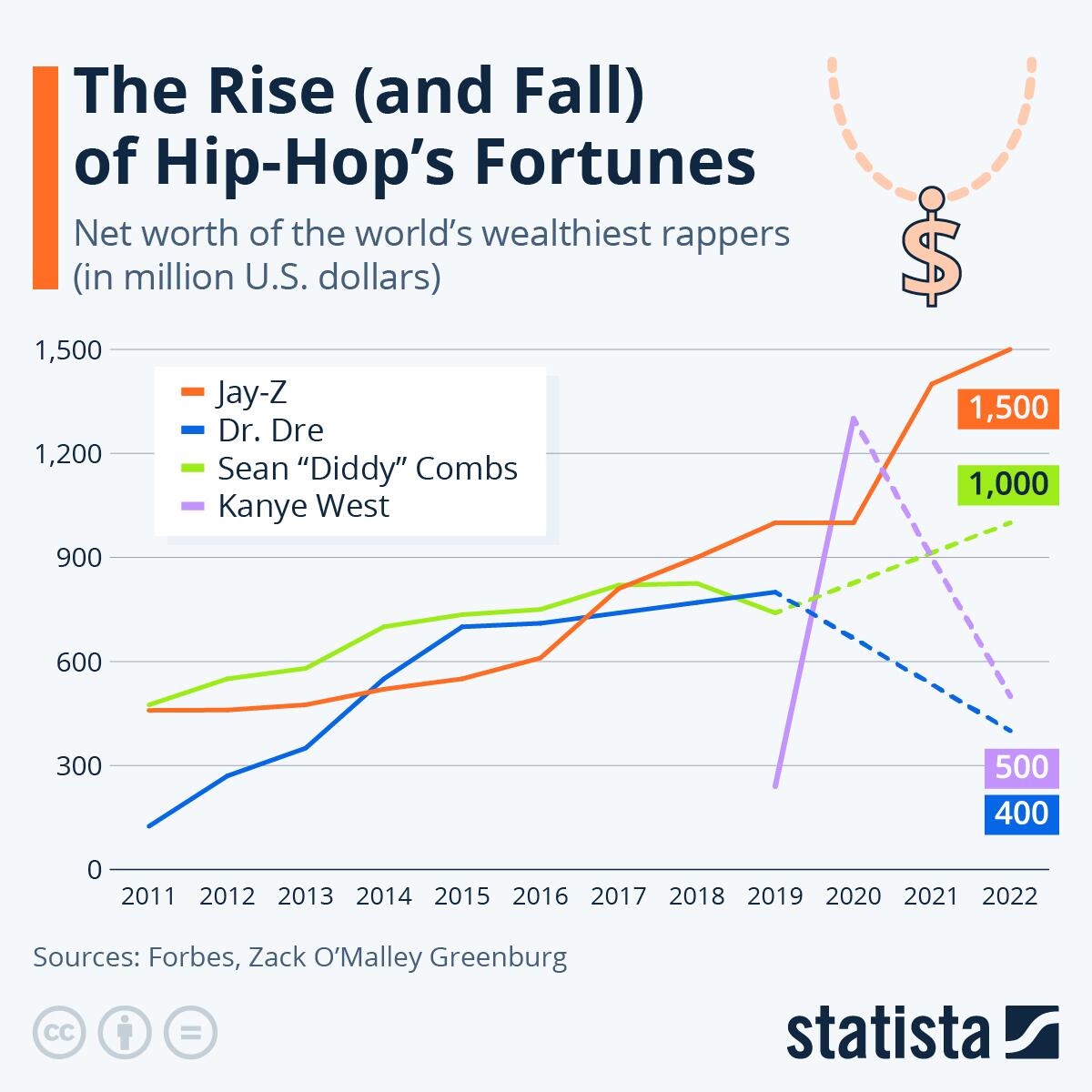
From humble and DIY roots, hip-hop has turned into big business in the decades since and has minted three billionaire rappers. Out of these, two – Jay-Z and Sean “Diddy” Combs – have current net worths of $1 billion or more – based on information on the Substack blog of former Forbes writer Zack O’Malley Greenburg, who has chronicled the fortunes of hip-hop‘s wealthiest since 2011. While Jay-Z branched out into other markets with his clothing line Rocawear as early as 1999 and today has a wide-ranging business portfolio, Sean “Diddy” Combs draws his wealth and considerable cash flow from spirit deals and media company Revolt.
Getting rich has been almost as central to hip-hop’s message as keeping it real. Yet, some of hip-hop’s biggest names have seen their fortunes dwindle. Dr. Dre, born Andre Young, might have been the first self-proclaimed hip-hop billionaire, but according to O’Malley Greenburg, his fortune – boosted in 2014 by the sale of headphones brand Beats to Apple – peaked at $800 million in 2019, when the last list of hip-hop’s richest was published on Forbes. Since then, Young’s spending has surpassed his income according to the report and divorce proceedings showed a net worth of only $400 million in 2022 (with another $50 million payment still due at the time).
A bigger rise and fall was that of Kanye West, who first appeared among hip-hop’s richest at a net worth of just $240 million estimated by Forbes in 2019 – the same year the list declared Jay-Z hip-hop’s first actual billionaire. This might have enticed West to finally open his books to Forbes reporters, which subsequently estimated his net worth at $1.3 billion in 2020. Yet, O’Malley Greenburg reports in 2022 that, due to the “premature end” of West’s deal with Adidas in the throws of an antisemitism scandal, his net worth had decreased to $500 million.
We live in perplexing times. It’s almost inconceivable to think that there’s a war being waged against food, an absolute and undeniable necessity of life. Yet, here we stand, on the precipice of what looks like a catastrophic agenda against global sustenance.
So, what’s this newfound hostility against the thing that keeps us alive?
Take a deep breath. Farming uses nitrogen, and suddenly, nitrogen is the new antagonist in the tale of global warming. The narrative is simple: eliminate nitrogen, save the world. Yet, in the name of “preservation,” entire segments of our food production are under siege.
Consider rice – a staple for half the world’s population. Renowned agencies claim, “Rice accounts for roughly 10% of global methane emissions,” emphasizing the urgent need to curtail its production. But the ramifications? Starvation for billions.
Look to the Netherlands for further evidence. Dutch farmers, the backbone of a nation that is a leading exporter of meat and agricultural products, are being chased off their lands. A staggering number, 3,000 farms, are forecasted to be confiscated in the coming years. The tragic fallout is evident, with a reported 20 to 30 farmers tragically ending their lives annually.
Our friends in Europe are no strangers to these baffling decisions either. The European Commission greenlit a strategy to compensate livestock farmers for halting their operations in certain areas – with a stipulation that they never resume their animal breeding activities. The implications are clear: a drop in global food availability and an inevitable spike in prices.
Remember Sri Lanka’s ill-fated venture into 100% organic farming? The island nation faced a humanitarian nightmare with a staggering 90% of its population on the brink of starvation.
And the Western leaders’ stance on agriculture? Eric Utter encapsulates it perfectly in American Thinker, “The attack on farming by Western leaders is shockingly negligent. It’s criminal.” Especially when such views ignore the glaring fact that while agriculture may account for 33% of the world’s greenhouse gas emissions, it simultaneously sustains every single human being on this planet.
Organizations like the World Economic Forum tout visions of a “farm-free future,” dreaming of a world where food is crafted in sterile labs and humans are herded into congested urban centers. Toss digital currency into this dystopian mix, and you have the ultimate formula for absolute dominance.
In our modern era, the recipe is simple: concoct a crisis, even if none existed.
Incite racial tension among children.
Reverse the progress women achieved over decades.
Worsen shortages and tamper with the money supply.
Tackle borders haphazardly.
Condemn specific foods, close farms, or incite wars to create famine.
Muzzle voices of dissent by labeling truth as “misinformation.”
A tactic reminiscent of Cloward and Piven: create a crisis, then implement severe measures to address that very crisis.
Our global food supply is now in peril, thanks to overblown reactions to this so-called “nitrogen issue“. But why this apathy? Sri Lanka, for instance, is an alarming testament to this flawed approach.
The truth remains that nitrogen is pivotal for plant metabolism. Without commercial nitrogen fertilizers, hunger was a dire reality in many corners of the world. If we shun these fertilizers, we voluntarily invite famine back into our lives. The idea of bug diets, ‘rewilding,‘ and organic farming might sound avant-garde, but they certainly won’t satisfy the global hunger.
It’s glaringly evident that this isn’t just about combating climate change. At its core, it’s an insidious bid for control.
In the profound words of Ayn Rand, “We can ignore reality, but we cannot ignore the consequences of ignoring reality.“
China’s Crashing Loans Show Risk of Beijing Acting Too Late
By Charlie Zhu and Helen Sun, Bloomberg markets live reporters and strategists
Three things we learned last week:
1. China’s economy weakened further in July but Beijing was slow to arrest the decline. The nation’s banks extended the smallest amount of monthly loans since 2009, and aggregate financing was less than half the level forecast by economists.
Worse, loans to the real economy plummeted to RMB 36.4BN, the lowest since 2006. As Goldman notes, “last week’s print underscores the weak demand in the economy and the need for the government to implement more easing measures.”
In addition, both consumer and producer prices fell in July from a year ago, the first time since 2020 that both sets of prices registered a decline. This is taking place as companies are slashing prices to jumpstart consumption, underscoring the deflationary pressure that’s building in China.
The trade outlook is looking similarly dire. Overseas shipments dropped in July by the most in more than three years, and imports contracted for a fifth consecutive month. While it’s not surprising to see the former shrinking due to slowing global growth, sustained weakness in the latter is worrying as it suggests that domestic demand is also faltering.
“The credit demand is very subdued,” said Lu Ting, chief China economist at Nomura Holdings Inc. “The key remains to send clear policy signals regarding the private sector, foreign companies and the real estate industry, so that people become willing to borrow money and invest, including in housing.”
Meanwhile, Country Garden Holdings Co.’s troubles reflect the impact of a delay in rolling out forceful housing market policies: once the country’s top builder, the developer has become a penny stock as it was said to be considering a move to extend some of its notes that will fall due soon. This is adding to the overall gloom surrounding Chinese assets.
Country Garden’s liquidity situation may deteriorate as sentiment weakens, and Bloomberg Intelligence analyst Kristy Hung warns that a default would impact the housing market more than China Evergrande Group’s collapse as the former has four times as many projects as the latter.
It’s a vicious cycle. As builders struggle to deliver homes, buyers will refrain from purchasing, which will crimp sales further. The crisis of confidence shows no signs of abating with home sales down the most in a year in July. The securities regulator held a meeting with developers on Friday, after the central bank organized a similar session. Is help on the way?
* * *
2. Elsewhere, an anti-corruption campaign aimed at the pharmaceutical industry is invoking memories of previous government crackdowns. Local media reported that as of July 26, the number of hospital executives being probed for allegedly violating laws and regulations was double the tally registered in the whole of last year. The CSI 300 Health Care Index dropped to the lowest since September, reflecting growing jitters about the crackdown.
In another discouraging sign, a central bank adviser’s call to treat the private sector and state-owned firms equally was deleted from a top think tank’s social media account, a sign of how sensitive the issue is even as the ruling Communist Party vows to support private enterprise.
* * *
3. Given that things are looking so glum, authorities are taking incremental steps to bolster economic growth and contain the risks. The finance ministry was said to be looking to allow provincial-level governments to raise about 1 trillion yuan ($138 billion) via bond sales to repay the debt of local-government financing vehicles and other off-balance sheet issuers.
In another bit of good news, the nation has also lifted a ban on group tours to a slew of countries including the US, UK, Australia, South Korea and Japan, setting the stage for a rebound in domestic and global tourism.
“Without sugar-coating economic developments in China, digging beneath the surface, things are probably slightly less bad than they appear at first glance,” Paul Danis, head of asset allocation at RBC Brewin Dolphin, wrote in a note Thursday before the credit data was released. It seems unlikely that China will fall into a balance-sheet recession like Japan, but the main risk is that Chinese authorities may make a number of bad policy choices, he wrote.
America is trapped in the loop of 1968. The politics of that fateful year have set the patterns and bounds of our national life for decades.
It’s as though we have lived an endless recurrence: the Black Panther Party reappears as the Black Lives Matter movement; the Weather Underground pamphlets launder themselves into academic papers; the Marxist-Leninist guerrillas trade in their bandoliers and become managers of an elite-led revolution in manners and mores. The ideology, narrative, and aesthetics of the left-wing social movements of that earlier time, though now often degraded through cynicism and repetition, have maintained the position of a jealous hegemon.
The cultural revolution that began a half-century ago, now reflected in a deadening sequence of acronyms—CRT, DEI, ESG, and more—has increasingly become our new official morality. Many conservatives have made an uneasy peace with this transformation of values, even as the culture around them has, in many places, collapsed.
This attitude no longer suffices. It is time to break the loop of 1968. We need a counterrevolution.
This is the word that haunts the revolutionary mind. The French Revolution fell to the forces of Thermidor; the Revolution of 1848 fell to the empire of the bourgeoisie; the Bolshevik Revolution fell to the democratic-capitalists, the imperialist-backed juntas, and the forces of global capitalism. Marx himself viewed counterrevolution as an overwhelming threat. “Every important part of the revolutionary annals from 1848 to 1849 bears the heading: Defeat of the revolution!” he lamented.
The urgent task for the political Right today is to comprehend the dynamics of revolution and counterrevolution and to create a strategy for dislodging the New Left ideology of 1968, which has solidified control over the most fundamental structures of American society. The challenge must be met not solely in the realm of policy debate but on the deepest political and philosophical grounds.
Today’s counterrevolution is not one of class against class but takes place along a new axis between the citizen and an ideologically driven state. Its ultimate ambition is not to replace the new “universal class”—the heirs of the 1960s cultural revolution, who have worked to professionalize it and install it in elite institutions—or to capture the bureaucratic apparatus that the universal class currently controls; instead, it seeks to restore the nation’s founding principle of citizen rule over the state.
The current moment can be symbolized as a conflict between the Revolution of 1968 and the Revolution of 1776. And despite the seemingly overwhelming power of their opponents, the partisans of 1776 have some significant advantages. The 1968ers promise liberation through the destruction of old forms of order; they appeal to the romantic spirit of the revolutionary. But their campaigns inevitably collapse into nihilism. They tear away the supposed masks, denounce the great ideals, humiliate the old heroes—and leave nothing but an immense void in their place.
The counterrevolution must take its bearings from the common citizen and offer to restore his dignity and mastery over his own life. It must reverse the process of institutional capture, break up centralized ideological powers, and return influence to local communities. The strategy has been described as “right-wing Leninism,” but this misunderstands a key point: while the revolution seeks to demolish America’s founding principles, the counterrevolution seeks to restore them; while the revolution proceeds by a long march through the institutions, the counterrevolution works to remove power from institutions that have lost or betrayed the public trust.
The architects of the counterrevolution—intellectuals, activists, and political leaders—must develop a new political vocabulary that can break through the Left’s identitarian and bureaucratic narratives, tap into the reservoir of popular sentiment that will provide the basis for mass support, and design policies to sever the connection between the radical ideologies and administrative power.
Given current circumstances, with the Left’s seemingly wholesale capture of major institutions—public education, the universities, private-sector leadership, culture, and, increasingly, even the sciences—the current battlefield can appear overwhelming. But today’s Left has an Achilles heel: its power is, to a significant degree, a creature of the state, subsidized by patronage, loan schemes, bureaucratic employment, and civil rights regulations. These structures often appear permanent, but they can be reformed, redirected, or abolished through the democratic process.
With a presidential election looming, conservatives need to develop a national counterrevolutionary agenda. For some ideas for what that might look like, they can turn to a surprising guide: Richard Nixon.
The movement against the Revolution of 1968 had already begun to take form in the closing stretch of that year. As the radical left-wing factions asserted themselves in the universities and in the streets, voters cast their presidential ballots for former vice president Richard Milhous Nixon, who promised to restore “law and order” on behalf of the “silent majority.” Nixon is held in contempt these days, even by many conservatives, but parts of his legacy deserve reappraisal. He acutely understood the threat of ideological revolution and anticipated the dynamics of bureaucratic capture.
In his presidential nomination speech of 1968, as the forces of the New Left’s cultural revolution were rapidly ascending, Nixon set the stakes for the American public and established themes that still dominate American politics today. “My friends, we live in an age of revolution in America and in the world,” Nixon said. “We see cities enveloped in smoke and flame. We hear sirens in the night. We see Americans dying on distant battlefields abroad. We see Americans hating each other; fighting each other; killing each other at home.”
Through the chaos and tumult of the cultural revolution, Nixon called to the “great majority of Americans, the forgotten Americans, the non-shouters, the non-demonstrators.” He defended this silent majority against attacks that have since become ubiquitous. “They’re not racists or sick; they’re not guilty of the crime that plagues the land; they are black, they are white; they’re native-born and foreign-born,” he told the convention audience in Miami Beach. “And this I say, this I say to you tonight, is the real voice of America.”
Nixon appealed to the Revolution of 1776 as the antidote to the Revolution of 1968. “To find the answers to our problems, let us turn to a revolution—a revolution that will never grow old, the world’s greatest continuing revolution, the American Revolution,” he said. “The American Revolution was and is dedicated to progress. But our founders recognized that the first requisite of progress is order. Now there is no quarrel between progress and order because neither can exist without the other. . . . And to those who say that law and order is the code word for racism, here is a reply: Our goal is justice—justice for every American.”
An early priority in Nixon’s counterrevolution was to tame the national bureaucracy. Between 1969 and 1971, Nixon unveiled a series of proposals under the concept of the “New Federalism,” designed to consolidate federal agencies under tighter presidential authority, convert entire federal programs into direct block grants to states and municipalities, eliminate specific expenditures through the budget impoundment process, and replace the Great Society’s antipoverty initiatives, which sought to reengineer human behavior, with a simple guaranteed income program for the poor.
Nixon believed that the federal government should provide a financial backstop for the American people, but he wanted to curb the power of the government’s experts, managers, and bureaucrats, who, he recognized, wanted to remake organic social institutions in the service of left-wing ideology. Nixon once asked his domestic policy advisor Daniel Patrick Moynihan if his proposed basic-income program would “get rid of social workers.” Moynihan responded: “It would wipe them out.”
The second element of Nixon’s counterrevolution—the most successful during his presidency—was the campaign to reestablish “law and order.” The late 1960s were marked by mass rioting, looting, and arson in America’s urban areas. The promise of the civil rights movement, which established full formal equality for black Americans in 1964 and 1965, had turned to disillusion. Members of the New Left’s coalition of white middle-class students and black urban agitators took to the streets in a cataclysm of political violence, promising to wage guerrilla war against the government and to establish a Marxist-Leninist state. Radicals planted thousands of bombs and assassinated police officers in major cities.
Nixon responded with an appeal to the middle class. “When the nation with the greatest tradition of the rule of law is plagued by unprecedented lawlessness; when a nation that has been known for a century for equality of opportunity is torn by unprecedented racial violence,” Nixon said, “then it’s time for new leadership for the United States of America.”
As president, Nixon ruthlessly dismantled the radical organizations, such as the Black Panther Party, Black Liberation Army, Weather Underground, and Communist Party USA, that threatened violent revolution against the state. His FBI director, J. Edgar Hoover, launched a sophisticated campaign to infiltrate, disrupt, and disperse their networks, with devastatingly effective results. Of course, some of what Hoover’s FBI did ran the gamut from questionable to flatly illegal, and these practices not only violated the rights of numerous American citizens but also undermined the authority by which the U.S. government rightly engages in containment of lawless individuals or groups. Still, by the end of Nixon’s first term, most of the subversive organizations had imploded, and many of their leaders were on the run, in prison, or in the ground.
And the New Left’s intellectual leaders believed that Nixon’s drive against radical groups was succeeding. “The Nixon Administration has strengthened the counterrevolutionary organization of society in all directions,” wrote the neo-Marxist philosopher Herbert Marcuse in 1972. “The Black Panther party has been systematically chased down before it disintegrated in internal conflicts. A vast army of undercover agents is spread over the entire country and through all branches of society.” The revolution, he believed, was finished.
The third element of Nixon’s counterrevolution was the formation of a counter-elite. Nixon felt besieged by the post–New Deal liberal establishment and the New Left counterculture that had captured the sympathies of the press. The bureaucracy, he believed—whether in the Communist Soviet Union or capitalist United States—would inevitably be controlled by a ruling elite that, with the advent of mass communications and administration, could wield unprecedented powers. He feared that the new elites would undermine older middle-class values, and his notorious “enemies list” was a crude proxy for the kind of individuals who would make that happen.
“The leadership class is made up of highly educated and influential people in the arts, the media, the academic community, the government bureaucracies, and even business,” Nixon maintained. “They are characterized by intellectual arrogance, an obsession with style, fashion, and class, and a permissive attitude,” he wrote, a profile that has not changed much in the half-century since. Nixon was blunt: “The press is the enemy. The establishment is the enemy. The professors are the enemy,” he told advisor Henry Kissinger in the Oval Office.
In their place, Nixon hoped, his administration could help “create a new establishment” to counterbalance the elite universities and the media, which, Nixon estimated, was “90–10” against him. In meetings with his chief of staff, H. R. Haldeman, Nixon shared his desire to freeze out liberal reporters, to adopt a harder line against his foes, and to “go out into the heartland” to recruit a conservative counter-elite uncorrupted by the Ivy Leagues. He believed that a resounding reelection victory could establish the conditions for a deeper shift in the nation’s power structure. “What [liberal presidential candidate George] McGovern stands for, the eastern liberal media stands for, the eastern intellectuals stand for . . . must be crushed,” he told aides in October 1972. “It cannot come back and have an opportunity to have much influence in American life for a while.”
By the end of his first term, frustrated by the permanent administration in Washington, Nixon had conceived of his most important task as leading a counterrevolution against the state bureaucracy—or, as he put it in his 1971 State of the Union Address, a “New American Revolution,” in which the federal government would be put back into check and power returned to the common citizen. As Nixon aide Richard Nathan explained in his book The Plot That Failed: Nixon and the Administrative Presidency, the president increasingly saw himself as a champion of the “general interest,” caught at the center of a system arrayed against it.
In November 1972, Nixon got his resounding reelection, winning with the largest popular vote margin of any candidate in the postwar era, defeating McGovern in 49 out of 50 states, including McGovern’s home state of South Dakota. The press immediately noted the significance of Nixon’s ambitions. The New York Times published a postelection editorial titled “Nixon Counterrevolution,” warning that the reelected president wanted to “advance an ideological grand design” that would reverse the progression of the New Deal and the Great Society, abolishing federal programs that imposed elite-approved views on local communities and administered society from above. “Mr. Nixon seeks to accomplish a retrogressive counterrevolution in the guise of an administrative reorganization,” the editorial cautioned.
As his second term began, Nixon proceeded to abolish entire federal offices and programs that promoted left-wing social theories; suspend federal housing programs, pending review; and restrict the methods and ideological scope of federally funded social-services initiatives. He also proposed a truly ambitious system of “revenue sharing,” which would send billions in federal funding directly to states and municipalities, which, he believed, could administer social programs in greater alignment with local communities. The only way to avoid the slide into bureaucratic tyranny, Nixon believed, was to centralize control over the executive branch in the White House and to decentralize financing and administration of social programs, ensuring that they operated with minimal bureaucracy and as close to the people as possible.
To be sure, not all of Nixon’s domestic policy proposals were wise or successful. He enacted wage and price controls, expanded the reach of government through the creation of the EPA and other departments, and strengthened President Lyndon Johnson’s affirmative-action policy. His guaranteed income and block-grant proposals, if adopted, might have yielded unintended consequences, disincentivizing work and enabling ideological capture at the local level, respectively. But Nixon, whatever his flaws, thought seriously about how to reshape America’s institutions and had a vision for policy that was commensurate with the problem.
In the end, Nixon was subverted by the very forces he feared most. His enemies in the bureaucracy and the press were able to use the Watergate scandal to oust him and stop his plans for realignment. The tragedy of Nixon is that he accomplished his dream of winning a “new majority” but was unable to transform it into a “new establishment.” His closest aides described the experience as working in “the White House surrounded”—in a position of constitutional power, vitiated by the rise of the permanent bureaucracy.
With Nixon’s counterrevolution long since halted, the process of institutional capture has only intensified. Today, the federal government spends billions of dollars yearly supporting left-wing ideology and administration. The institutional Left, both within and without government, has built a vast network of departments, programs, contracts, grants, nonprofits, and service providers that circulate money throughout the system. Further, the federal government has financed and guaranteed more than $1.6 trillion in student loans, which help subsidize left-wing academic departments and “diversity and inclusion” bureaucracies at universities across the United States. Indeed, the entire federal bureaucracy, with more than 2 million civilian employees, is now under orders to advance “diversity, equity, and inclusion”—that is, to conform all its programs to racial ideology—across every department of government. It is not just social workers, then, but doctors, scientists, law-enforcement agents, and military commanders who have been recruited, willing or not, into the Left’s ongoing cultural capture.
Herbert Marcuse was premature in declaring the death of the revolution. Left-wing activists have today resurrected the militancy and tactics of the 1960s radical movements, organizing demonstrations and using the threat of violence to achieve political aims. During the summer of 2020, the Black Lives Matter movement led protests in 140 cities. Many of these demonstrations became violent—the largest eruption of left-wing race rioting since the late 1960s. Members of BLM, Antifa, and other so-called antifascist groups rampaged through neighborhoods, established street dominance in certain areas, and even launched a short-lived “autonomous zone” in Seattle. Protesters in Portland, Oregon, laid siege to a federal courthouse and rioted for more than 100 consecutive nights.
The intellectual descendants of the so-called New Left have warped the national narrative in dramatic ways. Today’s master-signifiers, their grounding first developed during the earlier period—“systemic racism,” “white supremacy,” “white privilege,” “antiracism”—have pushed the Right into a posture of seemingly permanent defense. The Black Lives Matter movement has recast the country’s “greatest heroes as the arch-villains,” as one old-time activist put it. And the managers of America’s institutions have ensured that schools, universities, nonprofits, and corporations repeat these themes ad nauseam, transmitting them to the next generation.
Conservatives today rarely appeal to Richard Nixon for inspiration, allowing the Watergate narrative and Nixon’s own ideological and policy inconsistencies to obscure the potential of his vision for resisting the Left’s cultural revolution. This is a mistake—but what would Nixon’s blueprint for counterrevolution look like today?
The starting point is correctly to perceive the current state of play in America. The bitter irony of the Revolution of 1968 is that it has attained power but hasn’t opened up new possibilities. Instead, it has locked major institutions of society within a suffocating orthodoxy. Though it has amassed significant administrative advantages, it has failed to deliver positive results to the broad public. It has thus not gained the trust of the common citizen. Its hold remains tenuous; it can be overcome.
The Oval Office can help drive the counterrevolution. Following the Nixon centralization-decentralization model, the next conservative president should establish ideological authority over the federal bureaucracy in the White House and, in partnership with Congress, decentralize as much of the federal government as possible, with an eye toward gutting the power of the social engineers. For decades, conservatives in Congress have effectively written a blank check to captured institutions, experienced dismay at the subsequent behavior of those institutions, and then continued to fund them. These are all policy choices—and they can be changed.
On the first day in office, the new president could prepare executive orders targeting the concepts and formulations that have traveled from the fringes of the 1960s Left to the center of American power. At the head of this list would be a ban on the government promotion of left-wing racialist ideology, or critical race theory, and to abolish the “diversity, equity, and inclusion” bureaucracy that serves as its administrative vehicle. The order would replace all this with a system of strict color-blind equality, prioritizing the values of equal treatment, individual excellence, and race-neutral decision-making. As part of this policy, the president could also rescind Lyndon Johnson’s Executive Order 11246, which established the legal basis for “affirmative action”—a euphemism for state-sanctioned racial discrimination in the interest of favored identity groups—and forbid the use of identity-based quotas, preferences, and “disparate impact” analysis as an acceptable basis for any federal decision-making, to the fullest extent of the law.
To start reshaping the culture inside federal agencies, the president should order an executive supplement to the Hatch Act, which prohibits civil service employees from engaging in partisan political activity, that would bar all social and political activism unrelated to such workers’ official duties. The policy would restrict federal employees from promoting the messages or displaying the symbols of political causes, such as Black Lives Matter or radical gender activism, while using federal resources and facilities. In principle, the restriction would apply equally to the Left and Right; in practice, it would almost exclusively restrict left-wing activism, given the left-dominated composition of the federal workforce and culture of the federal bureaucracy.
Following this, as Nixon demonstrated using the budget impoundment process, the next president should aggressively “defund the Left” and assert, unequivocally, that all federal programs, contracts, grants, and projects must reflect the values of the voters who elected him or her, unless specifically required by statute to do otherwise. Existing grants and contracts that violate these principles should be canceled, litigated, and strangled with red tape. Over time, this impoundment effort could deprive the Left’s public and private networks of hundreds of billions of dollars, which are laundered through universities, schools, nonprofits, and other entities. With a willing majority in Congress, this order could be codified into law, blocking federal funding of partisan left-wing ideological programs, much as the Hyde Amendment bans federal funding for abortion.
Next, reprising Nixon’s great theme of “law and order,” the next president should create a federal task force for disrupting violent left-wing activist groups. As Nixon did with the Black Panther Party and the Weather Underground, the next president should, using entirely legal means, pursue action against violent or lawless left-wing groups such as Antifa. The threat of political violence cannot be allowed to shape life in America’s cities, nor can it be used to put pressure on the electoral process—both of which occurred in 2020. With a relatively modest budgetary commitment, federal law enforcement could infiltrate groups, disrupt their financial networks, and prosecute their criminal behavior.
The new president could also work toward the objective that Nixon envisioned but never accomplished: the restructuring of American institutions more broadly. This can be attained through both content and form.
The federal government could use the tools of the 1968 revolution—above all, civil rights law—to advance the counterrevolution. The next administration can instruct the attorney general to set up a new civil rights enforcement office within the Department of Justice and then recruit hundreds of conservative lawyers to staff it. This new office, adhering to a conservative interpretation of civil rights law, would investigate corporations, universities, schools, and other institutions that engage in racial preferences, hostile diversity and inclusion programming, and critical race theory–style scapegoating and discrimination. These practices would all be deemed violations of Title VI of the Civil Rights Act and prosecuted with the full force of the Justice Department.
The president can instruct the Secretary of Education to employ a similar method to strike at the origin point of the revolution: the universities. On the first day of the new administration, the Department of Education should announce a new unit within its civil rights division, tasked with investigating universities—beginning with the Ivy Leagues—for racial discrimination in admissions, identity-based preferences in hiring, and activist-style DEI programs. As a complement to these enforcement provisions, the DOE should also require all federally supported universities to submit race, sex, grade-point average, and standardized test data for each incoming class and tie federal student loan programs—accepted at virtually every university in the country—to specific metrics on academic merit, open debate, and civil discourse. Universities that tolerate mobs and enforce left-wing orthodoxy will be punished; universities that encourage equal treatment and academic excellence will be rewarded. As incentives change, so will the institutions.
Finally, reviving the spirit of Nixon’s early New Federalism, the president, working with Congress, should decentralize the government’s colossal “health, education, and welfare” bureaucracy, block-granting large portions of federal expenditures to state governments, which are, at least in theory, less vulnerable to ideological capture. In addition, the president should pursue, in Nixon’s phrasing, an “income strategy,” similar in function to Social Security, which prioritizes direct financial assistance, rather than a “service strategy,” which seeks to manipulate values and behavior. Families, not bureaucrats and social workers, should be in charge; bonds of affection, not coercion, should be the primary shaper of human life. The cultural revolution has gained ground by imposing its values through centralized administrative structures; the counterrevolution must fight not only to overturn that system on intellectual grounds but also to provide families with the freedom and resources to build a new, decentralized system that respects their deepest rights of conscience and belief.
Would this battle be winnable? Nixon himself felt a sense of urgency, writing in his diary shortly after reelection that his second-term agenda was “the only way, and probably the last time, that we can get government under control before it gets so big that it submerges the individual completely and destroys the dynamism which makes the American system what it is.” Of course, for the battle to be winnable requires that it first be waged—and that requires winning elections, a formidable task.
Yet, we have some reason for optimism. For the past half-century, the left-wing revolution has relied on a high-low coalition—the “new proletariat” of the white intelligentsia and the black underclass—but its reach is inherently limited. The counterrevolution has an opportunity to build a broad, multiracial, middle-out coalition that seeks to overthrow the synthetic institutions of the Left and protect the organic institutions of the common citizen. Nixon’s “silent majority” has diversified: Latinos and Asians are beginning to revolt against left-wing ideology, including critical race theory and gender radicalism; parents of all racial backgrounds have flooded local school boards to express opposition to their ideological corruption. With a national leader drawing on the great themes of the counterrevolution, conservatives can reconstitute Nixon’s majority and wield democratic power to bring the cultural revolution to heel.
The question that troubled Nixon during his presidency was the basic one of politics: Who rules? He saw that the deepest conflict in the United States was not along lines of class, race, or identity but between the bureaucracy and the people. And the Revolution of 1968, which sought to connect ideology to institutional power and to shape human society through elite guidance, was ultimately antidemocratic. Nixon understood that bureaucratic rule meant the end of our constitutional order.
The telos of the counterrevolution is the restoration of political rule—rule of, by, and for the people. From the summer of 1968 through the summer of George Floyd, the common citizen has found himself continuously shamed, cowed, and degraded. But despite this, he has retained the power of his instincts, which orient him toward justice, and of his own memory, which makes possible the retrieval of the symbols and principles that once animated the republic. Indeed, most Americans still believe in the promise of the Declaration and the Constitution. The statues of America’s Founders might have been toppled, spray-painted, and hidden away; their principles might have been deconstructed, denigrated, and forgotten in the country’s elite institutions. But the vision of the Founders strikes at something eternal. The common citizen understands this intuitively.
To this end, the counterrevolution’s guiding purpose must be to reanimate the instinct for self-government and to mobilize an organic movement of citizens who will reassert their influence in the institutions that matter: the school, the municipality, the workplace, the statehouse, the Congress. The antidemocratic structures—the DEI departments and the intrusive bureaucracies—must be dismantled. The rule of experts must be replaced by the rule of the people; the threat of violence must be met with the power of justice.
The United States under counterrevolution will be a pluralist republic: local communities will have the autonomy to pursue their own vision of the good, within the binding principles of the Constitution. The common citizen will have the space for living and passing down his own virtues, sentiments, and beliefs, free from the imposition of values from above. The government will protect the basic dignity and political rights of the citizen, while refraining from the utopian task of remaking society in its image. The principles of the society under counterrevolution are not oriented toward sweeping reversals and absolutes but toward the protection of the humble values and institutions of the common citizen: family, faith, work, community, country. The promise of this regime lies in the particular, rather than the abstract; the humble, rather than the grandiose; the limited, rather than the limitless.
The great vulnerability of the cultural revolution is that it undermines the morality and stability of the common citizen. And as it corrodes the institutions of family, faith, and community, it causes an emptiness in the human heart that cannot be filled with its one-dimensional ideology. The counterrevolution must begin at that exact point. If the culmination of America’s cultural revolution is nihilism, the counterrevolution must begin with hope. This means rediscovering and revitalizing the principles, language, and sentiments of the Revolution of 1776.
“The idea that a bureaucratic elite in Washington knows best what is best for people everywhere . . . is a notion completely foreign to the American experience,” Nixon observed. “The time has now come in America to reverse the flow of power and resources from the States and communities to Washington and start power and resources flowing back from Washington to the States and communities and, more important, to the people all across America.”
It is a project against cynicism. Rather than simply present itself as a force of opposition, the counterrevolution must offer the population a competing set of values, in language that clarifies our choices: excellence over diversity, equality over equity, dignity over inclusion, order over chaos.
Bill Gross Is Bearish On Both Bonds And Stocks, Sees Inflation Stabilizing At 3%
Emerging briefly from retirement, former bond king Bill Gross appeared on Bloomberg TV on Friday for an 18 minute interview, in which said stock and bond bulls are wrong, as both markets are overvalued; he also discussed inflation’s impact on investments, suggesting a case for around 3% inflation going forward (as ever more pundits agree with us that the Fed will eventually raise its inflation target from 2% to 3%), adding that the Fed might consider stopping or lowering rates if this level is reached.
The former PIMCO co-founder said the fair value of the 10-year Treasury yield is about 4.5%, compared with the current level of around 4.16%, and pointed out that 10-year yields historically traded about 135 basis points above the Federal Reserve’s policy rate. Of course, the current market – where the 2s10s curve has been inverted for over a year – is anything but comply with historical precedent; still according to Gross even if the Fed lowers interest rates to about 3%, the current 10-year yield remains too low, given the historical relationship.
Gross also believes that the skyrocketing government deficit will add supply pressure on the bond market, and push yields higher.
Siding with Bill Ackman, Gross said that “all of the bulls on Treasuries… I’d think their arguments are a little misplaced. We are going back to proper valuation on longer-term notes and bonds.”
Gross also delved into the significance of higher rates as a sign of a healthy economy and discussed real yields’ implications for economic growth and inflation control; he pointed to a potential slowdown in consumption due to rising real rates and the impact of past fiscal programs. Incidentally, the divergence between real rates and Fwd PE multiples has never been greater.
Turning to stocks, Gross was bearish here too and echoed Mike Wilson’s favorite regurgitated soundbite saying that the equity risk premium (ERP) – the difference between the earnings yields and bond yields – is at two decade lows, indicating that stocks are too expensive.
Gross also said that he has sold out his holdings of regional banks, after the recent rally and pointing to the changing market conditions. Looking ahead, the former bond king believes that the asset with the “best value” is energy pipeline partnerships, for their attractive high yields and tax-deferred returns.