80.7 F
Chicago
Friday, August 28, 2026
Home Blog Page 3443

UPS Suffered Larger-Than-Expected Shipment Losses Due To Labor Concerns

UPS Suffered Larger-Than-Expected Shipment Losses Due To Labor Concerns

By Mark Solomon of Freight Waves,

UPS said it experienced greater-than-expected shipment losses due to concerns about a possible Teamsters union work stoppage, with about 1 million daily packages being diverted to competitors and 200,000 additional daily parcels not entering the system because sales fell through due to shipper uncertainty.

Carol B. Tomé, UPS CEO, told analysts Tuesday that she expects by year’s end to win back all of the business and to close deals on lost sales, though the company’s efforts will take some time. “It’s all hands on deck” to recover diverted volumes and push about $7 billion in potential sales through the pipeline, she said. “We are already seeing some volume return,” she said, without elaborating.

UPS has set up a “control tower” operation whose mission is to win back business without it leading to service disruptions, Tomé said.

Average daily volume in UPS’ domestic segment, its largest, dropped 9.9% in the second quarter, compared to the 2022 period. There was more parcel diversion in July than the company expected, though the losses weren’t as severe as in June. UPS said it expects that by the end of 2023 it will return average daily volumes to even with December 2022 levels. For the second half of 2023, it expects average daily volumes to be down by single-digit percentages year over year.

According to the company, the diverted business was split evenly, with one-third each going to FedEx Corp. (NYSE: FDX), the U.S. Postal Service and regional delivery carriers.

UPS’ U.S. average daily volume in the quarter totaled 17.4 million parcels, according to ShipMatrix, a consultancy. Domestic and international volume combined totaled 20.9 million daily parcels, the firm said.

The company expects wages and benefits to rise by 3.3%, compounded annually, over the life of the contract. The bulk of the increases will occur in the first year, because the Teamsters wanted a front-loaded bump to offset current inflation levels, UPS said. The first-year increases, which will average $2.75 an hour for full- and part-timers, were higher than planned, UPS said. The fifth year will be the second-highest-cost year, with smaller increases in years two through four.

Tomé would not specify what level of general rate increase will be imposed for 2024 to recoup the higher labor costs.

A tentative five-year agreement was reached July 25, heading off a potential Aug. 1 strike. The 340,000 UPS Teamsters have until Aug. 22 to ratify or reject the agreement. Officials representing 162 UPS Teamster locals have unanimously endorsed the contract.

Amit Mehrotra, analyst at Deutsche Bank, said the comments on the call reaffirmed his belief that UPS should be able to manage the increased costs per package resulting from the labor agreement. He has a $212-per-share 12-month price target. Less sanguine was Jonathan Chappell of Evercore ISI, who said UPS’ formidable cost-management efforts and expected price increases will not offset the headwinds over the next few quarters from the higher labor costs. He has a $185-a-share price target, down from $187. After a rocky start to the day, UPS shares recovered much of their early losses. It closed at it traded at $180.59 a share, down $1.56 per share.

Management’s comments come on the heels of a difficult second quarter and lowered expectations for the full year. Full-year revenue is expected to be $93 billion in 2023, down from the prior forecast of $97 billion, UPS (NYSE: UPS) said in a statement. It now expects an adjusted operating margin this year of 11.8%, compared with an earlier forecast of 12.8%.

In the second quarter, revenue came in at $22.1 billion, compared to $24.4 billion in the year-earlier quarter. Operating profit of $2.8 billion was down 18.4%, on an adjusted basis, from the same period a year ago. Adjusted operating margin was reported at 13.2%. Adjusted diluted earnings per share of $2.54 was slightly above consensus estimates of $2.50.

UPS said the guidance change was “primarily to reflect the volume impact from labor negotiations and the costs associated with the tentative agreement” that was reached on July 25. The stock fell 5.6% in U.S. trading before exchanges opened.

Second-quarter revenue for the company’s domestic segment, its largest, fell to $14.3 billion from $15.4 billion, while adjusted operating profit dropped to $1.85 billion from $1.68 billion. Average daily volume fell 6.9% year over year.

The international segment posted revenue of $4.4 billion in revenue, down from $5.07 billion, driven by a 6.6% drop in average daily volume. Adjusted operating profit fell to $902 million from $1.2 billion.

UPS’ Supply Chain Solutions unit, which includes all its nonpackage business, reported a 23.4% drop in revenue to $3.2 billion as rate and volume declines in freight forwarding more than offset growth in its health care logistics business. Adjusted operating profit came in at $336 million, down from $517 million in the 2022 quarter.

Domestically, the company experienced lower volumes across all verticals. Business-to-consumer volume fell 11.1%, while business-to-business volume dropped 8%. Customers continued to trade down from air to lower-cost ground services. Average daily air volume fell 16% year over year.

At the same time, the U.S. business reduced costs in the quarter by $889 million, the largest year-over-year expense reductions in UPS’ history.

While the U.S. macro environment came in as UPS expected, the international climate was worse than expected. Economic conditions in Asia, which were in slow-recovery mode in the first quarter, stalled out in the second. Activity in Europe was hampered by weak demand and high inflation, the company said. The one bright spot — in relative terms — was China, where a decline of 7% was an improvement over the first quarter.

Overall, the fourth quarter looks brighter than the third, due in part to peak seasonality, the company said.

Tyler Durden
Wed, 08/09/2023 – 15:45

Surprise! The FBI Lied About ‘White Supremacist’ Memo Targeting Catholics, New Document Reveals

Surprise! The FBI Lied About ‘White Supremacist’ Memo Targeting Catholics, New Document Reveals

When the FBI was busted targeting Catholics in a now-retracted leaked document which said Roman Catholics were ‘at risk of committing acts of extremist violence,’ the agency downplayed it as the work of a ‘rogue field office.’

Now, thanks to a less-redacted internal FBI document released Wednesday by the House Judiciary Committee, we learn that the effort was far more widespread than the agency acknowledged.

 Now, Chairman Jim Jordan (R-OH) wants more details.

In February, a whistleblower leaked a heavily redacted January report from the FBI’s Richmond office: “Interest of Racially or Ethnically Motivated Violent Extremists in Radical-Traditionalist Catholic Ideology Almost Certainly Presents New Mitigation Opportunities.”

The document defined “radical-traditionalist Catholics” as those who attend Latin Mass and, according to the FBI, adhere to “anti-Semitic, anti-immigrant, anti-LGBTQ, and white supremacist ideology,” based on what the WSJ editorial board called half-baked “open-source” reporting from liberal news outlets to justify further investigation.

FBI headquarters quickly said the report didn’t meet its “exacting standards” and had been withdrawn. FBI Director Christopher Wray told the Judiciary Committee in July that the report was “a single product by a single field office.” He added that “as soon as I found out about it, I was aghast and ordered it withdrawn and removed from FBI systems,” and he said he began an internal probe.

On July 25 the FBI finally provided the committee with a less-redacted version of that Richmond document. The report says that its information on Catholics was “primarily derived” from an “FBI Richmond contact”; an “FBI Portland liaison contact” who informed on a subject who “gravitated to” traditionalist catholicism; and an “FBI Undercover Employee” who reported on a subject who attended a Catholic church in California. -WSJ

The FBI’s Los Angeles field office, meanwhile, “initiated an investigation” into one subject, while the Richmond office “[c]oordinated with” the agency’s Portland office to prepare the field report.

In other words – it wasn’t just the product of a single field office as Wray had claimed, but was instead a widespread effort among several offices.

What’s more, the Journal calls out the FBI’s ‘troubling decision’ to redact the roles of the Los Angeles and Portland offices from the original version of the Richmond document it provided to Congress in March. The agency defended the earlier redactions due to “ongoing criminal investigations.”

Yet, as the Journal asks:

What changed from March until July, other than a threat of contempt from the Judiciary Committee? It’s hard not to conclude that the bureau was trying to hide the breadth of its Catholics-as-radicals investigation.

In a Wednesday letter, Jordan asks Wray to amend his July testimony “to fully explain the nature and scope of the FBI’s assessment of traditional Catholics as potential domestic terrorists.”

Tyler Durden
Wed, 08/09/2023 – 15:25

Can You Feel It?

Can You Feel It?

Submitted by QTR’s Fringe Finance

As is the standard disclaimer for my blog, just be on notice that I could be imagining things, delusional, or just plain old drunk off whiskey, but last week, I felt a little something shift in terms of market sentiment.

The key event that took place last week was Fitch’s downgrade of U.S. long-term debt from AAA to AA+. The response to what should have been a “historic” legitimate warning sign from an age-old ratings agency that the U.S. is on an unsustainable fiscal path was every analyst, sell-sider, bank, FOMC member, government official, investment advisor, Twitter user and financial media personality immediately explaining why Fitch was dead wrong and why its rating change was “arbitrary”, “meaningless” and “outdated”.

Even for the cesspool that is our financial industry, and the dildos contained therein, this was a stunning level of ignorance, the likes of which I haven’t seen in my time in the industry.

After all, Fitch’s reasoning for the U.S. downgrade was clear, with the agency citing “debt-limit political standoffs, an inadequate fiscal framework and a complex budgeting process”. James McCormack, Fitch Ratings’ managing director and global head of sovereign and supranational ratings, said earlier this year:

“It’s not just the debt limit. What we’ve seen in the United States is a steady deterioration in governance.”

Hell, even NPR understood why Fitch made the move, with Chief Economics Correspondent Scott Horsley laying it out plainly:

“The federal government is still running really big deficits. Of course, that wasn’t surprising during the pandemic, but the red ink has continued to flow. The deficit nearly tripled in the first nine months of this fiscal year. And what’s more, Fitch says the government has no real plan for fixing the situation. You know, the spending limits adopted as part of that recent debt limit deal barely scratched the surface. They addressed only a small fraction of the overall budget, and they don’t deal with the longer-term challenges such as financing Social Security and Medicare for an aging population.”

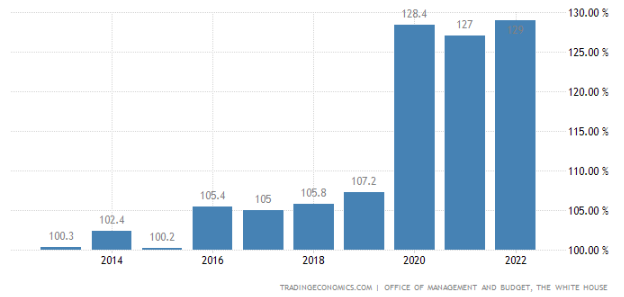
And, despite everybody in the industry’s inability or lack of desire to accept these basic realities, Fitch is making a lot of sense. You can see it not only in governance, but in basic financial metrics used to keep track of a country’s creditworthiness and credibility among its peers. Our money supply has expanded in alarming fashion, our economy feels like it’s about to hit a recessionary wall with rates over 5%, the BRICS nations are exploring the idea of a gold-backed reserve currency and our country’s debt/GDP has ballooned out of control the last 3 years:

TradingEconomics.com

In other words, Fitch is noticing the things that Austrian-focused analysts have been pointing out for the last few years, namely that the U.S. is embarking on an unprecedented experiment in arrogance when it comes to monetary policy. The further down this path we go, the less visibility we have on what the future will bring. In other words, the U.S. is simply becoming more of a risk.

Now don’t get me wrong, the downgrade isn’t devastating, but it isn’t something that should be ignored either. The very same American exceptionalism that has led us down the faulty path of Modern Monetary Theory is once again rearing its head in ignoring one of the world’s preeminent rating agencies, diluting what otherwise should have been a bold statement about the “untouchable” United States.

I put this video up on the morning of the downgrade, expressing my thoughts as I walked to go get my coffee.

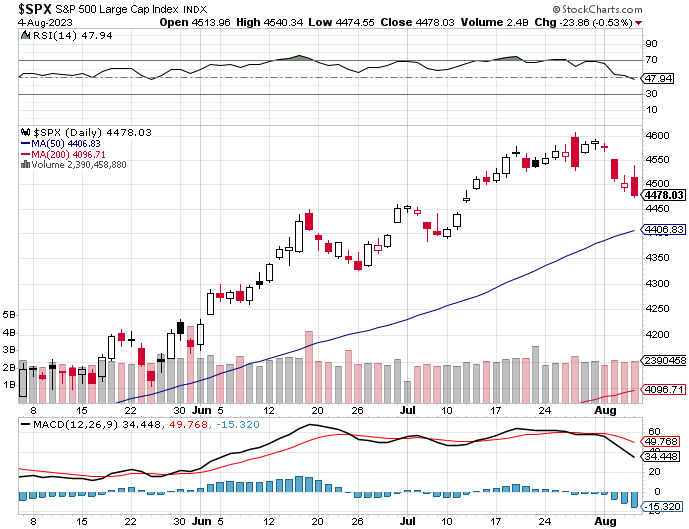
The market finally sold off about 2% the day after the downgrade, but then rebounded Thursday before selling off to end the week, following Apple and Amazon’s earnings.

As you can see above, while the numerical values of the market indices weren’t much changed last week, it felt to me as though there was somewhat of a psychological sea change on the street and in the market, despite everybody’s best efforts to ignore the obvious and pretend our financial outlook is full of unicorns and rainbows.

My readers know that I already believe that the fundamental catalysts for a recession are well in place and moving already. I have been saying for months that the pipe bomb of quantitative tightening, hawkish Fed policy and a slowing economy is already making its way through the plumbing of the market. The only question is when it’s going to blow.  

We’ve done well to ignore this idea over the last six months, with the main talking points in the financial media revolving around the idea of a soft landing. I continue to believe that a soft landing is a mathematical impossibility and will not happen.


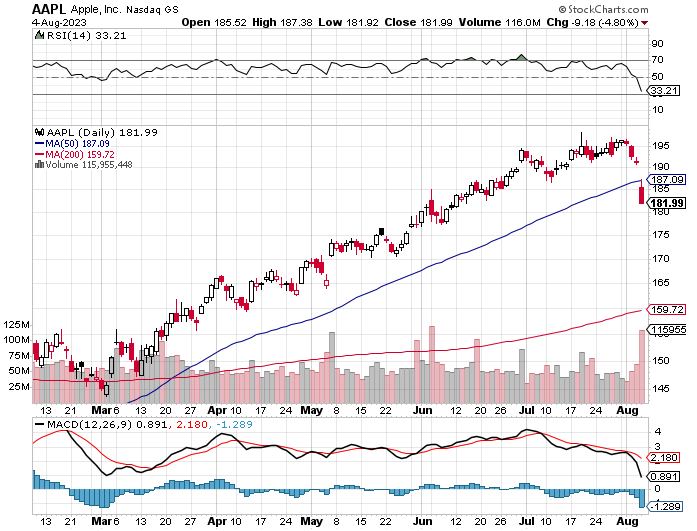
The sentiment shift was most noticeable late in the session on Friday, when the market sold off more than 1% from its high of the day to finish the day red. The VIX moved slightly higher and, importantly, Apple (AAPL) broke its long-term technical trend, falling under its 50 day moving average for the first time in months. You don’t need to be a “technician” (whatever the hell that means), to see the trend break in Apple:

If you ask me, Apple has been an interesting part of this market.

It has been crucial in helping drive the market indices higher. Apple has, for all intents and purposes, done everything 100% right for as many years as I can remember. The stock is on an unstoppable decade-long trend higher and it has famously become the first $3 trillion company to trade publicly on U.S. markets.

But Apple has overheated in several ways. First off, it no longer trades with the modest 10x multiple that once made it appealing to Carl Icahn back in the early 2000’s. Apple now trades closer to a forward multiple of 30x. This means that no only has the business grown, but so has the way the market has decided to value it.

While Apple’s financials are still as sound as can be (generating $100 billion in cash from operations per year with $100 billion-ish cash in the bank and less than 1x EBITDA in debt), the company did have itself a little reality check when it reported earnings last week, posting revenue that declined year over year for the third quarter in a row. The decline was expected, which befuddled Wall Street when the stock sold off, but it was still a decline.

If Apple is a barometer for the economy and, as I believe it to be, a barometer for the stock market, this earnings report may have been crucial in helping shift sentiment alongside Fitch’s downgrade.

I’ve been saying for months that this market is being driven by residual psychological sentiment leftover from the easy money policies that we’ve had in place over the last decade. Apple has been part and parcel with that fairytale. Now that those easy money policies are over, and now that Fitch is desperately trying to splash a little bit of cold water on the United States, while at the same time Apple is stuck at a place where it needs to innovate in order to sustain its aggressive multiple, we find ourselves at an interesting inflection point.

If Apple’s new Vision product doesn’t knock it out of the park completely, it’ll be the company’s first big consumer product dud in as long as I can remember.

Already, reviews don’t make it seem as though it’s going to be a grand slam. The Verge says the product is “still searching for a purpose”. Wired calls it “an alarming misfire” and asks if “Apple has lost its innovation mojo”.

When Apple came out with the Watch, it was a new slice of innovation for the company but hardly the game changer that the iPhone was. And, as anybody that has invested in Apple knows, iPhone pretty much has driven the business over the last 15 years. With iPhone starting to stagnate and the smartphone market starting to become saturated, Apple is going to need to look elsewhere for aggressive growth to continue to justify its multiple.

If the Vision fails to excite the masses, there is a serious chance that Apple could see its multiple contract. And because it is one of the most widely held stocks anywhere, and part of many major weightings and ETFs, if Apple goes, so goes the market.


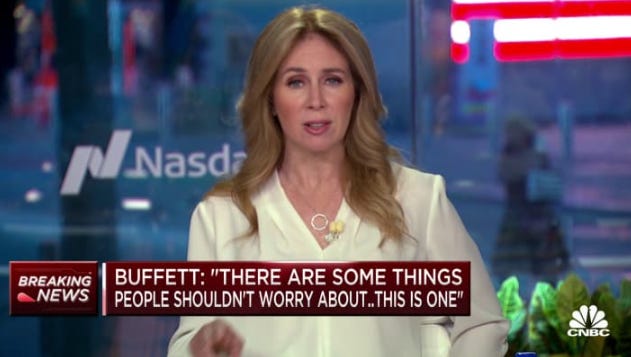
Finally, among those who wrote off Fitch’s downgrade last week was none other than Warren Buffett.

“There are some things people shouldn’t worry about. This is one,” he said after the downgrade on CNBC.

He added that he had bought $10 million worth of U.S. Treasuries to the start the week and forecasted that he would continue to do so.

“The only question for next Monday is whether we will buy $10 billion in 3-month or 6-month,” he added.

Buffett has based his entire career on the idea on an “America First” PR spin. The last 20 or 30 years of his “strategies” have relied heavily on government bailouts and his own brand equity to “turn around” individual company carcasses. His equity investments are buoyed by the same flawed monetary policy that led us to last week’s Fitch downgrade.

For his strategy to continue to work, monetary policy in the U.S. is going to have to support it and the dollar will need to hold up. So far, this has not been an issue and its why I refer to Buffett not as simply the best investor over the last half century, but the best within the confines of the Keynesian system we are in.

A U.S. debt downgrade isn’t a single stock downgrade. It’s not a call to the top of the pyramid of the U.S. investment system. Instead, its a foundational crack of the bedrock where the entire market, as well as the dollar, sits.

Pardon my mostly pre-industrial revolution French, but if the Keynesian system starts to blow, Buffett’s comments about the downgrade and American exceptionalism won’t mean shit. And while I’m not saying Buffett is wrong here and now, I am saying that at some point he will be. This is why I continue to try to keep my finger on the pulse of market sentiment at the bedrock level.

I can’t remember the last time we had a Friday like last Friday, where we sold off into the close. In fact, Fridays have been affectionately named “free money Fridays” because the market generally does nothing but go up to end the week.

Could that trend breaking, combined with Apple’s trend breaking, combined with Fitch’s dose of reality finally have enough gusto to move the tectonic plates underneath U.S. market psychology? We’ll have to see.

I’d love to hear from my subscribers as to whether or not you felt a sentiment shift last week as well – or, if once again, I’m simply having a magic mushroom flashback.

50% OFF ALL SUBSCRIPTIONS: Subscribe and get 50% off and no price hikes for as long as you wish to be a subscriber.

QTR’s Disclaimer: I am not a guru or an expert. I am an idiot writing a blog and often get things wrong and lose money. I do not fact check contributor material that I aggregate from other sources. I may own or transact in any names mentioned in this piece at any time without warning and generally trade like a degenerate psychopath. This is not a recommendation to buy or sell any stocks or securities or any asset class – just my opinions of me and my guests. I often lose money on positions I trade/invest in and I’m sure have lost more than I’ve made in my time in markets. I may add any name mentioned in this article and sell any name mentioned in this piece at any time, without further warning. Positions can change immediately as soon as I publish this, with or without notice. You are on your own. Do not make decisions based on my blog. I exist on the fringe. The publisher does not guarantee the accuracy or completeness of the information provided in this page. These are not the opinions of any of my employers, partners, or associates. I did my best to be honest about my disclosures but can’t guarantee I am right; I write these posts after a couple beers sometimes. Also, I just straight up get shit wrong a lot. I mention it three times because it’s that important.

Tyler Durden
Wed, 08/09/2023 – 15:05

Yields Slide After Impressive 10Y Auction Sees Most Foreign Buying Since February

Yields Slide After Impressive 10Y Auction Sees Most Foreign Buying Since February

When the Treasury issued its latest refunding schedule last week and yields blew up on the ominous TBAC forecast of a lot more issuance on deck, few expected this week’s auctions to be outstanding. Yet yesterday’s 3Y auction was nothing short of stellar, and despite fears that we would see some blow up in today’s sale of $38BN in benchmark 10Y paper, not only was today’s just concluded auction strong but it was in fact one of the strongest 10Y auctions this year.

Pricing at a high yield of 3.999% (almost as if someone would have been stopped out at 4.000%), this was above last month’s 3.847% and only below the Nov 2022 4.106% which was the cycle high. It also tailed the When Issued 3.998% by 0.1bps, which while the 6th consecutive tail for the 10Y tenor, was also the smallest tail since February when we saw the last stop through.

The Bid to Cover was 2.56, slightly above last month’s 2.53 and above the recent average of 2.45; in fact it was the highest BtC since February’s 2.66.

The internals were the most impressive, however, with Indirects awarded 72.2%, up sharply from the 67.7% last month, the most since February and well above the six-auction average of 67.0%. And with Directs taking 18.3%, which was just below the recent average of 19.1%, Dealers were left holding 9.5%, the lowest since February.

The market expected worse, and yields which earlier rose as high as 4.04%, slid to session lows just below 3.99% as fears that the coming treasure issuance deluge have so far failed to spook primary buyers…

Tyler Durden
Wed, 08/09/2023 – 13:27

CNN Changes Tune On Ukraine’s Counteroffensive: ‘Extremely Unlikely’ To Succeed

CNN Changes Tune On Ukraine’s Counteroffensive: ‘Extremely Unlikely’ To Succeed

Authored by Dave DeCamp via AntiWar.com,

A Western official told CNN in an article published Tuesday that it’s “extremely” unlikely that Ukraine will make progress in its counteroffensive in the coming weeks that will alter the balance of the war with Russia.

“They’re still going to see, for the next couple of weeks, if there is a chance of making some progress. But for them to really make progress that would change the balance of this conflict, I think, it’s extremely, highly unlikely,” an unnamed senior Western diplomat said.

Rep. Mike Quigley (D-IL) also spoke to CNN about the counteroffensive and said the briefings Congress has received on the assault are “sobering.” He said the situation was the “most difficult time of the war.”

Leading up to the counteroffensive, the Discord leaks and media reports revealed that the US did not believe Ukraine could regain much territory. 

The Wall Street Journal recently reported that Western officials did not think Ukraine had enough weapons or equipment to dislodge Russian forces. But the Biden administration pushed for the assault anyway, as it rejected the idea of a ceasefire.

Ukraine is struggling to break through multiple layers of Russian defense, most notably vast minefields. The Wall Street Journal quoted a Ukrainian platoon commander in an article published Tuesday who said the Ukrainians are “demining the fields with bodies,” demonstrating the massive human cost.

“It’s awful,” the platoon commander said. Another Western diplomat told CNN that Ukraine hasn’t even gotten through Russia’s first defensive line.”

“Even if they would keep on fighting for the next several weeks, if they haven’t been able to make more breakthroughs throughout these last seven, eight weeks, what is the likelihood that they will suddenly, with more depleted forces, make them? Because the conditions are so hard,” the diplomat said.

Tyler Durden
Wed, 08/09/2023 – 13:25

House Republicans Release Bank Records Showing Over $20 Million In Payments To Biden Family, Associates

House Republicans Release Bank Records Showing Over $20 Million In Payments To Biden Family, Associates

Republicans on the House Oversight Committee on Wednesday revealed over $20 million in payments they claim foreign actors from places like Russia, Ukraine and Kazakhstan sent the Biden family and their associates while Joe Biden was vice president.

Hunter specifically received millions from Russian oligarch Yelena Baturina, Ukrainian energy giant Burisma, and Kazakh oligarch Kenes Rakishev while father Joe was VP, the committee found.

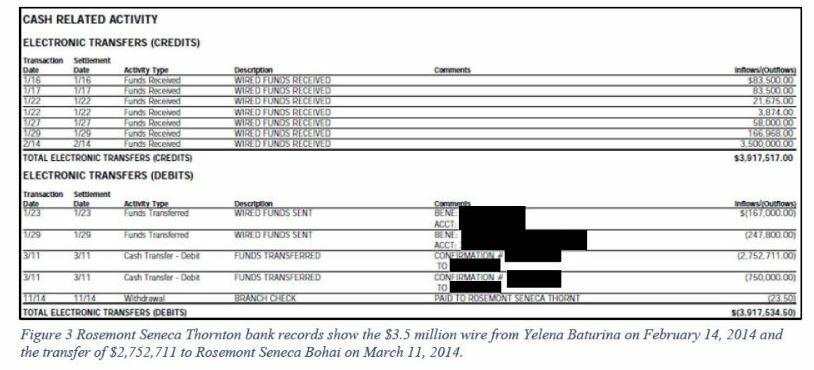
The records show Baturina wired $3.5 million to Rosemont Seneca Thornton, a shell company belonging to Hunter and Archer, in February 2014.

Three-quarters of a million dollars was then transferred directly to Archer, and the rest was used to fund a new company, Rosemont Seneca Bohai.

The bank record shows a transfer of $3.5 million on February 14, 2014 and a transfer of $2.7 million to Rosemont Seneca Bohai on March 11, 2014. –Daily Mail

“During Joe Biden’s vice presidency, Hunter Biden sold him as ‘the brand’ to reap millions from oligarchs in Kazakhstan, Russia, and Ukraine. It appears no real services were provided other than access to the Biden network, including Joe Biden himself. And Hunter Biden seems to have delivered,” said committee chairman James Comer (R-KY).

“It’s clear Joe Biden knew about his son’s business dealings and allowed himself to be ‘the brand’ sold to enrich the Biden family while he was Vice President of the United States.”

In one instance, Kazakh oil oligarch Kenes Rakishev wired $142,000 to Hunter Biden‘s shell corporation to buy a new Porsche (which Hunter bought the next day), before a dinner was set up between the oligarch and Joe Biden, bank records show.

The president’s son photographed himself smoking crack in his Porsche while driving through a residential area to the airport in June 2018

And on March 25, 2014, there were two separate transfers for $2.2 million and $200,000 respectively into the Rosemont Seneca Bohai account, which Hunter and Devon Archer used to receive other personal payments such as those from Burisma. The committee says Hunter then transferred the money into another Rosemont Seneca Bohai account that he and Archer were able to access.

After this, then-VP Joe Biden attended a dinner with Baturina, Hunter, Archer and others at Cafe Milano in Washington DC.

And guess who was left off Biden’s list of sanctioned Russian oligarchs? Baturina.

The committee also says they have proof that Archer and Biden were paid $1 million each for their role on Burisma’s board, or $83,333 per month.

Nothing to see here, just energy expert Hunter Biden raking it in from the company has father would later protect by forcing Ukraine to hire its head prosecutor.

The committee has subpoenaed records from six different banks and have received thousands of records regarding the shell corps, but have not ‘yet’ subpoenaed bank records for the Biden family.

On Tuesday, House Speaker Kevin McCarthy called on President Biden to “give us his bank statements.”

Third Bank Records Memorand… by James Lynch

Tyler Durden
Wed, 08/09/2023 – 13:05

Rand Paul Slaps Fauci With DC Criminal Referral Over Perjury Allegations

Rand Paul Slaps Fauci With DC Criminal Referral Over Perjury Allegations

Sen. Rand Paul (R-KY) has filed a criminal referral against Dr. Anthony Fauci for allegedly lying under oath about the origins of Covid-19.

In a Tuesday letter to DC US Attorney Matthew Graves, Paul demanded an investigation into Fauci for allegedly perjuring himself during a 2021 congressional hearing in which he said COVID-19 couldn’t have come from a Chinese lab he was funding.

Dr. Fauci testified that ‘the NIH has not ever and does not now fund gain-of function research in the Wuhan Institute of Virology.’ In a subsequent hearing, I warned Dr. Fauci of the criminal implications of lying to Congress and offered him an opportunity to recant his previous statements,” Paul wrote in the letter obtained by the Daily Mail.

“In response, Dr. Fauci stated that he had ‘never lied before the Congress’ and ‘d[id] not retract that statement,'” adding “Dr. Fauci’s testimony is inconsistent with facts that have since come to light.

The move comes weeks after Paul submitted an ‘official criminal referral’ to the Justice Department, which a Paul aid told the Mail, never responded.

“Since AG Garland doesn’t appear to want to do his job, I’ve today sent evidence for a criminal referral for Anthony Fauci to the US Attorney in DC,” Paul said in another tweet.

“Before Congress, Dr. Fauci denied funding gain-of-function research, to the press he claims to have a dispassionate view on the lab leak hypothesis, and in private he acknowledges gain-of-function research at WIV to his colleagues  His own colleagues have acknowledged Dr. Fauci’s inconsistency,” the letter to Graves continues. “A congressional hearing, however, is not the place for a public servant to play political games – especially when the health and well-being of American citizens is on the line.”

Paul previously wrote to Attorney General Merrick Garland on July 14 and July 23 calling for an investigation into whether Fauci lied under oath over his knowledge of dangerous virus research that was taking place at the Wuhan lab, in China.

In July 2021, Dr Fauci testified how his former department ‘has not ever and does not now fund gain-of-function research in the Wuhan Institute of Virology.’

Gain-of-function research refers to a type of scientific investigation conducted on  viruses, with the purpose of enhancing their transmissibility or virulence.

The aim is to understand how viruses evolve and potentially predict and prepare for future disease outbreaks, but also raises concerns regarding biosafety and biosecurity. -Daily Mail

Earlier this month, Paul said he had Fauci ‘dead to rights’ over lying during testimony

Meanwhile, journalist Hans Mahncke has an interesting thought for Rand… send the referral to AGs in red states.

As Summit News notes, Earlier this week, Paul shared a link to an article in the Free Press, outlining how Fauci is “guilty as charged.

Tyler Durden
Wed, 08/09/2023 – 12:45

The Collapse Of The EV SPACs: Another One Goes Bankrupt, Others On The Verge

The Collapse Of The EV SPACs: Another One Goes Bankrupt, Others On The Verge

Authored by Wolf Richter via WolfStreet.com,

The SPAC boom will surely go down in history as one of the biggest stock-market heists ever, made possible by Consensual Hallucination…

EV maker Proterra, which makes mostly a few electric buses a year – when giant competitors make many thousands – filed for Chapter 11 bankruptcy today, 25 months after having gone public via merger with a SPAC. It once had a market cap of nearly $4 billion.

It was by no means a record in terms of how long it took for an EV SPAC to go bankrupt; that record is held by Electric Last Mile Solutions, which took only 12 months to get it over with. EV maker Lordstown made the trip from SPAC merger to bankruptcy in a little over two-and-a-half years. The shares of other EV SPACS have totally collapsed, and most of them are headed for bankruptcy.

Proterra’s shares, or rather the SPAC’s shares before the merger, spiked after the merger was announced in January 2021 from around $10 to $31.06 and then began to collapse. Five days ago it was still at $2. Today, it plunged to 17 cents, down by 99.4% from the peak.

We’ll get to a bunch more charts like this in moment, with lots of scandals around them. The SPAC boom in 2020 and 2021 will surely go down in history as one of the biggest stock market heists ever. It has left behind a trail of investigations and settlements and scandals. Short sellers had a big party.

But it left no victims behind, just a bunch of eager players that tried to weasel out some money from other eager players, and some succeeded, and others got cleaned out. It was the era of consensual hallucination, when the Fed’s free money reigned. These creatures have long been populating my pantheon of Imploded Stocks.

Tesla is not part of this listIt is kicking the ICE vehicle makers in the nuts and is taking massive share from their ICE vehicles! And it’s very profitable, after a decade of losing tons of money. Tesla put EVs on the map. And legacy automakers gave it a decade to build its position, and now they can’t get their ducks lined up in a row to even defend their turf.

Rivian is not part of this list either because it went public via classic IPO. It’s actually ramping up mass-production and is on track to make 50,000 trucks in 2023. It raised its production target today to 52,000. But it’s losing so much money and burning so much cash ramping up production that it’s breath-taking. Today, it reported a quarterly loss of $1.2 billion. Its shares got crushed, down 86% from the peak just after the IPO. So it gets its own place right here:

Our EV SPAC heroes.

Lordstown and Electric Last Mile, since they filed for bankruptcy, no longer qualify for a chart here. Electric Last Mile has been sold in pieces, and Lordstown’s shares are still ping-ponged around over the counter, but forget it.

Nikola [NKLA], at $2.20 today, has collapsed by 97% from its high in June 2020 when the merger with a SPAC was approved. The outfit embodies the scandalous nature of these things that went to such heights during the era of consensual hallucination and then thankfully collapsed.

Canoo [GOEV], SPAC merger completed in December 2020. $0.56 now. From peak: -97.5%.

Fisker [FSR], SPAC merger October 2020, preceded by Fisker Automotive which made the Fisker Karma. Now $5.93. From peak: -81%.

Lucid Motors [LCID], SPAC merger announced in February 2021. Now $7.19. From peak: -89%.

Workhorse [WKHS], SPAC merger in October 22, 2020. Now $1.10. From peak: 97%.

Faraday Future [FFIE] SPAC merger in July 22, 2021. Tuesday special, $0.27. From peak -99%.

Lion Electric [LEV], a Canadian company, SPAC merger November 2020, now $2.32, from peak: -93%

Polestar [PSNY] SPAC merger completed in November, 2022; started trading in June 2022, at $11, giving it a market cap of $23 billion. Now at $4.25, down 74% from the peak. The company is majority owned by Chinese giant Geely, which had bought Volvo, which had bought a startup that became Polestar. The vehicles are made in China, and they’re ramping up production. Given its big corporate backing, and part-ownership, this one might be among the survivors:

*  *  *

Enjoy reading WOLF STREET and want to support it? You can donate. I appreciate it immensely. 

Tyler Durden
Wed, 08/09/2023 – 12:25

European NatGas Prices Explode 40% Higher

European NatGas Prices Explode 40% Higher

In a stunning move, reminiscent of the first few months of Putin’s invasion of Ukraine, European NatGas prices exploded a stunning 40% higher today (oil and coal prices are also rising) as the possibility of worker strikes at some LNG plants in Australia threatens global supply….

US NatGas is also getting dragged higher…

For context, here is EU NatGas (energy equiv) compared to WTI and US NatGas…

As Bloomberg reports, aorkers at Chevron Corp. and Woodside Energy Group Ltd. facilities in Australia voted to strike, which has the potential to affect liquefied natural gas exports from the country, tightening the global market for the fuel. The exact timing of the industrial action – if it goes ahead – wasn’t immediately clear.

Asian buyers “are likely to bid up LNG imports” to replace Australian volumes if there are disruptions, which would affect Europe as well, said Nick Campbell, a director at consultant Inspired Plc.

“LNG has become a baseload supply in the European gas supply mix, therefore any signs that this flow is at risk leads to support in price.”

The US-EU Nattie Arb is widening out again, back above its historical range…

Additionally, potential delays in Norway’s seasonal maintenance, a drop in LNG imports to Europe last month, increased flows from the region to Ukraine, and the weather are all factors in the price jump:

“Strength appears to be driven largely by a further extension of hot temperature forecasts well into the 3rd week of this month as well as by a broadening of hot temps across a larger portion of the US than had been expected at the start of this week,” says Ritterbusch & Associates in a note.

“As the heat continues with the associated warming of water temperatures across the Atlantic heightening concerns over hurricane activity, the speculative shorts appear to be scrambling to cover positions.”

It’s also possible that this week’s price surge caused a wave of position-covering by investors who previously bet on further declines in gas. Similar moves caused an extreme volatility in June.

More problematically, winter gas contracts also gained, albeit at a lower pace, as German utility EON SE warned of more risks during the upcoming heating season.

“The crisis is not over,” though the likelihood of a repeat of last year has diminished, Chief Executive Officer Leonhard Birnbaum said in an interview with Bloomberg Television.

Winter is coming… and so is re-inflation.

Tyler Durden
Wed, 08/09/2023 – 09:53

Over 45 Injured After Massive Explosion Hits Military Optics Plant Near Moscow

Over 45 Injured After Massive Explosion Hits Military Optics Plant Near Moscow

On Wednesday a Russian factory northeast of Moscow erupted into a massive explosion of unknown cause, injuring at least 45 people, and causing damage to surrounding buildings. Some are in serious condition.

It happened at the Zagorsk optical-mechanical plant in the city of Sergiev Posad, and while there were overnight reports of another drone attack from Ukraine on the capital city being thwarted, TASS and other state sources are saying it was an accident. 

Russia’s federal investigative agency has launched a criminal probe over “violation of industrial safety requirements for hazardous production facilities,” but acknowledged it is still assessing the cause of the blast.

The plant develops and produces optical and optoelectronic devices for the Russian military and law enforcement, along with other industries including healthcare. 

CNN and others are citing state sources to say it was an industrial accident linked to a pyrotechnic warehouse:

The source of the detonation was a pyrotechnics warehouse rented by a third company on the site of the plant, RIA Novosti said, citing local authorities. It described the incident as a violation of technological processes.

The blast was not caused by unmanned aerial vehicles (UAVs) – military drones that Ukrainian and Russian forces have both used to launch strikes on enemy territory – according to preliminary information, TASS reported.

Certainly there were plenty of area residents which likely believed they were under attack by new Ukrainian drone strikes, given the uptick in drone operations targeting the capital of late. 

Dramatic video of the explosion showed a huge mushroom cloud of gray smoke rising high above the city, with onlookers in shock as emergency vehicles fled to the scene. 

Some Ukrainian sources are alleging it was an attack and not an ‘accident’

The final word thus far from Russian authorities is that a “human factor” was to blame, but the definitive cause had not been given within hours of the incident. 

Industrial accidents happen, but an explosion this large is naturally resulting in much speculation over whether this was actually a drone attack or sabotage, especially given the plant developed difficult to produce military tech. If it was an attack, Moscow would have reason to conceal it, given such a direct hit deep inside Moscow’s military-industrial sector would show Russian air defenses to be weak. 

Tyler Durden
Wed, 08/09/2023 – 09:30