65.8 F
Chicago
Monday, August 24, 2026
Home Blog Page 3500

Meta’s Threads ‘Bombs’ As Daily Active Users Halved

Meta’s Threads ‘Bombs’ As Daily Active Users Halved

The hype surrounding “Threads,” the new social network launched by Meta CEO Mark Zuckerberg, has collapsed. Threads has unraveled so quickly that new data shows active users have been halved. 

Threads launched in the US on July 5 and reached over 100 million sign-ups by that weekend. Shortly after, Zuckerberg wrote in a post, “Can’t believe it’s only been five days!” 

Zuckerberg appears to have prematurely taken a victory lap because early last week, we noted data from SensorTower and SimilarWeb showing an exodus of users and a plunge in engagements. The note was titled Threads Unravels: So-Called ‘Twitter Killer’ App Sees Exodus Of Users, Plunge In Engagement.

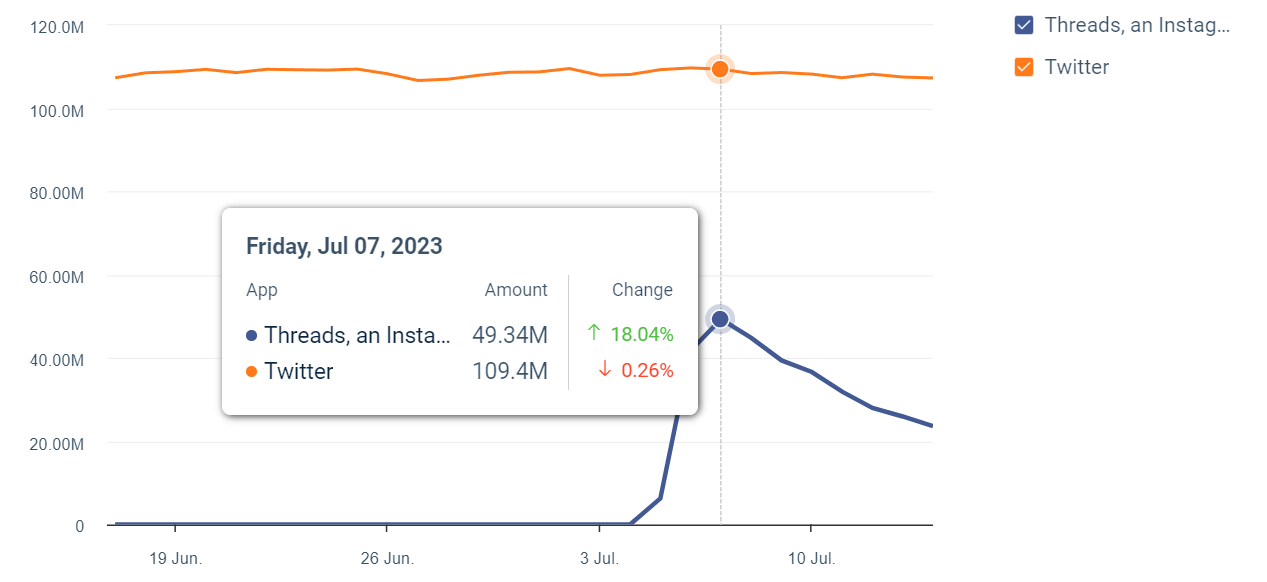
New data from SimilarWeb shows the exodus has worsened. As of last Friday, daily active users on the app collapsed from 49 million to 23.6 million in a week. Usage in the US peaked on July 7 at about 21 minutes of engagement. By Friday, that number plunged to just six minutes. 

SimilarWeb said the app lacks basic features that “offer a compelling reason to switch from Twitter or start a new social media habit.” Also, some users found Threads has been dominated by censorship. 

Threads briefly captured a big chunk of Twitter’s market

Threads’ total daily minutes of use has collapsed

All the hype around Threads was driven mainly by corporate media, such as The New York Times, which penned a piece titled “Threads, Instagram’s ‘Twitter Killer,’ Has Arrived.” Federal-funded NPR News wrote, “Is Threads really a ‘Twitter killer’? Here’s what we know so far.” And here’s a CBS News article titled “Meta’s “Twitter killer” app Threads is here – and you can get a cheat code to download it.”  

Notice the concerted effort by legacy media to bash Elon Musk’s free-speech Twitter?

Threads is unraveling, but it seems like a better venture for Zuckerberg than his disastrous VR bet. 

Tyler Durden
Wed, 07/19/2023 – 09:05

Inflation Can’t Slow Fast Enough For UK Equities

Inflation Can’t Slow Fast Enough For UK Equities

By Michael Msika, Bloomberg Markets Live reporter and strategist

UK inflation has cooled more than expected for the first time since January, which may provide a temporary relief to underperforming British stocks, as traders trim wagers on the extent of further Bank of England policy tightening.

While moves by the Fed and the ECB have helped bring down price pressures significantly in the US and Europe over the past year, the Bank of England has had less success. Inflation is still running at 7.9% year-on-year, and further policy tightening will still be necessary, which threatens to send the UK economy into a recession.

A surge in the pound has failed to lift domestic stocks as investors fret about the economy, with many attributing the strength of the currency to hawkish policy rather than confidence in the market. With speculative positioning on sterling rising to the highest since 2007, a reversal could boost large-cap exporters instead.

“I’m not so optimistic about UK domestic stocks,” says Anthi Tsouvali, multi-asset strategist at State Street Global Markets. “I think that inflation will be high for a while.” It might take time for sentiment to turn, she predicts, favoring large caps that have little exposure to the local market.

Overall, British stocks remain out of favor. According to the Bank of America fund manager survey in July, allocation to UK equities fell four percentage points in the past month to a net 21% of respondents now underweight.

Investors have sold UK stocks indiscriminately in the past 18 months, says Canaccord Genuity’s Quest analyst Graham Simpson, predicting that a peak in bearishness isn’t far off. That’s made the UK market “cheap as chips,” he notes. Indeed, the MSCI UK Index now trades at a 40% discount to global peers.

While neither interest rates or inflation are at satisfactory levels, “we could finally be at a stage where we have enough ‘known knowns’. And that is something UK investors can work with and potentially reap the rewards,” he said before the latest inflation data. Screening for factors of value, quality and momentum, he names stocks including 3i, AJ Bell, Bytes, Centamin, Gamma Communications, Hikma, IMI, JD Sports, MITIE, Morgan Sindall, Paragon, and Wise.

“UK mid and small cap stocks look cheap and would garner interest if a rollover in UK inflation can lift UK macro sentiment,” Morgan Stanley strategists led by Graham Secker said earlier this month, flagging the extreme pessimism from investors over the UK market. While the strategists see recession and monetary tightening risks rising, with a “likely challenging autumn ahead,” they still see decent disinflation in the second half of the year.

One bright spot has been the resilient UK consumer, with confidence levels rising for five consecutive months. The next reading is due Friday and figures are expected to stabilize.

“UK equities offer very attractive expected returns for the long-term investors, but it requires the mentality of going against consensus and having a long-term investment horizon,” says Saxo Bank strategist Peter Garnry.

Tyler Durden
Wed, 07/19/2023 – 08:45

US Housing Starts, Permits Plunged In June; Rental Unit Apps Collapse

US Housing Starts, Permits Plunged In June; Rental Unit Apps Collapse

After a surprising surge in May, US Housing Starts and Building Permits both decline in June (-8.0% MoM and -3.7% MoM respectively) and Starts saw sizable downward revisions from last mopnth (from +21.7% MoM to +15.7% MoM).

Source: Bloomberg

Under the hood, only single-family building permits increased in June (6th month in a row of increases). Multi-family permits and both single- and multi-family Starts dropped.

Source: Bloomberg

Multifamily construction dropped over 11%, but worse still, applications to build multifamily dwellings such as apartments fell 13.5% (the most since November) to 540k (lowest since Oct 2020)….

These MoM moves have dragged the Starts and Permits SAAR down notably (1.434mm and 1.440mm respectively)…

Source: Bloomberg

Finally we note that while Housing Starts and Completions remain well off their 2022 highs, Construction Jobs remain very close to those highs…

Source: Bloomberg

Is there a wake-up for residential construction employment coming?

Finally, we note that Mortgage Bankers Association data released earlier this morning showed applications for home purchases dropped last week as the contract rate on a 30-year fixed mortgage – while improved – remained close to 7%.

Tyler Durden
Wed, 07/19/2023 – 08:40

CVNA Shares Soar To 14-Month Highs On Debt-Restructuring Plan

CVNA Shares Soar To 14-Month Highs On Debt-Restructuring Plan

In Dec 2022, CVNA hit a record low of $3.55. This morning, in the pre-market, it traded as high as $58.88 after the used-care retailer announced a plan to restructure its debt (and pre-announced Q2 results).

First things first, the troubled company announced Revenue and Ebitda that beat expectations.

  • Revenue $2.97 billion, estimate $2.56 billion (Bloomberg Consensus)

    • Retail vehicle unit sales 76,530, estimate 76,937

    • Wholesale vehicle unit sales 46,453, estimate 39,317

  • Adjusted Ebitda $155 million, estimate $57.4 million

    • Adjusted Ebitda margin 5.2%, estimate 0.51%

  • Gross profit $499 million, estimate $409.6 million

The car-seller also filed to sell 35 million Class A shares (up to $1 billion per agreement with Citigroup Global Markets and Moelis & Company).

Carvana also announced today an agreement with noteholders representing over 90% of outstanding senior unsecured notes to reduce total debt, extend maturities, and lower near-term cash interest expense.

  • Pact With Noteholders Cut Total Debt, Extend Maturities

  • To Cut Carvana’s Total Debt Outstanding by Over $1.2B

  • Apollo, Pimco, Ares Support Debt Exchange Pact

  • Pact Cuts Over 83% of ‘25, ‘27 Note Maturities

  • Pact Cuts Cash Interest Expense $430M+/Yr for 2 Yrs

The CEO was very optimistic…

“Carvana performed exceptionally well in the second quarter and set Company records for Adjusted EBITDA and gross profit per unit, which was up 94% year-over-year, all while continuing to lower expenses. Our strong execution has made the business fundamentally better, and combined with today’s agreement with noteholders that reduces our cash interest expense and total debt outstanding, gives us great confidence that we are on the right path to complete our three-step plan and return to growth,” said Ernie Garcia, Carvana’s Founder and Chief Executive Officer.

The response was exuberance – CVNA was up as much as 30% in the pre-market…

…to its highest since May 2022…

Today’s explosion higher comes one week after JPMorgan cut the company’s rating to a ‘underweight’ with a $10 target price.

Perhaps, the JPM analysts didn’t see the size of the short interest…

The short-squeeze appears to have only just begun…

Tyler Durden
Wed, 07/19/2023 – 08:27

Volatility Index Is So Low It Has To Go Up?

Volatility Index Is So Low It Has To Go Up?

Authored by Lance Roberts via RealInvestmentAdvice.com,

The volatility index is so low it has to go higher eventually. Such seems obvious, but this year, despite the banking crisis, higher interest rates, and slowing economic data, investors continue to abandon hedges amid bullish optimism.

But what exactly is the volatility index, more commonly called the “VIX,” and why does it matter?

“The Cboe Volatility Index (VIX) is a real-time index representing the market’s expectations for the relative strength of the S&P 500 Index (SPX) near-term price changes. Because it is derived from the prices of SPX index options with near-term expiration dates, it generates a 30-day forward projection of volatility. Volatility, or how fast prices change, is often seen as a way to gauge market sentiment, particularly the degree of fear among market participants.

It is an important index in the world of trading and investment because it provides a quantifiable measure of market risk and investors’ sentiment.” – Investopedia

Investors view the “VIX” as a gauge of investor “greed” or “fear.” Given that investors tend to be wrong at extremes, such has been an excellent leading indicator of a reversal when the index reflects extreme fear or greed. Since there is an inverse relationship between the volatility index (VIX) and investor sentiment, the chart below inverts the VIX index for a better comparison. Unsurprisingly, low VIX readings correlate to investor bullishness.

To understand the relationship to the market, we created a composite index. The index combines retail and institutional investors’ net bullish sentiment and an inverted volatility index (1 minus the VIX reading). We overlaid the composite index against the S&P 500 index. Unsurprisingly, high index readings regularly associate with market events and corrections. Low readings occur near market lows.

Investors should expect a correction with the combined index readings approaching higher levels. However, as Nick Colas recently stated, these periods can last longer than expected.

Once we’re in a [low-volatility] regime, it tends to last unless a true ‘unknown unknown’ comes along. With the VIX well below average now, we look to be in a low-vol/good return environment until a genuine shock comes along. It is hard, but not impossible, to ‘surprise’ the VIX with new information that switches it from running below to suddenly above trend.‌

This is not a bright green light for further equity gains in 2023, but it does set the bar quite high regarding what sort of catalyst is needed to derail the current rally.”

Notably, his point is that stability ultimately breeds instability.

Stability Breads Instability

Economist Hyman Minsky argued there is inherent instability in financial markets. During periods of bullish speculation, the excesses generated by reckless, speculative activity will eventually lead to a crisis. Of course, the longer the speculation occurs, the more severe the crisis will be.

We can visualize these periods of “instability” by examining the Volatility Index versus the S&P 500 index. Note that long periods of “stability” with regularity lead to periods of “instability.”

Given the volatility index is a function of the options market, we can also view these alternating periods of “stability/instability.” The chart below shows the daily price changes of the index itself.

With the entirety of the financial ecosystem more heavily levered than ever, the “instability of stability” is now the most significant risk.

The “stability/instability paradox” assumes that all players are rational. Therefore, such rationality implies avoidance of destruction. In other words, all players will act rationally, and no one will push “the big red button.”

The Fed depends on “everyone acting rationally” as they continue to hike rates to combat inflationary pressures. So far, the markets have compiled by absorbing financial events in stride and pushing asset prices higher. However, with the most aggressive rate hike campaign since the late 70s proceeding, the market largely ignores the risk of “something breaking” as bullish exuberance returns. Historically, bullish sentiment rises DURING the rate hiking campaign but ends poorly.

The hope, as always, is this time will be different.

0DTE (Zero Days To Expiration)

While volatility is low currently, it is unlikely that volatility has been permanently suppressed. There is a decent correlation between volatility and the Fed’s rate-hiking campaign. Given that rate hikes eventually “break something,” particularly given the impact of higher borrowing costs on an increasingly leveraged economy, this time is likely no different. However, there is undoubtedly a lag effect between volatility and rate hikes, suggesting a recession remains a key risk.

Notably, while investors are becoming exceedingly complacent about a continued low volatility environment, they may be walking into a trap. Unfortunately, investors never know with certainty until the “trap is sprung.”

One reason supporting the claim that “the VIX is broken” is the rise of short-term options termed “0DTE” or “Zero Days To Expiration.” These extremely short-term put-and-call options on individual stocks and indexes expire within 24 hours. As the chart shows, almost half of the options volume on the S&P 500 is 0DTE. Such dwarfs the single-digit rates existing before the pandemic.

More importantly, the traditional measure of “fear and greed” in the financial markets, the VIX, does not consider these 0DTE options.

“The risk from 0DTE (in our view) comes from a heavy imbalance (ex: too many non-hedgers short downside). We think a lot of 0DTE is one dynamic-hedger trading with another dynamic hedger, and/or underlying replacement (i.e., buy calls instead of long stock).” – SpotGamma.

It is certainly possible the rise of 0DTE options may be contributing to the suppression of the volatility index, making it appear to be less effective near term. However, we won’t know with certainty until the next “volatility event” arrives. Unfortunately, it could be too late for many investors to do much about risk management.

But as our analysis shows, we suspect the VIX is working probably as it is a function of bullish market sentiment. While such suggests the market can, and likely will, go higher in the near term, it is also the fuel needed for the subsequent decline.

All that is missing is the unexpected, exogenous event that sparks the first wave of selling.

Tyler Durden
Wed, 07/19/2023 – 07:20

CRE Dominos Fall: Starwood Defaults On $212.4 Million Atlanta Office Tower

CRE Dominos Fall: Starwood Defaults On $212.4 Million Atlanta Office Tower

Starwood Capital Group has defaulted on a $212.5 million mortgage backed by an office building in Sandy Springs, an ultra-wealthy suburb in northern Fulton County, Georgia, just above Atlanta. 

The mortgage is on Tower Place 100, a 790,000 sqft mixed-use property built in 1974 and renovated in 2017. The largest tenant is WeWork companies which occupy 84,594 sqft. 

At the end of 2022, the tower was 62% leased, down from 87% in 2018 when the loan was originated. 

Bloomberg data shows the loan matured on July 9. Starwood has failed to refinance or pay off the debt. Delinquency commentary on the Terminal reads, “Borrower confirmed they are unable to pay off the loan at maturity. Counsel engaged. PNA pending.” 

CRE lending standards have tightened considerably in response to the Federal Reserve’s aggressive interest rate hikes over the past sixteen months to combat inflation. Further tightening in lending was seen earlier this year after several regional banks failed. The combination of the two, plus remote and hybrid work, has led to declining property values. 

Last month, Brookfield Asset Management Ltd. made the “difficult decision” to stop payment on a $558 million loan for San Fransico’s largest shopping mall after “challenging operating conditions.” Park Hotels & Resorts Inc. also ceased making payments on a $725 million CMBS loan secured by two of its San Francisco hotels. 

We reported Tuesday that a 30-story office tower in downtown Baltimore was just sold at a 63% discount versus 2015 prices

Meanwhile, financing-data firm Trepp showed the delinquency rate for offices with CMBS loans soared to 4.5% in June from 1.7% a year earlier. 

“Most CMBS financing is non-recourse, which means owners can walk away from properties without exposing themselves to further financial damages,” Bloomberg noted. And that’s precisely what owners have been doing and will continue to do. 

We noted last month that “full-blown trouble” is ahead for the CRE office space. 

Tyler Durden
Wed, 07/19/2023 – 06:55

“The Euro Is Up For All The Wrong Reasons”: European Stock Risks From Currency Moves Are Growing

“The Euro Is Up For All The Wrong Reasons”: European Stock Risks From Currency Moves Are Growing

By Michael Msika, Bloomberg Markets Live reporter

Europe’s currencies are hitting multi-month highs as the US dollar takes another leg lower. While that’s bad news for exporters, it’s not even helping domestic stocks much.

Since last September’s low, the euro has surged over 17% against the dollar, marking a 17-month high. The pound and the Swiss franc have also soared. Yet a basket of shares with exposure to EU sales has lagged the single currency, with the trend similar in the UK.

“The euro is up for the wrong reasons,” says Barclays strategist Emmanuel Cau. While a strong euro is typically an indicator of positive sentiment, the move this time is driven by higher rates rather than better economic growth, he notes. Equity flows show investors favor the US over Europe, while the gap in relative economic surprises is likely at an extreme, he says.

“One of the reason for the breakdown of relationship between domestic stocks and the currency is that the European economy has been quite weak, we’ve had a technical recession in Europe, the manufacturing data is still very weak,” says Goldman Sachs strategist Sharon Bell, adding a catch-up will depend on the improvement of the economic data. Bell also points out most domestic stocks don’t benefit from the AI trend secular drive, and some domestic sectors like telecoms and utilities suffer from high rates given their elevated debt levels.

Given Europe’s export-heavy stock market, strong domestic currencies on average hurt profits in the region. In a model based on year-on-year figures and with all else equal, Barclays estimates that euro-area earnings will take a 2.5% hit from the stronger single currency.

The greenback has been weakening for 10 months, and the latest leg lower — fueled by bets that cooling inflation will usher in an end to Federal Reserve interest-rate hikes soon — may exacerbate trends seen so far. Dollar-exposed sectors like health-care have underperformed, while cyclical sectors have led gains.

While most of the impact of a weaker dollar may not yet be felt in second-quarter results, companies such as luxury-goods makers Swatch and Burberry have recently warned of currency headwinds. Outlook statements and analyst calls during the earnings season may offer more clues on the impact this year.

Looking ahead, European winners from a strong local currency are hard to identify, says Bloomberg Intelligence strategist Laurent Douillet, but adds that losers are likely to be health care, consumer-related sectors and industrials.

Strategists such as Bank J. Safra Sarasin’s Wolf von Rotberg say that the dollar’s reversal is a “temporary development.” He expects a global and US slowdown toward the end of 2023 or early 2024 to potentially strengthen the dollar again. In that scenario, health-care shares and Switzerland, whose stock benchmark has a heavy weighting of the sector, would benefit the most, he adds. In the meantime, a weak greenback may help sectors like miners and oil as it tends to support commodities, von Rotberg says.

For Syz CIO Charles-Henry Monchau, the weakness in the dollar could spur some rotation toward EM assets and commodity-related stocks. “Let’s not forget that the dollar is a risk off currency and currently we are risk on,” he says.

Tyler Durden
Wed, 07/19/2023 – 06:30

Record Olive Oil Prices Keep Italian Pizza-Making Costs High

Record Olive Oil Prices Keep Italian Pizza-Making Costs High

After extreme heat in southern Europe caused significant crop damage, olive oil prices are soaring further into record-breaking territory. This has led the cost of cooking a classic Pizza Margherita to remain well above the current Italian inflation rate. 

Bloomberg calculations based on Istat and Economy Ministry data showed the cost of ingredients plus energy to cook a Pizza Margherita increased 14% in June compared to a year earlier. The good news is costs associated with pizza-making have subsided since late 2022 but remain twice that of overall Italian inflation. 

“The cost of buying prepared pizza rose only 7% from a year earlier, making it more worth while to buy a ready-made version of the delicacy at the store,” Bloomberg noted. 

The five components of the pizza basket include flour, mozzarella, tomato, olive oil, and electricity. 

Here’s the cost breakdown: 

  • Flour consumer prices rose 6.8% Y/y but fell 0.6% M/m
  • Mozzarella consumer prices rose 17.7% Y/y but fell 0.4% M/m
  • Tomato consumer prices rose 12.8% Y/y but fell 10.0% M/m
  • Olive oil consumer prices rose 26.7% Y/y and 2.4% M/m
  • Electricity consumer prices rose 1.4% Y/y but fell 6.6% M/m

And a visual of the roller coaster in the price of the pizza basket cost index.

The good news is pizza making costs are coming back down to Earth. But one of the basket’s components, olive oil, continues to soar to new record heights.

We penned a note in May titled Olive Oil Prices Soar As Top Producer Plagued With Droughtwhich outlined that severe drought and parched soils in Spain have sparked widespread olive tree crop damage. 

Data from Bloomberg shows that Spanish extra-virgin olive oil prices have risen 282% since the August 2020 lows. Prices command 7,519 euros per metric ton — the highest level on record with data going back to 2010. 

“Output in Spain could more than halve this season due to the arid conditions, according to a Spanish farming industry group,” Bloomberg wrote in May. Spain accounts for 40% of the world’s supply, indicating that prices across Europe and other regions are set to increase further. 

Declining olive oil production due to the devastating effects of heat waves in Europe offers a grim outlook for pizza lovers battered by high costs. 

    Tyler Durden
    Wed, 07/19/2023 – 05:45

    Canadian PM Trudeau Corners Himself Between His Enthusiasm For Trans & Muslims

    Canadian PM Trudeau Corners Himself Between His Enthusiasm For Trans & Muslims

    Authored by Thomas Lifson via AmericanThinker.com,

    The needle on my schadenfreude meter jumped so hard to the right that it’s stuck there in red zone, where my soul is endangered by excessive pleasure in the suffering of another. It must be because I find Canada’s Prime Minister Justin Trudeau such a phony doofus, pretending to be a model of unpretentious tolerance while destroying the civil liberties of his opponents (as in the brutal repression of the Ottawa Freedom Convoy demonstrations against his extreme Covid lockdown).

    The former high school drama teacher certainly loves role playing, including costumes, as in his notorious familial cosplay during a trip to India 5 years ago that was so over the top that many locals felt uncomfortable:

    YouTube screengrab (cropped)

    But last month he found himself caught between his urges to pander to the trans movement on the one hand, and his longstanding desire  to be perceived as the champion of Muslims in Canada, a position that enables him to criticize and demean believing Christians as intolerant bigots.

    But there is a slight problem that just won’t go away. Believing Muslims don’t want their children indoctrinated in schools with ideology being pushed by the trans movement in North America. Just over three weeks ago,  Canadian Muslims demonstrated outside his office in Ottawa, as reported by the Post Millennial:

     A group of Muslims gathered outside Canadian Prime Minister Justin Trudeau’s office to protest the LGBTQ indoctrination and the addition of Progress Pride flags on government buildings. Canadian flags could be seen at other entrances.

    In a video posted on Twitter by Dacey Media, protesters chanted, “Leave our kids alone” and “The Flag has to go” while pointing to the Progress Pride flag on the side of the building. 

    “We need the Canadian flag up there,” one man says to the crowd pointing to a flag on the side of the building. “This is the Prime Minister of Canada, it should only be the Canadian flag.” 

    The issue had first heated up in Alberta, the oil-rich province that is milked to subsidize Eastern Canadian provinces, and which tends to be more conservative. On June 6th, a junior high school teacher in the provincial capital Edmonton was caught on tape berating Muslim pupils for skipping school to avoid LGBTQ Pride events:

    “You can’t be Canadian if you don’t believe people can’t marry whoever they want! You don’t belong here!”

    Oops!

    On July 12  Trudeau was in Calgary, the largest city in Alberta and a major oil center, and sat down with a Muslim parent, trying the play the respect-everybody role, and wearing an open collar sports shirt as Mr. Casual Nicegyuy. And that’s where he stepped in it. You’ll find below an 8 minute+ Twitter video with more than 7 minutes of Trudeau going on and on (he loves to hear himself talk), which I invite you to watch if you can stand him play acting his role that long. (I had to force myself, but that’s my job.) Fortunately, the Post Millennial transcribed the key points. Using the favorite terminology of Nina Jancowicz, he cited “misinformation and disinformation.” For Muslims who revere the Koran as the word of Allah delivered to Mohammed, the implications are mind boggling.

     “First of all, there is an awful lot of misinformation and disinformation out there.

    But he didn’t stop there. He continued on, casting devout Muslims following the Koran as patsies of… the American right wing.

    People on social media, particularly fuelled by the American right-wing, are spreading a lot of untruths about what’s actually in the provincial curriculums.

    “Now if you look at the various curriculums, you’ll see that there is not what is being said out there about aggressive teaching or conversion of kids to being LGBT. That is something that is being weaponized by people who are not doing it because of their interest in supporting the Muslim community,” Trudeau said.

    Twitter video screengrabs

    Here is the tweet containing the full performance:

    Muslims and Christians objecting to LGBTQ indoctrination (sometimes, side-by-side) are not the only Canadians disgusted by Justin. Watch as he is enthusiastically booed delivering the opening remarks at the North American Indigenous Games yesterday:

    Now, living during the presidency of Joe Biden, I have no legitimacy in mocking Canadians for their head of government.  But I do hope that the bloom is off the rose and that this era of Canadian politics will be over with a massive electoral repudiation. It’s probably too much to expect the government will fall, as can happen in a parliamentary system, but I have had enough to Justin to last 5 lifetimes.

    Tyler Durden
    Wed, 07/19/2023 – 05:00

    IEA Warns Of Winter NatGas Crisis If Russia Cuts Supplies

    IEA Warns Of Winter NatGas Crisis If Russia Cuts Supplies

    Natural gas stockpiles in Europe are plentiful, exceeding the five-year average for this time of year. The continent’s storage is poised to reach full capacity earlier than anticipated, providing governments and companies with reassurance that last year’s energy crisis may be unlikely to repeat. However, a new report cautions that the threat of a severe winter and potential interruptions in Russia’sNatGas supply to Europe still poses significant risks. 

    “While market fundamentals have significantly eased since the start of 2023, and the European Union is well on track to fill up its storage sites to 95% of working capacity, full storage sites are no guarantee against winter volatility,” the International Energy Agency wrote in a report Monday. 

    “Our simulations show that a cold winter, together with a full halt of Russian piped gas supplies to the European Union starting from 1 October 2023, could easily renew price volatility and market tensions,” IEA said. 

    IEA’s warning comes after the second winter of reduced NatGas flows from Russia. Before the Ukraine invasion, Russia was the leading supplier of petroleum oils and NatGas to the EU. A major diversification of suppliers has been underway ever since, according to think thank Bruegel. 

    Here are the top NatGas import routes into the EU and LNG routes. 

    In a note to clients earlier this month, Morgan Stanley said dwindling NatGas supplies from Russia means the EU is more reliant on not just LNG exports from abroad but also domestic renewable energy. If Europe encounters a deep freeze and solar and wind don’t offset a surge in power demand, then TTF, Europe’s benchmark gas price, could surge to 100 euros a megawatt-hour. 

    IEA also noted a scenario where there is a warm winter, and LNG flows remain close to last year’s highs, then “storage sites would end the heating season with inventory levels above 50 percent of capacity even without Russian piped gas.” 

    “Continued structural gas demand reductions” such as energy-efficient heat pumps “will be required to ensure a secure gas balance for the 2023/24 winter,” it added. 

    * * * 

    Here’s the full report:


    Tyler Durden
    Wed, 07/19/2023 – 04:15