MyPillow Auctioning Off Equipment After These Big-Box Retailers Canceled Mike Lindell
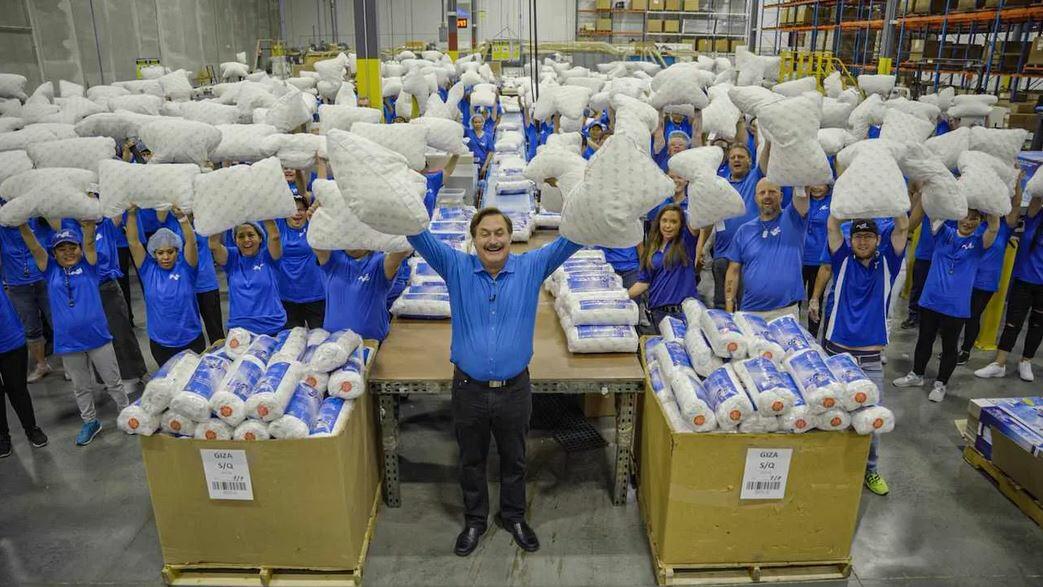
MyPillow CEO Mike Lindell says that his company is auctioning off hundreds of pieces of equipment and subleasing manufacturing space after several big-box retailers and shopping networks ditched the company’s products over Lindell’s personal views.
Lindell, a vocal supporter of former President Donald Trump who has gone to great lengths to dispute the results of the 2020 election, told the Star Tribune that he’s lost $100 million from ‘attacks by the box stores.’
“It was a massive, massive cancellation,” said Lindell. “We lost $100 million from attacks by the box stores, the shopping networks, the shopping channels, all of them did cancel culture on us.”
The stores which dropped MyPillow products include;
Walmart
Bed Bath & Beyond
Slumberland Furniture
Now, Lindell is selling over 850 pieces of ‘surplus equipment’ online, including sewing machines, industrial fabric spreaders, conveyor belts, electric forklifts, and more.
As the Tribune notes, the auction doesn’t appear related to a $1.3 billion defamation lawsuit against MyPillow and Lindell brought by Dominion Voting Systems, which alleges Lindell defamed the company as part of his campaign to show that the 2020 presidential election was “rigged.”
Lindell has not backed down from his assertions that there was something wrong with the 2020 election and its results. He said he plans to host an event next month detailing a new way to hold elections.
But the ongoing controversy over his claims has forced major shifts in his business. After some shopping networks dropped his products, the company has moved to direct sales, shooting new television commercials and trying to boost its presence through email marketing, radio spots and direct mailing. -Star Tribune
According to Lindell, the company is also subleasing some of its manufacturing space because the packaging for direct sales is different than what the company required when producing products for large retailers.
“We kind of needed a building and a half, but now with these moves we’re making, we can get it down to our one building,” he said.
“If the box stores ever came back we could have it if we needed it, but we don’t need that,” Lindell continued. “It affected a lot of things when you lose that big of a chunk [of revenue].“
According to the World Health Organization, there have been 6,947,192 confirmed COVID-19 deaths globally as of June 28. Of those, 1,127,152 occurred in the United States, making the number of Americans killed by the virus more than 19 times the number of American soldiers killed in the Vietnam War.
And yet, over three years since the beginning of the pandemic, we still don’t know where the virus originated. The fear is that the next time around, the number of deaths could be much higher; because we didn’t learn from this pandemic, we wouldn’t be as prepared as we should for the next one.
This fear is shared by all Americans. That is probably why in March, the U.S. Congress unanimously passed the “COVID-19 Origin Act of 2023,” requesting that the Office of the Director of National Intelligence (ODNI) “declassify all information relating to potential links between the Wuhan Institute of Virology and the origin of COVID-19.” “The ODNI must submit to Congress an unclassified report with all such information with redactions only as necessary to protect sources and methods,” the new law says.
On June 23, ODNI released a 10-page report titled “Potential Links Between the Wuhan Institute of Virology and the Origin of the COVID-19 Pandemic.” As someone who has been following this development closely, ODNI’s report told me nothing beyond what I already knew, except for one little gem on page 5: that the Wuhan Institute of Virology (WIV) had developed a technique that “left no traces of genetic modification of SARS-like coronaviruses.”
“Some of the WIV’s genetic engineering projects on coronaviruses involved techniques that could make it difficult to detect intentional changes,” the report stated.
Why did the WIV want to develop such a technique? Scientists at the institute had been publishing their research on viruses in the best scientific journals, including on “genetic modification of SARS-like coronaviruses,” so it didn’t look like they wanted to hide what they had been doing. Maybe what they published was only part of their research, and they wanted to conceal the research they didn’t publish? What would that be?
Before the ODNI report, U.S. investigative journalists revealed in early June that three WIV researchers, Ben Hu, Ping Yu, and Yan Zhu, were allegedly the first COVID-19 patients, having fallen ill in the fall of 2019. They were reportedly conducting research on SARS-like viruses and engaging in “gain-of-function” experiments. Gain-of-function, which involves altering the properties of a pathogen in order to study its potential impact on human health, increases the infectiousness of viruses and/or makes them more lethal.
The WIV denied such allegations. “The recent news about so-called ‘patient zero’ in WIV are absolutely rumors and ridiculous,” Ben Hu told the journal Science in June.
I was hoping that the ODNI report would shed more light on the origin of SARS-CoV-2. It didn’t, but a patent application I found through a web search strongly suggests that the Liberation Army (PLA) had the genetic sequence of the virus in its possession as early as September 2019. This would fit well with the allegation that the three WIV scientists were infected by the virus in the fall of 2019.
It’s worth noting that the same allegation was made by the Department of Justice in a fact sheet published Jan. 15, 2021, which said the U.S. government had “reason to believe that several researchers inside the WIV became sick in autumn 2019, before the first identified case of the outbreak.”
Officially, World Learned of Virus in January 2020
The first cases of the atypical pneumonia (later known as COVID-19) were reported in Wuhan in December 2019. The news was soon supressed by the Chinese Communist Party, as China was preparing to celebrate the Lunar New Year—a time that no bad news is allowed. Whistleblowers like Dr. Wenliang Li were punished. Officially, Chinese virologists did not have a chance to study the novel virus until early January 2020.
On Jan. 11, 2020, Professor Yong-Zhen Zhang’s group from Fudan University in Shanghai submitted the genome sequence of SARS-CoV-2 to GenBank (accession number MN908947.1) in Maryland. Prof. Zhang obtained the virus by collecting bronchoalveolar lavage fluid from a 41-year old male patient in Wuhan, who had been admitted to hospital on Dec. 26, 2019. Chinese state media reported his death on Jan. 11, 2020.
Jan. 11, 2020, was the day that SARS-CoV-2 officially became known to the world. WHO announced that it had received the genetic sequence of the novel coronavirus from the Chinese regime and would soon make it public.
On Feb. 24, 2020, Dr. Yusen Zhou and 10 other inventors from the PLA’s Institute of Microbiology and Epidemiology in Beijing filed a patent application(number 202010112679.9) titled “Novel coronavirus titled “COVID-19 vaccine, preparation methods and applications.” The application described in detail the design of the vaccine, the method to produce the vaccine, and the immunogenicity of the vaccine.
I am a vaccine scientist who worked for one of the world’s largest vaccine companies for more than 10 years, and I spearheaded SARS-CoV-1 vaccine development in 2003. I was stunned by the speed these PLA inventors were able to not only study the new virus and develop and test a vaccine so quickly, but also put together a patent application in merely 44 days (from Jan. 11 to Feb. 24)!
Vaccine development is an arduous process, usually taking about 10-15 years on average to accomplish. Before COVID-19, the fastest a vaccine that had ever been developed was the mumps vaccine in 1967, which took four years.
Of course, the U.S. government’s “Operation Warp Speed” made it possible for vaccine companies to accelerate their processes, which we now know compromised safety and effectiveness. Moderna published their Phase I/II clinical data on July 14, 2020, and Pfizer published theirs on Aug. 12, 2020. Then in December of that year, the U.S. Food and Drug Administration granted the Moderna and Pfizer vaccines Emergency Use Authorization.
When I worked in the vaccine industry, I was the liaison between R&D (Research and Development) scientists (which I was also a member of) and our in-house lawyers in the IP (Intellectual Property) office. I was personally involved in the filing of dozens of patent applications. Normally, patent applications should be filed as soon as scientists discover something new, useful, and non-obvious—the three properties patent lawyers stress that scientists keep an eye out for and document.
A patent application can be filed before a vaccine is tested and granted for distribution. One could argue that the PLA’s application was “provisional,” meaning it would serve as a placeholder so that experimental results could be added later when available, hence it is possible that it only took 44 days to draft their patent application.
Yes, when things move extremely smoothly, a patent application could be put together in about one and a half months. However, the PLA’s filing contains real experimental data that would take time and effort to perform and collect. This makes it extremely unlikely that the scientists only received access to the virus information on or after Jan. 11, 2020.
Telling Timeline
If the PLA did have access to the virus, maybe they got the information from Prof. Zhang before he submitted the genetic sequence to GenBank, or maybe they got it elsewhere. Or it could be that since the scientists are with the PLA, how they obtained the virus constitutes a military secret.
Today marks the final day of Amazon Prime Day. Customers are scouring the e-commerce website for the best deals. So far, there have been hefty discounts on certain appliances and electronics. However, some Twitter users have raised concerns about potential ‘misleading advertising’ strategies by vendors.
Twitter user Chad|Money Matters has brought to our attention possible deceptive marketing tactics by an Amazon vendor. The item in focus is an Ottman footstool sold by the Amazon Basics Store. He posted a screenshot of the item selling for $69.08 on Monday, one day before Prime Day. On Tuesday, the first day of Prime Day, the item was listed for the same price but had a red label reading “37% off … Prime Day Deal” and was marked down from a typical price of $110.40.
— Chad | Money Matters (@Chadmoneymatter) July 11, 2023
Amazon price tracking website Camelcamelcamelshows prices for the Ottman footstool were around the $69 mark throughout June, then days before Prime Day rocketed to $109.80.
Twitter users weren’t thrilled by this development.
“Wait, are you suggesting it’s all just a marketing scheme and it’s not really about great savings,” one person said.
Someone else said, “Amazon prime day just tried to scam me. They showed me an item that I bought before, but raised up the price artificially then told me that they lowered the price making it the same, but tricking that it’s cheaper.”
“I did some research here. I have software tools that can verify price. This was 78.00 and more a while ago. But the true recent price was 69.00 and today its $65.63. $3.00 off which is really nothing. Its been Prime exclusive 69.00 for a while,” another Twitter user said.
The folks at the Federal Trade Commission should take a look at this.
Biden critics are accusing the White House of a “cocaine cover-up” as the Secret Service investigation into “CocaineGate” drags on with no resolution.
Amid growing skepticism regarding the trustworthiness of the “ongoing investigation,” the Press Secretary Karine Jean-Pierre on Tuesday didn’t have an update for reporters.
“Do you have any update on the investigation into the cocaine at the White House?” a reporter inquired.
“I don’t have any updates,” Jean-Pierre responded. “I just don’t have anything updated. I would refer you to the Secret Service on that particular question.”
“Do you have any update on the investigation into the cocaine at the White House?”
Karine Jean-Pierre: “I don’t have any updates … I just don’t have anything updated.” pic.twitter.com/WWumCUu8A4
The USSS have not been answering to press inquiries about the discovery, however, telling news outlets that they cannot comment on ongoing investigations. The Secret Service will be briefing Congress on Thursday, after House Oversight Chairman James Comer Comer fired off a letter to USSS Director Kimberly Cheatle demanding to be briefed on the White House security failures that led to the “unacceptable and shameful” discovery of cocaine in the West Wing.
Sen. Tom Cotton (R-Ark.) also called for a briefing in a letter on July 5.
“If the White House complex is not secure, Congress needs to know the details, as well as your plan to correct any flaws,” the Republican senator wrote, demanding a list be provided of every individual who has access to the White House without passing through a security screening.
Congress and the American people deserve to know how cocaine got into the White House. pic.twitter.com/Fps9AJ6hSQ
According to the Daily Mail, Cotton has not yet received a reply from Cheatle.
Details about where the cocaine baggie was found have changed multiple times since the discovery was made on July 2.
Initially, a spokesman for the USSS told reporters that Secret Service officers “located an unknown item on the White House complex.” Then, an audio recording from the Hazmat team sent to the White House to investigate the substance indicated it was located in the library. Next, the White House said it was found in the highly trafficked West Wing lobby.
White House Press Secretary Karine Jean-Pierre on Wednesday strongly suggested that a member of the public on a tour may have left the drug in a “heavily-traveled area” of the West Wing.
“This is a heavily, heavily trafficked – heavily traveled to be more accurate – area of the campus of the White House. And it is where visitors to the West Wing come,” Jean-Pierre insisted.
“I just don’t have anything else—I’m not going to speculate on who it was.”
Finally, on Thursday, NBC News reported that the contraband was found in a cubby near the “much more secure” West Executive entrance—not the West Wing lobby.
According to NBC’s Andrea Mitchell, “average people just can’t get in” where the cocaine baggie was found.
Although fingerprint and DNA analysis were done last week on the “dime-sized zipper baggie” the drug was found in, no results have yet been shared. The investigation was expected to be concluded by Monday.
Now, some are accusing the Biden White House of engaging in a cover up to protect the culprit.
On Fox News Monday, Rep. Pat Fallon (R-Texas) said the Biden White House is refusing to hand over the results of the finger print analysis.
“If the cocaine was found on a bag, doesn’t it have fingerprints on it? And how long would it take to answer that question? Weeks, days, hours?” asked Fox News host Martha MacCallum.
“I asked some of our State Troopers, Texas Rangers and Sheriffs—those kinds of people who do this for a living—and they all said to me that on very porous surfaces like bags and envelopes, you’ll be able to determine within an hour if there’s fingerprints on it,” Rep Fallon replied.
“By my math we’re 192 hours from the time it was discovered yet we don’t know.” Fallon noted that “if there were no fingerprints, they could have told us immediately.”
The Texas congressman also said the fingerprints may have been run through a database and pointed out that the cocaine was found in an area “where high level aides and staffers are,”
most of whom “have been fingerprinted at one time or another.”
Fallon told MacCallum that the Secret Service “very well may already know who it belongs to and aren’t sharing with us.”
Rep. Pat Fallon on the cocaine found at the White House: “If there [were] no fingerprints, they could have told us immediately. So I suspect there are fingerprints…” pic.twitter.com/o7OovkXoE3
— The Post Millennial (@TPostMillennial) July 10, 2023
Kash Patel, a former House Intelligence Committee staffer, and chief of staff to the acting United States secretary of defense under President Donald Trump, told former Trump official Sebastian Gorka on Tuesday that local law enforcement, not just the Secret Service, should be involved in the investigation.
“The White House is subjected to law enforcement and we’re talking about felony levels of narcotics,” he said.
I talk to @KashsCorner, author of the new book “Government Gangsters,” about the bizarre cocaine scandal in the Biden White House.
In an interview with Just the News, former FBI agent and acting commissioner of the Customs and Border Protection Agency Mark Morgan said last week that the White House cocaine mystery should take “about 30 minutes to solve.”
“I was there countless times, I put my cell phone in that exact box that they’re talking about. I know it well. Oftentimes, there is a marine that’s standing there. This literally should take them about 30 minutes to solve,” Morgan said on Wednesday.
According to former Secret Service agent Dan Bongino, the culprit has to be a member of the Biden family because everyone else has to go through a strict security checkpoint. “It had to be one of the protectees—there’s no other explanation,” Bongino declared in a video posted on Rumble. “That would never have gotten through the checkpoint. Not a chance in Hell.”
On Friday, even an MSNBC reporter questioned the Secret Service’s line that the mystery may never be solved, saying it’s “hard to believe” the Secret Service can’t figure out who brought the cocaine to the White House, given the heavy security.
“The cocaine cover-up is officially ridiculous,” said Judicial Watch president Tom Fitton in a video commentary posted onto Twitter.
The Biden White House cocaine cover-up is officially ridiculous. But, per usual, @JudicialWatch stepping up with independent investigation. pic.twitter.com/4x5HLbA0iE
The number of unsold electric vehicles at dealers in the second quarter tripled compared to the past year, signaling a weakened demand for the segment, said a recent report by leading auto-dealer data company Cox Automotive.
In second quarter 2023, the average inventory for electric vehicles (EVs) topped more than 92,000 units on the ground at dealer lots, according to the 2023 Cox Automotive Mid-Year Review presentation. This is up 342 percent compared to second quarter 2022. During this period, the new “EV days’ supply,” which refers to the average number of days a warehouse holds inventory before selling it, rose 166 percent, to 92 days from 38.5 days. While the pace of EV sales is up, it is “not rising as fast as inventory builds,” said Jonathan Gregory, senior manager, Economic and Industry Insights.
Original equipment manufacturers (OEMs) are facing a “field of dreams moment,” he stated. “They have built inventory, and now they wait for buyers to come. This is one of the hottest topics we’ve had this year.”
Brands like Jaguar, Infiniti, and Lincoln had the highest days of supply, at over 100 days. The lowest numbers were seen among Toyota, Honda, Kia, and Lexus, with each brand having less than 30 days of supply.
Tesla continued to dominate the luxury EV segment with a market share of 25.5 percent, followed by Mercedes at 12.5 percent, BMW at 12.2 percent, and Lexus at 11 percent. Among EVs priced above $50,000, Ford held the biggest share at 22.1 percent, followed by Chevrolet at 12.1 percent.
Unlike other parts of the world, U.S. citizens remain on the sidelines when considering an EV purchase.
According to an April 2023 report by consumer intelligence company JD Power, more Americans are unwilling to buy EVs. In March, 21 percent of new vehicle shoppers said they were “very unlikely” to consider an EV, up from 17.8 percent in January.
During this period, the proportion of people who said they were “very likely” to buy an EV remained flat at around 26 percent.
“Lack of public charging infrastructure and price have been the top two concerns for the past 10 months, along with related issues involving range anxiety, time required to charge, and power outage and grid concerns,” the report said.
Dealer-Customer EV Expectations Diverge
While inventory is building up at dealer lots, a study by Cox Automotive found a wide gap between dealers and customers regarding future expectations of EV use.
According to Cox Automotive’s 2023 Path to “EV Adoption: Consumer and Dealer Perspectives” study, even though 53 percent of consumers see EVs as a future and that such vehicles will replace gas engines over time, only 31 percent of dealers held such a view.
“Nearly half (45 percent) of dealers surveyed feel that EVs still need to prove themselves in the marketplace,” said a press release on June 27.
In addition, the study also found that while customer interest in EVs is rapidly rising, sales continue to remain far lower in comparison. The research found that 51 percent of consumers were considering a new or used EV even though electric vehicles are only expected to make up less than 8 percent of total new vehicle sales this year.
Cox Automotive is expecting the sale of new EVs to surpass one million units for the first time in 2023. According to the firm’s Dealer Sentiment Index, the biggest factor which held back EV dealers during the second quarter was the state of the economy. This was followed by interest rates, limited inventory, market conditions, and credit availability for consumers.
President Biden’s commitment to end fossil fuels has been ineffective in reducing the demand for oil – but very effective in both weakening the U.S. and empowering our primary global adversary, China. Assuming that a reduction in global carbon emissions is necessary to fight “climate change” (a disputed proposition), it nonetheless makes little sense environmentally, economically, or strategically to hobble the American fossil fuel sector (cancelling pipelines, discouraging financing, restricting leases, and slow walking permits) before sufficient sources of renewable energy with a proven capacity to meet global demand can be demonstrated.
In its World Energy Outlook 2022, even the International Energy Agency (IEA) warned that if the supply of oil “were to transition faster than demand, with a drop in fossil fuel investment preceding a surge in clean technologies, this would lead to much higher prices – possibly for a prolonged period.” The IEA’s warning had the advantage of being written after the war in Ukraine threatened worldwide energy supplies, which, more effectively than any desk-top research, demonstrated the global economic threat posed by a too-rapid retreat from fossil fuels.
Worldwide demand for crude oil is currently forecast to hit an all-time high in 2023. China’s demand, in particular, is surging. In May, the IEA “revised up” its forecast for growth in global demand, with “China accounting for nearly 60% of global growth in 2023.”
In the U.S., 79% of energy consumption comes from fossil fuels, while 13% comes from renewable energy sources, according to the Energy Information Administration (EIA). That’s after tens of billions of dollars in government spending in support of renewables, particularly wind and solar, which combined account for a mere 5% of our energy consumption. The bottom line: so-called renewables are insufficient – and lack the necessary dependability – to meet our energy needs.
Despite this heavy fossil fuel dependence, over the past two decades carbon dioxide emissions in the U.S. have declined by 15% while China’s have grown by 216%, according to the EIA. The U.S. emissions reductions were due, in great part, to an increase in the use of inexpensive and clean-burning natural gas, which, thanks to fracking, the U.S. has and can produce in abundance.
If the goal is actually to reduce global carbon emissions without causing global economic chaos, increased use of dependable and abundant American natural gas makes far more sense than curtailing U.S. production and spending billions on unreliable and expensive “renewable” energy sources. Let’s face it, if renewables were economically viable, dependable, and available in sufficient supply, the Chinese would be using them. In fact, they have every incentive to do so.
Most of the processing of the minerals needed for electric-vehicle batteries happens in China. Using wind, solar, and batteries for energy production and transportation requires significantly more metals (three times more copper, seven times more rare earths, 19 times more nickel, 25 times more graphite, and 42 times more lithium) than natural gas, oil, or coal production and transportation. The U.S. mines and processes a negligible amount of these metals, which primarily come from countries such as Australia, China, Congo, and Indonesia. Notably, 60% of rare earths are mined in China. Chemical processing, battery components, and assembly are mostly done by Chinese companies. China also processes 87% of rare earths, 65% of cobalt, 58% of lithium, and 40% of copper.
As a result, China’s economy has benefitted significantly from the global push toward renewable energy. Of the 12.7 million jobs worldwide related to renewable energy, 5.4 million jobs are in China, 0.9 million in the U.S., and 1.2 million in Europe. Of the worldwide jobs related to solar energy manufacturing, 68% are in China, as are 48% of jobs related to wind power.
To further reduce U.S. carbon emissions, the Biden administration proposes spending hundreds of billions to increase our dependence on unreliable wind and solar power. This plan is set forth in the so-called Inflation Reduction Act, a green energy bill that does virtually nothing to reduce inflation. According to a summary of the act by Senate Democrats, the bill would “reduce carbon emissions by roughly 40% by 2030.”
But there would be consequences. Using a clone of the Biden’s EIA’s energy model, a Heritage Foundation study found that reducing carbon dioxide emissions 44% by 2030 would cause 1.2 million in annual average job losses in the U.S., plus an aggregate GDP loss of $7.7 trillion through 2040 – or $87,000 per family of four. Average household electricity expenses for American families would increase by 23%. All to replace reliable and abundant energy sources that have been reducing U.S. carbon dioxide emissions for two decades.
Biden’s energy policies are needlessly weakening the U.S. and strengthening China. Since the 1970s, with the help of its innovative energy industry, America has won independence from OPEC. It makes no sense to implement policies that weaken our economy while once again putting our access to energy at the mercy of a hostile and even more dangerous adversary.
Andy Puzder is the former CEO of CKE Restaurants and a senior fellow at the Heritage Foundation and Pepperdine University, and he is a member of RealClearEnergy’s Brain Trust, a group of strategists offering insight and guidance on today’s critical energy topics.
Data Brokers To Be Barred From Selling Your Location Data Under Proposed Massachusetts Law
A law under consideration in Massachusetts would ban data brokers from selling cell phone location data, Gizmodo reports.
For those who have been living under a rock, data brokers are constantly selling cellular location data to various entities, including state, federal, foreign, and local governments. While the data is supposed to be anonymized, it can very easily be de-anonymized.
The Location Shield Act would outlaw “selling, leasing, trading, or renting location data” in the state of Massachusetts, and would require companies to obtain user consent if they want to collect or process such data. Noncompliance with the law would expose companies to state legal action via the AG’s office, along with class-action litigation.
The law appears to have been catalyzed by the Supreme Court’s overturning of Roe v. Wade. Ever since federal protections for abortion were abolished, the issue of data privacy has taken on new relevance for women. Rights advocates fear that digital evidence of all sorts (including, potentially, data of the kind that the Shield Act tackles) may be used to prosecute women for breaking abortion laws. As a result, a number of rights groups, including the ACLU and Planned Parenthood, pushed for the adoption of the Shield Act, partially as a means of protecting abortion-seekers from prosecution, should they choose to travel to the state for medical procedures. Massachusetts is considered a safe haven for women from other states who may travel there to seek abortions. -Gizmodo
“Every day, unregulated data brokers buy and sell personal location data from apps on our cellphones, revealing where we live, work, play, and more. To protect our privacy, safety, access to abortion and other essential health care, Massachusetts needs to ban this practice now by passing the Location Shield Act,” wrote the ACLU on its website.
Now to see if it passes, and if so, whether other states will follow suit.
Biden Administration Helping CCP By Restricting Domestic Mining: Minnesota Senator
A Minnesota state senator says that the Biden administration’s restrictive stance towards domestic mining projects is making the US dependent on the Chinese Communist Party.
“We need to change the narrative on mining in this country,” said Sen. Tom Bakk in an appearance before the House Ways and Means Committee on July 10. “It’s contrary to their own objectives.”
Mr. Bakk testified during a field hearing in Kimball, Minnesota. He said northeast Minnesota has the largest deposits of copper, cobalt, nickel, platinum group metals, and other products the renewable energy industry needs.
Mr. Bakk said the United States could be a net exporter of these items. The CCP’s July 3 announcement of new state controls that restrict exports of germanium and gallium, elements used in producing high-performance computer chips, shows it is willing to disrupt supply chains, he said. –Epoch Times
“It’s bad for Minnesota; it’s bad for the country. Frankly, I think it’s bad for the world,” said Bakk, who added that the Biden administration has severely hobbled mining in the United States, leaving China with a monopoly.
“It’s urgent that we stop putting up roadblocks to domestic mineral production because our ability to avoid devastating supply chain disruptions and build a greener future depends on it,” he said, referring to the Duluth Complex in the northeast tip of the state near Lake Superior.
Bakk said that mining has been a significant industry in the area for 140 years, and that it could be once again with the growing interest in green technology, as the rich deposits could not only be used for domestic needs, but exported to other countries.
“That deposit would have supported several generations of miners,” said Bakk, adding that the US Government seems to be divided on its support for green energy.
On one hand, President Joe Biden told American auto workers last September that they would be building electric cars.
“Companies have announced new investments of more than $36 billion in electric vehicles and $48 billion in batteries manufacturing in the U.S.,” said Biden.
Mining had yet to take place on the site to that point.
In 2018, the Trump administration reversed that decision and renewed the leases. In January 2022, the Interior Department determined that the Trump decision violated the law, did not consider the U.S. Forestry Service’s consent authority, and failed to consider all possible environmental impacts.
Not only were the leases canceled, but all mining operations in the forest were prohibited. This includes any studies related to mining.
According to Mr. Bakk, this will cause the kind of environmental damage the lease opponents want to prevent. At the same time, it will make the United States more vulnerable to the CCP. He said importing the products would have an added environmental impact.
“Consider the greenhouse gas emissions associated with [importing the metals],” he said.
China Has Too Much Control
Mr. Bakk said the best way for America to address climate change is with its raw materials.
“The data is clear. We need to mine these materials, and we’re going to successfully combat the negative effects of climate change,” he said.
Committee member Rep. Pete Stauber (R-Minn.) agreed with Mr. Bakk. He expressed concern over China’s willingness to engage in trade wars with the United States and the rest of the world. He said the United States is squandering an opportunity to become more prominent internationally and to solidify its relations with other countries.
“China has a long history of engaging in trade wars with the United States and other countries, and the world is increasingly dependent on critical minerals.
“We have an incredible opportunity to export these minerals to allies and partners around the globe, lessening the grip of countries like China and global supply chains,” Mr. Stauber said.
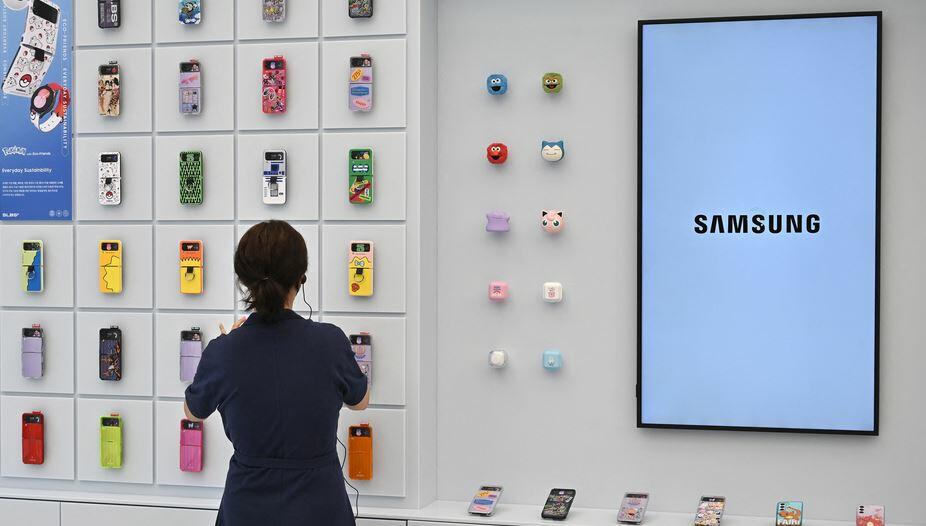
Amid escalating tension between South Korea and China, Samsung has drawn attention by pulling out of the Shanghai Mobile World Congress for the first time in six years and initiating its maiden patent lawsuit against Chinese company BOE. The moves come in the wake of repeated allegations of technology theft by China against Samsung’s technology.
Samsung Display took a decisive step on June 26, instigating a patent infringement lawsuit against BOE Technology Group Co., Ltd. (BOE), China’s premier display company. The lawsuit, filed in the Eastern District Court of Texas, asserts that BOE had unlawfully appropriated four of Samsung’s patented organic light-emitting diode (OLED) display technologies that it uses in the iPhone 12.
This legal action marks Samsung’s first patent lawsuit against BOE after it repeated warnings against unauthorized appropriation of Samsung’s technology.
BOE is a public company with its headquarters in Beijing’s Yizhuang Economic and Technological Development Zone, and its business empire spans displays, sensors, smart systems, and health services.
In the lawsuit, Samsung Display articulated its grievance, stating that BOE has infringed upon the company’s patent rights by selling panels identical to those that Samsung Display has utilized for the iPhone 12 in the U.S. market.
This litigation extends the ongoing legal feud between Samsung Display and BOE that surfaced last year.
In May 2022, Samsung Display issued a notice of patent infringement to BOE, followed by a complaint with the International Trade Commission (ITC) against 17 U.S. component wholesalers in December of that same year.
Samsung sought to ban the use of counterfeit components and display panels allegedly based on its sophisticated OLED patents, including one on its “Diamond Pixel” technology.
The move was triggered by U.S. smartphone repair shops using both genuine Samsung Display panels and counterfeit Chinese products when replacing iPhone 12 OLED display panels. It requested the U.S. tribunal ban 17 U.S. smartphone parts wholesalers from importing such parts and panels that allegedly use its patented technology into the United States.
Confronted with this unfavorable situation, BOE retaliated in May this year by filing a counterclaim against Samsung Display’s and Samsung Electronics’ Chinese legal entity. The lawsuit, filed with a court in Chongqing, China, accused Samsung Display of plagiarizing its OLED display panel technology.
South Korean public opinion suggests that Samsung Display, having grown weary of the CCP’s alleged acts of thievery, decided to retaliate with a countersuit.
Grappling With Significant Losses Due to China’s Brazen Technology Theft
Beijing’s alleged global technology theft operation wreaks havoc worldwide, with South Korea, an electronics industry powerhouse, bearing the brunt of its onslaught. Samsung Electronics, a global leader in semiconductors and OLED display panels, struggles to protect its technology.
A recent large-scale technology theft by Beijing, revealed to be of significant detriment to South Korea, exemplifies the severity of the situation.
In mid-June, South Korea’s Suwon District Prosecutor’s Office filed a lawsuit against a former Samsung Electronics executive surnamed Choi for allegedly stealing design data from a Samsung Electronics semiconductor factory and attempting to build a replica factory in China.
Choi, 65, a South Korean tech industry veteran, reportedly received approximately $360 million from the Chengdu government to establish a semiconductor company in China, recruiting over 200 key personnel from Samsung Electronics and SK Hynix.
Choi was once lauded with titles for his innovation, hands-on approach, and round-the-clock dedication. However, this time, the government that honored him as a national tech hero is accusing him of industrial espionage on a grand scale.
Prosecutors described the defendant in a statement as an “undisputed top domestic expert in semiconductor manufacturing.”
“The data, which Samsung Electronics obtained through more than 30 years of research and development, is worth 300 billion to trillions of won (about $200 million to billions). It is not only a company’s trade secret but also a national core technology,” prosecutors said.
China Warns NATO Must Not Ever Expand Into Asia-Pacific
China is furious at signals it is observing at the Vilnius summit regarding potential future NATO expansion into the Pacific region, and into China’s ‘own backyard’ of southeast Asia.
Beijing on Wednesday vowed a “resolute response” if NATO should ever expand this far east. China’s mission to the European Union issued a scathing statement following the NATO communique published Tuesday. “The China-related content of the communique disregards basic facts, wantonly distorts China’s position and policies, and deliberately discredits China. We firmly oppose and reject this,” China’s diplomats said.
Specifically, the NATO communique said, “The PRC employs a broad range of political, economic, and military tools to increase its global footprint and project power, while remaining opaque about its strategy, intentions and military build-up.”
“The PRC’s malicious hybrid and cyber operations and its confrontational rhetoric and disinformation target Allies and harm Alliance security,” it added.
The Chinese mission had emphasized in its response that it opposed NATO’s “eastward movement into the Asia-Pacific region,” while warning that, “Any act that jeopardises China’s legitimate rights and interests will be met with a resolute response.”
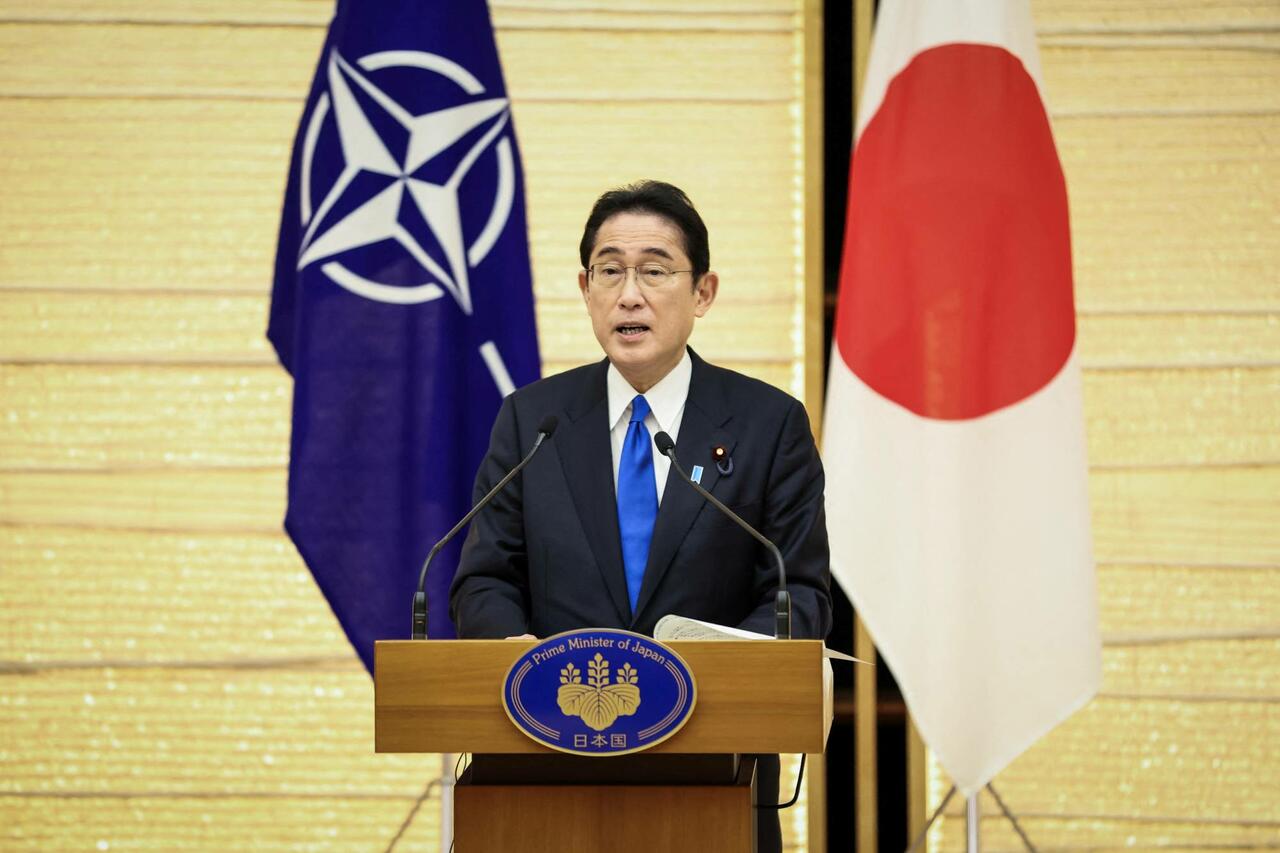
Certainly Beijing is also very closely following the presence of four regional allies of the US, including Australian Prime Minister Anthony Albanese, Japanese Prime Minister Fumio Kishida, New Zealand Prime Minister Chris Hipkins and South Korean President Yoon Suk-yeol–all who were in attendance at the major NATO summit in Lithuania.
Starting in May, Kishida talked up future NATO membership for his country, but plans to open a NATO liason office in Tokyo were halted this week.
“Nato appears to have shelved plans to open a liaison office in Tokyo, a proposal that had been discussed as part of the western military alliance’s plans to deepen cooperation with partners in the Asia-Pacific but which was strongly opposed by China,” The Guardian writes Wednesday, after there was no mention of the office anywhere in the lengthy communique.
🧵 Macron’s resistance to a @NATO office in Japan is a storm in a teacup, but also an opportunity for the US to clarify its expectations of all its allies in any major war. One possible result of a Taiwan war is the fragmentation of NATO. Why is this?https://t.co/nRe1hzhg94
A sentence acknowledging the NATO liaison office had reportedly been included in an initial draft of the communique, and survived multiple rounds of editing, but did not make it into the final publication.
With the already raging controversy over Ukraine’s future in NATO (or lack thereof), perhaps the Western allies weren’t ready to deal with China’s wrath at this time?