In comments to the House Judiciary Committee, Durham reiterated the report’s findings that there was “not a legitimate basis” for the Crossfire Hurricane investigation – before shooting down several barbs from Democrats;
Special Counsel Durham says that, at the time, there was “not a legitimate basis” to launch the Crossfire Hurricane investigation into Trump. pic.twitter.com/0wO1hIEs3u
— The Post Millennial (@TPostMillennial) June 21, 2023
COHEN: “Your reputation will be damaged!”
DURHAM: “My concern about my reputation is with the people who I respect, and my family, and my Lord, and I’m perfectly comfortable with my reputation with them, sir!” pic.twitter.com/zughWAoN2l
Durham said that several FBI agents apologized to him for how the Trump investigation was run.
DURHAM: “I have had any number of FBI agents…who have come to me and apologize for the manner in which that investigation was undertaken. I take that seriously!” pic.twitter.com/3vqE08nrl0
“The FBI was too willing to accept and use politically funded and uncorroborated opposition research such as the Steele Dossier,” said Durham, who also confirmed that there was no collusion found between the Trump campaign and the Russian government.
🚨BREAKING: John Durham testifies before House Judiciary Committee: “The FBI was too willing to accept and use politically funded and uncorroborated opposition research such as the Steele Dossier.” pic.twitter.com/bi4mHvQPoN
“Our findings were sobering. I can tell you, having spent 40 years plus as a federal prosecutor, they were particularly sobering to me.” — Special counsel John Durham
1. Why were former FBI Director James Comey and former Deputy Director Andrew McCabe, along with FBI officials Bill Priestap, Peter Strzok, and Kevin Clinesmith, and others allowed to refuse cooperation?
2. Where is Mifsud?
3. Why were “omissions” or “misstatements” by FBI officials and/or their sources treated as such, and not as criminal lying, as would likely have happened in Robert Mueller’s investigation?
4. Why was Halper’s name kept out of the report? What other “informant” activity was obscured?
5. Why did you punt on the hack?
It’s a great read which subscribers to Racket News can check out here.
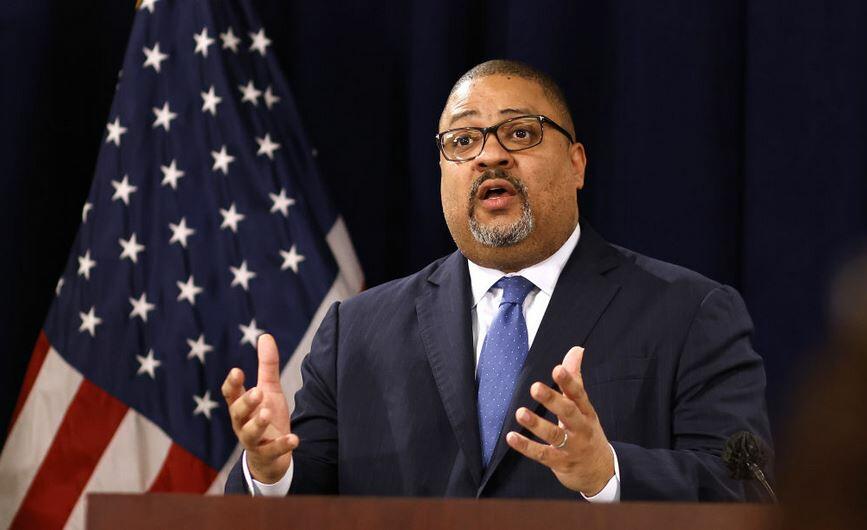
Manhattan District Attorney Alvin Bragg was sued by a conservative organization in a bid to turn over prosecution records relating to the cases against former President Donald Trump, who was arrested on multiple counts earlier this year.
The Heritage Foundation think tank filed two Freedom of Information Law lawsuits against the Manhattan prosecutor, alleging that he and his office coordinated with Rep. Daniel Goldman (D-N.Y.), the White House, and the Department of Justice (DOJ) about the prosecution targeting Trump.
“Regrettably, these questions have not been met with answers. These reports have raised concerns in many circles based in large part upon the longstanding history of President Trump’s political opponents coordinating their activities to systematically weaponize the criminal justice system against him and thereby pervert the course of Justice,” the first lawsuit (pdf) against Bragg stated.
A second lawsuit (pdf) filed by the conservative Washington-based think tank also claimed that Bragg retained pro-bono assistance from top law firms in connection to the Trump case. They are asking a court to release requested documents to the public under the New York Freedom of Information Law and declare that Bragg hand over the documents.
The Epoch Times has contacted Bragg’s office and the Heritage Foundation for comment on the lawsuit.
Mike Howell, director of Heritage’s Oversight Project, told Fox News that his organization suspects that Bragg was “coordinating, or otherwise communicating” with opponents of Trump, adding that there is reason to believe Bragg is a “prolific communicator” via his phone.
“The fact we have to file a lawsuit against Bragg who says he can’t produce these records and says he doesn’t have the systems to do so, is proof-positive of another dual standard of justice at play in this country,” Howell said. “You have a weaponized actor who’s going after the former president on a loony theory about his document retention, whereas the DA can’t even keep his own documents and it’s in violation of the information laws he is bound by,” he continued.
The lawsuit further alleges that Bragg hasn’t responded to requests for communication between Bragg or his office and other parties. Heritage stated that it has the right to see those communications under New York’s Freedom of Information Law.
Neither Trump nor his lawyers have yet to respond to the lawsuit. Bragg’s office also has not made any public remarks.
Responding to the Heritage lawsuits, a spokesperson for Bragg’s office told the New York Post on Friday: “We’ll decline to comment and respond in court papers.”
In the meantime, Trump’s lawyers are trying to move the case to a federal court or demanding that New York Supreme Court Justice Juan Merchan recuse himself. Lawyers for the former president on Friday filed a motion asking the case to be transferred to the federal level, saying that the alleged crimes—relating to the 2016 election and his campaign—”took place while the president was in office.”
“According to [Bragg’s office], the crux of its case was a purportedly ‘illegal scheme that was largely perpetrated before defendant became [P]resident.’ Such an alleged scheme, albeit nonexistent, could only violate federal, not state, campaign finance laws, as made clear by both the federal jurisprudence and the New York State election board,’” Trump’s recent filing said.
Merchan, who has been often criticized by Trump, has stated that the case will head to trial on March 25, 2024, which would be in the middle of the 2024 GOP primary campaign. A hearing in the case was scheduled for June 27.
Watch Live: Fed Chair Powell Tells Congress “Long Way To Go” In Inflation Fight
The market has slide in overnight trading ahead of Fed Chair Jerome Powell’s monetary policy testimony to Congress.
According to just released prepared remarks, he will tell lawmakers on Wednesday there is still “a long way to go” to cool inflation and interest rates are expected to rise further this year, reiterating his comments from last week.
“[I]nflation pressures continue to run high, and the process of getting inflation back down to 2 percent has a long way to go,” Powell’s prepared remarks state.
“Nearly all [officials] expect that it will be appropriate to raise interest rates somewhat further by the end of the year,” he added.
Reducing inflation will likely require slower economic growth and “some softening of labor market conditions.”
“The economy is facing headwinds from tighter credit conditions for households and businesses, which are likely to weigh on economic activity, hiring, and inflation,” though the extent to which remains uncertain.
Finally, Powell reassured that the U.S. banking system is sound and resilient, but noted that recent bank failures have highlighted the importance of ensuring appropriate rules and supervisory practices for banks of all sizes.
“The focus is on whether the July meeting is truly ‘live’ and if the Fed dot plot of two more hikes is a true base case depending on the data, or doom-mongering on inflation in an effort to ensure no premature easing in financial conditions,” said Tapas Strickland, head of market economics at NAB.
Powell will appear before the House Financial Services Committee at 10 am ET, then the Senate Banking Committee on Thursday.
“Inflation” is the key focus of his prepared remarks.
Chairman McHenry, Ranking Member Waters, and other members of the Committee, I appreciate the opportunity to present the Federal Reserve’s semiannual Monetary Policy Report.
We at the Fed remain squarely focused on our dual mandate to promote maximum employment and stable prices for the American people. My colleagues and I understand the hardship that high inflation is causing, and we remain strongly committed to bringing inflation back down to our 2 percent goal. Price stability is the responsibility of the Federal Reserve, and without it, the economy does not work for anyone. In particular, without price stability, we will not achieve a sustained period of strong labor market conditions that benefit all.
I will review the current economic situation before turning to monetary policy.
Current Economic Situation and Outlook
The U.S. economy slowed significantly last year, and recent indicators suggest that economic activity has continued to expand at a modest pace. Although growth in consumer spending has picked up this year, activity in the housing sector remains weak, largely reflecting higher mortgage rates. Higher interest rates and slower output growth also appear to be weighing on business fixed investment.
The labor market remains very tight. Over the first five months of the year, job gains averaged a robust 314,000 jobs per month. The unemployment rate moved up but remained low in May, at 3.7 percent. There are some signs that supply and demand in the labor market are coming into better balance. The labor force participation rate has moved up in recent months, particularly for individuals aged 25 to 54. Nominal wage growth has shown some signs of easing, and job vacancies have declined so far this year. While the jobs-to-workers gap has narrowed, labor demand still substantially exceeds the supply of available workers.1
Inflation remains well above our longer-run goal of 2 percent. Over the 12 months ending in April, total personal consumption expenditures (PCE) prices rose 4.4 percent; excluding the volatile food and energy categories, core PCE prices rose 4.7 percent. In May, the 12-month change in the consumer price index (CPI) came in at 4.0 percent, and the change in the core CPI was 5.3 percent. Inflation has moderated somewhat since the middle of last year. Nonetheless, inflation pressures continue to run high, and the process of getting inflation back down to 2 percent has a long way to go. Despite elevated inflation, longer-term inflation expectations appear to remain well anchored, as reflected in a broad range of surveys of households, businesses, and forecasters, as well as measures from financial markets.
Monetary Policy
With inflation remaining well above our longer-run goal of 2 percent and with labor market conditions remaining tight, the Federal Open Market Committee (FOMC) has significantly tightened the stance of monetary policy. We have raised our policy interest rate by 5 percentage points since early last year and have continued to reduce our securities holdings at a brisk pace.2 We have been seeing the effects of our policy tightening on demand in the most interest rate–sensitive sectors of the economy. It will take time, however, for the full effects of monetary restraint to be realized, especially on inflation.
The economy is facing headwinds from tighter credit conditions for households and businesses, which are likely to weigh on economic activity, hiring, and inflation.3 The extent of these effects remains uncertain.
In light of how far we have come in tightening policy, the uncertain lags with which monetary policy affects the economy, and potential headwinds from credit tightening, the FOMC decided last week to maintain the target range for the federal funds rate at 5 to 5-1/4 percent and to continue the process of significantly reducing our securities holdings. Nearly all FOMC participants expect that it will be appropriate to raise interest rates somewhat further by the end of the year. But at last week’s meeting, considering how far and how fast we have moved, we judged it prudent to hold the target range steady to allow the Committee to assess additional information and its implications for monetary policy. In determining the extent of additional policy firming that may be appropriate to return inflation to 2 percent over time, we will take into account the cumulative tightening of monetary policy, the lags with which monetary policy affects economic activity and inflation, and economic and financial developments. We will continue to make our decisions meeting by meeting, based on the totality of incoming data and their implications for the outlook for economic activity and inflation, as well as the balance of risks.
We remain committed to bringing inflation back down to our 2 percent goal and to keeping longer-term inflation expectations well anchored. Reducing inflation is likely to require a period of below-trend growth and some softening of labor market conditions. Restoring price stability is essential to set the stage for achieving maximum employment and stable prices over the longer run.
Before concluding, let me briefly address the condition of the banking sector. The U.S. banking system is sound and resilient. As detailed in the box on financial stability in the June Monetary Policy Report, the Federal Reserve, together with the Treasury Department and the Federal Deposit Insurance Corporation, took decisive action in March to protect the U.S. economy and to strengthen public confidence in our banking system. The recent bank failures, including the failure of Silicon Valley Bank, and the resulting banking stress have highlighted the importance of ensuring we have the appropriate rules and supervisory practices for banks of this size. We are committed to addressing these vulnerabilities to make for a stronger and more resilient banking system.
We understand that our actions affect communities, families, and businesses across the country. Everything we do is in service to our public mission. We at the Fed will do everything we can to achieve our maximum-employment and price-stability goals.
The current market speculation surrounding artificial intelligence (A.I.) has garnered everyone’s attention. You can’t turn on a television or pick up a newspaper without a mention of “artificial intelligence.” The “F.O.M.O.” (Fear Of Missing Out) in stocks associated with developing and implementing artificial intelligence is evident. The chart below shows the performance differential between the basket of the big “7” stocks associated with A.I. versus the S&P 500 and the Small/Midcapitalization Russell 2000 indices.
Given that the big “7” are a large part of the S&P 500, the entire returns year-to-date in the broad index have come from just those seven stocks. As noted by Doug Kass recently:
“Taken in a broader context, over 100% of all the gains this year in the S&P Index have been driven by seven stocks. Three of those seven stocks account for 68% of the S&P’s entire yearly gains. Year-to-date, the unweighted S&P Index, has climbed by +9.1%, thanks to a +30% rise in technology, while the Russell Index is -1.0%, and the equal-weighted S&P 500 Index is -1.1% lower.”
Of course, companies are not oblivious to the investor flows into their corporate stock and are jumping on the bandwagon as well to hype the speculation by mentioning “artificial intelligence” in earnings reports and press releases. As shown below, the number of mentions of artificial intelligence has soared in recent months.
“Of these companies, 110 cited the term “AI” during their earnings call for the first quarter. This number is well above the 5-year average of 57 and the 10-year average of 34.
In fact, this is the highest number of S&P 500 companies citing “AI” on earnings calls going back to at least 2010 (using current index constituents going back in time). The previous record was 78, which occurred in the prior quarter (Q4 2022).
At the sector level, the Information Technology (38), Industrials (17), and Communication Services (15) sectors have the highest number of S&P 500 companies citing “AI” on Q1 earnings calls, while the Communication Services (75%) and Information Technology (66%) sectors have the highest percentages of companies citing “AI” on Q1 earnings calls.” – FactSet
Of course, companies are also willing to take as much money as possible from the speculation.
“Watch what they do, not what they say. If NVDA knew with certainty this was going to keep going to infinity for a while, they would not likely be selling all this stock now. They don’t even need the money. This is a cash rich company. But they are smart to do so. Why not build a war chest when the getting is good?” – Doug Kass
Dot.com Redux
All of this is interesting because we saw much the same in 1999 as companies rushed to jump into the “internet boom” that would change the world.
The difference versus today was that companies would advance regardless of actual revenue, earnings, or valuations. It only mattered if they were on the cutting edge of the internet revolution. Today, the companies racing higher on artificial intelligence have actual revenues and income. However, I am sure there will be an explosion of new companies coming to market to jump on the “A.I.” train, ultimately diluting those earnings and revenues.
What remains the same is that analysts, and investors, once again believe that “trees can grow to the sky.” The internet craze in 1999 sucked in retail and professionals alike. Then, Jim Cramer published his famous list of “winners” for the decade in March 2000.
Such is unsurprising, as endless possibilities existed of how the internet would change our lives, the workplace, and futures. While the internet did indeed change our world, the reality of valuations and earnings growth eventually collided with the fantasy. As we showed previously, the “revolutions” are not new and can last for quite a while, but ultimately, valuations always became problematic when earnings growth failed to meet lofty expectations.
Throughout history, low valuations preceded the best investment return periods. Such is because low valuations allowed for multiple expansions as investors could“pay up” for expected earnings growth. For example, in 1994, investors could buy Microsoft (MSFT) shares at a Price-to-Sales ratio of roughly three. As the internet boomed and more computers were needed to attach to the internet, sales for Microsoft accelerated. Today, shares of Microsoft are trading at more than 11 times Price-to-Sales. The expectations are that AI will fuel another massive boom in revenue.
However, therein lies the problem with valuations. There is little margin for error for NVDA or MSFT with price-to-sales ratios of 38x and 12x, respectively.
While the current speculation can last much longer than logic, or valuations, would dictate, reality will eventually matter. For now, the speculation is supported by the dreams of a new A.I. world with endless possibilities. The belief is that EVERY company will eventually buy products from the likes of NVDA and MSFT, which will provide a massive surge in earnings. However, there are some significant challenges to that thesis.
“The barriers to entry are massive in terms of IP, capital, and established industry relationships.The investment that companies will need to make to be successful in AI is enormous, and only a handful of companies can afford that investment.
I think it’s reasonably similar to the cloud, where GOOG, MSFT, and AMZN have become the dominant players because they have the capital in what is also a capital-intensive game. Similar idea for NVDA et al. here for AI.” – Jim Covello via Goldman Sachs
As with the data cloud services, there are two headwinds to eventual earnings and revenue growth. The first, as noted, is that only a handful of companies have the capital to compete successfully in that business. Secondly, and most crucial, is that as cloud services become more prevalent, profit margins decline as competition increases.
While NVDA recently stated they expect revenue to surge by 50%, leading to a massive jump in its stock price, NVDA will be unable to sustain that growth rate for long. The problem for many companies currently hyping A.I. as part of their business model, the cost will ultimately be the barrier to entry. As my colleague Doug Kass recently noted:
“Are you paying anything for ChatGPT? But MSFT and GOOGL are spending enormous amounts of money producing ChatGPT (and Bard). These NVDA H100 products sell for $270K per pop. Not kidding, I have never seen anything like it. This is another impediment to growth, as only a few companies can spend at scale on this stuff. The 8 GPU baseboard alone is $195K. They make about $190K of gross profit per H100 sold.”
As I noted previously with respect to Nvidia (NVDA), the ability for them to sell enough GPUs to justify current valuations is going to be a challenge. More importantly, once the few companies that can afford these products have bought them, the sales rate will slow considerably. Such makes the current valuations for NVDA hard to justify.
But that is just my opinion.
An Expert Opinion
If you want an expert opinion on the A.I. speculation, I suggest there is no better one than Roger McNamee, a Silicon Valley investing legend, in a recent CNBC interview.
Today’s things they’re calling A.I., particularly the generative A.I.s – these are just B.S. generators, they have no verified content in them, and the results totally unreliable.
The notion we will apply these to things like searches will result in one lousy outcome after another.
The guys at OpenAI [the company behind ChatGPT] are trying to create the illusion that their actions are inevitable. Yet there is no way to monetize this other than surveillance capitalism – [monetizing user data] – and we know from social media how much harm that causes.
What you’re looking at is a battle between the OpenAI guys trying to create this sense of inevitability and the market saying, “Wait, interest rates are now 5%, it costs half a billion dollars in parts [the cost of Nvidia’s A.I. Chips] to do each training session. That’s too high in a 5% interest rate environment when you have a business with no obvious business model.”
[Using chatbots] You have to do fact-checking on a search engine that defeats the purpose of a search engine. That isn’t progress.
While A.I. has enormous potential, the trick is you need to change the incentives. Executives who lead these projects are incentivized to protect those who use them and ensure that the content produces accurate results. Until you see those things driving the industry, the products will suck.
His bottom line, however, is the best…
“There are corporations and journalists that have completely bought into this. Before investors buy into this we should just ask: How are you going to get paid? How are you going to get a return on something that is effectively a half million dollars each time you do a training set… in a 5% environment.”
See the problem.
There is nothing wrong with speculating in these names while speculation runs rampant. However, just remember that eventually, reality will prevail. So, from an investor’s view, don’t get too greedy and forget to sell.
‘Blatant Provocation’: China Lashes Back After Biden Labels Xi A Dictator
On Wednesday China lashed back at US President Joe Biden for his earlier referring to Chinese leader Xi Jinping as a dictator. The timing of Biden’s Tuesday night remarks, issued at a fundraiser, were especially awkward given he had just dispatched Secretary of State Blinken for a two day visit to China where he met with Xi.
“That’s a great embarrassment for dictators. When they didn’t know what happened,” Biden said while speaking on recent tensions at the California event, and while referring to the Chinese spy balloon shootdown in early February.
The irony, obvious and yet perhaps lost on Biden, is that Blinken’s trip was a desperate attempt of administration to rescue spiraling US-China relations, and with Biden’s one single “dictator” comment these efforts have likely come to nothing.
China’s foreign ministry blasted Biden’s dictator comment as “extremely absurd and irresponsible.”
FM spokesperson Mao Ning said Biden’s words “go totally against facts and seriously violate diplomatic protocol, and severely infringe on China’s political dignity.”
“It is a blatant political provocation. China expresses strong dissatisfaction and opposition,” Mao told a daily briefing. “The U.S. remarks are extremely absurd and irresponsible.”
Biden’s full remarks on Xi being caught ‘unaware’ by the spy balloon incident were as follows:
“That’s what’s a great embarrassment for dictators, when they didn’t know what happened. That wasn’t supposed to be going where it was. It was blown off course up through Alaska and then down through the United States. And he didn’t know about it,” Biden said. “When it got shot down, he was very embarrassed. He denied it was even there.”
This has prompted the Chinese foreign ministry to repeat its rejection of Washington’s narrative regarding the balloon and its purpose:
Mao reiterated China’s contention that the balloon was for meteorological research and had been accidentally blown off course.
“The U.S. should have handled it in a calm and professional manner,” she said. “However, the U.S. distorted facts and used forces to hype up the incident, fully revealing its nature of bullying and hegemony.”
Meanwhile, also on Wednesday China is engaged in some muscle-flexing off its coast, sailing its Shandong aircraft carrier and a grouping of warships through the Taiwan Strait.
Per regional media, “Beijing has ramped up sea and air incursions in recent years around Taiwan, which it claims as its own territory, but the deployment of the Shandong through the waterway separating the island from China is a rarity.”
YouTube has continued its censorship of those with opposing positions on Covid 19 and vaccines. This week it prevented users from hearing the views of Democratic presidential candidate Robert F. Kennedy Jr. Despite Kennedy running on the failures of the pandemic response, YouTube will not allow users to hear what it considers harmful thoughts.
On Sunday, both Kennedy and podcast host Jordan Peterson tweeted that they were the latest to be censored by the company. Kennedy tweeted: “What do you think… Should social media platforms censor presidential candidates? My conversation with [Peterson] was deleted by [YouTube].”
He added: “Luckily you can watch it here on [Twitter] (thank you [Elon Musk]).”
The incident shows why many on the left continue an unrelenting attack on Musk and Twitter.
Musk eliminated most of the company’s censorship system and, despite a few censorship controversies, the site is now the most open social media site among the major companies.
A Google spokesperson told Fox News DigitalYouTube “removed a video from the Jordan Peterson channel for violating YouTube’s general vaccine misinformation policy, which prohibits content that alleges that vaccines cause chronic side effects, outside of rare side effects that are recognized by health authorities.”
Rather than allow experts and others to debate that question, Google and YouTube will not allow the debate to occur. It is consistent with calls from Democratic leaders for dissenting voices to be removed on subjects ranging from Covid to gender identity to climate control.
President Joe Biden has at times acted as a virtual censor-in-chief, denouncing social-media companies for “killing people” by not censoring enough. Recently, he expressed doubt that the public can “know the truth” without such censorship by “editors” in Big Tech. There is growing evidence of long-suspected back channels between government and Democratic political figures and Big Tech. Some of those contacts were recently confirmed but Congress again refused to investigate.
For years, scientists faced censorship for even raising the lab theory as a possible explanation for the virus. Their reputations and careers were shredded by a media flash mob. The Washington Post declared this a “debunked” coronavirus “conspiracy theory.” The New York Times’ Science and Health reporter Apoorva Mandavilli was calling any mention of the lab theory “racist.”
When a Chinese researcher told Fox News that this was man-made, the network was attacked and the left-leaning PolitiFact slammed her with a “pants on fire rating.”
The mask mandate and other pandemic measures like the closing of schools are now cited as fueling emotional and developmental problems in children. The closing of schools and businesses was challenged by some critics as unnecessary. Many of those critics were also censored. It now appears that they may have been right. Many countries did not close schools and did not experience increases in Covid. However, we are now facing alarming drops in testing scores and alarming rises in medical illness among the young.
The point is only that there were countervailing indicators on mask efficacy and a basis to question the mandates. Yet, there was no real debate because of the censorship supported by many Democratic leaders in social media. To question such mandates was declared a public health threat and what the WHO called our “infodemic.”
A lawsuit was filed by Missouri and Louisiana and joined by leading experts, including Drs. Jayanta Bhattacharya (Stanford University) and Martin Kulldorff (Harvard University). Bhattacharya previously objected to the suspension of Dr. Clare Craig after she raised concerns about Pfizer trial documents. Those doctors were the co-authors of the Great Barrington Declaration, which advocated for a more focused Covid response that targeted the most vulnerable population rather than widespread lockdowns and mandates. Many are now questioning the efficacy and cost of the massive lockdown as well as the real value of masks and the rejection of natural immunities as an alternative to vaccination. Yet, these experts and others were attacked for such views just a year ago. Some found themselves censored on social media for challenging claims of Dr. Fauci and others.
The media has quietly acknowledged the science questioning mask efficacy and school closures without addressing its own role in attacking those who raised these objections.
Yet, the censorship continues to the point that even a presidential candidate is now being silenced on social media.
The censorship of Kennedy is a national disgrace. Despite the proven legitimacy of prior censorship of viewpoints like the lab theory and natural immunities, Google continues to silence those with opposing views.
YouTube is signaling that this election will be another exercise in corporate approved messaging and ideas.
If you want to use YouTube, you will now have to engage in self-censorship, eliminating views that Google disagrees with. You may be able to “Broadcast Yourself” but you must first “Censor Yourself” . . . or YouTube will do it for you.
The growth in EV demand is outpacing the infrastructure needed to charge them, with experts predicting the need for more than a million new public EV charging stations in the U.S. by 2030 to accommodate the demand.
Both cobalt and silicon, which are crucial for renewable energy sources like EV batteries, are in oversupply, causing bearish pressure on their prices; increased output from the Democratic Republic of the Congo and China is a key reason behind this.
The production of grain-oriented electrical steel (GOES), necessary for the power sector and increasingly hard to source, is facing difficulties due to its complex manufacturing process and the rising demand, which is affecting universal access to reliable and modern energy services.
The Renewables MMI (Monthly Metals Index) continued to edge sideways, this time rising by just 2.64%. Cobalt and neodymium rising in price contributed the most to the index’s upward movement. This occurred despite massive oversupplies of cobalt, which is crucial to utilizing renewable energy sources like EV batteries. Meanwhile, grain-oriented electrical steel dropped month-over-month, with the steel plate components of the index either moving sideways or dropping slightly.
U.S. Infrastructure Racing to Get Where EV Demand Sits
EV demand grew by 14% in 2022, and experts project an additional 18% growth by the end of 2023. In fact, global EV battery demand alone expanded by a whopping 65% in 2022. However, finding charging stations continues to present a problem. While the number of charging stations for EVs continues to grow, there’s only about one EV charging station for every gas station in the U.S., with each gas station averaging 4-8 pumps. This means only 1 EV charging station exists for every 4-8 gas pumps, which is a 1:4 ratio, at best.
EV and EV battery demand continue to outpace the infrastructure necessary to keep them charged. For instance, only 6% of charging stations lie along the interstate highway system, the center of the national road network. Moreover, around 8% of the U.S. population lives more than 10 kilometers away from a public charging station. To reduce this percentage to less than 5% would require an additional 1,185 stations while reducing it to zero would require around 5,000 more. Of course, connecting all of these charging stations to renewable energy sources as some suggest would also be a monumental undertaking.
To accommodate the demand for electric cars, experts project that more than a million new public EV charging stations will be required in the U.S. by 2030. According to a recent S&P Global Mobility assessment, the U.S. must triple its charging infrastructure by 2025, an x8 increase over the country’s current charging capacities.
Renewable Energy Sources: Cobalt and Silicon Still in Oversupply
Both cobalt and silicon prices face bearish pressure due to oversupply. Though the price of silicon seems temporarily stable, some traders and experts remain pessimistic. Meanwhile, cobalt prices remain close to historically low levels without much price movement.
One cause for the cobalt overstock is a rise in output from the Democratic Republic of the Congo, the world’s largest producer. This production increase is the main factor behind the market’s cobalt glut as well as plummeting prices. Likewise, the current silicon overstock is also the result of increased manufacturing capacity causing an excess of supply. This is especially true within China, where the over-availability of cobalt and silicon continues to impact global prices.
GOES MMI
Month-on-month, the GOES MMI dropped by 4.23%. The index suffered its lowest drop since December of 2022.
GOES Increasingly Difficult to Source. Renewable Energy Sources Could Suffer
Grain-oriented electrical steel is becoming increasingly difficult to find and source. One of the primary factors is rising demand in the power sector, which continues to leave GOES in short supply. Another problem is the difficulty of manufacturing grain-oriented electrical steel. Indeed, the process necessitates a high degree of metallurgical understanding and skill. This means there are fewer qualified candidates for these jobs, and salary expectations are higher due to it being such a specialized field.
The shortage is significant because it impacts the ability to ensure universal access to affordable, reliable, and modern energy services. To some, the scarcity of transformers is one of the top problems for public utilities nationwide. Earlier this year, about 80% of American Public Power Association members reported having less equipment on hand than in 2018. That was before the pandemic disrupted supply chains and before the latest rise in demand for renewable energy sources. With hurricane season coming and summer storms beginning to fire up across the Midwest, the problem of too few transformers and too little grain-oriented electrical steel comes at worse time.
Solutions For GOES Shortages
One solution to the problem is to increase domestic output. After all, the U.S. can improve its ability to produce GOES by developing and constructing new construction stations. Furthermore, the United States can engage in research and development to increase the efficiency of grain-oriented electrical steel manufacturing. This takes place through the development of innovative technologies and procedures that minimize energy usage and waste. Finally, the U.S. might consider purchasing grain-oriented electrical steel from other countries. However, this technique may not prove viable in the long run due to the danger of supply chain interruptions and trade conflicts.
Service members who received general discharges when separated from the military for their refusal to obey the vaccine mandate say their transition to civilian life has been hampered because they were not given honorable discharges.
The majority of service members kicked out over their refusal to get vaccinated received general discharges. With a general discharge, service members lose all educational benefits, reemployment rights, and civil service retirement credit.
Hayden Robichaux, donor relations coordinator for the Mighty Oaks Foundation, is one such service member. He had to build a career in the Marine Corps. He spent his initial two years serving as the military equivalent of a firefighter. But life as a Marine was interrupted by Secretary of Defense Lloyd Austin’s announcement of a COVID-19 vaccine mandate in August 2021, he told The Epoch Times.
Robichaux refused the vaccine and sought religious exemption.
“But it seemed like everybody who sought religious exemption was denied,” he said. Months later, a leaked June 2021 memo by the Pentagon watchdog revealed the department may have been violating standards in its process of denying religious exemption requests for the COVID-19 vaccine.
In addition to his religious conviction against the vaccine, he took objection to the fact that the only vaccines offered to service members at the time were labeled as authorized for emergency use, rather than having full FDA approval. This argument stems from the wording of the Pentagon’s vaccine mandate, which covers “COVID-19 vaccines that receive full licensure from the Food and Drug Administration (FDA), in accordance with FDA-approved labeling and guidance.” Robichaux and others believe that this means the mandate did not apply to any vaccines issued under emergency use authorization (EUA), such as the Pfizer-BioNTech vaccine.
They argue that the military mainly offered service members EUA Pfizer-BioNTech vaccine, rather than the FDA-approved Cominarty vaccine, and thus could not compel personnel to take them. They also argued that a Pentagon policy that says the Cominarty and EUA Pfizer-BioNTech vaccines are interchangeable was illegal.
“With each denial,” Robichaux said, “I kept putting in appeals and each was denied; they were brushed off.” As he continued to refuse the vaccine, he said his leadership became “pissed.” In October 2021, he was given 10 days to get the jab. He soon faced the threat of Article 15, a form of nonjudicial punishment that can be imposed by a commander, that would “put a stain” on his career.
“Because of this,” he said, “I almost changed my mind, telling them that I was going to get it.” Members of his immediate family have collectively served in the military for over 80 years since the Vietnam War. “And I wanted to continue the legacy that we have under our name,” he said.
In the end, Robichaux maintained his religious objection to the vaccine and did not take it. Not only did he receive an Article 15, but he was also denied a promotion to corporal. While he admits he may have disobeyed the command to take the vaccine, he said, “I don’t believe it was a lawful command, as I should have never been forced to take an EUA product.”
Robichaux was discharged from the Marine Corps in February 2022. “My commanding officer recommended me for an honorable discharge, but once it went up the chain of command, it came back as a general discharge,” he said. His discharge was characterized as being connected to the commission of a serious offense. Domestic battery, murder, rape, terrorism, and drug use are considered typical commissions of a serious offense.
Since leaving the Marine Corps, he said, “I’ve only met one person that received an honorable discharge.” This, he said, is concerning when one considers the thousands of service members who were separated from the military. One day, Robichaux would like to have his discharge upgraded.
More of the Same
The Epoch Times also spoke to Private First Class Derrick Wynne, who joined the Army in July 2020. Nearly two years later, he was discharged from service for refusing to take the COVID-19 vaccine once mandated by Defense Secretary Austin.
Wynne described himself as a “hard refusal,” as he didn’t apply for an exemption. He refused because “they were offering vaccines issued under emergency use authorization,” which he considered as legally distinct from the fully FDA-approved vaccines service members were mandated to take.
Restaurants Face Unappetizing Slowdown As Consumers Buckle Amid Two-Year Inflation Storm
Two years of negative real wage growth, depleted savings, mounting credit card debt, and soaring interest rate payments put pressure on consumers’ wallets. This might lead to some consumers trading down to cheaper quick-serve restaurants, ditching casual-dining chains in the second half of this year, according to a new report.
Bloomberg Intelligence’s Michael Halen penned a new note titled “2H Restaurant Sales: Inflation Killing Appetites.” It outlines, “Consumer spending finally buckles under more than two years of inflation and price hikes,” and the likely result is a trade-down of casual-dining chains like Brinker and Cheesecake Factory for quick-service chains like McDonald’s and Wendy’s.
The trade-down, which could start as early as this summer, is expected to dent consumer spending in restaurants such as Cheesecake Factory, Texas Roadhouse, and at brands operated by Brinker and Darden, Halen said.
Casual-dining industry same-store sales rose just 0.9% in May, according to Black Box Intelligence, as traffic dropped 5.4%. We expect cash-strapped low- and middle-income diners to cut restaurant visits and checks through year-end due to more than two years of real income declines and ballooning credit-card balances.
Halen provides more details about quick-service restaurants to fare better than causal-dining ones as “consumer spending finally buckles.”
Quick-service restaurants’ same-store sales could moderate with consumer spending in 2H but should fare better than their full-service competitors. Results rose 2.9% in May, according to Black Box data, as a 5% average-check increase was partly offset by a 2% guest-count decline. Check- driven comp-store sales gains are unsustainable, and we think inflation and menu price hikes will motivate low- and middle-income diners to reduce restaurant visits and manage their spending in 2H. On Domino’s 1Q earnings call, management said lower-income consumers shifted delivery occasions to cooking at home. Still, a trade-down from full-service dining due to cheaper price points may cushion the blow.
McDonald’s, Burger King, Wendy’s, and Jack in the Box are among the quick-service chains in Black Box’s index.
The latest inflation data shows consumers have endured the 26th straight month of negative real wage growth. What this means is that inflation is outpacing wage gains. And bad news for household finances, hence why many have resorted to record credit card usage.
And the personal savings rate has collapsed to just 4.4%, its lowest level since Sept. 2008 (the dark days of Lehman). And why is this? To afford shelter, gas, and food, consumers are drawing from emergency funds due to the worst inflation storm in a generation.
As revolving consumer credit has exploded higher and the last two months have seen a near-record increase…
… even as the interest rate on credit cards has jumped to the highest on record.
With record credit card debt load and highest interest payments in years, plus depleted savings, oh yeah, and we forgot, the restart of student loan payments later this year, this all may signal a consumer spending slowdown at causal diners while many trade down for McDonald’s value menu. Even then, we’ve reported consumers have shown that menu items at the fast-food chain have become too expensive.
Ukrainian President Volodymyr Zelenskyy, in a recent interview with NBC News, pushed back on comments from Republican politicians who are hesitant to keep bolstering Ukraine’s military against Russia.
Zelenskyy joined NBC News to talk about Ukraine’s ongoing counteroffensive and his requests for additional weapons and aircraft for Ukrainian forces. During the Thursday interview, NBC correspondent Richard Engel asked Zelenskyy to respond to Republican presidential candidate Ron DeSantis’s characterization of the Ukraine-Russia conflict as a “territorial dispute” and fellow Republican candidate Donald Trump’s vow to quickly end the conflict and sue for peace between the two countries.
“If any candidate thinks supporting Ukraine is too costly, are they ready to go to war? Are they ready to fight? Send their children? Die?” Zelenskyy said. “They will have to do it anyway if NATO enters this war, and if Ukraine fails and Russia occupies us, they will move on to the Baltics or Poland or some other NATO country. And then the U.S. will have to choose between keeping NATO or entering the war.”
Zelenskyy said Ukraine continuing to fight is to the benefit of NATO nations like the United States.
“I wonder if those candidates realize the price Ukraine is paying in this war,” the Ukrainian president said.
Engel asked Zelenskyy whether he was worried if certain candidates winning the 2024 U.S. presidential election raised concerns for Ukraine.
“The American people will choose the most worthy president and we will support this choice. And that’s normal and fair,” Zelenskyy replied. “Of course some statements from representatives of specific groups and politicians calling for diminished support of Ukraine, yes that does worry us. I think that’s a big risk for Ukraine. It’s not the person at the top, it’s the change of policy we want to avoid. I believe that won’t happen.”
Trump, DeSantis, RFK Jr. Seek Ukraine Settlement
Rather than continuing to arm and fund Ukraine’s military, Trump and DeSantis have both called for a peaceful cessation of hostilities.
In a March response to a questionnaire from then Fox News host Tucker Carlson, DeSantis said the United States has many pressing national security concerns but “becoming further entangled in a territorial dispute between Ukraine and Russia is not one of them” and “peace should be the objective.”
Following his initial comments about Ukraine, DeSantis told Fox News host Piers Morgan that the Russian decision to invade Ukraine was “wrong” and labeled Russian President Vladimir Putin a “war criminal,” but stood by his position that the United States should not get further involved in the conflict.
DeSantis also questioned the idea that Russia poses a threat beyond Ukraine, chalking up Russia’s progress so far in the war to a “loss.”
“I do not think it’s going to end with Putin being victorious. I do not think the Ukrainian government is going to be toppled by him and I think that’s a good thing,” DeSantis told Morgan in March.
Trump has repeatedly called for a peaceful settlement to the conflict, including during a contentious town hall interview with CNN in May. When CNN host Kaitlin Collins asked whether he wants Ukraine to win the war, Trump said, “I think in terms of getting it settled so we [can] stop killing all these people—Russians and Ukrainians. I want them to stop dying.”