Hours before 18,000 South Korean troops were due to kick off this year’s Ulchi Freedom Shield exercise alongside their American counterparts, President Trump pulled the rug – instructing Secretary of War Pete Hegseth to “substantially reduce the Joint Military Exercises” with Seoul. By Wednesday the allies confirmed the annual drills – the backbone of combined readiness against the North – had been chopped nearly in half, from 11 days to five, with live field-training events canceled or downgraded to computer simulations.
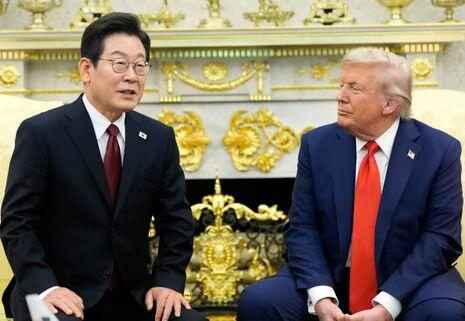
According to Trump, the drills are costly (with Washington footing most of the bill); the exercises send a ‘hostile and inappropriate’ signal toward a North Korea that has been “unthreatening and respectful” on his watch; and – revenge… Seoul refused to help with the war on Iran. Trump recounted asking President Lee Jae-myung whether South Korea would care to join the denuclearization of the Islamic Republic, and characterized Seoul’s answer as a breezy “No thanks!”

This sent Seoul scrambling, as Lee spent Tuesday’s cabinet meeting insisting the US alliance remains the bedrock of South Korean security, while his military worked out how to salvage an exercise that was already underway. Meanwhile, Pyongyang spent last week denouncing the drills as “a rehearsal for an aggressive war” – lobbing two ballistic missiles in the space of six days earlier this month. Chinese Foreign Minister Wang Yi arrived in Seoul mid-week for security talks, presumably trying to keep a straight face.
The Drawdown That Dare Not Speak Its Name
With US-SK relations having souring over the past couple of years over the punishment of US tech giants with arbitrary fines (extortion, basically), Trump’s decision follows long-telegraphed push to shrink US Forces Korea itself. The Wall Street Journal reported back in May 2025 that the Pentagon had drafted options to pull roughly 4,500 of the 28,500 US troops off the peninsula and reposition them in Guam and elsewhere in the Indo-Pacific. While the Pentagon denied it, lawmakers freaked out and wrote a 28,500-troop floor directly into the FY2026 NDAA.
This means that the Trump administration has had to get creative: the exercises are halved under the guise of “strategic flexibility,” while the admin is repurposing USFK (United States Forces Korea) for a China-Taiwan contingency rather than a purely North Korean one, and Seoul is now under pressure to pay quite a bit more for the privilege of hosting a force whose mission increasingly isn’t about Korea at all. Lee himself has conceded that Washington’s demand for flexibility is apparently one Seoul cannot easily accept.
This Didn’t Come Out Of Nowhere
Longtime readers know the US-SK alliance has been deteriorating for well over a year. As we detailed last October, South Korea’s Fair Trade Commission has spent a decade functioning less like an antitrust regulator and more like a toll booth for American tech: an $854 million hit on Qualcomm in 2016, $177 million on Google in 2021 over Android, serial actions against Apple’s App Store – all while domestic firms Naver and Kakao have been allowed to skate despite similar actions. One study put the combined ten-year economic damage of Seoul’s tech crackdown at roughly $1 trillion, including $525 billion to the US economy.
Washington noticed. In December, as we reported, the Office of the US Trade Representative (USTR) abruptly scrapped a scheduled KORUS Joint Committee meeting – the main forum for managing the free-trade relationship – after Seoul kept pushing digital regulations the administration considers discriminatory, despite having signed a framework weeks earlier promising not to. And in February, the House Judiciary Committee opened a formal investigation and subpoenaed Coupang – the NYSE-listed, American-owned “Amazon of Korea” – for documents on its treatment at the hands of Korean regulators.
Then Seoul stepped on the rake again after a former Coupang employee improperly accessed phonebook-grade customer data – names and addresses – with roughly 3,000 records actually downloaded, later recovered, never sold or misused, and with no documented consumer harm. Taiwan, whose customers were swept up in the same incident, handled it the way regulators normally do: a review, a compliance plan, move on.
Seoul decided to bust Coupang’s balls. Police raided the company repeatedly; a dozen agencies launched investigations and enforcement actions, most of them having nothing to do with data security; politicians publicly vilified Coupang’s American founder; and the firm’s acting CEO – a US citizen – was dragged through days of kangaroo court hearings in which, per the committee’s account, he was denied American counsel, accused of perjury over truthful testimony, and threatened with travel bans, criminal charges, and jail.
In June, Korea’s privacy regulator hit Coupang with a $409 million fine – the largest privacy penalty in the country’s history, and more than four times the next-biggest, which had been levied on a Korean firm that exposed far more sensitive data. On July 1 – the same month Seoul lit its landmarks red, white, and blue for America’s 250th birthday – House Judiciary published its report, “Closed for Competition,” documenting officials pressuring the national pension fund to dump Coupang stock, lawmakers threatening to drive the company out of the country, and the prime minister urging regulators to pursue it “with the same determination used to wipe out mafias.”
Deport The Regulators?
Which brings us to Capitol Hill’s latest innovation. In late July, Rep. Michael Baumgartner (R-WA) – who in April led 54 House colleagues in a letter demanding Seoul stand down – introduced the No Racketeers on Our Shores Act, which would amend the Immigration and Nationality Act to deny US entry to, or deport, foreign officials “who weaponize the government to discriminate against American companies.” The bill’s fact sheet cites the Coupang case by name. In short: keep shaking down American firms, and your regulators can enjoy the view from outside the United States.
Two weeks ago, Judiciary Republicans fired off yet another letter, this time over Seoul’s new “fake news” amendment – a KMCC-enforced regime that can fine publishers with over 100,000 subscribers, and large platforms, for spreading disfavored information. The platforms that clear those thresholds – Facebook, X, Instagram, YouTube – are, conveniently, almost all American.
Trump-Kim Bromance 2.0?

Amid the chill with South Korea, the WSJ reported Tuesday that Trump is pushing aides to arrange a meeting with Kim Jong Un as soon as this fall – potentially around the November APEC summit in Shenzhen. On Wednesday Trump confirmed it himself, telling reporters he’ll meet Kim this year, describing the N. Korean leader as “well behaved,” and casually confirming Pyongyang’s arsenal at 57 “very powerful” nuclear weapons. Kim’s sister Kim Yo Jong claims to be unaware of any recent correspondence, and no date has been set.
No half-measures…
Tyler Durden
Thu, 08/20/2026 – 16:40