74.8 F
Chicago
Thursday, August 20, 2026
Home Blog Page 3602

Default By Inflation Is The Real Drama In The Global Debt Market

Default By Inflation Is The Real Drama In The Global Debt Market

Authored by Brendan Brown via The Mises Institute,

The real drama of default in global markets has not been the federal debt ceiling negotiations in Washington but the write-off by inflation. The issue of whether it turns out that the US Treasury for a few weeks has been slow in servicing its debts—with all delays subsequently rectified—is a sideshow. We could regard this as camouflage for the ongoing real write-off operation. In this, countries led by the US, where a great inflation emerged during the pandemic and Ukraine war, have achieved big reductions in the real value of their debts.

The governments have also gained from a reduction in the total nominal market value of their fixed-rate debts due to the rise in interest rates. Those gains do not show up directly in national accounts. Rather, they are opportunity cost savings. Governments will not have to pay the prevailing higher level of interest rates on that part of their debts which are in fixed-rate form until far-off maturity dates. The savings for government show up in investor wealth statements and balance sheets in so far that they are based on present market values rather than fictitious historic cost. As long as the losses are on government bonds held by the central bank, there is no benefit to big government—it is all a wash in consolidated accounting across the public sector as a whole.

This real write-off by inflation occurred without any of the political wrangling feted by interminable commentary in the financial media. A dance of high inflation stakes has occurred, featuring the central bankers, politicians, and their cronies. The first and biggest dance was when the Fed stuck to its zero interest and quantitative easing policies through the first two years of the pandemic (2020–21), citing with great confidence its central scenario of transitory inflation. The Fed was silent or dismissive about alternative possible scenarios. Chief Jerome Powell told us with great aplomb that the Fed was not even thinking about when the discussion should begin on lifting interest rates from zero.

Incredibly, at least in hindsight, the Fed announced its new framework of “flexible inflation targeting” in August 2020, already well into the germination period for the great pandemic inflation. The idea was that higher inflation for sometime in the future was welcome to “make up” for the long years of inflation less than the 2 percent target during the 2010s. Big government, in all its branches and alongside powerful outside interests—including the private equity barons, who would benefit from a reduction in the real value of their debts in a shock outbreak of high inflation—happily tolerated the complacency.

The same choreography has played out in the high-inflation countries of Europe including the United Kingdom, Italy, France, and Spain. Yes, there was some resistance within the European Central Bank (ECB) from Germany and Holland, but mooting this was a general concern in its policy board to avoid a return of European debt crisis. Remember that as late as July 2021 the ECB rolled out its new monetary framework of quasi-flexible inflation targeting, a year later than the Fed, albeit in a greener and less explicit form. The message was that the ECB would be more tolerant of inflation overshoots than undershoots as it was harder to get inflation up than down!

Japan and Switzerland have been outliers in the dance of default by inflation. There has not been a real write-off in Japan or Switzerland on anything like the scale of the high-inflation countries. Over the four-year period of 2020–23, the estimated fall in purchasing power of the domestic money has been around 17 percent in the US, 20 percent in Italy, and 5 percent in Switzerland and Japan.

In Switzerland, a low public debt to gross domestic product ratio (around 40 percent) means that big government would not join an inflation dance with the central bank. In Japan, it’s quite the opposite. Japan’s crushingly high public sector means there is visible danger of the government and the National Diet joining the Bank of Japan in a dance. The musical theme would be high optimism about future inflation despite continuing very low interest rates. The collapse of the yen against the Swiss franc reflects the specter of eventual real default by inflation in Japan. The yen/Swiss franc exchange rate has soared from 112 on the eve of the pandemic to 153 now.

Japan’s real debt write-off is small so far. High consumer price index inflation did not emerge in the second half of 2021 and early 2022 because household and business spending in the US, eurozone, and United Kingdom remained remarkably cautious. But that restraint could be fading now during a powerful rise in the Tokyo stock market alongside a crescendo of foreign optimism (the so-called Buffett boom) and the super cheap yen. So, the future of inflation in Japan might well be very different from 2021–22.

The low inflation then, however, helps to explain the so far stubbornly bad time profile of Japan’s gross general government debt to gross domestic product—rising from 238 percent in 2019 to 259 in 2020 and to 261 in 2022, eventually falling this year according to the International Monetary Fund to 258 as consumer price index inflation rises (3.2 percent year-over-year in May and long-term interest rates at below 0.5 percent). By contrast, the same ratio in the US rose from 109 in 2019 to 134 in 2020, falling back to 122 this year despite a general government deficit running now at 5–6 percent of gross domestic product. In Italy, the same ratio was at 134 percent on the eve of the pandemic, rising to 155 in 2020, and falling to an estimated 140 percent this year.

Big government is duly celebrating, but there are others joining the inflation party even if sobered by coincidental losses. Consider the indebted corporations looking forward to a future of much higher interest rates and yet enjoy income streams which tend to rise in real terms. Private equity enterprises earning revenues from long-term contracts supplying public sector services (for example in healthcare or prisons) are one obvious example, but there are many others. They welcome a real debt write-down by inflation. In the same vein are the indebted homeowners who are incurring losses (small so far in the US in general but greater in some foreign hotspots) on real estate but who expect their salary incomes to rise with prices.

The bottom line: we should not underestimate the potency of the coalition dancing to the tune of optimistic central bank narratives. Therein lies the danger to economic and financial health, not at the short-lived tensions related to US debt-ceiling legislation.

Tyler Durden
Tue, 06/13/2023 – 18:05

Escobar: US Attempts ‘Divide & Conquer’ Strategy Against BRICS

Escobar: US Attempts ‘Divide & Conquer’ Strategy Against BRICS

Authored by Pepe Escobar,

Something extraordinary, at least on the surface, happened on the sidelines of the Shangri-La Dialogue in Singapore earlier this month – a somewhat pompous affair self-described as “Asia’s premier defense summit”.

Intel heads of 24 nations met in de facto semi-secrecy, because in the end the event was duly leaked (Western spin qualified it as an “informal” meeting).

Among the 24, the real deal comprised the US and all the other Five Eyes, plus representatives of two BRICS members, China and India. All the others were not identified with certainty or preferred to remain anonymous – presumably due to their “hanger on” status.

Crucially, key BRICS member Russia was not represented.

Reuters swore the information about the not-so-secret gathering came from five different – unnamed – sources.  A Southeast Asian diplomat independently confirmed the presence of the Five Eyes, China, India and Singapore – and that was it. The de facto sponsor of the meeting was Singapore’s Ministry of Defense.

Things gets curioser and curioser when we examine the leak a bit closer. So many sources basically corroborating each other point to a concerted spin – practically on an official level. If this was meant to be really secret, as in the past, that would have been the case, with every involved lip conveniently sealed. So why leak it?

Washington’s Divide and Conquer Strategy

Such spy vs. spy meetings, historically, take ages to prepare, especially one involving 24 nations and featuring superpower rivals US and China. That implies countless qualified sherpas redacting documents; very complicated logistics; an ultra-secure environment; and an extremely detailed script covering every intervention.

All of that must have been discussed in excruciating detail for months, side by side with putting together the larger agenda for the Shangri-La Dialogue: and all the while there were no leaks.

And then what was leaked, after the meeting, was just that it happened. With only selected participating players fully identified. There’s absolutely nothing on substance.

It beggars belief that the Five Eyes would openly discuss Western security fears and/or procedures openly with the Chinese, not to mention the other minor hangers-on. After all the Beijing leadership is fully aware the US-UK is engaged in full hybrid war against China, with the Five Eyes and containment mechanisms such as Quad and AUKUS in tow.

The main reason for the leak is a dead giveaway when we see what US Think Tankland is spinning: the US was talking security with China and India behind Russia’s back. Translation: the US is trying to undermine the BRICS and the Shanghai Cooperation Organization (SCO) from the inside.

This is purely wishful thinking – because no one knows anything about the substance of the discussions. The meat of the matter was not leaked on purpose.

The dead giveaway about the leak being engineered to undermine the BRICS – at least in the Western public sphere – would have to come from the usual suspects themselves: US think tanks, inserted in what the indispensable Ray McGovern, a former CIA analyst, christened as MICIMATT (Military-Industrial-Congressional-Intelligence-Media-Academia-Think Tank complex).

The chairman of the Eurasia Group laid it all out in detail: US foreign policy needs essentially to deploy the whole arsenal of Hybrid War techniques to seduce, coerce or subdue 6 so-called “swing states” in the geopolitical arena: Brazil, India, Indonesia, Saudi Arabia, South Africa and Turkiye.

It’s no accident three of these are BRICS members (Brazil, India, South Africa) and the other three (Indonesia, Saudi Arabia, Turkiye) are prime candidates to the inevitable expansion, BRICS+, already being discussed and about to get started during the upcoming BRICS summit in August in South Africa.

The American tactics remain predictable: classic Divide and Rule; attempts to undermine BRICS from the inside via P.R. operations and a vast 5th brigade; and if all goes wrong, attempts at color revolution and regime change.

Recently, the tactics miserably failed against both Turkiye and Saudi Arabia, and are also failing in terms of provoking mischief within the key RICs trio (Russia-India-China).

Growing Signs of US Desperation

The leak was, once again, shadow play: an extra layer of fog of war – and related to an ongoing war. It’s quite intriguing the “secret” gambit took place right before the green light from the usual suspects for Kiev to bomb the Kakhovskaya dam, and the de facto start of the spun-to-death Ukrainian “counter offensive.”

To have DNI head Avril Haines and her Beijing counterpart Chen Wixin discussing this on the same table is as far-fetched as it comes.

A more realistic scenario would have China and India on the same table discussing their intractable border issues. But they don’t need to go to Singapore to do that; they do it in the framework of the SCO, of which both are members, with Russia playing a mediator role.

US Think Tankland/MICIMATT spinning, predictably masquerading as political analysis, never reaches beyond the level of guesswork: they assume that China was discussing security with the superpower that really matters – the US – while ditching their comprehensive strategic partnership with Russia.

Nonsense strikes again: top security issues concerning both are discussed at the highest level, for instance during the recent visit to Moscow by China’s Minister of Defense Li Shangfu, complete with a personal encounter with Putin.

Even without any input on the substance of the meeting, it’s fair to consider all about the leak that points to Ukraine.

The American intel narrative would go something like this: we need an exit strategy, badly, immediately. So let’s get Chinese intel to convince the Russians to freeze the battlefield as it stands – a ceasefire of sorts. Then we can re-weaponize Kiev and have another go at it later on.

Anyone following Russia-China high-level interaction these past few months knows this is – once again – nonsense. Beijing may have its 12-point plan for peace – which Moscow respects. But facts on the ground, imposed by US/NATO hubris, have engineered a major game-changer.

And then there’s the really fundamental question: when and how Russia will decide to cross the Dnepr. Only after that Moscow will be willing to discuss any possible “peace”, and only under its own terms.

At the same time, both Moscow and Beijing are fully aware that the proxy US/NATO war in Ukraine against Russia is a rehearsal inbuilt in the ongoing Chronicle of a War Announced: the real one, up next, against China, with Taiwan as pretext.

To believe that Chinese intel would willingly bend to the whims of the Five Eyes because they feel China is in a precarious geopolitical position does not even qualify as laughable. And yet that’s also inbuilt in US Think Thankland spin.

It’s as laughable as the Beltway narrative, imposed 24/7, of “China threatening war over Taiwan” when it’s the Hegemon that is using Taiwan as a remixed Ukraine, forcing Beijing to lose its Taoist patience.

So in the end what really stands out in this spy vs. spy saga? Not much. Except yet another whiff of Hegemon desperation.

Tyler Durden
Tue, 06/13/2023 – 16:20

Dollar Dives As Yellen Questions Reserve Currency; Bonds & Bullion Battered After Mixed CPI

Dollar Dives As Yellen Questions Reserve Currency; Bonds & Bullion Battered After Mixed CPI

Something for every narrative in this morning’s CPI:

  • Headline CPI tumbled (yay, Fed is done forever!);

  • Goods inflation rebounding (Fed can pause as Services prices slow);

  • Core CPI warmer than expected and still sticky high (Fed can’t stop, but maybe a skip!);

  • SuperCore accelerating (Fed should keep hiking!).

Choose your own adventure. The STIRs market chose to kneejerk dovish, but as reality set in rate-hike expectations for September rose (June and July were lower but the latter still high). Moreover, the market has now fully priced out any rate-cuts this year (Dec now pricing in rate 6bps higher than current)…

Source: Bloomberg

The initial reaction in stocks was ‘Buy Mortimer, Buy!”, but as the cash equity market opened we saw the rotation from mega-cap tech to small-caps reassert itself…

By the close, Small Caps were the winner, up over 1%, while The Dow lagged and S&P and Nasdaq were just a smidge better – all the majors were green on the day…

AI stocks soared, but we note that comments by AMD’s CEO that her new chips could mean ‘fewer GPUs’ are required for AI seemed to spook the entire sector…

Meme stocks soared…

Source: Bloomberg

TSLA rallied again today – the 13th straight day higher (a new record win streak) and up 41% in that time…

Notably, ORCL – which hit a fresh all-time record high at the open – spent the rest of the day being sold and ended red, despite strong earnings last night…

Treasuries were clubbed like a baby seal after an initial kneejerk lower on headline CPI.

Source: Bloomberg

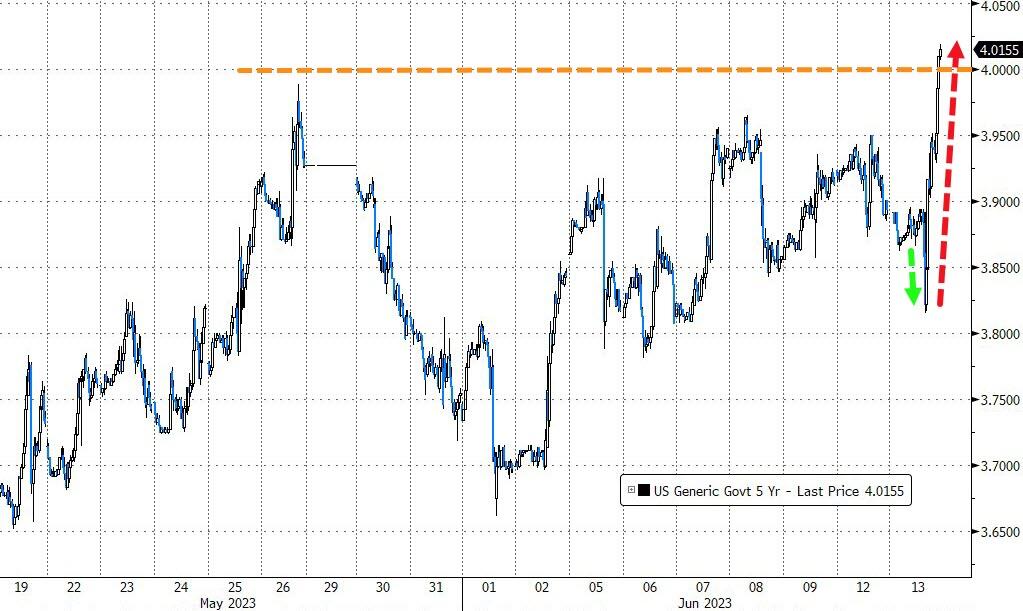
2Y yields at highest since March and 5Y yields topped 4.00% for the first time since March 10th

Source: Bloomberg

The yield curve (2s30s) kneejerked steeper on CPI then crumbled flatter all day to end at its most inverted of the day…

Source: Bloomberg

The dollar ended lower again – but well off its CPI-spike-lows – back at almost one-month lows

Source: Bloomberg

…as Treasury Secretary Yellen said she “expects a slow decline in the dollar as reserve currency.”

Bitcoin spiked up to the pre-weekend-purge levels before fading back and ending the day unchanged…

Source: Bloomberg

Gold spiked modestly on the headline CPI and was then monkeyhammered back to the lows of its recent range…

Oil prices ended higher, rebounding off yesterday’s lows/resistance…

Finally, just as we saw in the middle of the supply-chain chaos during COVID, firms are pre-buying, bringing forward demand dramatically – and stocks just want to extrapolate the trend…

Which leaves us “here”…

Source: Bloomberg

Can’t be the same, right?

And what to expect tomorrow?

Tyler Durden
Tue, 06/13/2023 – 16:00

The Collapse Just Won’t Stop: 10 Weeks Later, Tranheuser Busch Sales Still Cratering, Down 27%

The Collapse Just Won’t Stop: 10 Weeks Later, Tranheuser Busch Sales Still Cratering, Down 27%

The historic, unprecedented self-sabotage at Tranheuser-Busch at the hands of woke, underqualified, virtue-signaling idiot, just refuses stop.

Ten weeks after the attention-starved Dylan Mulvaney posted an April 1 video on his Instagram account to promote Bud LIght, which was promptly led to a boycott by tens of millions of warm-blooded Americans (and foreigners) who have had it up to here with the tranny lobby shoving itself down everyone’s throat – both literally and metaphorically – (Tr)anheuser-Busch InBev’s Bud Light brand continued to see steepening volume declines, Citi reports, citing the latest weekly US Nielsen data through June 3.

According to Citi Analyst Simon Hales, the latest weekly US Nielsen data through to 3rd Jun shows that Bud Light volume declines accelerated last week to -29.9% vs -26.1% in the week ending 27th May, and sales worsened to -27.0% from -23.3%.

On a relative share basis, volume share was down -342bps vs -316bps in the previous week and value share was down -280bps vs -263bps implying an acceleration in share losses vs recent weeks.

Moreover, there continues to be contagion to the wider ABInBev brand portfolio, with Budweiser, Busch and Michelob all weaker again. According to Citi, Busch volumes are down by -13.8% vs -12.2% and Stella Artois volumes down -9.9% vs -10.1%

Meanwhile, Coors Light saw its recent market share gains accelerate over the last two weeks.

The latest data shows little sign that consumers are moving on from the Bud Light controversy and Citi concludes that “aAs such, we expect the Bud Light controversy is likely to continue to dominate news flow and weigh on short-term investor sentiment.”

More in the full Cit report available to pro subs.

Tyler Durden
Tue, 06/13/2023 – 15:45

Silver Is Significantly Underpriced Given The Looming Supply Shortage

Silver Is Significantly Underpriced Given The Looming Supply Shortage

Authored by Michael Maharrey via SchiffGold.com,

Given the current macroeconomic environment and the supply and demand dynamics, silver is significantly undervalued at $24 to $25 an ounce.

The bullish case for silver in the mainstream typically revolves around price inflation. There are certainly reasons to think inflation is stickier than the powers that be want to admit and that the Federal Reserve isn’t going to be able to win the inflation fight. That is bullish for both silver and gold.

But I don’t hear a lot of people in the mainstream talking about the looming supply shortage in the silver market.

In fact, the growing demand for silver in the solar power industry will likely put a significant squeeze on supply in the coming years, and the current price of silver does not reflect the likely shortages.

While the mainstream hasn’t talked much about this, people in the industry are aware of what’s going on. In an article published by Seeking Alpha, Silver Bullion Pte Ltd. CEO Gregor Gregersen mentioned that he “was intrigued by unofficial chatter about upcoming silver scarcities due to rapidly growing photovoltaic demands” during the Asia Pacific Precious Metals Conference.

We’re already seeing a squeeze on the supply of silver. While silver demand set records in every category in 2022, supply was flat with mine output falling by 0.6%. This resulted in a 237.7 million ounce market deficit in 2022.

It was the second consecutive annual deficit in a row. The Silver Institute called it “possibly the most significant deficit on record.” It also noted that “the combined shortfalls of the previous two years comfortably offset the cumulative surpluses of the last 11 years.”

This trend is not expected to reverse. As Gregersen noted, silver mine production has fallen due to a lack of investment.

Production cannot be materially increased over the short term as it can take over 10 years to commence new mining operations. Therefore, increased silver prices will not lead to increased mine production for a long time.”

Meanwhile, the demand for solar power is rising rapidly and that is going to drive the demand for silver significantly higher.

The International Energy Association (IEA) predicts that in 2023, investment in the solar power industry will exceed the amount of money flowing into oil production.

Due to its outstanding electrical conductivity, silver is an important element in the production of solar panels. It is used to conduct electrical charges out of the solar cell and into the system. Each solar panel only uses a small amount of silver, but with the demand for solar panels growing exponentially every year, those small amounts of silver add up.

According to a research paper by scientists at the University of New South Wales, solar manufacturers will likely require over 20% of the current annual silver supply by 2027. And by 2050, solar panel production will use approximately 85–98% of the current global silver reserves.

A few years ago, analysts projected that the amount of silver used in solar panels would fall. After all, silver is expensive and there is a strong incentive to find alternatives. In fact, the amount of silver used in the production of solar panels has been reduced by about 80%. But that trend is expected to reverse. The Australian paper noted that more efficient ‘N-type’ technologies now being developed require even more silver than current ‘PERC’ cells that make up more than 80%of the current market. TOPCon and SHJ panels require 30 to 80% more silver than the older technology.

Some argue demand for silver in solar energy production will eventually flatten as the industry develops cheaper alternatives to the white metal. But according to the paper, even if the industry reduces the use of silver, demand will still increase.

The results show that the current rate of reduction in silver consumption is not sufficient to avoid increasing silver demand from the PV industry and that the transition to high-efficiency technologies including TOPCon (a more advanced N-type silicon cell technology, first scaled in 2019) and SHJ (Silicon heterojunction solar cells, which are very efficient) could greatly increase silver demand, posing price and supply risks.”

Recession worries would typically dampen industrial demand for silver, but the photovoltaic industry is essentially recession-proof due to support from governments around the world. With battling climate change a priority, it is highly unlikely investment in solar power and other green energy technologies will fall, even in the midst of an economic downturn.

All of this signals a rapid increase in silver demand in an environment of constrained supply.

Economics 101 tells you that higher demand without a corresponding increase in supply will lead to increasing prices.

Silver isn’t currently priced for this dynamic.

In fact, silver is significantly undervalued compared to gold.

The current silver-gold ratio is just over 81-1. That means it takes over 81 ounces of silver to buy an ounce of gold. To put that into perspective, the average in the modern era has been between 40:1 and 50:1. Historically, the ratio has always returned to that mean. And when it does, it does it with a vengeance. The ratio fell to 30-1 in 2011 and below 20-1 in 1979.

Historically, when the spread gets this wide, silver doesn’t just outperform gold, it goes on a massive run in a short period of time. Since January 2000, this has happened four times. As this chart shows, the snapback is swift and strong.

Gregersen wrote that it is only a matter of time before the mainstream picks up on the dynamics in the silver market.

In conclusion, the photovoltaic industry’s impending impact on silver pricing cannot be overlooked. As the silver shortages loom on the horizon, it is only a matter of time before mainstream media reports on these significant developments. Once the news spreads, we can anticipate substantial price surges in the silver market.”

Now is the time to buy while silver is effectively on sale.

Tyler Durden
Tue, 06/13/2023 – 15:25

Home Depot CEO Warns ‘Organized’ Theft Tsunami Is “A Big Problem”

Home Depot CEO Warns ‘Organized’ Theft Tsunami Is “A Big Problem”

Like many other retailers, Home Depot has been forced to lock high-value items behind cages to counter rampant theft as Democrat officials in major cities fail to enforce law and order, which has only emboldened criminals. 

Home Depot CEO Ted Decker spoke with CNBC’s Becky Quick about retail theft and other inventory loss — known as “shrink” — ravaging the home improvement stores nationwide. 

Quick pointed out Home Depot was very early in warning about America’s retail theft crime wave several years ago. She asked Decker what items were currently being locked up at stores. 

Decker responded, “It’s (shrink) is a big problem for retail. And it goes across retail,” adding, “This isn’t the random shoplifter anymore.”

The CEO is likely referring to criminal organized gangs stealing merchandise and reselling on online marketplaces. 

Many of these thefts occur in Democrat-controlled metro areas where progressive city leaderships have relaxed theft rules, which has only backfired and sparked a shoplifting epidemic. 

He said Home Depot is working with state and local officials nationwide to inform officials about the theft wave. And he championed a new law requiring those selling items on online consumer marketplaces to be vetted, a move that might prevent stolen items from being resold. 

Decker continued, “We hate doing it … but have had to lock up a lot of high-value items … and they’re not all big like power tools and generators … some are as small as circuit breakers.” 

Quick asks the CEO if there’s going to be a point if stores will have to close because of out-of-control theft. Decker said,

“A certain number of retailers had to shut down stores in a number of tough cities, but we’re fortunate we have not.” He added,

“We are increasingly concerned about the life safety of our associates and our customer base.” 

Quick noted that two Home Depot employees were recently killed over trying to stop thieves. She asked the CEO, “How big of a problem is it (shrink)? — can you quantify it?” 

Decker said, “We know what our number is, and we don’t talk about it, but it has been pressure on our gross margin.”

Shrink is a $100 billion problem for US retailers. It’s becoming such a problem that execs that mentioned “shrink” on recent earnings calls surged to the highest level ever in data compiled by Bloomberg from 2013. 

Weeks ago, David Johnston, vice president of asset protection and retail operations for the National Retail Federation, told FOX Business that retailers are expected to lose $100 billion this year due to theft. 

“Based on what we’re hearing already from many of these CEOs and based on what we’re experiencing daily in retailers across the nation… I do foresee us to have a much higher loss in 2023,” Johnston said. 

As a result, retailers are shutting down stores in certain Democrat-controlled cities (read: here & here) as these areas are being transformed into crime-ridden hellholes due to failed policies. 

Tyler Durden
Tue, 06/13/2023 – 15:05

Sliding Oil, Sticky Inflation Spell Danger For Exuberant Stocks

Sliding Oil, Sticky Inflation Spell Danger For Exuberant Stocks

By Garfield Reynolds, Bloomberg Markets Live reporter and strategist

US equities’ rally to the highest in more than a year has been at least partly driven by sustained expectations that moderating inflation will soon bring the Federal Reserve’s tightening cycle to an end. That ignores the potential that slowing inflation signals a significantly weaker economic outlook than what’s being priced in.

The rally seemingly shows no fear that Tuesday’s US CPI readings could come in hot enough to provoke a fresh hawkish tack from the Fed. But in many ways, the concern should be more about the medium term. The Cleveland Fed’s nowcast for PCE core inflation — the gauge itself being the indicator that policymakers focus on — has actually climbed since February when it hit the lowest since 2021. And that’s come even as crude oil declined despite OPEC+ output cuts.

That makes for a toxic mix for growth. Inflation readings that are strong enough to keep the Fed biased toward further hikes at a time when weakening oil demand underscores the downside risks for the global economy.

The concern remains that the rally in risk assets fails to account for the potential that a drop in inflation sufficient to convince the Fed to stop hiking can only come with a sustained slump for the economy.

* * *

Even though Tuesday’s CPI release showed a significant drop – as widely expected – it still leaves inflation much higher than the Fed’s goals (at least until the Fed raises its inflation target). As Reynolds concludes, “stock investors may ultimately regret getting what they are wishing for.”

Tyler Durden
Tue, 06/13/2023 – 13:45

Trump Makes Way To Courthouse For Arraignment In Classified Docs Case

Trump Makes Way To Courthouse For Arraignment In Classified Docs Case

Update (1340ET): Trump has departed his golf club in Doral an is currently making his way to the federal courthouse in Miami.

*  *  *

Former President Donald Trump is expected to be arraigned this afternoon at the federal courthouse in Miami, where he’s indicated that he will plead not guilty to 37 counts in connection with claims that he mishandled classified documents.

The indictment alleges that the former president made false statements, willfully retained national defense information and conspired to obstruct justice – offenses which carry a maximum of 400 years in prison if convicted on all charges.

Presiding over Trump’s arraignment will be US Magistrate Judge John Goodman, however the case itself will be overseen by US District Judge Aileen Cannon, a Trump appointee.

Meanwhile in a Monday night court order, a federal judge ruled that the media won’t be allowed to have any electronic devices in the courthouse during today’s proceedings.

Trump is expected to travel back to his Bedminster, New Jersey golf club afterwards, where he’ll deliver remarks this evening.

Black Trump supporters rally

Outside the Miami Courthouse, a group of around two dozen “Blacks for Trump” supporters have gathered to rail against the indictment, NBC News reports.

One member, Maurice Symonette, who calls himself “Michael the Black Man,” slammed the indictment “fake” and “filled with fluff.” Symonette is a staple at Trump rallies and is a former member of the Nation of Yahweh, a Black separatist cult, and one of 16 members charged with murder and attempted murder more than two decades ago.

This is the largest demonstration so far, where for more than an hour a lone supporter dressed in royal regalia waved a Trump-DeSantis sign. -NBC News

On Monday, Miami Police Chief Manny Morales said that the city is bracing for potentially thousands of protesters at the courthouse, and has been coordinating with state and federal partners “to ensure that we maintain not only peace and order,” but also to allow demonstrators “to express themselves and their First Amendment rights.”

Tyler Durden
Tue, 06/13/2023 – 13:34

House Oversight Panel Subpoenas Former Hunter Biden Associate Devon Archer

House Oversight Panel Subpoenas Former Hunter Biden Associate Devon Archer

Authored by Caden Pearsen via The Epoch Times,

The House Oversight Committee has issued a subpoena to Devon Archer, the former long-time business partner of Hunter Biden, as part of its ongoing investigation into the business dealings of the Biden family.

The committee, led by Chairman James Comer, is particularly interested in Archer’s involvement in the family’s international business deals, which included countries like China, Russia, and Ukraine.

The subpoena compels Archer to testify at a deposition before the panel on June 16, focusing on attempts by foreign nationals to influence high-ranking U.S. officials’ family members through financial incentives.

In a letter to Archer’s attorney, Comer emphasized the importance of Archer’s role, highlighting his multiple meetings with then-Vice President Biden, including at the White House.

“Both information that the Committee has reviewed and public reporting indicates that Mr. Archer played a significant role in the Biden family’s business deals abroad, including but not limited to China, Russia, and Ukraine,” Comer wrote (pdf).

“Additionally, while undertaking these ventures with the Biden family, [Mr. Archer] met with then-Vice President Biden on multiple occasions, including in the White House. Mr. Archer’s testimony is critical to the Committee’s investigation.”

The committee’s investigation aims to obtain communications and documents that could shed light on potential financial crimes or misconduct involving the Biden family’s foreign business dealings.

In his letter, Comer accused the Biden family of receiving significant amounts of money from foreign companies without providing clear legitimate services.

“Mr. Archer is associated with corporate entities that the Committee has identified and the Biden family’s role in each of them,” Comer wrote.

“Furthermore, he has significant information regarding the purpose of these companies and knowledge of relevant documents related to the Committee’s investigation.”

The committee seeks to reform government ethics and disclosure laws to ensure transparency into the income, assets, and financial relationships of immediate family members of vice presidents and presidents, Comer said.

Additionally, the committee plans to strengthen reporting requirements for foreign transactions involving senior elected officials’ family members and increase transparency on ownership of opaque corporate entities.

There is also consideration to extend reporting obligations beyond a president or vice president’s term to prevent financial transactions from evading oversight.

150 Transactions Flagged

Last year, Comer revealed that over 150 transactions from the Biden family’s business dealings were identified by U.S. banks through Suspicious Activity Reports (SARs) filed with the Financial Crimes Enforcement Network.

These reports are filed to comply with the law, which mandates banks to flag cash transactions over $10,000 per day and report them to prevent criminal activities like money laundering and tax evasion.

Archer and Hunter Biden were both board members of Burisma, a Ukrainian energy company. According to emails found on Hunter Biden’s abandoned laptop, there were indications that Hunter attempted to facilitate a deal involving Archer on behalf of Burisma. The deal involved Kazakhstan and a Chinese company that the Pentagon considers a national security risk.

Recently, Archer faced an unsuccessful appeal in a separate case involving fraud. He was convicted and sentenced to one year and one day in prison for his involvement in a scheme to defraud the Wakpamni Lake Community Corporation of the Oglala Sioux Tribe, resulting in the loss of tens of millions of dollars.

While Hunter Biden was not charged in the defrauding operation, his lawyers have stated that his name was used without his knowledge in those schemes. However, emails indicate Hunter Biden’s involvement with Archer’s company.

The House Oversight Committee has been investigating “the Biden family’s influence peddling schemes.” Recently, the FBI conceded to the panel’s authority and provided committee members access to an unclassified FBI document.

The unclassified document is believed to contain allegations from a trusted FBI informant that then-Vice President Biden was involved in a $5 million bribery scheme with a foreign national, with certain actions expected in return.

Republican members of the panel who have reviewed the document have deemed it credible. However, Ranking Member Rep. Jamie Raskin (D-Md.) has downplayed its significance.

Tyler Durden
Tue, 06/13/2023 – 13:25

Blowout Demand For 30Y Treasuries At Stop-Through Auction Sends Dealer Award To Record Low

Blowout Demand For 30Y Treasuries At Stop-Through Auction Sends Dealer Award To Record Low

After a solid 3Y and a mediocre 10Y auction, moments ago the Treasury completed the week’s accelerated sale of coupon paper when it auctioned off $18 billion in 30Y paper (in the form of a 20Y-11M reopening). The auction, one day ahead of the Fed’s “pause” announcement, was solid with impressive metrics.

The high yield of 3.908% was above last month’s 3.741% and was the highest going back to November’s 4.080%. However, it also stopped through the 3.919% When Issued by 1.1bps, the 3rd consecutive non-tailing auction.

The bid to cover of 2.522 indicated stellar buyside demand, printing above last month’s 2.426 and in fact, was the highest going all the way back to Jan 2020.

The Internals were also stellar, with Indiracts awarded 72.9%, the highest since January, and with Directs awarded 18.1%, meant that Dealers were left with a record low award of just 8.96%.

Overall, this was a stellar auction, perhaps one of the best 30Y sales on record…

… and signals that as far as the bond market is concerned, the Fed’s tightening cycle is largely over.

Tyler Durden
Tue, 06/13/2023 – 13:19