75.7 F
Chicago
Monday, August 17, 2026
Home Blog Page 3651

Pressure’s Up A Notch

Pressure’s Up A Notch

By Maartje Wijffelaars, Senior Macro Strategist of Rabobank

Yesterday we learned that the US economy has been performing better than thought, ironically partly because of a detected fraud. Indeed, while initial jobless claims did rise by 4k in the week to 20 May, they have in fact come in 13k(!) lower than in the week before – and 16k lower than expected. This twisted math has been made possible by the detection of a major fraud in jobless claims in the state of Massachusetts, where claims have been revised down by 50,000 in the two weeks up until 13 May. Furthermore, US GDP growth for the first quarter was revised up from 1.1% to 1.3% QoQ on an annualized basis. Personal consumption growth was strong at 3.8%, the strongest figure in almost two years.

However, it didn’t keep DBRS from following Fitch’s move on Wednesday, putting the rating for the US under review with negative implications. While it still expects debt ceiling talks to be concluded in time, the risk that they won’t cannot be neglected. DBRS made clear that a downgrade to “selective default” would happen immediately once Treasury misses a payment related to its debt obligations. Interestingly, other missed payments over a “meaningful period of time” or a high risk of frequent debt ceiling standoffs in the future – even if this one is solved in time – could also lead to a downgrade. Later during the day, Moody’s commented that it keeps an eye on the USD 2 billion interest payments due on 15 June. If the Treasury would not be able to make the payment, Moody’s will downgrade its US rating by one notch from AAA to AA1.

Reuters last night reported that Biden and McCarthy are close to reaching a deal that would raise the debt ceiling for two years. The deal would include spending caps on almost everything apart from defense. How exactly ‘close’ is defined is unknown – earlier in the evening it was reported that Republicans still required more spending cuts worth USD 70 billion – and a temporary suspension of the debt limit might still be necessary. At the same time, as the X-date is approaching fast (1 June according to Janet Yellen), the risk of an accident is also growing. In a note last week, our US strategist Philip Marey stated that a suspension of the debt limit is likely, but he also underscored that the risk is substantial that the X-date will pass without an agreement on anything, and hence that some payments would be missed. According to the Wall Street Journal, the administration is preparing a contingency plan, but supposedly it does not yet mention any prioritization of payments. It rather discusses how to deal with a breach administratively.

In our view, it seems likely, however, that in a scenario of too little cash, the administration would try to favor bond holders, to prevent an official default and the subsequent expected significant financial market repercussions. To be clear, market reaction is likely to grow as time progresses and the ongoing uncertainty is certainly not going to benefit the economy – which we already project to enter a recession in the second half of the year, but we are not seeing the pressure that we would expect in the event of default. While certain money market rates have increased, longer-term yields barely seem to respond and the S&P500 yesterday even recovered some ground that had been lost since the start of the week.

The impact of economic overperformance so far seems to be stronger than that of the risk linked to breaching the debt ceiling. Meanwhile, even though some Fed officials suggested the central bank should step in in case of turmoil resulting from a breach of the debt ceiling, the looming accident doesn’t seem to give way for a pivot. There clearly is disagreement over whether they should pause or go ahead hiking, however. Indeed, multiple speeches and Wednesday’s FOMC comments showed a clear divergence in opinions. We still expect the Fed to take a pause from June. But if the credit tightening anticipated by the Committee fails to materialize, more hikes beyond that meeting might be required to get the inflationary pressure under control.

Speeches, the minutes, good economic data – with especially services holding strong throughout Q2 according to the PMI – and upwardly revised inflation for Q1, have also led to the market pushing backwards its expectations of a Fed pivot to the end of this / early next year. In fact, a July rate hike is now almost fully priced in, supporting the dollar. We project the dollar to gain some more ground in the coming months.

This despite the fact that we, like the market, expect more rate hikes by the BOE – especially after the strong inflation figures this week – and the ECB. Indeed, yesterday’s weak German GDP figures are unlikely to deter the ECB with headline inflation at 7% and core inflation at 5.6% in April and wage pressures still building. This was underscored by speeches from different ECB members yesterday, including de Guindos, Villeroy, Nagel and Knot, all of whom in different wording confirmed our thinking that the ECB will continue to hike in the coming months. Opinions do seem to differ in terms of how long the ECB will need to continue hiking, however, before taking a pause to monitor the impact of past hikes.

We continue to project two more ECB hikes, one in June and one in July. But we also believe that rates are likely to stay high longer than the market is currently projecting, with upward and downward risks to that hiking profile more or less balanced. PMI surveys this week underscored that while price pressures in the manufacturing sector are receding, they are still strong in the services sector. Next week we will get the first estimates of inflation in May. We believe the figures will show that inflation has softened, but that core inflation proves to be sticky. Further ahead, food and core inflation will slow gradually, while especially the energy component will act as a drag on headline inflation. Base effects and the major ongoing decline in wholesale gas prices will lead to large drops in YoY price developments.

Dutch TTF one-month ahead currently sits at EUR 25.15 per MWh, a two-year low, as a result of a variety of factors. A warm winter has led to fill levels far above normal levels at this time of the year, Chinese spot demand has not returned as expected after its reopening, and also industrial demand in Europe remains weak despite the major fall in prices. Remember, last year many factories have been mothballed due to the high gas price, but while certain production has returned, weak demand currently seems to prevent a further uptick. Due to the rather weak economic outlook at home and across the globe, industrial demand is likely to remain below average for the remainder of the year.

Given recent developments, we might temporarily see negative wholesale prices over summer, although at the same time, heavy droughts in the south of Europe might also lead to above average summer gas demand, due to weak hydro and nuclear power, like last year. In any case, after summer, gas prices are still likely to pick up again from current levels. While Chinese demand remains a gamble, heating demand in autumn and winter will require more LNG imports over those months, supporting prices. Still, barring any major event, it seems very unlikely we will return to the heady prices seen in Q3 2022.

Tyler Durden
Fri, 05/26/2023 – 10:15

UMich Inflation Expectations Remain At 12 Year Highs

UMich Inflation Expectations Remain At 12 Year Highs

The most important segment of the UMich sentiment survey continues to be inflation expectations, and after the preliminary data showed medium-term expectations rising significantly, the final print for May was expected to drop modestly from 3.2% to 3.1% (while the rebound in short-term inflation expectations was expected to hold). Both inflation expectations dropped from the flash print, from 4.5% to 4.2% for 1Y and from 3.2% to 3.1% for 5-10Y. However, 5-10Y inflation expectations remain at their highs of the last 12 years…

Source: Bloomberg

The headline sentiment print was better than expected but still lower from April

Source: Bloomberg

Consumer sentiment slid 7% amid worries about the path of the economy, erasing nearly half of the gains achieved after the all-time historic low from last June. This decline mirrors the 2011 debt ceiling crisis, during which sentiment also plunged. This month, sentiment fell severely for consumers in the West and those with middle incomes.

Buying Conditions all dropped in May…

Source: Bloomberg

Interestingly, Republicans’ sentiment slipped most while Democrats’ confidence barely dipped…

Source: Bloomberg

UMich warns that the year-ahead economic outlook plummeted 17% from last month. Long-run expectations plunged by 13% as well, indicating that consumers are concerned that any recession to come may cause lasting pain.

Tyler Durden
Fri, 05/26/2023 – 10:07

Did Governor Newsom Spark Target Boycott Among Liberals?

Did Governor Newsom Spark Target Boycott Among Liberals?

Target executives, embracing “woke” capitalism, were completely oblivious, or maybe just ignorant, to the “Bud Light moment.” After Bud Light pulled the plug on advertisements with transgender influencer Dylan Mulvaney because of damaging boycotts by conservative beer drinkers, the trans community launched a boycott of their own because the brewer abandoned Mulvaney. A similar situation is unfolding with Target as Democrats are furious with the retailer’s move to remove LGBTQ products from storefronts. 

California Gov. Gavin Newsom, a diehard progressive, tweeted this week, “CEO of Target Brian Cornell selling out the LGBTQ+ community to extremists is a real profile in courage.” 

Newsom appears furious with Cornell’s directive to a number of US stores to remove LGBT-themed products ahead of June Pride month. A Target insider told Fox News swimsuits for transgender people to gender-fluid coffee mugs, as well as many other LGBTQ+ products were either removed from the storefront or shifted to the back of stores to mitigate consumer boycotts. 

“This isn’t just a couple of stores in the South. There is a systematic attack on the gay community happening across the country,” the governor said. 

With a Twitter account of over 2 million, Newsom might have kicked off a boycott by Democrats. 

This is precisely what happened to Bud Light when the brewer ditched Mulvaney, angering the LGBTQ+ community and triggering boycotts on both sides of the political aisle. 

When will these corporate elites ever learn that diving into gender identity politics is a dangerous game?  

Tyler Durden
Fri, 05/26/2023 – 09:50

Fed’s Favorite Inflation Indicator Re-Accelerated In April

Fed’s Favorite Inflation Indicator Re-Accelerated In April

One of The Fed’s favorite inflation indicators – Core PCE Deflator – disappointed the doves, printing hotter than expected (headline and core both +0.4% MoM vs +0.3% MoM exp), pushing the YoY inflation signals higher…

Source: Bloomberg

Even more focused, is the Fed’s view on Services inflation ex-Shelter, and the PCE-equivalent shows that is very much stuck at high levels…

Source: Bloomberg

However, while acyclical core inflation continued to slide, cyclical core inflation dipped very modestly but remains extremely high. Cyclical core PCE inflation, which tracks inflationary pressures that are linked to the current economic cycle, is at the highest on record going back to 1985.

Source: Bloomberg

Personal Income and Spending were both expected to rise significantly on MoM basis and did but spending soared 0.8% MoM

Source: Bloomberg

Spending and Income on a YoY basis both rose in April…

Source: Bloomberg

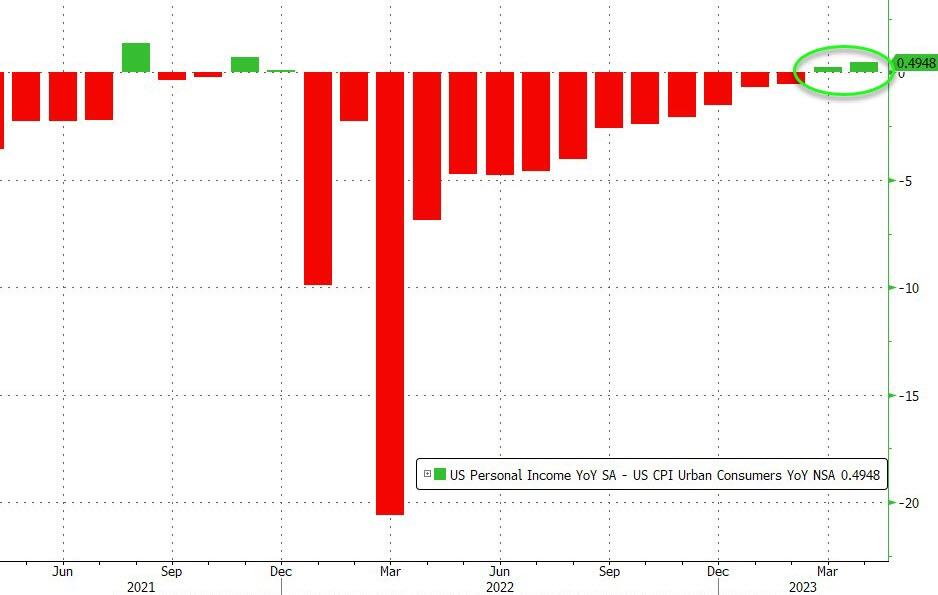
‘Real’ income – admittedly rough estimate, adjusted by CPI – rose marginally in April…

Source: Bloomberg

Breaking down the income side:

  • April Private wages up 5.6%, up from 5.3% in March

  • April Government wages up 5.3%, up from 5.1% in March

On an inflation-adjusted basis, spending (real) rose 0.5% MoM…

Source: Bloomberg

As a result of all that, and a number of revisions…

…the savings rate in April dipped to 4.1% from 4.5% as credit card use hits new record highs…

Source: Bloomberg

This is absolutely NOT what Powell and his pals wanted to see.

Tyler Durden
Fri, 05/26/2023 – 09:41

Fade The Rally, The Dollar’s Destiny Is Lower

Fade The Rally, The Dollar’s Destiny Is Lower

Authored by Simon White, Bloomberg macro strategist,

Debt-ceiling worries are driving the dollar up for now, but real yields, the fiscal deficit and structural overvaluation favor the medium-term downtrend remaining intact.

All of the recent move higher in nominal yields (discussed here) has been driven by real yields. Inflation, erroneously, is seen as yesterday’s problem, with breakevens remaining near the lower end of their two-year range.

Higher real yields might be expected to be good for the dollar. The currency has indeed risen in recent weeks, but this is more to do with safe-haven demand in the event the debt ceiling becomes binding.

In fact, using real yields on their own to gauge the performance of the dollar risks oversimplification. Higher real yields aren’t an automatic boost for the currency.

To understand why, we must look at the real yield curve.

This gives us a proxy for the real return an FX-hedged overseas investor would get for buying longer-term US debt. Dollar returns at the margin are driven by this, as can be seen in the robust leading relationship in the chart below.

The chart also shows that it is short-term real yields that have been rising more than longer-term real yields, flattening the real-yield curve, a process that started last summer ahead of the dollar’s peak in October. The flattening trend is intact, strongly suggesting the dollar will continue its decline once the debt ceiling is out of the way.

This cyclical outlook accords with two important structural factors that are dollar negative.

The first the US’s yawning fiscal deficit. At ~7% of GDP it is among the largest of major countries, and is historically wide – even before the US has entered a recession.

Furthermore, the US currency remains one of the most overvalued. The dollar’s real-effective exchange rate continues to look expensive on a long-term basis, even after the last eight-months’ sell-off.

Tellingly, the dollar’s weakness is not eliciting the typical demand for trade, cross-border credit and FX reserves it would normally, strongly suggesting its dominance has peaked.

Tyler Durden
Fri, 05/26/2023 – 07:20

These Are All The Countries That Use F-16 Fighter Jets

These Are All The Countries That Use F-16 Fighter Jets

During the G7 summit held from 19 to 21 May in Japan, US President Joe Biden gave permission for other countries to deliver F-16 fighter jets – manufactured by the U.S. company Lockheed Martin- to Ukraine.

As Statista’s Martin Armstrong notes, the “historic” decision, welcomed by Ukrainian President Zelensky, the delivery of these planes developed in the 1970s and currently used by 25 countries, had so far been blocked by Washington.

If these deliveries become a reality, it would allow Kiev to replenish its air combat capabilities, after the loss of about 60 of the roughly 100 combat aircraft it had at the beginning of the Russian invasion.

Infographic: The Countries That Use F-16 Fighter Jets | Statista

You will find more infographics at Statista

It remains to be seen who will supply Ukraine with F-16s.

As the producing country with the largest stockpile (936 active aircraft), the U.S. has however already pledged to take part in the training of Ukrainian pilots to use the F-16. As the data in our chart shows, after the Americans, it is Turkey that has the most F-16s (243 aircraft). Following them are Israel (224), Egypt (218), South Korea (167), Greece (153) and Taiwan (136 and 66 on order). Together with the United States, these countries own three-quarters of the world’s F-16 fleet. Other European countries also have several dozen F-16s in stock, such as Belgium (52), Poland (48), Denmark (43) and the Netherlands (29).

Tyler Durden
Fri, 05/26/2023 – 06:55

Ron Paul: Biden’s Running Out Of Ukraine Money? Good!

Ron Paul: Biden’s Running Out Of Ukraine Money? Good!

Authored by Ron Paul via The Ron Paul Institute for Peace & Prosperity,

When the smoke finally clears, President Biden’s Ukraine debacle will go down – along with Afghanistan and Iraq – as one of the greatest foreign policy disasters in US history. Hundreds of thousands have been killed on both sides in the service of the US neocons’ long standing desire to “regime change” Russia.

And let’s not forget that $100 billion authorized by Congress to finance the neocons’ “Project Ukraine.”

With Russian control established in the strategic city of Bakhmut over the weekend, the neocon Ukraine project – like all neocon foreign policy projects before it – looks to be progressing rapidly toward failure. But that won’t stop the Biden Administration from attempting to extort more money from an America already teetering on the brink of economic collapse. And let’s not forget the battle over the “debt limit” raging in DC.

The Biden Administration’s profligate domestic spending is a battleground for Republican lawmakers, however when it comes to endless spending on Project Ukraine, with a few exceptions the two parties are in lockstep. At least when looking at Republican party leadership.

One thing is sure: we can count on Congress to throw good money after bad. After all, 20 years fighting the Taliban in Afghanistan got us…the Taliban in Afghanistan! With a cost of perhaps three trillion dollars. But the military-industrial complex and the think tanks pushing war and the mainstream media glorifying war all got paid well.

It may seem bleak, but this is where we have something to be optimistic about. As I’ve always said, you don’t need a majority to change the course of the country. A dedicated minority driven by the principles of liberty can produce incredible results.

The mainstream media is in a panic over the fact that of the $48 billion appropriated for Ukraine, only $6 billion remains. That won’t be enough to sustain “Project Ukraine” for more than a few weeks. With the tide of US public opinion turning overwhelmingly against throwing more money down the corrupt black hole called “Ukraine,” even unprincipled politicians are going to start listening to the emerging progressive/conservative alliance in Congress that’s had enough.

In Congress a principled multipolar minority is going to overtake a corrupt and mindless majority – bolstered by the American people. And that’s a good thing.

Election season is upon us, and although we would prefer to have recruited a majority of progressives and conservative/libertarians in Congress to our view that a hundred billion to Ukraine and possible World War III is not a good idea, we must nevertheless be satisfied that political realities are in our favor.

The communists talked about the “correlation of forces,” which took into account factors beyond military power to include politics and “soft power.” With that in mind, it seems likely that as the public mood in the US turns against sending endless billions to a corrupt Ukraine with the threat of World War III in the mix, the political animals in DC will begin abandoning the sinking ship.

With President Biden clearly flailing – and with the surprisingly strong primary challenge of Robert F. Kennedy Jr. – we should look for lawmakers to begin abandoning “Project Ukraine” in droves. That movement, led by principled conservatives and progressives, will sink forever the neocon “Project Ukraine” and thus save us from global nuclear annihilation. Hopefully after this disaster, Americans will turn against neocons one and for all.

Tyler Durden
Fri, 05/26/2023 – 06:30

Backlash & Boycott-Calls Hit North Face After Ad Featuring Drag Queen Inviting Everyone To ‘Come Out’

Backlash & Boycott-Calls Hit North Face After Ad Featuring Drag Queen Inviting Everyone To ‘Come Out’

A North Face advertisement featuring a drag queen in rainbow-themed outdoor sports gear has sparked backlash after going viral online. The popular outdoor apparel company has learned nothing from mounting customer boycotts against Bud Light and Target in recent weeks

“Hi, it’s me, Pattie Gonia, a real-life homosexual,” drag queen and self-described environmentalist and community organizer Pattie Gonia said in The North Face ad, adding, “Today I’m here with the North Face. We are here to invite you to come out … in nature with us!”

“We like to call this little tour, the Summer of Pride. This tour has everything: hiking, community, art, lesbians, lesbians making art. Last year we gay sashayed across the nation and celebrated pride,” the drag queen continued. 

Commenters on the video were mixed. One person said, “Did you learn nothing from Budweiser?”

“Sexual preference doesn’t need to be showcased in every single brand to sell stuff,” another user wrote. 

“Y’all gonna learn reallllll quick. You push an agenda that goes against THE MAJORITY OF your customers values, you gonna lose customers. You’re digging your own grave that’s what doesn’t make sense to me,” someone else said. 

The North Face has attached its brand to the drag queen for the second consecutive year. Here are a few posts from Gonia’s own Instagram page:

A seemingly endless stream of Twitter users are boycotting the brand. 

And this all comes as consumers are boycotting Bud Light, Target, and other brands. As we’ve noted, corporations have freedom of speech under the First Amendment but have to understand if their political ideologies don’t align with consumers, then the people also have freedom of speech to voice their opinion. That’s why corporations should stay out of identity politics or face boycotts. 

Tyler Durden
Fri, 05/26/2023 – 05:48

Up To 500,000 Killed By Fake Medicines in Sub-Saharan Africa; UN Report

Up To 500,000 Killed By Fake Medicines in Sub-Saharan Africa; UN Report

Nearly half a million people are estimated to be killed by counterfeit medicines in sub-Saharan Africa every year, according to data from the United Nations Office on Drugs and Crime. Of these, 267,000 deaths are believed to be linked to falsified or substandard antimalarial medicines, while a further 169,271 are linked to falsified or substandard antibiotics for severe pneumonia in children.

Statista’s Anna Fleck reports that, according to the 2023 report ‘Trafficking in Medical Products in the Sahel’, while it is difficult to gauge the overall quantities of medical products that are being trafficked, various studies indicate that the share of medical products that are falsified and substandard hits between the 19-50 percent mark. Between 2017 and 2021, at least 605 tons of different medical products were seized in West Africa during international operations in the region.

Infographic: Up To 500,000 Killed by Fake Medicines in Sub-Saharan Africa | Statista

You will find more infographics at Statista

The Sahel countries – listed in this report as Burkina Faso, Chad, Mali, Mauritania and the Niger – rely on imports of medical products due to their own pharmaceutical industries being in the earlier stages of development. The counterfeit drugs are thought to predominantly come from both pharmaceutical exporters such as Belgium, France, China and India, which have been diverted from the legal supply chain, or else to be manufactured in neighboring countries.

The report highlights how factors such as limited access to quality, safe, effective and affordable medical products as well as a lack of border controls are among some of the main reasons for the high figures, as well as poor traceability of medical products and weak legislation.

Counterfeit drugs include those that have been sold without having been approved, cleared or licensed, may have passed their expiry date, or may not contain the necessary active ingredients.

Tyler Durden
Fri, 05/26/2023 – 05:45

US, EU Politicians Demand Withdrawal Of COP28 Chief

US, EU Politicians Demand Withdrawal Of COP28 Chief

Via The Cradle,

…lawmakers claim oil executives like Jaber are seeking to undermine climate change efforts…

Over 100 members of the US Congress and European Parliament signed a letter calling for Sultan Ahmed al-Jaber to be removed as the head of the upcoming COP28 climate conference, Reuters reported on 24 May.

COP28 will be hosted by the United Arab Emirates (UAE) in December and will center around efforts to mobilize $100 billion of public and private climate finance for developing economies.

Jaber, who heads the Abu Dhabi National Oil Company and serves as the UAE’s climate envoy, was designated in January to lead the talks.

In the public letter, lawmakers, including US Democratic senators Bernie Sanders and Elizabeth Warren, voiced “profound concern” that oil companies would be able to “exert undue influence” on the climate negotiations.

Addressing US President Joe Biden, European Commission President Ursula von der Leyen, and the UN, the letter stated, “We urge you to … engage in diplomatic efforts to secure the withdrawal of the president-designate of COP28.”

On the European side, the signatories hailed mostly from green political parties, which have exercised increasing influence over the continent’s energy policies, perhaps most prominently in Germany.

Germany’s Green Party has been losing support as its energy policies move forward, increasing energy costs and threatening Germany’s energy intensive industrial economy.

Energy costs have risen in part due to efforts to shut down both the coal and nuclear energy industries, while supporting sanctions against Russia due to the Ukraine war which have blocked imports of cheap Russian natural gas.

An effort to mandate the installation of expensive heat pumps in homes in the place of gas and oil heating systems as well as a proposal to ban combustion-engine cars as of 2035, have also been unpopular.

Meanwhile, Sultan al-Jaber called for a major boost to public and private finance for the climate change project in Africa.

At the African Development Bank 2023 Annual Meetings in Sharm El Sheikh, Egypt, Jaber said that Africa has “huge potential for low-carbon growth and sustainable development.”

“But one critical challenge stands in its way – and that is the lack of available, accessible, affordable finance. And this lack of finance is putting the world’s climate goals and Africa’s sustainable development at risk,” he said, according to UAE news agency Wam.

“Cop28 is exploring additional mechanisms to supercharge the flow of private finance to Africa.”

Jaber called on developed nations to come through with the $100 billion in climate finance they pledged more than a decade ago.

However, Axios notes that some view such efforts as “green colonialism,” as “rich nations preemptively cut off desperately poor countries from the cheap fossil fuels that helped make them rich in the first place.”

“This is already leading to harmful policies that will hurt millions of poor Africans by slowing down their continent’s economic development while doing little, if anything, to help fight climate change,” wrote Todd Moss and Vijaya Ramachandran in Foreign Policy.

Tyler Durden
Fri, 05/26/2023 – 03:30