75.7 F
Chicago
Monday, August 17, 2026
Home Blog Page 3653

The Debt Ceiling Game Is Parent-Child With A Bad Nash Equilibrium

The Debt Ceiling Game Is Parent-Child With A Bad Nash Equilibrium

By Dhaval Joshi of BCA Research

The Debt Ceiling Game Is Parent-Child With A Bad Nash Equilibrium

  • In game theoretical terms, the debt ceiling standoff is the Parent-Child game.
  • The ‘Child’ is the Democrats who can cut spending a lot (be very good), cut spending a little (be quite good), or not cut spending (be bad). The ‘Parent’ is the Republicans who can refuse to lift the debt ceiling (punish), or lift the debt ceiling (not punish).
  • For the Republicans, the best strategy is not to lift the debt ceiling unless the Democrats cut spending a lot, or unless the economy starts to tank.
  • For the Democrats, the required spending cuts will lessen as the economy starts to tank, but the likelihood will increase that a recession damages President Biden’s re-election hopes.
  • The debt ceiling game’s endpoint will avoid default only if it implies economic pain.

The 2001 four-times Oscar winning movie A Beautiful Mind starred Russell Crowe as John Nash, the mathematician who revolutionized game theory by introducing the concept of the ‘Nash equilibrium’. It’s a great movie, well worth watching if you haven’t already.

Nash’s big breakthrough was to define the steady state of a game, by identifying the combination of choices from which no player can gain by unilaterally changing his choice. This is the Nash equilibrium. When all players know each other’s payoffs, the Nash equilibrium becomes the game’s logical endpoint (Figure 1).

Right now, the Democrats and Republicans are playing a game that our US Political Strategists have long warned poses a higher-than-usual risk of national debt default BCA Research – Shades Of Gridlock: Risk Of US Debt Default. The Democrats (Dems) must concede spending cuts for the Republicans (Reps) to lift the debt ceiling and prevent the US government from defaulting on its debt. This raises the questions: What is the game? What are the payoffs? And what is the Nash equilibrium?

The Debt Ceiling Game Is The Parent-Child Game With A Bad Nash Equilibrium

Game theorists, as well as parents, will recognize the debt ceiling standoff as the Parent-Child game, in which “the child” can be good or bad, and “the parent” can punish or not punish. In this case, the child is the Dems who can cut spending a lot (be very good), cut spending a little (be quite good), or not cut spending (be bad). The parent is the Reps who can refuse to lift the debt ceiling (punish), or lift the debt ceiling (not punish).

What are the payoffs to the Reps and Dems? In this case, the payoffs come from the overarching prize of winning the 2024 Presidential Election. This is because each of the six combination of choices produces a potential swing from independent voters. Given that a Reps gain is a Dems loss, each payoff takes the form (X, -X), where the first number is the likely swing to the Reps, and the second is the mirror-image swing from the Dems.

The payoffs are the sum of two components. The first component comes from the economic impact. A US debt default would almost guarantee a recession, and a recession within a year or so from a Presidential Election tends to generate a huge swing to the non-incumbent party, in this case the Reps. Say the swing is 5 percent. Then the payoff for this component would be (5, -5) (Figure 2).

President Biden himself has recently acknowledged this gain to the Reps and loss to the Dems:

“I think there are some MAGA Republicans in the House who know the damage that (a debt default) would do to the economy, and because I am president, and the president’s responsible for everything, Biden would take the blame”

Working against this is the second component, which measures independent voters recoiling from the party that is the non-compromiser, and is therefore to blame for the recession.

If the Dems are ‘quite good’, meaning that they cut spending a little, but the Reps still ‘punish’, then this may cost the Reps some votes for being the non-compromiser, say (-2, 2). Note that the specific number here is not important, just that the loss for being the non-compromiser is less than the gain from recession (Figure 3).

So, what is the Nash equilibrium in this game setup? Unfortunately, it is a bad equilibrium in which the Dems are ‘quite good’ but the Reps best strategy is ‘punish’. It is a Nash equilibrium because neither side can gain by unilaterally changing its choice. For the Reps, as Biden has alluded, the gain from a recession (5, -5) outweighs their loss from being the non-compromiser (-2, 2), giving them a payoff of (3, -3), compared to (0, 0) if they compromise (Figure 4).

How To Shift To A Good Nash Equilibrium

Now let’s say that the Reps’ loss from being the non-compromiser becomes larger than their gain from a recession. This could happen in one of two ways. Either because the Dems are ‘very good’, meaning they cut spending a lot, making it tough to justify ‘punish’. Or because the economy starts to tank, meaning that being the non-compromiser becomes very costly. Say the Reps payoff for being the non-compromiser worsens to (-6, 6) (Figure 5 and Figure 6).

In either case, the Nash equilibrium shifts to a good equilibrium in which the Dems cut spending a lot in a non-tanking economy, or cut spending a little in a tanking economy. And the Reps best strategy is ‘don’t punish’, meaning to lift the debt ceiling.

Some Conclusions

It is not my intention to take sides in the debt ceiling standoff. Rather, it is just to point out the best strategies in a plausible game theoretical setup, and what it means for the game’s endpoint.

For the Reps, the best strategy is not to lift the debt ceiling if the Dems cut spending a little, until the economy starts to tank, because this is when the cost of being the non-compromiser becomes penalizing (Figure 7 and Figure 8).

For the Dems, cutting spending a lot will be politically difficult. The required spending cuts will lessen as the economy starts to tank, but the likelihood will increase that a recession damages Biden’s re-election hopes.

This raises the question, what if the game finishes at a different endpoint to the Nash equilibriums – for example, with the Dems cutting spending a little in a non-tanking economy and the Reps lifting the debt ceiling? This would imply one of the following:

One possibility is that neither the Reps nor the Dems understand the game theory. However, Biden’s remarks suggest that they do, at least implicitly.

Another possibility is that the Reps are altruistic, putting the country before their own political ambitions. But call me cynical, I don’t believe that any political party would give a free pass to its opponent unless the country were in crisis, which it is not. Meaning, the Reps can wait until the market or the economy starts to tank.

A third possibility is that the Reps are convinced that a recession is coming anyway, so why force it and risk looking like the bad guy? In this case, appearing to be the good guy might be a win-win for the Reps, but a bad omen for the economy.

To sum up, the debt ceiling game’s Nash equilibrium is a bad equilibrium in which the Dems are ‘quite good’ but the Reps best strategy is ‘punish’ until the economy starts to tank. The debt ceiling game’s endpoint will avoid default only once it implies economic pain. Hence, it reinforces our 6-12 month horizon defensive positioning in asset allocation, sector allocation, and currency allocation.

Tyler Durden
Thu, 05/25/2023 – 20:40

Mayor London Breed Chased Off By Violent, Screaming Mob During Presser In SF Junkie Nest To Denounce Drug Epidemic

Mayor London Breed Chased Off By Violent, Screaming Mob During Presser In SF Junkie Nest To Denounce Drug Epidemic

Authored by Monica Showalter via AmericanThinker.com,

From the annals of “What was she thinking?,” here’s San Francisco’s mayor, London Breed.

According to the New York Post:

San Francisco Mayor London Breed and the city’s board of supervisors were forced to retreat inside after a meeting they attempted to hold in a notorious open-air drug market was disrupted by jeers, shouting and a woman who hurled a brick into the crowd, according to a report.

On Tuesday, city leaders decided to hold the meeting outdoors in United Nations Plaza to highlight problems plaguing the area — including surging fentanyl overdoses — and to discuss potential solutions, KRON4 reported

Breed and Supervisor Aaron Peskin took to the podium and proclaimed the city has been tolerating “illegal, out-of-control behavior for far too long.”

“Many San Franciscans do not feel safe,” Peskin said.

“Brazen drug dealing and deteriorating street conditions have exacerbated a humanitarian crisis on our streets.”

But less than 10 minutes after the meeting began, it was cut short as the crowd hurled insults at the mayor and supervisors until they just walked away from the podium, according to KRON.

Suffice to say, it didn’t end well.

Breed’s city has been turned into a crime- and homeless-infested hellhole on her watch. A feces-strewn open-air drug market in many quarters, where junkies, addicts, criminals, vagrants, and bums all gather together for their drug deals, panhandling, and shoplifting projects.  This particular hellhole, at United Nations Plaza, has always been a center of mayhem — I remember it as a trash-strewn, urine-soaked junkie redoubt when I lived in the city 30 years ago.

It hasn’t changed any, except that an infusion of city money to NGOs to “help” the homeless has made it a lot nastier.  Anyone who’s ever lived in that city would know that that’s not the place you go for a well heeled press conference announcing all the new government money you are going to be spending to end crime in the city.

You don’t go into a tiger’s lair to talk about how you’ll be taming the tigers.  You don’t go into a terrorist den and denounce terrorism if you have anything resembling a brain.  And you especially don’t go into an open-air drug market, full of dealers and their customers, to talk about how you’ll be ending the fentanyl crisis, putting junkies in compelled treatment, and shutting the scene down because “everyone” opposes this activity.

Actually, what should be news to Breed is that some people are for it — the dealers, their addicted clients, and the NGOs that thrive on “serving” and perpetuating the situation for the sake of winning more government funding.

This is their home.  This is their habitat.  This is the place they made, and they don’t want any changes, other than more money coming in.  Like everyone else, they have “interests.”

Bad people exist, and in some places, they are all bad people. 

A smart mayor would send in the cops and maybe the bulldozers with no warning. 

Not Breed.

She was last seen insisting that “this is a safe city,” kid you not.

She just learned the hard way it’s not, but don’t expect her to make that connection.

What this shows is how remarkably naïve Breed is about the problems plaguing her city, even just blocks from San Francisco’s City Hall.

Don’t count on any of her proposed “solutions” to make so much as a dent in that city’s problem.

Tyler Durden
Thu, 05/25/2023 – 20:20

Russian Jets Intercept US Bombers Over Baltic For 2nd Time In Days

Russian Jets Intercept US Bombers Over Baltic For 2nd Time In Days

Russia on Thursday announced it had scrambled fighter jets to intercept two inbound US strategic bomber planes in order to prevent them from “violating the state border” over the Baltic Sea.

It marks the second such dangerous intercept incident in merely three days. While such incidents over the Black and Baltic seas are not uncommon, it is unusual for more than one encounter to be reported within only a matter of days, suggesting the two super powers are increasingly bumping up against each other in the region amid the unpredictable backdrop of the Ukraine war.

Russia’s military described that an Su-27 fighter jet alongside an Su-35 were deployed in response to identifying “the air targets as two US Air Force B-1B strategic bombers“.

USAF B-1B Lancer, US Air Force

“The violation of the state border was prevented,” the defense ministry said – and after the US bombers were turned back the Russian jets “returned safely to their air base.” It said that the intercept flight was “carried out in strict accordance with international rules for the use of airspace.”

In addition to this week’s intercepts of US planes, other Western aircraft, including French and German surveillance planes, were shadowed by Russian jets in recent weeks.

Tuesday saw a similar incident play out, also involving a pair of US bombers. But the Pentagon downplayed it as “nothing significant”.

The National Defense Control Center of the Russian Federation had the described of Tuesday’s incident, “The crew of the Russian fighter classified the air targets as two US Air Force B-1B strategic bombers and occupied the established air watch zone.”

Pentagon press secretary Brig. Gen. Pat Ryder had additionally confirmed it: “My understanding is that it was a safe and professional interaction with Russian aircraft. So nothing significant to report on that front,” he said in a prior briefing.

The US could be back to probing Russia’s aerial defense perimeter following a mid-March incident which saw a US MQ-9 drone crash into the Black Sea.

Video of the mid-March incident…

The US Department of Defense later published a short video of a Russian fighter jet performing an unsafe maneuver while dumping jet fuel on the drone, damaging it and ultimately causing it to crash. The US had said it would temporarily pull back how close its aircraft patrol near Russia’s borders.

Tyler Durden
Thu, 05/25/2023 – 19:20

How Black Lives Matter Got Police Violence Wrong

How Black Lives Matter Got Police Violence Wrong

Authored by Christopher J. Ferguson via The Epoch Times (emphasis ours),

In the early 2000s the United States enjoyed comparative racial optimism.  Majorities of both black and white citizens felt race relations were improving.  Even left-leaning NPR highlighted “colorblindness” as an ideal.  A generation later, race relations have nosedived.  We hear regularly about “systemic racism” and “white supremacy.”  Colorblindness now is considered racist.  This whiplash may leave many people wondering what happened.   

The 2014 Collapse in Race Relations  

The collapse in race relations began in 2014. Exactly why this year was pivotal is unknown, though it coincides with the debunked “hands up, don’t shoot” framing of the Michael Brown killing and a larger “great awokening” wherein extreme identitarian views became more influential on the political left. Since 2014, little data suggests race disparities have gotten worse. Racist attitudes in the United States are at historic lows.  However, news media coverage worrying over racism soared.     

I studied this issue empirically in 2021.  I wanted to see whether actual police shootings of unarmed black men correlated with race relations or whether news media coverage highlighting police shootings of black men was a better predictor.  It turns out race relations are unrelated to actual police shootings, but correlate with news media coverage, which tends to obsess over shootings of black Americans while ignoring shootings of other individuals.  

The Moral Panic Over Race and Policing   

After the 2020 murder of George Floyd, the United States experienced a “racial reckoning.”  News media claimed police were systemically targeting black Americans for fatal violence.  Defunding or even literally abolishing policing became serious policy proposals.  The United States, we were told, was systemically racist.    

Data on policing and race is complex and nuanced.  Police killings of unarmed suspects are rare, according to the Washington Post, and they’ve been declining.  Numbers peak at 95 for all races in 2015, declining to 32 for all races in 2021.    

When it comes to police shootings of unarmed individuals, white suspects are shot more often than black suspects (by contrast, Asians are rarely shot by police compared to either group).  Though more unarmed whites than blacks are killed by police, black suspects are indeed proportionally overrepresented.  We can see the proportional differences in the following chart:  

However, commission of violent crime is also ethnically disproportional.  Black and Hispanic men commit violent crimes disproportionally more often than do white or Asian men.  That police shootings and commission of violent crime so neatly track one another is not a coincidence.   

One might conclude that, perhaps, overrepresentation of black Americans as perpetrators of violent crime might be due to overpolicing of black communities.  However, when we look at victims of homicide, most of which are the same race as the killers, we see the same pattern of black victims being overrepresented.  This means the overpolicing hypothesis does not fit the data.    

It is also worth noting that most young men of any ethnicity do not commit violent crimes.  Race itself is not a determinant of violent crime.  In one recent study, although racial composition of neighborhoods predicted violent crime, race no longer predicted violent crime once other community factors such as insufficient food, housing issues, air pollution and proportion of single-parent homes are controlled..    

Studies largely find the same thing when it comes to excessive use of police force.  In another recent study, we found that class issues, particularly communities experiencing higher levels of mental health issues among residents — not race — predicted reports of excessive police force (except for Latinos, who reported less police force).  To be fair, studies on this do vary in conclusion.  However, in my view the weight of evidence suggests that class, not race, predicts excessive police force.    

We found that higher levels of mental health problems among community residents predicted reports of excessive police force.  This is probably because police are likely coming into contact with mentally ill residents who may escalate an encounter that began over something trivial.  Other studies also suggest the chronically mentally ill more often experience physical force during police encounters.  The mentally ill may struggle to respond to aggressive police commands.  Thus, relatively minor encounters initially may intensify into dangerous situations. Better police training with mental illness may help.  

Progressive “Fixes” Have Often Made Things Worse  

Though often ostensibly speaking on behalf of minority groups, progressive theories on race have often made practical situations worse.  The most obvious cost to low-income neighborhoods has been in delegitimizing or even defunding police and the predictable surge in crime that created.  Evidence does suggests that the George Floyd protests and riots were associated with increased resignations of police officers as well as decreased policing in high-crime neighborhoods.  These in turn, were associated with increased violent crime.    

There are more subtle, harmful impacts as well.  Informing people that they are at ever-present danger from police can be traumatizing.  Research has long demonstrated that convincing people they are victims causes them to perceive injustice where it may not actually occur.    

It doesn’t help the Black Lives Matter organization has undermined confidence in its mission through a lack of transparency on financial matters and spending millions on mansions for its leaders, with comparatively little to show for how they have helped ordinary Black poor or working-class people.    

There is a wide space between thinking the United States is a racial utopia and that it’s an early 20th century apartheid state.  But if we promote pessimistic narratives that are not well-grounded in data and focus on “solutions” that emphasize our differences and conflicts, we may actually risk the exact bad outcomes we hoped to alleviate.  

Christopher J. Ferguson is a professor of psychology at Stetson University in Florida and author of “Catastrophe! The Psychology of Why Good People Make Bad Situations Worse.”  

Tyler Durden
Thu, 05/25/2023 – 19:00

Seattle Official Rejects Calls For Resignation Over Homeless, Pedophile, Sex-Offending Board Nominee

Seattle Official Rejects Calls For Resignation Over Homeless, Pedophile, Sex-Offending Board Nominee

A Seattle official is refusing to resign after defending a convicted pedophile sex offender nominated to a local homelessness board.

Shanee Colston (L) defended convicted sex offender Thomas Whitaker-Raven Crowfoot (R)

During a May 3 Zoome meeting of a subcommittee of the King County Regional Homelessness Authority (KCHRA), Committee co-chair Shanee Conston shouted down a Marine veteran and sexual assulat survivor Kristina Sawyckyj, after she brought up that the candidate, Thomas Whitaker-Raven Crowfoot is a convicted sex offender who had “touched” her on a previous occasion.

We have a code of ethics on this board and Thomas Whitaker-Raven Crowfoot is a sex offender — repeat sex offender — and I have had a bad experience with him,” said Sawyckyj, before an angry Colston cut her off and berated her for ‘outing’ the sex offender.

“That’s just not okay, at all. I won’t stand for that as a co-chair. We’re not here to discover people’s backgrounds,” yelled Colston. “And I’m actually glad that is the case that he’s here because sex offenders are another population that is most vulnerable that don’t have housing. People do change.”

“This is about equity and everyone, everyone, deserves housing. I don’t care if they’re a sex offender. I don’t care if they’re Black. I don’t care if they’re indigenous. I don’t care if they’re a criminal. I don’t care if they’re coming out of jail or prison. Everyone deserves housing,” she continued.

A second board member tag-teamed with Colston, asking Sawyckyj if she had taken the matter to the police – which she said she had.

Watch:

In case you are wondering, no this is not The Onion and yes, Crowfoot is a pedophile sex offender. As KATV.com reports, 38-year-old Thomas Whitaker-Raven Crowfoot, was convicted of communicating with a minor for immoral purposes in 2012, according to the King County Sheriff’s Office. Crowfoot was also charged with raping a minor in 2010according to Publicola, and was also convicted of harboring a minor, who was a 13-year-old that he reportedly had sexual relations with.

Earlier this week, KCRHA Chief Program Officer Peter Lynn appealed unsuccessfully for Colston to resign over the issue, KOMO-TV reports.

The organization said in a statement that it “shares the concerns of our community about the nomination of a registered sex offender for the Continuum of Care Board, and does not support that nomination” of Whitaker to the board, Fox News reports. “We agree that the behavior by the current Board Co-Chair in shouting down the board member who identified that the nominee is a registered sex offender was unacceptable, and we immediately asked the Co-Chair to resign.”

Tyler Durden
Thu, 05/25/2023 – 18:40

Man Paralyzed For 12 Years Walks Again Thanks To Brain, Spinal Cord Implants

Man Paralyzed For 12 Years Walks Again Thanks To Brain, Spinal Cord Implants

Authored by Katabella Roberts via The Epoch Times (emphasis ours),

A paralyzed man has been able to walk again for the first time in years simply by using the power of his mind thanks to implants fitted in his brain and spinal cord.

Gert-Jan Oskam, 40, victim of a spinal cord injury that left him paralyzed, walks with his implants during a press conference in Lausanne, Switzerland, on May 23, 2023. (Fabrice Coffrini/AFP via Getty Images)

Gert-Jan Oskam, a 40-year-old Dutchman, was paralyzed in his legs and partially paralyzed in his arms following a cycling accident 12 years ago during which he suffered spinal cord damage.

He was told he would never walk again.

However, after being fitted with a device called a “brain–spine interface,” Oskam regained the ability to voluntarily move his legs and feet just by thinking about it, according to a study published May 24 in the journal Nature.

He can now stand, climb stairs, and even traverse complex terrains with the help of a walking aid, according to researchers.

I feel like a toddler, learning to walk again,” Oskam told the BBC. “It has been a long journey, but now I can stand up and have a beer with my friend. It’s a pleasure that many people don’t realize.”

An international team of researchers, led by Dr. Grégoire Courtine, Professor Jocelyne Bloch, and others from the Swiss Federal Institute of Technology in Lausanne, fitted Oskam with the brain–spine interface, which works by creating a direct link between “cortical signals and the analogue modulation of epidural electrical stimulation targeting the spinal cord regions involved in the production of walking,” according to researchers.

How the Device Works

Put simply, the device restored the neurological link between the brain and the spinal cord, which is typically severed during accidents such as Oskam’s.

The device was implanted into Oskam’s skull, meaning it is not visible to the naked eye. When Oskam thinks about walking, the implant detects electrical activity in the cortex, the outer layer of the brain, and sends brain waves wirelessly to a computer that Oskam wears in a backpack.

The information is then transmitted to a pulse generator inserted into his spinal cord, effectively switching on muscles and allowing him to produce specific movements.

Gert-Jan Oskam, 40, victim of a spinal cord injury that left him paralyzed, poses with his implants that allows him to walk naturally during a press conference in Lausanne, Switzerland, on May 23, 2023. (Fabrice Coffrini/AFP via Getty Images)

Oskam also underwent around 40 rehabilitation sessions using the brain–spine interface, after which he regained the ability to voluntarily move his legs and feet.

Researchers believe Oskam’s movements would not have been possible with spinal stimulation alone and that the training sessions “prompted further recovery in nerve cells” which were not completely severed during his injury.

As well as being able to walk while using the device, Oskam can also walk short distances without the device, provided he uses crutches.

Read more here…

Tyler Durden
Thu, 05/25/2023 – 18:20

Mexico Deploys 1000s Of Troops As Popocatépetl Volcano Rumbles, Millions Warned Of Possible Evacuation

Mexico Deploys 1000s Of Troops As Popocatépetl Volcano Rumbles, Millions Warned Of Possible Evacuation

Popocatepetl volcano has been blanketing towns with ash and disrupting flights at Mexico City’s airport this week. Authorities are preparing for the possible evacuation of millions of people as thousands of troops were deployed to the region, according to NPR News

On Tuesday, Mexico raised the alert level of Popocatepetl to “yellow phase three” from “yellow phase two,” one notch below the top “red” level. About 25 million people are living within 60 miles of the 17,797-foot volcano.

The country’s Defense Department said nearly 7,000 troops had been deployed to the region, located 45 miles southwest of Mexico City.

Troops are being positioned in case an evacuation is needed.

“There is no risk to the population at this time,” National Civil Defense Coordinator Laura Velazquez said earlier this week. 

Velazquez noted, “We don’t know what’s going to happen. We are prepared for any scenario.”

Many are wondering if the next big eruption is imminent. 

Servando de la Cruz Reyna, a senior geophysics researcher at the UNAM in Mexico, told AP News there are no signs that the current waves of rumblings, and minor eruptions could point to higher volcanic activity. He said:

“The probability that this continues as it has previously is far higher than the probability that this grows to much higher levels.” 

However, Popocatepetl is a stratovolcano capable of a massive eruption. That is why Mexican authorities are preparing for any scenario by staging thousands of troops in the area because millions might need to be evacuated if a mega eruption is seen. 


Tyler Durden
Thu, 05/25/2023 – 18:00

NVDA Adds Record Market Cap; Everything Else Dumps As Debt-Ceiling Idiocy Continues

NVDA Adds Record Market Cap; Everything Else Dumps As Debt-Ceiling Idiocy Continues

Nvidia… that is all.

Yes there was macro data: GDP second look improved, jobless claims shitshow due to MS fraud revisions, pending home sales disappointed, Kansas City Fed better than expected; and some Fed Speak (Boston’s Collins sees a ‘pause’ – like everyone else), but really this was all about Jensen Huang (who’s personal; wealth jumped over $8 billion today).

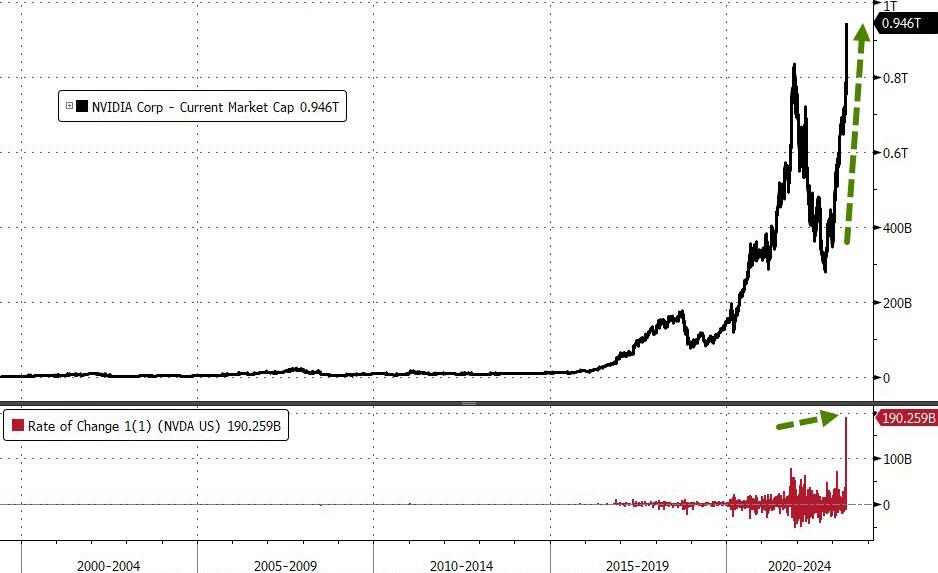
From the open, the day was all about one stock – NVDA, soaring 25% or so and adding just under $200 billion in market cap – that is 2 Intels! – and from the Oct 2022 lows, NVDA has added $665 billion in market cap…

Source: Bloomberg

That is the largest single-day market cap gain for any stock in US equity market history…

NVDA added more market cap today than the total market cap of 472 of 500 S&P companies, including:

  • Cisco (197.3BN)

  • Thermo Fisher ($197BN)

  • Accenture ($190BN)

  • AMD ($174BN)

  • T-Mobile ($168BN)

  • Adobe ($168BN)

  • Nike ($166BN)

  • Disney ($166BN)

  • Netflix ($162BN)

Bear in mind that it’s unclear how many jobs AI will have to replace to make the “$1 trillion data center” investment viable but Goldman has estimated 300 million middle/upper class jobs in US/Europe will be made obsolete… but at least your pension will be higher before you face permanent ejection from the workforce.

But, as the following Advance/Decline line for the Nasdaq shows, NVDA was practically alone…

Source: Bloomberg

On the day, Nasdaq exploded higher (obviously), Small Caps lagged notably with The Dow unch and the S&P gaining helped by NVDA durr…

Notably 0-DTE traders were hell-bent on getting some upside traction going in the S&P with three big impulses during the day…

Source: SpotGamma

Small Caps suffered as banks were sold again ahead of tonight’s Fed bailout data…

The equal-weight S&P 500 ended the day unch, while the cap-weight was up around 1%…

For some context with regard the concentration in markets, this is the seasonally worst relative performance of the equal-weight S&P to the cap-weight S&P in at least 30 years

Source: Bloomberg

The divergence in performance today between Small Caps and Nasdaq was the largest since Nov 2020…

Source: Bloomberg

Treasuries were dumped hard today, because why make 4 or 5% risk-free when you can pile into a tech stock at 175x Trailing P/E? The short-end was clubbed like a baby seal relative to the long-end today (2Y +15bps, 30Y +1.5bps) and the 2Y is ugly on the week…

Source: Bloomberg

The 2Y Yield rose back above 4.50%, back ast its highest since the middle of the SVB bank collapse crisis…

Source: Bloomberg

The yield curve (2s10s) flattened significantly, to its most inverted since the SVB crisis lows…

Source: Bloomberg

As Nomura’s Charlie McElligott noted earlier, the cross-market is real-time pricing-in debt deal optimism (@Punchbowl reporting “Rs expect the compromise will come together sometime in the next few days”) at the same time that the regional banks deposit-flight story remains (temporarily) quiet – which means that the “left tail” of the distribution being that  “~150bps – 250bps emergency cut” type of calamity scenario is seeing its market implied probability crater… all while “higher for longer” (even holding terminal through end of year) picks up Delta, with the debt-deal compromise being expected in the next few days, allowing the Fed to get back to the economic task at hand.

The market can then too price-in the now very-well socialized concerns with regard to the back half of year “liquidity drain” which is set to accelerate powerfully both in US and Europe, as outlined recently where again, the danger feeds into “higher interest rates” but this time, largely from the risk of

1) TGA rebuild / T-Bill “supply shock” / “reserve drain” which can then bleed-into a “crowding-out” across the risk-curve…

…especially when occurring in conjunction with

2) aforementioned “higher for longer” Fed,

3) QT,

4) ongoing Deposit flight into MMF / RRP as additional siphoning of Reserves,

5) consumer and corporate drawdown on remaining pandemic “excess savings,”

6) expiration of student loan moratorium, and

7) a monster European TLTRO repayment in Jun and 8) APP reinvestment cessation in July

And that is all very evident in the dramatically hawkish trend in STIRs…

Source: Bloomberg

The dollar rallied for the 9th day of the last 11 to its highest since 3/17/23 as flight cash continues…

Source: Bloomberg

Japanese Yen fell to 140/USD for the first time since 11/23/22…

Source: Bloomberg

Gold was puked back to two-month lows…

Oil tumbled after Russia poured cold water on OPEC+ production cut “ouchy” threat…

The “confusing triangle” continues its trilemma-y ways…

Source: Bloomberg

Finally, we note that the last time Nasdaq was this high relative to small caps was the peak of the dotcom bubble…

Source: Bloomberg

..probably nothing, right?

Tyler Durden
Thu, 05/25/2023 – 16:00

“Stark Reminder Things Can & Do Fail” – Sen. Rubio Demands No Commercial Real Estate Bailouts

“Stark Reminder Things Can & Do Fail” – Sen. Rubio Demands No Commercial Real Estate Bailouts

Authored by Senator Marco Rubio, via RealClearPolitics.com,

In the mid-2000s, small-town Minnesota resident Charles Marohn saw an upscale strip mall being built in a neighboring city. By 2020, the mall was still half-vacant. It was a clear signal that supply had exceeded demand. Yet just as the pandemic began to recede, Marohn saw another, even larger mall go up on an adjacent property.

It violates all the laws of common sense, but it’s the norm across much of the United States.

Many of us have seen evidence of the commercial real estate industry’s “if you build it, they will come” mindset firsthand — the large empty office buildings, unused business parks, and blank storefronts. Now, it has Wall Street spooked.

“I see a tsunami of loans coming due,” one CEO recently told CBS.

“It’s really the perfect storm,” said another.

“You could see a run on all small regional banks. … And that could put us back to where we were with the financial crisis of ’08.”

Other real estate insiders are already calling for “some sort of intervention or assistance from federal regulators or a bailout from elected officials.”

On the one hand, the fact that our financial class is willing to admit the error of its ways is an improvement over the days leading up to the Great Recession, when real estate investors indulged in delusions of never-ending profits until the bill finally came due, and responsible homeowners were left to pick up the tab.

On the other hand, the “experts” should have seen this coming years ago. Other people did. For instance, locals sounded the alarm on commercial real estate glut in Washington, D.C., as far back as 2017. Of course, that didn’t stop developers from erecting new buildings in the nation’s capital, which still has vacancy rates above 20%.

Vacant properties, the work-from-home revolution, rising crime in urban centers, the unaffordability of city housing — all of these factors and more should have made it obvious that commercial real estate was approaching a cliff. Instead, there was unfounded optimism that things would return to “normal.” Owners used an “extend and pretend” strategy to get to the next monthly payment or quarterly earnings report. The façade only came down with the failure of Silicon Valley Bank.

That failure was a stark reminder that things can and do fail, and that investors in failed businesses can be wiped out. That’s the way the real world works. Unfortunately, the financialization and consolidation of our economy have disconnected our markets from reality. WeWork and private real estate investment trusts — some of which are now blocking investor withdrawals — are among the clearest examples of this, but they are far from the only examples.

Take the case of the Minnesota strip mall. If the developer had sought financing for the project from a local bank, it probably never would have gotten off the ground. But as Marohn writes, “[i]f the local bank has any involvement today, it is [typically] as a broker — getting paid to make the transaction happen and then selling that commercial loan onto a secondary market.” In other words, financial constructs are disrupting local market feedback.

We have created an economy in which large-scale investors only realize they’ve gone wrong when it’s too late to turn back. This proved devastating to middle-, working- and lower-income Americans in 2008, who suffered a historic economic downturn while those “too big to fail” were bailed out by Washington. Unfortunately, history may be repeating itself.

If the Biden administration protects investors from the consequences of their actions, as the Federal Reserve let slip it would do in March, it will essentially be transferring wealth — at a massive scale — from America’s working class to the very investors and laptop liberals responsible for this crisis. That would tear our social fabric to shreds and further expand our class divide.

As policymakers, our duty is to the common good, not the stock market. Whether we like it or not, our economy is in the midst of a massive transformation. There will be winners and losers, but bailing out commercial real estate investors isn’t in our national interest. In fact, it would be the definition of unjust.

Tyler Durden
Thu, 05/25/2023 – 15:45

Debt Ceiling Negotiations Favor GOP: Piper

Debt Ceiling Negotiations Favor GOP: Piper

Update (1530ET): A new note from Piper Sandler suggests that President Biden and the Democrats are losing the debt ceiling debate, and that Republicans have the upper hand in negotiations that “increasingly look like it will roughly freeze defense spending and slightly cut domestic spending below this year’s levels.”

“Any deal is likely to be opposed by the most conservative Republicans and the most progressive Democrats,” the note reads. “We have always thought between 40% and 70% of House Republicans would support a deal, depending on its components, and roughly half of Democrats.”

It’s increasingly looking like a deal will be more on GOP terms and win the support of most Republicans.”

Piper also thinks that “Democrats have played their hand poorly” by misjudging Speaker McCarthy’s leadership abilities.

Since Democrats have argued for months for a clean debt ceiling increase and the GOP passed a bill with its priorities, the negotiations have been on Republican terms,” in which the most likely outcome is a debt ceiling deal that will “modestly cut domestic discretionary spending below last year’s levels and defense spending will be roughly flat.”

Congress will likely agree to cap spending for at least two years.

As far as permitting reforms, the GOP is arguing for an overhaul of the environmental permitting process, while Democrats are seeking changes to the rules governing the construction of transmission lines. The near term solution may be to agree to some of the permitting reforms, while kicking the more expansive reforms down the road.

Piper’s base case is that a deal “will be reached by this weekend and passed into law by June 1.”

*  *  *

With the dreaded “X-Date” fast approaching, House Republicans and the White House remain at an impasse over how to raise the debt ceiling.

House Speaker Kevin McCarthy

Republicans are telegraphing compromise – with Speaker Kevin McCarthy (R-CA) saying on Thursday that ‘not everyone will be happy with the debt deal,’ but that he expects a compromise will emerge sometime in the next few days. According to Punchbowl News, GOP leadership feels confident they can win the support of the majority of the House Republican Conference for the eventual package.

Piper Sandler’s Donald Schneider is projecting a new X-Date, with the Treasury having as little as $10 billion on hand by June 2 and $2 billion by June 9. For reference, Treasury typically never goes below $25 billion on hand, “especially with 0 extraordinary measures left, as would be the case in early June.”

That said, this can all blow up this afternoon as “there could be another dozen twists and turns between now and the announcement of any agreement. The last yard is always the toughest one,” according to Punchbowl.

The House Democratic Caucus is livid over the state of negotiations, with many rank-and-file Democrats feeling that they’re about to be asked to vote on a package that will satisfy Republican demands, while getting very little of what they want in return.

“I think time is starting to run out,” said Rep. Pramila Jayapal (D-WA), adding “I think Wall Street should be weighing in.”

The White House — especially President Joe Biden — will have a lot of work to do to get this across the finish line. Just ask the House Democratic leadership, which has been fielding many of the complaints from members. One senior House Democratic aide suggested that Biden must try to sell lawmakers on the package by saying he — and the country — need to put the debt-limit mess behind them.

This will be a big test for House Minority Leader Hakeem Jeffries and Minority Whip Katherine Clark. They’ll have to deliver dozens of Democratic votes for Biden on a deal that benefits the president’s reelection campaign perhaps more than anyone else. -Punchbowl

Several Democrats have told the outlet that they question the leadership at the White House in terms of how the entire negotiation has been handled.

Republicans are hitting back. Rep. Matt Gaetz (FL) said this week that his conservative colleagues “don’t feel like we should negotiate with our hostage,” adding “the one-person motion to vacate has given us the best version of Speaker McCarthy.”

Meanwhile, Sen. Mike Lee (R-UT) says that a debt-limit deal without substantial spending reforms will “not face smooth sailing in the Senate.”

I will use every procedural tool at my disposal to impede a debt-ceiling deal that doesn’t contain substantial spending and budgetary reforms. I fear things are moving in that direction,” Lee tweeted, which Rep. Chip Roy amplified.

Meanwhile, treasuries are reacting to the constant cries of progress (despite their likely walkback in a few hours), with a bear-flattening move extending as 2-year yields rise as much as 13bp on the day, topping 4.5%, after GOP Chairman of the US House Committee on Foreign Affairs Michael McCaul declaring that a deal is ‘close,’ and they are down to the details now.

  • Futures volumes surge into the move with around 60,000 10-year note contracts trading over 3-minute window as the futures hit session lows at 112-22; US 10-year yields around 3.785%, remain cheaper on the day by 4.5bp
  • Front-end of the curve leads days losses with 2-year yields trading around 4.50% — 2s10s spread flatter by 7bp on the day
  • Fed-dated OIS bid in early session with around 14bp of rate hike premium priced into the June policy meeting, up from 12bp Wednesday close and a combined 27bp priced for June and July meetings combined -Bloomberg

To expedite the issue once an agreement is reached, McCarthy refuses to waive a rule that allows members 72 hours to review the text of the agreement. As Punchbowl surmises, it’s possible that a deal won’t emerge until next weekend, June 3-4. After that, Senate Majority Leader Chuck Schumer will need to scramble to get any package to the floor before a default.

Tyler Durden
Thu, 05/25/2023 – 15:31