86.5 F
Chicago
Sunday, August 16, 2026
Home Blog Page 3673

US Supreme Court Allows Illinois Gun Control Law To Remain In Effect

US Supreme Court Allows Illinois Gun Control Law To Remain In Effect

Authored by Jack Phillips via The Epoch Times (emphasis ours),

The US Supreme Court on Wednesday sided with the state of Illinois over a strict new gun control law, denying an emergency request for an injunction.

Justices of the US Supreme Court pose for their official photo at the Supreme Court in Washington on Oct. 7, 2022. (Olivier Douliery/AFP via Getty Images)

The measure, which bans what the state considers “assault weapons,” will remain intact while the case brought by an Illinois gun store owner works its way through lower courts. The owner filed a petition with the high court to block the ban on a wide variety of firearms as well as “large capacity” magazines.

No explanation was given for the denial by Justice Amy Coney Barrett.

The  case is currently in front of the U.S. Court of Appeals for the 7th Circuit, which is based in Chicago. The decision is likely to be appealed regardless of the outcome.

More viaThe Epoch Times (emphasis ours),

In a separate case, a federal judge blocked the gun law. However, the 7th Circuit Court has placed that decision on hold in the meantime.

The 7th Circuit appeals court also has expedited consideration of at least five different cases challenging the Illinois law. Meanwhile, the state Supreme Court is considering a similar lawsuit against the measure.

Earlier this year, the state enacted the “Protect Illinois Communities Act” that bars the purchase, sale, delivery, and manufacture of so-called assault weapons and magazines that hold more than 10 rounds. It specifically named AK-47-style rifles and AR-15-style rifles as “assault weapons” under the law, which also requires those who previously purchased semi-automatic rifles to register their ownership with Illinois State Police.

According to an FAQ of the law, “No, Illinois residents cannot purchase an AR-15 or assault weapon beginning January 11, 2023, unless subject to one of the narrow exemptions.” The FAQ also states that the law bans “a magazine, belt, drum, feed strip, or similar device that has a capacity of, or that can be readily restored or converted to accept, more than 10 rounds of ammunition for long guns and more than 15 rounds of ammunition for handguns; or any combination of parts from which a device described can be assembled.”

Illinois Gov. J.B. Pritzker, a Democrat, signed the bill into law.

“For the past four years, my administration and my colleagues in the State Capitol have been battling the powerful forces of the NRA to enshrine the strongest and most effective gun violence legislation that we possibly can,” he said. “I couldn’t be prouder to say that we got it done. And we will keep fighting—bill by bill, vote by vote, and protest by protest—to ensure that future generations only hear about massacres like Highland Park, Sandy Hook, and Uvalde in their textbooks.”

Legal Challenges

Second Amendment advocate groups have repeatedly criticized the law as unconstitutional, and gun rights activists, including Robert Bevis, a gun store owner in Naperville, filed lawsuits to block the state law as well as a similar local ordinance that was passed in the city of Highland Park. Those laws were sparked following last July’s mass shooting at a Highland Park Fourth of July parade that left multiple people dead.

“The challenged laws ban arms commonly possessed by law-abiding citizens for lawful purposes. Heller’s central holding is that a categorical ban on arms held by law-abiding citizens is unconstitutional,” his lawyers wrote to the 7th Circuit judges last month, referring to a 2008 ruling by the Supreme Court on the landmark District of Columbia v. Heller case, in which the high court found that a District law regulating gun ownership to be unconstitutional.

Contending that Bevis’s constitutional rights were violated, his lawyers added: “One would suppose that the district court would apply the Heller test or, failing that, at least explain why it believed the test is not applicable. The district court did neither. It erred when it simply ignored Heller’s central holding. Nowhere in its opinion does it apply, or even acknowledge, Heller’s holding in this regard.”

Tyler Durden
Thu, 05/18/2023 – 19:00

“I’ve Been Here”: Feinstein Seems Unaware Of Months-Long Senate Absence

“I’ve Been Here”: Feinstein Seems Unaware Of Months-Long Senate Absence

California Senator Dianne Feinstein returned to Washington last week after a nearly three-month absence as she battled a stubborn case of shingles. However, in a Tuesday conversation with reporters, the 89-year-old appeared unaware that she’d been in California from February to May.  

As she was being rolled off an elevator via wheelchair, Slate‘s Jim Newell asked how she was feeling. “Oh, I’m feeling fine,” Feinstein replied. “I have a problem with the leg.” Asked what was wrong with it, Feinstein said, “Well, nothing that’s anyone concern but mine.”

The picture of health: 89-year-old Dianne Feinstein as she returned to the Senate on May 10 (Anna Moneymaker/Getty Images via Insider)

That’s when things took an unsettling turn, according to Newell as well as the Los Angeles Times‘ Benjamin Oreskes. When another reporter asked how colleagues had been responding to her return to the Senate, Feinstein said, “No, I haven’t been gone…You should follow the—I haven’t been gone. I’ve been working.”

Charitably exploring the best possible interpretation, the reporter asked, “You’ve been working from home…is what you’re saying?” 

“No,” replied an increasingly irritated Feinstein. “I’ve been here. I’ve been voting. Please. Either know or don’t know.” Feinstein missed more than 90 floor votes while she recuperated in San Francisco. 

After deflecting a question about Democratic House reps calling for her resignation, she was wheeled off before she could do more damage. 

Tuesday’s incident is just the latest of many illustrations of Feinstein’s apparent deepening senility. As we wrote upon her return to Washington, “Feinstein may have beaten shingles, but her declining mental health is arguably of even greater concern.”

Her mental decline has been chronicled by the most liberal of major newspapers, with the New York Times and San Francisco Chronicle last year publishing insider accounts of Feinstein being unable to remember names, meetings and phone conversations. The Times described her as sometimes “walk[ing] around in a state of befuddlement.” 

An unnamed Democratic legislator told the Times that, in a meeting with Feinstein in February 2022, the legislator had to keep reintroducing him- or herself, and repeatedly help her find her purse, as well as answering identical small-talk queries over and over. 

The oldest member of Congress, Feinstein will turn 90 on June 22. In February of this year, she announced that she will not be running for re-election — and just a few hours later, appeared to be unaware of the historic announcement.  

Feinstein sits on the Judiciary Committee, which was left with a 10-10 tie during her long absence, thwarting Democratic ambitions to stock federal benches with leftist judges — and prompting California Rep. Ro Khanna and New York Rep. Alexandria Ocasio-Cortez — both Democrats — to call for her resignation. 

Asked Wednesday if Feinstein is equipped to carry out her duties, Democrat and Judiciary Chairman Dick Durbin told CNN, “I can’t be the judge of that…she has to make that decision for herself and her family as to going forward.” Fellow Dem Sheldon Whitehouse was blunter, telling Slate‘s Newell, “I’m gonna leave that to the medics.”

Durbin’s reply assumes Feinstein is capable of making such a decision. That’s a reach, particularly when you consider that a resignation would go against the interests of her handlers who’d surely like to keep their Senate jobs as long as possible.

For now, Feinstein is still managing to serve the Blue Team’s interest. As Sen. Richard Blumenthal told Slate“There’s one job that no one else can do for us, which is to vote. And she’s been doing that job in the last few days, and so far as I can tell, she’s been doing well.”

Tyler Durden
Thu, 05/18/2023 – 18:40

Feds Start Enrolling Volunteers For mRNA Flu Vaccine Trial

Feds Start Enrolling Volunteers For mRNA Flu Vaccine Trial

Authored by Bill Pan via The Epoch Times (emphasis ours),

Vaccine developers at the National Institute of Allergy and Infectious Diseases (NIAID) are enrolling healthy adult Americans to test an experimental universal influenza vaccine using mRNA technology.

A syringe with an influenza vaccine sits on a table in an Oct. 14, 2020, file image. (Mario Tama/Getty Images)

The Phase 1 trial will be conducted at Duke University in Durham, North Carolina, the NIAID said on Monday. Researchers will test the experimental vaccine, dubbed H1ssF-3928 mRNA-LNP, for safety and its ability to induce an immune response.

For this early-stage trial, the federal research agency is looking for up to 50 healthy volunteers aged 18 through 49. There will be three 10-participant groups receiving 10, 25, and 50 micrograms of the experimental vaccine, respectively. After evaluation of the data to determine an optimum dosage, an additional 10 participants will be administered with the optimum dosage.

The study also will include a group of participants to receive a currently available flu vaccine that protects against the four most common flu virus strains in circulation.

The NIAID said it expects to collect all the data needed by March 15, 2024, and conclude the study by Aug. 30, 2024.

The name H1ssF is an abbreviation of H1 hemagglutinin stabilized stem ferritin, meaning that the vaccine uses the “stem” part of the influenza hemagglutinin protein displayed on the surface of a ferritin nanoparticle as the immunogen. The “stem” remains largely unchanged throughout influenza mutations, as compared to the “head,” which constantly changes as the virus mutates into different strains in a process called “antigenic drift.”

Most of the body’s immune response to the influenza virus is directed toward the ever-changing “head” of the hemagglutinin protein, and hence seasonal influenza vaccines must be updated each year. NIAID researchers believe that a vaccine that targets the “stem” without the distraction of the “head” could offer stronger and longer-lasting immunity.

The other part of the experimental vaccine’s name, mRNA-LNP, means that the messenger RNA-encoded immunogen is delivered inside a lipid nanoparticle (LNP). The vaccine doesn’t contain the immunogen, but uses LNP-coated mRNA to instruct the host cells to assemble the immunogenic proteins that can trigger the production of effective antibodies.

Safety Risks

The same mRNA technology is used to make both Pfizer-BioNTech and Moderna COVID-19 vaccines, two of the most administered vaccinations in the world. Despite their widespread use, championed by governments of many countries under the premise that the shots are safe and effective, the mRNA vaccines continue to spur concerns about serious side effects, including a heightened risk of cardiac-related deaths in healthy teenagers and young adults after vaccination.

Last October, the Florida Department of Health issued a warning against giving young men mRNA COVID shots, citing an analysis (pdf) that found “an 84 percent increase in the relative incidence of cardiac-related death among males 18-39 years old” within 28 days following the jab.

“With a high level of global immunity to COVID-19, the benefit of vaccination is likely outweighed by this abnormally high risk of cardiac-related death among men in this age group. Non-mRNA vaccines were not found to have these increased risks,” said Dr. Joseph Ladapo, Florida’s surgeon general.

Read more here…

Tyler Durden
Thu, 05/18/2023 – 18:20

Gunmaker Heckler & Koch Deletes Woke Tweet Rant After Backlash

Gunmaker Heckler & Koch Deletes Woke Tweet Rant After Backlash

When will companies take the time to vet their communications departments, especially after the expensive advertising snafu by Bud Light involving the promotion of identity politics? Consumers are growing increasingly fed up with companies championing all things ‘woke’ and are participating in boycotts in response. 

The latest example is a woman managing German gun manufacturer Heckler & Koch (known for the MP5 submachine gun) who apparently went rogue on the company’s official Twitter account, defending Miller Lite’s woke feminist advert

The PR blunder by H&K has all but been deleted, but Breitbart News found the now-deleted tweets that read:

“Wow- woke? Allow me to translate: objectifying women was never a good marketing strategy. In the firearms industry, that was a prominent strategy up until recently. Many industries have done that (including beer corps).”

As an actual woman typing this, I’ll use more words for you to comprehend: using bunnies to sell products is trash marketing. Supporting women by not doing that is good.”

Breitbart reported it all started when Graham Allen tweeted the controversial Miller Light commercial, expressing the possibility of a ‘Bud Light moment.’

Allen wrote: 

“Did NOBODY learn from Bud Light’s COSTLY mistake? Miller Lite just dropped this WOKE advertisement!!! When will these beer companies learn????”

Then H&K’s Twitter account responded to Graham Allen with this:

The Germans were very swift and deleted the tweets and released this statement, “H&K does not engage in identity politics. A policy was violated. Changes were made.” 

“Next up is an official apology, but it’s a good start,” TurningPoint USA contributor Lauren Chen tweeted at H&K. 

Others thanked H&K for “dealing with that nonsense quickly and correctly. This is the way to go.” 

Hmmm.

Tyler Durden
Thu, 05/18/2023 – 18:00

Hawkish FedSpeak Batters Bonds & Bullion; Tech Melt-Up Accelerates

Hawkish FedSpeak Batters Bonds & Bullion; Tech Melt-Up Accelerates

‘Positive’ jobless claims data (which simply unwound last week’s farce in MA) and ‘not pretty’ existing home sales data were dominated today by some notably more-hawkish-than-recent-norms FedSpeak to start the day:

Dallas Fed’s Logan: “The data in coming weeks could yet show that it is appropriate to skip a meeting…”

“As of today, though, we aren’t there yet… We haven’t yet made the progress we need to make. And it’s a long way from here to 2% inflation.”

Fed Gov Jefferson: “Inflation is too high, and we have not yet made sufficient progress on reducing it,” he said.

“Outside of energy and food, the progress on inflation remains a challenge… a year is not a long enough period for demand to feel the full effect of higher interest rates.”

St.Louis Fed’s Bullard warned that “it may warrant taking out some insurance by raising rates somewhat more to make sure that we really do get inflation under control…”

“Our main risk is that inflation doesn’t go down or even turns around and goes higher, as it did in the 1970s.”

So, a pause at best, more hikes possible, no signs of cuts at all, and the curve is adjusting that way…

Source: Bloomberg

Rate-change expectations continued to trend hawkishly higher (removing more cut expectations)…

Source: Bloomberg

Overall, Treasury yields soared higher with the short-end monkeyhammered (2Y +12bps, 30Y +5bps)…

Source: Bloomberg

And the yield curve flattened (inverted) further, shouting recession…

Source: Bloomberg

In fact, as Goldman notes, the 2y and 3y segments of the money market curves price substantially higher probability of recession compared to all four cycles since 1990

…and then the rate-cuts?

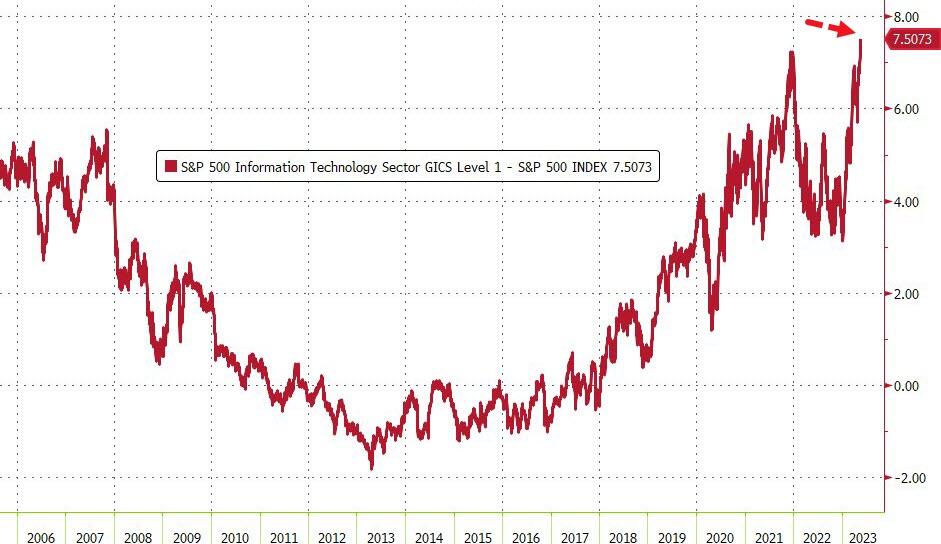
Tech stocks saw more panic/safe-haven/momo/AI-fomo flows today with Nasdaq handily outperforming while The Dow and Small Caps underperformed and the S&P danced in the middle. The last two hours saw everything melt-up…

NVDA continued its melt up (another upgrade), rallying 5% today (AI God mode)…

As we reflected earlier, for NVDA to grow into its market cap, not only does AI have to put everyone out of work by 2030 but humans will be daytrading in zoos entertaining the algos…

NFLX also surged after reports that its ad-supported subs had hit 5 million…

Regional bank stocks bobbed and weaved between gains and losses…

The Dow is unch YTD, Nasdaq is not…

Source: Bloomberg

After all that, The Nasdaq is outperforming The Dow by an entire bull market…

Tech valuations are at extreme levels relative to the broad market now…

Source: Bloomberg

The equal-weighted S&P is unchanged YTD…

Source: Bloomberg

The dollar continued to rise tick for tick with the Sept Fed rate expectation (implying only marginal gains from here for the dollar)…

Source: Bloomberg

Bitcoin was rug-pulled again at $27,000…

Source: Bloomberg

Gold extended its losses after breaking $2000

Oil prices dipped lower again today with WTI back at a $71 handle

Finally, Goldman points out The Confusing Triangle: the dollar, tech stocks and real rates into a recession.

The dollar rallies (fact) on higher real rates (check) OR rising risk aversion (not present), tech rallies (fact) on lower real rates (not present) OR higher risk appetite due to US exceptionalism (check).

Source: Bloomberg

One of these would be wrong if real rates and US exceptionalism are equally weighted but it is hard to say which one as both are expensive and due for a meaningful correction given the probability of recession.

Goldman suggests that given that equities are at odds with oil in terms of pricing the probability of an adverse growth outcome, we would think that in the past week or so the dollar is right and equities aren’t.

Tyler Durden
Thu, 05/18/2023 – 16:01

Disney Abandons Billion-Dollar Florida Development Plan, Shutters ‘Galactic Starcruiser’ Hotel Amid DeSantis Suit

Disney Abandons Billion-Dollar Florida Development Plan, Shutters ‘Galactic Starcruiser’ Hotel Amid DeSantis Suit

Disney is pulling the plug on a $1 billion development in Orlando Florida amid a fierce dispute with Governor Ron DeSantis (D). The complex would have brought in over 2,000 jobs to the region, with an average salary of $120,000, according to the NY Times, citing an estimate from the Florida Department of Economic Opportunity.

The project, known as the Lake Nona Town Center, was supposed to involve the relocation of more than 1,000 employees from Southern California, including most of a department known as Imagineering, which works with Disney’s movie studios to develop theme park attractions. Most of the affected employees complained bitterly about having to move — some quit — but Disney largely held firm, partly because of a Florida tax credit that would have allowed the company to recoup as much as $570 million over 20 years for building and occupying the complex. –NY Times

In a Thursday email to employees, Josh D’Amaro, Disney’s theme park and consumer products chairman, cited “changing business conditions” as a reason for the cancellation, adding “I remain optimistic about the direction of our Walt Disney World business.”

D’Amaro noted that $17 billion was still earmarked for construction at Disney World over the next decade, a plan which would create an estimated 13,000 additional jobs.

The Times notes that around 200 employees had already relocated from California to Florida, for which D’Amaro said the company would discuss options, “including the possibility of moving you back.”

The Lake Nona campus, about 20 miles from Disney World near the Orlando International Airport, had been championed by Bob Chapek, who served as Disney’s chief executive from 2020 until he was fired last year. Mr. Iger, who came out of retirement to retake Disney’s reins, was much less enthusiastic about the project — even before the company became mired in its battle with Mr. DeSantis. As soon as he returned to Disney, Mr. Iger began telling lieutenants, for instance, that it made little sense to move Imagineering so far away from Disney’s movie studios. As he is fond of saying, “Creative teams need to be together.” -NY Times

Visitors walk along Main Street at The Magic Kingdom of Walt Disney World in Orlando, Fla., on Sept. 30, 2022. (Bryan R. Smith/AFP via Getty Images)

The company is also closing a luxury hotel at Walt Disney World, Bloomberg reports.

The Star Wars: Galactic Starcruiser – pet project of former CEO Bob Chapek, will shutter its doors at the end of September. The 100-room property, for which prices start at $4,800 per couple, takes guests on a two-day imaginary cruise in a space ship.

Meanwhile, as The Epoch Times reports, Disney has also asked a Florida court to dismiss a lawsuit filed by the board of supervisors appointed by Gov. Ron DeSantis to oversee Walt Disney World’s theme park operations.

DeSantis took over Disney World’s self-governing district through legislation passed by the Florida legislature before appointing new overseers to run it.

The entertainment company’s former Reedy Creek Improvement District where Disney World is located, now called the Central Florida Tourism Oversight District, has been the center of a year-long feud between Disney and the Republican governor of Florida.

The new board filed a legal challenge against Disney’s case in Federal court after it accused the governor and the board members of carrying out a campaign of political retribution for opposing a bill against grooming in schools.

Disney filed a May 17 lawsuit, arguing that the board’s challenge against it was rendered moot after DeSantis signed a bill voiding the development plans for its theme park.

DeSantis has been battling Disney as he appears to be positioning himself for a run as a Republican presidential candidate for 2024.

Disney’s Long-Running Feud With Florida Over Gay Politics

Disney claimed it was the victim of “weaponizing” actions by Florida Republicans who wanted to punish it for opposing the bill.

The entertainment giant publicly criticized the controversial Florida bill, which prohibits the promotion of sexual orientation and gender identity propaganda in schools.

Florida Republicans and DeSantis targeted Disney’s special tax district, formerly called the Reedy Creek Improvement District, which granted it the right to effectively self-govern its theme parks in Orlando since 1968.

The special tax district was left intact, but its five-member board was sacked and replaced with the governor’s hand-picked nominees.

Right before the new board came in, Disney signed agreements with the old board in March and stripped the new supervisors of development authority over the 25,000-acre district.

DeSantis’ board sued Disney for illicitly crafting the “11th-hour” modifications to the district charter that would have removed their powers of oversight.

Disney countered those accusations against the last-minute move and argued that the changes were merely written to secure its long-term development plans.

DeSantis Attempts to Weaken Disney’s Power

The new board voted to revoke Disney’s last-minute changes to the charter, which it claimed it made to secure its investments.

DeSantis separately pushed legislation to nullify changes to the charter that voided Disney’s future development deals in Orlando.

The entertainment giant expanded its lawsuit against Florida last week and accused DeSantis of raising the stakes after he signed the new round of legislation to stop its plans.

This motion by Disney is entirely predictable and an acknowledgement they know they will lose this case,” a spokesman for the pro-DeSantis board overseeing the special tax district, told CNBC.

Disney argued that by signing the bill to reduce its power over the district, the Florida governor had essentially carried out the same action that his board was trying to achieve through the courts.

The company claimed that the governor’s signature “makes any order this Court could issue—in either party’s favor—legally irrelevant” and argued that DeSantis’s legislation had undercut the new board’s claim against it, regardless of who would have won in court.

Disney said if the Florida court rules that its changes were valid, then “the board would still be prohibited from complying with them under the new state statute.”

However, if the court sides with DeSantis’s picked board, its ruling “would be pointless because the contracts would already be void under the new state statute,” Disney explained.

“In short, any declaration about the contracts’ enforceability, voidness, or validity—either way—would be an advisory opinion with no real-world consequence. Trial courts in Florida are forbidden from issuing advisory opinions, and this case should be dismissed,” the company argued.

DeSantis is currently former President Donald Trump’s main challenger for the 2024 Republican nomination and has been trying to gain favor among his base, while gaining nationwide attention over challenging left-wing activism in the state.

Tyler Durden
Thu, 05/18/2023 – 15:40

Turley: If Congress Really Wants Reform, Durham Has Given It A Blueprint For How To Do It

Turley: If Congress Really Wants Reform, Durham Has Given It A Blueprint For How To Do It

Authored by Jonathan Turley,

For those interested in the truth about the Russian collusion investigation, the Durham Report has hundreds of pages of details of the alliance of political, government and media figures behind arguably the greatest hoax in U.S. history. The only thing it does not have is an actual indictment or true accountability for the critical players in an effort to derail an American presidency. Indeed, some witnesses associated with the Clinton campaign appear to have refused to cooperate with the investigation. Congress could change that.

Buried in the detailed account is a little noticed footnote stating that Clinton General Counsel Marc Elias “declined to be voluntarily interviewed by the Office.” Likewise, Durham noted that “no one at Fusion GPS … would agree to voluntarily speak with the Office” while both the DNC and Clinton campaign invoked privileges to refuse to answer certain questions.

It is not clear whether Durham was able to get a full account from these sources, but he was still able to establish the details on how this unprecedented political hit job succeeded despite a lack of evidence. In the course of that account, Durham demolished the prior claims of Democratic members like Adam Schiff and many in the media. Durham concludes that the investigation should never have been launched and that the whole effort was based on “raw, unanalyzed, and uncorroborated” information.

It turns out that the “pee-tape” was the creation of a Clinton operative without any factual basis despite years of the media (and former FBI Director James Comey) referencing the false salacious claim.

It turns out that Trump was correct that the FBI did spy on his campaign despite years of mocking denials in the media.

Indeed, Trump was right that this was a manufactured hoax engineered by the Clinton campaign, weaponized by the FBI, and then promulgated by the media.

As expected, the media has imposed another virtual blackout on coverage of the report other than to deny that there is anything new for the public to see. For those of us concerned about the rise of a type of state media in the United States, the report and its coverage has only magnified those concerns.

So is that it? Just a shrug and spin?

Not necessarily.

In a recent Fox interview, former Attorney General Bill Barr indicated that he always viewed Durham’s primary mandate as establishing what occurred in the Russian collusion investigation and making that information public.

Congress can now use that foundation to compel cooperation from key figures in this scandal, if necessary, under a grant of immunity. The witnesses could still be prosecuted if they lie or mislead congressional investigators or commit perjury.

They could start with Marc Elias, who features prominently in the Durham Report.  It was Elias who managed the legal budget for the campaign. We now know that the campaign hid the funding of the Steele dossier as a legal expense. (The Clinton campaign was later sanctioned by the FEC over its hiding of the funding).

New York Times reporter Ken Vogel said that Elias denied involvement in the anti-Trump dossier. When Vogel tried to report the story, he said, Elias “pushed back vigorously, saying ‘You (or your sources) are wrong.’” Times reporter Maggie Haberman declared, “Folks involved in funding this lied about it, and with sanctimony, for a year.”

Elias was also seated next to John Podesta, Clinton’s campaign chairman, when he was asked about the role of the campaign, he denied categorically any contractual agreement with Fusion GPS. Even assuming that Podesta was kept in the dark, the Durham Report clearly shows that Elias knew and played an active role in pushing this effort.

Elias is now ironically advising Democratic campaigns on election ethics and running a group to “defend democracy.” He is still counsel to the Democratic Congressional Campaign Committee (DCCC) headed by Rep. Suzan Kay DelBene, D-Wash. Elias was recently severed by the Democratic National Committee from further representation and has been previously sanctioned in federal court in other litigation.

Elias testified at the criminal trial of his former partner Michael Sussmann, but the scope of that examination was strictly limited by the court. Congress could compel his testimony on the full range of conduct leading to the scandal.

Likewise, other figures from Steele to Comey could be compelled to give full accounts in light of this Report. Congress has an interest in hearing from these witnesses as it explores how to make real reforms at the Justice Department and the FBI.

The need for congressional action was made clear by the FBI itself in its immediate response to the Report. It insisted that it has reformed itself after what it described as “missteps identified in the report.”

There are many ways to describe an investigation into false allegations raised by an opposing political party to derail a presidency. Calling that a “misstep” is like calling the explosion of the Hindenburg a “mislanding.” The FBI has now gone through regular cycles of scandals followed by assurances of self-reform.

Even if one is willing to suspend disbelief over the latest “trust us we’re the government” press release, it ignores that fact that the FBI was accused again in 2020 of playing a role in burying the Hunter Biden laptop scandal.

If Congress wants to reform this system, Durham has given it a blueprint for how to do it. After the Report, there is now an undeniable right of Congress to seek this testimony as part of its legislative and oversight functions under Article I. While figures like Elias may  “decline to be voluntarily interviewed,” this does not have to be a voluntary exercise.

In speaking with many witnesses, Durham was dealing with some potential crimes with expired statutes of limitation. If witnesses lie to Congress, they could also face charges under a new statute of limitations.

If history is any measure, nothing concentrates the mind as much as a subpoena and immunity grant . . . and it may be time to concentrate some minds in Washington.

Tyler Durden
Thu, 05/18/2023 – 15:25

“Huge” Bearish Bets Gone Wrong Cost Carl Icahn $9 Billion In Losses

“Huge” Bearish Bets Gone Wrong Cost Carl Icahn $9 Billion In Losses

Regular readers may recall that there was a time back in 2016 when Carl Icahn emerged as one of the market’s biggest bears, warning CNBC that a lot of companies are “way overvalued” and that he was “very concerned about the market in the short-term“, not long after we first reported that the bearish exposure of the billionaire’s investment vehicle, Icahn Enterprises, had gone a record 149% net short.

And despite frequent at-the-time accusations that Uncle Carl was merely trying to find exit liquidity with his apocalyptic rhetoric, and was secretly bullish taking the other side of others’ liqujidations, we now learn that Icahn’s bearishness at a time when the S&P was moving higher year after year was not only real but ended up costing him dearly. 

The FT has reported that Carl Icahn admitted he was wrong to make a “huge bet” that the market would crash after the ill-fated trade cost his firm nearly $9bn over roughly six years.

According to a Financial Times analysis, the prominent activist investor lost about $1.8bn in 2017 on hedging positions that would have paid out if asset prices had tumbled before losing a further $7bn between 2018 and the first quarter of this year.

“I’ve always told people there is nobody who can really pick the market on a short-term or an intermediate-term basis,” Icahn told the FT in an interview to discuss the analysis. “Maybe I made the mistake of not adhering to my own advice in recent years.”

According to the FT, Icahn Enterprises started aggressively betting on a market collapse in the aftermath of the 2008 financial crisis and became increasingly bolder in subsequent years, deploying a complex strategy that involved shorting broad market indices, individual companies, commercial mortgages and debt securities.

At times, Icahn’s notional bearish exposure exceeded $15bn according to regulatory filings. “You never get the perfect hedge, but if I kept the parameters I always believed in . . . I would have been fine,” he said. “But I didn’t.”

In retrospect, the perfect hedge would have been… a zero hedge. But we digress.

Icahn Enterprises, the billionaire’s majority owned listed vehicle which has been hammered in recent weeks by losses as a result of a short report by another prominent bear, Hindenburg Research, reported a total of $4.3bn in short losses in 2020 and 2021 as markets quickly rebounded from the pandemic slump following the Federal Reserve’s huge stimulus.

“I obviously believed the market was in for great trouble,” said Icahn. “[But] the Fed injected trillions of dollars into the market to fight Covid and the old saying is true: ‘don’t fight the Fed’.”

It’s the same logic we applied in the aftermath of the bank failures in March, when contrary to consensus popular opinion that markets would crash, we said the chase was only starting as a result of the massive liquidity injection by the Fed to stabilize markets. We were right.

The trades, the FT writes, have left Icahn in a vulnerable position and threaten to undermine his status as one of the most feared activist investors on Wall Street.

As Icahn’s short bets were margin called and drained billions of dollars from his investment firm, he plowed nearly $4bn of his own money into his publicly listed vehicle, filings show. That injection helped keep the firm’s internally calculated investment portfolio value relatively stable. Incidentally, it was back in 2016 when we first speculated that Icahn would be subject to margin calls and would have to inject fresh liquidity.

Icahn exposed himself to another risk by taking out a margin loan that was first disclosed in early 2022. Hindenburg’s report drew attention to the margin loan from Morgan Stanley, against which Icahn pledged 60% of his stake in Icahn Enterprises as collateral. Hindenburg argued this could lead to his business unravelling if the plunging stock price triggers a margin call that would force Icahn to liquidate some of his stake (which of course is standard operating practice for every margin loan and was used for years as the lynchpin of the bearish thesis against Tesla, much to the disappointment of countless bears who were steamrolled as the stock exploded higher).

In a statement earlier this month that addressed Hindenburg’s allegations, Icahn Enterprises said Icahn was in “full compliance” with regards to all personal loans and announced a $500mn stock buyback authorisation in a bid to bolster its share price. With regards to its market valuation, the company said that “over time, [our] performance will speak for itself”.

Icahn told the FT that he had used the margin loan to make additional investments and had billions of dollars of cash outside of his public vehicle. “Over the years I have made a great deal of money with money,” he said. “I like to have a war chest and doing that gave me more of a war chest,” he added, referring to the margin loan.

Icahn Enterprises has warned that “a prolonged decline” in its stock price “could increase the likelihood of a foreclosure or forced sale” of Icahn’s stake if he was “subject to a ‘margin call’”.

Ironically, after losing billions on his short bet when the Fed kept propping markets higher, it is a market crash that could now lead to ruin for the famous corporate raider and billionaire.

Icahn’s bearish bets are the main reason his investment portfolio has lost money in every year since 2014. Over the roughly six year period that he lost $9bn on the short bets, the portfolio made about $6bn from his activist wagers, leaving the vehicle with an overall investment loss of nearly $3bn.

Don’t fight the Fed, indeed.

Separately, Icahn Enterprises generated $3.5bn of gains during the period by selling companies it controlled — including casinos and a railcar leasing business — that were held outside the investment portfolio.

Over the past six years, the NAV of Icahn Enterprises fell from $7.9bn in 2017 to $5.6bn this month, net of fresh injections. That poses a potential problem for Icahn, who has historically taken the large $8 a share annual dividend in stock rather than cash. This has caused the number of outstanding shares to more than double over the roughly six-year period, pushing its net asset value per share down from $33 to roughly $16.

Retail investors who took their dividends in cash would have received more than $40 a share during the same period.

As pressure on his firm mounts, Icahn has been forced to rein in his short bets just as some investors fear that a regional banking crisis and the debt ceiling stand-off could result in a sharp market sell-off.

“I still to some extent believe that this economy is not good and there are going to be problems ahead,” Icahn said. “We are still hedged, but not to the extent we were.”

Which is precisely why they call it a max pain market: only after the last bear has been carted out feet first, will stocks finally crash.

Tyler Durden
Thu, 05/18/2023 – 14:49

Talk Is Cheap; What Will The Fed Actually Do?

Talk Is Cheap; What Will The Fed Actually Do?

Authored by Michael Maharrey via SchiffGold.com,

Gold had dropped by over $100 in the last two weeks. Meanwhile, the dollar rose to a 7-week high on May 17. If you’re thinking that this looks a lot like how gold and the dollar moved at the height of the Federal Reserve’s inflation fight, you’re right. That’s because the central bankers at the Fed have stepped up the hawkish rhetoric in the last couple of weeks increasing expectation that interest rates will stay higher for longer.

But talk is cheap. The real question is how will the Fed respond when the bottom drops out of the economy.

Fed-Speak

Over the last two weeks, several Federal Reserve officials made comments emphasizing their resolve to carry through with the inflation fight and indicating that interest rates won’t go down anytime soon.

Chicago Fed President Austan Goolsbee, who typically tends to lean toward dovishness said it is “far too premature to be talking about rate cuts.”

Atlanta Fed President Raphael Bostic was more hawkish, saying that policymakers won’t be thinking about rate cuts “until well into 2024.” He also said he would be inclined to continue raising rates into a recession.

What we’ve seen is that inflation has been persistently high, consumers have been really resilient in terms of their spending, and labor markets remain extremely tight. All of those suggest that there’s still going to be upward pressure on prices. If there’s going to be a bias to action, for me it would be a bias to increase a little further as opposed to cut.”

Bostic also emphasized that getting inflation back to 2% is “job number one,” saying, “If there’s going to be some cost to that, we’ve got to be willing to do that.”

Cleveland Fed President Loretta Mester also took an aggressive tone, saying rates are not yet at a point where the central bank could hold steady.

I don’t put it in terms of a pause; I put it in terms of a hold. Have we gotten to that rate yet? At this point, given the data we’ve gotten so far, I would say no.”

Richmond Federal Reserve President Thomas Barkin told Bloomberg that he was “comfortable” seeing interest rates rise even further.

I think the message sent in the last statement was one of optionality, it wasn’t one of a pause or a peak. I want to learn more about what’s happening with all these lagged effects (from earlier rate hikes), but I also want to reduce inflation. And if more increases are what’s necessary to do that, I’m comfortable doing that.”

New York Federal Reserve President John Williams sounded a similar tone saying, “We haven’t said we are done raising rates,” adding, “If additional policy firming is appropriate, we’ll do that.”

This all dovetails with the hawkish tone that Jerome Powell tried to set during the press conference after the May FOMC meeting. He emphasized that the Fed is now in a “data-dependent” mode and insisted that “a decision on a pause was not made today.”

We on the committee have a view that inflation is going to come down—not so quickly, it will take some time. In that world, if that forecast is broadly right, it would not be appropriate to cut rates.”

He also hinted that the Fed could hike further, “We are prepared to do more if greater monetary policy restraint is warranted.”

As we have seen over the last year-plus, any indication that the Fed will keep hiking has boosted the dollar and weighed on gold. This has been the case over the last week as the open-mouth operations from the Fed have boosted expectations that the Fed will raise rates in June from 12% to 22%.

Meanwhile, a majority of economists polled by Reuters said they think the Fed will at least hold rates at the current level through the end of 2023 even if there is a recession.

Talk Is Cheap

But talk is cheap. It’s easy for Fed officials to say, “We’re committed to slaying inflation. We’ll keep raising rates even if the economy dips,” when the economy appears to be on relatively solid footing. The real question is what will the Federal Reserve actually do when the economy tanks.

History tells us they won’t stick to their guns, and they’ll go right back to easy money policies to prop up the economy. They did in after the dot-com bubble popped. They did it in 2008. They did it in 2018 when the stock market tanked and the economy got wobbly with just modest tightening. And they did it in spades during the pandemic.

The disconnect seems to be that Fed officials and economists in general think the looming recession will be relatively mild. In fact, after the May FOMC meeting, Powell still insisted the Fed could get price inflation to the 2% target and bring the economy to a “soft landing.”

Bank of America chief US economist Michael Gapen’s recent comments typify mainstream thinking.

In our view, rather than lean against a mild recession, the Fed would view it as an acceptable price for bringing inflation back down to target.”

Notice Gapen says “mild.”

The problem is there is no reason to believe that the coming recession will be mild. If the bust is proportionate to the boom, we’re in for one hell of a bust.

The Federal Reserve and the US government pumped trillions of dollars of stimulus into the economy during the pandemic. This was on top of the trillions of dollars it pumped into the economy after the 2008 financial crisis. It held interest rates artificially low for well over a decade. This created all kinds of malinvestments and bubbles in the economy. As Peter Schiff put it, the Fed has screwed up everything that is a function of interest rates.

Over the last year, the Fed has pushed rates to the highest level since before the 2008 financial crisis. While it still hasn’t gotten price inflation anywhere near the 2% target, there is no way that this isn’t going to break things in an economy that depends on a low interest rate environment. We’ve already seen cracks in the system with the ongoing financial crisis. The Fed managed to paper over that with its bailout, but it’s only a matter of time before something else breaks.

But right now, everything basically seems fine. Sure, we’re seeing some contraction in the economic data. But the labor market is still strong (based on the cooked government data) and consumers are still spending (themselves into record levels of debt). Until there is a crisis, nobody is going to believe there’s going to be a crisis.

Think about it. The mainstream has a pretty bad track record of seeing things coming, as Schiff pointed out during a recent interview.

Why couldn’t they see 2008 coming? That was obvious. Why couldn’t they see this inflation problem? I mean, they were claiming it was transitory when it was obvious that it wasn’t. It’s all about spin when it comes to the government. They’re never going to be honest. They’re either going to lie about what’s going to happen, or maybe they’re just so ignorant that they really can’t see what is clearly apparent to anybody who objectively looks at the facts. So, you’ve got to think for yourself and recognize that the government is never going to tell you about a crisis. You just need to prepare for it yourself.”

It’s also important to remember that the 2008 financial crisis happened over a year after the Fed stopped raising interest rates. In fact, it was already cutting rate when the Great Recession kicked off. There is always a lag between changes in policy and the impacts of those changes.

So, this brings us back to the operative question – what will the Fed policymakers do when the poo actually hits the fan? Do they have the fortitude to follow through on their tough talk? Or will they fold like an old card table?

History tells us they will fold. And until they prove otherwise, there is no reason to think they won’t. In the immortal words of Pretty Woman, “That’s the fork they know.”

When faced with a crisis, they will almost certainly implement “temporary emergency measures” to hold everything together. That means rate cuts and quantitative easing.

This is why Schiff says we’re not just facing a recession. Great Depression 2.0 is incoming.

But unlike the depression of the 1930s, where the people at least got the benefit of falling prices that provided some relief. During the depression, you lost your job, but at least the cost of living went down. And if you didn’t lose your job, you were actually better off because you had your paycheck and your paycheck went further because consumer prices fell during the 1930s. But this time, even the people who don’t lose their jobs are going to suffer because they’re going to lose the value of their paychecks. They’re going to lose the value of their savings. Because everything that you need to buy is going to be a lot more expensive. And that’s going to compound the burden for the unemployed. Because not only are they going to be without jobs, but their savings are going to be destroyed. And even if they get checks from the government, it’s not going to be enough to afford the basic necessities.”

Tyler Durden
Thu, 05/18/2023 – 12:45

Unprecedented: Montana Gov Bans TikTok – First Amendment Battle Looms

Unprecedented: Montana Gov Bans TikTok – First Amendment Battle Looms

Montana Republican Governor Greg Gianforte on Wednesday signed into law a statewide ban on the enormously popular short-form video app, TikTok, which Beijing-based ByteDance owns. The platform has been accused of being a potential conduit for data that the Chinese government could use to spread misinformation.  

“The Chinese Communist Party using TikTok to spy on Americans, violate their privacy, and collect their personal, private, and sensitive information is well-documented,” said Gianforte in a statement.

“Today, Montana takes the most decisive action of any state to protect Montanans’ private data and sensitive personal information from being harvested by the Chinese Communist Party,” the governor said.

Last month, the bill titled SB419 was approved in the Montana House of Representatives, with a vote of 54-43. Following this, it was sent to his desk for signature. 

In Helena on Wednesday, Gov. Greg Gianforte signs the bill banning TikTok in Montana (Garrett Turner/AP via KFYR TV)

The hammer is slated to fall on Jan. 1, 2024. At that point, the law would impose $10,000-per-day fines on any “entity” for any instance in which a person “is offered the ability” to either access TikTok or download it. Covered entities would include app stores or TikTok itself. Importantly, users are not targeted. 

Of course, it remains uncertain that the law will ever be enforced, as it’s certain to face legal challenges from TikTok and groups like the ACLU, which said the law is unconstitutional and “trample[s] on the free speech of hundreds of thousands of Montanans.”

TikTok CEO Shou Zi Chew testifies before in a House hearing in March (AFP via Getty Images and New York Post)

While stopping short of announcing plans to litigate, TikTok spokeswoman Brooke Oberwetter told said that Montana’s new law violates the First Amendment. 

“We want to reassure Montanans that they can continue using TikTok to express themselves, earn a living, and find community as we continue working to defend the rights of our users inside and outside of Montana,” Oberwetter said in a statement. 

Earlier this year, the US government banned TikTok on government-owned devices. At least 30 states have some ban on TikTok being used on state government-owned devices — and some state universities ban it from their networks — but Montana is the first to target civilian use.  

In March, Kentucky Sen. Rand Paul blocked a federal bill that would have imposed a nationwide TikTok ban.

“Every accusation of data-gathering that’s been attributed to TikTok could also be attributed to domestic big tech companies,” Paul said in a speech on the Senate floor. “One of the bills they’re looking at doing is broad enough that the president will be given the power to designate whatever country he sees fit to be an adversary, and whatever company underneath that definition. It will basically be a limitless authority for the president to ban speech.” 

Tyler Durden
Thu, 05/18/2023 – 12:25