75.5 F
Chicago
Sunday, August 16, 2026
Home Blog Page 3680

PIPEs Emerge As Clever Funding Tool In Dire Markets

PIPEs Emerge As Clever Funding Tool In Dire Markets

By Drew Singer, Bloomberg Equity Capital Markets reporter and strategist

Private investments in public equity are growing in popularity as rocky markets force boardrooms to get increasingly creative in order to raise the cash they need.  

A year of volatile markets has limited the ability of US-listed firms to do traditional follow-on offerings, opening the door to so-called PIPEs as an alternative. The latest include a $200 million raise by Legend Biotech Corp., a $250 million sale by Enviva Inc. and a $10 million deal by Stronghold Digital Mining Inc.

The strategy is spreading after a significant reduction in US public capital markets activity that started last year continues to limit companies’ access to cash, Wilson Sonsini Goodrich & Rosati said in a report published April 26.

“We expect that these market challenges, along with the additional financing difficulties resulting from high-profile bank failures during the first quarter of 2023, will continue to complicate capital raises for the immediate future and companies may increasingly turn to PIPEs as a way to meet their financing needs,” it says.

Behind closed doors, conversations around PIPEs have picked up over the last two years as equity valuations dropped but corporate cash needs didn’t, said Kevin Eisele, managing director for equity capital markets at William Blair. In 2022, companies raised $8.8 billion using PIPEs, with most of the issuers coming from the life sciences industry, according to the Wilson Sonsini report.

Meanwhile, rocky markets and lower valuations have been stifling demand for traditional, registered follow-on offerings. US-listed firms have raised $17.7 billion through registered stock offerings this year as of May 15, down 78% from the same span of 2021 but roughly the same as at that point in 2022, according to data compiled by Bloomberg.

The fully confidential nature of PIPE transactions gives issuers more flexibility to share information under nondisclosure agreements, Eisele added. It’s become increasingly common for secrets to be shared ahead of equity raises, but the strategy is less straightforward with the registered stock sales.

Another reason PIPEs are becoming more popular is issuers’ needs to structure financings in ways that cater to the demands of specific parties. PIPEs can involve tranches and the sale of securities besides common shares, and they can more easily get priced at a premium to market levels, for example.

“Investors love these situations because they get guarantees around their allocation and it’s more of a negotiation directly between the issuer and the investors,” Eisele said. “It ultimately falls to the level of conviction that investors have under specific circumstances, because they’re going in mindful that they’ll be locked up for a period of time.”

In recent years, PIPEs emerged as a common component of reverse mergers with special purpose acquisition companies. But the approach lost its luster as investors soured on the once-booming business of SPAC deals.

The latest use of PIPEs is also a break from what was done in prior market downturns, when the strategy was typically limited to those turning to technicals-focused investors rather than those who endorse the company’s fundamentals.

“PIPEs were always sort of viewed negatively,” Eisele said. “It’s become a really viable alternative for a lot of issuers and its been very legitimized as a great way for issuers to get fundamental investments when there’s a strong level of interest from those investors and opportunities to structure and tranche financings.”


Tyler Durden
Tue, 05/16/2023 – 13:05

‘Constant Pressure For Oral Sex’: Salacious Accusations Leveled Against Rudy Giuliani In $10 Million Lawsuit By Former Employee

‘Constant Pressure For Oral Sex’: Salacious Accusations Leveled Against Rudy Giuliani In $10 Million Lawsuit By Former Employee

Former New York Mayor Rudy Giuliani is being sued for $10 million by a former employee who claims she agreed to be paid an annual salary of $1 million plus expenses, as well as pro bono legal representation, after the Trump ally started forcing her to perform sexual acts (mostly blowjobs) and work in the nude.

In a 70-page lawsuit filed on Monday in the Supreme Court of the State of New York, Noelle Dunphy, allegedly a former director of business development for several Giuliani-owned companies, claims she was hired for non-sexual purposes, only for Giuliani to reveal a “secret desire to pursue a sexual relationship.”

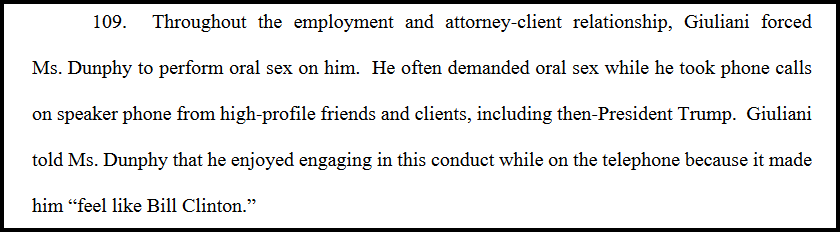
According to the complaint, Giuliani told her he loved blowjobs while on the phone because it made him “feel like Bill Clinton.”

“He had fashioned himself publicly as a major player in American politics, a successful businessman, and an important powerbroker who wielded enormous control over others,” Dunphy’s lawyers wrote. “He made clear that satisfying his sexual demands—which came virtually anytime, anywhere—was an absolute requirement of her employment and of his legal representation.”

“Giuliani began requiring Ms. Dunphy to work at his home and out of hotel rooms, so that she would be at his beck and call. He drank morning, noon, and night, and was frequently intoxicated, and therefore his behavior was always unpredictable.”

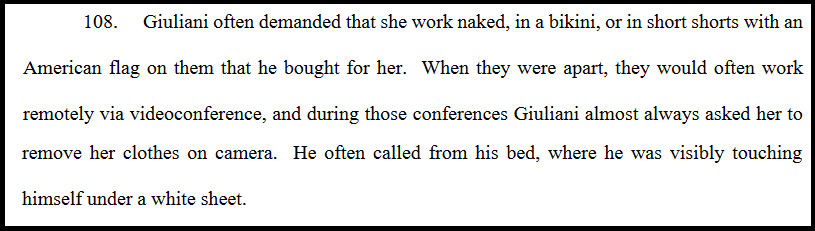
She claims that Giuliani “often demanded that she work naked, in a bikini, or in short shorts with an American flag on them that he bought for her.”

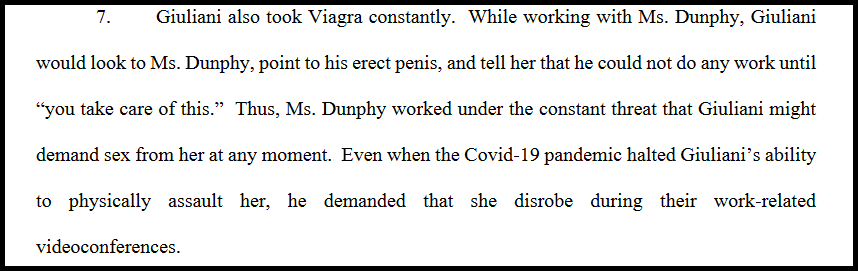
She also says that Rudy “took Viagra constantly,” and that he would point to his erect penis and tell her that he couldn’t do any work until “you take care of this.”

In another alleged encounter, Giuliani paid to fly Dunphy to New York for a business meeting. He put Dunphy up in his guest sweet in his Upper East Side apartment, during which he allegedly forced her to blow him (again).

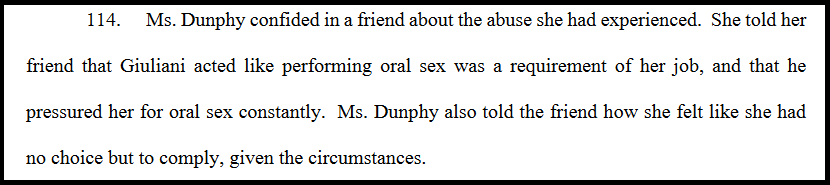
Dunphy says Giuliani “pressured her for oral sex constantly.”

More via the Epoch Times,

Dunphy’s Employment ‘Kept Secret’

According to the lawsuit, which also names three of Giuliani’s companies, Dunphy was hired by Giuliani while he was in the midst of an “acrimonious divorce” from his third wife Judith and he told Dunphy that her employment would need to be kept “secret” until the divorce proceedings were over.

“He claimed that his ‘crazy’ ex-wife and her lawyers were watching his cashflow and that his ex-wife would ‘attack’ and ‘retaliate’ against any female employee that Giuliani hired,” the lawsuit states, adding that Giuliani promised Dunphy that his divorce would be resolved “any day now.”

Lawyers for Dunphy claimed that on the very first day she began working for Giuliani, he kissed her in the back seat of a limo and asked if he could enter her home.

“Ms. Dunphy was stunned and shaken,” her lawyers wrote. “She politely declined and thanked him for her new job and his legal representation. As he was preparing to leave, Giuliani told Ms. Dunphy that since they would be working from different locations that week, he would like it if Ms. Dunphy sent him some flirtatious photos.”

‘Racist, Antisemitic Remarks’

“In addition to his sexual demands, Giuliani went on alcohol-drenched rants that included sexist, racist, and antisemitic remarks, which made the work environment unbearable,” lawyers for Dunphy wrote.

Giuliani also allegedly demanded often that Dunphy “dress as conservatively as possible when out in public or at work events” and forbade her from “seeing or talking on the phone with anyone without his approval,” lawyers said.

The lawsuit states that Dunphy has recordings of her interactions with Giuliani and that he gave her permission to record her interactions with him, as well as his interactions with others “anytime, anywhere.”

Dunphy was fired in January 2021 without pay, according to her lawyers.

In a text message to Dunphy at the time of her termination, Giuliani allegedly told her it was best if they not communicate, adding, “you have nothing to be afraid of and nothing to sue me for.”

“I have no animosity to you. You can feel safe that I would do nothing to hurt you and I feel sorry for you. I had hoped you got over your unjust claims of being afraid and wanting to sue. This is just not a basis for any form of communication. Sorry, I tried to make it sensible,” he wrote.

Giuliani ‘Unequivocally Denies Allegations’

Giuliani and his companies committed “unlawful abuses of power, wide-ranging sexual assault and harassment, wage theft, and other misconduct,” lawyers for Dunphy said.

Dunphy is seeking $10 million in compensation from Giuliani.

Giuliani’s communications adviser, Ted Goodman, said in a statement to CBS News on Monday that Giuliani “unequivocally” denies the allegations made by Dunphy.

Goodman added that “every news outlet covering this story must include the fact that an ex-partner accused her of being, ‘an escort that fleeces wealthy men.’”

“He [Giuliani] claimed she’s taken part in ‘prior schemes to defraud high net-worth men,’ according to a 2016 New York Post story. He also claimed she, ‘bragged about extorting $5 million’ from the son of a successful Wall Street investor, with a fake rape claim in 2011. Mayor Giuliani’s lifetime of public service speaks for itself and he will pursue all available remedies and counterclaims,” Goodman said.

In a separate statement to the New York Daily News, a Giuliani representative said that the former Trump lawyer and Dunphy dated “for a while” but that Dunphy was never employed by Giuliani or any of his entities.

They added that the lawsuit is “pure harassment and an attempt at extortion.”

Dunphy also filed a related “summons with notice” against Giuliani in January, seeking $3.1 million.

Meanwhile, the responses…

Tyler Durden
Tue, 05/16/2023 – 12:45

IEA Warns Oil Bears Are Disregarding An Imminent Supply Shortage

IEA Warns Oil Bears Are Disregarding An Imminent Supply Shortage

By Tsvetana Paraskova of OilPrice.com

The decline in oil prices over the past few weeks contrasts with an expected tightening of the market later this year when demand exceeds supply by nearly 2 million barrels per day (bpd), the International Energy Agency (IEA) said on Tuesday.

Since the middle of April, oil prices have lost all the gains from OPEC+’s latest announcement of new production cuts.

Early on Tuesday, WTI Crude traded at around $71 per barrel, down from more than $80 a barrel in the days following OPEC+’s surprise news of more than 1 million bpd cuts between May and December 2023.

In the latter part of April and early May, the price of Brent oil slumped by $16 a barrel in just two weeks, as concerns about the economy and future demand weighed on market sentiment, the IEA said in its closely-watched Oil Market Report today.  

Oil prices registered last week their fourth week of weekly losses as concerns about the Chinese and U.S. economies continued to negatively impact market sentiment. This was the longest weekly losing streak for oil since November 2021.  

“Prices were pressured lower by muted industrial activity and higher interest rates, which, combined have led to recessionary scenarios gaining traction and worries of a downward shift in oil demand growth,” the IEA said in its report, commenting on the oil prices.

“The current market pessimism, however, stands in stark contrast to the tighter market balances we anticipate in the second half of the year, when demand is expected to eclipse supply by almost 2 mb/d,” the international agency added.

Global oil supply has been lower in recent weeks due to outages in Iraq, Nigeria, and Brazil, and supply losses are set to increase in May with wildfires shutting in part of Canada’s production and OPEC+ producers starting to implement the latest cuts, the IEA noted.   

Tyler Durden
Tue, 05/16/2023 – 12:25

The Default Setting

The Default Setting

By Michael Every of Rabobank

Wouldn’t it be great if we could hold down a button and reset the world back to the default setting we thought was normal before our present mishigas? Boy, could we do with it!

Neoclassical economic models think we constantly mean-revert anyway, ignoring the role of credit, supply chains, political-economy, and geopolitics. It’s like a Google Maps that only does straight roads, not bends: worth following for long stretches when nothing is happening, but wrong every time we turn left or right. In the real world, sharp bends are all around us.

The Financial Times’ Gideon Rachman today warns: ‘Xi Jinping’s Taiwan ambitions threaten China’s rise’, not the first op-ed warning of the risk of war. The same paper reports that shipping groups are increasingly seeking break clauses in contracts with Chinese businesses to make it easier for them to walk away from any deals if sanctions are imposed on China: why the sudden concern, and wouldn’t that imply massively disrupted supply chains? Elsewhere, Iran seized a third oil tanker, and nobody seems to have even noticed. There is also not much coverage of Special Counsel Durham’s report into Russiagate concluding the Department of Justice and FBI “failed to uphold their mission of strict fidelity to the law. Will we now reset journalism to the default setting of bipartisan honest-brokers? Right after we dump neoclassical economic models.

US Treasury Secretary Janet “No financial crisis in my lifetime” Yellen is warning there are only days left until the US defaults on its debts, as President Biden and House Speaker McCarthy ceremonially rip the steering wheels out of their cars today in a pre-2024 game of chicken. We can expect things to get worse before they get better, but that we aren’t seeing wholesale selling of Treasuries down the curve, or the US dollar suggests nobody sees this is an existential issue – yet. However, as Yellen failed to take advantage of the lowest rates in history to refinance the public debt to limit pain from the rates re-set higher which the Fed she still speaks as if she runs is inflicting, the question will linger. And note the interest on the US federal debt is set to exceed spending on the Pentagon soon, as military spending is set to be higher for longer. Something is going to be reset. It’s just a question of what.

The Fed’s Bostic just stressed the “longer” in “higher for longer” rates too despite the New York Fed manufacturing survey collapsing to -31.8 from 10.8 prior and vs. -3.9 expected. Dovish Vice-Chair Goolsbee says he is getting “vibes” of a credit squeeze beginning. Yet some think that squeeze is what the Fed wants to see if the lending is frivolous rather than anything productive. Indeed, are the Fed trying to return the US economy to its historical default setting of low inflation, high production, not financialisation, and military strength in depth? The question is then how the liquidity keeps flowing to anything productive when it dries up to anything frivolous. I’ve made that point repeatedly because there isn’t any other policy that works: it’s just a question of how this is done and when. Meanwhile, the market obviously thinks the US default setting is very low inflation, very low rates, and very low domestic production of everything except financial assets (“Who needs HIMARS, we have CDOs!”).

In China, production is not matched by domestic demand outside services, for now: see ‘Recovery on shaky legs?’ from Teeuwe Mevissen, who thinks USD/CNY will test 7 again. Indeed, today’s China data were mostly big misses, with industrial production 5.6% y-o-y vs. 10.9% consensus, 3.6% year-to-date (y-t-d) vs. 4.9%; retail sales 18.4% y-o-y vs. 21.9% consensus, 8.5% y-t-d vs. 8.2% – which doesn’t match the trend of lower imports; fixed asset investment 4.7% y-o-y y-t-d vs. 5.7%, and property investment -6.2% y-o-y y-t-d vs. -5.7%. Overall, this looks deflationary.

Yet the European Commission just raised its Eurozone inflation outlook and warned of “persistent challenges”. CPI is now seen at 5.8% y-o-y in 2023 vs. 5.6% before, and 2.8% for 2024 vs. 2.5% – and that is despite the sharp fall in energy prices. Core inflation is seen much higher than in the last projection, and only declining slowly, remaining above the 2% target in 2023 and 2024. So, “Länger höher”, even as March industrial production data were -1.4% m-o-m.

In the Antipodes, the chatter is the RBNZ may hike Kiwi rates to 6% and the RBA to 4.35%, a message broadly backed by its latest set of minutes, which noted upside risks to sticky services inflation and the fact that strong population growth combined with low rental vacancy rates could see rents jump even higher than the RBA’s own elevated forecasts. So higher rates….which will then be passed on directly to renters by landlords! Meanwhile, headlines are still of properties next to sewer vents going for millions of dollars as multiple families bid to buy themselves protection from an unofficial political-economy default setting of ‘neo-feudalism lite’. As one US presidential candidate flags removing the right to vote for those under 25 unless they perform national service –welcome to ‘Starship Troopers’, where service guarantees citizenship: “Would you like to know more?”– an Aussie Twitter wag says every Australian should be subject to military service until they buy a home. Which is how thinks used to work once, of course.  

Like I said, it would be great to be able to reset everything – but it just isn’t going to happen. Or at least not in the way that most people expect.

Tyler Durden
Tue, 05/16/2023 – 09:31

US Industrial Production Unexpectedly Jumped In April

US Industrial Production Unexpectedly Jumped In April

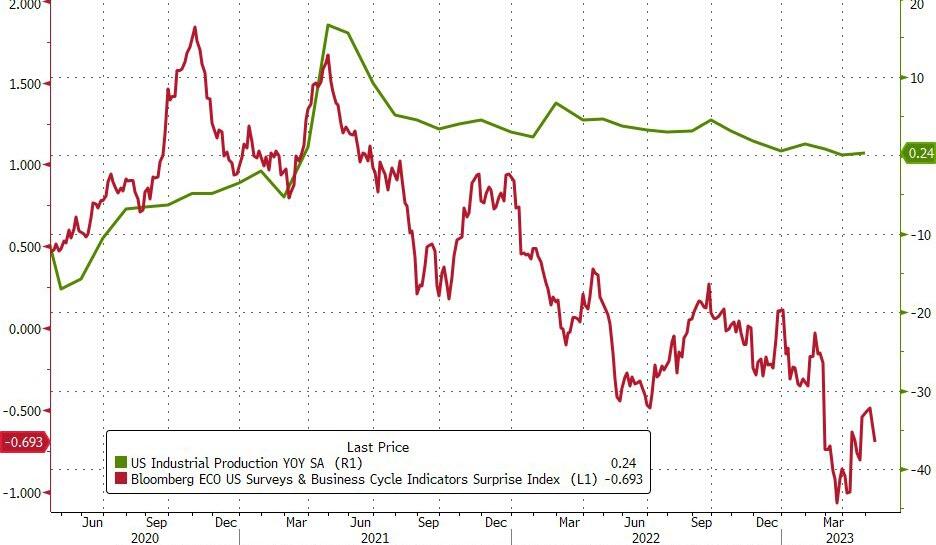
Despite a bloodbath in regional Fed manufacturing surveys, US industrial production and manufacturing activity jumped (unexpectedly) in April.

Headline Industrial Production rose 0.5% MoM in April (up from the 0.5% MoM rise in March and well ahead of the 0.0% change expected). However, on a YoY basis, industrial production remain languishing around unchanged…

Source: Bloomberg

Additionally, after a 0.8% MoM decline in March (revised down from -0.5%), US Manufacturing production rose 1.0% MoM (smashing the 0.1% MoM expectation)…

Source: Bloomberg

However, even that was not enough to get Manufacturing back above 0 on a YoY basis.

Capacity Utilization picked up modestly too…

Is this the ‘soft landing’ everyone hoped for? ‘Soft’ sentiment surveys say otherwise…

Or is it just more manufactured data?


Tyler Durden
Tue, 05/16/2023 – 09:27

The AI Revolution – A Repeat Of History?

The AI Revolution – A Repeat Of History?

Authored by Lance Roberts via RealInvestmentAdvice.com,

The artificial intelligence, or AI,” revolution is upon us. The financial media and headlines are abuzz with stories of generative “AI” and the subsequent “industrial revolution.”

Not surprisingly, attention has turned to AI with the launch of ChatGPT. The benefits are already apparent with the incorporation of AI into search engines. Even TikTok videos on ” making a million” using AI suggest why stocks associated with AI surged in recent months.

The Industrial Revolution is often considered a continuous event from the 1800s to the present. However, it is better understood as a series of paradigm shifts. The first, which began in the late 18th century, was propelled by mechanization and steam power. Mass production, electricity, and the assembly line fostered the second, which ran through the early 20th century. The third, which began post-WWII, introduced giant leaps in space exploration, computers, automation, and information technologies.

The fourth paradigm shift is occurring now. That revolution encompasses the advent of exponential technologies, from artificial intelligence and intelligent machines to robotics, blockchain, and virtual reality. Those technologies have already impacted how we live for over a decade.

These booms provided great opportunities as the innovations offered great investment opportunities to capitalize on the advances. Each phase led to stellar market returns that lasted a decade or more as investors chased emerging opportunities. (We will come back to those blue-shaded areas momentarily.)

We are experiencing another of these speculative “booms” as “Generative AI” grips investors’ imaginations. The chart below compares the 1999 “Dot.com/Internet Revolution” in the Nasdaq composite versus the 2023 “Generative AI” revolution.

If that analogy holds, it suggests the opportunity to capitalize on the impact of “AI” from an investment perspective remains.

But what about those blue-shaded boxes?

Those Blue Shaded Boxes

While the allure of “AI” certainly has investors salivating at the potential return profile, the valuation problem remains. As shown, despite the technological advances made from space exploration, the internet, or even “AI,” over-valuation can lead to long periods of stagnation.

Throughout history, low valuations preceded the best investment return periods. Such is because low valuations allowed for multiple expansions as investors could “pay up” for expected earnings growth. For example, in 1994, investors could buy Microsoft (MSFT) shares at a Price-to-Sales ratio of roughly three. As the internet boomed and more computers were needed to attach to the internet, sales for Microsoft accelerated. Today, shares of Microsoft are trading at more than 11 times Price-to-Sales. The expectations are that AI will fuel another massive boom in revenue.

However, therein lies the problem with valuations. At 11x price-to-sales, there is little margin for error. A good reminder of the importance of valuations was the comment made by Scott McNeely. Scott was the CEO of Sun Microsystems at the peak of the Dot.com revolution in 1999.

“At 10 times revenues, to give you a 10-year payback, I have to pay you 100% of revenues for 10 straight years in dividends. That assumes I can get that by my shareholders. Iassumes I have zero cost of goods sold, which is very hard for a computer company. That assumes zero expenses, which is really hard with 39,000 employees. That assumes I pay no taxes, which is very hard. And that assumes you pay no taxes on your dividends, which is kind of illegal. And that assumes with zero R&D for the next 10 years, I can maintain the current revenue run rate. Now, having done that, would any of you like to buy my stock at $64? Do you realize how ridiculous those basic assumptions are?”

This is an important point. At a Price-to-Sales ratio of two, a company needs to grow sales by roughly 20% annually. That growth rate will only maintain a normalized price appreciation required to maintain that ratio. At 11 times, the sales growth rate needed to maintain that valuation is astronomical.

But it isn’t just Microsoft. The table below lists the S&P 500 companies trading at five times sales or higher. I have highlighted a few of the more visible companies discussed in the mainstream media.

Yes, many of these companies will benefit from adopting “AI.” However, it is hard to justify, even under optimistic assumptions, that revenue growth will support the multiples paid today.

Even ChatGPT suggested the same.

“Paying more than five times the price to sales for an investment may pose several potential problems for investors, including overvaluation risk, unstable earnings, market saturation, competitive pressure, and industry-specific factors. As such, investors must conduct thorough due diligence and consider various financial and non-financial factors before making any investment decisions.”

Or, as Warren Buffett once quipped:

“Price is what you pay. Value is what you get.”

Been Here Before

“Maybe this time is different. Those words, supposedly the most dangerous to utter in the investing realm, came to mind amid the frenzied pops in the highly anticipated initial public offerings recently.” – Randall Forsyth, “Shades of 1999.”

For anyone who has lived through two “real” bear markets, the imagery of people trying to “trade” their way to riches is familiar. The recent surge in anything “AI” related is not new.

The companies that advanced regardless of actual revenue, earnings, or valuations were on the cutting edge of the internet revolution. As such, many thought “trees could grow to the sky.” Endless possibilities existed of how the internet would change our lives, the workplace, and futures. While the internet did indeed change our world, the reality of valuations and earnings growth eventually “mean reverted.”

It is crucial to remember that while valuations are essential to the eventual outcome of speculative market phases, it is a terrible market timing indicator. Price measures the current “psychology” of the “herd” and is the most precise representation of the behavioral dynamics of the living organism we call “the market.”

We are currently in a speculative phase regarding “AI” and its impact on the world as we know it. Unsurprisingly, searches for “AI” have exploded as retail investors chase performance.

And the breadth of the winners versus the losers in the market is extremely weak.

“The AI boom and hype is strong. So strong that without the AI-popular stocks, S&P500 would be down 2% this year. Not +8%.” – Societe Generale

The difference this time is that we are not starting from a place of low valuations. As noted above, current valuations are expensive across the entire market and astronomical in stocks like Microsoft, Nvidia, Adobe, and Apple.

While we are in the boom phase of the “AI” market, valuations suggest that the ride will eventually end. Chasing markets is the purest form of speculation. It is simply a bet on prices going higher rather than determining if the price being paid for those assets is selling at a discount to fair value.

A lot of money will be made in “AI” before this phase ends. But as with all market phases in the past, the end of the era was simply a function of the realization that “valuations matter.”

Tyler Durden
Tue, 05/16/2023 – 09:10

McCarthy Says Debt Ceiling Talks ‘Not In A Good Place’ As Yellen Warns ‘Time Is Running Out’

McCarthy Says Debt Ceiling Talks ‘Not In A Good Place’ As Yellen Warns ‘Time Is Running Out’

House Speaker Kevin McCarthy (R-CA) said on Monday that negotiations over the debt limit with Democrats and President Joe Biden are “not in a good place,” and that Biden had delayed talks for 100 days.

“We only have so many days left,” McCarthy said on Monday – reiterating today that there had been ‘no progress’ in the talks. “The president decided to wait 100 days before he would negotiate. He treated this the same way he treated the border [crisis]—he wanted to ignore the problem.”

McCarthy and Biden are scheduled to meet at 3pm ET on Tuesday.

Complicating matters is a Biden’s scheduled trip to Japan on Wednesday to attend the Group of Seven meetings.

According to McCarthy, Democrats “would have to get serious about negotiating” before he considers any progress to have been made. “They would have to really talk about where they’re going to go.”

I don’t think we’re in a good place, I know we’re not. This ignoring the problem, thinking it will go away … he could bumble his way into a default just like he did on the border.

McCarthy has sought to use the threat of defaulting on the nation’s debts to force Democrats to limit their spending. “Save, and grow,” he said of the GOP’s economic strategy.

Time is of the essence,” was McCarthy’s message for Biden on Monday. He has argued that the government can’t continue to spend money at the pace it is now.

An increase in the debt limit would not authorize new federal spending. It would only allow for borrowing to pay for the policies and legislation what Congress has already approved. –Epoch Times

“I’m really concerned that the Senate hasn’t passed anything. I’m really concerned that the president waited 100 days before he’d even talk to us. I’m really concerned about the president’s continued spending, of what it will do to Medicare and social security,” McCarthy said on Monday. “I’m really concerned about … instead of the Democrats sitting down, realizing we have a division in government, and being honest and adult and discussing this but simply lying about what we’re doing.”

Treasury Secretary Janet Yellen echoed McCarthy’s warning on Monday, saying that “time is running out” to avert an economic catastrophe, and that default could see financial markets “break” with worldwide panic that triggers margin calls, bank runs and fire sales.

“We are already seeing the impacts of brinksmanship: investors have become more reluctant to hold government debt that matures in early June,” Yellen said in remarks prepared for delivery to a banking conference on Tuesday, Bloomberg reports. “The impasse has already increased the debt burden to American taxpayers.”

The Treasury chief issued a fresh letter to congressional leaders Monday restating that the Treasury risks running out of sufficient cash for all federal obligations as soon as June 1. The livelihoods of millions of Americans “hang in the balance,” she said in excerpts of her speech to the Independent Community Bankers of America Capital Summit released by the Treasury.

Every single day that Congress does not act, we are experiencing increased economic costs that could slow down the US economy,” Yellen said.

Biden and McCarthy have been at an impasse since January over raising the government’s $31.4 trillion borrowing limit. Economists have cautioned that US default risks triggering a market selloff, a surge in borrowing costs and a blow to the global economy that could rival the 2008 crash.

According to people familiar with the meetings, the White House has pushed to exclude elements of a bill passed by House Republicans last month – including the elimination of Biden’s student-loan forgiveness program, as well as several legislative accomplishments.

Republicans, meanwhile, have rejected a Democratic proposal that would seek to raise revenue by altering a dozen provisions of the tax code, including a cryptocurrency loophole which allows investors to claim losses on assets that they then purchase. Another proposal from Democrats would be the elimination of a loophole that allows large real estate investors to effective receive interest-free government financing, Bloomberg reports.

According to Rep. Dusty Johnson (R-SD), the GOP has three red lines; no clean debt increase, no tax increase, and the bill must reduce the deficit.

Yellen also addressed recent banking turmoil, reiterating that US deposits remain safe.

“Recent banking troubles including the resolution of First Republic are not a sign of any shift in the fundamental health of the US banking system,” she said, adding “Americans should rest assured that their deposits are safe. Their deposits will be there when they need them.”

Tyler Durden
Tue, 05/16/2023 – 08:50

Headline US Retail Sales Disappoints In April, Slowest Annual Growth Since May 2020

Headline US Retail Sales Disappoints In April, Slowest Annual Growth Since May 2020

Weak tax refunds were expected to weigh on retail spending going forward, but perhaps not quite yet as expectations were for a MoM rebound from March’s unexpected decline with omnciscient BofA forecasting around consensus:

And rebound it did, but the headline print was disappointing – up only 0.4% MoM (vs +0.8% MoM exp) – but core and control group data (which fits into GDP calcs) were better than expected…

  • Retail Sales 0.4%, Exp. 0.8%

  • Retail Sales ex Auto 0.4%, Exp. 0.4%

  • Retail Sales Control Group 0.7%, Exp. 0.3%

Prior months were revised little stronger:

  • March Retail sales -1.0%, Revised to -0.7%

  • March Retail sales ex auto -0.8%. Revised to -0.5%

  • March Retail sales control group -0.3%, Revised to -0.4%

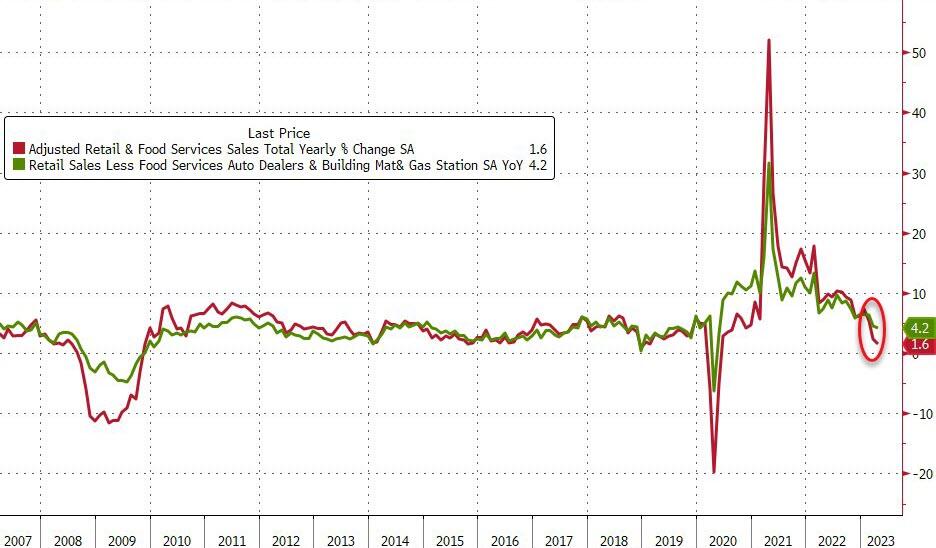
What is more notable is that (nominal) retail sales rose just 1.6% YoY (well below inflation) – the slowest since May 2020 – suggesting the consumer is feeling the pinch in a big way…

Source: Bloomberg

All of the YoY measures are at their slowest pace since COVID lockdowns…

Under the hood, 7 out of 13 retail categories rose last month.

The value of motor vehicle sales increased 0.4%, while receipts at gasoline stations fell 0.8%…

The market seems most focus on the Control Group’s beat with 10Y Yields up 4bps post-date.

Tyler Durden
Tue, 05/16/2023 – 08:38

Von Greyerz: A Disorderly Reset With Gold Revalued By Multiples

Von Greyerz: A Disorderly Reset With Gold Revalued By Multiples

Authored by Egon von Greyerz via GoldSwitzerland.com,

Tectonic shifts lie ahead. These will involve a US and European debt crisis ending in a debt collapse, a precipitous fall of the dollar and the Euro with Gold emerging as a reserve asset but at multiples of the current price.

The next phase of the fall of the West is here and will soon accelerate. It has been both precipitated and aggravated by the absurd sanctions of Russia. These sanctions are hurting Europe badly and affecting the US in a way that they didn’t expect, but was obvious to some of us. The Romans understood that free trade was essential between all the countries that they conquered. But the US administration blocks have both the money and the ability to trade of the countries they don’t like. 

But shooting yourself in the foot really hurts and the consequences are in front of our eyes. No foreign country will want to hold US debt or dollars. That is a catastrophic problem for the US as their deficits will grow exponentially in coming years. 

So a debt collapse is not just a looming disaster but a bomb hurling towards the US economy at supersonic speed. 

With the imminent death of the petrodollar and explosion of US debt, there is only one solution for the funding requirements of the US Government – the FED which will stand as the sole buyer of US Treasuries. 

A CATASTROPHIC DEATH SPIRAL 

So the DEBT spiral of higher debt, higher deficits, more Treasuries, higher rates and falling bond prices will soon turn into a DEATH spiral with a collapsing dollar, high inflation and most probably hyperinflation. Sounds like default to me but that word will probably never be used officially. It is hard to admit defeat even when it stares you in the face!

Yes, the US will probably obfuscate the situation with CBDCs (Central Bank Digital Currencies) but since that is just another form of Fiat money, it will at best buy a little time but the end result will be the same.

 US Debt Ceiling Farce belongs to Broadway rather than Wall Street

The debt ceiling was created in 1917 as a means of restricting reckless spending by the US government. But this travesty has gone on for over 106 years. During that time there has been a total disdain for budget discipline by the ruling Administration and congress. 

The problem is not just the debt but the cost of financing it. 

The annualised cost of financing the Federal debt is currently $1.1 trillion. If we assume conservatively that the debt grows to $40 trillion within 2 years, the interest cost at 5% would be $2 trillion. That would be 43% of current tax revenue. But as the economy deteriorates, interest will easily exceed 50% of tax revenue. And that is at 5% which will probably be much too low as inflation rises and The Fed loses control of rates. 

Thus a very dire scenario lies ahead and that is certainly not a worst case scenario.  

THE FED IS BETWEEN A ROCK AND A HARD PLACE 

The Fed and the thus US government are now between Scylla and Charybdis (Rock and a Hard Place). 

As it looks today, the US will bounce between Scylla and Charybdis in coming years until the US financial system and also the economy takes ever harder knocks and goes under just as every monetary system has in history. 

Obviously the rest of the West including an extremely weak Europe will follow the US down. 

BRICS AND SCO – RISING POWERS

The whole world will suffer but the commodity rich nations as well as the less indebted ones will ride the coming storm far better. 

This includes much of South America, Middle East, Russia and Asia. The expanding power blocks of BRICS and SCO (Shanghai Cooperation Organisation) will be the strong powers where a much increasing part of global trade will take place. 

Barring major political and geopolitical upheavals, China will be the dominant nation and the main factory of the world. Russia is also likely to be a major economic power. With $85 trillion of natural resource reserves, the potential is clearly there for this to happen. But first the political system of Russia needs to be “modernised” or restructured. 

What I outline above is of course structural shifts that will take time, probably decades. But whether we like it or not, the first phase, which is the fall of the West, could happen faster than we like. 

A MONETARY SYSTEM ALWAYS ENDS IN A DEBT EXPLOSION 

In 1913, total US debt was negligible, and in 1950, it had grown to $406 billion. By the time Nixon closed the gold window in 1971, debt was $1.7 trillion. Thereafter the curve has become ever steeper as the graph below shows. From September 2019 when the US banking system started to crack, the Repo crisis told us that there were real problems although no one wanted to admit it. Conveniently for the US government, the Repo crisis became the Covid crisis which was a much better excuse for the Government to print unlimited amounts of money together with the banks.   

Thus, just in this century, total US debt has grown from $27 trillion to $94 trillion!

But that was history and we know we can’t do anything about the past. But now comes the fun. 

I have been warning about a coming debt explosion for some time. Well, I believe this is it. 

In a recent article about the price of gold I explained that the final stages of hyperinflation are exponential.  

We will see a very similar exponential pattern with the coming debt explosion. If we assume that the final 5 minutes of the exponential phase started in September 2019, the stadium was then only 7% full and will in the next few years grow from 7% to 100% full or 14X from here. 

This is obviously just a demonstration and no exact science, but it shows that theoretically US debt could now explode. 

So let’s take a quick look at a few factors that will cause the debt explosion.

BANK FAILURES  

A Hoover Institute report calculates that more than 2,315 US banks currently have assets worth less than their liabilities. The market value of their loan portfolios are $2 trillion lower than the book value. And remember this is before the REAL fall of the asset values which is still to come. 

Just take US property values which are greatly overvalued by the lenders: 

So the four US banks that have gone under recently are clearly just the beginning. And no one must believe that it is just small banks. Bigger banks will follow the same route. 

During the 2006-9 subprime crisis, bailouts were the norm. But at the time, it was said that the next crisis would involve bail-ins.

But as we have seen so far in the US, there were no bail-ins. Clearly the government and the Fed were concerned about a systemic crisis and did not have the guts to bail in the bank customers, not even above the FDIC limit. 

As the crisis spreads, I doubt that bank depositors will be treated so leniently. Neither the FDIC, nor the government can afford to rescue everyone. Instead depositors will be given an offer they can’t refuse which is compulsory purchase of US treasuries equal to their credit balance. 

The European banking sector is in an even worse state than the US one. European banks are sitting on large losses from bond portfolios acquired when interest rates were negative. No one knows at this stage the magnitude of the losses which are likely to be substantial. 

Both in commercial property and housing, the situation is worse in Europe than in the US since the European banks are funding most of these loans directly themselves, including € 4 trillion of home mortgages. 

The banks also have a mismatch between low rates received on mortgages against high rates paid to finance them. 

The ex-governor of the Bank of France and ex-head of the IMF, Jacques de Larosière accuses the authorities of subverting the private banking system with deranged volumes of QE after it had become toxic: 

“Central banks, far from promoting stability, have delivered a Masterclass in how to organise financial crisis”

$3 QUADRILLION OF GLOBAL DEBT & LIABILITIES  

If we add the unfunded liabilities and the total outstanding derivatives to the global debt, we arrive at around $3 quadrillion as I discussed in this article:

“This is it! The financial system is terminally broken”

Sadly, the Western financial system is now both too big to save and too big to fail. 

Still all the king’s horses and all the king’s men cannot save it. So even if the system is too big to fail, it will with very dire consequences.

GOLD TO BE SUBSTANTIALLY REVALUED IN THE DISORDERLY RESET

Just over a century after the creation of the Fed and the beginning of the debt ceiling, the mighty dollar has lost 99% of its value in purchasing power terms. 

And measured against the only money which has survived in history – Gold – the dollar has also lost 99%. 

This is obviously not an accident. Not only is gold the only money which has survived but also the only money which has kept its purchasing power throughout the millennia.

For example, a Roman Toga cost 1 ounce of gold 2000 years ago, which today is also the price for a high quality man’s suit. 

You would have thought that losing 99% of its value for the reserve currency of the world would be a disaster. Well it is of course, but the US, as well as most of the Western world, has adjusted by increasing debt exponentially to make up for the disastrous debasement of the currencies. 

What is even more interesting, gold is up 8-10X this century against most currencies.

That is a superior performance to virtually all major asset classes. 

And still nobody owns gold which is only 0.5% of global financial assets. 

More recently gold is at all-time-highs in all currencies including the dollar. 

But in spite of the extremely strong performance of gold or more correctly put, the continued debasement of all currencies, no one talks about gold.

Just looking at the number of articles covering gold in the press in the graph below (white bars), it confirms that the most recent price increase of gold (blue line) is met by a yawn. 

This is obviously very bullish. Imagine if all stock markets made new highs. It would be all over the media. 

So what this is telling us is that this gold bull market, or currency bear market, has a very long way to go. 

As I often point out, no fiat money but only gold has survived throughout history. 

Gold’s rise over time is always guaranteed as governments and central banks will without fail destroy their currency by creating virtually unlimited fake money.  

Since this has been going on for 1000s of years, history tells us that this trend of constantly debasing fiat money is unbreakable due to the greed and mismanagement of governments. 

And now with the debt crisis accelerating, so will the gold price. 

Luke Groman makes a very interesting point in his discussion with Grant Williams (grant-williams.com by subscription).  Luke suggests that although the dollar will not yet die as a transactional currency, that it is likely to be replaced by gold as the reserve asset currency.  

The combination of dedollarisation and liquidation of US treasuries by foreign holders will lead to this development. 

Commodity countries will sell for example oil to China, receive yuan and change the yuan to gold on the Shanghai gold Exchange. They will then hold gold instead of dollars. This will avoid the dollar as a trading currency when it comes to commodities. 

In order for gold to function as a reserve asset, it will need to be revalued with a zero at the end and a bigger figure at the beginning as Luke says. The whole idea would be that gold will become a neutral reserve asset which floats in all currencies. 

The inverse triangle of Global debt resting on only $2 trillion of Central Bank gold shown above makes the revaluation of gold obvious. 

A floating gold price as a reserve asset is of course much more sensible than a fixed gold price backing the currencies and would be the nearest to Free Gold

See my 2018 article, “Free Gold will kill the Paper Gold Casino”.

So the consequence of gold becoming a reserve asset could involve a rise of say 25X or 50X the current level.  Certainly not an improbable outcome in today’s money. The debasement of the dollar and other Western currencies is likely to have a similar effect but then we are not talking in today’s money. Time will tell. 

As gold is now in an acceleration phase, we are likely to see much higher levels however long it takes and whatever the reason is for the rise. 

The 1980 gold price of $850, adjusted for real inflation would today be $28,300 

As gold is now in an acceleration phase, we are likely to see much higher levels however long it takes. 

What is clear is that fiat money, bonds, property and stocks will all decline precipitously against gold. 

What is important for investors is to take protection now against the most significant RESET in history which is a disorderly reset. 

So if you don’t hold gold yet, please, please protect your family, and your wealth by acquiring physical gold.  

Gold repositioning as a Global Reserve Asset could happen gradually or it could happen suddenly. But please be prepared because when it happens you don’t want to hold worthless paper money or assets. 

Tyler Durden
Tue, 05/16/2023 – 07:20

Much Of The Markets Still Don’t Believe The US Can Default

Much Of The Markets Still Don’t Believe The US Can Default

By Ven Ram, Bloomberg markets live reporter and strategist

“if political [debt ceiling] kabuki ends in risk-off drama then Fed does QE (like BoE last Oct)…this is why other assets classes not worried.” – BofA’s Michael Hartnett

Except in some specific corners, most of the markets don’t quite buy the story that the US Treasury could, after all, default on its obligations.

T-bills due around the estimated time of the X-date have shown some angst, with yields on one-month instruments up some 200 basis points in less than a month. Meanwhile, credit-default swaps are pricing in a 3% chance of a default. While that may not seem alarming, that default pricing is way higher than in 2011 and 2013, when we were last witness to such stress.

Yet, the rest of the markets are still pretty sanguine about the eventual outcome. The S&P 500 is still holding onto to its 7+% rally for the year, while the Nasdaq 100 is up a gravity-defying 22%. Front-end Treasury yields have come off more than 100 basis points from their peak for the cycle, but that is more a reflection of the markets positioning — rightly or wrongly — for a putative Fed pivot rather than anything to do with the debt-ceiling impasse. Gold, which BBG readers reckon will be a haven should the US indeed default, hasn’t done much so far this month.

While the supposed X-date — when the Treasury will have run through its gamut of emergency maneuvers — is supposedly June 1, in reality it may turn out to be different because it’s impossible to look through the crystal ball and know precisely when, say, tax receipts may flow in. That is perhaps one reason the markets reckon that lawmakers will do what common sense dictates by the time the D-Day rolls in.

The point, though, is the the US economy, already facing considerable headwinds from the turmoil in the banking industry, isn’t quite so well-placed to flirt with another Wile E. Coyote moment. And that is the part the stock markets haven’t quite priced in — yet.

Tyler Durden
Tue, 05/16/2023 – 06:55