73 F
Chicago
Wednesday, August 12, 2026
Home Blog Page 3770

The Global Great Awokening

The Global Great Awokening

Authored by Noah Carl via The Daily Sceptic,

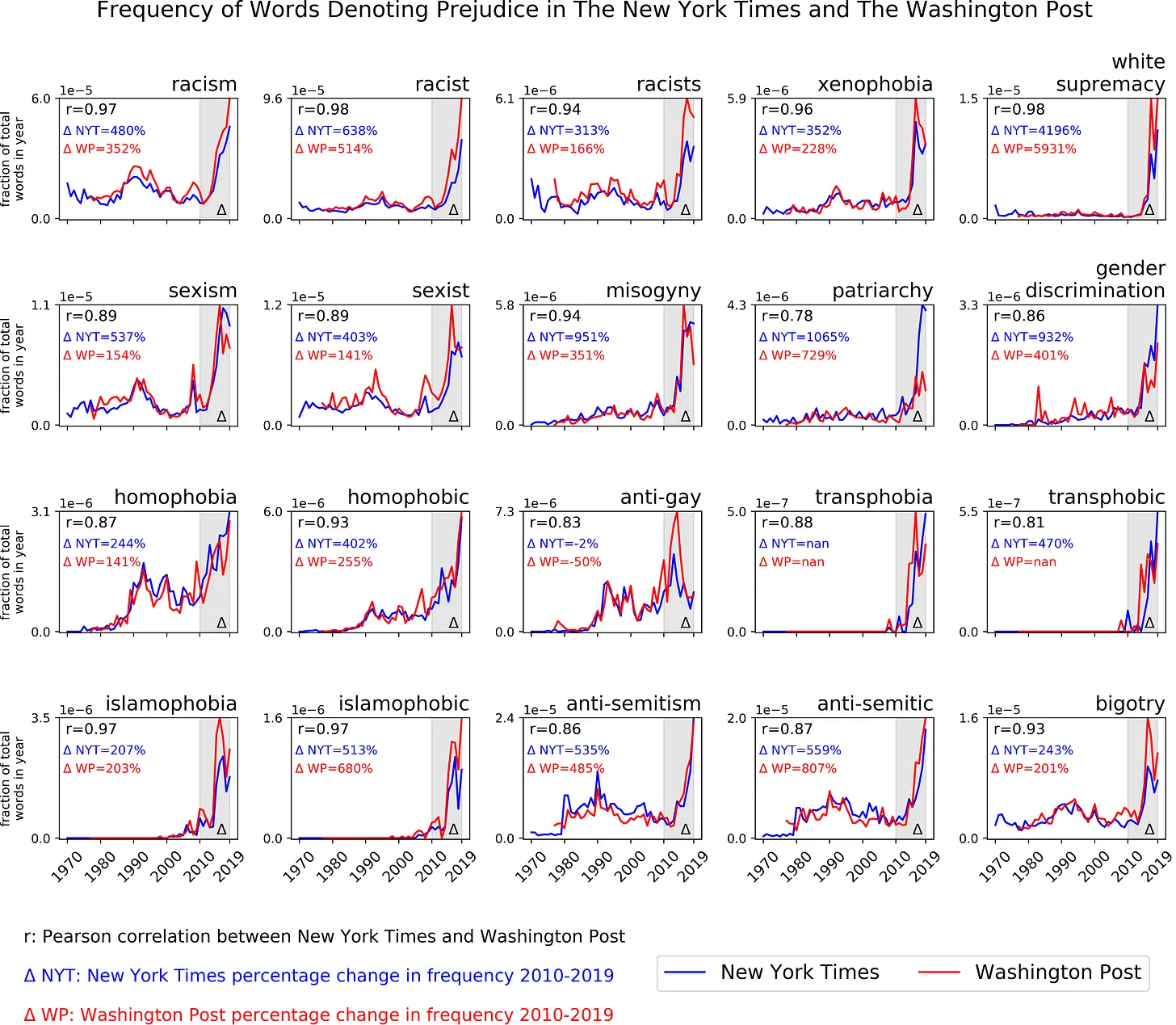
David Rozado has become something of a household name here at the Daily Sceptic, thanks to his pioneering studies on wokeness. You know those charts showing sharp upticks in the usage of terms like ‘sexism’, ‘racism’ and ‘transphobia’? He’s the guy who made them.

Until recently, he’d confined himself to studying the Anglosphere and his native Spain. Rozado has now extended his analysis to dozens of other countries, and what he finds is pretty remarkable: The Great Awokening is a global phenomenon.

In almost every country Rozado looked at, there was increase in the frequency of what he calls “prejudice-denoting terms” beginning around 2012. As the left-hand chart below indicates, this was true even in countries like Kenya and Nigeria – where you’d assume people would be more concerned about things like poverty.

Charts taken from ‘The Great Awokening as a Global Phenomenon’.

The chart uses a standardised scale, which makes the trend in each country visible while masking average differences across countries. So what do those average differences show? When Rozado plotted them separately for each type of prejudice, the results were quite interesting (see right-hand chart above).

As you’d expect, mentions of ‘Islamophobia’ were most common in Muslim countries, while mentions of ‘anti-semitisim’ were by far the most common in Israel. And mentions of ‘sexism’ (and related terms) were most common in Spain. For the other three types of prejudice, the pattern was less clear, though the UK came close to the top on all three.

Perhaps the most interesting finding to emerge from Rozado’s analysis is that the big increase – the “woke hockey stick”, as I’ve named it – appears to be more or less simultaneous in all countries. This is somewhat surprising. Most of us had been assuming that it occurred first in the US, then in other Western countries, and then (if at all) in the rest of the world.

Among Western countries, the US does appear to be a front-runner on mentions of ‘racism’, as you’d predict, though the margin isn’t huge. (Russia has also seen a big increase, though Rozado believes this mainly reflects commentary mocking the Western media’s preoccupations.)

So did the Great Awokening originate in America, as most of us had been assuming? I believe it did. Though I also believe it was amplified in many countries at the same time through social media.

As to why the phenomenon probably did originate in the US, you have to remember that non-Americans read American media far more than Americans read non-American media. What’s more, many influential journalists and activists in countries outside America go to study at America’s elite colleges, where they imbibe the tenets and language of woke ideology.

So you’ve got many influential journalists and activists all around the world reading American media and regurgitating what they learned at US colleges. Then social media hits. And because that’s where influential people congregate, articles couched in the latest woke jargon frequently go viral, causing less-influential people to adopt the same jargon in their own articles.

Soon everyone in the media of a particular country is using terms like ‘patriarchy’, ‘transphobic’, and ‘people of colour’.

My argument is admittedly somewhat speculative. But that doesn’t mean it can’t be tested. You’d have to go back and see which articles went viral first, and who wrote them. I suspect that English-speaking journalists, especially those who studied in America, would be overrepresented among the authors.

Tyler Durden
Sun, 04/16/2023 – 07:00

The Disruptive Military Technologies The Pentagon Is Spending Nearly $150 Billion On

The Disruptive Military Technologies The Pentagon Is Spending Nearly $150 Billion On

Authored by John Haughey via The Epoch Times (emphasis ours),

President Joe Biden’s $886.3 billion Fiscal Year 2024 (FY24) defense budget request includes $145 billion for research and development into emerging technologies to create new weapons systems using Artificial Intelligence (AI), hypersonic munitions, and electromagnetic swarms.

The U.S. Department of Defense launches a sounding rocket from NASA’s launch range at Wallops Flight Facility on Wallops Island, Va., on Oct. 26, 2022. (Evelyn Hockstein/Reuters)

The Department of Defense (DOD) and its subsidiary military branch technology laboratories, working in tandem with universities and high-tech contractors that increasingly include small businesses, have produced such big-ticket splashes as newly deployed directed-energy weapons systems and hypersonic/ballistic sensors.

Among prospective products and systems seeking funding in the FY24 spending request is a ‘Rocket Cargo’ transport that can move 100 tons of cargo anywhere on Earth within an hour; a counter-swarm electromagnetic weapon that can disable drones and be powered from a wall plug; a rotating detonation engine without moving parts; a “pop-up hide” that can make Marines disappear in plain sight; a Predictive Vehicle Activity for Identification and Location (PreVAIL) program that “will bring a novel approach to automated target detection and recognition.”

There are also less sexy utilitarian products being tested in the budget, such as a Portable Fluid Analyzer, a ship-to-ship system that converts Morse code into text messages, and an assembly line of bigger, faster, better-armed unmanned aircraft, from micro-drones to the latest Unmanned Long-endurance Tactical Reconnaissance Aircraft (ULTRA.)

All have survived, or must soon traverse, “The Valley of Death.”

Unlike notable valleys in American military history—Valley Forge, the Chosin, Khe Sanh, the Korengal—this “Valley of Death” is not a place on a map but that dreaded moment of realization on a military product development timeline when a cutting-edge weapon that will deliver a decisive battlefield advantage cannot advance out of prototype to production and get onto the battlefield in time.

An operational version of the Active Denial System, a military counter-personnel directed energy weapon that is the equivalent of science fiction’s heat ray. (Unlisted USAF personnel/Public domain/ Wikimedia Commons )

‘The Valley of Death’

Integrating new, still-maturing technologies into existing programs and platforms without “radical disruption” to multi-year procurement and acquisitions systems is among the most tweaky of challenges confronting the military, Pentagon officials said during a two-hour April 13 webinar presented by the National Defense Industrial Association (NDIA).

The DOD’s Under Secretary of Defense for Research & Engineering Heidi Shyu and the DOD’s Defense Advanced Research Projects Agency (DARPA) Director, Dr. Stefanie Tompkins, noted the proposed $145 billion Research, Development, Test, and Evaluation (RDT&E) budget is up 12 percent from this year with the Air Force receiving one-third of the requested outlay.

Shyu said the Science and Technology component of the RDT&E budget request is $17.8 billion, up 8.3 percent over this year’s $16.5 billion budget.

The annually updated National Defense Science & Technology Strategy is on Secretary of Defense Lloyd Austin’s desk, she said.

Shyu said the strategy will focus on joint mission; creation and deployment of capabilities at speed and scale; establishment of an enduring advantage in talent, infrastructure, research, and collaboration; directed energy weapons; and hypersonic/ballistic sensors.

Technology leaders for three military branches—Army Deputy Assistant Secretary for Research & Technology William Nelson, Naval Research Chief Rear Adm. Lorin Selby, Air Force Research Laboratory Commander Maj. Gen. Heather Pringle—outlined cooperative ventures with industry and workforce development plans, especially in currying bids and participation in projects by small businesses.

The $886.3 billion FY24 defense request includes $842 billion for the Pentagon with emphasis on the “growing multi-domain threat posed by the People’s Republic of China (PRC),” which the DOD has again named the nation’s most pressing “pacing challenge.”

March and April is typically when DOD and military command officers testify before congressional panels about their spending requests during the annual budget cycle leading up to Oct. 1, the official start of the federal fiscal year.

All five of the panelists at the NDIA webinar have been making the rounds on Capitol Hill to meet with congressional bean-counters to discuss funding for new whiz-bang weapons, such as fusion-based target recognition systems, to such relatively mundane innovations as snow tires for Humbles, since February.

But on April 13 before the NDIA, a Washington-based nonprofit that represents 1,800 corporations and nearly 60,000 individuals working in the defense manufacturing industry, it was all about “The Valley of Death.”

The USS Ponce conducts an operational demonstration of the Laser Weapon System while deployed to the Arabian Gulf. (U.S. Navy photo by John F. Williams/Released)

‘Moats of Despair’

Delivering new technologies developed in the commercial sector under DOD contract into the field in a seamless transition, especially when so many weapons systems are interrelated, is a daunting challenge, the officials said.

In fact, in June 2022, Deputy Secretary of Defense Kathleen Hicks called transition discord “one of our biggest problems—the so-called ‘Valley of Death,’ scaling up to full-scale production and fielding” new weapons systems.

Selby said there isn’t just one “Valley of Death” but at least three, which he described as “moats of despair.”

“The first ‘Valley of Death’” is the stage where “the first identified prototype” is manufactured and tested and “it didn’t pan out or we failed internally” to properly build and test it, he said.

That ‘Valley of Death’ is within my control” at that point, Selby said.

The next “Valley of Death” is moving a product from prototype to production, he said, which is when other factors come into play, such as costs and manufacturing capabilities, which can make further development unfeasible. “This is a deep valley,” where many projects go to die, he said.

The final ‘Valley of Death” is “getting that production to scale,” Selby said. “You got something, something that is ready to go onto a platform, as part of a modernization package” but you don’t control production schedules especially for an item that was previously manufactured at a “low rate production.”

“The warfighter is screaming, ‘I need that and need that tomorrow’—that is [a problem] we have to solve. We have not solved it,” he said. “How do I rapidly go to scale? That’s the question. That’s how you win.”

Read more here…

Tyler Durden
Sat, 04/15/2023 – 23:30

Watch: Beyond The Reset

Watch: Beyond The Reset

This excellent animated short film about the not-too-distant-but-very-dystopian future is at once humorous and terrifying.

It speculates on the potential consequences of the infamous Great Reset, medical tyranny, woke culture, and green agenda.

Everything, that World Economic Forum (WEF) is planning for us.

If you’d like to buy the creator a beer, his PayPal address is oleg@3depix.com

Tyler Durden
Sat, 04/15/2023 – 23:00

They Must Have A Good Reason

They Must Have A Good Reason

Authored by Todd Hayen via Off-Guardian.org,

There is a strange idea hovering about that if you don’t know something then it doesn’t exist.

Kind of like the image of the proverbial ostrich with his head in the sand. But it goes beyond denial. Ignorance is when you don’t know something at all, denial is when you know it, but you ignore it.

What I am talking about here is when you know something and do not deny it, but simply rationalize it away with a statement like “they must have a good reason for doing that,” or similarly, “maybe we don’t know all that there is to know about that.” Which is often followed with, “and I don’t have the time, (inclination, care, interest, curiosity, ability, intelligence, etc.) to look into it further.”

This has always bugged me to some extent, but I must admit I have been marginally guilty of this sort of thinking myself. I mean, do we really have the time to check everything? Well, now I think we have to make the time, and, of course, not everything is important enough to require vetting it for truth. That is an awful thing to say, but I am afraid it is the truth.

Part of this “gullibility” that causes many people to just brush things off assuming that all is ok comes from indoctrination from an early age. I grew up in a culture that seemed to be really obsessed with people’s safety—particularly the safety of children. Think of all the recalls of toys and such. If some toy comes out that has the slightest bit of uncertainty about how it might harm your child, it is pulled.

I should not say I “grew up” with this because most of the crap I played with as a kid would be considered a lethal weapon today—Lawn Darts, BB and pellet guns, Vac-U-Forms, chemistry sets, Easy Bake ovens (this was my sister’s toy, she was a little girl, I was a little boy—I tell you this for clarity). The “safety craze” didn’t really start until a decade or so later. I even remember some kid I knew got an “Atomic Energy Lab” toy that had actual uranium ore in the kit.

I would have died (literally) to get my hands on one of these.

Those were the days.

So over the decades, due to these recalls and safety concerns, we have developed a false sense of security. What regulation agency would bother to recall Lawn Darts but at the same time allow an unsafe vaccine to reach the unwilling arms of children? Well, toys are toys, vaccines are medicine. There ‘ya go.

The government, and other regulatory agencies, know what’s right, right?

Being born into a culture (US) that was known for its integrity, truthfulness, righteousness, and a penchant for character and goodness (ha, ha), no one would ever think that the CIA would have been actively trying to assassinate Fidel Castro, among others, for decades.

I remember first hearing a rumor about this when I was about 15. “No way,” I thought to myself. “Assassinations are illegal! My country would never be involved in such a thing!” Especially attempting to murder a leader of a country that really was just minding their own business. At least so it seemed. (Today, when we hear of such things, we shrug our shoulders and say, “They must know what they are doing.”)

And what about Iran’s Mosaddegh? He was minding his own business overseeing the affairs of Iran as Prime Minister from 1951 to 1953. The US wasn’t happy with him for a number of reasons (primarily economic, like, for example, Mosaddegh wanted Iran to get a bigger share of oil profits that the US and UK were sucking out of his nation’s oil fields, imagine that! What audacity!). The CIA bopped him off as well—indirectly with a CIA created insurrection, which led to Mosaddegh’s imprisonment and more than likely contributed to his health issues, then he died). Sure there is detail here I am not presenting, but you get the picture.

The US Government must have had a good reason.

How about Obama’s drone war? Killing a whole whack of people, including children (I would say “women and children” but I might get in trouble for that).

He must have had a good reason.

Personally, I don’t think there is any “good” reason to kill children—even if as collateral damage or unintentionally.

I am presenting here only a few examples among thousands…more than we even know of course. And this is just government actions, what about pharmaceutical actions, or other medical actions? They all must have good reasons.

As a whole most people seem to think that atrocities cannot happen in the US (or Canada, or the UK, or other countries in the “civilized” West). We are just too sophisticated for that. The irony here is the official spokespeople for the US, for example, actually present themselves as do-gooders. They either keep their actions covert and Top Secret, or they present them as “good things.” We only have to look to people like Julian Assange and Edward Snowden to see how the US treats whistleblowers who seek to expose the fact the US really doesn’t have a good reason to do much that it does—at least no reason that benefits us.

If you ever corner a sheep and throw this sort of stuff at them, they will first hit you with the statement, “why do you have to be so negative? Why can’t you just trust your government to take care of business in our best interests as a nation?” They will say that the government has to have secrets in order to keep us safe, and those people who break the law (Assange and Snowden, among many others. Since we are counting, let’s include the truckers of Canada as well) are criminals, and it doesn’t matter if your intention is good, if you break the law you are a criminal and should be punished.

If you try to argue with these sheep about anything more complex, like the CIA’s intervention into Middle Eastern affairs, they will just blow it off and say something like, “All that overseas stuff is just too complicated to sort out. And those Middle Eastern countries (except Israel) are all bad guys, I don’t really care what the US does to them, they know what they are doing.”

Sheep are funny that way. “La, la, la, la, la, la” with fingers plugging their ears. It is easy to push them to this point. Sheep poking. Try it some time for fun and pleasure.

One good way to get them there really quickly is to bring up some false flag issue that has been in the big time news within the last few decades. The 9-11 fiasco is my favorite. You’ll get the sheep fingers into the ears really quickly with the “la la la’s” going full blast. Don’t try something too far out there though, like the moon landing, or the hot ticket now, germ vs. terrain theory. You’ll only just get eye rolls for those whacko topics.

I am curious though…speaking of 9-11… what will happen when that incident is exposed for what it was? (Assuming that will ever occur.)

I will bet you money, no matter how ludicrous it would be, their first response to the realization that their own government was responsible for the destruction of those buildings at the World Trade Center, will be, “They must have had a good reason.”

Actually they did, but it wasn’t a good reason for us.

Tyler Durden
Sat, 04/15/2023 – 22:30

US Criticizes China’s Death Sentence Of ‘Wrongfully Detained’ American Citizen

US Criticizes China’s Death Sentence Of ‘Wrongfully Detained’ American Citizen

Authored by Aldgra Fredly via The Epoch Times (emphasis ours),

The United States on Thursday expressed its “disappointment” over China’s decision to uphold a death sentence of an American man who had been “wrongfully detained” for over a decade on drug-related charges.

Texas resident Katherine Swidan holds a picture of her son Mark Swidan who has been held in China for a decade. (Courtesy of the Swidan family)

Mark Swidan, a Houston resident, was detained on Nov. 13, 2012, while on a business trip to China. He was accused of being a part of a network involved in the manufacturing and trafficking of drugs.

Swidan pleaded not guilty to all charges but was denied by the Jiangmen Intermediate Court, which upheld his death sentence with a two-year suspended sentence, according to the U.S. Department of State.

“We are disappointed by this decision and will continue to press for his immediate release and return to the United States,” Vedant Patel, a Department of State spokesman, said in a statement.

“U.S. officials have repeatedly expressed their concerns to senior PRC [People’s Republic of China] officials about Swidan’s treatment, medical care, and his inability to send or receive mail in a timely manner,” he added.

Patel said that President Joe Biden and Secretary of State Antony Blinken will “continue to remain personally focused” on the release of Swidan and other U.S. nationals who were “wrongfully detained” or held hostage around the world.

Lack of Evidence

Swidan was aged 37 at the time of his arrest. He was sentenced to death in 2018 despite a lack of evidence presented against him.

No drugs were found on Swidan’s body or in his hotel room when he was arrested, according to a report [pdf] released by the United Nations Working Group on Arbitrary Detention in 2020.

The prosecution failed to produce forensic or telecommunications evidence, such as emails, phone call records, or letters. His passport records showed that Swidan was not in China when the alleged offense occurred.

U.S. officials had previously called for his release. In February, Texas Republicans—including Sen. Ted Cruz, Sen. John Cornyn, and Congressman Michael Cloud—introduced a resolution demanding his release ahead of Blinken’s planned trip to Beijing.

They’ve sentenced him to death on charges for which they have little to no evidence, and I had been urging Tony Blinken when he was going to Beijing to raise Mark’s case and to make the case for Mark to be released,” Cruz said in a statement.

Blinken indefinitely postponed his visit after a suspected Chinese spy balloon was detected flying over the continental United States. A U.S. military jet later shot down the balloon on Feb. 4.

“Bringing Mark Swidan home to his family should be a top priority for this administration,” Cloud said. “Too many innocent Americans remain wrongfully imprisoned by authoritarian regimes who are happy to collect human lives as a capital for future political bargaining.”

‘Badly Mistreated’

According to the U.N. report, Swidan was “badly mistreated” while in detention and exposed to “poor sanitary conditions.” He was denied medical treatment and barred from communicating with his family or U.S. Consulates.

Read more here…

Tyler Durden
Sat, 04/15/2023 – 22:00

Hacking Humanity: Transhumanism

Hacking Humanity: Transhumanism

Authored by Michael Rectenwald via The Mises Institute,

The notion that the world can be replicated and replaced by a simulated reality says a great deal about the beliefs of those who promote the metaverse [treated in the previous chapter]. The conception is materialist and mechanistic at base, the hallmarks of social engineering. It represents the world as consisting of nothing but manipulable matter, or rather, of digital media mimicking matter. It suggests that human beings can be reduced to a material substratum and can be induced to accept a technological reproduction in lieu of reality. Further, it assumes that those who inhabit this simulacrum can be controlled by technocratic means. Such a materialist, mechanistic, techno-determinist, and reductionist worldview is consistent with the transhumanist belief that humans themselves will soon be succeeded by a new transhuman species, or humanity-plus (h+)—perhaps a genetically and AI-enhanced cyborg that will outstrip ordinary humans and make the latter virtually obsolete.

The term transhumanism was coined by Julian Huxley, the brother of the novelist Aldous Huxley and the first director-general of the United Nations Educational, Scientific and Cultural Organization (UNESCO). In an essay entitled “Transhumanism,” published in the book New Bottles for New Wine (1957), Huxley defined transhumanism as the self-transcendence of humanity:

The human species can, if it wishes, transcend itself—not just sporadically, an individual here in one way, an individual there in another way, but in its entirety, as humanity. We need a name for this new belief. Perhaps transhumanism will serve: man remaining man, but transcending himself, by realizing new possibilities of and for his human nature.

One question for transhumanism is indeed whether this transcendence will apply to the whole human species or rather for only a select part of it. But Huxley gave some indication of how this human self-transcendence might occur: humanity would become “managing director of the biggest business of all, the business of evolution . . .” As the first epigraph to this Part makes clear, Julian Huxley was a proponent of eugenics. And he was the President of the British Eugenics Society. It was in his introduction of UNESCO, as the director-general that he suggested that eugenics, after the Nazi regime had given it such a bad name, should be rescued from opprobrium, “so that much that now is unthinkable may at least become thinkable.” As John Klyczek has noted, “In the wake of vehement public backlash against the atrocities of the Nazi eugenic Holocaust, Huxley’s eugenics proper was forced to go under-ground, repackaging itself in various crypto-eugenic disguises, one of which is ‘transhumanism.’” Transhumanism, Klyczek suggests, is “the scientific postulate that human evolution through biological-genetic selection has been largely superseded by a symbiotic evolution that cybernetically merges the human species with its own technological handiwork.”

Contemporary transhumanist enthusiasts, such as Simon Young, believe that humanity can take over where evolution has left us to create a new and improved species—either ourselves, or a successor to ourselves:

We stand at a turning point in human evolution. We have cracked the genetic code; translated the Book of Life. We will soon possess the ability to become designers of our own evolution.

In “A History of Transhumanist Thought,” Nick Bostrom details the lineage of transhumanist thought from its prehistory to the present and shows how transhumanism became wedded to the fields of genomics, nanotechnology, and robotics (GNR), where robotics is inclusive of Artificial Intelligence (AI). It is the last of these fields that primarily concerns us here. The transhumanist project has since envisioned the transcendence of humanity via technological means. In the past thirty years, this technological transcendence has been figured as “the singularity.”

Vernor Vinge, the mathematician, computer scientist, and science fiction author introduced the notion of the technological singularity in 1993. The singularity, Vinge suggested, is the near-future point at which machine intelligence will presumably supersede human intelligence. Vinge boldly declared: “Within thirty years, we will have the technological means to create superhuman intelligence. Shortly after, the human era will be ended.” Vinge predicted that the singularity would be reached no later than, you guessed it, 2030. The question Vinge addressed was whether, and if so, how, the human species might survive the coming singularity.

The inventor, futurist, and now Google Engineering Director Raymond Kurzweil has since welcomed the technological singularity as a boon to humanity. Kurzweil, whose books include The Age of Spiritual Machines (1999), The Singularity Is Near (2005), and How to Create a Mind (2012), suggests that by 2029, technologists will have successfully reverse-engineered the brain and replicated human intelligence in (strong) AI while vastly increasing processing speeds of thought. Having mapped the neuronal components of a human brain, or discovered the algorithms for thought, or a combination thereof, technologists will convert the same to a computer program, personality and all, and upload it to a computer host, thus grasping the holy grail of immortality. Finally, as the intelligence explosion expands from the singularity, all matter will be permeated with data, with intelligence; the entire universe will “wake up” and become alive, and “about as close to God as I can imagine,” writes Kurzweil.

Thus, in a complete reversal of the Biblical creation narrative, Kurzweil posits a dumb universe that begins with a cosmic singularity (the Big Bang) and becomes God by a technological singularity. This second singularity, Kurzweil suggests, involves the universe becoming self-aware, vis-à-vis the informational, technological agent, humanity. Thus, in the technological singularity, the technological and the cosmic converge, as Kurzweil resembles a techno-cosmic Hegelian. (Hegel figured collective human self-consciousness progressing in self-actualization and self-realization, finally becoming and recognizing itself as God, “through the State [as] the march of God in the world.”) Incidentally, according to Kurzweil, our post-human successors will bear the marks of their human provenance. Thus, the future intelligence will remain “human” in some sense. Human beings are the carriers of universal intelligence and human technology is the substratum by which intelligence will be infinitely expanded and universalized.

More recently, Yuval Noah Harari—the Israeli historian, WEF-affiliated futurist, and advisor to Klaus Schwab—has also hailed this singularity, although with dire predictions for the vast majority. According to Harari, the 4-IR will have two main consequences: human bodies and minds will be replaced by robots and AI, while human brains become hackable with nanorobotic brain-cloud interfaces (B/CIs), AI, and biometric surveillance technologies. Just as humans are functionally replaced, that is, they will be subject to the total control of powerful corporations or the state (or, what’s more likely, a hybrid thereof, a neo-fascist state). Rather than a decentralized, open-access infosphere of exploding intelligence available to all, Singularitarian technologies will become part of the arsenal for domination. The supersession of human intelligence by machine intelligence will involve the use of such data and data processing capabilities to further predict and control social behavioral patterns of the global population. In addition, the biotechnical enhancement of the few will serve to exacerbate an already wide gulf between the elite and the majority, while the “superiority” of the enhanced functions ideologically to rationalize differences permitted by such a division. That is, Harari suggests that if developments proceed as Vinge and Kurzweil predict, this vastly accelerated information-collecting and processing sphere will not constitute real knowledge for the enlightenment of the vast majority. Rather, it will be instrumentalist and reductionist in the extreme, facilitating the domination of human beings on a global scale, while rendering opposition impossible.

In an article in Frontiers in Neuroscience, Nuno R. B. Martins et al. explain just how such control could be implemented through B/CIs, which the authors claim will be feasible within the next 20 to 30 years:

Neuralnanorobotics may also enable a B/CI with controlled connectivity between neural activity and external data storage and processing, via the direct monitoring of the brain’s ~86 x 109 neurons and ~2 x 10¹⁴ synapses. . .

They would then wirelessly transmit up to ~6 x 1016 bits per second of synaptically processed and encoded human–brain electrical information via auxiliary nanorobotic fiber optics (30 cm3) with the capacity to handle up to 1018 bits/sec and provide rapid data transfer to a cloud-based supercomputer for real-time brain-state monitoring and data extraction. A neuralnanorobotically enabled human B/CI might serve as a personalized conduit, allowing persons to obtain direct, instantaneous access to virtually any facet of cumulative human knowledge (emphasis mine).

Such interfaces have already reached the commercialization stage with Elon Musk’s Neuralink, Kernel, and through DARPA, among others.

When neuralnanorobotic technologies that conduct information and algorithms that make decisions interface with the brain, the possibilities for eliminating particular kinds of experiences, behaviors, and thoughts becomes possible. Such control of the mind through implants was already prototyped by Jose Delgado as early as 1969. Now, two- way transmission of data between the brain and the cloud effectively means the possibility of reading the thoughts of subjects, interrupting such thoughts, and replacing them with other, machine-cloud-originating information. The desideratum to record, label, “informationalize,” rather than to understand, let alone critically engage or theorize experience will take exclusive priority for subjects, given the possibilities for controlling neuronal switching patterns. Given the instrumentalism of the Singularitarians— or, as Yuval Harari has called them, the “Dataists”— decisive, action-oriented algorithms will dominate these brain-cloud interfaces, precluding faculties for the critical evaluation of activity, and obliterating free will. Given enough data, algorithms will be better able to make decisions for us. Nevertheless, they will have been based on intelligence defined in a particular way and put to particular ends, placing considerable emphasis on the speed and volume of data processing and decision-making based on data construed as “knowledge.” Naturally, Aldous Huxley’s Brave New World comes to mind. Yet, unlike Huxley’s mind-numbing soma, brain-cloud interfaces will have an ideological appeal to the masses; they are touted as enhancements, as vast improvements over standard human intelligence.

Harari peels back the curtain masking transhumanism’s Wizard of Oz promises, suggesting that even before the singularity, robotics and machine intelligence will make the masses into a new “useless class.” Given the exorbitant cost of entry, only the elite will be able to afford actual enhancements, making them a new, superior species—notwithstanding the claim that Moore’s Law closes the technological breach by exponentially increasing the price-performance of computing and thus halving its cost per unit of measurement every two years or less. How the elite will maintain exclusive control over enhancements and yet subject the masses to control technologies is never addressed. But perhaps a kill switch could be implemented such that the elite will not be subjected to brain-data mining—unless one runs afoul of the agenda, in which case brain-data mining could be (re)enabled.

In a 2018 WEF statement, Harari spoke as the self-proclaimed prophet of a new transhumanist age, saying:

We are probably among the last generations of homo sapiens. Within a century or two, Earth will be dominated by entities that are more different from us, than we are different from Neanderthals or from chimpanzees. Because in the coming generations, we will learn how to engineer bodies and brains and minds. These will be the main products of the 21st century economy (emphasis mine).

No longer capable of mounting a challenge to the elite as in the nineteenth and twentieth centuries, and having no function, the feckless masses will have no recourse or purpose. Exploitation is one thing; irrelevance is quite another, says Harari. And thus, as Harari sees it, the remaining majority will be condemned to spend their time in the metaverse, or worse. If they are lucky, they will collect universal basic income (UBI) and will best occupy themselves by taking drugs and playing video games. Of course, Harari exempts himself from this fate.

As for the elite, according to Harari, their supposed superiority to the masses will soon become a matter of biotechnological fact, rather than merely an ideological pretension, as in the past. The elite will not only continue to control the lion’s share of the world’s material resources; they will also become godlike and enjoy effective remote control over their subordinates. Further, via biotechnological means, they will acquire eternal life on Earth, while the majority, formerly consoled by the fact that at least everybody dies, will now lose the great equalizer. As the supernatural is outmoded, or sacrificed on the altar of transhumanism, the majority will inevitably forfeit their belief in a spiritual afterlife. The theistic religions that originated in the Middle East will disappear, to be replaced by new cyber-based religions originating in Silicon Valley. Spirituality, that is, will be nothing but the expression of reverence for newly created silicon gods, whether they be game characters, game designers, or the elites themselves.

Harari’s pronouncements may amount to intentional hyperbole to make a point, but his statements are remarkable for the cynicism and disdain for humanity they betray. They are revelatory of the unmitigated gall of believers in the transhuman future. Coupled with the neo-Malthusian impulses of the elite, centered around the UN and the WEF, a picture emerges of an elite whose objective is to reduce the population of “useless eaters,” while keeping the remainder in their thrall.

[This piece is an excerpt from The Great Reset and the Struggle for Liberty.]

Tyler Durden
Sat, 04/15/2023 – 21:30

Stunning Satellite Images Show Rare “Superbloom” Blanketing California’s Hillsides

Stunning Satellite Images Show Rare “Superbloom” Blanketing California’s Hillsides

After a deluge of atmospheric rivers that dumped 78 trillion gallons of water on California, effectively ending a severe multi-year drought within several months, a rare superbloom has emerged in the state’s southern region across hillsides, and it’s even visible from space.

CBS News reported new photos via NASA’s Landsat 9 satellite show a rare wildflower superbloom in Southern California after years of drought. The wet conditions spurred the germination of flower seeds all at once, leading to large swaths of land covered in various colors. 

Southern California’s superbloom phenomenon. Source: NASA 

Maxar Technologies also published satellite photos showing the hillside outside Palmdale covered in yellow and orange flowers.

Another image shows a hillside covered in purple. 

And another shows hillsides covered in yellow. 

The rare desert botanical phenomenon has captured the attention of Southern California residents. Many have taken day trips to see the colorful hillsides. 

Although severe drought conditions have largely subsided and wildflowers blanket the hillsides, this abundance of vegetation could potentially serve as fuel for fires when drought conditions reemerge. 

Tyler Durden
Sat, 04/15/2023 – 21:00

Contentious COVID-19 Drugs Are All Anti-Malarial: May Not Be A Coincidence

Contentious COVID-19 Drugs Are All Anti-Malarial: May Not Be A Coincidence

Authored by Marina Zhang via The Epoch Times (emphasis ours),

The COVID-19 recommendations hydroxychloroquine, ivermectin, and now artemisinin all have one thing in common: They are antimalarial drugs or have such properties.

Yet studies suggest that this may not be a mere coincidence; malaria and COVID-19 may be more similar than people may realize.

Malaria Versus COVID-19

From the outset, malaria and COVID-19 are very distinct diseases.

Malaria is a parasitic disease. An infection starts when an individual is bitten by a mosquito carrying a parasite from the Plasmodium genus. Upon infection, the parasite first goes to the liver and multiplies in liver cells. Then it migrates to the bloodstream, invades and proliferates in red blood cells, and causes these cells to expand and burst.

Common malaria symptoms such as fever, chills, and sweating occur during the blood-stage infection. Complications include anemia, and on rare occasions, cerebral malaria, liver failure, fluid buildup in the lungs, and acute respiratory distress syndrome.

COVID-19, on the other hand, is a viral disease. Infection occurs primarily through the inhalation of contaminated droplets. The virus invades the body through the nasal cavities, entering the upper and then lower respiratory tracts.

Inflammation of the lungs ensues as the body’s immune cells fight off the infection. The person’s oxygen levels start dropping as inflammation worsens in the advent of a cytokine storm, and the lungs become damaged. Some of the virus can also go into the bloodstream and invade other organs, causing systemic inflammation and damage.

Several Commonalities

While one mainly affects blood cells and the other primarily affects the lungs, both diseases are characterized by a strong inflammatory response early in the infection, according to a 2022 paper in Frontiers in Immunology.

Symptoms-wise, both infections from malaria and COVID-19 can lead to fever, fatigue, shortness of breath, diarrhea, and muscle pain.

If inflammation is prolonged, the body will experience a significant increase in cytokines, and individuals can become severely injured or even die.

The two diseases are also similar in that they both sequester iron, use the same receptors in their pathogenesis, and even share similar structures in their proteins.

Iron Storage

Both the Plasmodium parasite and the SARS-CoV-2 virus require iron to proliferate. Therefore, both the parasite and the virus need to store iron inside the ferritin protein within infected cells. High or increased levels of ferritin are therefore an indication of severe disease and inflammation.

Drugs that are capable of targeting iron storage or preventing proliferation may therefore be successful in treating both malaria and COVID-19.

Similar Receptors

The angiotensin-converting enzyme 2 (ACE-2) receptor is involved in both malaria and COVID-19 infections.

In COVID-19, the virus binds to ACE-2 to invade cells. ACE-2 is ubiquitous within the human body, present within at the very least:

  • Lungs
  • Blood vessels
  • Muscles
  • The gut
  • Nerves
  • Stomach
  • Heart
  • Kidneys
  • Pancreas
  • Testes
  • Uterus

Organs that have a high number of ACE-2 receptors are therefore at a higher risk of COVID-19 infection.

The significance of ACE-2 in malaria is uncertain. However, one study, as well as the one published in Frontiers in Immunology, showed that people who have their ACE-2 receptors reduced due to genetic predispositions are more resistant to malaria.

According to the Frontiers in Immunology study, malaria parasites use the CD147 receptors on red blood cells to gain entry into the cell. The COVID-19 virus also uses CD147 in the absence of ACE-2 receptors. CD147 has also been linked to the formation of blood clots in COVID-19 infections.

Therapeutics that can target CD147 and ACE-2 may be successful in treating both malaria and COVID-19.

Similar Protein Structures

Additionally, both pathogens share a degree of overlap in their protein structures. The COVID-19 surface N protein has at least 40 percent structural similarity with important malarial proteins in charge of transport, attachment, and invasion.

This means that drugs that can target malarial proteins may also be able to target SARS-CoV-2 viral proteins.

Antimalarial Drugs Used in COVID-19

Early in the pandemic, many studies recommended antimalarial and anti-parasitic drugs such as hydroxychloroquine, chloroquine, ivermectin, and artemisinin as potential treatment options for COVID-19. These recommendations, however, soon received backlash, with one reason being that malaria and COVID-19 seem to be very different diseases.

But many doctors and studies found these therapeutics helpful in treating acute COVID-19. Professor Jose Luis Abreu, whose specialty is in plant science at The State University of Nuevo León, used the proposition of “parallelism between malaria and COVID-19” as an explanation for why antimalarial drugs such as ivermectin, artemisinin, and hydroxychloroquine may be applied to COVID-19 in his protocol.

Block COVID-19 Receptors and Proteins

In simulation studies, ivermectin, hydroxychloroquine, and artemisinin can bind to SARS-CoV-2 N proteins, which have structural similarities with malaria proteins. In treating malaria, hydroxychloroquine and artemisinin have been shown to block malarial proteins from replicating and proliferating.

All three drugs can also bind to CD147 and ACE-2 receptors, as previously reported by The Epoch Times. These drugs can also bind to COVID-19 spike proteins directly to prevent viral attachment to cell receptors and also prevent viral proliferation by blocking proteins that take part in viral replication.

Read more here…

Tyler Durden
Sat, 04/15/2023 – 20:30

Have Internal-Combustion-Engine Vehicle Sales Already Peaked?

Have Internal-Combustion-Engine Vehicle Sales Already Peaked?

Electric vehicle (EV) sales have grown rapidly over the past few years, but have they managed to make a dent in the global market?

To find out, Visual Capitalist’s Marcus Lu visualized data from BloombergNEF that breaks down annual vehicle sales by three categories:

  • Internal combustion (including traditional hybrids)

  • Plug-in hybrids

  • Battery electric

From this, we can see that EVs are definitely building up market share. In fact, combustion vehicle sales appear to have peaked in 2017.

Growth in EV Market Share

The following table lists global EV sales, as well as their relative market share.

Year EV Sales EV Market Share (%)
2013 206,000 0.2
2014 320,000 0.4
2015 543,000 0.6
2016 791,000 0.9
2017 1,262,000 1.3
2018 2,082,000 2.2
2019 2,276,000 2.5
2020 3,244,000 4.2
2021 6,768,000 8.3
2022 10,522,000 13.0

*Includes plug-in hybrids. Source: EV Volumes

We can see that EV sales really picked up steam around 2019. This is likely due to various government subsidies and a growing list of models to choose from.

EV ranges, once a major limiting factor, are also becoming less of a concern as battery technology improves and more charging stations become available.

Will Combustion Vehicle Sales Stage a Comeback?

It seems unlikely that combustion vehicles will be able to reclaim much of their lost market share.

China, the world’s largest car market, is leading the world in terms of EV adoption. As of 2022, one in four new cars sold in the country is electric. The U.S. and EU are transitioning slower, but should catch up thanks to government subsidies and a planned phase-out of fossil fuel vehicles.

In the EU, the sale of new internal combustion vehicles will be banned by 2035. However, an exemption was recently made on behalf of Germany to allow the sale of cars that run on synthetic fuels.

In the U.S., the 13 states that adhere to California’s Zero Emissions Vehicle (ZEV) Program are aiming for 100% of cars sold in 2035 to be ZEVs. These states include California, Colorado, Connecticut, Maine, Maryland, Massachusetts, Minnesota, New Jersey, New York, Oregon, Rhode Island, Vermont, and Washington.

Tyler Durden
Sat, 04/15/2023 – 20:00

How AI Can Track, Manipulate Voters

How AI Can Track, Manipulate Voters

Authored by Kevin Stocklin via The Epoch Times (emphasis ours),

How well do artificial intelligence (AI) programs know us humans?

A visitor watches an AI (Artificial Intelligence) sign on an animated screen at the Mobile World Congress (MWC), the telecom industry’s biggest annual gathering, in Barcelona. (Josep Lago/AFP via Getty Images)

In most cases, it’s quite well and, in some ways better than we know ourselves.

A study by AI experts at Brigham Young University, titled “Out of One, Many: Using Language Models to Simulate Human Samples,” found that predictive AI programs exhibited a striking degree of what they call “algorithmic fidelity,” or precise mapping to actual human behavior.

“Because these AI tools are basically trained on stuff that humans produce, things that we write, documents we make, websites we write, they can reflect back to us a lot of interesting and important things about ourselves,” Ethan Busby, political psychologist and co-author of the study, told The Epoch Times. “Kind of like if someone read your diary from start to finish, they would know a lot of things about you, and you’re not going to like every single thing.

“In a similar way,” Busby said, “these tools have read so many things that humans have produced, and they can replicate or say back to us things about ourselves that we didn’t necessarily know.”

The study sought to analyze human behavior in the context of elections and asked how accurately a GPT-3 language model could predict voting patterns based on socio-demographic factors like a person’s gender, age, location, religion, race, and economic status. The authors used these factors to create “silicon samples,” or composite personas based on varying combinations of these attributes.

You can basically ask these tools to put themselves in a specific frame of mind and pretend to be essentially this person, pretend to have these characteristics,” Busby said. They asked the program how these “silicon samples” would vote in specific campaigns, then they compared the results to actual voters’ behavior in elections between 2012 and 2020, using data from the American National Elections studies.

For example, Busby said, regarding the 2016 election, “We could say what kinds of groups are going to be pivotal in Ohio?” What they found was that AI quickly learned to accurately predict how people would vote, based on their attributes.

Left and Right Decry AI, When It Costs Elections

Artificial intelligence is highly useful to organizations that want to target things like political messaging campaigns or fundraising efforts. But some political analysts have raised red flags about this, inferring unfairness and election interference. Their degree of outrage, however, largely depends on whether their candidates or causes succeeded or failed.

In 2017, The Guardian, a left-wing British newspaper, wrote a series of articles claiming that conservative tech entrepreneur Robert Mercer, whom it called “the big data billionaire waging war on the mainstream media,” had financed a campaign strategy using AI to circumvent mainstream media narratives. This, the paper alleged, illicitly swayed voters in favor of Donald Trump, resulting in his victory in the presidential election in 2016.

Read more here…

Tyler Durden
Sat, 04/15/2023 – 19:30