73 F
Chicago
Wednesday, August 12, 2026
Home Blog Page 3771

Data-Centers & Small Nuclear Reactors – A Match Made In Heaven?

Data-Centers & Small Nuclear Reactors – A Match Made In Heaven?

Authored by Brian Gitt via RealClear Wire,

Most of us don’t think about the huge data centers that enable our constant internet usage. But they’re essential to our civilization—and they consume enormous amounts of electricity 24/7.

Powering these data centers is fast becoming a problem. Northern Virginia, for instance, hosts the largest concentration of data centers in the world. Tech giants like Amazon, Facebook, Microsoft, and Google have invested $126 billion in Virginia data centers. And the region’s insatiable appetite for power continues to grow due to surging demand for cloud computing services. 

Without reliable power, cloud service providers can’t grow to match the pace of increasing demand. But the electrical grid can’t keep up. Right now, power transmission bottlenecks in Northern Virginia could delay new data center development into 2026.

Data center developers across the pond are facing the same problem. Microsoft and Amazon halted plans to build new data centers in Dublin, Ireland, because of power shortages and threats of rolling blackouts. And British officials paused construction on new houses in West London until 2035 because data centers had already maxed out the local grid’s capacity. 

And it’s not just power consumption that is sparking opposition to data centers. Concerns about greenhouse gas emissions, water usage, noise pollution, and the overall sustainability of data centers are fueling local opposition that is constraining where—or even whether—data centers get built. 

Google, Amazon, Microsoft, and Facebook have responded to the demand for clean energy by investing heavily in wind and solar projects. But wind and solar alone can’t solve the problem. Those energy sources simply can’t deliver the uptime that data centers need. Consider the European wind drought of 2021 that cut wind power in the UK by 32 percent for 6 months. The need for round-the-clock uptime presents a serious—perhaps insurmountable—obstacle to data centers relying solely on sources of power like wind and solar that don’t generate power at night, or on cloudy days, or when the wind doesn’t blow.

Some people hope we’ll eventually be able to store surplus wind and solar energy in batteries. But the reality is that batteries are too expensive to store enough energy to supply reliable power for weeks (let alone months) of uncooperative weather. 

The good news is that there’s a solution—a power source reliable enough to provide uptime round-the-clock at low cost and with zero emissions: a small onsite nuclear power plant dedicated to supplying power to a data center. 

Small modular reactors (SMRs) supply between 10 and 300 MW of power 24/7. A data center supplied by an SMR would face no more competition for power with local communities. No more waiting for new transmission lines or power plants to be built. And no more emissions. When we consider the full lifecycle of different power sources (including mining, manufacturing, and disposal), solar emits four times more carbon than SMRs.

SMRs differ from large conventional nuclear plants as much as modern smartphones differ from old rotary phones. Conventional plants are large and complicated, and cumbersome US and European regulations make them expensive to build. Two units (1,117 MWs each) currently being built in the US state of Georgia have cost upwards of $30 billion. Construction on them, moreover, is six years behind schedule, and when they finally come online in 2023, they will have taken 14 years to complete. These kinds of costs and delays present a capital risk factor for large conventional nuclear plants. 

Large nuclear reactors are also land-intensive. They typically require over 800 acres and usually need to be sited near a lake, river, or the ocean to access water for cooling. Plus, they don’t recycle spent fuel.

SMRs are simpler and much less expensive to construct. Off-the-shelf components and factory prefabrication bring construction costs as low as $60 million. SMRs have a small footprint—about two acres for the smallest reactors, which is less than 0.5% of the land used by traditional reactors. Most don’t use water for cooling and therefore don’t have to be sited near a lake, river, or ocean. They can be installed on site or at a nearby location in under a year, and developers needn’t put capital at risk as some SMR companies offer power purchase agreements (PPAs).

Oklo, for instance, owns and operates the power plant and sells 24/7 clean power at costs equal to or less than traditional energy sources. Oklo’s streamlined regulatory approach and extensive experience working with the U.S. Nuclear Regulatory Commission minimizes the time required to get a license to operate. The expected timeline from a signed PPA to powering servers (including licensing, permitting, and constructing) is two to three years. Plus, SMRs can be designed to recycle spent fuel—both their own fuel and fuel from large nuclear plants.

SMRs promise data centers what they’re looking for: a reliable, low-cost, carbon-free energy source that yields round-the-clock uptime. Data centers of all sorts (hyperscale, colocation, or telecom) can use SMRs to secure the energy independence they need to overcome bottlenecks in the grid and to avoid competition for energy with local communities. 

Tyler Durden
Sat, 04/15/2023 – 19:00

The E. Coli Super-Pathogens You Should Know About

The E. Coli Super-Pathogens You Should Know About

Authored by Dr. Sean Lin and Jacky Guan via The Epoch Times (emphasis ours),

Foodborne illnesses, also known as food poisoning, are a serious public health issue. Each year, they make 48 million people get sick, hospitalize 128,000, and cause the death of 3,000. Pathogenic E. coli is one of the most common known foodborne pathogens. However, the severity of various E. coli strains varies tremendously and the public should be cautious about one particularly dangerous type of E. coli.

E. Coli 101

Escherichia coli, also known as E. coli, is one of the most common types of bacteria known to mankind. From helping with digestion in your stomach to being a producer of artificial insulin, the bacteria discovered in 1885 have been studied countless times and improved our understanding of the microscopic world.

The E. coli we infamously know from the news belong to the group Enteropathogenic E. coli (EPEC) and are pathogens responsible for food poisoning. Foodborne illnesses also include Salmonella and Norovirus (responsible for the recent cruise ship outbreaks). Typically, an E. coli infection occurs when a person comes into contact with contaminated food, animals, or water. It usually only causes mild abdominal pain or brief diarrhea. Other symptoms include stomach cramps, nausea, vomiting, and fever.

Typical treatment usually involves rest, hydration, and nutritional support. The disease is usually self-limiting as the body can normally clear it. The use of antibiotics is common in treating E. coli, yet antibiotic resistance is also a problem worldwide. However, severe forms of E. coli are the Shiga toxin-producing variants of the bacteria that can have dire consequences.

STEC Variants Severely Damage Intestinal Linings and Kidneys

The variants of E. coli that produce Shiga toxins (Stx) are called Shiga toxin-producing E. coli, or STEC. They have gained a lot of attention in the past few decades, as they are known for causing severe disease.

STEC belongs to the EPEC group. STEC strains are capable of producing toxins named Shiga toxin type 1 (Stx1), type 2 (Stx2), or both, encoded by stx1 and stx2 genes, respectively.

The toxins are named after Kiyoshi Shiga, who first described the bacterial origin of dysentery caused by Shigella dysenteriae. Historically, the toxin produced by E. coli was named Shiga-like toxin (SLT). Now, Shigella dysenteriae and STEC are regarded as the most common sources of Shiga toxins.

Symptoms of a STEC infection include abdominal pain and watery diarrhea. There are also severe—possibly life-threatening—cases characterized by hemorrhagic colitis. These types of E. coli are also called Enterohemorrhagic E. coli (EHEC). Shiga toxins are also associated with hemolytic uremic syndrome (HUS).

In particular, the STEC O157:H7 and STEC O104:H4 are the two most notorious STEC strains. One could say these STEC groups are something like super soldiers in the E. coli army.

Shiga toxin-producing bacteria are E. coli strains one does not want to encounter. (The Epoch Times)

The Shiga toxin does most of its work in small blood vessels, as it is rather ineffective in large vessels such as major veins and arteries. This is how the toxin can specialize against the digestive tract, kidney, and lungs. For example, the Shiga toxins are good at destroying clusters of nerve endings or small blood vessels in the kidneys, which can lead to kidney failure and even HUS. It can severely damage the lungs as well, so food poisoning associated with Shiga toxins is often also associated with lung and nervous system damage.

Read more here…

Tyler Durden
Sat, 04/15/2023 – 18:30

Visualizing Air Pollution Levels Around The World In 2022

Visualizing Air Pollution Levels Around The World In 2022

The World Health Organization (WHO) estimates that air pollution leads to 7 million premature deaths every year.

Out of the six common air pollutants, particulate matter measuring 2.5 microns or smaller in diameter, or PM2.5, is accepted as the most harmful to human health. This is due to its prevalence in the atmosphere and the broad range of adverse health effects associated with its exposure, such as heart disease, stroke, lung cancer and chronic respiratory diseases.

With that context in mind, this visualization from Visual Capitalist’s Selin Oğuz and Miranda Smith uses IQAir’s World Air Quality Report to map out the 2022 average PM2.5 concentrations in select major cities around the globe, expressed in micrograms per cubic meter (μg/m³).

Understanding the WHO Air Pollution Guidelines

Did you know that in 2019, only 1% of the global population lived in places where WHO global air quality guidelines were met?

Designed to protect public health from the harmful effects of air pollution, the guidelines cover a range of air pollutants, including particulate matter, ozone, nitrogen dioxide, sulfur dioxide, and carbon monoxide.

The healthy limits for PM2.5 are set at an annual average of 0-5 μg/m³.

WHO Classification Annual Average PM2.5 Concentration (μg/m³) % of countries within classification, 2022*
WHO Air Quality Guideline 0 – 5 9.9%
Interim Target 4 5.1 – 10 18.3%
Interim Target 3 10.1 – 15 19.8%
Interim Target 2 15.1 – 25 28.2%
Interim Target 1 25.1 – 35 9.9%
Exceeds Target Levels 35.1 – 50 7.6%
Exceeds Target Levels > 50 6.1%

*Percentages are calculated as a proportion of the 131 countries that had sufficient air quality data and were included in IQAir’s World Air Quality Report in 2022.

According to IQAir’s World Air Quality Report, only 13 countries or territories met the recommended concentration of PM2.5 in 2022. Among them were Australia, Finland, Puerto Rico, Iceland, Bermuda, and Guam.

Above this guideline, many countries fell within the four interim targets, while nearly 14% recorded air pollution levels that exceeded all target levels.

The Effects of Air Quality on Mortality

While it can be a little difficult to grasp what the above concentrations represent, thinking of them in terms of their effect on mortality can shed some light on their significance.

According to the WHO, non-accidental mortality rates multiply by 1.08 per 10 µg/m³ increase in PM2.5 concentration, but only up to 35 μg/m³. Above that, mortality growth rates may not be linear, resulting in many more deaths.

Here is an example to highlight what that means.

  • Say that, for a population living within the WHO PM2.5 guideline, the non-accidental mortality rate is arbitrarily set to 100 deaths for a given period.

  • If this area’s PM2.5 concentration goes up to 10 μg/m³, putting them at Interim Target 4, they would see 104 deaths in that same amount of time.

  • At Interim Target 3, where their PM2.5 concentration would be 15 μg/m³, they would see 108 deaths.

  • At Interim Target 2, they’d see 117.

  • Finally, at Interim Target 1, they’d see 126.

Beyond Interim Target 1 (above 35 μg/m³), deaths would potentially grow much faster. As of 2022, around 14% of countries report levels above this threshold, including Chad, India, Pakistan, Qatar, and Nigeria.

The State of Air Pollution Around the World

While many cities in North America and Europe have seen steady and relatively lower PM2.5 concentrations during the last few years, many cities (especially those in Asia) have been making strides in lowering their air pollution levels.

Nonetheless, many of them still record PM2.5 concentrations that are more than six times the WHO guideline.

City 2022 annual average PM2.5 concentration (μg/m³) 2018 annual average PM2.5 concentration (μg/m³)
🇪🇬 Cairo, Egypt 47.4 N/A
🇮🇳 Mumbai, India 46.7 58.6
🇦🇪 Dubai, UAE 43.7 55.3
🇮🇩 Jakarta, Indonesia 36.2 45.3
🇳🇬 Lagos, Nigeria 36.1 N/A
🇨🇳 Beijing, China 29.8 50.9
🇵🇪 Lima, Peru 25.6 28
🇲🇽 Mexico City, Mexico 22.1 19.7
🇨🇳 Guangzhou, China 21.3 33.2
🇵🇭 Manila, Philippines 14.6 N/A
🇦🇷 Buenos Aires, Argentina 14.2 12.4
🇸🇬 Singapore, Singapore 13.3 14.8
🇮🇹 Rome, Italy 12.6 N/A
🇰🇪 Nairobi, Kenya 11.5 N/A
🇷🇺 Moscow, Russia 10.8 10.1
🇧🇷 Rio de Janeiro, Brazil 10.6 N/A
🇺🇸 Los Angeles, USA 10.5 14.4
🇺🇸 New York, USA 9.9 N/A
🇬🇧 London, UK 9.6 12
🇯🇵 Tokyo, Japan 9.2 13.1
🇨🇦 Toronto, Canada 8.5 7.8
🇨🇦 Vancouver, Canada 7.6 N/A
🇳🇴 Oslo, Norway 6.9 8.2
🇿🇦 Cape Town, South Africa 6.7 N/A
🇺🇸 Miami, USA 6.4 7.8
🇦🇺 Perth, Australia 4.9 N/A
🇦🇺 Sydney, Australia 3.1 7.6

Most parts of the world did not meet the annual WHO recommendation for clean and healthy air in 2022.

However, the cost of inaction toward cleaner air is very high. In addition to the millions of premature deaths each year, the global cost of health damages associated with air pollution currently sits at $8.1 trillion.

Unfortunately, things that are integral to our quality of life, such as industrial activities, transportation, energy production, and agricultural practices, are also the leading causes of air pollution around the world.

As such, a multi-faceted approach to lowering pollution is essential to protect lives, especially to benefit those already more vulnerable to poor air quality, such as kids and the elderly.

Tyler Durden
Sat, 04/15/2023 – 18:00

Lula: Peace Club To De-Dollarization

Lula: Peace Club To De-Dollarization

Authored by Andrew Korybko via The Automatic Earth blog,

Brazilian President Lula was successful in reaching an agreement to de-dollarize his country’s trade with China, the significance of which was earlier explained in the context of his country’s grand strategy here, but failed to convince his counterpart to join a so-called “peace club” on Ukraine during their summit. This is no small shortcoming either since it was promoted by his Foreign Minister as one of the reasons behind his trip in an interview that he gave to the Financial Times (FT) late last month.

Globally prominent outlets such as BloombergFrance24, the US Government-run “Radio Free Europe/Radio Liberty” (RFERL), and others all accordingly reported that this issue would be high on the agenda during Lula’s talks with President Xi. His supporters on social media also went wild getting everyone’s expectations up about this as well, even though “Brazil & China Are Poles Apart When It Comes To Their Envisaged End Games In Ukraine” so it was never likely that anything would come of this.

While China, India, and South Africa have consistently abstained from anti-Russian UNGA Resolutions, Brazil bucked the BRICS trend by always voting against Russia except when it came to suspending it from the Human Rights Council. Lula became the first BRICS leader to personally condemn Russia in his joint statement with Biden back in February, after which he ordered his diplomats to vote in support of the latest anti-Russian UNGA Resolution later that same month.

Foreign Minister Vieira was obviously well aware of the sharp differences between Brazil and China’s officially envisaged end games to this conflict yet he still made it seem to FT like there was a chance that the People’s Republic would tacitly support his country’s position via participation in the “peace club”. That was nothing more than wishful thinking, which belied Brazilian diplomats’ refusal to acknowledge China’s principled approach to this conflict since they in hindsight seemed to assume that it was flexible.

Reality slapped them and their supporters in the face upon the publication of the joint Brazilian-Chinese communique on Friday, which can be read in English on the official website of the Brazilian Ministry of Foreign Affairs here. The ninth paragraph of that document will now be shared in full so as to prove Lula’s failure to sway President Xi to his country’s side contrary to the unrealistic expectation that Vieira set for his trip when talking to the FT late last month:

“Both parties stated that dialogue and negotiation are the only viable way out of the crisis in Ukraine and that all efforts leading to a peaceful solution to the crisis must be encouraged and supported. Brazil received in a positive way the proposal by China that offers reflections conducive to the search for a peaceful solution to the crisis. China received in a positive way the efforts by Brazil in favour of peace. The parties made an appeal for more countries to play a constructive role in the promotion of a political solution to the crisis in Ukraine. The parties decided to keep in contact on this matter.”

As can be seen, absolutely nothing of tangible significance came from Lula’s over-hyped “peace club” proposal. This paragraph of their joint statement is purely perfunctory and simply acknowledges their shared interest in peace without touching upon their sharp differences in terms of how this should be achieved. The “positive way” in which China “received” “the efforts by Brazil in favour of peace” is similar in spirit to Russia’s reported support of the optics connected to Lula’s peace rhetoric.

What’s meant by this was explained more in detail here last week but just refers to Russia and China’s interest in showing the world that the international community wants peace as soon as possible instead of indefinitely perpetuating this proxy war. Their soft power interests in no way even remotely imply endorsement of Lula’s envisaged end game as articulated in his joint condemnation of Russia with Biden and the anti-Russian UNGA Resolution that he ordered his country’s diplomats to vote in support of.

China wasn’t ever going to be manipulated into de facto taking the US’ political side in this conflict against Russia by dint of joining Lula’s “peace club” and thus extending credence to his hostile demand that their shared BRICS partner immediately withdraw from all the territory that Kiev claims as its own. Doing so would have discredited President Xi’s signature peace proposal that his diplomats unveiled on the one-year anniversary of the conflict and which he discussed at length with President Putin in March.

Lula therefore failed in his function as Biden’s “Trojan Horse” for tricking the Chinese leader into informally adopting an anti-Russian policy, but this unfriendly gamble didn’t spoil their much larger success in agreeing to de-dollarize bilateral trade. About that, while it’s indisputably a positive development that’ll accelerate the global systemic transition to multipolarity, his Finance Minister Fernando Haddad made it clear that neither this nor the trip in general were aimed against the US.

In his own words, “It doesn’t make sense to get closer to China and move away from the United States. We want the best relations with the United States and the European Union.” This aligns with the insight that was hyperlinked to in the introduction regarding Brazil’s grand strategy, which was elaborated upon in this piece here from Friday that discusses the significance of Lula’s reported plans to launch a global influence platform in joint partnership with the US Democrats.

To summarize, he believes that Brazil can “balance” – however clumsily and imperfectly – between de-dollarizing with China and aggressively propagating liberalglobalism across the world with the US, thus enabling his country to preemptively avert potentially disproportionate dependence on either. Relations with Russia are limited in this paradigm to commodities (including energy investments) and cooperation on BRICS’ new reserve currency, which are important but pale in comparison to China and the US’ roles.

All told, the grand strategic significance of Lula’s de-dollarization success with China far outweighs his failure to trick it into tacitly adopting an anti-Russian policy by joining his proposed “peace club”, but the second-mentioned outcome still deserves to be discussed. Those who expected this to happen must cogently account for the fact that it didn’t occur, though without resorting to the conspiracy theories that have become popular among his supporters, if they want to retain a semblance of credibility.

*  *  *

Support the Automatic Earth via Patreon.

Tyler Durden
Sat, 04/15/2023 – 17:30

US Arms Industry Planning 1st Taiwan Trip In Years To Talk Joint Production

US Arms Industry Planning 1st Taiwan Trip In Years To Talk Joint Production

Authored by Dave DeCamp via AntiWar.com,

Around 25 US defense contractors plan to send representatives to Taiwan next month, marking the first time the arms industry will send a delegation to the island since 2019, Nikkei Asia reported this week.

Rupert Hammond-Chambers, president of the US Taiwan Business Council, said the delegation will look to boost cooperation with Taiwan’s industry and wants to explore jointly producing weapons. The arms that Taipei is interested in producing include drones and ammunition.

Taiwan’s domestic-made Teng Yun 2 drone, via Asia Times

The planned arms industry trip to Taiwan comes as the US is looking to ramp up arms sales and general military cooperation with Taiwan, which will further exacerbate tensions with Beijing.

The delegation plans to meet with Taiwanese President Tsai Ing-wen, who recently provoked major Chinese military drills by meeting with US House Speaker Kevin McCarthy in California.

When asked about the prospect of US companies jointly producing arms with Taiwan, a Biden administration official expressed support for the idea.

“From a very high-level perspective, we think that co-production arrangements make sense, but we need to take a look at them on a case-by-case basis, and it has to be at the request of US industry,” the official told Nikkei.

Since Washington severed diplomatic relations with Taipei in 1979, the US has always sold weapons to Taiwan. But the US is now looking to expand support by providing billions in military aid included in the 2023 National Defense Authorization Act (NDAA).

Some of the Taiwan aid has hit a snag with the appropriations committees, but the Pentagon has said it plans to use the $1 billion in Presidential Drawdown Authority to start arming Taiwan. The authority is what President Biden has been using to arm Ukraine by sending weapons directly from US military stockpiles.

Tyler Durden
Sat, 04/15/2023 – 16:30

The Biden Administration Is Once Again Tightening Rules On Vehicles Emissions

The Biden Administration Is Once Again Tightening Rules On Vehicles Emissions

It’s a case of Joe Biden versus the free market. 

Recall, just yesterday, we wrote about how, despite enormous subsidies, EV adoption in the United States was slowing. In other words, it turns out, not everybody shares the virtue signaling stance of blindly switching to a more expensive method of driving with more complex refueling demands…just because the government “said so”.

Enter the Biden administration, yet again, which is now unveiling what Fox News is calling “the most aggressive tailpipe emissions ever crafted” to try and further the push into EVs.

The new rules proposed by the EPA and White House “will impact car model years 2027 through 2032”. The White House claims they will result in “carbon emission reductions of nearly 10 billion tons by 2055 and would save consumers an average of $12,000 over the lifetime of vehicles,” the report says.

The White House stated: “Cars and truck manufacturers have made clear that the future of transportation is electric. The market is moving.”

It added: “As a car enthusiast and self-proclaimed car guy, President Biden is seizing the moment. His Investing in America agenda is expanding domestic manufacturing and accelerating adoption of zero-emission vehicles, including battery electric, plug-in hybrid electric, and fuel cell electric vehicles.”

The administration also estimates that the new rules will “reduce oil imports by 20 billion barrels”.

Meanwhile, critics state the obvious: that new rules on emission standards will make the cost of all vehicles rise. If its rules are enacted, “67% of new sedan, crossover, SUV and light truck purchases could be electric by 2032,” the White House predicts. 

Myron Ebell, the director of the Competitive Enterprise Institute’s Center for Energy and Environment told Fox News: “The Biden administration is trying to bend every federal rule they can find to force people into buying EVs. There is still a market that allows drivers to buy the vehicles of their choice, but government coercion is rapidly limiting those choices.” 

He concluded: “If Biden policies are successful, we will soon have a choice between buying an EV and not being able to afford a vehicle at all.”

Conspicuously, the White House didn’t mention any restrictions or concerns about the way that heavy metals are being mined for use in EV batteries, because – well, child labor and toxic work conditions in continents in Africa aren’t in vogue, popular, trendy talking points.

But…but…carbon!

Tyler Durden
Sat, 04/15/2023 – 16:00

SEC Sides With Conservatives Over Launching PayPal Discrimination Probe

SEC Sides With Conservatives Over Launching PayPal Discrimination Probe

Authored by Kevin Stocklin via The Epoch Times (emphasis ours),

The Securities and Exchange Commission (SEC) sided with conservative investors this week in their request to investigate what they say is PayPal’s systematic political and religious discrimination against customers.

Over the objections of PayPal’s management, the SEC allowed a proposal by the National Center for Public Policy Research (NCPPR) to go to a shareholder vote at the company’s next annual meeting. This decision follows a similar decision on March 29, in which the SEC green-lighted a proposal regarding alleged political and religious discrimination at JPMorgan Chase, America’s largest bank.

In an April 10 letter to PayPal’s attorneys, the SEC stated that NCPPR’s proposal “requests that the board conduct an evaluation and issue a report within the next year evaluating how it oversees risks related to discrimination against individuals based on their race, color, religion (including religious views), sex, national origin, or political views, and whether such discrimination may impact individuals’ exercise of their constitutionally protected civil rights.”

Responding to PayPal’s request to block the proposal from going to a shareholder vote, the SEC stated: “We are unable to concur in your view that the Company may exclude the Proposal under Rule 14a-8(i)(7). In our view, the Proposal transcends ordinary business matters.”

PayPal had argued that its shareholders should not consider NCPPR’s request because the issue of viewpoint discrimination is part of the company’s “ordinary business operations” and that “the proposal seeks to ‘micro-manage’ the company by probing too deeply into matters of a complex nature upon which shareholders, as a group, would not be in a position to make an informed judgment.”

The NCPPR proposal stated, among other things, that “companies that provide banking or financial services are essential pillars of the marketplace. On account of their unique and pivotal role in America’s economy, many federal and state laws already prohibit them from discriminating when providing financial services to the public. And the UN Declaration of Human Rights, consistent with many other laws and the U.S. Constitution, recognizes that ‘everyone has the right to freedom of thought, conscience and religion.’”

Conservatives Charge Viewpoint Discrimination

We know from news stories that PayPal has been discriminating on the basis of viewpoints, shutting down accounts that differ from their ‘woke’ political principles,” Scott Shepard, a director at NCPPR and co-author of the proposal, told The Epoch Times. “We’re giving them a chance with this to consider ways to rectify those problems.”

PayPal has scored well in terms of its support for progressive causes. Standard & Poor’s ranked it a 49 out of 100 in the social-justice category of its environmental, social, and governance (ESG) score, more than double the industry average of 22, though below the industry best of 90. Its overall ESG rating increased steadily from 18 in 2018 to 58 today.

The logo of online payment company PayPal during LeWeb 2013 event in Saint-Denis near Paris on Dec.10, 2013. (Eric PiermontI /AFP via Getty Images)

PayPal scored a perfect 100 percent on the Corporate Equality Index (CEI), published by the Human Rights Campaign (HRC). The HRC publishes various corporate indices that it says are “benchmarks of LGBTQ-inclusive policies, practices, and benefits of our nation’s employers.” Noting left-wing philanthropist George Soros’s funding of the HRC, some analysts have suggested that campaigns such as Bud Light’s endorsement of trans activist Dylan Mulvaney were part of a standard corporate practice of pursuing high scores from ESG rating agencies and progressive organizations like the HRC. Anheuser-Busch, the brewer of Bud Light beer, scored 100 on HRC’s Corporate Equality Index.

Read more here…

Tyler Durden
Sat, 04/15/2023 – 15:30

Anheuser-Busch Transitions Into Damage Control Mode – And People Aren’t Buying It

Anheuser-Busch Transitions Into Damage Control Mode – And People Aren’t Buying It

After rolling out a Bud Light ad campaign featuring flamboyant transgender influencer Dylan Mulvaney – whose ditzy caricature of a woman mocks decades of actual progress by feminists (who have apparently been wokeshamed into silence), Anheuser-Busch’s damage control team kicked into action on Friday after the Mulvaney ad sparked a massive backlash.

“We never intended to be part of a discussion that divides people,” said Anheuser-Busch InBev CEO Brendan Whitworth in a carefully crafted, heavily focus-grouped press release which failed to mention Mulvaney, Bud Light, or transgender issues. “We are in the business of bringing people together over a beer.”

I care deeply about this country, this company, our brands and our partners. I spend much of my time traveling across America, listening to and learning from our customers, distributors and others,” the statement continued. “Moving forward, I will continue to work tirelessly to bring great beers to consumers across our nation.”

Translation: Let’s all forget about this over a beer.

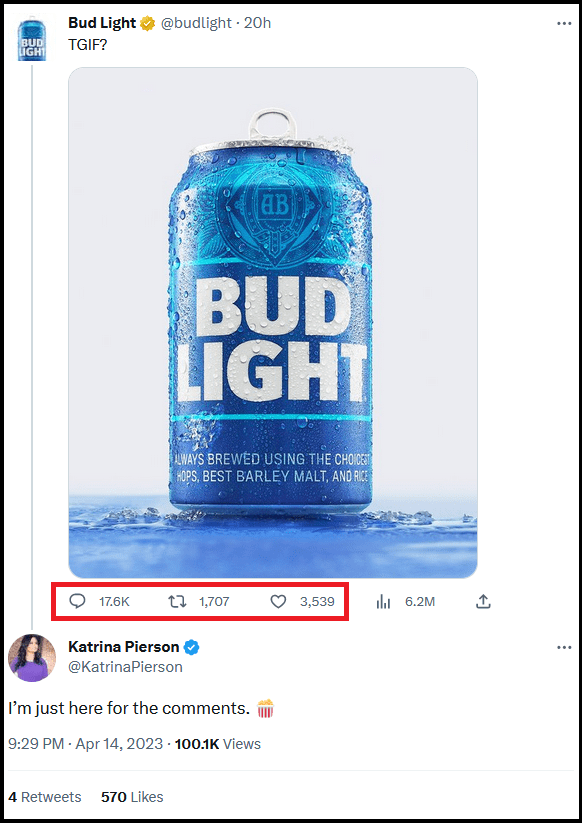
The company then went with a ‘hey fellow beer drinkers’ ad campaign, tweeting “TGIF” along with a picture of a Bud Light can. It was received about as well as one would imagine… with a massive ratio of people commenting vs. ‘liking’ it.

The campaign was mocked mercilessly.

More via The Epoch Times (emphasis ours),

Brand Damage

Some analysts and investors said that the damage likely won’t sink Anheuser-Busch, but the damage has been done to the Bud Light brand.

The logo of Anheuser-Busch InBev pictured outside the brewer’s headquarters in Leuven, Belgium, on Feb. 28, 2019. (Francois Lenoir/Reuters)

“I simply don’t understand why they hired the person who was doing the marketing,” Oxygen Financial CEO Ted Jenkin told Fox News Thursday. “I mean, if your target customer is Kid Rock, and then all of a sudden you decide to go to RuPaul, that just doesn’t make any sense at all.

Because Bud Light generally targets “blue-collar workers and younger adults that are 25 to 29 years old,” the campaign should be problematic for the firm. “So, I don’t think that this one campaign is going to colossally destroy the brand,” it said.

“But certainly short term, it puts doubt into their loyal drinkers of Bud Light to say, ‘Do I want to continue to be drinking Bud Light based upon who they’re showing representing Bud Light?’” he asked. “Anytime a company puts on a national spokesperson that has backlash, it certainly can affect your business.”

A research fellow with the National Center for Public Policy Research wrote this week that Anheuser-Busch is owned by InBev, a multinational conglomerate worth tens of billions of dollars. One product, he wrote, won’t do a huge amount of damage to the brand or value.

But that seems like a plausible result. The Venn diagram of people interested in drinking Bud Light and those eager to support the issue at the sharp edge of the wokist culture war is pretty much just two circles vaguely near one another,” Shepard wrote. “While InBev investors won’t suffer too much, distributors of AB products and others who do business with the company surely will.”

Shepard further stipulated in the article that the “bottom-line effects of wokeness are clearer at other American companies that have abandoned fiduciary duty for politics,” referring to large corporations’ having adopted left-wing talking points and narratives around race and sex.

Tyler Durden
Sat, 04/15/2023 – 15:00

Fungal Outbreak Affects Over 90 Workers At Michigan Paper Mill

Fungal Outbreak Affects Over 90 Workers At Michigan Paper Mill

Authored by Jane Ngyuen via The Epoch Times (emphasis ours),

Nineteen confirmed cases of blastomycosis, a type of fungal infection, have been linked with a northern Michigan paper mill, with a further 74 people believed to be probable cases, according to local health authorities.

A medical illustration of Blastomyces, the fungus that causes blastomycosis. (Courtesy of CDC)

Public health officials said on April 7 that both confirmed and probable cases are workers at Escanaba Billerud Paper Mill infected with Blastomycosis after showing symptoms. A probable case is a person with symptoms with a positive antigen or antibody test.

Blastomycosis is an infection caused by a fungus called blastomyces that live in soil and decaying wood.

Earlier on Feb. 28, the Public Health Delta and Menominee Counties (PHDM) was first alerted of several atypical pneumonia infections in individuals employed at the mill.

On March 3, the mill learned of the infections from the PHDM.

The exact source of the fungus has not yet been found. However, it is believed that it arrived on damp and rotten wood at the mill.

Although the source of the infection has not been established, we continue to take this matter very seriously and are following recommendations from health and government officials and implementing numerous, proactive steps to protect the health and safety of our employees, contractors, and visitors,” Brian Peterson, the mill’s vice president of operations, said in a statement.

An investigation into an outbreak of blastomycosis is ongoing and includes health and safety officials at the local, state, and federal levels.

Experts said that an outbreak that affects a large number of people is highly unusual as the fungal disease is not usually transmitted from person to person.

Workers at the mill are now being asked to wear company-provided N95 masks. Deep cleaning of ventilation systems in the plant is underway, as advised by health officials, to avoid disease spreading.

Billerud AB, an American subsidiary of the Swedish pulp and paper manufacturer, operates the mill.

About Blastomycosis

According to the U.S. Centers for Disease Control and Prevention (CDC), the Blastomyces fungus lives in moist soil and decomposing matter.

People can get blastomycosis after breathing in fungal spores from the air, which can infect the lungs.

Most people who breathe in the spores don’t get sick, but some might experience the following symptoms: cough, fever, chest pain, difficulty breathing, night sweats, fatigue, weight loss, muscle aches, and joint pain.

In severe cases, the fungus spreads from the lungs to other organs, including the muscles, bones, and brain. It can take anywhere from three weeks to three months for symptoms to appear after exposure to the fungus, the CDC says.

Read more here…

Tyler Durden
Sat, 04/15/2023 – 14:30

What If The Dollar Falls?

What If The Dollar Falls?

Authored by Peter St.Onge via The Mises Institute,

The past few weeks, major countries have been moving away from the US dollar, raising doubts about the dollar’s long-dominant role in the world. Eight weeks ago, it was just pariah nations like Iran or Russia trying to de-dollarize. Now it’s Brazil, France, even Saudi Arabia—the lynchpin of the decades-long “petrodollar” arrangement.

If the dollar does lose its position as the global reserve currency, it will be catastrophic for the American economy. Catastrophic for the American people on whose backs 80 years of reserve status were built. And it will subject billions of foreigners, for whom the dollar has meant decades of being bullied, to history’s greatest bait and switch.

Dollar at Risk

In late March, Saudi Arabia announced it will price oil in Chinese yuan. Even CNN was worried, in a rare display of situational awareness, while Fox fretted about “Weimar”—hyperinflation.

The dollar has been the undisputed global reserve currency since the 1940s. Reserve currency status looks great on paper: You get to print stacks of green paper and foreigners give you cool stuff for it, like toasters, luxury cars, and copper mines. The problem is who profits—who gets paid when foreigners crave the green paper?

Unfortunately, it’s not the American people; it’s whomever’s printing money: The Fed, meaning the Treasury, to whom they hand their ill-gotten profits, and—you guessed it—Wall Street. Commercial banks.

To see why, imagine foreigners didn’t want dollars. The Fed and banks could only print a little bit since printing a lot would create inflation, and voters would toss them out.

But if foreigners want a large number of dollars, the Fed and banks can print a matching amount. It’s like a river flowing into the money supply reservoir, matched up with a river flowing out to foreigners. The reservoir stays stable, and voters don’t riot.

But notice where the profits went. That river to foreigners didn’t go to we the dollar-holders—we are the reservoir; we are unchanged. The profits went right through us to the source of the river: the US Treasury and Wall Street.

So, like the rest of our crony financial system, it’s a hustle. The American people think they’re benefitting from reserve status, but the profits were sucked out and handed to the people who designed the institutional fleecing we call a financial system.

Enter Weimar

Now, here’s the problem. What if foreigners suddenly don’t want dollars?

Maybe China’s paying them to sell oil in yuan, or maybe the Fed lost the plot and creates too much inflation.

Demand dries up, the dollar starts to lose value, and foreigners start worry their life savings and corporate treasuries are melting. They sell out of the dollar. A little at first, more and more if it accelerates.

Now that river to foreigners reverses, it flows back into the reservoir. The dollar collapses. 70 years of Fed and Wall Street money printing comes rushing back like a tsunami running up a canyon. We’re talking double-digital inflation, over multiple years, at a minimum.

If they screw this up, reserve currency status could turn out to be a trap, an absolute catastrophe for the American people.

What Are the Stages of De-dollarization?

So what happens if the dollar falls?

For starters, foreigners don’t need as many dollars. Meaning there are extra dollars nobody wants. This makes the price of the dollar fall—it gets weaker.

It’s usually slow at first, then picks up speed if it keeps going, a progressive rush for the exits. This is because the first ones out only lose a little bit, but the longer they waited, the more they’ll lose.

Who’s left holding the bag as the dollar becomes increasingly worthless? Easy: Americans. The only people on earth who are actually obligated to use the US dollar, thanks to an obscure law passed in 1862 as a wartime emergency that nevertheless managed to stick around for 151 years.

So Americans have no choice: unless you swapped your dollars for gold, or Bitcoin, or goats, you go down with the ship.

What happens to those Americans? A falling dollar drives up the price of everything that comes into America. But it also drives up the price of anything traded on world markets. Meaning the raw materials and imported components that drive American factories and sustain American consumers.

The first to jump would be gasoline, heating fuel, and food prices—all of those are world markets. Along with prescription medicines since China has a creeping stranglehold thanks to our idiotic over-regulation—indeed, this is more or less true for every consumer product that China dominates: we shot ourselves in the foot, and now it’s coming back to bite us.

Next, those expensive commodities and input prices pour out through the supply chain. Yanking prices up in industry after industry—cars, construction materials like steel or concrete, clothes, furniture, TVs, computers, and medical devices.

Gone are the days of affordable luxuries—now you gotta work for them.

The Main Event: Capital Flows

And that’s when the main event begins: capital flows.

If foreigners get nervous, they sell not only dollars, they sell assets denominated in dollars. Starting with the most liquid: stocks, bonds, and treasuries. These are easy to trade—IBM stock is easier to sell than a Taiwanese factory in Wisconsin—so they go first.

About 40% of American stocks are owned by foreigners and about one-third of corporate bonds. If foreigners start fleeing, both plunge. This could cut your 401k almost in half, and it could drive up borrowing costs for companies to impossible levels.

Leading to mass bankruptcies on top of the wave of bankruptcies the Fed’s already engineering to try and stop the inflation it started.

It doesn’t stop there: one-third of US treasuries are owned by foreigners—over $8 trillion in bonds. If foreigners start dumping those, it will either send US government debt service soaring by potentially hundreds of billions of dollars a year. Or, much more likely, it forces the Fed to step in and buy up all that foreign demand, flooding yet more trillions into the economy.

This would flip inflation overnight marching back towards double-digits.

Conclusion

There are ways to stop this. But given the Washington clown show to raise the debt ceiling yet again, paired with their obsession with sanctions that scare foreign countries off the dollar, Washington isn’t remotely close to the serious thinking it will take to right this ship.

Losing reserve currency status would savage the American economy, and it would savage the American people. No country needs reserve currency status—after all, it doesn’t benefit the people. But, like climbing a cliffside with no gear, once you go halfway, you better not let go.

[A version of this article first appeared on Peter St. Onge’s substack.]

Tyler Durden
Sat, 04/15/2023 – 13:30