72.7 F
Chicago
Wednesday, August 12, 2026
Home Blog Page 3780

Elon Musk Reportedly Buys 1000s Of GPUs For AI Project

Elon Musk Reportedly Buys 1000s Of GPUs For AI Project

Authored by Savannah Fortis via CoinTelegraph.com,

According to anonymous sources close to the company, Musk purchased nearly 10,000 graphics processing units intending to further his AI projects at Twitter.

Elon Musk, CEO of SpaceX, Tesla, and, as of October 2022, Twitter, recently made headlines when he spearheaded a letter to halt artificial intelligence (AI) development due to societal concerns. Despite the effort, the tech mogul seems to be pushing forward with his own plans for developing AI infrastructure.

report from Business Insider revealed that Musk appears to be moving forward with plans for an AI project at Twitter. According to two anonymous sources familiar with the company, the Twitter CEO recently purchased nearly 10,000 graphics processing units (GPUs) to be used on the platform.

Typically, GPUs work on large-scale AI models due to the massive computation power required by the technology. This follows a tweet from Musk on March 18, in which he said that the company would use AI to “detect & highlight manipulation of public opinion” on Twitter.

The anonymous sources reportedly deemed the project to be in its early stages, but the purchase of such a quantity of GPUs shows Musk is “committed” to it. One of the sources said the project works with a large language model. However, the sources also said the definite role of generative AI at Twitter is unclear.

Additionally, Twitter recently acquired new talent with an extensive background in the AI field. In March, engineers Igor Babuschkin and Manuel Kroiss joined Musk’s team after working with DeepMind, an AI research subsidiary of Alphabet, Google’s parent company.

These developments come only a few weeks after Musk signed an open letter, along with thousands of other researchers in the tech space, to temporarily halt the development of AI due to the risk to humanity.

Musk is also on record in 2017 giving a warning to regulators at an event with the United States National Governors Association that AI research needs to be regulated “before it’s too late.“

Tyler Durden
Wed, 04/12/2023 – 13:01

FOMC Minutes Preview: “Down To The Wire”

FOMC Minutes Preview: “Down To The Wire”

Submitted by Newsquawk

  • Since the March FOMC, fears around the banking crisis have cooled, with no additional failures reported, reducing chances of an imminent policy shift from the Fed with the labor market still tight and inflation still well above target.

  • WSJ’s Timiraos reported the March decision to hike was one of the closest calls at the FOMC in years, coming down to the wire as officials kept track of the fallout from SVB and questioned whether they should pause.

  • Fed officials have since been cautious about getting ahead of, or forecasting, any sharp falls in credit availability, instead sticking to the status quo in terms of the need to bring down inflation whilst caveating that there is great uncertainty hanging over the banking sector.

  • The minutes will provide us with more insight into how the recent banking failures played into the policy decision and the extent to which the  overhang of the events may cap the degree that officials tighten further.

  • Officials have been reticent to get into specifics about how much they see reduced bank lending as a substitute for Fed rate hikes, and it’s unlikely the minutes will give us much either, although they should reveal a nod to the relationship as some officials have pondered in public comments lately.

STATEMENT AND SEP REVIEW: The FOMC lifted its Federal Funds Rate target by 25bps to 4.75-5.00%, in line with market expectations. Its updated economic projections left the terminal rate view unchanged at 5.1%, and its statement removed the reference to the Committee anticipating that ‘ongoing increases in the target rate will be appropriate’, though added that ‘some additional policy firming may be appropriate’. Its median view for where rates will be in 2024 was nudged up to 4.3% from 4.1%. The inflation profile was raised for this year, though left unchanged for 2024 and 2025, while the core inflation view was slightly nudged up for this year and next. The Fed expressed confidence in the banking system, stating that it was ‘sound’ and ‘resilient’, adding that the recent developments were likely to result in tighter credit conditions and will weigh on economic activity, hiring and inflation. Some had expected that the Fed might slow its pace of balance sheet reduction, though the statement said that it would continue to reduce Treasury and MBS holdings in line with its previous announcements. Market expectations for the Fed rate hike trajectory continued to run more dovishly than the dots, with money markets pricing less than one more 25bps hike this cycle, where the May 3rd meeting has an implied probability of 75% for a hike, and 25% for no hike. Markets are also pricing the year-end rate at 4.40% (vs Fed’s 5.1% dot).

PRESSER AND Q&A REVIEW: Fed Chair Powell, when asked about the updated SEPs, said that no participants had rate cuts in their baseline scenario for this year. He also took care to emphasise the uncertainties presented by the current situation, and essentially made the case that the Fed would be deciding policy based on incoming data, meeting-by-meeting, and will be based on the actual and expected effects of the credit tightening. Powell said that if the Fed needed to push rates higher, it would, but for now, officials see the likelihood of credit tightening, and the impact of this can be seen as another hike. Powell still sees a path to a soft landing, and the Fed is trying to find it.

Tyler Durden
Wed, 04/12/2023 – 12:45

Morgan Stanley Sees Freight Upcycle Nearing

Morgan Stanley Sees Freight Upcycle Nearing

By Todd Maiden Of FreightWaves,

A dash of optimism around improving freight demand in the back half of the year was noted in a quarterly survey of shippers released Monday.

Morgan Stanley’s Freight Pulse showed sentiment among the group improved slightly even as data points have yet to point to an upward trajectory for freight markets. Of shippers polled, 38% said they will likely maintain current inventory levels, which was a 10-percentage-point increase from the fourth-quarter report. The number of respondents saying they need to reduce inventories also declined for the first time since the third quarter of 2021.

Nearly 75% of shippers surveyed expect inventories to normalize in 2023, with almost 50% saying it will happen in the second half of the year.

“Despite all the bad headlines and mixed datapoints on macro, our latest quarterly Shipper Survey keeps showing signs of improvement under the surface,” stated Ravi Shanker, Morgan Stanley transportation equity analyst.

Heading into the first-quarter earnings season, which starts in earnest next week when J.B. Hunt reports, many analysts are taking a wait-and-see approach to the back half after being more bullish to start the year.

Outlook improves among shippers, capacity to stay loose

Shippers’ overall view of the economy also moved higher for the second consecutive quarter. However, a 4.9 reading remained “comfortably below” the 15-year-old survey’s long-term average of 5.8. Shippers from the manufacturing and food and beverage verticals were most constructive while responses from retail shippers saw the biggest declines.

The outlook for transportation capacity across all modes loosened again.

Capacity predictions for the next six months were the loosest for airfreight and ocean, while rail capacity is expected to be the tightest. However, the outlook for rail capacity saw the biggest sequential deterioration out of all modes.

The outlook for both volume and pricing growth in trucking was described as “pretty grim,” with volumes “consistently in negative territory (similar to 2020 levels but slightly better than 2009 levels).” Pricing sentiment saw the biggest declines ever recorded, down in the low-single-digit range. However, the report pointed out that the comparisons were to record price levels.  

FreightWaves’ trucking data has yet to inflect positively. Rejected tenders continue to bobble along the bottom alongside spot rates.

Chart: (SONAR: OTRI.USA). A proxy for truck capacity, the Outbound Tender Reject Index, shows the number of loads being rejected by carriers. The index has fallen to below 3% compared to a little more than a year ago when fleets were rejecting more than 20% of loads under contract. To learn more about FreightWaves SONAR, click here
Chart: (SONAR: NTIL.USA). The National Truckload Index (linehaul only – NTIL) is based on an average of booked spot dry van loads from 250,000 lanes and 10,000 daily spot market transactions. The NTIL is a seven-day moving average of linehaul spot rates excluding fuel. Spot rates are currently 31% lower y/y.

There was no change in truckload capacity expectations, with most respondents indicating intermodal will soon be the loosest mode after being the tightest over the last three quarters. Even with lower TL rates and rail service issues, 43% of shippers said they are shifting some freight from TL to the rails. This was the first increase in a year for the metric with only 25% saying they would make the change a quarter ago.

The report also showed rail volumes will be flat year over year (y/y), down from a 0.7% growth expectation last quarter. Pricing expectations stepped slightly higher but remained below the long-term average. Shippers said rail service has deteriorated, almost reaching the survey low established in the third quarter of last year.

Expectations for parcel call for slight y/y volume growth (except for airfreight) with the rate outlook snapping back into positive territory.

“We are not sure what the macro outlook holds in store for us but what is very clear is that at the current pace of destocking, inventory levels should be normalized soon and if the consumer holds up in 2H23, conditions are ripe for a restocking upcycle (esp. if we also overcorrect on inventory destocking),” Shanker said.

Tyler Durden
Wed, 04/12/2023 – 12:25

NPR Throws Giant Tantrum, Quits Twitter

NPR Throws Giant Tantrum, Quits Twitter

National Public Radio (NPR) announced on Wednesday that it will stop using Twitter, and will “no longer post fresh content to its 52 official Twitter feeds,” as the first major news organization to go quiet on the social media platform.

Composite / Getty Images via summit.news

The move comes after Twitter CEO Elon Musk labeled NPR “state-affiliated media,” and then changed it to “government funded” over the weekend after widespread pushback.

“We are not putting our journalism on platforms that have demonstrated an interest in undermining our credibility and the public’s understanding of our editorial independence,” NPR told The Hill. “We are turning away from Twitter but not from our audiences and communities,” the outlet added.

Of course, NPR doesn’t have the balls to actually nuke their account – which will still allow people to click all of their existing content. Instead, they will cease tweets from their various accounts – the primary one of which has over 8 million followers.

Last week, Twitter slapped ‘state affiliated media’ (or similar) labels on several outlets, including the BBC.

In perhaps their last series of tweets, NPR claims to produce “consequential, independent journalism every day in service to the public.” (except for when it comes to things like influencing elections by protecting the Biden family from credible reporting on crackhead Hunter’s laptop, of course).

As Summit News noted last week… In 2020, Twitter made the move to label many accounts, including Russian media outlets RT and Sputnik, as well as reporters working for them as ‘state-affiliated media’, and said it would prevent tweets from those accounts appearing on the home screen, in notifications, or in searches.

However, NPR was left alone.

Twitter Labels RT As ‘State Affiliated Media’, But Ignores BBC, NPR

Twitter claimed it was doing this “to make the experience more transparent,” adding that “we don’t let state-affiliated media accounts advertise on Twitter. We’ll also no longer include them or their Tweets in recommendations, as we continue to support a free and independent press.”

So the question is, does NPR push an agenda and ideology influenced by the state, including woke narratives?

The following examples would suggest yes, it certainly does.

NPR Denigrates Slain Shinzo Abe as “Divisive Arch Conservative”

NPR Declares Using Wrong Colour Emojis is Probably RACIST

NPR Slams Biden For Meeting With Historians Because They Were All “White”

NPR Claims That Calling a Riot a “Riot” is Racist

NPR Hides Fact That Man Accused of Plotting to Kill Biden Was a Bernie Bro Who Possessed Book on Islam

NPR Gushes Over Baghdadi: “He Was a Real Leader”

*  *  *

For more on that…

Some, such as former ProPublica president Dick Tofel, agreed with the move by NPR:

Others mocked it:

Tyler Durden
Wed, 04/12/2023 – 12:05

Real Neutral Rate May Be Trapped Between IMF, Summers Ballparks

Real Neutral Rate May Be Trapped Between IMF, Summers Ballparks

By Ven Ram, Bloomberg Markets Live strategist and reporter

What happens to global interest rates after the major central banks reach the end the tightening cycle?

There are two broad schools of thought. The first is what I call the snakes & ladders theory, which is that real neutral rates will go back to square one. The other posits that rates are unlikely to go back to the incredibly low levels we saw before the pandemic.

  • The International Monetary Fund believes the recent increase in inflation-adjusted interest rates are likely to be temporary. The reasons it offers may sound familiar: total factor productivity growth and demographic forces including an ageing population are among factors that are likely to keep real rates under check.

  • The second school — whose proponents include former Treasury Secretary Lawrence Summers — suggests that the post-pandemic fiscal support we have seen from the governments will drive up public debt, raising natural rates. Moreover, transitioning to a cleaner economy and deglobalization causing trade fragmentation may also push up the r*.

The Fed’s March dot plot implicitly invoices a neutral real rate of 50 basis points, though it would be fair to conclude that the rate has been probably higher than that — at least in the post-pandemic inflation cycle. Given that r* is an unobservable variable and we are yet to reach peak rates in the US — let alone embark on a loosening cycle thereafter — we won’t know the definitive verdict for the relevant rate for this cycle for a long time to come.

For what it is worth, my two cents is that the real neutral rate isn’t either in the 0%-0.5% camp or in the 1.5%-2% territory, but somewhere in between. Even a rate that is in between — of, say, 1% — has profound implications for what we should expect in terms of where central bank nominal rates will be headed when the loosening cycle begins eventually.

Tyler Durden
Wed, 04/12/2023 – 11:45

Most People Calling CPI Professionally Are Not Comparing Apples To Apples

Most People Calling CPI Professionally Are Not Comparing Apples To Apples

By Michael Every of Rabobank

Barley; sugar; and apples and bananas

Obviously, inflation is the main focus today.

  • Not the report that Egypt might be preparing to send 40,000 rockets to Russia, which is a huge geopolitical shock for those who can find the Suez canal on a map outside of periods when Taiwanese container ships are stuck in it.

  • Not China saying it’s ‘ready to fight’ after 3 days of large-scale military drills around Taiwan.

  • Not China agreeing to take Australian barley imports again.

  • Not the headlines from Europe and the US suggesting a Butlerian Jihad against AI and de facto in favor of butlers.

  • Not Twitter now being part of ‘X’, which might be part of a WeChat-style uber-app.

No, just US inflation – which is more than enough. Yesterday already saw weak Chinese CPI, down 0.3% m-o-m and up only 0.7% y-o-y, and weak PPI,  down 2.5% y-o-y, both of which are seeing calls for more stimulus: which in China means more supply, not more demand, which is why it never generates any inflation, except in commodity prices. Relatedly, we also saw sugar hitting a decade high yesterday – and it’s not as if sugar goes into anything we eat nowadays, right?

We heard that ‘cut rates now!’ Tenreyro at the BOE is to be replaced by Megan Greene, who appears more hawkishly inclined. Then again, the Chicago Fed’s Goolsbee, the new Obama-era appointee, just argued bank credit tightening already underway is equivalent to 50-75bps of Fed hikes, conflicting with the New York Fed’s Williams, who said he didn’t see any such problem. Some readings of the NIFB small business survey backed the pessimistic credit view yesterday. Yet the same survey also showed SMEs had already seen loan conditions tightening, and are used to it; their actual planned capex remains at pre-Covid levels; and they still struggle most with inflation and finding staff, with pay deals still at elevated levels.

So to the US number, where the consensus is 0.2% m-o-m and 5.1% y-o-y headline, and 0.4% m-o-m and 5.6% y-o-y core: and we will get core services ex-housing, core core, core core core, and ‘excluding everything going up’ measures that everyone will seize on to back their particular view on inflation dynamics, as they do with all other data. Indeed, nobody will change their minds after the CPI number, whatever it is. Markets might move, but minds will remain rigidly fixed.

For some, inflation is always transitory. 2% CPI, or lower, is a natural law like gravity, either because central banks are credible –no laughing at the back!– or ‘because Marx’ – no screaming at the back! Yes, CPI can overshoot for years, but it will eventually crash again. A high print now just means a low print in T+12. So, buy the long end of the yield curve regardless of the carnage at the short end and/or in stocks, or because of it.

For others, inflation is a problem, on the demand side (in services now) and/or the supply side, because the world has changed: post-Covid; post joining fiscal and monetary policy; post-Ukraine; mid structural changes to the labour market and demography; and mid US-China decoupling and worries of worse. Every high CPI print risks becoming more entrenched in our psychology, as the New York Fed’s median 1-year ahead inflation expectations survey just increased 0.5ppts to 4.7%, the first increase in the series since October 2022, and the 3-year edged up 0.1 pp to 2.8%.

On which note, it is worth ironically worth sharing a pre-CPI long read spotted by my eagle-eyed BOE-watching colleague Stefan Koopman – ‘Inflation is Conflict’ (Lorenzoni and Werning). This paper makes the eponymous claim that even absent any economic model, or the Friedman argument of “too much money chasing too few goods,” or the supply-chain argument of “too few goods being chased by too much money,” inflation is at root always all about conflict over compromise.

As the authors note, “The contribution of this stylized model is to isolate the role of conflict in inflation. Indeed, it is meant as a shock to the system that may sow the seeds of doubt in economists, like ourselves, raised on the notion that to speak of inflation requires first and foremost a discussion of money and interest rates, complemented perhaps with the concepts of natural levels of output, employment or interest rates. The results of our stylized model attempt to leave no easy way out of this traditional mindset, leave no natural interpretation for inflation except conflict.”

If you are of an economic bent, read it in full. Of course, you still won’t change your mind on what drives inflation, but it will kill an hour or two before the US data release. If you aren’t of an economic bent, the simple introduction to the paper can be best summarized here via their analogy to two parties selling apples and bananas.

Simply, if the two take turns to set the relative price of their goods (i.e., the apples to bananas ratio), then they can say: “1”, “1”, “1”, “1”, and we have zero inflation. Or, the pattern can be “1”, “1.1”, “Ah, so 1.1 back at you!”, “Ah ha, so 1.2 to you!”, “Really? How do you like 1.3?!” and an escalatory cycle. Note this absent money, interest rates, supply-side shocks, profits, or nominal or real wage growth, some of which the paper slots in later – and all of which are extremely pertinent at the moment. How are these conflicts going to be resolved?

This simple apples and bananas model ironically again makes the point that most people calling CPI professionally are not comparing apples to apples.

  • If you think ‘Marx’, CPI always come down: but, to be consistent, so does capitalism, which doesn’t make the most compelling argument for long government bonds, or fiat currency, long term.

  • If you think ‘Friedman’, CPI must be crushed via higher rates or higher taxes and lower spending: that makes a compelling argument for long government bonds down the curve and fiat currency, especially if you think the world is actually Marxian.

  • If you think ‘Lenin’, the rise of geopolitics and war as inflationary supply-side disrupters adds a new dimension to current internal conflicts: and to how you should respond in markets.

Or, one can have no secular or fundamental view on inflation whatsoever, and just play ‘The price is right’ (“Higher than 0.2% – bingo!” “Lower than 0.2% – you’re a genius!”) Which is frankly bananas in a different way.   

Tyler Durden
Wed, 04/12/2023 – 10:51

Biden Admin Drains SPR For 2nd Week In A Row As Granholm Confirms Refilling Plan

Biden Admin Drains SPR For 2nd Week In A Row As Granholm Confirms Refilling Plan

Oil prices jumped this morning after a quiet overnight session thanks to the dovish CPI print exuberance.

“The petro-nations’ somewhat surprising supply cut last week triggered a shift in sentiment,” said Norbert Ruecker, head of economics at Julius Baer Group Ltd. in Zurich.

“Beyond the geopolitical noise, the ongoing fundamental trends seem robust.”

But all eyes remain on inventories for signs of trouble as recession anxiety grows.

API

  • Crude  +377k (-1.3mm exp)

  • Cushing -1.4mm

  • Gasoline +500k

  • Distillates -2mm

DOE

  • Crude +597k (-1.3mm exp)

  • Cushing -409k

  • Gasoline -330k

  • Distillates -606k

After API’s reported small build, analysts still expected a draw in crude stocks (extending the recent trend) but they were wrong as the official data showed a small 597k build. Stocks at the Cushing hub slipped for the 6th straight week and products saw very small draws…

Source: Bloomberg

The so-called ‘adjustment factor’ actually turned red this week…

Source: Bloomberg

Crude stocks remain seasonally high…

Source: Bloomberg

US Crude production rebounded to cycle highs despite he slowing rig count…

Source: Bloomberg

WTI was hovering around $82.50 ahead of the official data, and held steady after…

Finally, after last week’s OPEC+ ‘rebellion’, Energy Secretary Jennifer Granholm confirmed that the US plans to refill the Strategic Petroleum Reserve to levels seen prior to President Joe Biden’s historic release last year following Russia’s invasion of Ukraine.

The Energy Department “will look to take advantage of prices if it is advantageous to the taxpayer in the rest of the year, but it’s a lot to refill,” Granholm said during remarks at an energy forum held by Columbia University.

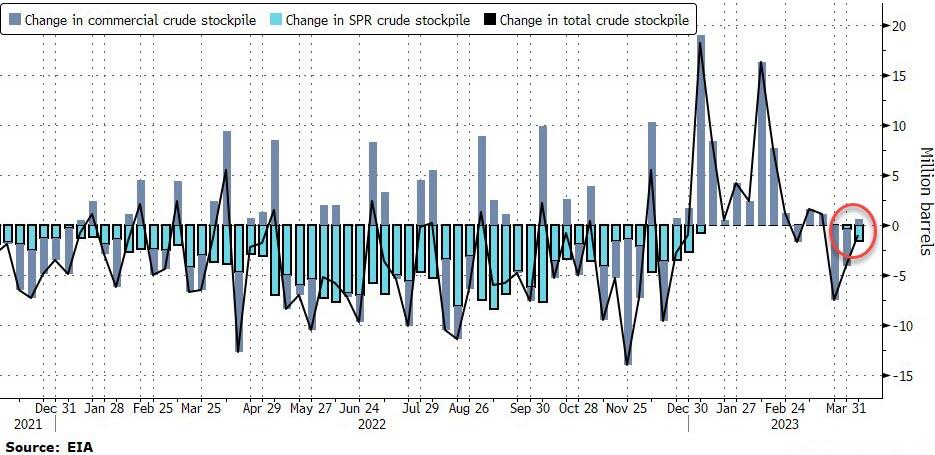
But she appears to be full of shit as the Biden admin actually drained the SPR for the second week in a row (the 1.6mm barrel draw more than offset the 600k build in commercial stocks)…

WTF Jenny?

WTI’s prompt spread – the difference between its two nearest contracts – affirms that the oil market is tightening. It has swung to 8 cents a barrel in backwardation, the widest this year on a closing basis.

Tyler Durden
Wed, 04/12/2023 – 10:37

Yardstick On US Economy Shows Recession Fears Rising

Yardstick On US Economy Shows Recession Fears Rising

Authored by Ven Ram, Bloomberg cross-asset strategist,

A powerful indicator of economic risk is on an uptrend, suggesting that investors are preparing for a recession in the US.

The ratio between gold and oil has surged to almost 24 from average levels of around 17 that have prevailed since the start of the millennium. Gains in bullion tend to far outstrip increases in oil prices during the onset of a recession. That’s because investors position themselves for the Federal Reserve to cut interest rates, after a long period of expansion when they would have been typically focused on the inflationary impulse stemming from higher energy prices.

The ratio between gold and oil adds to a dashboard of metrics that investors can use to adjudge, in real time, where in the economic cycle we are. Last month, the spread between high-yield dollar-denominated corporate bonds and those on investment-grade securities widened to levels that have been sufficient to trigger a recession in the past.

The Fed is approaching the end of its tightening cycle, with a likely 25-basis point increase next month, putting its benchmark rate on a par with the terminal rate indicated in its dot plot. Interest-rate traders are now factoring in rate cuts of about 50 basis points by the end of the year.

That speculation has spurred gold, which has risen almost 10% so far this year, outpacing gains of 7% for the S&P 500 and about 3% for the Bloomberg Treasury Index.

On display is gold’s convexity, a property that bestows outsized gains when interest rates ebb lower and diminished losses when yields head higher. A study in 2020 showed that bullion has a duration of 20 when interest rates fall. On the flip side, the Fed’s most ambitious policy tightening in decades last year showed the empirical duration of gold to higher rates was just above three years.

Crude-oil prices have risen some 5% this month after OPEC+ unveiled a surprise production cut of more than 1 million barrels a day, though it’s far from clear if the increase will be sustainable beyond the here and now.

While gold versus oil has been an extremely useful barometer for investors reading the tea leaves on the US economy, there was a period from late 2014 to early 2016 when the ratio was elevated without a recession being triggered. However, it should be noted that the surge in the ratio then came on the back of sliding oil prices, unlike the case now.

All told, investors would do well to pay heed to the signals coming from the commodities complex as well as the credit markets as we approach an inflection point in the US economy.

Tyler Durden
Wed, 04/12/2023 – 10:25

“Such Is Life”: FTX Bankruptcy Filing Details SBF’s Cavalier Attitude Toward Misplaced $50 Million

“Such Is Life”: FTX Bankruptcy Filing Details SBF’s Cavalier Attitude Toward Misplaced $50 Million

What’s $50 million amongst friends?

That appears to be the cavalier attitude that FTX head Sam Bankman-Fried took while managing his now defunct FTX, according to a new report from Yahoo, which detailed “a complete failure” of corporate controls at the company. 

The company’s latest bankruptcy report filed Sunday, coming in at 43 pages, detailed a “lack of appropriate record keeping and controls” in its finances, accounting, governance, and even cybersecurity, Yahoo reported. 

The company admitted it didn’t even have a complete and current list of employees when it started going through the bankruptcy process. It’s still poring through QuickBooks, Google docs, spreadsheets, and Slack records, to – as Yahoo put it – “get any insight into where the hell customers’ money went”.

Among other things, the company has found nearly 80,000 transactions labeled “Ask My Accountant” in QuickBooks. It also found communication from SBF stating internally that “we are only able to ballpark what [Alameda’s] balances are… we sometimes find $50 million of assets lying around that we lost track of; such is life.”

The filing said that FTX executives “stifled dissent, commingled and misused corporate and customer funds, lied to third parties about their business, joked internally about their tendency to lose track of millions of dollars in assets, and thereby caused the FTX Group to collapse as swiftly as it had grown.”

Those running the company “showed little interest in instituting oversight or implementing an appropriate control framework”, according to FTX CEO managing the company’s bankruptcy John Ray III.

Hey with these kind of money management and bookkeeping skills, maybe Sam Bankman-Fried could be managing the books for the Pentagon or the Department of Defense.

Tyler Durden
Wed, 04/12/2023 – 10:05

Majority Of New Yorkers Feel Subway Unsafe At Night, Quarter Worry About Safety During The Day: Poll

Majority Of New Yorkers Feel Subway Unsafe At Night, Quarter Worry About Safety During The Day: Poll

Authored by Petr Svab via The Epoch Times (emphasis ours),

More than half of residents feel unsafe riding the New York City subway alone at night and one in four feels that way even in the daytime, according to a survey conducted earlier this year.

A subway train arrives in a station in New York City on May 17, 2021. (Angela Weiss/AFP via Getty Images)

The numbers are even higher for women and Asian Americans, two-thirds of whom feel unsafe at night and about a third of whom feel unsafe during the day.

Residents felt more worried about waiting for a train on the platform than riding the train itself.

The survey follows a series of high-profile crimes on the subway in recent years where people have been assaulted or even pushed onto the tracks. Victims have disproportionately been women and Asian Americans. Perpetrators have disproportionately been black men.

Yet the level of crime in the subway system, in general, hasn’t changed much over the past decade and is even slightly down so far this year compared to last year, according to New York City Police Department data.

What has increased dramatically, however, is crime in the city more broadly. Felony assaults, in particular, have been on the rise for years and so far this year have been at their highest since 1998. Also up are petty theft such as shoplifting, misdemeanor assaults, and car theft. Murder has somewhat declined this and last year, but is still up from 2019 after a dramatic rise in 2020 and 2021.

But New Yorkers still feel the city streets are safer than the subway, according to the survey. Sixty-eight percent said they felt safe walking down the street alone during the day compared to 58 percent feeling safe riding the subway alone. At night, 59 percent felt unsafe riding the subway alone, but only 50 percent felt unsafe walking alone.

Read more here…

Tyler Durden
Wed, 04/12/2023 – 09:45