78.6 F
Chicago
Tuesday, August 11, 2026
Home Blog Page 3815

Small European Countries “Morally & Financially Exhausted” By Ukraine War Effort

Small European Countries “Morally & Financially Exhausted” By Ukraine War Effort

Ukraine’s Western backers have of late expressed more and more skepticism over the future success of the war effort against Russia. This doubt grew louder and more public starting two weeks ago, when Czech President Petr Pavel said in an interview with Polish media that the window is closing on a major new Ukrainian counteroffensive. He then acknowledged that his country may not be able to maintain current levels of assistance to Kiev.

“The window of opportunity is open this year. After next winter, it will be extremely difficult to maintain the current level of assistance,” Pavel was quoted as saying. “War fatigue is not only the exhaustion of human resources and equipment, the destruction of infrastructure in Ukraine, but also fatigue in the countries that provide aid.”

This week another small central European country has echoed the same. Slovak President Zuzana Čaputová said at a foreign policy event that Slovakia is “morally and financially exhausted” after more than a year of support given to Ukraine, and as war refugees pour in.

Czech President Petr Pavel (left): Le Monde/Getty Images

She also observed that the influx of Ukrainian war refugees into her country threatens to harm the economy and her own citizens’ standard of living. Stressing there are limits to Slovakia’s support for Ukraine, she suggested the populace may now see that limit as having been reached or surpassed, and this is leaving the country vulnerable.

“Although the majority of our residents remain willing to accept Ukrainian refugees, the majority feel that their standard of living is falling with the arrival of refugees, despite the data clearly pointing to the successful integration of refugees into the labor market,” Čaputová said.

Slovakia in particular has been sacrificing much of its own military hardware for Ukraine, this month pledging to hand the bulk of its tiny air force over. “The first four of 13 Soviet-era MiG-29 fighter jets that Slovakia decided to give Ukraine have been safely handed over to the Ukrainian air force, the Slovak Defense Ministry said on Thursday,” Reuters reported last week. The country is seeking upgraded replacement aircraft and parts from the United States.

The small central European country has also absorbed tens of thousands of refugees:

However, public attitudes differ, with a poll by Globsec think-tank showing in December that 39% of Slovaks thought NATO and the United States were responsible for the war in Ukraine. Support for NATO is lower in Slovakia than in most other member states, the military alliance’s research shows.

Interestingly, Ukraine’s president Zelensky himself admitted that if his military didn’t start securing victories, support from the West will slide amid the general fatigue of war. Zelensky while speaking to the Associated Press early this week described that loss of Bakhmut will mean that Putin will smell weakness. According to the Ukrainian leader’s words:

Speaking with The Associated Press, Zelenskyy said that if Bakhmut were to fall, Putin could “sell this victory to the West, to his society, to China, to Iran,” as leverage to push for a ceasefire deal that would see Ukraine agree to give up territory.

“If he will feel some blood — smell that we are weak — he will push, push, push,” Zelensky continued. “Our society will feel tired” if the Russians gain victory in Bakhmut, he said. “Our society will push me to have compromise with them.” Implicit in these words are perhaps a first-time admission that significant sectors of the Ukrainian population are ready for compromise and peaceful negotiations to end the war.

And tellingly, CBS commentary on the AP interview included the following observation: “He appeared acutely aware of the risk that his country could see its vital support from the U.S. and Europe start to slip away as the 13-month war grinds on.”

Tyler Durden
Fri, 03/31/2023 – 13:27

Era Of Remote Work Ends For Millions Of Americans

Era Of Remote Work Ends For Millions Of Americans

Authored by Jane Nguyen via The Epoch Times,

Millions of Americans stopped working from home in 2022, according to a Labor Department report released on March 22.

The agency said that 72.5 percent of establishments, defined as each business location, reported little to no telework among employees between August and September 2022, a 12.4 percent increase from 2021.

Before the pandemic upended the workplace, 76.7 percent of companies reported little to no remote work among their employees.

The percentage of employers reporting that all of their employees were teleworking did not see significant change in 2022, at about 11 percent compared to about 10 percent in 2021.

The percentage of establishments reporting that some of their employees were working from home dropped in 2022. About 16 percent reported that they had some employees working from home, compared to about 30 percent in 2021.

Remote work isn’t completely ending, as companies in “university towns, tech hubs, and government centers,” per Bloomberg, have continued to offer remote positions in 2023.

In a survey conducted by the employment website ZipRecruiter, job seekers, on average, said they would take a 14 percent pay cut in order to work remotely.

Hybrid Work

Employers have recently been pushing harder to get staff to work on-site more often, as fears of the economic downturn prompt an increased emphasis on worker productivity.

Major companies such as Twitter, Disney, and Meta are expecting employees to come into the office more frequently.

Elon Musk ended Twitter’s “work from anywhere policy” after acquiring the company last year, saying he would require them to work at least 40 hours a week from the office. Walt Disney Co. has recently pushed for four days a week on-site.

This month, Meta Platforms Inc. Chief Executive Mark Zuckerberg told employees that in-person time helps build relationships and get more done.

“Our hypothesis is that it is still easier to build trust in person and that those relationships help us work more effectively,” Zuckerberg wrote in a letter to employees.

Meta CEO Mark Zuckerberg speaks at an event in New York, on Oct. 25, 2019. (Drew Angerer/Getty Images)

“There’s a sense that innovation, creativity, and collaboration can suffer when teams are apart,” Mike Steinitz, senior executive director at Robert Half, told The Wall Street Journal.

The most common remote work situation is now hybrid work, with employees spending some days in the office and some working remotely, the New York Times reported.

Moreover, it has been a challenge to revoke remote work once it has been implemented.

“Many, many companies in recent months have insisted that people come back to the office five days a week, only to reverse that mandate within about a week after hearing that they’d lose their best and brightest,” Julia Pollak, the chief economist ZipRecruiter, told the outlet.

In a Robert Half survey last year, 66 percent of managers wanted their teams to work on-site full time, and that 50 percent of workers would quit and find a new job rather than be forced back to the office.

Tyler Durden
Fri, 03/31/2023 – 13:05

US-China Decoupling Will Force Europe To Choose Sides Sooner Rather Than Later

US-China Decoupling Will Force Europe To Choose Sides Sooner Rather Than Later

By Bas van Geffen of Rabobank

Financial markets finally enjoyed a somewhat quiet week again, with no further banks collapsing and market stress receding. Borrowing from the Fed’s discount window stood at ‘just’ $88 billion on 29 March, down from $110 billion a week ago.

So, thus far, the ECB’s base case that the market turmoil would prove to be fleeting and would not affect Eurozone banks, seems to be unfolding, paving the way for further rate hikes. Indeed, arguably, the banking stress aided central banks to some extent: it raised risk premia and, hence, banks’ cost of funding, which may have forced banks to tighten their credit standards and reduce their new lending. In other words, market conditions may amplify the ECB’s policy stance. As long as this happens in a gradual and predictable manner, this tightening of bank lending is desirable. However, the recent turmoil around the global banking sector suggests that this process may not always be so linear.

With cooler heads prevailing, that (hand) brake on credit provision has been lifted. So that leaves more tightening for the ECB, right? Indeed, the inflation data for March suggest as much. The available data for the euro area member states paint a picture of visibly retreating headline inflation. Yet, core readings remain stickier.

That said, the ECB – and other central banks for that matter – have to become more cautious. Not only because market stress could resurface, but also because data indicate that bank lending was already slowing prior to the episode of market stress. In fact, we estimate that the euro area credit impulse is now just marginally above zero. This is generally a premonition of slower consumption and investment spending. Again, that is currently desired by the central banks as they seek to dampen domestic demand; but if this credit impulse turns significantly negative, a deeper recession could be the result. Bloomberg Economics estimates that the US credit impulse had already turned negative by the end of last year. In short, central banks are still at risk of doing too little; but the risk of doing too much is clearly growing with each hike.

And whereas the ECB may have been right to assume that banking turmoil would be fleeting, their baseline growth forecasts may well miss the mark. They may be overly reliant on the assumption that trade with China would pick up significantly. That’s not just our words, a former senior official from the French central bank called these forecasts “heroic”. And it’s easy to see how a much less optimistic scenario could unfold.

The Wall Street Journal reported yesterday that chip makers may be forced to choose between the US and China. And why stop at chips? The US Treasury department will release more guidance on the Inflation Reduction Act today. Its aims have been clear for some time, but this think-tank report summarizes it well: “to generate new, globally distributed critical mineral supply chains that are not dependent on the Chinese Communist Party to access the building blocks of a more electrified, connected, and autonomous future.” Such attempts to reduce China’s stranglehold on e.g. the electric vehicles and clean-tech sectors will obviously increase global competition over key minerals and resources.

Europe will also closely watch these details of the Inflation Reduction Act, and to what extent it will hit the continent’s manufacturing. Earlier this week, the FT reported that, according to people with knowledge of the talks, Washington has offered to make cobalt, graphite, lithium, manganese and nickel, eligible for subsidies under its IRA, if they are mined or processed in the EU. But it remains questionable as to how much value this offer has in the eyes of European policy makers, as it will be a long time before increased mining capacity comes on stream on the European continent. Plus, the production and/or assembly of batteries and cars (the ‘value added part’ in the supply chain) still is required to take place in the US, Canada or Mexico.

Moreover, this US-China decoupling may force Europe to choose sides sooner rather than later. Indeed, the US has been pushing its allies to toughen their stance towards China. And the Netherlands have effectively already done so, when they followed the US in banning the export of certain semiconductor technology earlier this year. China’s ambassador to the EU threatened the bloc not to cut trade ties with China.

EC President Von der Leyen has refuted that Europe should ‘decouple’ from China, but did tell the bloc to start ‘de-risking’ in dealing with the country. That does not sound like the rejuvenation of close trade ties. De-globalization comes in many facets, but for the EU it may not so much stem from increased autonomy in the short-term (which, at least, would also have benefits for the domestic economy), but rather a more generic reduction of trade, as the US tightens the reins on China. That’s a losing business model for Europe.

Tyler Durden
Fri, 03/31/2023 – 12:25

Manhattan Assistant DA Nukes Twitter Account After Anti-Trump Bias Exposed

Manhattan Assistant DA Nukes Twitter Account After Anti-Trump Bias Exposed

Less than 24 hours after the Gateway Pundit exposed Manhattan Assistant District Attorney Meg Reiss’ public hatred of Donald Trump on Twitter, Reiss – who’s been accused of masterminding the case against the former president, locked and then deleted her account.

As TGP documented Thursday morning, Reiss ‘liked’ several anti-Trump tweets, exposing her absolute bias against the man her office is about to indict over hush money paid to former adult actress Stormy Daniels (real name Stephanie Clifford).

Of note, Trump’s alleged payment to Daniels through former lawyer Michael Cohen would normally be a misdemeanor which falls outside the statute of limitations. Not for Bragg’s office. Not for Reiss.

For comparison, Hillary Clinton was allowed to pay a fine to the FEC for actual election interference with the Steele Dossier hoax her campaign paid for and then boosted throughout the media.

As TGP further notes;

The Institute for Innovation in Prosecution(IIP) which is a research center out of the Soros-funded John Jay College has tagged her dozens of times.

Reiss served as the Executive Director for the IIP.”

DA of Brooklyn Eric Gonzalez also tagged Reiss, who previously served in the Brooklyn District Attorney’s Office as the Chief of Social Justice, on several occasions too: 

Most of these tweets Reiss liked were while she served in the Brooklyn District Attorney’s Office as the Chief of Social Justice and as she served as the director of the IIP.

However, her political bias extends into her time at the Manhattan DA’s office as well.

Earlier in the year as she was serving as Manhattan’s Chief Assistant District Attorney she retweeted a video of Democrat representative Hakeem Jeffries giving a speech at the State of the Union.

At one point during the video Reiss shared, Rep. Jeffries says Democrats will put “Maturity over Mar-a-Lago”.

 *  *  *

And then there’s this guy…

Tyler Durden
Fri, 03/31/2023 – 12:05

‘Day Of Vengeance’ Cancelled To Preserve “Safety Of Our Trans Community”

‘Day Of Vengeance’ Cancelled To Preserve “Safety Of Our Trans Community”

Authored by Steve Watson via Summit News,

A trans rights group that had organised a ‘day of vengeance’ protest has canceled the event citing a “threat to life and safety” of trans people following the killing of three children and three Christian teachers in Nashville by a trans identifying individual.

Composite / screenshot

Our Rights DC issued a statement asserting that “we lack the resources to ensure the safety of the protest and cannot in good conscience move forward with it.”

“The safety of our trans community is first priority,” the group added, claiming that trans people have been threatened since the shooting.

The group describes the alleged threats to the trans community as “the direct result of the flood of raw hatred directed toward the trans community,” claiming that it is “one of the steps in genocide.”

Those who warned about the upcoming protest sparking violence were locked out of Twitter:

Meanwhile, LGBTQ+ groups have threatened “serious consequences” if the FBI releases the mission statement of the Nashville shooter Audrey Hale.

Other extreme leftist groups are still promoting their own ‘trans day of vengeance’:

In Kentucky, trans activists stormed the Capitol Wednesday to protest a new law prohibiting child sex changes.

*  *  *

Brand new merch now available! Get it at https://www.pjwshop.com/

ALERT! In the age of mass Silicon Valley censorship It is crucial that we stay in touch.

We need you to sign up for our free newsletter here.

Support our sponsor – Turbo Force – a supercharged boost of clean energy without the comedown.

Also, we urgently need your financial support here.

Tyler Durden
Fri, 03/31/2023 – 10:15

“Recession Ahead” – UMich Consumer Sentiment Slides For First Time In 4 Months

“Recession Ahead” – UMich Consumer Sentiment Slides For First Time In 4 Months

The final print for the much-watched UMich inflation expectations was lower than the flash print for 1Y (down from 3.8 to 3.6%) while medium-term inflation exp rose from 2.8 to 2.9% intramonth…

Source: Bloomberg

Having dipped in the flash March print, the final UMich headline sentiment index extended declines, with both current conditions and expectations both lower than the flash print. Consumer sentiment fell for the first time in four months, dropping about 8% below February but remaining 4% above a year ago.

Source: Bloomberg

Surveys of Consumers Director Joanne Hsu noted that:

This month’s turmoil in the banking sector had limited impact on consumer sentiment, which was already exhibiting downward momentum prior to the collapse of Silicon Valley Bank.”

Adding that:

Overall, our data revealed multiple signs that consumers increasingly expect a recession ahead.

While sentiment fell across all demographic groups, the declines were sharpest for lower-income, less-educated, and younger consumers, as well as consumers with the top tercile of stock holdings.

All five index components declined this month, led by a notably sharp weakening in one-year business conditions.

Tyler Durden
Fri, 03/31/2023 – 10:07

Israeli Airstrikes Hit Damascus For Second Night In A Row

Israeli Airstrikes Hit Damascus For Second Night In A Row

Authored by Dave DeCamp via AntiWar.com,

Israeli airstrikes targeted the Syrian capital of Damascus early Friday morning for the second day in a row, marking the fifth time in March that Israel bombed Syria.

Syria’s state news agency SANA reported that Syrian air defenses “intercepted hostile targets” in the airspace of Damascus. There was no mention of any casualties or damage caused by the strikes.

Less than 24 hours earlier, SANA reported that two Syrian soldiers were wounded in Israeli strikes on the Syrian capital. Israeli officials haven’t commented on either strike, as Israeli typically does not take credit for individual airstrikes in Syria.

According to the Times of Israel describing the latest:

The Britain-based Syrian Observatory for Human Rights, an opposition war monitor, said the strikes targeted an arms depots for government forces and Iran-backed groups just south of Damascus.

Footage circulating on social media showed explosions in the sky, apparently from Syrian air defense missiles.

The intensified Israeli airstrikes in Syria come as Israeli Prime Minister Benjamin Netanyahu is facing a political crisis at home. After massive protests and dissent within the Israeli government, Netanyahu delayed his controversial judicial overhaul, but unrest in the country continues.

Earlier this month, Israeli airstrikes targeted the airport in the Syrian city of Aleppo, which was devastated by the massive earthquake that hit northwest Syria and Turkey on February 6. The strikes temporarily shut down the airport, cutting off a vital channel for earthquake aid.

Israel claims its operations in Syria target Iran and Iranian weapons shipments, but the airstrikes often kill Syrians and damage civilian infrastructure.

Tyler Durden
Fri, 03/31/2023 – 09:46

Cracker Barrel Leaves Portland, Following Walmart’s Lead

Cracker Barrel Leaves Portland, Following Walmart’s Lead

Cracker Barrel is calling it quits on Portland. 

It seems nary a day goes by when we aren’t writing about some major corporation – Target, Walmart, Walgreens, etc. – leaving a major city due to a rise in crime and theft. Today is going to be no different.

The restaurant chain this week acknowledged what Walmart’s CEO had already pointed out: that “crime and theft were taking their toll” on companies in Portland and that they would be leaving the city, according to Fox News

The company officially blamed Covid-19 for the closures, the report says. The company said: “As a standard course of business, we continually evaluate the performance of our stores, using various criteria to ensure we are meeting the needs of our guests and our business.”

It continued: “With that, we are saddened that we have been unable to overcome the impact the pandemic had on our business and have made the difficult decision to close the Beaverton, Tualatin, and Bend locations on March 20. The decision to close a store is never one we take lightly, and our focus right now is in assisting our impacted employees during this transition.”

When Fox News asked for more details, a spokesperson told them: “Like so many other companies, the pandemic impacted our business, and we have struggled to staff and profitably run these stores. Despite the extra efforts made, we couldn’t viably continue to keep our doors open.”

Recall, Walmart also recently closed all of its Portland stores, stating officially: “We have nearly 5,000 stores across the U.S. and unfortunately some do not meet our financial expectations. While our underlying business is strong, these specific stores haven’t performed as well as we hoped.”

Walmart CEO Doug McMillon later said: “Theft is an issue. It’s higher than what it has historically been.”

“Prices will be higher and/or stores will close” if crime didn’t slow, he continued. 

Portland native Dustin Michael Miller told Fox News: “Our city is out of control. It is unrecognizable. I’ve lived here my whole life, and it’s just deteriorated over the last five years.”

Tyler Durden
Fri, 03/31/2023 – 09:25

Wall Street Bonuses Plunge 26% in 2022, Largest Drop Since Global Financial Crisis

Wall Street Bonuses Plunge 26% in 2022, Largest Drop Since Global Financial Crisis

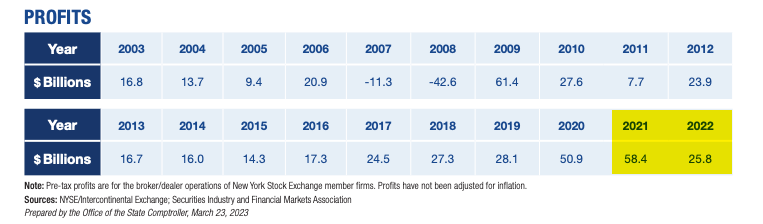
In 2022, Wall Street bonuses plummeted, as per the annual data published Thursday by New York State Comptroller Thomas P. DiNapoli. The average bonus dropped 26%, amounting to $176,700, compared to $240,400 from the prior year. 

The plunge in bonuses comes as no surprise considering capital markets had a rough last year with the Federal Reserve hellbent on increasing interest rates in the most aggressive fashion in decades to combat inflation. In doing so, capital markets were roiled, and deal flow for mergers and acquisitions also dried up, resulting in significantly lower profits for Wall Street banks versus a record 2021 year

“As a result, bonuses returned to pre-pandemic levels, which will mean a decline in related income tax revenue, as anticipated by New York state and the city,” the New York State Comptroller wrote in a press release.

DiNapoli said that bonuses in 2022 reverted to pre-pandemic levels after record highs in 2021. 

“Wall Street’s cash bonuses were expected to fall as several factors weighed on the securities’ industry profitability in 2022.

“A 26% decline brings the average bonus closer to what financial employees received prior to the pandemic. While lower bonuses affect income tax revenues for the state and city, our economic recovery does not depend solely on Wall Street. Employment in leisure and hospitality, retail, restaurants and construction must continue to improve for the city and state to fully recover.”

We anticipated that banker bonuses would plunge. Recall:

However, the trend in bonuses comes as Wall Street banks added 10,500 jobs. Total employment increased to 190,800 in 2022 from 180,300 the year before. 

Notice how bonuses are sliding but number of Wall Street employees are rising? 

Meanwhile, the 2022 bonus pool of $33.7 billion experienced a 21% decline compared to the previous year’s record-setting $42.7 billion, marking it the most significant drop since the Great Recession.

As a major source of revenue, DiNapoli estimates that the securities industry accounted for 22% ($22.9 billion) of the state’s tax collections in state fiscal year (SFY) 2021-22 and 8% ($5.4 billion) of city tax revenue in city tax collections for city fiscal year (CFY) 2022. 

In a testament to how much NYC relies on the industry for its tax base, the securities industry provides roughly one-fifth of private-sector wages despite accounting for just 5% of that sector’s employment. 

We suspect if capital markets continue to flounder and dealmaking activity remains depressed, 2023 will be a horrible year for bonuses — this could further impact the city’s economic recovery. 

Tyler Durden
Fri, 03/31/2023 – 07:45

Stocks’ Bullishness Is On Increasingly Thin Ice

Stocks’ Bullishness Is On Increasingly Thin Ice

Authored by Simon White, Bloomberg macro strategist,

Stocks are prone to significant further downside as overly optimistic hopes of a mild recession and an end to inflation fail to materialize.

Stocks are always glass-half-full. Despite rapid rate rises and pockets of acute stress in the banking sector, they appear to be expecting only a modest downturn and an end to the inflationary regime. Even more rose-tintedly, earnings are behaving as if the recession is already behind us.

Equity markets, though, have a habit of remaining jubilant right up until the asteroid strikes (October 2007?). So you don’t have to be a total killjoy to raise some questions to avoid getting sucked into what is likely to be another bear-market rally.

A cursory look at where equities are tell us they are not fearful about the economic backdrop. Only 16% off the highs and virtually unchanged over the last year, this is one of the mildest bear markets on record.

Stocks are currently trading as if any slump would be gentle. Options on the S&P have started to price in a greater possibility of deeper falls as put skew rises, while bigger upside moves are seen as less likely as call skew falls. Stocks are therefore implying some risk of a downturn, but are not expecting a big shock.

Forward earnings on the other hand have been rising, to the point where the real earnings yield is now positive again.

In fact, earnings and forward earnings’ behavior is historically consistent with a recession that has already started. Earnings are a lagging indicator and typically don’t start falling until after the downturn has begun. Earnings today have already begun to fall. Similarly, forward earnings often only begin to rise once the recession is underway.

Either way — a mild recession or one that’s come and gone — equities appear relaxed about inflation.

Duration is generally to be avoided if you believe inflation is going to remain high. Up until last year, lower-duration sectors such as energy and utilities were leading the market. This year these sectors are underperforming, while higher-duration ones such as tech and consumer discretionary are in front. Stocks are pricing inflation as yesterday’s problem.

But equities look to be mis-pricing recession and inflation risk.

A whole suite of indicators are symptomatic of a recession, and the recent steepening of the yield curve is consistent with a slump beginning as early as June.

Indeed, there is a strong relationship between the maximum inversion of the yield curve before a recession, and the peak-to-trough fall in equities.

As the chart below shows, the ~110 bps peak inversion of the 2s10s curve is consistent with a 35% total fall in equities, i.e. another ~19% fall in the S&P from here.

Further, inflation is likely to remain much stickier than stocks expect. Acyclical inflation in the US is driven by global factors, primarily China.

As China opens up, monetary easing is beginning to gain traction, which is soon expected to feed into higher inflation in China. Thus US inflation, boosted by acyclical inputs, is prone to start rising again, leaving higher-duration stocks and sectors at risk of a selloff.

It’s not just China though: other structural drivers such as elevated profit margins and wage growth are likely to lead to much stickier, more entrenched inflation. Stocks, instead, appear to be taking their cues from inflation swaps, which see headline CPI settling back to ~2.5% within a year.

The bond market is also not pricing in the risks of high inflation, inferred by term premium’s largely quiescent behavior so far. The equity risk premium – the excess earnings yield on stocks above Treasury yields – is also at more-than-10-year lows. But if we adjust it for term premium, the ERP is near 20-year lows. As the chart below shows, two of the last major market tops were accompanied by a very low adjusted ERP.


In a world of no or mild recession and inflation’s capitulation it would make sense for this measure to be so low. But there is no margin of safety.

A recession or higher inflation would see the risk premium rise and equities fall, potentially significantly.

Equities may see the glass as half-full, but they might not like the taste of what’s in it.

Tyler Durden
Fri, 03/31/2023 – 07:20