78.6 F
Chicago
Tuesday, August 11, 2026
Home Blog Page 3814

Is There A Link Between Obesity Levels In States And Concentration Of Fast Food Stores?

Is There A Link Between Obesity Levels In States And Concentration Of Fast Food Stores?

The US is grappling with an obesity crisis, as approximately 4 out of 10 Americans currently meet the medical criteria for being overweight. This makes them susceptible to severe health complications like diabetes, heart disease, and cancer. 

The question is, what’s the source of the obesity crisis?.. Well, it’s likely the eating habits of Americans. 

According to a 2018 Centers for Disease Control and Prevention (CDC) survey, as many as 1 out of every 3 Americans eat fast food daily.  

Fast food is associated with causing obesity because its high in calories and fat. It’s processed food packed with additives and often fried. Fast food costs less, and it’s quick, and tens of thousands of fast food restaurants with convenient drive-thrus are situated across America.

Before examining the regions in the US with the highest concentration of fast-food restaurants, it’s important to note that 2021 CDC data showed the highest amount of obesity among Americans was spread across the Midwest, Deep South, and Rust Belt states.

It’s crucial to remember the regions mentioned in the above data. When analyzing the locations of the ten largest fast-food chains in the US, it becomes apparent that many of these stores are indeed situated in the areas with the highest rates of obesity among Americans.

Subway

Starbucks

McDonald’s 

Dunkin

Taco Bell

Burger King

Pizza Hut

Domino’s

Wendy’s

Dairy Queen

There might be a connection between the presence of fast-food outlets in particular regions throughout the nation and the increasing obesity rates in those areas. 

Tyler Durden
Fri, 03/31/2023 – 19:20

California Man Arrested 10 Times In 31 Days, Faces 33 Charges

California Man Arrested 10 Times In 31 Days, Faces 33 Charges

Authored by Jason Blair via The Epoch Times (emphasis ours),

A man in Fresno County, California was arrested 10 times within a span of 31 days, according to the Clovis Police Department.

Keith Chastain. (Courtesy of Clovis Police Department)

Keith Chastain’s first arrest was on Feb. 19, and his tenth was on March 21. He was booked by Clovis police six times and other agencies four times.

Chastain, 38, faces 18 felonies and 15 misdemeanors. Charges include six stolen vehicles, vandalism, DUI, possession of a controlled substance, fraud, and more, according to authorities.

“I don’t know what is happening in his life to cause him to steal so many people’s vehicles and property. It’s sad; I hope he gets some help,” Clovis Police Corporal Meredith Alexander told KMPH Fox 26.

On his tenth arrest, police received a tip over the phone and caught Chastain driving a stolen truck in Old Town Clovis. Police said he was on his way to the police station in the stolen vehicle to pick up his personal property.

Tyler Durden
Fri, 03/31/2023 – 19:00

NYC Mayor Eric Adams Blames Tik Tok For 32% Surge In Car Thefts

NYC Mayor Eric Adams Blames Tik Tok For 32% Surge In Car Thefts

New York City Mayor Eric Adams has finally figured out the hive mind of a rash of car thefts in New York City: Tik Tok.

The mayor has taken to blaming the social media platform this week for a growing number of grand theft autos that are taking place under his watch in New York City. He says he wants to “hold the platform accountable”, according to a new Bloomberg report

Joined by New York Police Commissioner Keechant Sewell, Adams has said the “Kia Challenge”, a Tik Tok-based viral video showing how to steal Kia and Hyundai cars, is to blame for about 109 arrests made this year related to theft of Kia and Hyundai sedans. 

At a press conference Thursday, Adams said: “This really emphasizes my continuous call for the responsible behavior of social media. This challenge in particular with Kia and Hyundai, we see it as not only stealing a vehicle, but it’s stealing the future of our young people.”

Car theft spiked during the pandemic and hasn’t returned to pre-pandemic levels, the report says. Grand larceny of vehicles in New York was up a stunning 32% last year, more than any other felony. According to Sewell, most thefts are taking place in the Bronx and northern Manhattan. 

The videos that Adams references targets Hyundais and Kias that lack an engine immobilizer, Bloomberg reports. They have made their way around social media since last September, targeting vehicles made in the 2015-2019 year range. 

When asked about his opinion about a ban on Tik Tok due to national security concerns, however, Adams responded: “I think that it’s imperative for Congress and the federal lawmakers to do a deep dive and come up with the right way to monitor social media.”

He concluded: “As we continue to decrease crime and move crime in the right direction, we don’t need aggravating factors such as what we’re seeing in a social media challenge of this magnitude. We don’t need social media to contribute to social disorder.”

Tyler Durden
Fri, 03/31/2023 – 18:40

Where’s Waldo At Club Fed?

Where’s Waldo At Club Fed?

Authored by Joni Ernst and Adam Andrzejewski, op-ed via NewsWeek.com,

Government bureaucrats are slowly returning to the office after three years of working remotely. Washington, D.C. has the highest work-from-home rate in the country, and the mayor is angry because the city is a ghost town.

Despite empty government cubicles, President Joe Biden tucked a 5.2% pay raise for the 1.4 million employees of executive agencies into his proposed budget. That would be the single largest pay hike for the Swamp since 1980.

They don’t call it Club Fed for nothing.

According to newly released data obtained from the Biden administration via the Freedom of Information Act, these same bureaucrats are already collectively making $1.2 million a minute, $72 million an hour, and over $576 million a day. And that’s just the cash compensation cost to taxpayers!

Last year, the average salaries for employees at 109 of Washington’s 125 agencies were over $100,000 per year. And the lucrative perks included 44 days of paid time off “earned” after just three years on the job—nearly nine full weeks paid to sip margaritas on the beach.

It’s long past time to review the “cost effectiveness gap” at the Swamp’s manifold agencies and ask why federal employees are paid so much to deliver so little in the way of results.

For example, the Federal Deposit Insurance Corporation (FDIC) is supposed to ensure the safety and soundness of our banking system. 5,800 employees and auditors at the FDIC make an average annual salary of nearly $160,000. With the recent collapse of Silicon Valley Bank and headlines pointing to a fragile and distressed banking system, are taxpayers really getting what they’re paying for?

Then, there are the little-known agencies, such as the Appalachian Regional Commission, where the top-paid executives make close to $176,300. The commission is charged with helping pull residents out of poverty in 423 counties across 13 states. However, since the agency was created in 1965 under President Lyndon Johnson, only four counties have attained that goal.

Besides high salaries, there were the 1 million bureaucrats who received $1.5 billion in bonuses, after a whopping 99% of federal employees were rated “fully successful.” That’s not even plausible.

Cherry trees near their peak bloom on the grounds of the U.S. Capitol on March 20, 2023 in Washington, D.C.CHIP SOMODEVILLA/GETTY IMAGES

As the COVID-19 pandemic waned in 2021, Congress established a $570 million federal worker relief fund. The half-billion-dollar program provided paid leave for federal workers who had children not yet back for in-person schooling. Eligible bureaucrats could earn up to $21,000 over 15 weeks.

One of our Senate offices, alongside the other’s private organizational auditors, are now demanding answers to three existential questions posed by the reality of the modern federal workforce. Who is working? Where are they? And, most importantly, what are they doing?

Taking stock of the administrative state is difficult: The Biden administration just redacted the names of a whopping 350,861 rank-and-file federal workers from the Fiscal Year 2022 payroll disclosure. And it isn’t that these are all intelligence officers or spies; by comparison, in the final fiscal year of the Obama administration (FY 2016), only 2,300 names were redacted.

The administration also redacted 281,656 employee work locations.

So, we can’t accurately map the Swamp because it’s a literal game of “Where’s Waldo?” when it comes to the modern administrative state.

Again, we aren’t complaining about names or locations redacted from the National Security Administration, the Pentagon, or the Central Intelligence Agency, where there is a legitimate secrecy shield for national security.

The Biden administration is deliberately hiding key information on hundreds of thousands of regular employees within the alphabet-soup of agencies such as the Department of Health and Human Services, the Environmental Protection Agency, the Internal Revenue Service, the Social Security Administration, the Office of Personnel Management, the Department of Education, and so on.

We estimate that roughly $36 billion in salary and bonus compensation is hidden from oversight. We don’t yet know who, what, where, or how much. But we plan to find out.

All of which raises the question: Are these federal workers actually working, and what is their real value for the American taxpayer?

*  *  *

Joni Ernst, a Republican, is a U.S. senator from Iowa. Adam Andrzejewski is the founder and CEO of the nonprofit OpenTheBooks.com.

Tyler Durden
Fri, 03/31/2023 – 18:20

Large US Banks Saw Record Deposit Outflows Last Week, Small Bank Outflows Stall

Large US Banks Saw Record Deposit Outflows Last Week, Small Bank Outflows Stall

The Fed just released its weekly commercial bank data dump showing deposit inflows/outflows.

Two things to note:

1) This is for the week up to 3/24/23 (which includes the post-SVB reaction week)

2) ‘Large Banks’ includes the top 25 banks (which means SVB was among that group, hence, we get no indication of SVB rotation flows, and also the $30 bn deposit transfer to FRC may impact the results)

A slowing growth in money-market fund inflows hinted at a slowing pace of deposit outflows from the US domestic commercial banking system last week (even though the last three weeks have seen MM inflows top $300bn), but that was not what we saw, with deposits (ex large time deposits) tumbling $131bn…

Source: Bloomberg

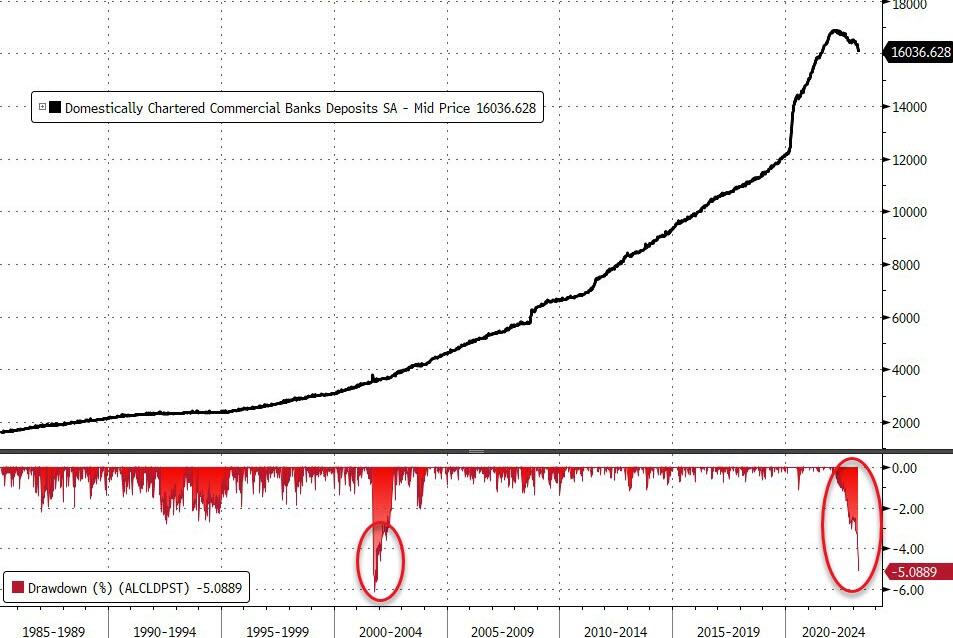
But, while many people’s attention has only been drawn to the US domestic bank deposit flows recently, they have been consistently suffering outflows for a year (this data excludes ‘large time deposits’). This is the 9th straight weekly decline in deposits…

Source: Bloomberg

Fascinatingly, both Large and Small banks saw deposit outflows (on a seasonally-adjusted basis) with Large banks losing a huge $129bn of deposits – the biggest weekly outflow ever…

Small banks, on the hand, saw a tiny $1.948 billion outflow (on a seasonally-adjusted basis)…

Source: Bloomberg (note different scales)

We note that the skew could be impacted by the $30bn rotation from “big banks” to FRC (a small bank)…

On a non-seasonally-adjusted basis, following the $196BN in small banks last week, we saw a $5.8BN INFLOW for small banks in the week ended March 22

The biggest (SA) large bank deposit outflow on record takes the overall level of deposits (ex-large deposits) to its lowest since March 2021…

In fact, outside of 9/11 (where infrastructure damage and closures prompted a blockage in payments/transfers), the total 5% drawdown in US domestic commercial bank deposits is the largest in history

Source: Bloomberg

While all of the data above is for domestic US banks, we also saw foreign bank deposits plunge $41 billion last week (slightly less than the $45bn from the week prior)…

Source: Bloomberg

Bear in mind this data includes the post-SVB period, where we had US regional banks all tumbling further and Yellen offering no guaranteed deposits, FRC stock collapse amid bailouts (though that will skew the data due to that $30bn infusion), and the fear of Credit Suisse’s collapse… and the ongoing gap between deposit rates and TSY yields

4% rates appears to have been the trigger for rotation (from deposits to MM)…

So with outflows continuing (and the spread between banks and TSY/MM fund yields), will banks start to compete for deposits? (Well not the biggest ones, for sure)…

“There are two key questions raised by the recent deposit turmoil,” Barclays Plc strategist Joseph Abate wrote in a note last week.

“How many deposits do banks ultimately lose to higher yielding money market funds? And how costly is it to replace this funding?”

Until now, when banks have lost deposits they haven’t had to compete aggressively so rates have lagged the Fed’s rate increases, and balances at government-only money fund balances had been flat since the hiking cycle began.

“But now that depositors have noticed, this dynamic is about to change,” Abate said.

And if the small ones start to ‘compete’ their profitability will collapse even further.

Which probably explains why regional banks just can’t bounce…

Still think this bank-run is over?

Tyler Durden
Fri, 03/31/2023 – 16:38

No Going Back

No Going Back

Authored by Vincent McCaffrey via AmGreatness.com,

The old normal isn’t coming back without some new thinking about what structures will reinvigorate our old principles…

Like most polls, Gallup polls are usually paid advertisements for whomever commissions them and therefore deserving of as little attention. However, the indefatigable Sharyl Attkisson recently reported on the results of one such survey and that did draw my attention. Evidently, 47 percent of Americans say life will never go back to pre-pandemic normal. I was somewhat stunned! How could 53 percent be thinking we could go back? 

This led me to darker thoughts on the collateral damage of our recent foolishness. At least 53 percent of Americans will be woefully unprepared for what is coming. Due to their own unwillingness to bear witness to the reality around them, much less recognize the consequences, the unprepared will be the first to panic, and their panic will result in more bad behavior at a time when strength of character will be needed. 

But there is worse yet: 33 percent of Americans say their lives are completely back to normal. I had no idea that 33 percent of Americans lived in caves! But then, my own ignorance never fails to astound me. What could be considered normal to these citizens? Even in peaceful and civilized New Hampshire, we can see the damage done. 

How could this be? Well, perhaps it is tied to the fact that more than half of all Americans are on some level of government welfare, from Social Security to child care assistance, and those payments have not been diminished. Nevertheless, the inflationary costs of food and fuel have dramatically risen in the last three years due to federal monetary policies as well as profligate spending, so that doesn’t explain everything. 

Anyone reasonably sentient must be aware of the problems caused by the COVID lockdown and the misdirection of tax revenues, allegedly to “soften” that blow, but actually and cynically proffered in order to gain votes. From drug use to family decomposition, the rise in crime and the disintegration of our physical infrastructure, there is a lot of visible devastation out there. Is this poll indicating 33 percent of Americans are comatose? 

It was even more discouraging to read that 50 percent of Republicans say their lives are back to normal. Granted, this may be a willful statement of their desire to return to normalcy, but it also might indicate why the Republican Party is so out of touch as to be okay with sending billions of dollars of taxpayer cash and military equipment to Ukraine while our own trains are derailing, bridges and roads are degrading, and air traffic is failing. 

In keeping with the old newspaper standing head, “women and children hardest hit,” 70 percent of women are likely to say things in general suck, while 51 percent say they are unsure of the future. Children were not polled—and, given our poor school systems—that might be an underlying long-term cause for our overall ignorance.

Confirming the previous doubts expressed about the veracity of the poll, only 38 percent of those who earn more than $90,000  per year say their lives are back to normal—that figure is composed of 50 percent who say they are Republican, 33 percent who say they are independent, and 24 percent who say they are Democrats. That is to say, most of those polled who are pretty well off are pessimistic, while 68 percent of those in an average income bracket ($36,000 to $90,000) are not happy now, and almost half do not expect things to return to “normal” in the future. 

But this negative point of reference is the larger issue. What do our fellow Americans expect and what are they likely to do about it? Remember, these are the same people who voted for the politicians who made this mess. Will they accept responsibility for their actions? 

Given the progressive indoctrination in public schools over two generations, bound as those institutions are to the deep state, and given the progressive harangue from mass media and the onslaught from the entertainment industry, what is the likelihood a majority of Americans today are prepared to turn against their handlers and accept an active role in their own welfare or bear witness to their past foolishness? 

But there is no going back. As a nation we cannot return to some better moment out of the 1990s or 1950s. The accepted norms of those generations are lost. And no force will bring them back minus their own deficiencies. We cannot unlearn the internet.

The course that a minority of the population (my guess is less than 33 percent) must now chart is not unlike to the path chosen by our founders and their generation. Given the general lack of knowledge today about history and the replacement of it by phony propaganda such as the “1619 Project,” the objectives must be tied to current circumstances to make them clear.

Highlighting graphic practicalities such as the rise of the multinational corporations in America with no allegiance to our own people, as they make arms and sell them to our enemies, can make a family with a son overseas more aware; tech companies that mine and sell our personal data and abuse our privacy make themselves obvious by their own actions; and the simple rising costs of living and doing business for a population which is otherwise occupied with the day to day struggle, cannot be ignored.

Those who have the security of ample property and income will not be on hand until their own ox is gored. The recent Dutch farmer revolt might be encouraging, if not for the important fact that the Canadian truckers who similarly risked everything had their countrymen simply turn away. 

People caught in an endless cycle of debt by major corporations (i.e, wage slaves) as the whole of America is turned into an enormous company town, will not be interested. Their homes are mortgaged, and their savings have already dwindled. They are afraid of retribution and losing what little they have left, even as their college loans are still outstanding. And those people (and it is a large number) who work for the bureaucracies, federal, state, and local, will be largely unavailable if not already organized against anyone who threatens their sinecures. They think they will be the survivors. But they haven’t a clue.

Democrats as a group will mainly be out to lunch—at least until the empirical evidence that they are dealing with thugs is smashed in their faces like a grapefruit (à la James Cagney and Mae Clarke), and then they might have a political awakening. But they are just as likely to proclaim their victimhood and look for another benefactor. 

Feminists will be the enemy of the good until they realize they were used and discarded by the Marxist agenda—but not enough of them are young athletes bewildered by having to compete against men who identify as women. With politics as their new religion, most are just as likely to blame the result on men, which will be true this time, to a point.

Independents—the nonaligned—are most often pawns to their insecurities. They are looking for the best deal at any one moment and will always be treated accordingly with verbal promises not worth the paper they’re printed on. They bargain over principle. The long-term game is beyond their comprehension. 

With so little help, and a task so large, the difficulties may appear insurmountable. But I would suggest that it could not have seemed any less impossible to the members of our first ad hoc Congress as they faced the most powerful nation on earth armed with an idea which had never been tried before.

China, Russia, Iran, and their allies will happily take advantage of any weakness. They are doing that right now. It is up to us to still elect leaders who will meet that challenge. But the current system of government is too flawed to survive much longer. It promotes corruption and dishonesty. Every election cycle enlarges our debt and weakens our fiber. Even if we manage to elect a good government, we must then live with an inevitable swing of the pendulum as the bad guys work to undermine any progress.

But any long-term objective must be in keeping with the best principles of our founders. Those tenets are tested and true, and they are already familiar to the greatest number of citizens. In the short term, the anachronistic structure set in place 200 years ago to give those truths a chance to flourish must now be examined for termites as well as for strength, and replaced, from pillar to post. The structure is important only so far as it protects and furthers those principles. 

It is the truth that matters, not the structure—just as my Free Will Baptist grandmother said, when I foolishly mentioned the peccadillos of some preacher of the time, “It’s the Lord I pray to, not the pastor.” 

My own thoughts return to that first Continental Congress. As we go forward and continue trying to elect better people to a job now thoroughly corrupted, we should act separately to elect a “shadow” government, similar to that of Westminster, but in the full light of day, with the peaceful purpose of proposing better ways and means. It must be constructed in public view and its purposes made clear. A short conversation with an average person will tell you that neither politicians nor our system are trusted. Given some time to show what might be done, with a consistent emphasis on principle and ways to make those ideas manifest, a larger public following should develop.

There is no Frodo among us who might faithfully handle the ring of power without succumbing to its poison. We cannot hope for a savior to make this happen. And the Lord will only help those who help themselves.


Tyler Durden
Fri, 03/31/2023 – 16:20

Case Against Trump A ‘Legal Disaster’: Jenna Ellis

Case Against Trump A ‘Legal Disaster’: Jenna Ellis

Authored by Eva Fu via The Epoch Times (emphasis ours),

The Manhattan district attorney’s case against former President Donald Trump is a “legal disaster” that has far-reaching legal ramifications, according to his former lawyer Jenna Ellis.

“The case against Donald Trump is a legal disaster, a weaponizing [of] the justice system against a political opponent,” Ellis, a former attorney for Trump’s 2020 campaign, told The Epoch Times after a grand jury in New York voted to indict the former president.

The Manhattan district attorney’s office has been investigating Trump in connection with an alleged hush money payment to adult performer Stormy Daniels during the 2016 presidential campaign. Trump, who is the frontrunner in the field of 2024 presidential hopefuls, has denied any wrongdoing, describing the March 30 indictment as “political persecution and election interference.”

Attorney Jenna Ellis arriving for a press conference at the Republican National Committee headquarters in Washington, on Nov. 19, 2020. (Mandel Ngan/AFP via Getty Images)

Ellis expressed the same view.

The only reason DA Alvin Bragg is bringing charges is because Trump is running for the GOP 2024 presidential nomination,” she said, noting that such efforts are likely to backfire.

“The DNC and RNC want a post-Trump America, yet they are incentivizing donors and the MAGA base to rally support against Trump because no one deserves to be politically prosecuted.”

She pointed to Trump’s top potential rival for the Republican nomination in 2024, Florida Gov. Ron DeSantis, who came out to denounce the indictment as “un-American.” He also declared that he will not assist in any extradition of Trump, a Florida resident, “given the questionable circumstances at issue with this Soros-backed Manhattan prosecutor and his political agenda,” referring to controversial billionaire financier George Soros.

Former President Donald Trump speaks to reporters before his speech at the annual Conservative Political Action Conference (CPAC) at Gaylord National Resort & Convention Center National Harbor, Md., on March 4, 2023. (Anna Moneymaker/Getty Images)

A throng of prominent Republicans have come to Trump’s aide in the wake of the indictment and criticized the charges against him as politically motivated.

House Speaker Kevin McCarthy (R-Calif.), like Ellis, said that Bragg has “irreparably damaged our country in an attempt to interfere in our Presidential election.”

As he routinely frees violent criminals to terrorize the public, he weaponized our sacred system of justice against President Donald Trump,” he wrote, vowing that the House will “hold Bragg and his unprecedented abuse of power to account.”

Rep. Elise Stefanik (R-N.Y.), the House GOP conference chair, released a statement saying the indictment was a “dark day for America.”

“The radical Far Left will stop at nothing to persecute Joe Biden’s chief political opponent ahead of the 2024 presidential election to suppress the will and voice of the American people,” she wrote.

Democrats, in the meantime, hailed the news, with Senate Majority Leader Chuck Schumer (D-N.Y.) saying that Trump is “subject to the same laws as every American.”

The swift response from DeSantis is rewarding politically, Ellis noted. With such a statement, she said, he is positioning himself as “a champion for the rule of law” and an “executive officer who will not allow political games.”

Voters will love that display of strength and backbone,” she said.

Trump’s lawyer Joseph Tacopina has told CNN that Trump, who is reported to be in Florida currently, will likely be arraigned early next week.

Tyler Durden
Fri, 03/31/2023 – 16:10

Bitcoin & Bullion Soar In Q1 As The Dollar Dumps, Banks Battered, Big-Tech Booms

Bitcoin & Bullion Soar In Q1 As The Dollar Dumps, Banks Battered, Big-Tech Booms

Q1 2023 – and even more specifically the month of March – can be summarized with one simple image…

Bank crisis in US and EU, global war rhetoric rising, de-dollarization actions escalating, US layoffs exploding? Makes you wonder about the state of the dollar eh?

Source: Bloomberg

BUT Everything must be ok right – the S&P 500 is above pre-SVB levels (just ignore the bank stocks collapse)…

Source: Bloomberg

However, a bigger picture look paints a different picture as the dollar suffered its second straight quarterly decline) as Bitcoin soared over 70% and Gold jumped almost 9% (bonds and stocks were also higher in Q1)…

Source: Bloomberg

In equity-land, the divergence across the majors in Q1 is quite shocking as long-duration mega-cap tech (and trash) soared while Big-Caps (Dow) and Small-Caps (Russell 2000 – heavy with small financials) ended around unchanged.

That was the Nasdaq’s best quarterly performance since Q2 2020 (and before that to Q1 2012)…

Source: Bloomberg

For the month, the Nasdaq is up over 8%, its biggest March advance since 2010. The Russell 2000 and Trannies were the ugliest horse in March’s glue factory…

Source: Bloomberg

Dow surged to its best week since November, but Small Caps outperformed, up over 3%…

The last 3 Friday have seen fear over SVB, CS, & DB respectively, so 4th time was the charm this week with a major melt-up as early 0DTE negative delta flows (as the S&P broke above 2065 JPM Collar Call Strike) were rapidly unwound as stocks continued to squeeze higher and that accelerated the gains…

Source: SpotGamma

The S&P rallied all the way back up to the key 4100 level today…

The S&P 500’s performance in Q1 was dominated by just 15 stocks…

In fact, it gets worse, according to Bianco Research, META, AAPL, AMZN, NFLX, GOOGL, MSFT, NVDA, TSLA account for all of the S&P’s YTD return. They are up +4.6%. The other 492 stocks collectively are down for the year (-.99%).

Source: Bianco Research

Mega-Cap techs saw market caps soar with AAPL back above $2.5 trillion, MSFT back above $2 trillion, AMZN back above $1 trillion, and META and TSLA back above $500 billion…

Source: Bloomberg

Tech and Discretionary dramatically outperformed in Q1 while Energy and Financials lagged…

Source: Bloomberg

European markets were mixed in March with Germany and France ending green while UK was the biggest loser…

Source: Bloomberg

On the month, European banks are modest underperformers relative to US banks, but both are ugly…

Source: Bloomberg

March was a wake-up call for commercial real estate, as Office REITs crashed hard…

Source: Bloomberg

US growth stocks have dominated Q1, crushing value stocks (until this week when the ratio of Russell 1000 Value/ Growth hit the August lows). For context, this is the biggest growth/value quarter since Q1 2020 (and before that Q1 2009)

Source: Bloomberg

March saw bond vol (MOVE) explode relative to equity vol (VIX) – to the same extent as October 2008…

Source: Bloomberg

Thanks to March ugliness (and basically no issuance), corporate bond spreads in US and EU are wider in Q1 after blowing out wider in March, erasing all the compression from Jan/Fed…

Source: Bloomberg

While stocks bounced back above pre-SVB levels, the credit market remains much more stressed (even with the rally of the last 2 days)…

Source: Bloomberg

Q1 was a wild one for bonds with Treasury yields exploding higher on hawkish Fed realizations and then collapsing lower on safe-haven/recession anxiety over the bank crisis. Amid all the chaos, yields ended the quarter surprisingly grouped, down around 30bps or so (with the belly outperforming)…

Source: Bloomberg

March was a big month for the yield curve with its biggest monthly steepening since May 2013 (2s10s +32bps), ending Q1 unchanged…

Source: Bloomberg

Yields were all higher on the week (with the short-end underperforming)…

Source: Bloomberg

The market’s expectations of The Fed’s actions has swung violently in Q1 from a post-payrolls-beat, post-hawkish-Powell surge (expecting rates to  be over 100bps higher by year-end) to a post-SVB failure collapse (expecting rates to be almost 100bps lower by year-end). The quarter ends with coin-flip odds of one more rate-hike before The Fed is done and then cuts starting by September…

Source: Bloomberg

Interestingly, the short-term yield curve is ending Q1 just a little more dovish than it started it – having been dramatically more hawkish and dovish intra-quarter…

Source: Bloomberg

The dollar is set to end the quarter 1.4% lower, its first consecutive quarterly loss since 2020, amid easing concerns about the global banking sector and money market wagers on Federal Reserve interest-rate cuts. This is the 5th monthly drop in the dollar out of the last 6 months


Source: Bloomberg

All the major cryptos had a good Q1, with Solana outperforming and Bitcoin gaining more than Ethereum (and that was in spite of ‘Operation Choke Point 2.0’)…

Source: Bloomberg

Bitcoin is up for the 3rd month in a row for its best quarterly gain since Q1 2021, back above $28,500 (and Ethereum is also up for 3 straight months (best Q since Q1 2021), nearing 7 month highs at $1850)…

Source: Bloomberg

NatGas was the standout commodity performance in Q1, collapsing 50% as warmer weather spoiled Putin’s party plans. Gold was the quarter’s best performer (along with copper – China reopening hopes) as crude closed lower…

Source: Bloomberg

Gold is up for the second quarter in a row (up over 19% in the  last 6 months – its best such gain since 2016), with its highest quarterly close in history. March saw gold rally almost 9% -its best month since July 2020 (topping $2000) once again…

Oil has been on a tear for the last two weeks with WTI back above $75, but remains down on the year, after breaking below its Jan/Feb range…

And finally, Q1 saw over $450 billion of inflows into Money-Market funds and over $300 billion in deposit outflows from US domestic banks…

Source: Bloomberg

And in case you were wondering what has sparked this sudden panic-buying in bonds, bullion, bitcoin, and big-tech? That’s easy – The Fed!!! Just as we warned would happen mid-March…

It’s the ‘old QE’ trade writ large. But what happens next (as The Fed balance sheet actually shrunk modestly last week) and Goldman’s US Activity Index just dropped into contraction…

With recessionary signals growing louder, maybe pricing in some ‘easing’ by The Fed is ‘fair’ but that appears fully priced-in to stocks at near-record high valuations (esp. mega-cap tech).

Tyler Durden
Fri, 03/31/2023 – 16:00

Yellen Warns Next Crisis Could Come From ‘Shadow Banks’ And Regulators Must Act

Yellen Warns Next Crisis Could Come From ‘Shadow Banks’ And Regulators Must Act

Authored by Tom Ozimek via The Epoch Times (emphasis ours),

Treasury Secretary Janet Yellen on Thursday said banking rules may need to be tightened after the recent failures of Silicon Valley Bank (SVB) and Signature Bank, while warning of structural vulnerabilities that must be addressed in the “shadow bank” sector that includes things like hedge funds and money market funds.

Treasury Secretary Janet Yellen testifies before the Senate Finance Committee in on Capitol Hill, in Washington, on March 16, 2023. (Chip Somodevilla/Getty Images)

In remarks prepared for delivery to the National Association for Business Economics (NABE), Yellen said that banking regulation and supervisory rules need to be reexamined in the wake of the twin collapses of SVB and Signature, which were sparked by bank runs.

“Anytime a bank fails, it is cause for serious concern. Regulatory requirements have been loosened in recent years. I believe it is appropriate to assess the impact of these deregulatory decisions and take any necessary actions in response,” Yellen said.

Yellen said a 2018 roll-back of bank capital requirements and stronger supervision for smaller and mid-size banks with assets below $250 billion should be reevaluated.

She added that regulatory reforms put in place after the 2008 financial crisis have helped the U.S. financial system cope with shocks, but that gaps remain and there’s scope to bolster resiliency.

“But the failures of two regional banks this month demonstrate that our business is unfinished,” Yellen said, adding that the U.S. financial system is now considerably more robust to shocks than it was during the previous crisis a dozen or so years ago.

This is perhaps best illustrated by the fact that we’ve seen relative stability in the overall banking sector this month, even as concerns grew about specific institutions,” she said.

Smaller community and regional banks have seen a rise in deposit outflows following the failures of SVB and Signature while big banks seen as “too big to fail” and more likely to be bailed out have been the beneficiaries. This has led to concerns that as deposits flee local banks, their provision of credit will dwindle, with negative economic impacts, especially on small businesses.

Yellen said it was important for regulators to assess whether the current supervisory and regulatory regimes are adequate for the risks that banks face and, if not, then policymakers “must act.”

While she made no specific proposals for tighter regulatory and supervisory standards, she said any next steps must take into account the “health and competitiveness of our vibrant community and regional banking institutions,” which could face an outsized impact from more regulations.

She acknowledged that more regulation means bigger and costlier burdens on banks in general, but that such costs “pale in comparison to the tragic costs of financial crises.”

Shadow Banks in Crosshairs

In her speech, Yellen called for tighter regulation of the growing non-bank or “shadow bank” sector, which includes money market funds, hedge funds, and crypto assets.

In the traditional banking sector, there are rules and measures in place to reduce the risk of bank runs. Alongside capital and liquidity requirements for banks, there are also deposit guarantees provided by the Federal Deposit Insurance Corporation (FDIC), which all reduce the likelihood that depositors will rush to withdraw their savings at the first sign of trouble.

“Yet the financial stability risks posed by money market and open-end funds have not been sufficiently addressed,” Yellen cautioned.

Money market funds, in particular, are vulnerable to runs and fire sales, Yellen said, in part due to the so-called “first-mover advantage” that established an incentive for investors to redeem “at the whiff of a problem.”

The first-mover advantage in context of money market funds means that the first redeemers can exit the fund at $1 per share, while those who wait may be subject to a reduced market value and so take a haircut. This creates an incentive for investors to redeem at the first sign of a problem, which can lead to runs and panic sales that pose a risk to financial stability.

During the 2008 financial crisis, expected losses on Lehman Brothers commercial paper led to a run on the $62 billion Reserve Primary Fund, which in turn sparked concerns about commercial paper issued by other banks and led to runs on other money market funds.

The first-mover advantage was also at play in March 2020 amid the pandemic shock, when a record $255 billion flowed out of bond mutual funds, Yellen noted.

This and other structural vulnerabilities regarding money market and open-end funds aren’t new, and the Securities and Exchange Commission (SEC) has, over the past two years, sought to address them through new regulatory proposals.

In particular, the SEC’s proposals would reduce the first-mover advantage and also require new liquidity management tools and mandate that these funds provide investors and the SEC with more comprehensive and timely information.

‘Negative Spiral of Margin Calls’

Hedge funds, meanwhile, which had nearly $10 trillion in gross assets in 2021, face leverage risks, Yellen said.

“Leverage can support economic growth, but excessive leverage is dangerous. It can add fuel to fire sales by triggering a negative spiral of margin calls and rapid asset liquidations,” she said. These fire sales can transmit stress to other market participants, including large, systemically important banks.

Post-crisis banking regulations have helped reduce the potential of spillovers to the banking system. But spillovers from these fire sales to other market participants remain a risk,” Yellen said.

Yellen said that, in an effort to address these risks, the multi-regulator Financial Stability Oversight Council’s restored Hedge Fund Working Group will continue to monitor them and develop policy recommendations.

Also on the Treasury secretary’s radar for systemic vulnerabilities that could seed a financial crisis are digital assets. Of particular concern are stablecoins, which could also be forced into asset fire sales in times of stress.

“A run on one stablecoin can lead to panicked runs on other stablecoins—causing even broader selloffs,” Yellen said, adding that Congress should pass legislation to establish a comprehensive prudential regulatory framework for stablecoin issuers and for other digital assets.

Yellen said the Biden administration is studying the potential for systemic risks from digital assets.

“And we are also exploring broader policy issues around the future of money and payments, including the possibility of a central bank digital currency,” Yellen said.

Meanwhile, global banking regulators have been discussing stepping up scrutiny of how risks from systemically important shadow banks could destabilize lenders.

Pablo Hernández de Cos, chair of the global Basel Committee, which writes bank capital rules that are applied across the world, said in a speech last week that additional guidance for managing shadow bank risks should be rolled out sometime this year.

Tyler Durden
Fri, 03/31/2023 – 15:47

“I Was Screaming Before You Interrupted Me”: Rep. Bowman Raves In Capitol On Gun Control

“I Was Screaming Before You Interrupted Me”: Rep. Bowman Raves In Capitol On Gun Control

Authored by Jonathan Turley,.

I have often discussed in columns what I call our “age of rage.”

There may be no more defining moment of that age than what unfolded today in the Capitol as Rep. Jamaal Bowman, D-N.Y., screamed about gun control. Various Democratic members, including former House Majority Whip Rep. Steny Hoyer, D-Md, tried to calm Bowman. However, after Rep. Thomas Massie, R-Ky, asked him to stop yelling, Bowman shouted “I was screaming before you interrupted me,” which could now go down as the epitaph for our age.

As members filed out of the House floor, Bowman was yelling about Republicans killing children and not caring about the carnage in our schools: “What are they doing about it? Nothing. They don’t have the courage. They’re cowards,” Bowman can be heard shouting as the video begins. “Three 9-year-olds. Are they going to those funerals? No!”

Massie stopped to address the attacks and noted “You know there’s never been a shooting at a school that allows teachers to carry?”

Bowman responded “More guns? More guns leads to more death” and continued to scream: “Republicans won’t do S— when it comes to gun violence.” He then continued on Twitter.

Massie responded:

“He wanted to discuss solutions to school shootings, but when I offered a solution he began shouting. When he asked for data, I gave him data, but then he just shouted more. Bring facts. There’s never been a school shooting in the hundreds of schools that allow staff to carry.”

The point is not the merits. This is an important national debate and the underlying facts continue to be debated, including statements from President Joe Biden that some of us have challenged.

However, this scene captured how rage has replaced reason in our public discourse.

Tyler Durden
Fri, 03/31/2023 – 13:44