Ukraine Civilians Wait In Long Lines For Fresh Water As Infrastructure Destroyed
There is an old lesson of warfare that says “never believe your own propaganda.”
After the initial Russian strikes against Ukraine’s power grids and infrastructure the general narrative was that Russian cruise missiles and drones were ineffective, inaccurate and that the country’s utilities would be back up and running in no time. The message was reticent of previous propaganda out of Ukraine which requires constant theatrics of impending victory. As long as they act as if they are winning, billions in NATO dollars will continue to flow.
Russian tactics were decidedly restrained in the early months of the conflict, with the Kremlin mostly avoiding precision attacks on vital resources, including power, water and internet. This is a departure from traditional military doctrine, which the US followed when it invaded Iraq and decimated vast segments of their grid utilities at the onset of the war.
The Russian pull-back to lines in the Donbas region was a clear indication that their strategy was about to change and that wider strikes were inevitable.
Now, Ukraine’s grid amenities are being systematically destroyed, and it is reported that Ukrainians in major cities like Kyiv are lining up for blocks daily just to fill a few meager jugs with fresh water at city well pumps.
The lack of access to utilities changes the dynamics of the war drastically.
With winter looming, millions of civilians will face cold months without electric heat, light or easy access to water and food.
The predictable end result of this will likely be a flood of refugees into Europe.
As Europe faces the twin challenges of an economic and immigration crisis, parties across Europe known for their strong stance against mass migration are seeing a massive boost in popularity, and Austria is no different. Now, a new poll shows the conservative Freedom Party of Austria (FPÖ) tying for the top spot for the first time since 2017.
This summer, the left-wing SPÖ was still leading in all the polls by up to 8 percentage points, but the party is currently suffering a substantial drop in support, according to a wave of new polls, including one from the Lazarsfeld Society which shows the FPÖ party, led by Herbert Kickl, is now tied for first place with the SPÖ at 26 percent. In second is the conservative ÖVP at 21 percent, which currently rules the country in a coalition with the Green Party, which is at 11 percent.
Herbert Kickl, the leader of FPÖ, is enjoying a surge in support over his twin stances against migration and sanctions on Russia.
It is also not the only poll showing the FPÖ jumping in popularity, with Politico’s poll of polls putting the FPÖ within two points of the SPÖ.
As Remix News previously reported, the left-wing SPÖ performed poorly in regional elections in Tyrol, while the FPÖ outperformed, with the results there serving as a bellwether for the rest of the nation. However, since that vote last month, the immigration crisis facing the country has only worsened, and the parties in power have shown that they have few solutions to halt uncontrolled immigration into the country.
“Austria is currently heavily burdened by illegal migration. The contribution that we are making in Europe is disproportionately high. The EU’s migration policy has failed. There is still no strong protection of the European Union’s external borders, and the reality of the problem is being ignored,” the ÖVP leader, Austrian Chancellor Karl Nehammer, said earlier this month to Austrian newspaper Kronen Zeitung.
Austria had already received more than 56,000 asylum applications as of August and experts expect a new record of applications this year, even dwarfing the refugee crisis in 2015 and 2016.
FPÖ is only major party against Russia sanctions
However, it is not only the migrant wave that is driving support for the FPÖ. The party has been aggressively calling for an end to sanctions on Russia, even demanding a referendum on ending all sanctions be held.
“It’s finally time to appear in the EU and say: These sanctions harm us much more than Putin. Our people have to foot the bill for them,” said deputy FPÖ chairwoman Dagmar Belakovich in the plenary session of the National Council.
The party’s leader, Herbert Kickl, has also pointed to the absolute necessity of Russian energy for Austria’s households and businesses. Inflation surged to 10.5 percent in September, mostly due to soaring energy prices.
“If you were honest, you would have to say to the population: We can’t do without this Russian oil and gas for a long time,” said Kickl.
“We need this cheap energy for households, for heating, for cooking, for hot water, for manufacturing companies.” He has argued that the government cannot compensate for this.
In another worrying sign for the ruling government, 40 percent of Austrians want new elections, with only 20 percent of those surveyed currently considering the government’s cooperation to be “stable and good.”
The Alternative for Germany (AfD) in Germany has seen a similar bump in its polling numbers over the same issues of migration and sanctions, although its rise has not been as quite as dramatic. The FPÖ ultimately faces fewer obstacles to power in Austria, with far more support from the populace as well as a history of governing in coalitions in the past.
The stepped-up measures from the UK’s chief veterinary officer make the housing measures a legal requirement, and are accompanied by stringent biosecurity measures to protect flocks from disease, Sky News reports.
The rules come into force one minute past midnight on Monday, November 7th, giving owners one week to prepare.
It comes after the national risk of bird flu in wild birds was raised to ‘very high’, and the whole of Great Britain was made a bird flu prevention zone two weeks ago.
Chief veterinary officer Christine Middlemiss said: “We are now facing this year the largest ever outbreak of bird flu and are seeing rapid escalation in the number of cases on commercial farms and in backyard birds across England. -Sky News
“The risk of kept birds being exposed to disease has reached a point where it is now necessary for all birds to be housed until further notice,” Middlemiss continued. “Scrupulous biosecurity and separating flocks in all ways from wild birds remain the best form of defence.”
All bird owners must follow the rules, whether they keep ‘a few, or thousands,’ she added.
“This decision has not been taken lightly, but is the best way to protect your birds from this highly infectious disease.”
The Department for the Environment and Rural Affairs reports that housing birds reduces the risk of infection.
That said, housing alone will not protect the birds, and keepers are instructed to implement enhanced biosecurity measures laid out earlier this month to prevent the disease from spreading. The measures include restricting access for non-essential people on site, and ensuring that workers change clothing and footwear before entering bird enclosures. Vehicles must also be disinfected regularly.
The UK Health Security Agency says the risk to public health remains unchanged.
By Allegra Catelli and Michael Msika, Bloomberg Markets Live reporters and analysts
Renewable energy stocks are having a hard time, even in the middle of Europe’s energy crisis. It seems that the sector needs central banks to take their foot off the gas in hiking interest rates, but it may have to wait a little longer.
The European Renewables Index has lost most of its summer outperformance over the wider Stoxx Europe 600 Index. Since a year-to-date peak in August, renewable stocks have fallen 20%, and only real estate has performed worse. They’ve recovered a bit since Oct. 12 thanks to expectations for a change in tone from central banks, but are again at risk of disappointing investors if the Federal Reserve remains hawkish with a jumbo rate hike this Wednesday.
“Overall, it is this conflict and divergence between the short-term pain of interest-rate worries versus the long-term gain from the policy side, and currently, the short-term pain is winning this battle,” says Credit Suisse equity analyst Jens Zimmermann.
Utilities could be particularly at risk, as higher rates will hurt the sector’s 2023 revenues the most, according to Citigroup strategists led by Beata Manthey. This week is heavy in earnings, with updates from the likes of Verbund, Vestas, Orsted and Scatec in coming days. Verbund, for example, is facing headwinds from rising rates, political intervention and falling power prices, according to Credit Suisse analyst Wanda Serwinowska. Infrastructure builders are also suffering challenges.
“Market expectations have already priced in a down year for onshore wind installations in 2023, and we see a US catalyst sooner than in the EU,” says Citigroup analyst Martin Wilkie, referring to tax credits in the US Inflation Reduction Act.
“We continue to believe that Vestas remains the key long term winner, but policy catalysts look to be end-fourth quarter at best, and possibly early 2023.”
While the longer-term policy outlook is supportive as governments look to meet targets to cut emissions, there’s speculation that energy windfall taxes could hit renewable equities in the near term. Germany’s plans would affect firms making electricity from lignite, nuclear, oil, renewables and waste, yet plants fed by gas or charcoal would be spared, fueling fund manager frustration.
“There has been no clear plan implemented to solve short, medium-term hurdles, this is also curtailing the growth of these companies,” says Maximilian Mahn, a portfolio manager at Bergos AG.
Others think the problems have been priced in, including windfall taxes, making these stocks’ valuations quite attractive. UBS analysts led by Sam Arie say a better-than-anticipated outlook for gas prices should provide an improved environment for the sector. Still, renewable stocks are not exactly cheap, with the sector still trading at a 90% premium to the broader market.
And there are plenty of other headwinds, from rising bond yields to slowing ESG money flows. The dividend yield advantage of renewables against bonds is fading away, a negative for stocks that have typically been good dividend payers, says Mahn.
The amount investors have been putting into ESG equity ETFs has retreated sharply this year, after rising to a record in 2021.
The dismal performance of ESG darlings such as tech stocks, combined with a rally in oil firms, has weighed on the attractiveness of such funds. A shift in the Fed’s narrative could start to change that.
Poland Signs Deal With Korea To Build 2nd Nuclear Power Plant, Days After Picking US Offer For First NPP
In one of Europe’s most coal-reliant countries, where desperate homeowners lined up in wait for days to buy coal ahead of the winter as far back as August, today Poland signed an agreement with South Korea to develop the European nation’s second nuclear power plant, accelerating its efforts to become energy independent, although it has decades to go.
Korea Hydro & Nuclear Power Co., a state-run nuclear plant operator, signed a letter of intent with Polish utilities PGE SA and ZE PAK SA on Monday, South Korea’s energy ministry said in a statement. The consortium will build four 1,400-megawatt APR-1400 reactors near ZE PAK’s coal plants in Patnow in Central Poland, Bloomberg and Reuters reported.
“The initiative of ZE PAK and PGE is extremely interesting because it fulfills the strategic goals of Poland and Poles — cheap energy and energy independence,” Poland’s Deputy Prime Minister Jacek Sasin was quoted as saying in the statement.
The companies, with government backing, intend to prepare a preliminary development plan for the plant by the end of this year, they said in a statement.
As Reuters notes, the agreement comes just days after Poland selected Westinghouse Electric to build its first nuclear plant. The European Union’s most coal-reliant country is pushing into nuclear power to provide stable electricity while curbing the need for imports of coal and natural gas. The deal is also a shot in the arm for Korea’s government, which has been promoting the export of atomic technology as part of a wider push to reduce emissions.
The companies will come up with a more detailed development plan by the end of this year setting out the expected budget and financing, according to the statement. The number of reactors to be built will be determined at a later date.
South Korea’s energy ministry said it also signed a separate memorandum of understanding with Poland’s State Assets Ministry agreeing to provide support to the companies in developing the project, and share information to further expand cooperation between the two nations.
Since the election this year of President Yoon Suk-yeol, who pledged to revive the country’s nuclear power industry, South Korea has stepped up efforts to win nuclear power plant export orders. The country has pushed for a long-term build-out of nuclear power at home, while pledging to be a major exporter of nuclear technology. In August, the Asian nation secured a 3 trillion won ($2.1 billion) order to supply equipment and material for the construction of nuclear plants in Egypt, Korea’s first such overseas deal since 2009.
Still, South Korea’s ambition to become a major exporter of nuclear technology faces a challenge after Westinghouse filed a lawsuit in the US to prevent Korea Electric Power Corp. and its unit Korea Hydro from “unauthorized” sharing of the technology with other countries. The legal dispute could hamper Korea’s ability to develop plants in other nations, including Poland, Saudi Arabia and the Czech Republic.
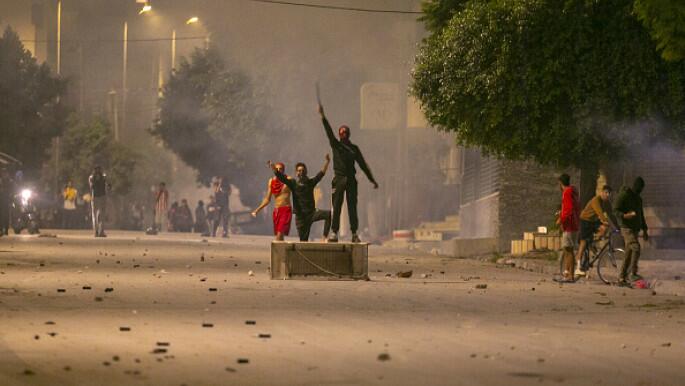
Protests erupted on 14 October across several working-class districts in the Tunisian capital following the death of a young man, Malek Slimi, who suffered severe injuries from a fall during a police chase in late August.
The demonstrations in the deprived Ettadhamen neighbourhood, where the 24-year-old was originally from, saw youths chanting slogans against the police and throwing stones at them amid outrage over the violence which they say led to Slimi’s death. Tunisia’s interior ministry has denied allegations of abuse.
Protesters and police clashed for a week, with young demonstrators setting rubber tires on fire and blocking roads, while security forces reportedly responded with the extensive use of tear gas and sound bombs to disperse the crowds. The clashes resulted in some 30 people being arrested.
Ghaylen Jlassi, a member of the Tunisian Intersection Association for Rights and Freedoms (IARF) who documented some of the recent protests in the Ettadhamen and Sidi Hassine districts, estimated that up to 50 youths aged between 18 and 25 had been detained. More than half have since been released thanks to the work of lawyers and human rights organisations.
As part of the arrest campaign, Fourat Ayari, an eyewitness to Slimi’s death, was said to have been abducted for a day by police for questioning at the beginning of last week. Activist Saif Ayadi was rounded up by plainclothes police officers after a press conference about the ‘Learn to swim’ campaign against impunity on Wednesday last week and freed three days later.
An active member of the Tunisian League for Human Rights (LTDH), he was the first to visit the family of the deceased and to speak to Ayari. Aw Saadi, an activist with Damj (the Tunisian Association for Justice and Equality), was also released alongside Ayadi.
“Tunisian youth and civil society have been demanding an end to impunity for the country’s security apparatus for years,” Nessryne Jelalia, former director of Al Bawsala, a Tunisian NGO promoting democracy and human rights, told The New Arab. “I’m surprised that these young people haven’t turned more radicalised,” she added.
“Clearly, all popular discontent has been handled with a heavy-handed security approach under the current regime just like under any of the preceding governments,” the prominent civil society activist said. “The police state has never gone, it has just been operating at different degrees over the past decade”.
Citing data gathered by Tunis-based independent media collective Inkyfada, she said that a total of 28 cases of police violence in which Tunisians have lost their lives have been identified since 2011, without those responsible being held accountable. IARF puts the number at 30 documented cases, including that of Malek Slimi.
The deaths have occurred during the dispersal of demonstrations, at police stations, during police pursuits, and during arrests or while under detention.
In the aftermath of the recent demonstrations, the LTDH urged the Interior Minister “to stop the use of force” against peaceful demonstrators and to prosecute the assailants to ensure accountability.
t also stressed the need to release all of those arrested. The rights group rebuffed “any unfounded legal proceedings” used against them, in particular regarding the charges of damaging private and public property or attacking police officers.
Numerous civil society groups, lawyers, and human rights defenders have condemned the use of the police and the judiciary to crack down on anti-government protests.
The Office of the UN High Commissioner for Human Rights expressed concern about allegations of the “disproportionate use of police force to disperse recent protests”, urging authorities to respect freedom of expression and peaceful assembly.
The latest wave of anti-police unrest comes amid growing public anger over economic deterioration, injustice, and oppression. Opposition groups staged separate rallies on 15 October in central Tunis against President Kais Saied, who they blame for a crippling economic crisis including food shortages and inflation.
Adding to the widespread frustration among the population was a migrant tragedy in the coastal city of Zarzis, where authorities reportedly buried some of the bodies of drowned Tunisian migrants without attempting to identify them in a show of perceived carelessness.
Two weeks ago, six young men from Mornag, on the outskirts of Tunis, were sentenced to three years in prison for taking part in night protests in their neighbourhood in late September following the suicide of a young street vendor after municipal police seized his weighing scale. Around the same time, people were also protesting against high prices and food shortages in different areas of the capital.
The recent youth-led protests took place in the context of rising social tensions in response to ongoing police impunity.
The trial for young football fan Omar Laabidi, who drowned in a river in 2018 while trying to escape a police patrol, has been dragging on for over four and a half years. The Ben Arous court held the fifth hearing on 20 October, where the 14 officers accused of causing Laabidi’s death appeared, yet the verdict in the case was deferred until 3 November.
In recent years, the LTDH has recorded almost 20 cases of young people who died in suspicious incidents involving the police, claiming that officials rarely face justice.
More than a decade since the 2011 revolution that ousted long-time ruler Zine El Abidine Ben Ali, repression by security forces in the birthplace of the Arab Spring continues. What’s more, since President Saied’s power grab in July last year, rights groups say authorities have increasingly used measures similar to those employed under Ben Ali.
Jlassi, who’s been actively participating in and monitoring protests around Tunis since 2018, noted that police aggression has been “on the rise” in the past year along with the use of military trials to convict civilians. IARF counted close to 17 cases of civilians brought before military courts since the chief of state seized power and suspended parliament on 25 July 2021, compared to 12 cases recorded in the previous ten years.
“It’s been a state policy for a long time,” Jlassi said, hinting at an existing “partnership” between judicial and police authorities that prevents bringing police officers to justice.
For Jlassi, the case of Omar Laabidi may be the only hope for justice when it comes to holding Tunisian police accountable, as all the other documented cases of deaths caused by police violence are still pending in the investigation phase.
“The president’s main focus right now is to head toward legislative elections, so he resorts to police authority to prevent any disruption to his project,” Asrar Ben Jouira, human rights activist and head of IARF, told TNA.
She highlighted how the country’s security forces continue to enjoy impunity for grave human rights violations. “Tunisia has been a police state since the time of Ben Ali. Kais Saied makes no exception,” the rights defender said.
Similarly, Ben Jouira observed an “increased incidence” of arbitrary arrests and ill-treatment at the hands of police officers and security personnel.
She pointed out that there was practically no media coverage of the recent demonstrations that spread across different suburbs of Tunis, with protests in marginalised urban areas often under-reported, which keeps a lot of police abuse out of the public eye.
In Jelalia’s view, there is now an “unprecedented” policy of turning to a security-oriented response to dissent, which is particularly “dangerous” because Saied’s presidential one-man rule operates in the absence of functioning democratic institutions.
More than two years since the lockdowns of 2020, the political mainstream, particularly on the left, is just beginning to realize that the response to Covid was an unprecedented catastrophe.
But that realization hasn’t taken the form of a mea culpa. Far from it. On the contrary, in order to see that reality is starting to dawn on the mainstream left, one must read between the lines of how their narrative on the response to Covid has evolved over the past two years.
The narrative now goes something like this: Lockdowns never really happened, because governments never actually locked people in their homes; but if there were lockdowns, then they saved millions of lives and would have saved even more if only they’d been stricter; but if there were any collateral damage, then that damage was an inevitable consequence of the fear from the virus independent of the lockdowns; and even when things were shut down, the rules weren’t very strict; but even when the rules were strict, we didn’t really support them.
Put simply, the prevailing narrative of the mainstream left is that any upside from the response to Covid is attributable to the state-ordered closures and mandates that they supported, while any downside was an inevitable consequence of the virus independent of any state-ordered closures and mandates which never happened and which anyway they never supported. Got it? Good.
This perplexing narrative was perfectly encapsulated in a recent viral tweet by a history professor who griped about the difficulty of convincing his students that government mandates had nothing to do with the fact that they couldn’t leave their homes in 2020.
Similarly, in an interview with Bill Maher, celebrity scientist Neil DeGrasse Tyson argued that we can’t assess the effects of lockdowns and mandates because the counterexamples, like Sweden, are too different to be applicable. (Starting at 2:15).
Likewise, astonishingly, in a debate on Monday, Charlie Crist, Democratic candidate for governor of Florida, accused Ron DeSantis of being “the only governor in the history of Florida that’s ever shut down our schools.” “You’re the only governor in the history of Florida that shut down our businesses,” Crist went on, “I never did that as governor. You’re the one who’s the shutdown guy.”
In fact, as DeSantis pointed out, Crist had publicly sued DeSantis to keep kids out of school in 2020, and he wrote DeSantis a letter in July 2020 saying the entire state should still be in lockdown.
Charlie Crist attempts to paint Gov. Ron DeSantis as “the shutdown guy” immediately after DeSantis talks about how he rejected Crist’s calls to shut the state down. pic.twitter.com/0XoEbgq4Pg
Arguments like these are as facile as they are transparent. Does anyone honestly think these people would be arguing that lockdowns didn’t happen, or that it’s impossible to measure their effects, if the policy had been a success?
As is extraordinarily well-documented by data, video evidence, news reports, government orders, testimonial evidence, and living memory, the strict lockdowns of spring 2020 were all too real. And few people publicly opposed them.
As former UN Assistant Secretary-General Ramesh Thakur has documented in meticulous detail, the harms that lockdowns would cause were all well-known and reported when they were first adopted as policy in early 2020. These included accurate estimates of deaths due to delayed medical operations, a mental health crisis, drug overdoses, an economic recession, global poverty and hunger. In March 2020, the Dutch government commissioned a cost-benefit analysis concluding that the health damage from lockdowns—let alone the economic damage—would be six times greater than the benefit.
Yet regardless, for reasons we’re still only beginning to understand, key officials, media entities, billionaires and international organizations advocated the broad imposition of these unprecedented, devastating policies from the earliest possible date. The resulting scenes were horrific and dystopian.
People lined up outdoors in freezing temperatures to get food.
It’s before the crack of dawn on a Saturday morning, yet the line outside the Winco Foods grocery store on Coffee Road stretches around the block. Market employees are allowing 15 people in at a time. Some folks have been in line since 3 a.m. pic.twitter.com/hPYuhnQUwY
In many cities, still-sick patients were tossed out of hospital beds and sent back to nursing homes.
Playgrounds were taped up.
Parks and beaches were closed, and some mainstream commentators argued that those closures should be even stricter.
Many who flouted these closures were charged or arrested.
Stores, and sometimes sections of stores, that were deemed “non-essential” were cordoned off.
School closures caused an unprecedented learning setback, especially for the poorest students. But even when schools were open, kids had to sit for hours in masks, separated by plexiglass barriers.
Many kids were forced to eat lunch outside in silence.
CHILD ABUSE: Kindergartners are forced to eat lunch outside in 40 degree weather at Capitol Hill Elementary School in Portland, Oregon.
The Financial Times reported that three million in the United Kingdom went hungry due to lockdown.
The situation was far worse in the developing world.
If these horror stories aren’t enough, the raw data speaks for itself.
The mainstream left’s newfound reluctance to refer to these policies as “lockdown” is especially curious, because they showed no such reluctance at the time they were actually implementing lockdowns in 2020.
By pretending that all of these horrors were attributable to public panic, apologists for the response to Covid are attempting to shift blame away from the political machines that imposed lockdowns and mandates onto individuals and their families. This is, of course, despicable and bunk. People did not voluntarily go hungry, or stand in the freezing cold to get food, or remove themselves from hospitals while they were still sick, or bankrupt their own businesses, or force their own kids to sit outside in the cold, or march hundreds of miles in exodus after losing their jobs in factories.
The collective denial of these horrors, and the refusal of media, financial, and political elites to report on them, amounts to nothing less than the greatest act of gaslighting that we’ve seen in modern times.
Further, the argument that all of these terrible outcomes could be attributed to public panic rather than state-imposed mandates would be far more convincing if governments hadn’t taken unprecedented actions to deliberately panic the public.
A report later revealed that military leaders had seen Covid as a unique opportunity to test propaganda techniques on the public, “shaping” and “exploiting” information to bolster support for government mandates. Dissenting scientists were silenced. Government psyops teams deployedfear campaigns on their own people in a scorched-earth campaign to drive consent for lockdowns.
Moreover, as a study by Cardiff University demonstrated, the primary factor by which citizens judged the threat of COVID-19 was their own government’s decision to employ lockdown measures. “We found that people judge the severity of the COVID-19 threat based on the fact the government imposed a lockdown—in other words, they thought, ‘it must be bad if government’s taking such drastic measures.’ We also found that the more they judged the risk in this way, the more they supported lockdown.” The policies thus created a feedback loop in which the lockdowns and mandates themselves sowed the fear that made citizens believe their risk of dying from COVID-19 was hundreds of times greater than it really was, in turn causing them to support more lockdowns and mandates.
Those who publicly spoke against lockdowns and mandates were ostracized and vilified—denounced by mainstream outlets like the New York Times, CNN, and health officials as “neo-Nazis” and “white nationalists.” Further, among those who really believed the mainstream Covid narrative—or merely pretended to—all the authoritarian methods that had supposedly contributed to China’s “success” against Covid, including censoring, canceling, and firing those who disagreed, were on the table.
Though many now claim to have opposed these measures, the truth is that publicly opposing lockdowns when they were at their apex in spring 2020 was lonely, frightening, thankless, and hard. Few did.
The gaslighting is by no means limited to the political left. On the political right, which now generally acknowledges that Covid mandates were a mistake, the revisionism is subtler, and tends to take the form of elites casting themselves—falsely—as having been anti-lockdown voices in early 2020, when the record is quite clear that they were vocal advocates of lockdowns and mandates.
Fox News host Tucker Carlson now rightly acts as a champion of the anti-mandate cause, but in fact Carlson was one of the most influential individuals who talked Donald Trump into signing onto lockdowns in early 2020. The UK’s short-lived Prime Minister Liz Truss stated that she’d “always” been against lockdowns, but she publicly supported both lockdowns and vaccine passes. Likewise, Canada’s conservative leader Pierre Poilievre now casts himself as an anti-mandate leader, but he supported both lockdowns and vaccine mandates as they were happening.
As Ben Irvine, author of The Truth About the Wuhan Lockdown, has tirelessly documented, right-wing publications including the UK’s Daily Telegraph now routinely act as opponents of lockdowns and mandates, while staying silent as to their own vocal support for strict lockdowns in spring 2020. And the same goes for countless other commentators and influencers on the political right as well.
To those who know their history, this wholesale gaslighting by elites on both the left and the right, while galling, isn’t terribly surprising. Most elites obtain power by doing whatever is in their own perceived best interest at any given time. They didn’t support lockdowns for any moral or even utilitarian reason. Rather, in spring 2020, elites calculated supporting lockdowns to be in their own best interest. Two years later, many now calculate it to be in their best interest to pretend they were the ones who always opposed lockdowns—while sidelining those who actually did.
This revisionism is all the more disappointing because a small handful of politicians including Ron DeSantis, Imran Khan, and Alberta Premier Danielle Smith have proven that admitting error in implementing lockdowns and mandates isn’t that hard, and can even be politically profitable.
The same should go for the political left. Thus far, we have yet to see anything remotely resembling regret from any leader on the left, but this is what a decent, Truman-era Democrat might say in these circumstances:
“The lockdowns of 2020 were a terrible mistake. While they were outside my field, it was my duty to properly vet the credibility of the advice that was coming from health officials and to end the mandates as soon as it was clear they weren’t working. In that role, I failed, and you all have my humblest apologies. Given the unprecedented harm that’s been done by these mandates, I support a full investigation into how this advice came about, in part to ensure there hasn’t been any untoward communist influence on these policies.”
Those who spoke against lockdowns and mandates in early 2020 showed that they were willing to stand up for the freedoms and Enlightenment principles for which our forebears fought so tirelessly, even when doing so was lonely, thankless, and hard. For that reason, anyone who did so has reason to feel extremely proud, and the future would be brighter if they were in positions of leadership. That fact is now becoming increasingly clear—unfortunately, even to those who did the opposite. One more reason to keep all the receipts.
* * *
Michael P Senger is an attorney and author of Snake Oil: How Xi Jinping Shut Down the World. Want to support my work? Get the book.
General Dynamics Reveals Next-Generation Army Tank, Could Replace M1 Abrams
America’s main battle tank, designed by Chrysler Defense (now General Dynamics Land Systems), has been in service for over forty years. The M1 Abrams is one of the world’s most fearsome tanks, though it’s becoming outdated and vulnerable on the modern battlefield.
Earlier this month, General Dynamics’ unveiled “AbramsX,” the next generation of main battle tanks that could one day replace the M1 Abrams, at the United States Army annual conference in Washington, D.C.
A demonstrator version of the AbramsX was on the show floor. The most notable upgrades for the new tank are weight reduction, fuel efficiency, artificial intelligence systems, and reduced crew size.
At 73.6 tons today, the M1 Abrams is a behemoth. Meanwhile, General Dynamics was able to shave off more than ten tons — with the new tank coming in around 60 tons, Timothy Reese, director of Business Development for General Dynamics Land Systems, told Sandboxx.
AbramsX features an auto-loader for the main gun, eliminating the need for a human tank loader, thus reducing crew size from four to three. Reese said the new tank’s land speed would stay the same, but lighter displacement would make it more maneuverable.
Another radical new design is the AbramsX’s power plant. It’s a diesel hybrid-electric system, compared with the M1 Abrams’ gas-guzzling turbine engine dating from the 1970s. The new power plant offers a 50% fuel savings, which increases mission time.
It’s too early to say what the future of the Army’s battle tank will be, considering new versions of the M1 Abrams are slated for the battlefield in the next several years.
General Dynamics also released a video of the AbramsX driving around a parking lot.
If the Army wants to achieve a 50% reduction in greenhouse pollution by 2030, compared to 2005 levels, then AbramsX could be America’s next main battle tank.
A left-wing civil rights group is asking the Supreme Court to review the felon disfranchisement provision of the Mississippi Constitution that permanently prevents certain felons from voting, claiming the law is rooted in racial animus.
The appeal is not expected to affect the approaching Nov. 8 elections.
The petition (pdf) in the case, Harness v. Watson, is expected to be docketed by the Supreme Court in the coming days. The respondent, Michael Watson, is Mississippi’s Republican secretary of state.
The petitioners, Roy Harness and Kamal Karriem, are black Mississippi residents. Harness was convicted of forgery in 1986. Karriem, a former Columbus city council member, was convicted of embezzlement in 2005. Both have completed their sentences.
According to a summary provided by the Mississippi Center for Justice, which is representing the men, Section 241 of the Constitution permanently blocks anyone from voting who was convicted of certain crimes that the original framers of the document believed were committed mostly by black people.
The state constitution bars those convicted of murder, rape, bribery, theft, arson, obtaining money or goods under false pretenses, perjury, forgery, embezzlement, or bigamy, from voting.
“It was one of several voting provisions in the 1890 Constitution designed to take the vote away from Black citizens who had obtained it during the Reconstruction period after the abolition of slavery and the end of the Civil War,” the summary states. “The other discriminatory provisions, including the poll tax and the so-called understanding clause, were eliminated in the 1960s in response to federal court orders and the federal Voting Rights Act of 1965.”
Rob McDuff is the attorney for the plaintiffs and the director of the Impact Litigation Project at the Mississippi Center for Justice.
“At a time when our state and nation are struggling with the vestiges of a history of racism, it is important that the United States Supreme Court step in to address this remaining vestige of the malicious 1890 plan to prevent an entire race of people from voting in Mississippi,” McDuff said.
“Although the Supreme Court has become more conservative in recent years, we hope it will see that the continued implementation of this racist provision is an affront to the promise of the Equal Protection of the Law contained in the Fourteenth Amendment to the U.S. Constitution.”
A federal district court upheld the ban, concluding it was bound by the 1998 ruling of the U.S. Court of Appeals for the 5th Circuit in Cotton v. Fordice, which held that the “discriminatory taint associated with the original version” had been erased when burglary was removed from Section 241 in 1950 and rape and murder were added as disenfranchising crimes in 1968.
Because a majority of voters approved these racially neutral amendments to the provision in 1950 and 1968 and discriminatory animus was not a factor at those times, Section 241 was “redeem[ed] … from its unconstitutional provenance.”
The district court ruling was affirmed by a three-judge panel of the U.S. Court of Appeals for the 5th Circuit. In August all 17 judges on the 5th Circuit reviewed the ruling and voted 10–7 to uphold the ban.
The 10-member majority acknowledged (pdf) the state’s 1890 constitutional convention was “steeped in racism,” that the “state was motivated by a desire to discriminate against blacks,” and that Section 241 was a “device that the convention exploited to deny the franchise to blacks.”
But any discriminatory intent was “cured” by the later constitutional amendments, the majority stated.
The Epoch Times reached out to Watson for comment but his office did not immediately respond.
Throughout history, humans have relied on cooperation and social relationships to thrive. Of course, who we spend time with evolves throughout our lifetime.
In the average American’s teenage years, they spend most of their time alone and with their family. This makes sense, as the majority of people under 18 still live in a home with their nuclear family unit, meaning parents and siblings. Not surprisingly, adolescence is also when time spent with friends reaches its peak.
Jumping forward to a person’s early adulthood, 25-year-olds spend an average of 275 minutes per day alone, and 199 minutes with coworkers. This aligns with people in their twenties beginning to enter the workforce.
By age 35, people are still spending the most time with themselves, at 263 minutes per day. However, time spent combined with children and partners, the runner-ups, adds up to 450 minutes or around 7.5 hours a day.
Although people are spending more time with kids and partners as they grow older, this trend may shift, as women are having fewer children. More women today are obtaining an education and are entering the workforce, causing them to delay or entirely put off having children.
Middle to Old Age
Upon turning 45, the average person spends 309 minutes a day alone, and in second place, 199 minutes with children. Time with coworkers remains relatively steady throughout someone’s forties, which coincides with the middle of career for most people in the workforce.
By age 55, time spent alone still takes top spot, but time spent with a partner goes up to 184 minutes, and time with coworkers also moves up, pushing out time spent with children.
Typically, time spent with children during the mid-fifties tends to see a sharp decline as children enter adulthood and begin to move out or spend more time out of the house.
Today, more children are staying at home longer or even moving back home. 52% of adult children in the U.S. today are living with their parents.
As people get closer to old age, around 65-years-old, they spend increasingly less time with coworkers as they begin to retire, and much more time alone or with a spouse. Then, from age 65-75, people consistently spend the most time alone, then with a partner and family.
Alone and Lonely?
One of the most significant trends on the chart is increased time spent alone.
By the time someone reaches 80, their daily minutes alone goes up to 477. This can be a problematic reality. As the population continues to age in many countries around the world, more elderly people are left without resources or social connection.
Additionally, while one quarter of elderly Americans live alone, the trend of solo living is going up across nearly every age group, and this trend applies to a number of mature economies around the world.
A natural conclusion would be that increasing alone time has negative impacts on people, however, being alone does not necessarily equate to loneliness. Our World in Data found that there was no direct correlation between living alone and reported feelings of loneliness.
One final consideration is the role technology plays in our social interactions. Thanks to smartphones and social platforms, time alone doesn’t necessarily equal isolation.
It is not just the amount of time spent with others, but the quality and expectations, that reduce loneliness.