79.9 F
Chicago
Monday, August 10, 2026
Home Blog Page 3845

Deficit Hawk Hypocrites And Warmongers Unite, Apparently Hoping To Start WWIII

Deficit Hawk Hypocrites And Warmongers Unite, Apparently Hoping To Start WWIII

Authored by Mike Shedlock via MishTalk.com,

The WSJ wants to send long-range missiles to Ukraine, Lindsey Graham discusses WWIII, and Republicans want defense spending to rise 5 percent more than inflation

Long-Range Missiles 

The WSJ editorial board says the best response Russian drones is to Send Long-Range Missiles to Ukraine.

The Pentagon on Thursday released footage of a Russian fighter jet that harassed, dumped fuel on and then collided this week with an American reconnaissance drone. The provocation warrants a U.S. response, and the right one is giving the Ukrainians the sophisticated and long-range weapons they need to defeat Vladimir Putin’s military.

President Biden now has more reason to do what he could have done long ago: Give Ukraine the weapons needed to win. Priority No. 1 is the Army tactical missile system, which would allow strikes deeper into Russian positions in Ukraine to gain momentum on the ground.

Question One: Oh, I suppose Russia will sit back and let that happen in its backyard just like the US allowed Russian missiles in Cuba. Right? 

Lindsey Graham: The Only Way to Avoid World War III Is to Start It

The American Conservative reports Lindsey Graham: The Only Way to Avoid World War III Is to Start It

It’s not atypical for Russian jets to intercept U.S. aircraft flying so close to its airspace. Russian aircraft have intercepted U.S. and allied aircraft over the Black Sea and off the coast of Alaska in years past. These interceptions have become more common as the U.S. and its allies continue to provide Ukraine with military and security assistance in the war against Russia, according to National Security Council spokesman John Kirby. Kirby said that almost all of these common interceptions have occurred without incident. The Tuesday incident, however, is drawing the eyes of the Biden administration and others in Washington not only because it resulted in the downing of an unmanned drone but because of the bizarre tactics employed by the Russian pilots, which Kirby called “unsafe and unprofessional.”

Russia’s Ministry of Defense has denied any wrongdoing on the part of its pilots. In a statement, the Ministry said the Russian Air Force scrambled fighter jets to identify the drone, which allegedly had its identifying transponder off. 

South Carolina Sen. Lindsey Graham appeared on Sean Hannity’s Fox News show last night and said the U.S. should shoot down Russian jets that intercept U.S. aircraft, manned or not.

“We should hold them accountable and say that, ‘If you ever get near another U.S. asset flying in international waters, your airplane will be shot down,’” Graham claimed. Graham went on to employ the tactic that every Republican uses when trying to make a bad idea sound like a good idea: invoking the name of Ronald Reagan. “What would Ronald Reagan do right now? He would start shooting Russian planes down if they were threatening our assets.” Later, addressing Biden, Graham said, “If you don’t change your game and up your game, we’re going to have World War III.”

Graham’s big-brained idea is that the only way to avoid World War III is to start it? To state the obvious, killing Russian pilots would bring the U.S. into direct confrontation with Russia. The United States would effectively be at war with Russia, and when Russia responds, the U.S. will feign surprise and drag the rest of NATO into the conflict. Entangling alliances are back, and so would the great war that follows them.

Graham, the neocons, and the liberal interventionists may claim the foreign policy mantle of Reagan, but their knowledge only goes so far as “peace through strength” and the USSR is an “evil empire.” In reality, Reagan responded to acts much more reckless and violent than the downing of an unmanned drone with restraint. When the Soviet Union shot down Korean Air Lines Flight 007 on September 1, 1983, killing all 269 people, including sixty-one Americans and one member of Congress, Reagan did not start striking Russian assets or shooting down Russian military planes. Rather, Reagan’s first instinct was, in his own words from a National Security Meeting, “to protect against overreaction. Vengeance isn’t the name of the game.”

 “If you don’t change your game and up your game, we’re going to have World War III,” graham said addressing Biden.

Question Two: Would shooting down manned Russian aircraft near the Russian border stop WWIII or help start it?

Deficit Hawk Hypocrites 

If you think Republicans really want fiscal constraint, you aren’t thinking. 

Biden proposes a defense department increase of 3.2 percent, but the Budget Draws GOP Criticism, Sets Up Spending Clash.

“The president’s defense budget is woefully inadequate and disappointing,” said Sen. Roger Wicker (R., Miss.), the top Republican on the Senate Armed Services Committee. He and other Republican leaders are advocating for military spending to increase at a minimum rate of 5% above inflation.

Fancy that. Republicans want spending 5% above inflation. 

Of course, Democrats are ready, willing and able to go along.

Democratic leaders welcomed Mr. Biden’s proposal Thursday as a good starting point, but they said they would insist that any military-budget boost require a corresponding bump in domestic spending.

Question Three: Has everyone gone mad?

*  *  *

Please Subscribe to MishTalk Email Alerts.

Tyler Durden
Tue, 03/21/2023 – 23:25

Where Biden Stands Vs. Trump, Obama On 6 Major Issues: Gallup

Where Biden Stands Vs. Trump, Obama On 6 Major Issues: Gallup

The latest Gallup poll reveals that President Biden’s standing on six major issues vs. his two predecessors is not great. See below for his Biden scores when it comes to; the economy, immigration, foreign affairs in general, and relations with Russia and China. A sixth chart compares Biden and Trump on the pandemic response.

Via Gallup:

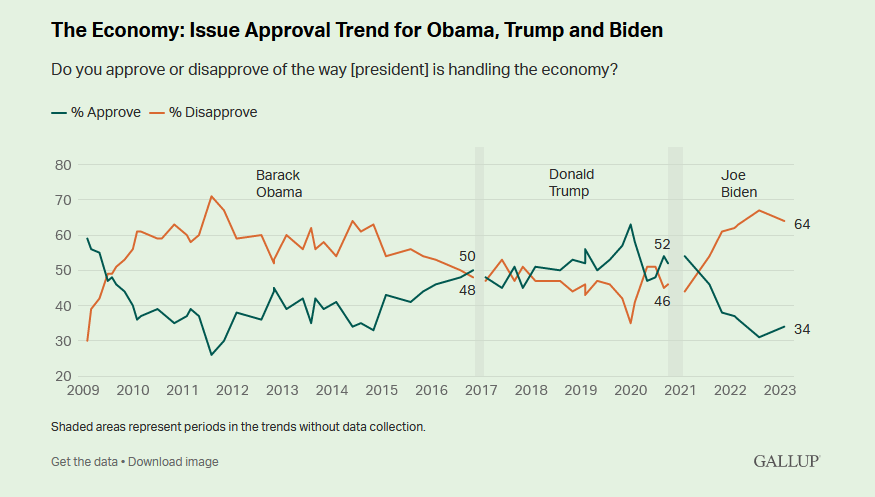
1. The Economy: Not Biden’s Strongest Suit

Biden’s latest job approval rating on the economy is about halfway between the worst ratings Trump and Obama each received. Both of his predecessors’ low points on the economy came toward the beginning of their presidencies, after which they saw strong improvement. This holds out some hope for Biden that he could follow a similar trajectory. Indeed, his 34% rating in February is slightly improved from his own low point of 31% in August 2022.

2. Foreign Affairs: A Quick Decline

Like Obama, Biden began his term in office with a majority of Americans approving of the job he was doing on foreign affairs in general. Yet, Biden’s approval ratings for handling foreign affairs have been 43% or lower since late 2021, including 41% now. However, Biden remains above the lowest points for both of his predecessors on the issue — 31% for Obama and 33% for Trump.

3. Immigration: Lower Than Trump

As recently highlighted in our weekly newsletter, Biden has mostly fared worse than his recent predecessors on the issue of immigration. Fewer Americans approve of the job he is doing on immigration than ever did for Trump. Obama received low approval on immigration at points in his first and second terms but saw some improvement by the end of his presidency.

4. Handling Russia: Similar to Obama and Trump

With the Russia-Ukraine war, which started over a year ago, being a major foreign policy focus of his presidency, Biden has spent a lot of time communicating to the American public about Russia. Today, Biden stands virtually tied with Trump’s last reading on handling U.S.-Russia relations, and his 37% approval rating on Russia matches Gallup’s only rating of Obama on the matter, from 2014.

5. Relations With China: Room for Improvement

For the third year in a row, Americans see China, more than any other country, as the United States’ greatest enemy in the world. As relations with China have soured, Biden’s marks on how he is handling it have worsened. Rising tensions between the nations in the past two years may also be a factor in the decline of Biden’s marks.

Gallup measured Obama’s approval on relations with China (39%) just once, in 2012, while it did so on three occasions for Trump, ranging from 40% to 47%.

6. Response to COVID: A Strong Point

COVID-19 emerged as a global pandemic in 2020 and thus has only been an issue of concern for Biden and Trump. This is one area Biden has generally outperformed his predecessor, with approval ratings ranging between 47% and 67%. After an initial high of 60% for Trump at the beginning of the pandemic, his ratings were between 36% and 44% in the summer and fall of 2020.

To stay up to date with the latest Gallup News insights and updates, follow us on Twitter.

Explore President Trump’s approval ratings and compare them with those of past presidents in the Gallup Presidential Job Approval Center.

Learn more about how the Gallup Poll Social Series works.

Tyler Durden
Tue, 03/21/2023 – 23:05

Alan Dershowitz: Trump Can Serve As President “From Prison”

Alan Dershowitz: Trump Can Serve As President “From Prison”

Authored by Jack Phillips via The Epoch Times (emphasis ours),

Retired Harvard Law professor Alan Dershowitz suggested that former President Donald Trump could run for office or even serve as president if he is convicted in connection to the Manhattan District Attorney’s office investigation.

Alan Dershowitz, an attorney for President Donald Trump, answers a question during the impeachment trial against Trump in the Senate at the U.S. Capitol in Washington, Jan. 29, 2020. (Senate Television via AP)

Trump announced on social media this past weekend saying he believes he’ll be arrested soon in connection to District Attorney Alvin Bragg’s probe into whether he was involved in allegedly making hush money payments to during the 2016 campaign. Unnamed sources have also told news outlets that the former president may be indicted, but Trump has denied any wrongdoing.

Dershowitz, an attorney who has represented controversial clients including O.J. Simpson and Jim Bakker, told Newsmax that he believes Trump will be indicted in New York City because of what he described as an unfair legal system in the Democrat-dominated city. But if Trump is convicted and sentenced to a prison term, the U.S. Constitution will allow him to serve in that capacity.

“He will be indicted,” Dershowitz, who also provided legal counsel to Trump during his first impeachment trial, told Newsmax. “In New York, you can indict a ham sandwich. In New York City, you can convict a ham sandwich because the jury pool is so unfair. Even if he’s convicted, he can run for president. He can run for president from prison; he can even serve as president from prison.”

The U.S. Constitution doesn’t bar felons from holding elected office, including the presidency. The Constitution’s text only lists three criteria to run for president: a candidate has to be age 35 or older, be a natural born citizen, and they must have lived in the United States for at least 14 years.

In a separate interview with Chris Cuomo, Dershowitz asserted that “Trump can run from prison, the way [Boston] Mayor [James] Curley did, and he could win, and he can govern from prison.” Curley, a Democrat who served as mayor of Boston four times in the early part of the 20th century, was convicted twice and notably served time in prison during his fourth term in office.

Former President Donald Trump speaks to guests gathered for an event at the Adler Theatre in Davenport, Iowa, on March 13, 2023. (Scott Olson/Getty Images)

Trump has previously stated that he will continue to run for president in 2024 even if he is charged. Later this month, Trump is slated to hold his first 2024 rally in Waco, Texas.

There has been no public announcement of any time frame for the Manhattan grand jury’s secret work in the case. At least one additional witness is expected to testify, further indicating that no vote to indict has yet been taken, according to a person familiar with the investigation who was not authorized to publicly discuss the case and spoke on condition of anonymity.

A Trump-affiliated lawyer, Robert Castello, told media outlets on Monday that he testified in front of a Manhattan grand jury and sought to denigrate testimony put forth by Michael Cohen, a former Trump attorney who has been described as a key witness in the case. Castello said that Cohen, who was sentenced to federal prison on a range of charges, is an unreliable witness.

Meanwhile, Bragg’s office has issued few public statements in connection to the investigation. A spokesperson for the district attorney issued a response to the Washington Post regarding a House Republican demand for information and testimony in connection to the Trump probe, merely saying that claims that New York City is dealing with a surge in violent crime is not true.

A Trump lawyer, Susan Necheles, told The Associated Press that Trump’s weekend Truth Social post was “based on the media reports,” and another Trump spokesperson said there had been “no notification” from Bragg’s office, though the origin of Trump’s Tuesday reference was unclear. The Epoch Times has contacted Bragg’s office for comment.

Trump’s aides and legal team have been reportedly preparing for the possibility of an indictment. Should that happen, he would be arrested only if he refused to surrender. Trump’s lawyers have previously said he would follow normal procedure, meaning he would likely agree to surrender at a New York Police Department precinct or directly to Bragg’s office.

The indictment of Trump, 76, would be an extraordinary development after years of investigations that yielded essentially nothing. It would also be the first time a current or former president was indicted.

Tyler Durden
Tue, 03/21/2023 – 22:45

SCOTUS Overturns Appeals Court Upholding Abortion Without Parental Consent

SCOTUS Overturns Appeals Court Upholding Abortion Without Parental Consent

Authored by Matthew Vadum via The Epoch Times (emphasis ours),

The Supreme Court threw out a federal appeals court decision on March 20 that upheld the right of a minor to go to court for permission to pursue an abortion without notifying her parents.

Then-Judge Ketanji Brown Jackson watches the Senate vote on her nomination to be an associate justice on the Supreme Court, from the Roosevelt Room of the White House in Washington on April 7, 2022. (Mandel Ngan/AFP via Getty Images)

Justice Ketanji Brown Jackson was the sole member of the Supreme Court to file a dissenting opinion in the case, Chapman v. Doe, court file 22-312.

In the case, the court vacated the ruling of the U.S. Court of Appeals for the 8th Circuit and remanded the case to that court with instructions to dismiss the proceeding as moot. Jackson objected to the specific manner in which this was done because it erased any precedential value the circuit court ruling may have had.

In the case, a pregnant minor, Jane Doe, visited her local courthouse to apply for a dispensation allowing her to bypass parental consent for the planned abortion. The office of the petitioner, Michelle Chapman, circuit clerk for Randolph County, Missouri, told her she couldn’t file a bypass petition without notifying a parent.

Doe got an abortion in Illinois after a court there authorized it, absent parental notification.

Doe filed a civil rights lawsuit in federal district court for damages, claiming that Chapman violated her 14th Amendment rights. Chapman took the position that she was immune to lawsuits because she followed a Missouri statute and a judge’s directions.

Chapman also claimed that Doe’s right to a bypass hearing wasn’t clearly established and that she therefore couldn’t have violated Doe’s rights.

In what was perceived as a victory for the pro-abortion movement, the district court ruled against Chapman, finding that the statute didn’t require prehearing notification of the minor’s parents to obtain judicial authorization for an abortion.

The 8th Circuit later determined that Doe’s claim must be allowed to proceed, finding that the right to bypass the parents was clearly established under the 14th Amendment.

But in September 2022, Chapman asked the Supreme Court to review the case after the Supreme Court overturned Roe v. Wade, finding there was no right to abortion in the U.S. Constitution and returning the regulation of abortion to the states.

In its June 24, 2022, ruling in Dobbs v. Jackson Women’s Health Organization, the high court also reversed a related 1992 precedent, Planned Parenthood of Southeastern Pennsylvania v. Casey, which affirmed Roe and declared that a woman had a right to obtain an abortion before fetal viability without undue interference from the state.

“Doe’s claims rely on the proposition” that requiring parental notification of a judicial bypass proceeding must satisfy the undue burden test announced in Casey, Chapman said.

Read more here…

Tyler Durden
Tue, 03/21/2023 – 21:25

Rent Inflation Approaches Two-Year Low Amid Cooling Market

Rent Inflation Approaches Two-Year Low Amid Cooling Market

Federal Reserve Chair Jerome Powell and his entire team should be cognizant of the fact that rents have been declining for many months. Despite this, Powell has been examining laggard data that persistently appears inflated. 

The latest CoreLogic report adds to the mounting evidence of leading rental market indicators showing rent inflation has been cooling for the ninth consecutive month in January, as the yearly growth rate slid to the lowest point since 2021. 

Single-family homes across the US experienced a 5.7% increase in value compared to the previous year. Each of the 20 major metropolitan regions monitored by CoreLogic saw annual rent growth in the single-digit range for the first time since the end of 2020.

Despite the high-frequency rent data from CoreLogic and other research firms indicating a clear deceleration, this slowdown has not yet been reflected in the Fed’s consumer-price data due to delays in the calculation process. 

Back in September, when looking at various leading rental market indicators, we reported that “Manhattan Apartment Rents Finally “Plateau” After Red-Hot Summer” a trend reversal that was also observed at the national level as we observed in “Nationwide Rents Drop For First Time In Two Years.” With rents peaking in August, two months later, the rental drop accelerated, as we discussed in “Just Tumbled The Most On Record As Economy Craters.” 

Last month we penned a note, “Apartment Rents Slide Across All US Cities Amid “Crush” Of New Supply,” but outlined the Fed’s shelter inflation data is well behind the curve (as usual). 

The good news is that with a long delay, the coming supply of new apartments – especially in places where housing inventory remains unusually low to the benefit of home sellers – will give renters more choices, making it not only more difficult for landlords to hike rents at rates seen last year. 

Tyler Durden
Tue, 03/21/2023 – 21:05

Gasoline Prices Buck The Trend Ahead Of Driving Season

Gasoline Prices Buck The Trend Ahead Of Driving Season

By Charles Kennedy of OilPrice.com

With U.S. gasoline prices trending about 3 cents lower than the same time last week, analysts are now speculating that the banking crisis and broader financial markets concerns may prevent prices at the pump from ticking upwards as they would normally do ahead of the summer driving season.

“The broad concern over recent failures of the U.S. and global banking system has put enough downward pressure on oil prices that we saw a reprieve in rising gasoline prices in the national average last week,” said Patrick DeHaan, the senior petroleum analyst for Chicago-based GasBuddy.

DeHaan said that while markets are volatile, and we will see some differentiation in prices as certain states switch to the more expensive summer blend of gasoline, much going forward in the immediate future depends on how the banking crisis plays out.

“Should the outlook for the banking sector improve, we could again see gasoline prices race higher, while continued or additional distress could raise the possibility of a broader economic slowdown, keeping gasoline prices in check,” he said. “Overall, there are a lot of possibilities.”

Shares of Credit Suisse plunged some 60% early on Monday after its rival, UBS, announced it would take over the bank for $3 billion to shore up global markets. The plunge in Credit Suisse shares last week followed the failures of U.S regional banks Silicon Valley Bank (SVB) and Signature Bank.

According to AAA, Monday’s natural average per gallon of gasoline is $3.443, compared to $3.446 on Sunday, and $3.473 a week ago. Monday was the first time in two weeks that gasoline prices in the U.S. had declined.

Last week, gasoline inventories fell 2.1 million barrels amid maintenance and the usual transition to summer gasoline began to replace less expensive winter fuel. Implied gasoline demand rose by 32,000 bpd. 

Tyler Durden
Tue, 03/21/2023 – 20:45

Zelensky Invites China To Discuss Peace After ‘No Breakthrough’ In Xi-Putin Meeting

Zelensky Invites China To Discuss Peace After ‘No Breakthrough’ In Xi-Putin Meeting

Ukraine appears willing to engage China in mediation efforts to end the war, at a moment China’s Xi Jinping is in Moscow discussing Beijing’s own 12-point peace plan. With the main part of talks with Putin having been concluded as of Tuesday night, there’s been no breakthrough among the “friends” to come of it thus far.

“We believe that many of the provisions of the peace plan put forward by China are consonant with Russian approaches and can be taken as the basis for a peaceful settlement when they are ready for that in the West and in Kyiv. However, so far we see no such readiness from their side,” Putin said, laying blame on the Ukrainians.

But Ukraine’s President Volodymyr Zelensky said Tuesday his government has reached out to Beijing. Zelensky said he has invited China to engage in talks on implementation of Kyiv’s own peace formula, and that he’s waiting for an answer.

“We offered China to become a partner in the implementation of the peace formula. We passed over our formula across all channels. We invite you to dialogue. We are waiting for your answer,” Zelensky announced at a Tuesday a press conference. He added: “We are receiving some signals, but there are no specifics yet”.

This comes after last month Zelensky issued an unexpectedly positive response to Xi’s offering China’s 12-point peace plan, in an effort to jumpstart negotiations. “I think the fact that China started talking about Ukraine is not bad. But the question is what follows the words,” Zelensky said at the time. “I think some of the Chinese proposals respect international law, and I think we can work on it with China. Why not? Our goal is to gather many around us to isolate one [Russia],” he had added.

The reality is that since China first unveiled the broad peace plan weeks ago, its role as a mediator does appear to be taking shape.

But all the while this has resulted in cynicism and condemnation from Washington as the US watches helplessly while Beijing and Moscow embark on an unprecedented level of cooperation.

Likely pressure is also growing on Zelensky to reject any Chinese hand of friendship and mediation – seeing in it a ploy to keep Russia strong and on the offensive in Ukraine. If China-Ukraine talks do come together with an eye toward bringing in Moscow, the US certainly won’t be happy.

Tyler Durden
Tue, 03/21/2023 – 20:25

…And Just Like That, The ‘Tight Money’ Era Is Over

…And Just Like That, The ‘Tight Money’ Era Is Over

Authored by John Rubino via Substack,

At the beginning of last week, everyone expected central banks to “tighten until something breaks”. By the end of the week it was clear that they’d already broken everything.

Two middling US banks imploded, European mega-bank Credit Suisse finally died a well-justified death, and “who’s next?” speculation ran wild. And just like that, the era of tight money ended.

Now the world’s monetary authorities have broadened the definition of “systemic risk” to cover pretty much anything. FDIC insurance has been extended to every bank account of any size. Credit Suisse is being bought for pennies on the dollar by rival Swiss giant UBS. And according to Bloomberg,

The Federal Reserve and five other central banks announced coordinated action on Sunday to boost liquidity in U.S. dollar swap arrangements, the latest effort by policymakers to ease growing strains in the global financial system.

Central banks involved in the dollar swaps will “increase the frequency of seven-day maturity operations from weekly to daily,” the Fed said in a statement coordinated with the Bank of Canada, the Bank of England, the Bank of Japan, the European Central Bank, and the Swiss National Bank. 

The Fed’s balance sheet — a measure of how much currency it creates and dumps into the economy — had been shrinking, which is to say the US money supply had been contracting. Now it’s soaring, up $300 billion in a matter of days.

The piecemeal, fingers-in-the-dike character of this response can be explained in one of two ways: Either the morons running the global financial system were completely blindsided because they actually thought rising interest rates and a falling money supply would slow inflation without unintended consequences, despite a century of contrary experience. Or the evil geniuses running the global financial system have engineered a multi-faceted crisis as an excuse to assume total control.

I’m agnostic on the above, but in either case, it seems clear that the world’s governments won’t be able to stop conditions from deteriorating. Consider:

Lenders were already scared. Now they’re terrified

Banks were already tightening credit standards before last week’s flash crisis. Now virtually all of them will stop lending to any but their strongest clients. A year from now the updated version of this chart will show a spike to record high tightening levels.

Autos are a bursting bubble

The number of underwater car loans, where the loan balance exceeds the value of the car, has been rising for months. Interest rates on used car loans had jumped from an average of 8% to over 10% in the past year. And auto loan delinquency rates have climbed to their highest levels in over 15 years, with an especially big jump among subprime borrowers. Now panicked banks will make car loans even harder to get while a growing number of borrowers will default on their existing loans. Typical recession behavior, but this time against a crisis backdrop.

Commercial real estate was toast in any event, but now it’s burnt toast

Office buildings, warehouses and such never fully recovered from the pandemic lockdowns, and by the 4th quarter of 2022 delinquencies on commercial real estate loans were rising sharply. Building prices were beginning to fall, and the specter of a commercial real estate crash was looming. And that was before banks and regulators went into their current panic mode.

Now just try refinancing an underperforming office complex and see how it goes.

And there’s more…

Stephanie Pomboy, an analyst whose work has been spot-on lately, tweeted this 12 hours ago:

ya know what’s keeping me up at night? Thinking about the unseen exposure by NONbank finl institutions to things far riskier than the stuff bringing down the banks. Esp, the prospect that some insurer (&counterparty in the giant mkt of credit derivatives) is about to go toes up

And don’t even get me started on pensions. I’ve ranted breathlessly on that. They will be the subject of a bailout the likes of which we have never before witnessed. If you think the bank bailout is gonna be massive…stay tuned. You ain’t seen nothing.

In other words, a lot can still go wrong, because excessive leverage is hidden all over the place. A pension bust would mean a multi-trillion dollar bailout, for instance, and that was probably coming even in “normal” times. As for derivatives, well, they’ll destroy the world eventually, so why not now?

The take-away? In the midst of all the various credit crises, controlling inflation will be moved to the back burner. And the world will realize that the central banks are out of ammo, with no choice but to let their currencies burn.

*  *  *

Subscribe to John Rubino

Tyler Durden
Tue, 03/21/2023 – 20:05

First Signs Of A Notable Low-Income Slowdown

First Signs Of A Notable Low-Income Slowdown

The bank crisis, Fed and macro continue to lead the market in a daily rollercoaster, and while that won’t change for at least a few days, Goldman’s consumer retail trader Scott Feiler notes in his trading note today, there are some notable things to highlight in consumer…

1. First signs of a notable low-income slowdown?:

Feiler notes that investors have been bearish consumers for much of the year, even before the issues with the banks: he writes that “we had heard COST and VISA talk to modest deceleration in February (100-200 bps), but nothing precipitous. The big question has been whether anyone has seen a more worrisome slowdown with tax refunds (down double-digits y/y) and SNAP reductions (end of February) more front and center.”

Well, according to the Goldman trader, we got that answer this morning from CTRN (Citi trends): it is an apparel store that caters to the low-income consumer. They guided 1Q sales to be down low double-digits vs Consensus +2%. This does not seem like conservatism like some other below consensus 1Q guides, as they explicitly said 1Q is off to a slow start. They said that given the macro-economic environment, they expect low income families, the bulk of their customer base, to remain under pressure in 1H.

2. Is this a read-across though or idiosyncratic?

CTRN is not getting a pass on that guide/commentary, with the stock -14%. The Goldman trader notes that “some of the feedback this morning from investors was that many consumer companies were at competitor conferences last week and the majority of companies continued to sound “fine” still.” While some of the other low-income names are underperforming, including WMT/BIG/DG/DLTR/FIVE/MCD, it’s still not clear that is just due to their low-income exposure, but potentially also from the rotation into beta today (IWM > SPY by over 100 bps today).

Bottom line: “investors are taking the comments from CTRN at least somewhat seriously, but are skeptical it’s a true read-across.”

Tyler Durden
Tue, 03/21/2023 – 19:45

Victor Davis Hanson: What Happened To Stanford?

Victor Davis Hanson: What Happened To Stanford?

Authored by Victor Davis Hanson via AmGreatness.com,

The list of serial embarrassments at Stanford reads like the suicides of Greek tragedy, where divine nemesis follows hubris…

Stanford was once one of the world’s great universities.

It birthed Silicon Valley in its prime. And along with its nearby twin and rival, UC Berkeley, its brilliant researchers, and teachers helped fuel the mid-20th-century California miracle.

That was then.

But like the descent of California, now something has gone terribly wrong with the university.

Students at Stanford Law School recently shouted down visiting Fifth Circuit Court of Appeals Judge Kyle Duncan. He had been invited to give a lecture by the school’s Federalist Society. 

The judge never even got the chance. The law school students drowned him out. They flashed obscene placards. They screamed that he was “scum.” One yelled he hoped the judge’s own daughters would be raped.

Others bellowed, “You’re not welcome here, we hate you!” “Leave and never come back!” “We hate FedSoc [Federal Society] students, f–k them, they don’t belong here either!” and “We do not respect you and you have no right to speak here! This is our jurisdiction!”

When the judge tried to reply, they drowned him out with “liar” and “scumbag.” Then, mission accomplished, they smugly stomped out.

Note these were ostensibly not teenaged undergraduates. Instead, they were wannabe adult professionals, in law school to learn jurisprudence and to enter the elite American legal system that is supposed to have protocols separating it from the mobocracies prevailing abroad.

One of those foundational principles is to honor the Constitution’s protection of free speech and expression—not to mention the ancient idea of respecting an invited guest, or the custom to treat with deference a federal judge, to say nothing of the duty to honor the codes and laws of the institution that they have chosen to join which prohibit disruption of lectures and any effort to drive out public speakers.

When an exasperated Justice Duncan called out for a university administrator to restore calm, his podium was instead hijacked by Associate Dean for Diversity, Equity, and Inclusion Tirien Steinbach. She then gave her own preplanned, scripted lecture that sided with the disruptive protesters! Quis custodiet ipsos custodes?

The diversity dean then turned on the speaker. She asked the startled judge whether it was even worth supporting his free speech rights, given he and his views were deemed abhorrent to the new absolutist Stanford.

Note well: DEI Deans normally do not attend law school lectures. She showed up because she apparently knew in advance that the law students would violate their own university’s codes of conduct and disrupt a speaker.

So she had planned, again in advance, to do nothing to stop them. Instead, she would prepare a performance-art speech for such a certainty, to chastise the speaker and defend the disrupters. She assumed correctly that none of the other administrators, who also strangely attended, would admonish her or the students for violating the laws of their own university. She apparently assumed, once more rightly, that her own leftist fides on campus would be enhanced.

So far neither the diversity dean nor the students have been disciplined by the university. When the dean of the law school, Jenny Martinez, offered an apology (but did not punish the students), most of her own class walked out on her. And dozens of Stanford’s law school students lined the corridor in attempts to intimidate her as if she was some sort of toxic pariah.

In a Soviet-style finale, the Acting Associate Dean of Students Jeanne Merino advised the Federalist Society students who were targeted by fellow law students that there were “resources that you can use right now to support your safety and mental health.” Then Merino directed them, inter alia, to none other than Diversity, Equity, and Inclusion Dean Tirien Steinbach herself, the very dean who had taken over the podium to lecture Judge Duncan!

The debacle revealed three disturbing characteristics about the Stanford law students:

One, they acted as if they were bullies and cowards. Videos of the mess showed how they turned mob-like in their chanting, flashing creepy placards, and, like Maoists, walking out on cue. Yet, when the judge fired back at their rudeness, like wounded fawns they took offense and pouted. And later, when there was mention that the names or photos of the protestors might be published, tit-for-tat, in the manner they themselves had put up posters of the Federalist Society members, they screamed that such exposure was unfair.

Two, they seem incompetent. To the degree there were any questions and answers, few knew how or even attempted to engage the judge on matters of the law and judicial theory. In other words, any grammar-school students could have matched their performance since it required no knowledge of the law, just an ability to chant and—in groupthink style—cry, scream, and mimic the majority.

Three, they were arrogant. One protestor blurted out that Justice Duncan probably could not have gotten into Stanford, as if their own puerile performance was proof of the school’s high standards of admission. That was obnoxious in addition to the fact that, as of recently, it may have become not so true. In July 2022, Stanford Law School announced that an uncharacteristic 14 percent of its graduates had flunked the California bar exam on their first attempt, a radical increase from past years. Four other California law schools—UC Berkeley, UCLA, UC Irvine, and USC—had a higher bar pass rate.

After watching the sad performance, one wonders who taught such rude and unimpressive people.

Ethics complaints were lodged last year against Stanford Law Professor Michele Dauber for tweeting a series of gross attacks on Camille Vasquez (“some Pick Me Girl lawyer”), the widely regarded attorney of Johnny Depp. Law professor Dauber also tweeted sick fantasies about Depp’s death—and imagined the actor’s corpse would “end up in a trash can eaten by rats.” Was she the sort of model that the law students had emulated?

Then there was Professor Pamela Karlan’s 2019 testimony before the House Judiciary Committee’s hearing on the impeachment of President Trump. Off-topic and gratuitously, Karlan weirdly attacked the name of the president’s youngest son, Barron Trump: “While the president can name his son Barron, he can’t make him a baron.” Was that the sort of puerility that the law students sought to embrace?

In 2021, a graduating Stanford law student sent the law school student body a bogus call to violence as if it was authored by the school’s small conservative Federalist Society. The fake call to arms read in part: “The Stanford Federalist Society presents: The Originalist Case for Inciting Insurrection . . . Riot information will be emailed the morning of the event . . . ” Was that the sort of smear that the law students learned?

TIMOTHY A. CLARY/AFP via Getty Images

Sam Bankman-Fried, the architect of the $26 billion FTX cryptocurrency meltdown that destroyed the livelihoods of thousands, is the son of two other Stanford Law School professors. Somehow they were involved in the Bankman-Fried family’s acquisition of a $16.4 million vacation home gifted to them from FTX shortly before it imploded.

According to the New York Times, both parent professors were intimately involved in their son’s multibillion-dollar business, either directly or through gifts to one parent’s political donor network:

He [Professor Bankman] and his wife, the Stanford Law professor Barbara Fried, were more than just supportive parents backing their child’s business. Mr. Bankman was a paid FTX employee who traveled frequently to the Bahamas, where the exchange was based. Ms. Fried did not work for the company, but her son was among the donors in a political advocacy network that she orchestrated.

Were these the ethical models that had influenced the law students?

Bankman-Fried is currently out on a $250 million bond and living under bond on the Stanford campus. He is out, in part, because two Stanfordites, former law school dean Larry Kramer and Andreas Paepcke, a Stanford senior research scientist, put up a $500,000 guarantee. Former Stanford student Caroline Ellison, a partner with Sam Bankman-Fried in his various financial collapses, has pled guilty to conspiracy to commit wire fraud, conspiracy to commit commodities fraud, conspiracy to commit securities fraud, and conspiracy to commit money laundering, and is now working with prosecutors. 

Perhaps the law school should not be singled out since it simply reflects what appears to be symptomatic of a once-great university’s freefall.

Philip Pacheco/Getty Images

A former Stanford student Elizabeth Holmes was recently sentenced to a long prison term for defrauding investors in connection with her company Theranos. She had fraudulently claimed to have invented a “revolutionary” miniaturized blood testing device. Many of her corporation’s oversight board members were drawn from the Stanford community.

The Wall Street Journal recently ridiculed a Stanford university group’s publication of a taboo vocabulary list (“Elimination of Harmful Language Initiative”). “Harmful” words supposedly unwelcome at Stanford included inflammatory expressions such as “American” and “immigrant.”

The Journal also noted that perhaps the cause of such Orwellianism was too many idle administrators chasing too few students: “For 16,937 students, Stanford lists 2,288 faculty and 15,750 administrative staff.”

More disturbing was the revelation of a “snitch list.” The harmful language initiative apparently is tangential to another new idea of rewarding Stanford snitches who feel offended by hurtful expression. Or, as the so-called “The Protected Identity Harm (PIH) Reporting” system put it, software will monitor campus speech and even offer “financial rewards for finding/reporting” any who supposedly violate approved language usage.

Was this the sort of campus experience that the parents of Stanford students pay for at about $90,000 per year?

Stanford was also plagued by a recent admissions scandal when a former head sailing coach accepted donations to his Stanford sailing program in exchange for trying to help two students’ admission applications. 

Tom Williams/CQ Roll Call

Then there were campus attacks on a pair of eminent Stanford public health experts, Drs. Scott Atlas and Jay Bhattacharya. Both were pilloried mercilessly by some of the Stanford faculty and administration for daring to doubt the efficacy of what has proved to be disastrous government-enforced COVID quarantines and school shutdowns.

Yet the arguments of Atlas and Bhattacharya—the science does not support the mandatory use of masks to halt the pandemic, natural immunity was as efficacious as or superior to vaccine-induced immunity, the vaccinations would not offer lasting protection against either being infected or infecting someone else, and the quarantine lockdowns would cause more damage and death (familial abuse, suicides, substance abuse, mental depression, uneducated children, economic catastrophe, millions of missed surgeries, screenings, tests, and doctor’s appointments) than the virus itself—were all eventually substantiated.

Neither doctor received apologies from the administrators, faculty, or students who attacked them.

Currently Stanford’s long-serving president Marc Tessier-Lavigne—an accomplished neuroscientist—has been attacked serially by the Stanford Daily campus newspaper, which has called for his resignation. It alleges the president was culpable of scholarly misconduct concerning the publication of a joint research paper decades ago. The charges are not proven and remain under investigation. But they make it difficult for a president to weigh in on the above controversies when some faculty and the student newspaper are serially calling for him to step down for ethics violations. 

In July 2020, a Stanford visiting neurology researcher, Chen Song, was arrested for not disclosing that she had apparently been an agent of China’s People’s Liberation Army. Stanford had also been investigated by the Department of Education for some $64 million in alleged Chinese-affiliated donations over a decade, all from previously unnamed, unidentified, and anonymous Chinese donors, most of them believed to be government associated.

The list of serial embarrassments reads like the suicides of Greek tragedy, where divine nemesis follows hubris. In this case, overweening intolerant ideology has sabotaged disinterested inquiry and meritocracy. Arrogance and sanctimoniousness lead Stanford to continue down this spiral—rather than pause, reflect, and redirect—and thereby only compound the public ridicule.

Stanford’s once-justified reputation for civility, transparency, tolerance, and professional ethics has been shredded before a global audience.

Given its hallowed history, and the university’s vital global role in cutting-edge research, medicine, and professional training, something has to change—before it is too late.

The university requires an array of compulsory workshops that faculty and many students must undergo. But given these recent debacles, perhaps two additional new training sessions are needed: required ethics instruction and a mandatory anger-management seminar.


Tyler Durden
Tue, 03/21/2023 – 19:25