79.9 F
Chicago
Sunday, August 9, 2026
Home Blog Page 3846

“A Big Failure For Us” – Sweden’s Biggest Pension Fund Loses Billions On Busted US Banks

“A Big Failure For Us” – Sweden’s Biggest Pension Fund Loses Billions On Busted US Banks

Yesterday’s (50%) collapse in First Republic Bank shares was – in a word – ‘surprising’ given all the positive ‘rescue’ chatter and upbeat overall market sentiment post-CS ‘rescue’. US Regional banks broadly speaking were having a good day, but FRC was clubbed like a baby seal despite headlines proclaiming no lessor mortal than Jamie Dimon himself was on the case to rescue the community bank.

Well, we may now know why the selling pressure was so strong as Bloomberg reports that Alecta, Swedens largest pension fund, has lost billions in the recent bank busts and started to abandon its large position in FRC last week.

“The uncertainty about First Republic’s future was too great, partly due to the fact that the lender was downgraded to junk status,” Billing said in emailed comments, after Bloomberg News obtained a copy of a written response by Alecta to the Swedish Financial Supervisory Authority.

Alecta said its total invested capital in First Republic stood at 9.7 billion kronor “before a sale on March 15.”

The Swedish fund had been buying First Republic shares since 2019, making it the bank’s fifth biggest shareholder.

The fund is reportedly facing losses of almost $2 billion as a result of a failed investment strategy that made it one of the biggest shareholders in two collapsed US banks and another that’s been caught up in the crisis (expected losses of 8.9 billion kronor and 3.2 billion kronor in Silicon Valley Bank and Signature Bank, respectively).

The scale of the losses has become clearer after the private pension group sold all of its First Republic Bank stake at a loss of 7.5 billion kronor ($728 million), according to Chief Executive Officer Magnus Billing.

“Obviously it’s a big failure for us as an investor,” Billing said last week.

“We need to learn something from that and take actions based on the lessons learned.”

We suspect Alecta is far from alone in facing these kind of losses.

Finally, we note that FRC is up 50% today (still down from Friday’s close)…

Did Alecta bottom-tick it?

Tyler Durden
Tue, 03/21/2023 – 15:20

Connecting Dots: COVID To SVB And Beyond

Connecting Dots: COVID To SVB And Beyond

Authored by Sheryl Kaufman via AmGreatness.com,

The next logical step is for the government to insure all bank deposits, which is tantamount to nationalizing the entire banking system. But to what end?

A collection of seemingly random crises can spell out a sinister “conspiracy theory” when you consider their connections and where they are leading.

An overplayed plot? Perhaps, but how many so-called conspiracy theories have proven to be reality recently?

First, the world economy shut down with the COVID lockdown.

Manufacturing stopped and capital construction projects were put on hold. No one was making anything, and consumers were buying very little. 

The government injected huge amounts of cash to stimulate spending, even though there wasn’t much to spend it on: witness supply chain issues. This cash was created out of thin air by the Federal Reserve. Household savings rates rose to new highs. Personal and commercial bank deposits soared. 

Consider banks, a confounding inversion of logic for most consumers. While it seems odd to think that a loan is an asset and a deposit is a liability, it makes sense when you realize that making loans is the method banks use to make money. Every time a bank takes in a deposit, they try to loan that money out as quickly as possible to put it to work making income for the bank. If no one is applying for loans, the bank invests the money in bonds to earn a little interest. 

During the COVID shutdowns with the stimulus monetary infusions, people and businesses were making deposits and not taking out loans. Banks had to put all that surplus cash into bonds. U.S. Treasury Bills were paying a few points interest—historically low rates given the low inflation of recent years—but more than no income for the banks. Longer term bonds paid slightly higher interest than short term. 

As the economy started to recover from the shutdowns, inflation was more than predictable with all that newly created money chasing the limited goods available. So in swooped the Federal Reserve to “solve the problem!” The Fed started cranking up interest rates to slow demand and ease inflation. 

Now think back to the banks. They are holding long term bonds at the pre-inflation low interest rates. When loan demand picks up or customers start withdrawing cash, they would ordinarily sell the bonds to make the cash available or turn it into more profitable loans to customers. The problem is that interest rates have risen so fast that the banks are “under water” on the bonds—which can only be sold at a loss since similar-term bonds are now paying higher interest. Really good risk managers will have this all hedged, but then there is SVB.

Silicon Valley Bank did not practice good risk management, obviously, for numerous colorful reasons that we need not explore here. 

The point is that this sequence of events from shutdowns, to stimulus, to inflation and rate hikes created major problems for banks. These events were all precipitated by government actions. It is no surprise that some, perhaps more, banks cannot meet customer withdrawals. 

The Federal Deposit Insurance Corporation (FDIC) provides “insurance” to cover deposits of up to $250,000 when a bank cannot meet customer withdrawals. This “insurance” fund comes from fees paid by banks. Like any insurance, the total fund is not large enough to cover a loss of everything insured by every participant all at once. 

Once again, the government comes to the rescue! Joe Biden announced that the government and the Fed will cover all the deposits at the “failed” banks above the FDIC limit.  Do you believe that this program “won’t cost taxpayers a dime?” The cost is going to come out of higher bank fees, paid ultimately by customers, or higher taxes. 

The next logical step is for the government to insure all bank deposits, which is tantamount to nationalizing the entire banking system. Once that is accomplished, putting in place the proposed Central Bank Digital Currency (CBDC) is a snap. 

Compound the CBDC with digital medical IDs from the World Health Organization (WHO), and all of our privacy and personal control of our lives is gone.

A fertile mind can string together further crises to paint a vivid “conspiracy theory” of totalitarian control. Do you doubt the logic?

Tyler Durden
Tue, 03/21/2023 – 14:59

Fake “For Hire” Ads Plague Job Hunters As Employers Posting “Ghost Jobs”

Fake “For Hire” Ads Plague Job Hunters As Employers Posting “Ghost Jobs”

While the official unemployment rate is sitting at multi-decade lows (notwithstanding this month’s recent uptick), people still looking for work are getting jerked around by fake job ads – in which businesses are maintaining active job postings that they aren’t actually trying to fill, the Wall Street Journal reports.

In a survey of more than 1,000 hiring managers last summer conducted by Clarify Capital, 27% said they had job ads up for more thyan four months. Of those who admitted they have postings that they weren’t actively trying to fill, close to half said they did so to give the impression that the company was growing.

Others said they kept these “ghost job” ads up in order to maintain a list of ready applicants in case an employee quits, or in case an “irresistible” candidate applies.

“It’s a waste of time,” says Will Kelly of Washington DC, who’s been looking for marketing and writing jobs after decades of experience. When he was looking for a job in 2021, around 20% of the listings which interested him were being posted and reposted without evidence that anyone was actually hired.

“I first thought of it as an anomaly, and now I see it as a trend,” he says.

Does this correlate to discrepancies we’ve recently noted in jobs data?

According to Nashville-based recruiter Vincent Babcock, the strategy risks turning off applicants who see the ads as misleading.

They’re posting jobs with the intention of hiring, but not anytime soon,” he said, noting that some companies might not even be looking to hire until Q3 or Q4.

For employers, constantly looking for talent can make sense, says Kelsey Libert, co-founder of Fractl, a digital marketing agency. She says her company keeps ads up for associate positions even when they aren’t hiring, because turnover for those jobs is often higher than other roles.

“Otherwise, you’re suddenly in a position where you need to spend a lot of money on LinkedIn ads to quickly drum up interest,” she says.

It’s better for you to hedge by leaving some of those job openings up.” -WSJ

What’s more, some companies require that a job ad be posted, even if a candidate has been predetermined, to give the appearance of a fair hiring process for the role. Other times, it’s a simple case of poor coordination within a large corporation, according to Stella Talent Partners founder, Elliott Garlock, who formerly worked in recruiting at Wayfair, Inc., where he says the online retailer frequently advertised for jobs that it wasn’t actually hiring for.

“It’s not because we were ill-intentioned and out to trick the candidate market,” he says.

That said, other companies might be reluctant to remove ads, Garlock says, because “we don’t want to signal we’re slowing down, so we’ll let these things ride.”

How to avoid ghost ads?

Look for job descriptions with a ton of detail. The more specifics, such as schedules or a clear list of responsibilities, the more likely the employer is serious about the job, according to Scott Dobroski, VP of communications for Indeed, who also suggested checking the timestamp on ads to find recent postings.

Tyler Durden
Tue, 03/21/2023 – 14:40

UK Sending Depleted Uranium Shells To Ukraine Tantamount To Using ‘Dirty Bomb’: Kremlin

UK Sending Depleted Uranium Shells To Ukraine Tantamount To Using ‘Dirty Bomb’: Kremlin

The UK’s junior Defense Minister Annabel Goldie told Parliament on Tuesday, “Alongside our granting of a squadron of Challenger 2 main battle tanks to Ukraine, we will be providing ammunition including armor piercing rounds which contain depleted uranium.”

“Such rounds are highly effective in defeating modern tanks and armored vehicles.” News of Britain sending armor-piercing tank rounds for Challenger II tanks to Kiev triggered a fierce reaction from the Kremlin, with a strong-worded statement emphasizing that such a weapon will be treated as tantamount to using a nuclear dirty bomb.

US military file image

Foreign Ministry spokeswoman Maria Zakharova in words posted to Telegram highlighted the dangerous health effects of depleted uranium for all when introduced on the battlefield.

“Yugoslav scenario. These shells not only kill, but infect the environment and cause oncology in people living on these lands,” she said, in reference to cancer and other deadly ailments.

“By the way, it is naive to believe that only those against whom all this will be used will become victims. In Yugoslavia, NATO soldiers, in particular the Italians, were the first to suffer. Then they tried for a long time to get compensation from NATO for lost health. But their claims were denied,” she said.

Zakharova then added, “When will they wake up in Ukraine?… Their benefactors poison them.” During the US occupation of Iraq, use of depleted uranium by NATO allies was linked to cancer and birth defects among the Iraqi population.

According to a summary of the hazardous weapons technology in the journal Scientific American:

Used as ammunition, it penetrates the thick steel encasing enemy tanks; used as armor, it protects troops against attack. And when it was used in the Gulf War and later during the Allied bombing of Yugoslavia and Kosovo, depleted uranium (DU) was hailed as the new silver bullet that would solve most of the military’s problems.

After the end of Operation Allied Force, however, several Italian soldiers were diagnosed with leukemia. Politicians and the media soon forged a link between the disease and depleted uranium use. They further drew a parallel with Gulf War Syndrome, and in no time, depleted uranium became the Agent Orange of the Balkan conflict.

Depleted uranium presents not only a radioactive hazard, but it is also a strong toxin, and when these munitions are used this toxicity and radioactive material can be scattered across a broad area that saw prior battles, and later encountered by humans.

On the same day, reports emerged of a new push by US lawmakers to introduce cluster munitions to Ukraine, which are banned by some international treaties and condemned by human rights organizations.

Tyler Durden
Tue, 03/21/2023 – 12:59

“Like Several Rate Hikes In One Day”: Yields On AT1 Debt Double Overnight After Shock Credit Suisse Wipeout

“Like Several Rate Hikes In One Day”: Yields On AT1 Debt Double Overnight After Shock Credit Suisse Wipeout

In the aftermath of the shocking reversal of the sacrosanct liquidation waterfall priority…

… in which Credit Suisse shareholders received CHF3 billion in value even as the bank’s entire Contingent Convertible (Additional Tier 1) junior creditor class was wiped out…

… European’s regulators rushed to calm furious investors – who suddenly dreaded their exposure to AT1 bonds at every European bank, which at last count accounted for some $275BN in securities – and assured them that Credit Suisse was a unique case and that it wouldn’t repeat elsewhere if and when more liquidations and bailins had to kick in.

They failed.

One day after Europe’s panicked response where one official after another lied through their teeth that equity will never again survive a full AT1 wipe out…

…  over the past 24 hours we have seen wholesale dumping of AT1 debt whose cost has essentially doubled overnight, a problem for European banks that use the notes as a crucial capital buffer.

As shown in the chart below, yields on a Bloomberg index of AT1s in Europe surged following Credit Suisse Group AG’s controversial wipeout of the risky debt, to an average of 15.4%, although they since eased slightly. In early February, yields on AT1s were as low as 7.8%, according to a multi-currency index compiled by Bloomberg. In fact, as of last night, the yield on the AT1 index surpassed the worst of the covid crunch, when yields briefly topped 15% and then tumbled after the coordinated central bank bailout of the world.

“This is a big tightening in financial conditions,” Gordon Shannon, a fund manager at TwentyFour Asset Management, told Bloomberg. “Bank funding is more expensive now and banks will lend less. This is like several rate hikes in one day and there is potential for this to play out across the rest of the market.”

The historic collapse in AT1 notes is a headache for banks, which hold this type of bond as a way to bolster financial resources that’s usually cheaper than normal equity such as shares. They were created by European regulators after the financial crisis as a way to impose losses on creditors when banks start to fail without resorting to taxpayer money.

According to Bloomberg calculations, there’s is now more than $258 billion of this type of debt outstanding in Europe, excluding the $17 billion written off by Credit Suisse. Of this, more than $20 billion of notes have first call dates this year, which means they may repriced to a much higher yield in coming months.

As those dates loom, banks will need to decide whether to issue new AT1 debt at the higher yields, or find another way to raise capital. One possibility, according to Goldman Sachs, is to replace AT1 capital with CET1 capital — or common shares — though this has traditionally been more expensive; at that point the bank may as well sell common stock.

While at some point yields will drop, in the immediate term JPM warned that the need to refinance AT1 debt could become a problem for the wholesale funding costs of European banks.

“While most banks were paying 8-10% coupon cost in recent issuance of AT1, we expect that credit investors are now likely to demand a higher risk premium across the spectrum, with the cost of AT1 issuance potentially rising into double digits,” JPMorgan analysts led by Kian Abouhossein wrote in a note. The cost of equity in the sector will also rise well into double digits, they said.

And in yet another typical European clusterfuck, at the same time the continent’s regulations about banks’ capital buffers which were established after the financial crisis, means they may have little alternative but to keep issuing junior debt and accept the higher costs that come with it.

“AT1s still have a role to play in the capital structure,” said Julien de Saussure, a fund manager at Edmond de Rothschild Asset Management. “Regulators could look at this and think they have not played their role right and change the triggers or look to grandfather the format and move to something else — but I think that is wishful thinking.”

There was a silver lining: after Monday’s historical wipeout, AT1 bonds posted modest advances in Europe and Asia after panic subsided, and investors heeded regulators’ assurances that the wipeout in Credit Suisse’s Additional Tier 1 notes wouldn’t happen in their jurisdictions under similar circumstances.

Commerzbank AG, Deutsche Bank AG and Intesa Sanpaolo SpA led the gain in AT1s, following a recovery in Asia, where bonds including those from Westpac Banking Corp. were quoted higher. The notes have only recovered some of their losses. Credit risk across both regions also fell, with indexes tracking credit default swaps linked to high-yield and investment-grade bonds in Europe erasing most of their widening since Credit Suisse roiled global markets.

“The fact that central banks and regulators in euro zone and UK came out and said ‘this is a Swiss decision and this is not the way in Europe,’ — this commitment on the AT1 asset class was important, it came quickly and it was good news,” said Erick Muller, head of product and investment strategy at Muzinich & Co. in London.

Alas, regulators and central bankers have a habit of lying “when it gets serious” and it has rarely been as serious as it is right now. So those skeptical to allocate cash to an asset that is here today but may be gone tomorrow may be wise to wait and see how the AT1 tranches is treated in the next European bank failure. Luckily, with the ECB hiking 50bps last week and set to hike even more next, they won’t have long to wait.

Tyler Durden
Tue, 03/21/2023 – 12:40

Chris Rock Tells Crowd “Arresting Trump Will Make Him More Popular Than Ever”

Chris Rock Tells Crowd “Arresting Trump Will Make Him More Popular Than Ever”

Authored by Steve Watson via Summit News,

Comedian Chris Rock made a salient point during a performance at an event in Washington DC, commenting that arresting Donald Trump is only going to end up with him becoming more popular.

Rock was appearing at a Mark Twain Prize awards ceremony honouring Adam Sandler, where in attendance were Nancy Pelosi and several Biden administration officials.

“Are you guys really going to arrest Trump?” Rock asked the crowd at the Kennedy Center, going on to note “Do you know this is only going to make him more popular?”

Drawing laughter in his inimitable style Rock continued, “It’s like arresting Tupac. He’s just gonna sell more records,” before asking “Are you stupid?” 

It’s funny because it’s true.

During the same performance, Rock took aim at Biden’s age, stating “Trump was so bad as a president, he was so bad that Joe Biden had to burst off a monument. Biden was dead for 16 years.” 

The comments come amid scheduled protests in New York ahead of Trump’s potential arrest related to payments made to his former attorney Michael Cohen, who then allegedly used them as ‘hush money’ in the Stormy Daniels saga.

Rock’s comments echo those of Elon Musk who predicted a “landslide victory” for Trump in 2024 if he is arrested.

*  *  *

Brand new merch now available! Get it at https://www.pjwshop.com/

In the age of mass Silicon Valley censorship It is crucial that we stay in touch. We need you to sign up for our free newsletter here. Support our sponsor – Turbo Force – a supercharged boost of clean energy without the comedown. Also, we urgently need your financial support here.

Tyler Durden
Tue, 03/21/2023 – 12:20

“An Extraordinary Change”: Labor Data Reveals Shocking Drop In Workplace Attendance Following Vax Campaign

“An Extraordinary Change”: Labor Data Reveals Shocking Drop In Workplace Attendance Following Vax Campaign

Last we heard from former Blackrock portfolio manager Ed Dowd and his deep-dive partners at Phinance Technologies, the rate of Serious Adverse Events reported during Covid-19 vaccine trials closely tracked a spike in disabilities reported following the vaccine’s official rollout.

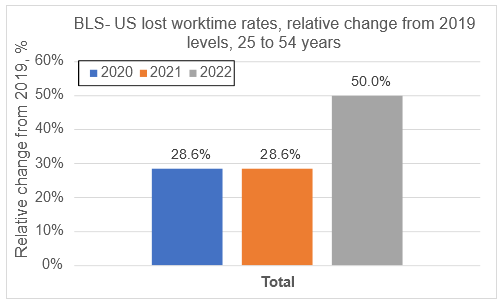
In their latest analysis, Dowd and crew use data from the Bureau of Labor Statistcs (BLS) to reveal a shocking spike in both employee absence and lost worktime rates, which they believe is due to vaccines – either from primary vaccine injuries, or because of weakened immune systems due to the jab, and not long covid caused by the virus itself.

Via Phinance Technologies

“It’s not a stretch to conclude from this data that the vaccines are causing death, disabilities & injuries due to a degradation of individuals’ immune system,” Dowd says. “The rate of change is not explained by the long Covid trope. Ask yourself where is funding for such studies?”

For those who want to dive right in to the analysis, follow the below links:

Part 1 – Overview of the Data

Part 2 – Analysis of Absence rates

Part 3 – Analysis of Lost Worktime rates

For the cliffs notes version, Dowd has dropped the following Twitter thread summarizing their analysis:

And for those who fell asleep in statistics class;

As one commenter notes, data from the UK reveals that firms are coming under increased pressure due to rising staff sickness, particularly among those over the age of 50. 

More to come next week…

Dowd explained his views how he reacted to the pandemic to Tucker Carlson. Now he, and his partners, spend their time poring through data to shine a light on harsh realities.

Tyler Durden
Tue, 03/21/2023 – 12:00

European Bank Bulls Are Resisting Capitulation

European Bank Bulls Are Resisting Capitulation

By Michael Msika and Julien Ponthus, Bloomberg Markets Live reporters and strategists

Some investors are tiptoeing back into European banking shares, greeting the swift takeover and central bank action that finally removed the yearslong Credit Suisse overhang. Yet, with confidence still fragile, buying banks remains a trade for the brave.

Dip buyers stepped in after early-Monday stock market declines that were sparked by concerns over parts of the emergency Sunday-night deal between Credit Suisse and UBS. A lot of bad news is already priced in, many reckon.

“We take the view that in 6 to 12 months, European banks will be higher than what they are now,” says Alexandre Hezez, chief investment officer at at Group Richelieu, a Paris-based asset manager. “One can’t say that the sector is overvalued. Results this year are expected to be good, we don’t see that changing significantly.”

Several strategists applauded the UBS-Credit Suisse tie-up, with HSBC’s Max Kettner describing himself as “much more confident.” Kettner notes that Europe’s bank share prices already incorporate an awful lot of bad news, with their index down about 16% in March. “Sentiment has gone and de-rated sufficiently to bearish levels that I’d be very-very careful to throw in the towel on constructive views now,” he adds.

The selloff slammed European bank valuations hard, taking them back to where they were in October. Average price-to-earnings ratios are now around 6.5 times forward earnings, not far off the levels seen during past crises, including ones in 2008 or 2011. The sector also offers the highest forward dividend yield in Europe, at about 7.6%.

“I think that European banks are solid and resilient,” says Simon Outin, global head of financials credit research at Allianz Global Investors.  “For me, the sector is solid, in terms of solvency, in terms of liquidity. We are not in 2008, really not.”

Concerns are by no means over. US authorities are fighting to head off potential deposit runs at regional banks. Rising interest rates and tightening financial conditions likely portend recession. A rise in default insurance costs at Deutsche Bank shows contagion fears still linger. So whether bulls do ultimately end up on top hinges now on a few things.

First, how well central banks navigate the next phase of their inflation battle, and how severe the anticipated recession could be. Banks typically perform well as interest rates and bond yields rise, though not during economic downturns. Analysts reckon that current yield levels on euro-zone bonds still imply some upside for bank shares, given they did not fully capture last year’s surge in borrowing costs.

Investors are also watching to see how policymakers calm the uproar around Credit Suisse’s Additional Tier 1 bonds — the riskiest bond category whose holders were wiped out in the merger. A rout in AT1 debt of other European lenders is raising fears of a seize-up in the market, which has been a key funding source for banks since the 2008 crisis.

“The risk is that all AT1 bonds collapse – so beyond Credit Suisse. This will put major pressure on banks’ financial ratios,” says Charles-Henry Monchau, chief investment officer at Banque SYZ.

Tyler Durden
Tue, 03/21/2023 – 11:43

“If We Again See Deflation Ahead, It Requires Fiscal AND Monetary Fusion”

“If We Again See Deflation Ahead, It Requires Fiscal AND Monetary Fusion”

By Michael Every of Rabobank

Shulman, Nosov, Tyulakov, Watford, Melnikov, Avayev, Protosenya, Krukovsky, Subbotin, Voronov, Rapoport, Maganov, Pechorin, Sungorkin, Gerashchenko, Pchelnikov, Petrunin, Mushegian, Taran, Makei, Kochenov, Zelenov, Bidenov, Buzakov, Antov, Maslov, Abdulaev, Pawochka, Makarov, Yankina, Rovneiko. The list of prominent Russians who mysteriously died since the start of 2022 has grown in exponential fashion. Does a market analyst think that’s randomness, prominent Russians being suddenly unlucky, or the Russian political-economy working? I raise the point because our metastasizing metacrisis should force us to look for patterns in our own political-economy even if it means reaching some uncomfortable conclusions.

After all, we just passed the 20th anniversary of the 2003 Iraq War, started over either a terrible error or a lie, which destabilised the Middle East and undermined US moral authority and military strength. Everyone I knew in 2003 knew there were no Iraqi WMDs but that the war was going to happen anyway. The logistics had been set in motion. All the nodders were nodding. I also distinctly recall being on the trading floor when the statue of Saddam came down: everyone turned off the TVs and went back to their desks as if it was all over, rather than the broader problems starting.

The same logistics were clear ahead of the Ukraine invasion in 2022 if one bothered to look. The problems are also still just starting there, even if markets are again trying to ignore them.

Markets can do so only because the US political-economy since Carter is that the labor share of GDP mysteriously dies while capital’s rises; and since Greenspan, that a Fed Put is always there to save investors. To underline how deeply this mentality is built in, even in a week where Credit Suisse became UBS, equity holders were smashed, and AT1 holders crushed, Bloomberg reports the ‘Biggest Fear for Trillion-Dollar Managers is Missing Next Rally’:

Some of the world’s biggest investors are looking beyond interest-rate hikes, bank failures, and the threat of recession to one of the greatest fears of money managers – missing out on the next big rally…. They’re convinced that an impending slowdown in the US and elsewhere will prompt central banks to switch back to looser policy, triggering a renewed surge higher in markets.”   

Of course, there is still room for a surprise from the Fed tomorrow, perhaps not in terms of an expected 25bps, but in the dot plot of what they think comes next. In a technical paper on the US yield curve, Philip Marey shows Dynamic Nelson Siegel model scenarios for the US 10-year yield for end-2023: 5.31% if inflation is sticky; 4.28% in the Fed’s December dot plot; and 1.53% in case of stagnation. That’s quite a range: then again, the US 2-year yield just traded an 40bps intra-day range yesterday. That would recently have been a safe projection for an annual trading range!

That predicted ‘DM = EM’ shift isn’t a surprise when you see the other names falling out of windows and off yachts or pedestals: Barnett; Bates Clark; Friedman; Jevons; Krugman; Samuelson; Walras; Wicksell, etc. – i.e., the collective reputation of neoclassical and neoliberal economics. Those shilling Goldilocks fantasies ten weeks ago sold linear, first-order, not non-linear, second, third, nth order thinking – like the above economists. If the number of people, or reputations, falling through windows goes 2, 4, 8, 16, I adjust my view of political-economy rather than of glazing.

In the real world, writing in the Financial Times, Gillian Tett notes the treatment of AT1 bonds in the Credit Suisse affair could contribute to an “insidious sense of investor doubt” about the neutrality of laws underpinning capital markets, with suspicions the Swiss authorities ensured the powerful Saudis got their money first. Likewise, SVB was not just a start-up bank but a national security issue, says the Pentagon, and Signature Bank was about dollar-rival crypto. The expansion of Fed swaplines excluded EM, again. Yes, the average Fed governor, like the average market analyst, may not even be able to spell geopolitics, let alone say it, but that doesn’t mean there isn’t a parallel reality to purely market perceptions of events.

Which brings us back to the view that it’s if not when we get a Fed Put. Let’s try to frame this in broader political-economy:

Covid-era inflation was never going to be “transitory”. That’s what happens if you finally use fiscal *and* monetary policy, having failed with only monetary, supply chains buckle, and entrenched oligopolies raise prices because they can. Oh, and war.

Nominal wage inflation was always likely to rise. Covid saw excess deaths, long illnesses, early retirement, lifestyle changes, and labor hoarding in ageing societies where fewer younger workers must produce the same volume of goods and services, while immigration came to a halt. Workers needed pay rises to try to catch up to inflation: and firms can afford to let them to some degree because profits are so high. Governments have to for political reasons.

Interest rates were always likely have to be ‘higher for longer’. What else were central banks supposed to do – argue for higher taxation and anti-trust action?

Raising rates in a financialised economy breaks things. Yet some things getting broken aren’t useful to the Pentagon, and others are more useful broken.

Risks of a credit crunch and deep recession are higher without more state action – which is why after suspending mark to market, the US is now studying extending deposit insurance universally. The state might need to step in even more. If so, will it be for free-wheeling Greenspan get-rich-quick schemes,… or China-style, centralization, re-regulation, and making banking as exciting as the civil (or military) service?

Sustaining state spending will be hard, but voters are in no mood for cuts. More so as defence budgets must surge now “production is deterrence”. On which, US ‘60 Minutes’ just nodded about how many more warships China builds each year than the US. The CSIS says in ‘Reviving the Arsenal of Democracy: Steps for Surging Defense Industrial Capacity’:

If there is a future conflict, the nation will have to go to war with the industrial base that it has at the time. The WWII model of engaging the industrial base in five years may not be sufficient for a conflict with a highly capable adversary with a strong industrial base, a strategy of onshoring all the components of production, and near-monopoly power over critical subcomponents, including critical materials used in defense production across the world.”

Cutting rates back to zero is not a viable strategy because of high inflation; low unemployment; the need for more production, not asset bubbles; the politics of selling asset-rich-income poor to an already furious public; and the fact that IT DOESN’T WORK. If we see deflation ahead, then we *know* it requires fiscal and monetary fusion – and then we know we get inflation again.

If the US does have to cut hugely again, every other DM is in deeper trouble. Worse, large EM are saying “No more 2003 or 2008!” as gold and crypto rise. I said Bretton Woods 3 Won’t Work, but also that if you want EM to set up CBDCs and use barter or gold for clearing, then let the Fed, ECB, BOE, BOC, RBA, etc., follow the BOJ. Look on as geopolitical sides are taken: as Xi visits Putin ahead of a visit to Beijing from Lula, Kishida is visiting India and making up with South Korea, floated as another Quad member.

Ideology is back as a justification for state action, as flagged in 2020. As we rush to restructure market architecture in a zero-sum, high-inflation, highly-geopolitical atmosphere, more technocratic or FTX-on-the-Forbes-front-cover Bloombergery is unlikely. History and logic says we will instead see new (old!) political-economy fusions of monetary, fiscal, industrial, and regulatory policy: like rate hikes and QE (or, some say, higher inflation targets); suspending or intervening in markets; and/or financial repression.

The logistics of this are starting to emerge if you can join the dots. The nodding heads are starting to nod. Clearly, however, most in markets don’t grasp how their political-economy is changing and don’t see the exponentially rising number of bodies and reputations falling out of windows.


Tyler Durden
Tue, 03/21/2023 – 09:23

Yellen To Reassure World That “Treasury Is Committed” To Bailing Out Regional Bank Depositors

Yellen To Reassure World That “Treasury Is Committed” To Bailing Out Regional Bank Depositors

The sound and fury of demands for universal deposit insurance are growing with Bill Ackman and Elon Musk the latest to join the calls for this ultimate step and as we detailed last night, Bloomberg reports Washington is studying just how to guarantee all $18 trillion in US deposits (with just $125 billion in the FDIC’s Deposit Insurance Fund).

“US officials are studying ways they might temporarily expand Federal Deposit Insurance Corp. coverage to all deposits, a move sought by a coalition of banks arguing that it’s needed to head off a potential financial crisis.”

But since US Treasury Secretary Janet Yellen’s embarrassing and confusing comments about who gets saved and who doesn’t (and who decides) during testimony before the Senate Finance Committee, it appears Washington thinks trotting out the little old lady once more to reassure nervous depositors is the right path back to financial stability.

As Reuters reports, in excerpts of prepared remarks to an American Bankers Association conference, Yellen said government steps taken in recent days to protect uninsured deposits in two failed banks and create new Federal Reserve liquidity facilities have shown a “resolute commitment to take the necessary steps to ensure that depositors’ savings and the banking system remain safe.”

But she immediately switches to try to quell any ‘picking winners’ sentiment by assuring her audience that:

“The steps we took were not focused on aiding specific banks or classes of banks. Our intervention was necessary to protect the broader U.S. banking system,” Yellen said.

And crucially, she claims they will rescue ALL depositors again…

“And similar actions could be warranted if smaller institutions suffer deposit runs that pose the risk of contagion.”

Of course, there is the obligatory – ‘do not worry, there is nothing to see here’ comment (or “it’s contained”)…

“The situation is stabilizing. And the U.S. banking system remains sound,” Yellen said.

“The Fed facility and discount window lending are working as intended to provide liquidity to the banking system. Aggregate deposit outflows from regional banks have stabilized.”

Tell that to First Republic Bank shareholders…

Specifically, the Treasury chief didn’t directly address the issue of temporarily expanding federal deposit insurance to cover all deposits in the excerpts released by the Treasury Department.

“Treasury is committed to ensuring the ongoing health and competitiveness of our vibrant community and regional banking institutions,” she said.

Of course, the only path to this is actual legislation, which means Congress (i.e. no executive order)…

“Any universal guarantee on all bank deposits, whether implicit or explicit, enshrines a dangerous precedent that simply encourages future irresponsible behavior to be paid for by those not involved who followed the rules,” the House Freedom Caucus said in a statement, and we are confident most of the progressive wing will not be too excited about bailing out billionaires and corporations with orders of magnitude more in the bank than the FDIC limit.

…and that means, don’t hold your breath for any blanket unlimited size deposit insurance.

Tyler Durden
Tue, 03/21/2023 – 09:02