74.3 F
Chicago
Wednesday, August 5, 2026
Home Blog Page 3930

Retail Investors Pour $1.5 Billion Each Day Into US Markets, The “Highest Amount Ever Recorded”

0
Retail Investors Pour $1.5 Billion Each Day Into US Markets, The “Highest Amount Ever Recorded”

For much of the waning days of 2022, the broader theme in markets was a downbeat one, especially for one group of habitual gamblers investors: after a stellar 2021 when nothing made sense and the junkiest of companies exploded higher steamrolling shorts, for retail investors 2022 felt like the polar opposite: a relentless series of gut punches which knocked the air out of basement dwelling daytraders and crushed some of the most popular retail names.

And indeed, a quick search of headlines from mid/late 2022 confirmed that the retail spirit had been broken:

It all culminated with the near record year-end liquidation when in addition to momentum, tax loss selling prompted retail investors to dump single stocks at an unprecedented pace as described Retail Investors Slamming The Bid Amid Tax-Loss Selling Capitulation

However, this record selling flow would not last long, and indeed, just one month later, we wrote that with LO institutions and hedge funds extending their bearish positioning, it was retail investors that picked up the BTFD torch in January, adding that “if retail is once again a more powerful price setter than institutions and hedge funds (thank you zero market liquidity), and we are facing another Jan 2021-type meltup, then watch out above even if none of the abovementioned technicals go into play.”

In retrospect we were right, but not even we had any idea just how much we were right.

That’s because according to the latest report from retail orderflow specialist Vanda Research, January was a blowout, record month for retail buyers in the market.

As Vanda’s Mario Iachini writes, “in the last month, retail investors poured an average of $1.51bn/day into the US markets, the highest amount ever recorded.” And as we expected, this group of investors “has continued driving US equity market swings since the second half of last year.”

Echoing verbatim our own thoughts, Vanda writes that “with recent surveys showing the institutional investor community remaining broadly bearish on stocks, it would be unwise to underestimate the importance of the retail cohort” as so many bearish hedge funds learned the very hard way in early 2021.That’s in keeping with retail sales and jobs data for January, suggesting that consumers retain impressive levels of buying power. While the jury is still out on whether that’s due to a robust job market or excess savings from pandemic stimulus, the bottom line is that investors should heed signals from the ‘unsophisticated money’ crowd.”

Having said that, seasonality suggests that flows could abate somewhat in the weeks ahead as earnings season falls in the rear-view mirror and investors start preparing for Tax Day in mid-April. However, if broad equity markets continue to perform well, we may instead see flows shifting towards smaller, more speculative companies (this is already occurring to an extent). And while the same could take place in the options market, especially with the dominance of 0DTE option activity, Vanda does not anticipate a repeat of the 2020-21 bubble, given that we are still in the late stages of the economic cycle.

Finally, contrary to popular belief, retail money market funds’ net assets at an all-time high suggest that retail investors still have plenty of capital to allocate to riskier investments, provided that market conditions remain supportive.

Vanda discusses this and other related topics in more detail below.

Total net purchases of US securities exceeded expectations by a significant margin on Wednesday. If we only consider periods when the S&P 500 closed in positive territory, Wednesday’s aggregate purchases surpassed the previous record set on February 8th. Normally, Vanda would expect this this level of inflows on a day when the S&P 500 experiences a daily decline between -1% and -4%. Instead, “this type of behavior suggests retail traders are FOMO-ing more than any sentiment recent survey would show.”

The flipside to the recent retail euphoria is that Vanda expects retail flows into cash equities to decrease in the weeks ahead, as seasonality suggests that March-April are typically middle-of-the-road months during the calendar year.

Furthermore, when looking at a rolling one-month period, inflows have never been higher since the dataset began in 2014 (second chart below). Sustaining such a robust daily pace will prove challenging but it won’t mean the end of the current bull market if institutional investors pick up the slack.

At the same time, and contrary to popular belief (especially among bears), the above doesn’t mean that retail investors are running out of capital to allocate to risky investments. Indeed, from a stock level perspective, the chart below suggests that retail investors have plenty of dry powder in the form of capital parked in money market funds that could be deployed in the equity space once confidence about future market returns increases more broadly.

Adding insult to injury for the institutional bears – of which there is plenty – there is potential for bullish positions to be added in the options market. However, it is uncertain to what extent retail investors are willing to participate in the rally with leverage, given they’re still sitting on significant losses (-25% on average). In any case, nobody expects that the level of speculation observed during the 2020-2021 period will be replicated as we’re still in the later stages of the market cycle. Those dynamics are more likely to take hold during the early recovery phases after a recession has occurred.

The soaring retail investor flows underpin the outperformance of their favorite stocks. A basket of the top 10 most-purchased retail stocks over recent months is experiencing a strong rebound relative to the SPX in 2023. Retail flows have accounted for a +US$18.5bn capital injection YTD in these names (listed below the chart). Should positive momentum in the broad equity market persist, it could push retail investors toward more speculative names, which are more susceptible to such flows given their smaller market cap.

Many smaller-cap single stocks are also beginning to populate the top part of the retail leaderboard so far in 2023. Indeed, the first table below shows that beyond the top 10 most-bought securities, there’s a host of smaller-cap names that have attracted significant inflows this year (~US$2.23bn in total). Moreover, the weighted average performance of this group of stocks is roughly +50%, which is widely outpacing the S&P500 total return of 8.2%.

The other outcome of this dynamic is a pick-up in retail purchases in the ARKK ETF and some of its underlying holdings. It was common back in 2020-21 for retail investors to buy ARK ETFs while at the same time piling in some of their more hyped underlyings. While we don’t expect retail speculation to reach those levels for the reasons discussed above, it is noteworthy that retail investors are vastly outpacing Cathie Wood and Co. regarding purchases across some of these names.

Vanda concludes its weekly retail tracking by pointing out that crypto TradFi proxies are among some of the best performers week-to-date.

Silvergate Capital (SI) shares were up 28.6% at the end of trading Wednesday after Citadel Securities announced that it had taken a stake in the company. Indeed, 13F filings show Citadel Securities bought 5.5% in the digital currency banking company. The shares are up 69% over the past month but remain 91% below their all-time high. With the latest data showing 67% of SI’s shares held short it is likely that retail purchases have helped fuel a short-squeeze over the last three trading days. Given the size of the short book, we wouldn’t be surprised to see retail traders attempt to push the stock further in the coming days, although flows over the past three months show that interest in this name tends to be sporadic and short-lived. In contrast, Coinbase (COIN) seems to enjoy stronger retail tailwinds as bullish activity in the options space is surging as well (second chart).

Finally, here is the aggregate retail flow tracker”

Tyler Durden
Mon, 02/20/2023 – 23:30

How New Zealand Dealt With “Disinformation”

0
How New Zealand Dealt With “Disinformation”

Authored by Tom Jefferson and Carl Heneghan via The Brownstone Institute,

The Lord of the Rings trilogy is spectacular, with Orcs, Elves and breathtaking scenery filmed on location in New Zealand. The special effects were good too – the eye of Sauron looked very realistic – perhaps it is.

We have come across a minimally redacted 28-page draft of a Kiwi Government document entitled “Communications approach to managing disinformation, online harms and scams” dated 10 Dec 2021 (Available here). 

The document’s aim appears to be coordinating countering disinformation seeking to harm “by threatening public safety, fracturing community cohesion and reduced trust in democracy.”

All well and good then; it’s a bit like saying, do not open fire on the Red Cross. 

Except that the object is “disinformation” relating to the Kiwi government’s response to the Covid pandemic.

The definition of disinformation in the document is on page 5:

We will not summarise the complex and superficial content of the document other than to note that this is precisely the attempt at normalising the message of the pandemic that we have reported. The government has put out a message, and its credibility must be defended at all costs, with tech media partners, academics, the community and, of course, the armies of Sauron.

One consideration is that the Covid narrative in Middle Earth (as elsewhere) is based on the misuse and misinterpretation of polymerase chain reaction (PCR) and the death of clinical medicine, as we have made clear

Cases may not have been active cases, hospitalisations may not be due to SARS-CoV-2, and deaths may be due to various causes related or unrelated to SARS-CoV-2. We will never know for sure. Why? Because the PCR cycle threshold for testing PCR “positive” in Middle Earth was 40 to 45, ensuring that most tested people would test positive even in the total absence of contamination (a very tall order). 

So presenting figures of cases, hospitalisations and deaths based on qualitative PCR results inflates the totals and undermines the confidence in the competence and honesty of public health bodies: it is disinformation.

We make the document available now (see here), and all our readers will find different parts interesting or as scary as the orcs.

So if you think you live in a democracy, one last word of warning: do not go too near the Black Gate. You may think it is fiction, but it’s not.

*  *  *

Republished from the author’s Substack

Tyler Durden
Mon, 02/20/2023 – 23:00

World War 3.1

0
World War 3.1

By Peter Tchir of Academy Securities

There has been more discussion about World War III in the past year than at any time in recent memory. Yet, we can’t help but wonder if World War III isn’t a misnomer and World War v3.1 is more accurate – because chips and semiconductors are likely going to play a huge role in initiating and winning any such global conflict.

The tech space, generically, likes using “versions” and decimalized numbers rather than Roman numerals, so let’s run with that.

This is more of a “thought” piece than something that is actionable today. However, we think that it is important to be laying out the background of how we are thinking about this important subject. It is something that comes up in more conversations and dominated the discussions we had when we were in Silicon Valley back in January. It will shape decisions and influence who wins and loses at the national and corporate levels.

The Intel CEO at Davos said that: “Chip supply chains will shape geopolitics more than oil over the next 50 years”.

Fifty years seems almost too long of a timeframe. It is already shaping geopolitics and getting it right in the next 5 to 10 years (not 50 years) will be crucial.

Academy’s Geopolitical Intelligence Group addressed “Rare Earths – A National Security Threat” back in February 2021. During meetings, our position has been that securing (and processing) rare earths and critical minerals will dominate our commodity efforts in the coming years. Ten years ago, all you needed was a map of energy production and you could pinpoint U.S. interests. In five years, all you will need will be a map of major cobalt, lithium, etc. deposits to determine where the U.S. will be most active. The sad reality is that China figured this out years ago and we are just now seeing the urgency of the issue.

I have said (half-jokingly, but mostly serious) that the West has a vision for sustainability but no workable plan to get there, while China has no vision but a great plan to secure the resources that they think the West will need.

While we haven’t focused as much on chips in the past, it is a natural extension of our though process and these rare earths and critical minerals (and their processing) are an integral part of the semiconductor supply chain.

While I’ve doubted the effectiveness of sanctions, the one area where even I think they have worked is in the higher-end of semiconductors. This is one reason why we need to write this World War v3.1 report now.

Another thing that prompted us to finally get this “initial” piece out there was the reports about IP theft at ASML. Finally, we’ve had several highly respected people recommend the Chip War book.

Today, we will lay out how we’ve been thinking about this at Academy and why we do think that “getting it right” will be crucial for countries and companies.

Prior “Thought” Pieces

Before diving into today’s subject, we have written several thought pieces that have stood the test of time. We’ve included a link to the “rare earths” piece above, but this is just one example.

On China, our views have evolved, but we’ve historically been more negative than most on the future of the relationship with the U.S., and so far, that has turned out to be accurate.

  • A DIME Framework for Strategic Competition. In 2019, few were talking about the importance of naming China a “Strategic Competitor” in national security strategies.
  • The Recentralization of China. In 2021, we saw China clamping down on their citizens and turning more inwards, while Xi consolidated power.
  • The Beijing Olympics as Cultural Bookends. This piece was completed just days before Russia invaded Ukraine. The report almost “begs” people to understand that China’s needs (with respect to the West) have changed and are unlikely to revert back to anything that we have seen in the past 10 to 20 years.

Russia has always been “top of mind” for our Geopolitical Intelligence Group, even when it wasn’t on the radar for most.

  • From Watch Russia (April 2021), to Russia on the Warpath (Jan 2022), to Scenario Update (10 days before the attack), the insights of our Geopolitical Intelligence Group have been invaluable in anticipating this conflict and helping investors and companies deal with it as effectively as possible.
  • Russia’s Nuclear Threat was published around Academy’s 2nd Annual Geopolitical Summit in Annapolis (we have our 2nd San Diego Summit in less than 2 weeks). It still reflects the scenarios that we see, though it is interesting that we’ve discussed the risk of China selling military equipment to Russia and that was high on the list of things that Secretary of State Blinken discussed with Chinese officials this weekend.

Setting the Table

General (ret.) Walsh pointed out a few key things to think about as we address the stress around chips from a geopolitical framework:

  • The Commerce Department is setting export controls on AI and semiconductors in an attempt to stop China from acquiring the highest-end semiconductors that could be used in advanced military systems during a future military conflict with the U.S.
  • The U.S. operational concept for future warfare is the Joint All-Domain Command & Control Strategy. China is attempting to outpace the U.S. military in the ongoing tech war by announcing their own operational concept called Multi-Domain Precision Warfare. The country which wins this tech war will possess the most advanced military capabilities (which will rely on high-end semiconductors).
  • China set 2030 as its target date to become the global leader in AI. China also expects to be on par with the U.S. militarily by 2035. High-end semiconductors are key to meeting this objective.
  • High-end chips are needed for AI, supercomputing, and weaponizing the technology required to achieve geopolitical power.

I spend a lot of time with military experts in my role here at Academy and found the intensity of the “military focus” on this topic surprising. It is good that the high tech sanctions do seem to be more effective than other sanctions that we’ve imposed (Russia and Iran). This is a top priority for national security at every level! The military has embarked on multiple projects to ensure that chips of Chinese origin are not in any sensitive U.S. military equipment. Without a doubt the military and national security focused agencies have been focused on this and that focus is only going to grow (both at the national level and ultimately at the corporate level).

The Semiconductor Industry Viewed Through a Geopolitical Lens

I am sure that people in the industry will cringe at some of the simplifications here, but I strongly believe the “simplifications” will help us understand this issue and lead to fewer errors in our thought process at this stage.

Before getting into that, I want to highlight what Admiral (ret.) Barrett had to say. She has an interesting viewpoint as she was responsible for the Navy’s cyber-attack capabilities.

  • Although the outsourcing of chip manufacturing (particularly to Asia where 75% of the world’s semiconductor chips are currently manufactured) was a known problem for years, these problems really hit home during the COVID pandemic and the subsequent disruption in critical supply chains that resulted in a massive shortage of chips. Investment in organic chip manufacturing in the United States by U.S. companies has been a recognized problem for years, but only recently have government attention and corporate investment taken hold. For example, Micron Technology is investing $100 billion to build four separate semi-conductor fabrication plants outside of Syracuse, New York. The first phase alone would provide 3,000 jobs and $20 billion of investment over the next five years (with the other phases to follow). This represents the largest single private investment in New York State’s history. The project will also create 40,000 construction and supply chain jobs, a significant boon to the state and national economy.
  • Control over the production of semiconductors/chips is critical to ensuring the viability of our supply chain and mitigating possible cyber-espionage and malicious activity. With the advent of the Internet of Things and digital modernization in every industry from manufacturing to agriculture, this type of control over chips for improved cyber-security is a national strategic imperative. President Biden’s CHIPS and Science Act of 2022 invests in our national capacity to build chips in the United States and directs policy and funding support to R&D, workforce skills development, and science/technology. The U.S. government investment associated with the Act is significant and provides $52.7 billion in funding including $13.2 billion for research and development and $39 billion for production incentives and workforce development. It also provides significant tax incentives for private industry investment in semiconductor/chip technology. This investment by both the government and private industry will result in competitive global business advantages, provide improved cyber-security for commercial and military industries, and will create jobs (particularly at plants that are built in economically depressed areas).

Types of Chips

  • Cutting Edge. These are the smallest, fastest, and most “state of the art” chips. The manufacturing of these chips is still dominated by Taiwan. While the U.S. and other countries might be catching up, Taiwan is still the clear leader and is well-positioned to continue that leadership. Even as Taiwanese companies build more foundries outside of Taiwan, they will not produce cutting edge products anywhere other than onshore (it is their “ace in the hole” from a geopolitical standpoint).
  • High Tech. Let’s classify these chips as anywhere from one to three generations behind the “state of the art process”. Taiwan is extremely strong here, but not alone. This is an area that the U.S. (and presumably Germany and Western Europe) can compete in. China is creeping up the scale here and is prioritizing this. Russia and Iran, two important adversaries in the space, cannot really compete at this level. This is the main battle ground and an area of growing competition.
  • Mid-to-Low Tech. These are the chips that are being phased out, but are useful as the products they were designed for continue to be built and the manufacturers don’t want to update the specs significantly. This is the “cash cow” of the industry and it is global in nature.
  • Commodity or Generic chips. This is not an area that lends itself to higher cost producers. It doesn’t help that much of the business was ceded to other regions and countries. At one level they are very generic, but at another level, why give up so much of the production?

While these classifications are overly simplistic, it will let us explore the geopolitical framework.

Chip Design AND Chip Manufacturing.

  • Designing chips is only part of the industry. It is difficult to design chips in any case, but it is extremely difficult to design chips that can be manufactured as well.
  • Building the foundries is crucial. The level of precision required to make the highest-end chips is unheard of in any other manufacturing setting.
  • It is the marriage of chip design and manufacturing technology that is the key. That is one reason why we highlighted the ASML story so early in today’s report. While it is easy to imagine people capturing schematics of chips, it is also easy to imagine them being unable to build those chips. Not that any chip company would give away their designs, but even if they did, a competitor (nation or otherwise) might have difficulty replicating it due to the difficulty in manufacturing (especially for a “cutting edge” or even “high tech” chip).
  • Maybe this “marriage” was obvious (and I’ve wasted your time), but it seems somewhat unique to the space and is crucial from a geopolitical standpoint.

Just by using these simple building blocks we can discuss a few scenarios that come up frequently in meetings.

D.C. Pushes Too Hard

The scenario that gets discussed the most is that D.C. pushes too hard. One thing that has stood the test of time is that the elected representatives serving in a national security capacity tend to put country first and politics second. That is a good thing as it ensures the safety of the country as much as possible.

One concern is that D.C. gets involved in technology that isn’t as critical. The entire industry seems to be behind on the “cutting edge” restrictions and even the “high tech” restrictions. There is a concern that the government could start interfering with segments of the industry where their action could do more harm than good (though that is potentially in the eye of the beholder).

At its simplest, U.S. companies sell a lot of “mid-tech” chips to China. That “cash cow” is an important part of what funds research and development for new chips and also funds the building of foundries on-shore. If these sales get attacked by D.C. (a possibility as the popularity of banning tech with China seems high), then the chip industry might be hurt and it would hamper its ability to wrestle more control of higher tech (and ultimately cutting-edge tech) away from Taiwan. This would potentially make it easier for China to catch up in this area.
The second problem is that many of those chips could wind up back in the U.S. as they are components in products that China manufactures for sale here.

From a commerce standpoint, there is a balancing act that needs to be executed by D.C. So far, so good, but it is something that needs to be watched closely. While we stated earlier in the piece that this isn’t necessarily an “actionable” T-Report, if we get an inkling that D.C. is going to go too far, this report will be highly actionable as this would hurt the chip industry and be inflationary (not a good combination for markets or the economy).

The other way our “success” could play out negatively is understanding what happens to China’s view of Taiwan.

China is doing what it can to build out their own chip industry. In terms of tech, they are behind us (but have closed a portion of the gap) and both countries (the U.S. and China) are behind Taiwan.

Could China Decide:

  • That hastening their progress in chip manufacturing is in their best interest and try to capture Taiwan’s foundries and bring them “in-house” by force?
    • This is unlikely because in any attack on Taiwan, there is some risk (no matter how much China tries to avoid this) that the factories would be damaged to the point that they are inoperable and even the equipment that can be salvaged isn’t enough for China to leapfrog us in development.
  • To ensure that if they can’t get cutting edge chips, that we can’t either?
    • If you can’t get cutting edge chips but your competition can, maybe it is just easier to stop their ability to get them. Highly unlikely at this stage, but worth thinking about.

Other Thoughts

While China remains a trading partner, albeit one where our relationship grows more complex by the day, Russia and Iran are not.

The Iranian drones that have been sold to Russia have very old technology. The sanctions on Iran have worked to limit their tech (and presumably what they get is going into their nuclear program which is their highest priority).

The fact that Russia needs these drones is a testament to how much the chip sanctions have hurt them.
Using the phrase “two sworn enemies” of the U.S. might seem a bit harsh, but it doesn’t seem too far off in terms of describing our relationship with Russia and Iran. So, here we are with “two sworn enemies” that are seeing their fighting capacity reduced due to access to chips. What do they do about that? Maybe they will take the proverbial “knee” and acquiesce to us, but that doesn’t seem to be in their nature. We could easily weave North Korea into this mix as well.

We are winning right now against Russia, Iran, and North Korea but I do get the feeling that we are cornering a wounded animal, which by all accounts is risky.

China has the time, money, and the political apparatus to catch up.

As General Walsh pointed out, they have specific goals in place and presumably have the plans in place to achieve these goals as well.

As Admiral Barrett pointed out, we have government support for industries too, but the relationships here tend not to be as linear as they are in China.

Bottom Line

We need to balance getting foundries built with government support and effectively cut off what technology “export” we can without going overboard.

China will try to develop their own industry, which we need to watch closely. It is also another element in their decision-making process regarding Taiwan.

The lack of “linearity” in the U.S. (i.e., open competition) has served us well. China’s single-minded approach gives them the benefit of scale that we don’t have, but risks major setbacks if they go down a wrong path.

We are a long way (hopefully) from World War v3.1 but the concept of a “commodity” war or battle for commodities is becoming a global competition for chips and technology and the stakes are extremely high!

This is a subject that will be taking up more of your time in the coming months and years and hopefully Academy will be an effective guide.


Tyler Durden
Mon, 02/20/2023 – 22:30

Biden Admin Negotiates Deal To Give WHO Authority Over US Pandemic Policies

0
Biden Admin Negotiates Deal To Give WHO Authority Over US Pandemic Policies

Authored by Kevin Stocklin via The Epoch Times (emphasis ours),

The Biden administration is preparing to sign up the United States to a “legally binding” accord with the World Health Organization (WHO) that would give this Geneva-based UN subsidiary the authority to dictate America’s policies during a pandemic.

A logo is pictured outside a building of the World Health Organization (WHO) in Geneva, Switzerland. (Denis Balibouse/Reuters)

Despite widespread criticism of the WHO’s response to the COVID pandemic, U.S. Health and Human Services (HHS) Secretary Xavier Becerra joined with WHO Director-General Tedros Adhanom Ghebreyesus in September 2022 to announce “the U.S.-WHO Strategic Dialogue.” Together, they developed a “platform to maximize the longstanding U.S. government-WHO partnership, and to protect and promote the health of all people around the globe, including the American people.”

These discussions and others spawned the “zero draft” (pdf) of a pandemic treaty, published on Feb. 1, which now seeks ratification by all 194 WHO member states. A meeting of the WHO’s Intergovernmental Negotiating Body (INB) is scheduled for Feb. 27 to work out the final terms, which all members will then sign.

Written under the banner of “the world together equitably,” the zero draft grants the WHO the power to declare and manage a global pandemic emergency. Once a health emergency is declared, all signatories, including the United States, would submit to the authority of the WHO regarding treatments, government regulations such as lockdowns and vaccine mandates, global supply chains, and monitoring and surveillance of populations.

Centralized Pandemic Response

“They want to see a centralized, vaccine-and-medication-based response, and a very restrictive response in terms of controlling populations,” David Bell, a public health physician and former WHO staffer specializing in epidemic policy, told The Epoch Times. “They get to decide what is a health emergency, and they are putting in place a surveillance mechanism that will ensure that there are potential emergencies to declare.”

The WHO pandemic treaty is part of a two-track effort, coinciding with an initiative by the World Health Assembly (WHA) to create new global pandemic regulations that would also supersede the laws of member states. The WHA is the rule-making body of the WHO, comprised of representatives from the member states.

“Both [initiatives] are fatally dangerous,” Francis Boyle, professor of international law at Illinois University, told The Epoch Times. “Either one or both would set up a worldwide medical police state under the control of the WHO, and in particular WHO Director-General Tedros. If either one or both of these go through, Tedros or his successor will be able to issue orders that will go all the way down the pipe to your primary care physicians.”

Physician Meryl Nass told The Epoch Times: “If these rules go through as currently drafted, I, as a doctor, will be told what I am allowed to give a patient and what I am prohibited from giving a patient whenever the WHO declares a public health emergency. So they can tell you you’re getting remdesivir, but you can’t have hydroxychloroquine or ivermectin. What they’re also saying is they believe in equity, which means everybody in the world gets vaccinated, whether or not you need it, whether or not you’re already immune.”

Regarding medical treatments, the accord would require member nations to “monitor and regulate against substandard and falsified pandemic-related products.” Based on previous WHO and Biden administration policy, this would likely include forcing populations to take newly-developed vaccines while preventing doctors from prescribing non-vaccine treatments or medicines.

Circumventing America’s Constitution

A key question surrounding the accord is whether the Biden administration can bind America to treaties and agreements without the consent of the U.S. Senate, which is required under the Constitution. The zero draft concedes that, per international law, treaties between countries must be ratified by national legislatures, thus respecting the right of their citizens to consent. However, the draft also includes a clause that the accord will go into effect on a “provisional” basis, as soon as it is signed by delegates to the WHO, and therefore it will be legally binding on members without being ratified by legislatures.

“Whoever drafted this clause knew as much about U.S. constitutional law and international law as I did, and deliberately drafted it to circumvent the power of the Senate to give its advice and consent to treaties, to provisionally bring it into force immediately upon signature,” Boyle said. In addition, “the Biden administration will take the position that this is an international executive agreement that the president can conclude of his own accord without approval by Congress, and is binding on the United States of America, including all state and local democratically elected officials, governors, attorney generals and health officials.”

There are several U.S. Supreme Court decisions that may support the Biden administration in this. They include State of Missouri v. Holland, in which the Supreme Court ruled that treaties supersede state laws. Other decisions, such as United States v. Belmont, ruled that executive agreements without Senate consent can be legally binding, with the force of treaties.

There are parallels between the WHO pandemic accord and a recent OECD global tax agreement, which the Biden administration signed on to but which Republicans say has “no path forward” to legislative approval. In the OECD agreement, there are punitive terms built in that allow foreign countries to punish American companies if the deal is not ratified by the United States.

As with the OECD tax agreement, administration officials are attempting to appeal to international organizations to impose policies that have been rejected by America’s voters. Under the U.S. Constitution, health care does not fall under the authority of the federal government; it is the domain of the states. The Biden administration found this to be an unwelcome impediment to its attempts to impose vaccine and mask mandates on Americans, when courts ruled that federal agencies did not have the authority to do so.

To circumvent that, they went to the WHO, for either the regulations or the treaty, to get around domestic opposition,” Boyle said.

According to the zero draft, signatories would agree to “strengthen the capacity and performance of national regulatory authorities and increase the harmonization of regulatory requirements at the international and regional level.” They will also implement a “whole-of-government and whole-of-society approach at the national level” that will include national governments, local governments, and private companies.

The zero draft stated that this new accord is necessary because of “the catastrophic failure of the international community in showing solidarity and equity in response to the coronavirus disease (COVID-19) pandemic.”

A report from the WHO’s Independent Panel for Pandemic Preparedness and Response (pdf) characterized the WHO’s performance as a “toxic cocktail” of bad decisions. Co-chair Ellen Johnson Sirleaf told the BBC it was due to “a myriad of failures, gaps and delays.” The solutions proposed by that report, however, did not suggest more local autonomy or diversified decision-making, but rather greater centralization, more power, and more money for the WHO.

Read more here…

Tyler Durden
Mon, 02/20/2023 – 22:00

Watch: North Korea Airs ICBM Missile Test Footage As Tensions Rise

0
Watch: North Korea Airs ICBM Missile Test Footage As Tensions Rise

North Korean state television has aired footage of their recent test of a new long range ICBM system capable of carrying a nuclear payload.  The missile covered 614 miles and reached an altitude of 3,584 miles, landing accurately in a designated area on the West Coast of Japan. 

Tensions have been rising in the region as the US commence joint military drills with South Korea.  North Korean leader Kim Jong Un warned Friday of “unprecedented strong responses” to those drills if they go ahead, while his sister, Kim Yo Jong, warned that “the frequency of using the Pacific Ocean as our shooting range depends on the nature of the US military’s actions,” according to a statement posted on the state-run Korean Central News Agency.

Monday’s missile tests were the second in three days with three such tests in less than a year.  

Tyler Durden
Mon, 02/20/2023 – 21:30

Residents Say They’ve Broken Out in Rashes After East Palestine Train Derailment

0
Residents Say They’ve Broken Out in Rashes After East Palestine Train Derailment

Authored by Jack Phillips via The Epoch Times (emphasis ours),

Locals who live near the train derailment and release of toxic chemicals near East Palestine, Ohio, have complained about various health problems since the incident unfolded earlier this month, including rashes, headaches, and other issues. And they’ve expressed concerns that these new symptoms may be tied to the chemicals that were burned or released.

ONG 52nd Civil Support Team members prepare to enter an incident area to assess remaining hazards with a lightweight inflatable decontamination system (LIDS) in East Palestine, Ohio, on Feb. 7, 2023. (Ohio National Guard via AP)

The Feb. 3 derailment triggered officials to initiate a controlled release and burn of various chemicals as they cited concerns that those materials would explode and send out deadly shrapnel. Chemicals carried on the Norfolk Southern-operated train include toxic vinyl chloride gas, which was vented and burned, releasing a large cloud of black smoke that hung over the area for days.

A plume of chemicals from the train derailment was also detected heading down the Ohio River, although some Ohio environmental officials assert that they may largely be fire retardant substances used to put out the fire. Other chemicals carried on the train include butyl acrylate, ethylene glycol monobutyl ether acetate, and 2-ethylhexyl acrylate, the U.S. Environmental Protection Agency said (pdf).

Residents of East Palestine were told they could return to their homes on Feb. 8. Since then, there have been reports from locals of adverse health events they’ve suffered amid separate reports of animals, including fish and chickens, dying off.

When we went back on the 10th, that’s when we decided that we couldn’t raise our kids here,” local Amanda Greathouse told CNN, adding that in the area, there was a smell that “reminded me of hair perming solution.”

About 30 minutes after returning home earlier this month, she developed nausea and a rash, Greathouse told the network. Her house is located about a block from the train derailment site.

A view of a caution tape as members of the U.S. Environmental Protection Agency (EPA) (not pictured) inspect the site of a train derailment of hazardous material in East Palestine, Ohio, on Feb. 16, 2023. (Alan Freed/Reuters)

When we left, I had a rash on my skin on my arm, and my eyes were burning for a few days after that,” added Greathouse, who said she has two preschool-age children.

“The chemical smell was so strong that it made me nauseous,” Greathouse said. “I just wanted to quickly pick up what I needed and leave. I only took a few pieces of clothes because even the clothes smelled like chemicals, and I’m afraid to put them on my kids.”

Read more here…

Tyler Durden
Mon, 02/20/2023 – 21:00

Inflation Or No Inflation

0
Inflation Or No Inflation

By Russell Clark of the Capital Flows and Asset Markets substack

A large number of economic thinkers that I respect are calling for peak inflation, and that interest rates increases have topped out. With oil prices down from USD 120 a barrel to USD 77 today, this would be a strong indication of reduced inflation pressure. For “peak inflationistas” the cherry on the top would be this week’s cover of the Economist, warning that inflation will be harder to contain than people think. The Economist has a long and illustrious career as a “contra” (a contra is somewhere who gets market calls consistently wrong). Peak inflationistas even have the benefit of financial markets agreeing with them, with US 2/10 year yield curve as inverted as it gets. Inversion really is the markets way of saying that they don’t believe central banks will raise interest rates any further.

Is the Economist wrong again? Just looking at US CPI YoY, it already peaked out and started falling, and with the bond market in inversion, it does like the Economist leader writers have proven why they are writers and not hedge fund managers.

But, these days I place politics as more important than economics in doing financial analysis. From this perspective, I do not see central banks, and particularly the Fed going dovish until they get food inflation under control. Rising food prices are political dynamite. So lets us look at the most recent US CPI data from a food inflation perspective. On a year over year basis it is still rising at 10%, and even though it is slowing a little, it still doing 10% on high comps from a year ago.

What I really like about food inflation is that it is universal and easily understandable. A Birkin bag or a Panerai costing 30% more is not inflation that matters to most people. But the price of bread and meat? That matters to everyone. What is really great about the US CPI data is that it breaks down white bread and meat CPI back to pre World War II. White bread CPI is still rising at nearly 20% year on year, while meat CPI is back to 2% year on year.

For CPI calculations, food CPI is given a total weight of 13.5%, with bread having a weight of 0.2% and meat having 1% weight. This means that soaring bread prices should not really be that important to Federal Reserve and other western central banks. But soaring bread prices are very important to politicians – certainly more than the CPI weightings given above. For me the question comes down to whether the meat index is right, or the bread index is right. Or in other words, will bread prices fall back, or will meat prices spike? One of the best things about free market capitalism, is that incentives are transparent. For US pork farmers are currently disincentivised to farm pigs. The price of hogs relative to corn are at close to 40 year lows, meaning that hog prices are not covering the cost of feed (which is mainly corn).

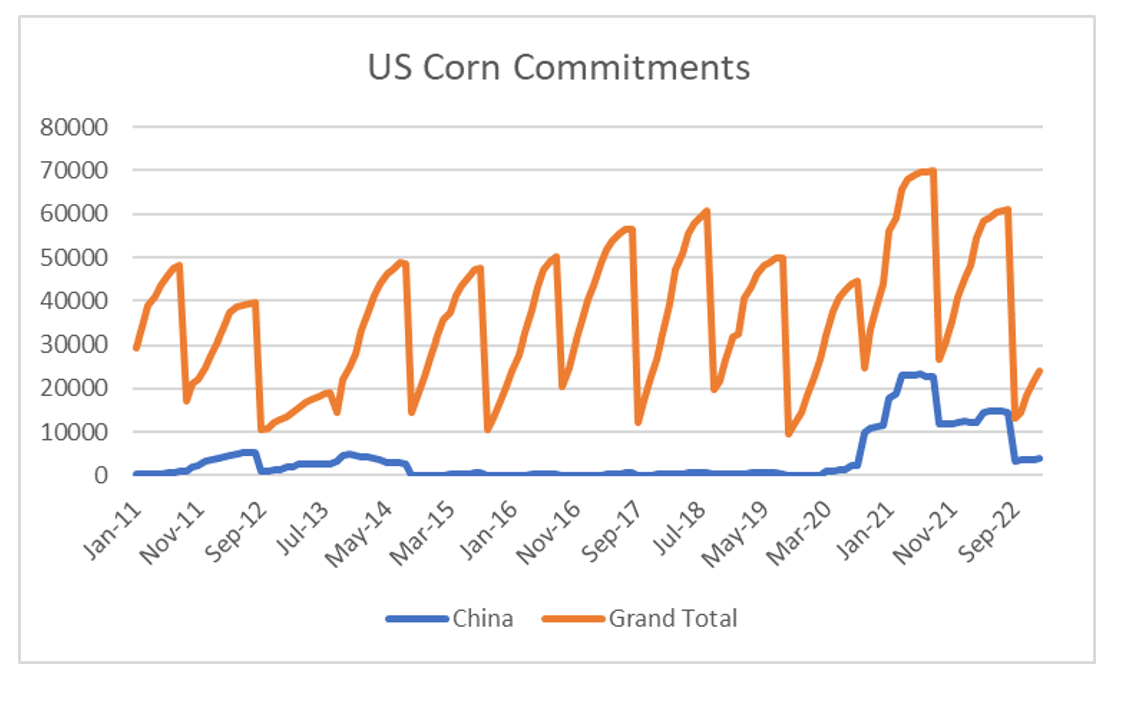
With hog farmers disincentivized to farm hogs, then one of two things must happen – corn prices must fall, or hog prices will rise. When we look at the corn market, we see that China has become a major buyer of US corn.

This is despite the Chinese placing tariffs on corn imports that have meant that Chinese corn prices are much higher than US prices.

In other words, geo-politics has driven China to have high food prices, which it now exporting back to the rest of the world. Just as we have seen with Covid, it is possible for the Chinese to change policies, but self sufficiency in food production seems to be a key policy for China. With Chinese activity picking up, my guess is that corn prices globally will remain high, which means feed prices will stay high, and meat inflation will catch up to bread inflation. In my view food inflation is still ongoing, and hence central banks will keep raising rates.

Tyler Durden
Mon, 02/20/2023 – 20:30

Watch: 2023 Don Lemon Would Accuse 2013 Don Lemon Of Being A White Supremacist

0
Watch: 2023 Don Lemon Would Accuse 2013 Don Lemon Of Being A White Supremacist

Authored by Steve Watson via Summit News,

In the wake of CNN’s last remaining woke host being sidelined for making a ‘sexist’ and ‘ageist’ remark about Nikki Haley, a video of Don Lemon from 2013 in which he surprisingly speaks sense has gone viral.

The video shows Lemon talking about what the black community should do to fix its problems, including stop littering, and encouraging kids to try harder in school.

The host also extols the virtues of marriage, and warns about the problem of absent fathers, asserting “just because you can have a baby doesn’t mean you should.”

Lemon even tells young black men to stop using the N word and to pull up their pants and stop walking around with their asses hanging out looking like prison bitches.

Imagine the meltdown that would occur if Lemon spoke like this today, just 10 years later:

Some pointed out how frightening it is that things changed so monumentally because of the woke mid virus:

What happened to that guy?

Video: CNN’s Lemon Blames Anti-Mask Conservatives For Rise in TRAFFIC ACCIDENT DEATHS

Video: CNN’s Lemon Says Unvaccinated “Idiots” Like Novak Djokovic Shouldn’t Be Part Of “Polite Society”

CNN’s Don Lemon Claims Black on Black Violence Has Nothing to do With Black Lives Matter

After Pro-Mask, Anti-Florida Rants, Don Lemon Takes a Maskless Vacation in Florida

Video: CNN’s Lemon Says Trump Supporters Are Like Drug Addicts

Photos, Maskless Fauci Hangs Out With Leftist Media Puppets At Crowded Dinner Party

Video: Pathetic CNN Scrambles To Sweep Rogan/Gupta Exchange Under The Carpet

*  *  *

Brand new merch now available! Get it at https://www.pjwshop.com/

In the age of mass Silicon Valley censorship It is crucial that we stay in touch. We need you to sign up for our free newsletter here. Support our sponsor – Turbo Force – a supercharged boost of clean energy without the comedown. Also, we urgently need your financial support here.

Tyler Durden
Mon, 02/20/2023 – 20:00

“It’s The End Of The World As We Know It And The Fed Feels Fine”

0
“It’s The End Of The World As We Know It And The Fed Feels Fine”

By Michael Every of Rabobank

Politico managed to achieve the most click-worthy title this weekend –It’s the end of the world as we know it – and Munich feels nervous.’ I will return to the Munich Security Conference in a moment, but first let’s look at a snapshot of recent economic trends:

The key question is this: do the Fed keep going until they break things; or do they stop and admit 3-4% CPI is good enough?

Both of those outcomes imply the end of the world as we have long known it in markets. The first is an argument for bear flattening in bonds, a collapse in everything except bonds, and of everything against the dollar. The second implies bear steepening in bonds, a rally in everything else as an inflation hedge, and a collapse of the dollar against everything else.

So, back to Munich. This key security conference was covered by Bloomberg, but desperation to believe the world they represent is not ending saw its headline writers spin that the US and China were “talking”. Yes – except the US accused Beijing of unacceptable behaviour over spy-balloons, and claimed China is considering providing “lethal support” to aid the Russian invasion of Ukraine. China effectively called the US a warmonger while trying to woo Europe, and on Sunday warned the US it would “bear all the consequences” if it escalated the balloon further.

Moreover, US talk about Russia was equally confrontational. Vice-President Harris accused Moscow of crimes against humanity, climbing a ladder that will be very hard to come down from. UK Prime Minister Sunak is lobbying to send Ukraine the most advanced NATO weapons. China will release its peace plan on the first anniversary of the war on Friday: the West is sceptical.   

This matters as the geopolitical is now the geoeconomic. NATO chief Stoltenberg directly stated Europe’s dependency on Russian gas was dismissed as being economic, not security-related before February 2022 and that the EU should not make the same mistake with China, or others, by depending on their raw materials or exporting key technologies to them. Of course, such talk is cheap. Indeed, geopolitical thinker Michta noted in a sombre analysis:  

“Was this what 1938 felt like before the German Nazi rape of Czechoslovakia? Satiated countries in the West issuing solemn assurances to Prague and others, but knowing deep in their bones that those checks would not be cashed?  Because it was somebody else’s business, not ours?…

Rhetoric is not policy. I’ve sat through too many discussions where everything has been said but not by everyone, so we droned on… It’s not rocket science. It’s about spending the money to produce weapons and munitions so we can send them to Ukraine. It’s about agreeing what the end state should look like not for Ukraine, but for all of us. It’s about imagination, leadership and courage.”

It is also about supply chains, on/friend-shoring, massive defence spending, capital controls – and then inflation and interest rates. One can no longer look at the latter in isolation.

Relatedly, Senator Hawley just gave a speech ‘China and Ukraine: A Time for Truth’ hammering home that the US cannot do what is it doing in Ukraine and step up in the Pacific, and arguing Europe must defend itself –and Ukraine– now. Neither Europe nor markets grasp the tail risk of what this shift in US stance would entail, just as they ignored Trump in early 2016, and didn’t read Marx ahead of China’s Common Prosperity. Even for the US, Hawley claims:

“Suppose China invades and seizes Taiwan. We try to stop it, but our forces are defeated and the island is lost. What would that mean?… Americans will confront a new, terrifying reality. Every American will feel it. The price hikes and disruptions we’ve seen in recent years will pale in comparison. Product shortages will be commonplace – shortages of everything from basic medicine to consumer electronics. According to some estimates, a war over Taiwan would send us into a deep recession with no clear way out, since huge swaths of our economy run on Taiwanese semiconductors. But the economic consequences are just the start

If China takes Taiwan, it will be able to station its own military forces there. It can then use its position as a springboard for further conquest and intimidation – against Japan, the Philippines, and other Pacific islands, like Guam and the Northern Marianas… As Asia’s new reigning power, China could restrict US trade in the region – perhaps block it altogether. Maybe we’ll be allowed in, but only on terms favourable to China. China exploited the trade system once before. They can do it again…

Imagine a world where Chinese warships patrol Hawaiian waters, and Chinese submarines stalk the California coastline. A world where the PLA has military bases in Central and South America. A world where Chinese forces operate freely in the Gulf of Mexico and the Atlantic Ocean.” Hawley’s proposed solution to prevent this “dark future” is “a nationalist foreign policy. A foreign policy in the spirit of Alexander Hamilton and Theodore Roosevelt. A nationalist foreign policy places America’s interests first. And deterring China from seizing Taiwan should be America’s top priority.”

Meanwhile, today’s headlines are also that inspectors say Iran’s uranium processing has almost reached nuclear weapons-grade purity (as they stand next to Russia and China); and North Korea just tested both short-range missiles and an ICBM that might soon be capable of holding a nuke. Both developments make urgent US, and European, action more likely. I don’t mean rate cuts.

One does not have to worry about the end of the world per se, but the world we knew is ending: in geopolitics; in geoeconomics; in monetary policy; and, with a lag, in markets

Tyler Durden
Mon, 02/20/2023 – 19:30

Moderna Backpedals, Guarantees ‘Free’ Covid-19 Vaccines After Demand Collapses

0
Moderna Backpedals, Guarantees ‘Free’ Covid-19 Vaccines After Demand Collapses

mRNA vaccine maker Moderna has backpedaled on a January plan to charge $110 to $130 per dose of Covid-19 vaccine (up from $26 per dose for booster shots), and is now promising that people won’t have to pay for the jab once the US Government stops buying shots.

“Moderna remains committed to ensuring that people in the United States will have access to our COVID-19 vaccines regardless of ability to pay,” the company said in a statement, adding that the vaccine “will continue to be available at no cost for insured people whether they receive them at their doctors’ offices or local pharmacies.”

Those without insurance – or whose insurance is inadequate, will be able to get jabbed “at no cost” via a Moderna assistance program.

As The Epoch Times notes,

Because the COVID-19 vaccines were added to the child immunization schedule, children whose families cannot pay for the vaccine will be eligible to receive them for free, with taxpayers covering the cost.

That would happen through a program called Vaccines for Children.

Advisers to the government, who recommended the addition to the schedule, said it was because the vaccines can prevent severe illness. The new vaccines, poised to replace the original shots, are not backed by any clinical trial data yet.

Dr. Rochelle Walensky, director of the U.S. Centers for Disease Control and Prevention (CDC), said that the only reason the vaccines were placed on the schedule was so they could be covered by the Vaccines for Children program.

“It was the only way that our uninsured children would be able to have access to the vaccines,” Walensky said during a congressional hearing on Feb. 8. “That was the reason to put it on the schedule.”

*  *  *

The announcement comes amid a collapse in demand for Covid-19 vaccines.

According to analyst estimates, Pfizer, Moderna, Gilead Sciences, AstraZeneca and Merck could suffer a drop in sales of nearly two-thirds, Reuters reports.

“We remain skeptical that COVID revenues will grow in 2024 and beyond,” said JPMorgan analyst Chris Schott in a recent research note, adding that vaccination rates could drop even further than the significant decline already seen in booster shots last year.

Moderna also expects 2023 revenue to drop sharply.

The company’s only product – its messenger RNA COVID vaccine – pulled in around $18.4 billion in 2022. Analysts expect that to drop to around $7 billion in 2023. The company is due to report earnings later this month.

Oppenheimer & Co analyst Hartaj Singh said investors are “frustrated Moderna hasn’t used their firepower more effectively to prepare for revenues and earnings going down in 2023 or 2024.” -Reuters

What changed?

Tyler Durden
Mon, 02/20/2023 – 18:30