More than 200 people are suspected to have died in Ebola outbreaks in the Democratic Republic of the Congo and Uganda, according to the latest figures published by the Centers for Disease Control and Prevention on May 29.
The vast majority of these are in the DRC.
With no vaccine available for this strain, the World Health Organization declared a public health emergency of international concern on May 17.
As Statista’s Anna Fleck details below, Ebola is a severe and often fatal disease which is spread through direct contact with blood, secretions or other bodily fluids of infected individuals or through contact with contaminated surfaces.
There are six strains of Ebola, four of which are known to cause disease in humans, with varying fatality rates.
The Zaire ebolavirus, commonly known as just the Ebola disease, is the most lethal strain, with historical case fatality rates reaching up to 90 percent among those who have not been treated.
The Bundibugyo strain of the ebolavirus is currently causing outbreaks in the Democratic Republic of the Congo and Uganda.
While the Zaire ebolavirus’ basic R₀ value, which is the measure for counting how easily disease spreads, is lower than several other diseases, transmission through close contact makes it highly dangerous in healthcare settings.
According to data published by Encyclopædia Britannica, the average number of people infected by an individual with the Ebola disease is 1.5 to 2.5.
Sizewell C and Hinkley Point C are expected to play a major role in expanding Britain’s nuclear generation capacity and reducing dependence on fossil fuels.
Both projects have faced concerns over delays and rising costs, with Hinkley Point C’s estimated price nearly doubling from its original forecast.
The U.K. aims to increase nuclear capacity to 24 GW by 2050, supported by large-scale reactors and emerging small modular reactor technologies.
The United Kingdom is focused on diversifying its energy mix away from fossil fuels to boost energy security and support decarbonisation aims.
This includes expanding its nuclear power capacity with the development of two large-scale nuclear plants – Sizewell C and Hinkley Point C, as well as developing small modular reactors (SMR).
However, its nuclear ambitions have not quite gone to plan, following years of delays and rising construction costs.
Sizewell C in Suffolk, eastern England, received its planning approval in 2022, was greenlit in 2025, and is expected to be operational by around the late 2030s. Investment for the development comes from the government, EDF Energy, Centrica, La Caisse, and Amber Infrastructure Limited. The project is expected to create 17,000 jobs during peak construction, including 7,900 in Suffolk. Once operational, the nuclear plant will produce up to 3.2 GW of clean electricity to power up to 6 million homes.
The government expects the plant to cost around £38 billion to develop and says it could provide around £2 billion a year in savings from the electricity system, compared to using other low-carbon technologies. However, Sir Geoffrey Clifton-Brown, the chair of the public accounts committee, which oversees the work of the National Audit Office (NAO), warned that “Sizewell C is a project of exceptional scale, complexity and significance for taxpayers… Experience from comparable nuclear projects in the UK and overseas highlights their vulnerability to delays and cost overruns.”
To date, the French nuclear firm EDF has invested £1.1 billion for a 12.5 percent stake in the project, while the U.K. government has invested £14.2 billion as the majority stakeholder. The NAO fears that if not properly managed, construction could run significantly over budget, as seen with other nuclear developments in recent years. This would make the break-even time much longer for consumers footing the construction costs through their taxes.
The NAO has, therefore, urged the government to mitigate the risk by using “close monitoring, greater transparency to parliament, and by securing value for money from the significant public and private investment”.
Lessons for building Sizewell C come from the construction of EDF’s Hinkley Point C plant, the first nuclear plant to be developed in the U.K. in over a decade. Hinkley Point C was approved by the U.K. government in 2013 and was greenlit in 2016. It is expected to begin operations in 2030, a year later than originally planned.
The project has faced several delays and price increases, the most recent of which was announced by EDF in February, adding a projected £2.16 billion. The plant is now expected to cost around £35 billion in total, almost double the original £18 billion 2016 estimate. EDF’s CEO, Bernard Fontana, said the new forecasts were “more realistic” and said that the 2030 launch of operations was “within a range that has not changed” since 2024, when it said operations would start between 2029 and 2031.
Once operational, Hinkley Point C is expected to provide around 7 percent of Britain’s electricity demand. While EDF’s two U.K. nuclear projects could help diversify the country’s energy mix and reduce reliance on fossil fuels, critics worry that the development of the two plants will face further delays and come in significantly over budget. EDF’s only other nuclear project using the same reactor type, at Flamanville in France, became fully operational in December after a delay of over 12 years; meanwhile, costs soared from an initial estimate of £2.85 billion to over £11.4 billion.
In 2025, the U.K. was deemed the “most expensive place in the world” to build nuclear power plants in a government review.
This was largely owing to “overly complex” bureaucracy around the sector.Nuclear Regulatory Taskforce said that “radical reset” of the rules around nuclear power could save Britain “tens of billions” in costs and reverse the industry’s “decline” in recent years. This suggests that the government must work to streamline bureaucratic processes without compromising safety and consider other cost-cutting options to avoid cost increases in nuclear development.
At the time, the Taskforce chair, John Fingleton, stated, “Our solutions are radical, but necessary. By simplifying regulation, we can maintain or enhance safety standards while finally delivering nuclear capacity safely, quickly, and affordably.”
In 2024, the U.K. government announced a target to increase the country’s nuclear power capacity fourfold, to 24 GW by 2050.
Pro-Palestine streamer and commentator Hassan Piker was banned from visiting the UK by the British Home Office, ahead of his planned meeting with former Labour Party chief Jeremy Corbyn. Piker was also due to meet with Green Party leader Zack Polanski. “The UK has revoked my visa as well. All at the behest of Israel. The west is betraying ‘liberal values’ for a genocidal fascist foreign government. Soon we will all become Israel,” Piker said on X on 1 June.
Cenk Uyghur, Piker’s uncle and host of the “Young Turks” political commentary program, said earlier that he was also denied entry into the UK. The Young Turks show has been highly critical of Israel.
The British Home Office justified the move by declaring Uyger a “serious risk to the public order” following his claim that “Israel controls the American government through donations to 94% of Congress,” according to an X post made by the Young Turks founder.
“I’ve been banned from the UK. I tried to get on a flight to London to attend SXSW London and give a speech at Oxford. I’ve been banned for criticizing Israel. Are we free anymore? This is oppression of Western citizens by our own governments on behalf of a different country!” Cenk said on social media.
“It’s an honor to have made Israel’s enemies list. I’m very proud to have fought against their genocide. The mighty United Kingdom is afraid of speech that shows you who’s responsible for those war crimes. But no amount of censorship will get us to stop telling the truth,” Uyghur added.
Polanski condemned London’s decision to ban both commentators from visiting the UK.
The British government is saying they’re banning me because I am “a serious risk to the public order” due to my criticism of Israel.
They say that my charge that Israel controls the American government through donations to 94% of Congress, while factual, is antisemitic…
“People often talk about dangerous road we’d go down under a Reform government – this is another clear warning we’re down there already.” He also demanded an immediate explanation from UK Home Secretary Shabana Mahmood.
Corbyn, who was expelled from the Labour Party years ago over criticism of Israel and allegations of “antisemitism,” also strongly criticized the UK decision, saying on Monday that banning Uyghur and Piker was an “attack on the freedom to criticize Israel, as well as the UK government’s own complicity in genocide.”
British authorities have cracked down heavily on pro-Palestine activism in recent years.
Last year, the UK proscribed activist group Palestine Action as a terror organization. Since then, thousands of people have been detained across the UK in connection with Palestine Action protests.
Corbyn calls the move “authoritarian”…
Banning Cenk Uyghur and Hasan Piker from entering the UK is an absurd and cowardly decision from an increasingly authoritarian government.
Let us call this what it is: an attack on the freedom to criticise Israel, as well as the UK government’s own complicity in genocide. https://t.co/c6jUrF3prA
The group has, for years, stood against Israeli occupation and UK military support for it. Earlier in 2026, several Palestine Action activists went on hunger strike over a $2.7 billion British military training contract to Israeli arms maker Elbit Systems’ British subsidiary.
The hunger strikers reached a critical phase before ending the strike in January, following the government’s decision to cancel the contract. The UK High Court ruled the July 2025 terrorist proscription on Palestine Action unlawful in February 2026.
Iran Has Dug Out More Missile Tunnels Than Previously Thought: Satellite Analysis
During the current but tenuous ceasefire, Iran has successfully managed to excavate multiple key sites tied to its missile program that were previously bombarded by the American-Israeli warplanes during the initial five weeks of Operation Epic Fury.
While the revelation is not exactly new, a fresh CNN report has confirmed through recent satellite imagery that more missile tunnels have been dug out than previously thought.
Tehran utilized basic construction equipment to dig out several missile launchers and reopen subterranean tunnels tied to its missile program. The visual analysis determined that Iran was able to successfully clear the entrances to 50 out of 69 targeted tunnels, alongside 18 distinct missile production sites.
“Iran has repaired other parts of the bases as well, including roads that the US and Israel bombed to prevent missile launchers from using them,” CNN wrote. “Satellite images show almost all these craters have now been filled, and at two sites, even repaved.”
This assessment heavily mirrors a series of leaked intelligence reports that have surfaced over the past month. CNN underscored that the US intelligence community currently estimates that Iran still has over 75% of its missile launchers fully available, and there’s been a constant production of drones ongoing throughout the ceasefire.
Sam Lair, a research associate at the James Martin Center for Nonproliferation Studies who analyzes told the outlet that “There’s nothing to prevent the launchers from being armed with the ample stockpile of missiles that the Iranians still have.”
He sought to highlight the limits of American firepower, in terms of damage, and given that it hasn’t been sustained:
“The US military is good at delivering tactical successes, and entombing and suppressing the Iranian missile force is a great example of that,” said Lair.
“However, if that isn’t accompanied by a set of reasonable strategic war aims and an achievable theory of victory, it can end up being a strategic failure.”
President Trump has been touting the near annihilation of Iran’s arsenal, and has lately said the rest of its launch sites could be taken out in a day if he gave the order.
Despite that peace talks are not really going anywhere, and Tehran even announced they’ve halted as of Monday morning, the White House doesn’t look in any hurry to start dropping bombs again.
Iran is poised to fire far more long-range missiles at Israel and other Middle Eastern nations after rapidly digging out its buried arsenals – an effort that highlights the limits to US bombing strategy, experts said. https://t.co/Rny1xTfFKlpic.twitter.com/STJFMe6L2O
So far both sides have settled in for a long conflict, centered on blockading the Hormuz Strait, and in anticipating of outlasting the other side in terms of absorbing economic and political pain.
A Three-Part Story: These Were The Best And Worst Performing Assets In February
The Middle East continued to dominate market attention in May, as constant, daily, recurring hopes and media leaks and trial balloons for some kind of US-Iran deal meant that Brent crude oil fell -19.3%, marking its biggest monthly decline since March 2020 as the pandemic lockdowns began. Those hopes for an end to the conflict meant that fears about stagflation eased dramatically, which pushed yields lower and supported risk assets as well. Indeed, the S&P 500 was up another +5.3% in total return terms to a new record, with chip stocks doing particularly well as excitement around AI returned. For instance, the Philadelphia semiconductor index rose another +22.2% in May, taking its YTD gains to a record +81.5% (in 2000 Semis got there faster but… well, you know the story).
And in South Korea, the KOSPI was up another +28.5% in May, taking its own YTD gains to +102.4%. Admittedly, it wasn’t all good news, and sovereign bond yields briefly hit multi-year highs towards mid-May. But as hopes for a US-Iran deal rose, bonds also recovered into month-end as oil and inflation concerns fell back again.
Before we get into the details, a quick summary from Deutsche Bank’s Henry Allen how for markets, May played out like a three-part story:
The first part started strongly, as an Axios report on May 6 said the US and Iran were close to a one-page memo to end the war (it’s almost a month later and the two sides still haven’t agreed on any memo). Oil prices fell sharply, with Brent crude down from $114/bbl on May 4 to $100/bbl on May 7. So stagflation fears eased considerably, particularly as the US jobs report featured another upside surprise for payrolls.
The second part was more pessimistic, as Trump posted that Iran’s proposal was “TOTALLY UNACCEPTABLE!” So that raised fears of an escalation, whilst a strong US core CPI print added to concern about more persistent inflation, particularly with the Strait of Hormuz still blocked.
This period saw bond yields hit multi-year highs in several countries. On May 19, the 30yr Treasury yield closed at a post-2007 high of 5.18%, 10yr bund yields hit a post-2011 high of 3.19%, and Japan’s 10yr yield hit a post-1997 high of 2.78%.
The third part saw optimism return, as multiple reports suggested a US-Iran deal was again close. In fact, oil prices ended the month at a one-month low, the S&P 500 posted 7 consecutive gains, and the 10yr Treasury yield fell for 7 consecutive sessions for the first time in over a year. So the full numbers pointed to a decent performance overall.
While events in Iran continued to dominate attention, the other big story in May was the return of AI excitement, with chip stocks massively outperforming. For instance, the Philly semiconductor index was up another +22.2%, and the KOSPI was up +26.2% in USD total return terms. That took their YTD gains to +82% and +94% respectively, after just 5 months of the year. In fact, in local currency terms, the KOSPI is up more than +100% YTD. So, despite all the geopolitical volatility this year, the AI story is still center stage for financial assets.
With that in mind, here is a high-level macro overview of the month that was.
Markets got May off to a strong start, with oil prices coming down as hopes grew for an end to the conflict. Most notably, Axios reported on May 6 that the US and Iran were close to a one-page memo that would end the war and set a framework for more nuclear negotiations. So that raised hopes that the war might soon be over, and Brent crude oil fell from $114.44/bbl on May 4th, to $100.06/bbl on May 7. Then shortly after on May 8, there was then fresh support from strong US data, as the jobs report for April surprised on the upside. That included a +115k increase in payrolls, which on the current series of revisions is the first time since 2024 that payrolls have been above +100k in consecutive months.
But despite that optimistic start, sentiment began to turn again towards the middle of the month. That was primarily driven by geopolitical developments, as Trump posted on May 10 that the proposal from Iran was “TOTALLY UNACCEPTABLE!” That raised fears of a fresh escalation, and Trump said on May 11 that “the ceasefire is on massive life support”. So with no sign of a peace deal and the Strait of Hormuz still blocked, oil prices began to recover again. Moreover, Trump openly speculated about an escalation, saying on May 19 that “I hope we don’t have to do the war, but we may have to give them another big hit”.
For markets, matters weren’t helped in this period by a strong US core CPI print on May 12, which raised fears about more persistent inflation, particularly as oil prices kept moving higher as well. Indeed, on May 18, the 6-month Brent future closed at $92.76/bbl, which was its highest level since the conflict began. So investors were pricing in a more protracted period of high oil prices that extended to the end of the year.
That backdrop meant that bond yields reached new highs in multiple countries. For instance, there were several records set on May 19, as the 30yr Treasury yield closed at a post-2007 high of 5.18%, the 10yr bund yield closed a post-2011 high of 3.19%, and Japan’s 10yr yield closed at a post-1997 high of 2.78%.
Meanwhile in the UK, a few days earlier on May 15, the 10yr gilt yield had also hit a post-2008 high of 5.17%. That came as speculation mounted around PM Keir Starmer’s position after the governing Labour Party lost seats in the local elections. In turn, that triggered multiple ministerial resignations, including Health Secretary Wes Streeting. Shortly after, a by-election was then called after an MP stood down, and Greater Manchester Mayor Andy Burnham announced he’d be standing for Parliament. That initially saw gilts lose ground, as Burnham had previously said that the UK shouldn’t be “in hock” to the bond markets, and had suggested that defence spending should be considered outside the fiscal rules. However, Burnham later ruled out changing the fiscal rules, which led to a clear rally for gilts. So coupled with easing fears of stagflation, the 10yr gilt yield actually fell -20bps over May as a whole, closing at 4.81%.
But even though sovereign bond yields hit multi-year highs in the middle of the month, more positive sentiment returned towards the end of May. That was driven – again – by multiple reports suggesting that a US-Iran deal might be moving closer. For instance on May 27, Iran’s state TV reported on an unofficial draft for an interim peace deal, raising hopes that the Strait of Hormuz would reopen. Then on May 28, an Axios report said that a deal had been reached on a 60-day memorandum of understanding to extend the ceasefire, with negotiations also starting over Iran’s nuclear program. And a similar message was then reported by other outlets. So that led to a decent fall in oil prices towards month end, meaning Brent crude ultimately closed at $92.05/bbl, its lowest level in over a month. And markets more broadly ended the month very strongly, with the S&P 500 up 7 days in a row, whilst the 10yr Treasury yield also fell for 7 consecutive sessions for the first time in over a year.
Which assets saw the biggest gains in May?
Equities: It was generally a strong month for equities, as hopes rose for some kind of US-Iran deal. In total return terms, the S&P 500 was up +5.3%, the STOXX 600 rose +3.2%, and Japan’s Nikkei was up +11.9%. Meanwhile, South Korea’s KOSPI surged another +28.5%, taking its YTD gains to +102.4%.
Sovereign bonds: As fears of stagflation receded, sovereign bonds advanced, particularly in Europe. So Euro sovereigns were up +1.1% in total return terms, and gilts rose +2.0%. US Treasuries saw a smaller advance as investors brought forward expectations for Fed rate hikes, but they were still up +0.1% in total return terms.
Which assets saw the biggest losses in May?
Oil: The prospect of a US-Iran deal meant Brent crude fell -19.3% in May, marking its biggest monthly decline since March 2020 when the pandemic lockdowns began.
Gold: With real yields moving higher and fears about inflation receding, gold prices fell back for a third consecutive month, falling -1.7% to $4,540/oz.
Bitcoin: it was a dismal month for the crypto currency which swung higher in April, defying the initial post-war gloom in gold and other anti-fiat assets, but then erased almost all April gains, to trade down almost 4%.
Finally, here is a visual recap of the best performing assets in May (in domestic and USD terms).
Florida Becomes First State To Sue “Unsafe” OpenAI And Sam Altman Over AI Harms
OpenAI no longer has to worry about being last in the AI IPO race and lagging ARRs when compared to Anthropic, not to mention a potential Supreme Court showdown against Elon Musk (pending appeal). Earlier today, Florida became the first state to file a lawsuit against OpenAI and its chief executive, Sam Altman, launching a new broadside in a growing rebellion against the alleged safety failings of artificial-intelligence chatbots.
The lawsuit, filed Monday by Florida Attorney General James Uthmeier, claims OpenAI and Altman knowingly released an unsafe product and ignored warnings that it could harm users, the WSJ reported.
The 83-page suit alleges that OpenAI allowed ChatGPT to aid and abet mass shooters, encourage people to take their own lives, degrade users’ critical thinking skills and addict minors to a tool that feigns human compassion.
“This litany of harms is driven by Defendants’ insatiable quest to win the AI arms race and amass large fortunes, despite knowing the danger of ChatGPT,” the suit said.
According to the WSJ, lawmakers, legal authorities and public interest groups have increasingly been raising concerns about the personal and societal risks posed by AI, one of the fastest-growing consumer technologies in history.
The suit says it seeks to protect Floridians from OpenAI’s conduct and mitigate what it describes as a dangerous public nuisance. The suit also seeks to hold Altman personally liable for harm it says he has caused Floridians.
Uthmeier opened a criminal investigation into OpenAI in April over the role its chatbot played in a mass shooting that killed two people at Florida State University last year.
The suit opens with a screenshot of an OpenAI blog post that says ChatGPT was built with safety in mind.
“Not so,” reads the suit’s text under the screenshot.
The suit alleges that OpenAI marketed ChatGPT as reliable despite its tendency to frequently generate dangerous misinformation, which is to be expected from a generative LLM trained on such toxic, liberal cesspools as Reddit and Wikipedia.
“ChatGPT was designed by the Defendants to keep users hooked into conversations by any means, regardless of the truth, because it leads to more use of the chatbot, more training data for its improvement, and more market value for OpenAI,” the suit alleges.
The suit also claims the company exploits human compassion to collect user data and lacks necessary safeguards for minors.
The suit describes a lack of safeguards in ChatGPT for teens and minors as reckless, and refers to instances of adolescent users being encouraged by AI to take their own lives.
The suit says OpenAI created some parental controls, but does not require children’s accounts to be linked to a parent’s account.
At FSU, the suspect turned to ChatGPT as a confidant and sounding board to plan the attack. He asked ChatGPT how many classmates he needed to kill to attract national media attention, and also how to use a gun. The chatbot promptly dispensed advice for his questions.
Until now ChatGPT has mostly faced litigation over copyright infringement claims. In November, OpenAI was ordered by a federal judge to turn over 20 million anonymized ChatGPT user logs to the NY Times and other newspapers suing the chat giant over its generative AI model. The newspapers had demanded the user logs to inspect how ChatGPT is used to create outputs they say infringe their copyrighted works. OpenAI pushed back, citing privacy concerns.
Spencer Pratt has a “shot” to win the Los Angeles mayor’s race, according to the latest polling.
The first thing Angelenos need to begin the biggest turnaround in L.A. history, however, is to admit the city has a problem: self-imposed dysfunction. Then they need to vote for someone who didn’t relish in causing it.
The choice going into Tuesday’s top two primary election is really that simple.
As we go into the final day of voting in the Los Angeles mayoral race, there are three candidates leading the pack: the worst and most destructive mayor of all time, Karen Bass, Bass’s radical, ideological twin and stalking horse, Nithya Raman, and Spencer Pratt.
Bass and Raman have been accused of teaming up to flood the zone with commies to game California’s top-two primary system. The top-two system is the Democrat protection act in real time. For normies, to the extent L.A. has them, Pratt is their only hope in this race.
Voters, some of whose ballots were burned up in a “safe” downtown L.A. drop box over the weekend, need to move the needle to the only person in the race who thinks there’s a problem.
Pratt believes that the answer to “homelessness” is drug treatment,welcomes the feds’ raid of cartel-run open-air drug and human trafficking, and thinks current laws on the books should be enforced to clean up the city. He has made animal abuse by drug addicts on L.A.’s Skid Row a signature issue.
If that addict on your street were your own son, what would you do? That is the defining question that guides my 5 step plan to fix the homelessness problem in LA. We *must* end this evil racket of corrupt politicians and NGOs who profit off the misery of these poor souls. They… pic.twitter.com/9VGwwe6srh
An L.A. area Democratic adviser told the Los Angeles Times that “anyone has a shot” in this race.
And the latest polling by U.C. Berkeley and the L.A. Times shows that it’s a dogfight. Karen Bass has 26% support by those polled, Raman is at 25%, and Spencer Pratt, whose house was destroyed in Bass’s Pacific Palisades fire disaster, is at 22%.
Pratt describes this campaign as his destiny. The former reality TV star, whose recent days have been spent touting his wife’s music career and taking care of their sons, feeding and loving his Pacific Palisades hummingbirds which he uses as his campaign’s logo, and trading in valuable crystals (at one point he believed he’d lost $1 million in crystals in the fire), he has become a man on fire after learning and publicly exposing the incompetence and unpreparedness leading to the January 2025 fires.
Pratt says, “We are going to win.”
But don’t take his word for it. Watch how his top opponents have attempted to retcon their own public records by suddenly declaring that homelessness and crime are big issues. Bass, the anti-cop, pro-Cuban revolunciónista, has done next to zero to clean up drug and trafficking encampments around businesses and schools, and has fought efforts to do so, but now touts she’s “reduced street homelessness by 17.5%.” Suddenly, she’s the solution to her own problem!
And how bad are things in Bass’s L.A.? She’s touting a plan to switch street lights to solar power because all the druggies have stolen the copper in the current ones. How brave and visionary is the woman who stops cops from doing their jobs?
Hilariously, the defund the police and fire lady is also taking credit for President Donald Trump and FBI Director Kash Patel’s drop in crime that the L.A. Times straight-facedly reports, “includ[es] a homicide rate not seen since the mid-20th century.” Do tell, Karen.
Raman, a sitting councilwoman who endorsed Bass until she was convinced that the best way to help her friend was to take up space in the mayor’s race, has made similar 59th minute of the 11th hour political conversions.
The only way L.A. can solve its problems is to hire the guy who wants to solve them, not just talk about it.
Jill Biden’s Memoir Tour Is Getting Trashed From The Left
Jill Biden has launched a book tour for her new memoir, View from the East Wing, in what appears to be an effort to salvage her husband’s political legacy after his 2024 campaign collapsed following his disastrous debate with President Trump.
Instead, she’s reopening a wound Democrats spent two years trying to let heal. Now, former aides, party operatives, and even friendly media figures are speaking out.
Last week, the former first lady sat down with CBS News correspondent Rita Braver and claimed that when she watched her husband onstage opposite Donald Trump during last year’s debate, she feared the worst. “I was frightened, because I had never ever seen Joe like that before or since, never,” she told Braver. “I mean, as I watched it, I thought, ‘Oh my god, he’s having a stroke. And it scared me to death.'”
NEW: Former First Lady Jill Biden says she thought her husband was having a stroke during his 2024 debate against Donald Trump.
Jill famously boasted on stage with Joe Biden after the debate about how he did “such a great job.”
However, many are pointing out that after the debate, she praised his performance. That contradiction now defines her memoir rollout, and virtually nobody on the left is happy about revisiting it.
“It feels unfair, essentially, at this point, to the party, that if you want to cement any piece of your husband’s legacy, let people move on from this and win some more elections, and then they can point to things and say, like, we’re building on the successes that we saw under the Biden administration,” Democratic strategist Jessica Tarlov said on Fox News last week.
🔥NEW: @greggutfeld *TORCHES* Jessica Tarlov after she complains Jill Biden hurting Dems by reminding Americans about Biden’s decline
“You guys used him as a Trojan horse – and now you’re paying for it. He was an old empty white male you foisted on the American public to trick… pic.twitter.com/hHdsvwm6pE
“I appreciate that we now get to see at least some version of a truth that she’s putting out there,” CNN’s Abby Phillip said last week, “because I think, yeah, the conversation should be had about the deceptiveness that was behind this. Like that’s the conversation that I think ought to be had. The autopsy that the Democrats did didn’t delve into that, but it should. What kind of political system covers that up? And makes it OK to lie to people about what everybody knows is true?”
CNN’s Abby Phillips slams Democrats for lying about Joe Biden’s cognitive problems.
“What kind of political system covers that up? And makes it okay to lie to people about what everybody knows is true?” pic.twitter.com/EH5XILtQ9f
– Jeff Charles, Asker of Questions (@jeffcharlesjr) May 28, 2026
On The Today Show on Monday, host Craig Melvin also didn’t accept her story at face value. He walked Jill through the gap between her private fear and her public assurances in the days that followed the debate, asking how she squares thinking Joe may have had a stroke with what she was telling the country afterward.
“I’m his wife,” she replied. “I’m not going to get out on the stage there and say, Joe, you really screwed that up,” she said. “I had to support him. I couldn’t come out and, I mean, really, publicly, say, Joe, you did a terrible job in a debate?”
“That’s a pretty low bar,” Melvin pointed out.
But it’s not just media pundits criticizing Jill Biden. Several Biden aides are furious about what Jill Biden has done with her memoir.
One former Biden official told Axios, “I just wish they would give some more time and space and let people move on. It all feels so disingenuous.” Another drew a direct line to the broader pattern of the post-election blame tour, telling the outlet, “The throughline between her book and Harris’s is that they blame everyone but themselves for the loss.”
Another former senior Biden official was even more blunt about the collateral damage.
“President Biden actually has a legacy that is impactful and should be celebrated at some point – getting us through the pandemic and passing life-changing bills,” the official said. “Why does he keep stepping on it himself?”
The sharpest indictment came from a former campaign aide who saw the whole thing from the inside. “It’s just so selfish,” they said. “The Bidens preached selflessness and service above all – and every decision they’ve made since he decided to run for reelection has been about themselves. It’s also ironic – the only people undermining President Biden’s legacy are the people closest to him.”
On Fox News, Democratic operative Melissa DeRosa recounted how the Democratic Party treated those who raised questions about Biden’s cognitive decline. They were accused of disloyalty and of handing the election to Trump. “We were told not to believe our lying eyes,” she said. Then came the kicker: “So a lot of Democrats privately are saying, you know what, Lady Macbeth, exit stage right. We don’t want to hear it anymore.” DeRosa also noted that just days after the debate, Jill Biden appeared on the cover of Vogue with the line “we will decide our future,” hardly the posture of a woman privately convinced her husband had just suffered a neurological event.
Former Jill Biden spokesman Michael LaRosa was quite candid about what he thinks Jill’s book tour is actually trying to accomplish. “They’re trying to change the tape in people’s minds about who she is,” LaRosa said. “That’s why she’s sort of changing her tune a little bit about her reaction in real time. She wants to say, ‘Oh no, my reaction was just as concerning and was just as severe as everyone at home. I was shocked.'”
Jill Biden set out to rewrite history, but she’s only managed to reopen the chapter Democrats most want to forget. Even her own party’s operatives, aides, and media allies aren’t buying the revised narrative, and the backlash makes clear that her book tour hasn’t salvaged Joe Biden’s legacy. It’s torched what little was left of it.
Trump Reportedly Ripped Netanyahu In Phone Call, Demanded Lebanon Truce: ‘You’re F**king Crazy, I’m Saving Your Ass’
Summary
Axios reports angry call between Trump and Netanyahu; Trump is said to have told Netanyahu “you’re fucking crazy’” while demanding Lebanon truce: “I’m saving your ass,”
Trump has announced the “shooting will stop” in Lebanon, after phone calls with both sides. Says Iran talks back on “at rapid pace”; Lebanese presidency confirms Hezbollah agreed to US ceasefire proposal
Iran announces halt to all exchanges with US, citing Israeli aggression in Lebanon. Trump says ‘haven’t heard’ this from Tehran, vows to keep US naval blockade in place.
Iran overnight initiated fresh attacks on neighboring Kuwait and even released video showing footage of a ballistic missile launch.
The US bombed radar & drone sites in Iran in response to the Iranians having shot down a US drone over the weekend. Reports of foreign jets over Iranian airspace.
Iran negotiator Ghalibaf charges US with breaking the ceasefire: “the naval blockade and escalation of war crimes in Lebanon” were “clear evidence of US noncompliance with the ceasefire.”
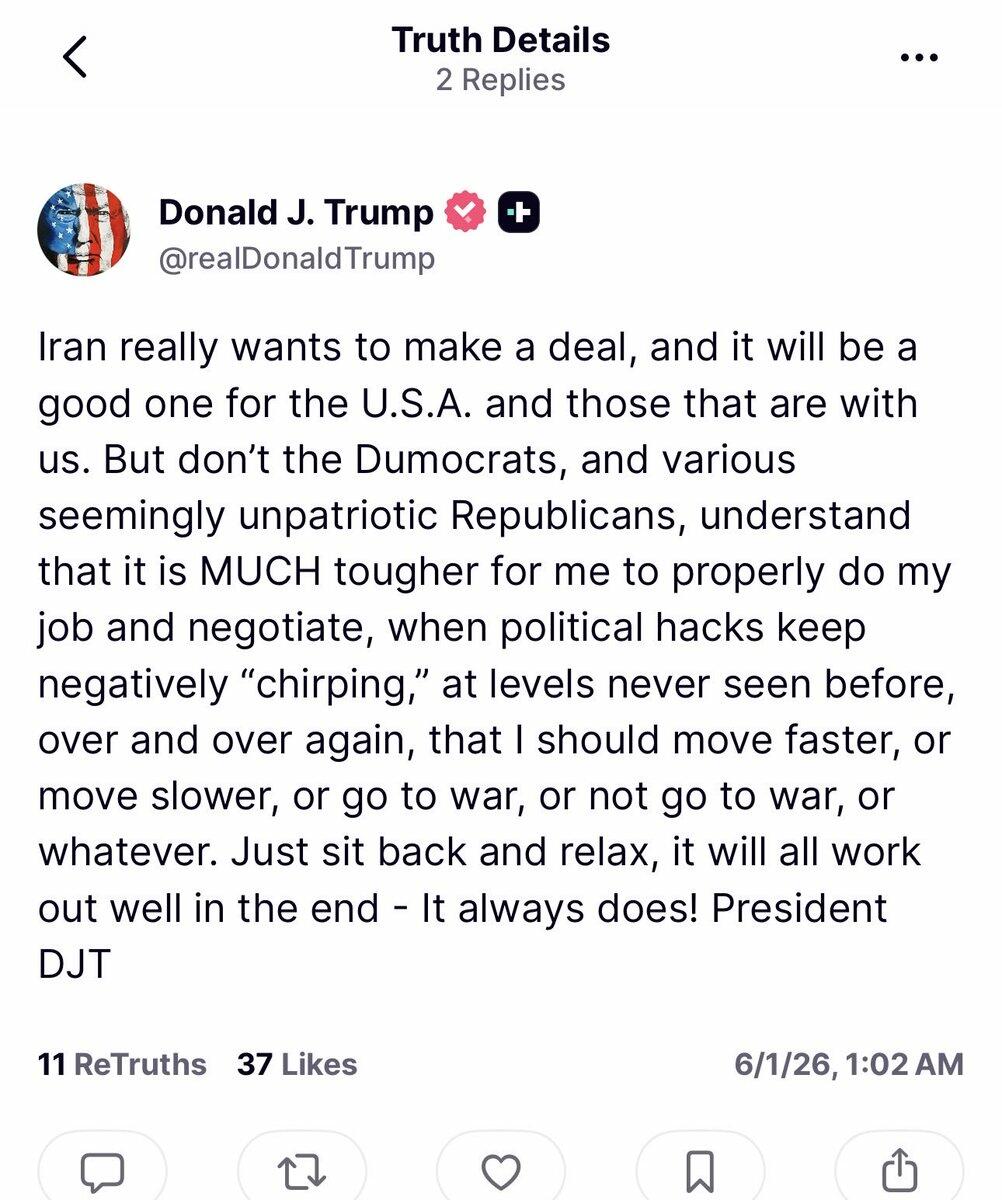
Trump Truth Social: “Just sit back and relax, it will all work out well in the end – it always does!”
A bizarre and unexpected evening report from Axios says that President Trump ripped into Netanyahu during a phone call, cussing at him and essentially ‘steamrolled’ him – angry over breaking the Lebanon truce and demanding that Israel’s military not attack Beirut.
Trump is said to have told Netanyahu “you’re fucking crazy’” while demanding Lebanon truce: “I’m saving your ass,” he also reportedly said. Iran early Monday said it halted talks with Washington because of Israel’s escalation in Lebanon. From the report:
One U.S. official said Trump told Netanyahu that following through on his threats to bomb the Lebanese capital would further isolate Israel around the world.
Two of the sources said Trump claimed he’d helped keep Netanyahu out of jail — a reference to his support during Netanyahu’s corruption trial.
Summarizing Trump’s remarks to Netanyahu, the U.S. official said: “You’re fucking crazy. You’d be in prison if it weren’t for me. I’m saving your ass. Everybody hates you now. Everybody hates Israel because of this.”
A second source briefed on the call said Trump was “pissed” and at one point yelled at Netanyahu: “What the fuck are you doing?”
And more:
The second U.S. official claimed that, in reality, Trump had “steamrolled” Netanyahu on the call. “Bibi said, ‘OK, OK, just make sure everything is taken care of,'” according to the official.
The level of detail in this call ‘leak’ is remarkable, suggesting it was an ‘official leak’ or intentional.
Reports of Ongoing Fighting in South Lebanon
Fresh reports of fighting, amid shaky truce declaration:
Sirens sound in the border community of Metula amid an apparent Hezbollah rocket attack from Lebanon.
The rocket fire comes despite US President Donald Trump announcing that Hezbollah would stop carrying out attacks on Israel amid the ceasefire.
Meanwhile, Iran claims it attacked a US container ship in the Sea of Oman (Fars News).
Lebanon Truce Affirmed
The Lebanese presidency has announced that Hezbollah agreed to a US proposal on the mutual cessation of attacks, which will expand to all Lebanese territory.
As we emphasized, the Israeli attack on Lebanon was obstructing the reaching of the agreement. The mediators exerted great effort today, and after the American pressure and the Israeli retreat, the doors are now open to return the negotiations to their natural and positive course, and there is no longer much left.
Iran Talks Back On?
Wishful thinking or already a reality? …following a proclaimed Lebanon truce, uneasy at best:
Trump Suggests He is Forging Lebanon Ceasefire
Trump has announced the “shooting will stop” in Lebanon, after a flurry of phone calls, including with Netanyahu. This came shoon on the heels of Hezbollah signaling it is ready to agree to an immediate truce. Israel too has reportedly halted plans to begin new airstrikes on Beirut.
The Lebanon crisis caused Tehran to earlier announced it is halting all contacts with the US. Will the US-Iran talks now be back on?
Trump to CNBC: ‘I don’t care’ if talks are over
Trump has shrugged off the apparent collapse of talks with Iran, after Tehran earlier said it has halted all communications with Washington over Israel’s expanded assault on Lebanon and Hezbollah. Trump has freshly told CNBC by phone, “I don’t care if they’re over, honestly.”
“I really don’t care. I couldn’t care less,” he added, and indicated he was “going to ask” Israeli Prime Minister Benjamin Netanyahu “what’s going on with Lebanon.” This suggests Trump could pressure America’s ally to lower tensions.
Trump appears to be betting the US can ‘outlast’ the Islamic Republic, in terms of inflicting economic pain amid the growing global oil supply crisis due to the Hormuz Strait closure. On this, he reacted as follows:
He also said he wasn’t worried about oil prices, which spiked following the report in Iranian state media that Tehran is vowing to “completely block” the Strait of Hormuz in addition to halting negotiations.
“I think the oil will be dropping like a rock in the very near, you know, the very near distance,” Trump said.
Trump Reacts
President Trump tells NBC News that he’s not heard from Iran on reports they’re suspending talks, and on Iran, “I think we’ve been talking too much if you want to know the truth, going silent would be very good”
We’ll keep the blockade in Hormuz.
I think I can wait as long as they want. They’re losing a fortune.
“It’s an appropriate thing to say, because they’re better negotiators than they are fighters,” he said in a brief phone call. “But they haven’t informed us of that.”
“It doesn’t mean we’re going to go and start dropping bombs all over there,” added Trump, who said Friday he would soon decide on a proposed deal to extend an ostensible ceasefire agreed to in early April. “We’ll keep the blockade.”
State Media: Iran Stops Exchanging Messages with US
Merely last week, Western MSM press reports were touting the usual ‘close to a deal’ headlines, but this morning demonstrates how illusory such claims were and are, as Iranian state media now suggests a total halt in communications between the sides.
Per state Tasnim, “Iran stops exchanging messages with the US in protest against Zionist crimes.” This as the IDF has sent ground forces deep into Lebanon, past the Litani River – in the deepest operation in decades. Tehran has insisted on linking up any US-Iran deal with a Israel-Lebanon peace. Tehran is now warning to “completely block the Strait of Hormuz, including the Bab al-Mandab Strait” – the latter with the cooperation of Yemen’s Houthis. All of this has direct impact on the US-Iran ceasefire:
IRAN’S STATE TV SAYS PROBABILITY OF CEASEFIRE BETWEEN IRAN AND U.S. ENDING IS HIGH IF ATTACKS ON LEBANON DO NOT STOP
• “The determination of the Iranian armed forces and all axes of the resistance front to respond to Zionist crimes and open new fronts“.
• “Tasnim has obtained information indicating that, given the continuation of the Zionist regime’s crimes in Lebanon and considering that Lebanon was one of the preconditions for the ceasefire and that this ceasefire has now been violated on all fronts, including Lebanon, the Iranian negotiating team is stopping “talks and exchange of texts through a mediator”.”
• “The immediate cessation of the Zionist regime’s aggressive and brutal army operations in Gaza and Lebanon and the necessity of the regime’s complete withdrawal from the occupied areas in Lebanon have been emphasized by Iranian officials and negotiators, and there will be no talks until Iran and the resistance’s views on this matter are met”.
• “Also, the Resistance Front and Iran have set their agenda to completely block the Strait of Hormuz, and activate other fronts, including the Bab al-Mandab Strait, in order to punish the Zionists and their supporters”.
Oil jumps on the headline of halted talks…
Futures slide…
Author and University of Chicago professor of the ‘realist’ school Robert Pape says the following on Monday published report: “We will run out of our cushion of oil inventories in July, whether it’s the middle or end of July,” he said. “And Iran knows that. So what Iran is doing is just stringing out the clock to get a better deal.”
“What that tells me is they’re not interested in returning the price of oil back to where it was before the war,” he said. “I think what we need to understand is Iran’s goal is to continue instability, continue elevated price of the world’s oil because it gains from that.”
CENTCOM: Intercepted Pair of Ballistic Missiles on Base
On Monday morning US Central Command issued its official statement and explanation over the earlier tit-for-tat brief flare-up in fighting, which appears to have ended…
“Last night at 11 p.m. ET, U.S. forces successfully intercepted two Iranian ballistic missiles targeting American forces based in Kuwait. These missiles were immediately defeated and no American personnel were harmed,” it said. “U.S. Central Command remains vigilant and will continue to protect our forces from Iranian aggression while supporting the ongoing ceasefire.”
Fresh Missiles on Kuwait
The extended US-Iran ceasefire is once again being severely tested, after Iran earlier in the daylight hours of Monday initiated fresh attacks on neighboring Kuwait and even released video showing footage of a ballistic missile launch. Kuwait in turn confirmed that has been intercepting inbound drone and missile fire.
It hosts a major American base, which is again being targeted, though it’s unclear if anything has been hit. The IRGC subsequently identified that it targeted the US base in response to weekend US strikes on Iranian sites. According to a description of the released propaganda video:
The start of the video includes a close-up of what looks to be a sticker on the body of a missile depicting a bruised US president Donald Trump, on the phone asking for help, and overlaid on a “closed” Strait of Hormuz. The caption reads: “Until the last American soldier leaves the region.”
Iran’s IRGC released footage showing the moment it launched missile attacks on what it claimed to be US airbases in Kuwait early Monday.
All sides, including the Iranians and Kuwaitis, are saying they have a right to defend themselves. The United States, for its part, has said that it bombed radar and drone sites in Iran in response to the Iranians having shot down a US drone over the weekend.
Kuwait, GCC Condemnation
After the US base in Kuwait was freshly targeted, Kuwait’s Ministry of Foreign Affairs issued the following: “The Ministry of Foreign Affairs reiterates the State of Kuwait’s condemnation and denunciation, in the strongest terms, of the heinous and repeated Iranian attacks, which represent a dangerous escalation and a direct assault on the security and stability of the State of Kuwait, as well as a flagrant violation of the rules of international law, the United Nations Charter, and Security Council Resolution 2817 of 2026, not to mention the grave threat they pose to the safety of civilians and vital facilities in the country,” it said in a post on X.
“The continuation and repetition of these aggressions undermine efforts aimed at de-escalating tensions and threaten security and stability in the region, emphasizing the State of Kuwait’s categorical rejection of these aggressive practices,” it added.
Also, a swift reaction was issued by the Gulf Cooperation Council (GCC). It expressed its “strongest condemnation” of Iran for its attack on Kuwait, blasting it as a “dangerous and irresponsible escalation”. Saying Kuwait remains a crucial part of the GCC, the bloc stated it stands “united and firm” and they fully support “all the measures and procedures it [Kuwait] takes to protect its security, preserve its sovereignty and territorial integrity, and maintain the security of its citizens and residents.”
IRGC Navy seeks to flex with increasing fast boat patrols of Strait of Hormuz:
IRGC fast boats running 24/7 patrols in the Strait of Hormuz, per new footage from Iran’s navy. The boats are steering commercial vessels through the waterway and intercepting any that don’t follow orders. pic.twitter.com/tG5Vh71DMK
Iran Latest Warnings: “The Bill Comes Due”; Ceasefire Breached
Top Iranian negotiator and parliament speaker Mohammad Bagher Ghalibaf has said that the continued American naval blockade of Iran’s ports and Israel’s intensifying offensive against Hezbollah in Lebanon illustrate that the US is not truly complying with the ceasefire.
He wrote on X that “the naval blockade and escalation of war crimes in Lebanon” were “clear evidence of US noncompliance with the ceasefire.” He stressed by way of warning: “Every choice has a price, and the bill comes due. It will all fall into place.”
As things in Lebanon intensify, given the IDF has plunged past the Litani River and plans to expand its ground force occupation. Yemen’s Houthis say they are ready to join Hezbollah’s efforts against Israel, per Tasnim. Iran’s Foreign Ministry has also freshly addressed the Lebanon crisis:
For immediate attention:
The ceasefire between Iran and the US is unequivocally a ceasefire on all fronts, including in Lebanon.
Its violation on one front is a violation of the ceasefire on all fronts.
The US and Israel are responsible for the consequences of any violation.
Iran’s FM Spokesperson Baghaei: The other side keeps shifting its demands and sending contradictory messages, which is dragging out negotiations. Israel’s escalation in Lebanon is aimed at destroying any chance diplomacy could work. The U.S. and Israel cannot be seen as separate.… pic.twitter.com/VFbOUwX9V2
Although we don’t know the details of the rumored agreement between the United States and Iran—or even if one will eventually be reached—anyone with a triple-digit IQ understands that Israel and the United States made a colossal blunder when they started the war. None of their stated goals have been achieved: The Iranian regime did not collapse, it did not surrender its nuclear stockpile, and its missile and drone capabilities are intact. It has demonstrated that it can shut down the Strait of Hormuz anytime it wants to inflict significant damage on its neighbors. All of U.S. President Donald Trump’s and U.S. Defense Secretary Pete Hegseth’s bragging and bluster over the past three months has been exposed as a lot of hot air.
Iran Touts More Breaches of US Blockade
A total of 15 vessels, including four oil tankers, have successfully transited the Strait of Hormuz over the last 24 hours, according to the Islamic Revolutionary Guards Corps (IRGC).
The IRGC navy confirmed that the ships only completed their passage after receiving explicit permission and coordinating directly with its command structure. Washington and its Gulf allies (with the exception of Oman) have repeatedly condemned any attempt to impose an ‘Iranian protocol’ involving the extraction of tolls.
In an official statement carried by Fars News, the IRGC issued a stark warning to the region, declaring that any cooperation with “hostile forces” would be viewed by Tehran as an “imminent security threat” that will be “dealt with accordingly”. This is tantamount to warning foreign vessels they could come under direct attack if they don’t comply.
More Latest Developments
via Newsquawk…
Iran may propose changes to the US peace draft memorandum of understanding, according to Tasnim. This follows a report that President Trump proposed further changes to the existing text, while a source stated that text exchanges continue and that Iran may submit its own edits.
Iranian Foreign Minister Araghchi told state media that talks and message exchanges with the US are ongoing, and that the talks cannot be judged until a clear result is reached.
Iranian Foreign Ministry Spokesperson said the negotiation team’s visit to Qatar was positive.
Iranian Foreign Ministry spokesperson said that they have a legal obligation to prevent aggressors from using their territory and facilities to attack another country.
Iran’s Presidential Office denied reports that Iranian President Pezeshkian submitted his resignation to the Supreme Leader, and stated that the stories were spread by some foreign media.
Iranian Supreme Leader’s military adviser Mohsen Rezaei said Iran has no intention of yielding or compromising with the US and will not place itself in a weak position, while he also stated that US President Trump is betraying diplomacy for the third time by continuing a naval blockade on Iran and making excessive demands.
IRGC said following aggression of US Army on a communication tower on Sirik Island, located in the Homozgan province an hour ago, fighters of the IRGC Aerospace Force targeted airbase where aggression originated and predicted targets were destroyed.
Iran’s top negotiator said “The naval blockade and escalation of war crimes in Lebanon by the genocidal Zionist regime are clear evidence of US noncompliance with the ceasefire”.
Iranian Foreign Ministry Spokesperson said at this moment they do not believe that the US has good intentions towards Iran.
Iran’s FM Baghaei said “No negotiations have taken place on the details of the nuclear issue at this stage”. One point being discussed is the allocation of funds for reconstruction. We are considering options for responding to the escalation of Israeli attacks in Lebanon.
Iran’s Baghaei said a ceasefire in Lebanon is an integral part of any agreement and end to the war; lack of trust and constant change in US and Israeli positions in Lebanon are causing a delay on the diplomatic process. The continuation of maritime piracy and attacks on Iranian shipping is an example of a violation of the ceasefire. The diplomatic apparatus is closely following developments and we will take every measure to defend Iran’s sovereignty. The exchange of messages is still ongoing.
Iran’s Deputy Foreign Minister Gharibabadi said Iran’s goal is not to hold ships in the Strait, but to declare a procedure that is not contrary to international law; these arrangements are not temporary and Iran will not back down. Stopping ships behind the Strait of Hormuz incurs storage and delay costs, and war insurance has increased by up to 500%. Accompanying Iranian forces costs less than war insurance and eliminates the risk of stoppage, inspection, and seizure. Iran’s goal is not to hold the ships, but to declare a procedure that is not contrary to international law; these arrangements are not temporary and Iran will not back down.
“Three consecutive explosions were heard in Bandar Abbas”, Iran International reported.
US President Trump reportedly sent tougher terms to Iran regarding the peace framework, according to officials cited by The New York Times.
US President Trump posted “Iran really wants to make a deal, and it will be a good one for the U.S.A. and those that are with us”. Full post “Iran really wants to make a deal, and it will be a good one for the U.S.A. and those that are with us. But don’t the Dumocrats, and various seemingly unpatriotic Republicans, understand that it is MUCH tougher for me to properly do my job and negotiate, when political hacks keep negatively “chirping,” at levels never seen before, over and over again, that I should move faster, or move slower, or go to war, or not go to war, or whatever. Just sit back and relax, it will all work out well in the end – It always does! President DJT”.
US President Trump posted “Fake News CNN said today, routinely, that my Iran Nuclear Deal doesn’t talk about Nuclear, when actually it states, very clearly, that Iran will not have a Nuclear Weapon”. Full post “ScraperFake News CNN said today, routinely, that my Iran Nuclear Deal doesn’t talk about Nuclear, when actually it states, very clearly, that Iran will not have a Nuclear Weapon. It then goes on, in very strong and lengthy detail, to discuss various other aspects of Nuclear. In fact, that’s what most of the agreement is about. CNN, and so many others in the Fake News Media, is a Low Ratings disaster. Even with new ownership, it is unlikely to ever get better!!! President DJT”.
US Secretary of State Rubio spoke in the last 48 hours with Lebanon’s President and Israel’s PM to try and promote a new ceasefire initiative, according to a senior US official cited by Axios’s Ravid. said:. US senior official said that the new initiative was proposed as part of the negotiations taking place between Israel and Lebanon, as another round of talks between diplomats from both sides is scheduled to take place this week in Washington. In order to advance the talks, US proposed that as a first step, Hezbollah stop all attacks on Israel, and in return, Israel will refrain from escalation in Beirut.
US Central Command confirmed military forces conducted strikes against Iranian radar at command and control sites located in Goruk and Qeshm Island over the weekend.
Kuwait Army said air defences are intercepting hostile missile and drone attacks.
BP will sell 5% in the $35-billion Browse LNG project in Australia, which Australian energy giant Woodside is looking to progress, the UK-based supermajor told Reuters on Monday.
BP is selling the 5% stake, out of its total of its 44% interest, to South Korea’s GS Energy.
“The dilution reflects BP’s disciplined approach to portfolio management by bringing in a committed partner,” BP said in a statement emailed to Reuters.
The Browse LNG project in Australia, proposed by Woodside Energy, entails the Browse to North West Shelf (NWS) Project to deliver natural gas from the Calliance, Torosa, and Brecknock fields to the existing Karratha Gas Plant.
The Browse project proposes to connect the natural gas fields via a 900-kilometre pipeline, connected to two floating production storage and offloading facilities, while a CCS solution has been incorporated into the offshore design.
Production capacity at Browse is planned to be 11.4 million tonnes per annum (LNG, LPG, and domestic gas) and a peak condensate production rate of 50,000 barrels per day.
The project is currently in the concept definition phase, and key activities continue in support of progress towards front-end engineering and design entry, Woodside said last month.
Woodside is the operator of the project with a 30.6% stake in the Browse Joint Venture. Before the BP-GS Energy deal, the British major held 44.33%. The sell-down will reduce BP’s interest in the joint venture to 39%.
Japan Australia LNG (MIMI Browse) Pty Ltd and PetroChina International Investment (Australia) Pty Ltd were the other shareholders in the joint venture before GS Energy joins the project with the 5% stake acquired from BP.
The Browse LNG project may have good chances to pass all pre-development and pre-construction stages in the coming years as Australian and Asian energy demand is rising, while the Middle Eastern crisis has created new energy security concerns among buyers.