Without the second Trump Administration, we would surely not have discovered, and most importantly, acted upon, the fraud being committed around the country, most notably in blue states like Minnesota and California. So much has been discovered so rapidly, President Trump appointed Vice President Vance to head an anti-fraud task force, and the DOJ hired additional prosecutors to handle the dramatically increasing number of cases. Federal officials are suggesting the sheer amount of fraud, discovered and yet to be discovered, is so staggering clawing back that money could balance the federal budget.
Instrumental in exposing sufficient fraud so it could no longer be ignored by local or state officials is independent journalist Nick Shirley, who exposed the infamous “Quality Learing Center” day care fraud in Minneapolis, as well as many less well-known fraudulent day cares. So effective was Shirley, and so quickly did his work anger local fraudsters and state officials, Shirley received so many death threats he apparently decided to give California a try. This was the immediate result:
Graphic: X Post
Independent journalist Nick Shirley has released a devastating 40-minute investigative video that exposes what appears to be massive waste and potential fraud in California’s hospice, Medi-Cal, and daycare programs. His report, now viewed more than 7.7 million times on X, uncovers over $170 million in questionable billings tied to ghost hospice and daycare operations that show virtually no signs of actually caring for patients or children.
Shirley found that focusing mostly on Victory Blvd. in Van Nuys:
Graphic: X Post
In Minnesota and California, honest public employees tried for years to expose fraud, but their superiors and the state Attorney General’s Office ignored them. But with Shirley’s discovery of incredible levels of fraud, the California Legislature was prodded into action: they’re criminalizing exposing fraud:
Independent journalist Nick Shirley accused California lawmakers of trying to shield taxpayer-funded organizations from scrutiny after the state Assembly advanced AB 2624, dubbed the “Stop Nick Shirley Act,” a bill the author says is intended to protect immigration service providers from harassment and threats.
“I obviously hit a nerve,” Shirley said during an appearance Wednesday night on “Fox News @ Night” with Trace Gallagher.
“What’s interesting about this, this bill is it’s protecting NGOs and nonprofits,” Shirley said. “These are organizations and groups that receive our tax dollars, yet they want to make it so we can’t find out what they’re doing with our tax dollars.”
Shirley argued the proposal would discourage investigations into organizations receiving public funds.
And that’s obviously the point of the legislation. But why would legislators, people sworn to protect the public, presumably at least in part by catching criminals defrauding taxpayers of billions, want to protect those criminals? It’s a puzzler, unless, perhaps, those NGOs and nonprofits are primary funding sources of the Democrat Party and Democrat politicians? But surely that can’t be happening in a single-party state like California, where corruption is all but nonexistent? Shirley explained:
“The Somalis in Minnesota, they stole hundreds of millions, billions of dollars, and then the hospice fraud that took place inside California,” Shirley said.
“Everyone was saying that was bogus. And then her husband actually tried to take credit for exposing the hospice fraud after I had went and exposed the hospice fraud.”
Shirley was referring to Assemblymember Mia Bonta’s husband, California Attorney General Rob Bonta, who has not responded to Fox News Digital’s request for comment.
“The fraud has been going on for so long. These fraudsters thought they could get away with it for so long that so many people started committing this fraud.”
Graphic: X Post
What’s really amazing, though utterly unsurprising, is Shirley is only talking about hospice fraud. That’s only the shrink-wrap packaging on the box of a 100-story-tall fraud package.
To paraphrase Shakespeare, something is rotten in the bluer than blue state of California.
Trump On Iran Halting Talks: ‘I Don’t Care’ – Will ‘Keep Blockade’, Not Worried About Oil Prices
Summary
Iran announces halt to all exchanges with US, citing Israeli aggression in Lebanon. Trump says ‘haven’t heard’ this from Tehran, vows to keep US naval blockade in place.
Iran overnight initiated fresh attacks on neighboring Kuwait and even released video showing footage of a ballistic missile launch.
The US bombed radar & drone sites in Iran in response to the Iranians having shot down a US drone over the weekend. Reports of foreign jets over Iranian airspace.
Iran negotiator Ghalibaf charges US with breaking the ceasefire: “the naval blockade and escalation of war crimes in Lebanon” were “clear evidence of US noncompliance with the ceasefire.”
Yemen’s Houthis warn they are ready to join Hezbollah’s military efforts against Israel.
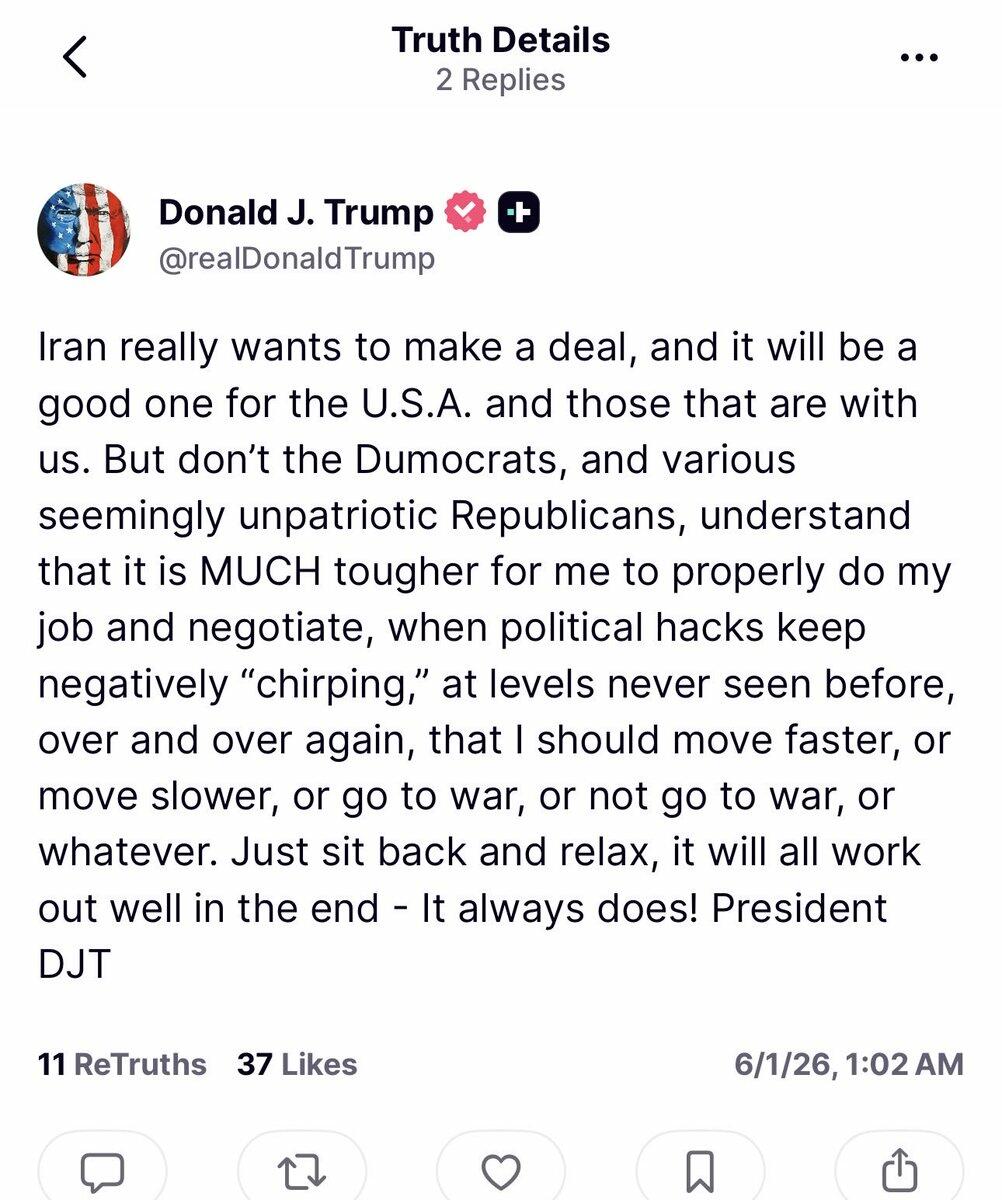
Trump Truth Social: “Just sit back and relax, it will all work out well in the end – it always does!”
Trump has shrugged off the apparent collapse of talks with Iran, after Tehran earlier said it has halted all communications with Washington over Israel’s expanded assault on Lebanon and Hezbollah. Trump has freshly told CNBC by phone, “I don’t care if they’re over, honestly.”
“I really don’t care. I couldn’t care less,” he added, and indicated he was “going to ask” Israeli Prime Minister Benjamin Netanyahu “what’s going on with Lebanon.” This suggests Trump could pressure America’s ally to lower tensions.
Trump appears to be betting the US can ‘outlast’ the Islamic Republic, in terms of inflicting economic pain amid the growing global oil supply crisis due to the Hormuz Strait closure. On this, he reacted as follows:
He also said he wasn’t worried about oil prices, which spiked following the report in Iranian state media that Tehran is vowing to “completely block” the Strait of Hormuz in addition to halting negotiations.
“I think the oil will be dropping like a rock in the very near, you know, the very near distance,” Trump said.
Trump Reacts
President Trump tells NBC News that he’s not heard from Iran on reports they’re suspending talks, and on Iran, “I think we’ve been talking too much if you want to know the truth, going silent would be very good”
We’ll keep the blockade in Hormuz.
I think I can wait as long as they want. They’re losing a fortune.
“It’s an appropriate thing to say, because they’re better negotiators than they are fighters,” he said in a brief phone call. “But they haven’t informed us of that.”
“It doesn’t mean we’re going to go and start dropping bombs all over there,” added Trump, who said Friday he would soon decide on a proposed deal to extend an ostensible ceasefire agreed to in early April. “We’ll keep the blockade.”
State Media: Iran Stops Exchanging Messages with US
Merely last week, Western MSM press reports were touting the usual ‘close to a deal’ headlines, but this morning demonstrates how illusory such claims were and are, as Iranian state media now suggests a total halt in communications between the sides.
Per state Tasnim, “Iran stops exchanging messages with the US in protest against Zionist crimes.” This as the IDF has sent ground forces deep into Lebanon, past the Litani River – in the deepest operation in decades. Tehran has insisted on linking up any US-Iran deal with a Israel-Lebanon peace. Tehran is now warning to “completely block the Strait of Hormuz, including the Bab al-Mandab Strait” – the latter with the cooperation of Yemen’s Houthis. All of this has direct impact on the US-Iran ceasefire:
IRAN’S STATE TV SAYS PROBABILITY OF CEASEFIRE BETWEEN IRAN AND U.S. ENDING IS HIGH IF ATTACKS ON LEBANON DO NOT STOP
• “The determination of the Iranian armed forces and all axes of the resistance front to respond to Zionist crimes and open new fronts“.
• “Tasnim has obtained information indicating that, given the continuation of the Zionist regime’s crimes in Lebanon and considering that Lebanon was one of the preconditions for the ceasefire and that this ceasefire has now been violated on all fronts, including Lebanon, the Iranian negotiating team is stopping “talks and exchange of texts through a mediator”.”
• “The immediate cessation of the Zionist regime’s aggressive and brutal army operations in Gaza and Lebanon and the necessity of the regime’s complete withdrawal from the occupied areas in Lebanon have been emphasized by Iranian officials and negotiators, and there will be no talks until Iran and the resistance’s views on this matter are met”.
• “Also, the Resistance Front and Iran have set their agenda to completely block the Strait of Hormuz, and activate other fronts, including the Bab al-Mandab Strait, in order to punish the Zionists and their supporters”.
Oil jumps on the headline of halted talks…
Futures slide…
Author and University of Chicago professor of the ‘realist’ school Robert Pape says the following on Monday published report: “We will run out of our cushion of oil inventories in July, whether it’s the middle or end of July,” he said. “And Iran knows that. So what Iran is doing is just stringing out the clock to get a better deal.”
“What that tells me is they’re not interested in returning the price of oil back to where it was before the war,” he said. “I think what we need to understand is Iran’s goal is to continue instability, continue elevated price of the world’s oil because it gains from that.”
CENTCOM: Intercepted Pair of Ballistic Missiles on Base
On Monday morning US Central Command issued its official statement and explanation over the earlier tit-for-tat brief flare-up in fighting, which appears to have ended…
“Last night at 11 p.m. ET, U.S. forces successfully intercepted two Iranian ballistic missiles targeting American forces based in Kuwait. These missiles were immediately defeated and no American personnel were harmed,” it said. “U.S. Central Command remains vigilant and will continue to protect our forces from Iranian aggression while supporting the ongoing ceasefire.”
Fresh Missiles on Kuwait
The extended US-Iran ceasefire is once again being severely tested, after Iran earlier in the daylight hours of Monday initiated fresh attacks on neighboring Kuwait and even released video showing footage of a ballistic missile launch. Kuwait in turn confirmed that has been intercepting inbound drone and missile fire.
It hosts a major American base, which is again being targeted, though it’s unclear if anything has been hit. The IRGC subsequently identified that it targeted the US base in response to weekend US strikes on Iranian sites. According to a description of the released propaganda video:
The start of the video includes a close-up of what looks to be a sticker on the body of a missile depicting a bruised US president Donald Trump, on the phone asking for help, and overlaid on a “closed” Strait of Hormuz. The caption reads: “Until the last American soldier leaves the region.”
Iran’s IRGC released footage showing the moment it launched missile attacks on what it claimed to be US airbases in Kuwait early Monday.
All sides, including the Iranians and Kuwaitis, are saying they have a right to defend themselves. The United States, for its part, has said that it bombed radar and drone sites in Iran in response to the Iranians having shot down a US drone over the weekend.
Kuwait, GCC Condemnation
After the US base in Kuwait was freshly targeted, Kuwait’s Ministry of Foreign Affairs issued the following: “The Ministry of Foreign Affairs reiterates the State of Kuwait’s condemnation and denunciation, in the strongest terms, of the heinous and repeated Iranian attacks, which represent a dangerous escalation and a direct assault on the security and stability of the State of Kuwait, as well as a flagrant violation of the rules of international law, the United Nations Charter, and Security Council Resolution 2817 of 2026, not to mention the grave threat they pose to the safety of civilians and vital facilities in the country,” it said in a post on X.
“The continuation and repetition of these aggressions undermine efforts aimed at de-escalating tensions and threaten security and stability in the region, emphasizing the State of Kuwait’s categorical rejection of these aggressive practices,” it added.
Also, a swift reaction was issued by the Gulf Cooperation Council (GCC). It expressed its “strongest condemnation” of Iran for its attack on Kuwait, blasting it as a “dangerous and irresponsible escalation”. Saying Kuwait remains a crucial part of the GCC, the bloc stated it stands “united and firm” and they fully support “all the measures and procedures it [Kuwait] takes to protect its security, preserve its sovereignty and territorial integrity, and maintain the security of its citizens and residents.”
IRGC Navy seeks to flex with increasing fast boat patrols of Strait of Hormuz:
IRGC fast boats running 24/7 patrols in the Strait of Hormuz, per new footage from Iran’s navy. The boats are steering commercial vessels through the waterway and intercepting any that don’t follow orders. pic.twitter.com/tG5Vh71DMK
Iran Latest Warnings: “The Bill Comes Due”; Ceasefire Breached
Top Iranian negotiator and parliament speaker Mohammad Bagher Ghalibaf has said that the continued American naval blockade of Iran’s ports and Israel’s intensifying offensive against Hezbollah in Lebanon illustrate that the US is not truly complying with the ceasefire.
He wrote on X that “the naval blockade and escalation of war crimes in Lebanon” were “clear evidence of US noncompliance with the ceasefire.” He stressed by way of warning: “Every choice has a price, and the bill comes due. It will all fall into place.”
As things in Lebanon intensify, given the IDF has plunged past the Litani River and plans to expand its ground force occupation. Yemen’s Houthis say they are ready to join Hezbollah’s efforts against Israel, per Tasnim. Iran’s Foreign Ministry has also freshly addressed the Lebanon crisis:
For immediate attention:
The ceasefire between Iran and the US is unequivocally a ceasefire on all fronts, including in Lebanon.
Its violation on one front is a violation of the ceasefire on all fronts.
The US and Israel are responsible for the consequences of any violation.
Iran’s FM Spokesperson Baghaei: The other side keeps shifting its demands and sending contradictory messages, which is dragging out negotiations. Israel’s escalation in Lebanon is aimed at destroying any chance diplomacy could work. The U.S. and Israel cannot be seen as separate.… pic.twitter.com/VFbOUwX9V2
Although we don’t know the details of the rumored agreement between the United States and Iran—or even if one will eventually be reached—anyone with a triple-digit IQ understands that Israel and the United States made a colossal blunder when they started the war. None of their stated goals have been achieved: The Iranian regime did not collapse, it did not surrender its nuclear stockpile, and its missile and drone capabilities are intact. It has demonstrated that it can shut down the Strait of Hormuz anytime it wants to inflict significant damage on its neighbors. All of U.S. President Donald Trump’s and U.S. Defense Secretary Pete Hegseth’s bragging and bluster over the past three months has been exposed as a lot of hot air.
Iran Touts More Breaches of US Blockade
A total of 15 vessels, including four oil tankers, have successfully transited the Strait of Hormuz over the last 24 hours, according to the Islamic Revolutionary Guards Corps (IRGC).
The IRGC navy confirmed that the ships only completed their passage after receiving explicit permission and coordinating directly with its command structure. Washington and its Gulf allies (with the exception of Oman) have repeatedly condemned any attempt to impose an ‘Iranian protocol’ involving the extraction of tolls.
In an official statement carried by Fars News, the IRGC issued a stark warning to the region, declaring that any cooperation with “hostile forces” would be viewed by Tehran as an “imminent security threat” that will be “dealt with accordingly”. This is tantamount to warning foreign vessels they could come under direct attack if they don’t comply.
More Latest Developments
via Newsquawk…
Iran may propose changes to the US peace draft memorandum of understanding, according to Tasnim. This follows a report that President Trump proposed further changes to the existing text, while a source stated that text exchanges continue and that Iran may submit its own edits.
Iranian Foreign Minister Araghchi told state media that talks and message exchanges with the US are ongoing, and that the talks cannot be judged until a clear result is reached.
Iranian Foreign Ministry Spokesperson said the negotiation team’s visit to Qatar was positive.
Iranian Foreign Ministry spokesperson said that they have a legal obligation to prevent aggressors from using their territory and facilities to attack another country.
Iran’s Presidential Office denied reports that Iranian President Pezeshkian submitted his resignation to the Supreme Leader, and stated that the stories were spread by some foreign media.
Iranian Supreme Leader’s military adviser Mohsen Rezaei said Iran has no intention of yielding or compromising with the US and will not place itself in a weak position, while he also stated that US President Trump is betraying diplomacy for the third time by continuing a naval blockade on Iran and making excessive demands.
IRGC said following aggression of US Army on a communication tower on Sirik Island, located in the Homozgan province an hour ago, fighters of the IRGC Aerospace Force targeted airbase where aggression originated and predicted targets were destroyed.
Iran’s top negotiator said “The naval blockade and escalation of war crimes in Lebanon by the genocidal Zionist regime are clear evidence of US noncompliance with the ceasefire”.
Iranian Foreign Ministry Spokesperson said at this moment they do not believe that the US has good intentions towards Iran.
Iran’s FM Baghaei said “No negotiations have taken place on the details of the nuclear issue at this stage”. One point being discussed is the allocation of funds for reconstruction. We are considering options for responding to the escalation of Israeli attacks in Lebanon.
Iran’s Baghaei said a ceasefire in Lebanon is an integral part of any agreement and end to the war; lack of trust and constant change in US and Israeli positions in Lebanon are causing a delay on the diplomatic process. The continuation of maritime piracy and attacks on Iranian shipping is an example of a violation of the ceasefire. The diplomatic apparatus is closely following developments and we will take every measure to defend Iran’s sovereignty. The exchange of messages is still ongoing.
Iran’s Deputy Foreign Minister Gharibabadi said Iran’s goal is not to hold ships in the Strait, but to declare a procedure that is not contrary to international law; these arrangements are not temporary and Iran will not back down. Stopping ships behind the Strait of Hormuz incurs storage and delay costs, and war insurance has increased by up to 500%. Accompanying Iranian forces costs less than war insurance and eliminates the risk of stoppage, inspection, and seizure. Iran’s goal is not to hold the ships, but to declare a procedure that is not contrary to international law; these arrangements are not temporary and Iran will not back down.
“Three consecutive explosions were heard in Bandar Abbas”, Iran International reported.
US President Trump reportedly sent tougher terms to Iran regarding the peace framework, according to officials cited by The New York Times.
US President Trump posted “Iran really wants to make a deal, and it will be a good one for the U.S.A. and those that are with us”. Full post “Iran really wants to make a deal, and it will be a good one for the U.S.A. and those that are with us. But don’t the Dumocrats, and various seemingly unpatriotic Republicans, understand that it is MUCH tougher for me to properly do my job and negotiate, when political hacks keep negatively “chirping,” at levels never seen before, over and over again, that I should move faster, or move slower, or go to war, or not go to war, or whatever. Just sit back and relax, it will all work out well in the end – It always does! President DJT”.
US President Trump posted “Fake News CNN said today, routinely, that my Iran Nuclear Deal doesn’t talk about Nuclear, when actually it states, very clearly, that Iran will not have a Nuclear Weapon”. Full post “ScraperFake News CNN said today, routinely, that my Iran Nuclear Deal doesn’t talk about Nuclear, when actually it states, very clearly, that Iran will not have a Nuclear Weapon. It then goes on, in very strong and lengthy detail, to discuss various other aspects of Nuclear. In fact, that’s what most of the agreement is about. CNN, and so many others in the Fake News Media, is a Low Ratings disaster. Even with new ownership, it is unlikely to ever get better!!! President DJT”.
US Secretary of State Rubio spoke in the last 48 hours with Lebanon’s President and Israel’s PM to try and promote a new ceasefire initiative, according to a senior US official cited by Axios’s Ravid. said:. US senior official said that the new initiative was proposed as part of the negotiations taking place between Israel and Lebanon, as another round of talks between diplomats from both sides is scheduled to take place this week in Washington. In order to advance the talks, US proposed that as a first step, Hezbollah stop all attacks on Israel, and in return, Israel will refrain from escalation in Beirut.
US Central Command confirmed military forces conducted strikes against Iranian radar at command and control sites located in Goruk and Qeshm Island over the weekend.
Kuwait Army said air defences are intercepting hostile missile and drone attacks.
When presented with uncomfortable irrefutable statistics on migrant crime, those on the left don’t debate—they threaten violence and scream about history as an excuse for chaos today.
That’s exactly what unfolded outside the Delaney Hall ICE detention facility in Newark, New Jersey, Saunday. GB News chief US correspondent Ben Leo was on the ground covering anti-ICE protests—already marked by days of clashes, a hunger strike by detainees, and assaults on officers—when he calmly laid out basic facts about illegal migrant crime patterns in the UK while engaging with the ‘protesters’.
The furious black nationalist got inches from Leo’s face, accused Brits of colonizing the world “through rape, murder and pillaging,” and warned he was “holding everything back not to break your f***ing jaw.”
Me: certain nationalities in UK are more likely to commit sexual offences than Brits
Leftist nutcase: “I’m gonna break your f*****g jaw.”
Leo stood his ground without flinching. Lurking right behind the seething guy, a spectacled soy leftist pathetically attempted to pile on, weakly joining the intimidation effort by demanding Leo “go back to your country”—the height of irony at an open-borders rally.
The incident, captured on video and shared widely, shows how facts about immigration enforcement trigger outright rage from open-borders activists. While ICE works to secure America’s borders under policies prioritizing law and order, protesters treat any challenge to mass migration as a personal attack worth physical intimidation.
In the clip, Leo began by referencing data showing certain nationalities in the UK are disproportionately involved in sexual offences compared to native Brits. The protester immediately pivoted to colonial history.
“The BRITS that colonised the whole world you mean? That raped and pillaged the WHOLE WORLD to get the power they have THE BRITS,” he shouts.
“YEAH The BRITS who did THAT. And YOU guys have the audacity TO SAY AFGHANS AND SOMALIS DID WHAT?”
Leo responded evenly: “Well it’s not Audacity. It is just a fact.”
The man escalated, demanding: “IS IT NOT A FACT THAT Y’ALL COLONIZED THE WORLD THROUGH RAPE, MURDER AND PILLAGING, RIGHT OR WRONG?”
The guy then repeated insults—“you’re a piece of s,” “you’re a liar”—and got inches from Leo’s face, spitting as he ranted about how he “came out here for violence,” not to talk.
Leo stayed composed, pointing out the obvious: “This doesn’t make your argument look good. That’s the left. That is the degenerate violent left. You give facts. You get data. And they get violent.”
The exchange ended with the soy leftist in the background yelling “go back to your country.” Leo’s deadpan reply: “I live here.” When asked how he got there: “Aeroplane.”
On GB News, Leo later reflected on the moment. He explained he could have countered with historical facts—Britain’s role in abolishing the slave trade, Royal Navy efforts against it—but prioritized de-escalation and safety amid the aggression. “I was more concerned about watching his hands… making sure that he wasn’t about to swing for me.”
‘The clip demonstrates that the left lunatics are exactly that.’@Benleo reacts to the moment when an anti-ICE protester aggressively confronted him after he presented some simple facts on migrants in Britain.
He also addressed the police response, calling it “chilling” and “worrying.” Officers appeared uninterested after the threat, with one suggesting Leo’s questions were “provocative.” Leo noted: “It didn’t really seem like the police were bothered… presenting simple facts and asking what you’re doing here… is somehow provocative.”
‘It didn’t really seem like the police were bothered.’
GB News Presenter @Benleo says the police response at the New Jersey detention centre, as he was being confronted, was ‘chilling’ and a worrying sign that authorities are too sympathetic towards agitators. pic.twitter.com/ixexJlXw1O
This isn’t isolated. Protests at Delaney Hall have turned violent for over a week, with reports of objects thrown, entrances blocked, and even an ICE agent bitten. Detainees allege poor conditions, but federal officials call the strike a political stunt amid efforts to deport serious offenders.
The confrontation exposes a deeper hypocrisy. Leftist activists rage against “colonialism” while ignoring how British institutions—rule of law, abolitionism, and innovation—built much of the modern world migrants flock to. They excuse crime waves from unchecked migration by pointing to the past, yet demand America absorb endless inflows without consequences.
Leo’s calm handling underscores a key truth: facts don’t care about feelings. When open-borders ideology meets reality—rising sexual offences, strained resources, cultural clashes—it produces not debate but threats. This is the same mindset behind attacks on figures like Charlie Kirk and repeated assassination attempts on President Trump.
America First policies, like robust ICE operations, exist precisely because ignoring these patterns endangers citizens. The left’s violent reaction proves they know the data is irrefutable—they just refuse to accept it.
The left’s mask slips when challenged. They’re not tolerant—they’re unhinged when their narrative cracks.
Your support is crucial in helping us defeat mass censorship. Please consider donating via Locals or check out our unique merch. Follow us on X @ModernityNews.
French Commandos Board & Seize 4th Russian ‘Shadow Fleet’ Vessel Since September
France announced Monday another weekend interdiction of a Russian “shadow fleet” vessel in international waters near its coast. The French Navy boarded and detained a sanctioned oil tanker, President Emmanuel Macron announced Monday, in an operation which had the assistance from the UK Royal Navy and other allies.
This marks the fourth time since September that French commandoes have intercepted a boarded a sanctioned Russian vessel in regional waters.
The vessel, identified as the Tagor, originated from Murmansk, Russia, and was taken by French authorities while it traversed around 400 nautical miles (740 km) west of the tip of Brittany.
“It is unacceptable for ships to circumvent international sanctions, violate the law of the sea and fund the war that Russia has been waging against Ukraine for more than 4 years,” Macron wrote in a post on X.
The apparent legal justification France’s navy has relied on for such actions is the practice of “flag-hopping” – which involves a crew repeatedly changing displayed flags, along with often invalid registrations to thwart international tracking monitors.
At the time of boarding, via soldiers rappelling from helicopter, the ship was falsely flying a Cameroonian flag while reportedly en route to the coastal African city of Limbe, Cameroon.
Macron confirmed further on X: “This operation took place in the Atlantic Ocean, on the high seas, with the support of several partners, including the United Kingdom, in strict compliance with the law of the sea.”
The Kremlin again condemned such ‘unlawful’ seizures in international waters, with spokesman Dmitry Peskov saying, “We consider these acts as illegal, they border on international piracy … Russia is taking measures to ensure the safety of its cargo.”
The vessel’s captain is a Russian citizen, according to an embassy disclosure from Paris. According to more:
Guillaume Le Rasle, a spokesperson for the prefecture, said the tanker was under EU and US sanctions. “It is a vessel that was known and tracked,” he told AFP.
“The decision to divert it was taken Sunday evening. The objective of the diversion is to verify the validity of its flag,” Le Rasle said, adding that the tanker, which has frequently changed flags, was “almost empty” at the time of boarding.
La Marine nationale a arraisonné hier matin un nouveau pétrolier sous sanctions internationales en provenance de Russie : le Tagor. Notre détermination est constante et totale.
The last several seized tankers were also flying flags of African nations, and these interdictions have stretched back through last year. In some instances, Russia has been sending military escorts – which of course has seen French and European militaries hold off executing any action.
Anthropic Confidentially Files For IPO As Frontier AI Labs Race To Go Public
Four days after releasing its latest Claude Opus 4.8 model and raising $65 billion at a $900 billion valuation, Anthropic confidentially filed a draft Form S-1 with the SEC late Monday morning for a proposed IPO of its common stock.
“This gives us the option to go public after the SEC completes its review. The proposed initial public offering will depend on market conditions and other factors,” the maker of the Claude chatbot wrote in a press release.
The move puts Anthropic and OpenAI in a race to become the first major frontier AI lab to tap public markets, as investor appetite for AI infrastructure and all things SpaceX remains hot into early June.
It’s “worth noting: filing first ≠ pricing first a confidential draft S-1 starts the SEC clock but sets no date,” CNBC reporter Deirdre Bosa pointed out on X.
The surprise news comes four days after Anthropic raised $65 billion at a $900 billion valuation, nearly tripling its prior valuation and potentially surpassing OpenAI as the most valuable frontier AI lab.
That round was led by Altimeter Capital, Dragoneer, Greenoaks, and Sequoia, with additional participation from major investors including Baillie Gifford, Blackstone, Brookfield, Abu Dhabi’s MGX, and Singapore’s Temasek.
The funding comes shortly after Anthropic released Claude Opus 4.8 and follows a prior $30 billion raise at a $350 billion valuation just three months earlier.
The Anthropic-OpenAI race to IPO comes as SpaceX is targeting an IPO for June 12, or next Friday, with shares expected to trade on the Nasdaq under the ticker symbol SPCX.
The U.S. Department of Commerce has issued new guidance to prevent Chinese companies from obtaining advanced U.S. artificial intelligence (AI) chips, such as Nvidia’s most sophisticated Blackwell processors, through overseas subsidiaries.
The May 31 guidance clarifies that export licenses are required for entities headquartered in China or Macau, regardless of where their affiliates are located.
The U.S. Commerce Department’s Bureau of Industry and Security (BIS) said that licensing requirements for advanced computing items destined for China- or Macau-headquartered entities were first established in November 2023 and remain in effect.
The agency said the requirement applies even when those entities are located outside China or Macau.
The clarification follows confusion over a May 2025 announcement by the BIS that it would not enforce certain parts of the Biden-era AI diffusion rule.
The rule was designed to restrict sales of advanced AI chips to strategic rivals while allowing broader access for U.S. allies.
The BIS said the policy change did not remove existing licensing requirements for exports involving Chinese or Macau-based customers, meaning companies must still obtain licenses unless an exemption applies.
The guidance also states that legitimate data center operators can continue to use, maintain, store, or replace advanced AI chips and equipment they already own.
The clarification does not require companies to shut down or remove existing systems.
Nvidia’s sales of advanced AI chips to China remain subject to U.S. export controls.
The Trump administration created a framework in 2025 allowing certain chips, including the H200, to be sold to approved Chinese customers under Commerce Department oversight.
Trump said in a Dec. 8, 2025, post on Truth Social that sales would be permitted subject to a 25 percent fee benefiting the U.S. government and limited to approved Chinese customers.
President Donald Trump (L) shakes hands with Nvidia CEO Jensen Huang as they discuss investing in America, at the White House on April 30, 2025. Jim Watson/AFP via Getty Images
An Nvidia spokesperson told The Epoch Times that the BIS guidance doesn’t impact its business.
It “simply reaffirms that NVIDIA’s current sales and vetting process is correct — licenses are required to ship controlled products to [China] headquartered companies,” the spokesperson said.
The Epoch Times reached out to AMD, another major supplier of AI chips, for comment, but did not receive a response by publication time.
Analysts Warn of Potential Gap
Former U.S. State Department official Chris McGuire, who focuses on technology and national security issues, said in a May 31 post on X that the ambiguity surrounding BIS enforcement may have enabled overseas subsidiaries of Chinese firms to legally acquire advanced U.S. AI chips without export licenses.
“Chinese companies have been buying these chips, very likely at scale,” McGuire wrote in the social media post.
He argued that the lack of clarity about which export controls remained in effect created an opening that may have allowed subsidiaries of Chinese firms operating in countries such as Malaysia to purchase Nvidia’s Blackwell processors.
McGuire said the new BIS guidance appears to close that pathway by making clear that exports to China-headquartered companies outside China still require licenses.
Nvidia CEO Jensen Huang eats a bowl of noodles on a street in Beijing on May 15, 2026. Jiang Panpan via AP/Screenshot via The Epoch Times
He said that BIS has not clarified whether it will enforce due diligence requirements that apply to semiconductor foundries such as Taiwan Semiconductor Manufacturing Co. (TSMC) when assessing whether advanced AI chips could ultimately benefit Chinese companies.
“This is a massive loophole that still needs to be closed,” McGuire said.
The Epoch Times reached out to TSMC for comment but did not receive a response by publication time.
Michael Sobolik, a senior fellow at Hudson Institute specializing in U.S.–China relations, raised enforcement concerns.
“This looks like an apparently MASSIVE loophole at the Department of Commerce,” Sobolik said in a May 31 post on X.
Quoting McGuire’s analysis, he questioned the effectiveness of export controls if they are not consistently enforced.
SpaceX IPO Update: New Filing Reveals Friends & Family Share Allocation, Anthropic AI Deal, And Water Risk
SpaceX has provided fresh details in an amended S-1 filing regarding its upcoming initial public offering, including a directed share program for employees and insiders, a major AI computing agreement with Anthropic, and new risk factors.
The company will reserve up to 5% of shares in its IPO for certain employees and friends and family of its executive officers. The company disclosed that participants on its “friends and family” list will not be subject to a lock-up restriction, allowing them to sell shares immediately upon listing.
While directed share programs are common in IPOs, the lack of lock-up for this group stands out. More than 60% of shares outstanding immediately prior to the offering remain subject to an extended lock-up period, including shares held by founder and CEO Elon Musk.
SpaceX stands as the preeminent launch provider globally, delivering unmatched reliability, cost-efficiency, and launch cadence. As of mid-2026, the company maintains a 100% success rate across dozens of Falcon launches this year and conducts the vast majority of U.S. orbital missions – carrying both commercial and government payloads, including NASA crew and cargo to the ISS as well as national security satellites. SpaceX’s Falcon family commands over 80% of the U.S. launch market and the bulk of global mass-to-orbit capability thanks to proven reusability.
Jeff Bezos’s Blue Origin, meanwhile, suffered a significant setback last week, when its New Glenn rocket exploded during a static fire test at Launch Complex 36 in Cape Canaveral. The incident destroyed the vehicle and caused extensive damage to the launch pad – including collapsed lightning towers and ground infrastructure – forcing months of repairs and further delaying the company’s entry into heavy-lift competition.
Here’s our video of the explosion at Launch Complex 36. It happened about 9 pm ET (0100 UTC) as Blue Origin was beginning a static fire test of its New Glenn rocket.
Blue Origin now faces additional hurdles in catching up to SpaceX, particularly as it seeks NASA Artemis contracts and commercial missions for Amazon’s Project Kuiper.
Major AI Computing Deal with Anthropic
The amended filing also discloses that SpaceX has an agreement to provide Anthropic PBC with artificial intelligence computing capacity consisting of approximately 325,000 Nvidia chips. The deal is valued at $1.25 billion per month and runs through May 2029. After an initial three-month period, either party can terminate with 90 days notice.
SpaceX noted in its risk factors that some compute service customers may rely on external capital to meet their payment obligations.
New Risk Factor: Water Scarcity?
SpaceX added water scarcity as a formal risk factor. Drought conditions, increased competition for water sources, and potential regulatory restrictions could raise costs or limit the company’s ability to cool its data center infrastructure. This reflects growing scrutiny over the high water and power demands of AI data centers.
Bloomberg last week reported that SpaceX is now targeting a valuation of at least $1.8 trillion for the IPO vs. $2T – which Elon Musk said was “false” in response after we surfaced the claim. Either way, the IPO is more or less a major referendum on the AI-fueled bull market.
The company is targeting pricing on June 11 and a trading debut on June 12 under the ticker SPCX on Nasdaq and Nasdaq Texas.
“Firing On All Cylinders, But…” US Manufacturing Surveys Send Mixed Signals In May
With US hard data taking a beating (relative to expectations) last week (red line below), analysts remain hopeful that US Manufacturing will hold up (durable goods orders were solid) with this morning’s Manufacturing PMIs set to signal stability.
The final May S&P Global US Manufacturing rose to 55.1 (down from the 55.3 flash print) but the strongest since April 2022
ISM’s Manufacturing PMI survey also signaled improvement, up from 52.7 to 54.0 (better than 53.0 expected).
The headline PMI has hit a four-year high, with strong factory production growth for a second successive month in response to a further marked upturn in order books, but since the outbreak of war in the Middle East we have seen production and demand buoyed by stock building as companies worry over rising prices and supply difficulties.
This stockpiling was again widely evident in May and makes it hard to take an accurate reading on the underlying health of the manufacturing economy, as growth will cool once this stock build has run its course,” Williamson noted.
“The incidence of supply chain delays is the highest since August 2022, with the buying of safety stocks not only adding to the supply squeeze from the closure of the Strait of Hormuz but also pushing prices higher for a wide variety of inputs.
Williamson ends on a more ominous – stagflationary – notes: warning that the resulting steep jump in producer costs sends a worrying signal that broader economy inflation has further to rise in the coming months.
“Working Better”: Saylor Teases BTC Buy After Strategy Sells For First Time Since 2022
Bitcoin is extending its recent weakness overnight (hurt by US-Iran tensions escalating again), trading back below its 100DMA after Strategy (MSTR) sold 32 bitcoin between May 26 and May 31 at an average net price of $77,135 a coin, totaling $2.5 million (disclosed in an 8-K filing on Monday).
Proceeds from the bitcoin sales are expected to be used to fund distributions on preferred stock, the firm said.
This is the first time Strategy has sold bitcoin since December 2022, when the company offloaded 704 BTC, according to onchain analyst Ai Yi.
However, the firm reportedly bought 810 BTC just two days after the sale at a lower price in a tax loss trade.
Strategy now holds a total of 843,706 BTC following the reduction – worth around $61 billion – bought at an average price of $75,699 per bitcoin for a total cost of around $63.9 billion, including fees and expenses.
In addition, for the week, Strategy raised $128.3 million through its at-the-market (ATM) common stock program and allocated a small portion of the proceeds to increase its U.S. dollar cash reserve from $871 million to $900 million.
Its executives previously said during its first-quarter 2026 earnings call that it may sell some of its holdings to fund dividends for STRC, Strategy’s perpetual preferred stock designed to maintain a $100 par value and offer high yields to investors.
Saylor explained then that the sale would eventually help Strategy buy more bitcoin than it would sell to cover STRC’s dividends.
He also noted that the firm’s current position requires bitcoin to appreciate at 2.3% annually for its existing holdings to cover STRC dividend obligations indefinitely, without selling any common stock.
Today’s sale announcement comes shortly after onchain data from Arkham Intelligence showed that Strategy moved roughly 411.6 BTC from its custody account on Coinbase Prime to a cold wallet address on the platform on May 28.
This prompted the odds of Strategy selling bitcoin before the end of 2026 to surge to 84%.
Strategy also noted it has purchased 2.6 times the amount of bitcoin mined in 2026 so far, describing MSTR as a “BitVac.”
“Working Better”
But, as CoinTelegraph.com reports, before the 8-K filing was released (but after the actual sales), Strategy chairman Michael Saylor on Sunday signaled the Bitcoin treasury company would be announcing fresh purchases of the cryptocurrency in the coming days.
The social media post comes just days ahead of a proxy vote that depends in large part on retailer shareholders to enable semi-monthly dividend payouts on the company’s STRC perpetual preferred stock.
“Working Better” was Saylor’s tweet late Sunday morning to accompany a bubble chart tracking Strategy’s Bitcoin (BTC) purchases over the past nearly six years.
That chart, from Iceland-registered StrategyTracker.com, has been consistently posted by Saylor in the days ahead of news of a purchase by the biggest publicly traded Bitcoin holder.
To be sure, any purchases to be announced will likely reflect the company bought at or below the average cost of previous BTC purchases.
Retail investors pressed to vote on STRC dividend change
Strategy is proposing to pay semi-monthly dividends on STRC, instead of monthly. The company claims that if approved and adopted, it will lead to reduced reinvestment lag, enhanced liquidity, market efficiency and increased price stability.
Just days ahead of the June 7 proxy vote deadline, Saylor and Strategy are pressing retail shareholders to return their proxy votes. On an internal company channel, Strategy’s investor relations team posted a message to all employees concerning the company’s 2026 annual meeting and provided links to the proposals under consideration by shareholders.
Part of message to Strategy employees from internal website. Source: Company filing on Edgar
“The amendment for STRC to pay semi-monthly dividends, needs 50% of all 85M shares outstanding as of April 17, 2026, to pass, which means every single vote counts,” read a May 28 post on Strategy’s verified feed on X.com.
CEO Phong Le posted a video a day earlier thanking STRC shareholders for their trust.
“I wanted to personally walk you through the proposed amendment and what it means for you,” he said as an introduction to the minute-and-a-half video.
Retail investors have shown limited interest in casting proxy votes. A November research note from The Harvard Law School Forum on Corporate Governance revealed data that showed retail investors have consistently voted only about 29% of their owned shares during the past five proxy voting seasons. Institutional holders have voted about 77%.
A Cyclical Bottom?
Bloomberg’s Andre de Silva writes that while a steep record daily capital drain in US Bitcoin ETFs exposes immediate fatigue, past precedent suggests that such severe capitulation frequently cleanses short-term positioning and signals a cyclical bottom for the digital asset.
AI infrastructure and semiconductor equities have attracted the most attention, but because Bitcoin typically retains its status as a high-beta proxy for broader risk appetite during macro expansions, this temporary diversion of capital suggests that a classic catch-up rally remains on the table.
The initial euphoria surrounding US Bitcoin ETFs has cooled, giving way to an unprecedented streak of redemptions. Investors pulled $2.96 billion from the funds over 10 consecutive trading sessions to close out May, according ETF providers. That culminated in $2.4 billion in total net outflows for the month. This sharp reversal stands in contrast to the preceding two months of healthy institutional demand, which saw combined inflows of over $3.3 billion across March and April. The late-May selling pressure spared no one, with BlackRock’s usually resilient IBIT hit by a near-record single-day redemption following a massive off-exchange block trade.
This capital flight highlights a stark divergence recently between digital and traditional risk assets.
While global stock benchmarks like the S&P 500, Nasdaq, and Asia’s top indices such as the Kospi scale new heights, Bitcoin has decoupled from the broader market rally.
Even the prospects of supportive regulation have failed to arrest the slide. This includes the Senate Banking Committee recently advancing the landmark Clarity Act to establish a formal crypto market framework, an initiative that Polymarket prices with a 55% chance of being officially signed into law this year. Instead, capital is aggressively migrating toward memory chip and semiconductor companies and, as indicted by David Savage, including Asia, leaving Bitcoin looking sluggish by comparison.
Beneath the surface, this purge of the ETF channel acts as a reliable contrarian indicator.
Historically, when US Bitcoin ETF flows hit these types of extreme negative troughs, they frequently coincided with local market bottoms.
Similar washouts during early 2025 preceded sharp, multi-month recoveries once institutional selling hit exhaustion.
While crypto sentiment has dropped into ‘Fear’ territory according to the Alternative.me Crypto Fear and Greed Index, which is a multi-factor market sentiment tracker, this cleansing of overleveraged or short-term positions might be exactly what the digital asset needs to reset and build a sustainable floor.
Key Events This Week: Jobs Report, JOLTS, ADP, ISMs And Fed Speakers
The key event for markets outside of Iran (which is once again front and center following news that Iran is halting all exchange of messages with the US in protest of Israeli crimes in Lebanon) will be Friday’s US May employment report. Economists forecast a notable moderation in payroll growth compared with the relatively strong pace seen earlier in the spring. Headline nonfarm payrolls are expected to rise by around consensus 89k, down from 115k in April, while private payrolls are forecast at roughly 89k after 123k previously. This slowing partly reflects expectations that hiring in sectors that have been particularly strong in recent months – notably transportation and warehousing, as well as retail trade – begins to cool. Unemployment is expected to remain steady at 4.3% (consensus also 4.3%).
Ahead of Friday’s jobs report, the rest of the US labor market data flow should reinforce the Federal Reserve’s growing confidence that labor market conditions are stabilizing. Tomorrow, the April JOLTS report will shed light on the gross hiring and separation flows that underpinned last month’s solid net job gains. On Wednesday, the ADP private payrolls report is forecast to show a gain of around 118k, up from 109k previously, consistent with the strength seen in ADP’s high-frequency indicators. On Thursday, weekly initial jobless claims are expected to remain relatively low, although there is scope for a temporary uptick to around 220k, partly reflecting seasonal distortions associated with the Memorial Day holiday period.
Beyond the labor market, the focus will also be on whether recent resilience in US economic activity is sustained. Today, the May manufacturing ISM survey is forecast to rise to around 53.0 from 52.7 in April, supported by encouraging signals from regional Fed surveys. Later in the week, Thursday’s services ISM is expected to edge higher to roughly 53.9 from 53.6. That said, the backdrop for consumer spending remains mixed. Elevated petrol prices and tariff-related increases in core goods inflation are emerging headwinds, and economists therefore expect tomorrow’s unit motor vehicle sales to remain broadly flat at around 16.0 million annualized.
Alongside the data, Federal Reserve communication will be closely watched. On Wednesday, the Fed will publish its Beige Book, offering anecdotal evidence on economic conditions across districts. Fed speak is scattered through the week but it’s mostly from officials who have spoken recently so it shouldn’t break new ground.
Outside the US, Europe will see several important inflation releases. Today, the ECB publishes its consumer expectations survey, providing an update on household inflation views. Tomorrow, the Eurozone releases its flash CPI estimate for May, following national releases over recent days and today. Further inflation data are due on Thursday from Switzerland and Sweden, adding to the regional picture ahead of upcoming central bank meetings.
Central bank speakers are also in focus outside of the Fed. ECB President Lagarde is scheduled to speak on Thursday, while Bank of England Governor Bailey appears multiple times through the week, including tomorrow, Thursday and Friday. In Asia, Bank of Japan Governor Ueda is due to speak on Wednesday.
In China we’ve already had most of the PMIs over the weekend and this morning (see more above) but the private sector services PMI is out on Wednesday. In Japan, Friday brings labour cash earnings data. Our Chief Japan economist expects wage growth to slow to around 2.5% year on year, from 2.8% previously. Elsewhere in the region, Australia releases its Q1 GDP figures on Wednesday.
Finally, the corporate earnings calendar is also busy, with several high-profile releases. In the technology sector, results are due from Broadcom, Palo Alto Networks and CrowdStrike during the week, while consumer-focused names reporting include Inditex, Dollar General and Lululemon Athletica. See the day-by-day calendar at the end as usual for a fuller week ahead preview.
Courtesy of DB, here is a day-by-day calendar of events
Monday June 1
Data: US May ISM index, April construction spending, China RatingDog manufacturing PMI, Japan Q1 Ministry of Finance’s financial statements statistics of corporations, Italy May manufacturing PMI, new car registrations, budget balance, Eurozone April M3, unemployment rate, Canada May manufacturing PMI, Switzerland Q1 GDP
Data: US April JOLTS report, May total vehicle sales, UK April net consumer credit, M4, Japan May monetary base, France April budget balance, Eurozone May CPI
Central banks: Fed’s Kashkari and Hammack speak, BoE’s Bailey and Greene speak
Earnings: Palo Alto Networks, Dollar General
Wednesday June 3
Data: US May ADP report, ISM services, April factory orders, China RatingDog services PMI, UK May official reserves changes, Italy May services PMI, Eurozone April PPI, Canada Q1 labor productivity, May services PMI, Australia Q1 GDP
Central banks: Fed’s Beige Book, Fed’s Barr and Logan speak, ECB’s Elderson and Cipollone speak, BoJ’s Ueda speaks
Data: US May jobs report, April consumer credit, Japan April labor cash earnings, household spending, leading index, coincident index, France April current account balance, trade balance, industrial production, Italy April retail sales, Canada May labour force survey
Central banks: BoE’s Bailey and Dhingra speak, BoE’s DMP survey
Looking at just the US, Goldman writes that the key economic data release this week is the employment report on Friday. There are several speaking engagements with Fed officials this week, including events with Governor Barr and Presidents Kashkari, Hammack, Logan, Barkin, and Daly.
Monday, June 1
09:45 AM S&P Global US manufacturing PMI, May final (consensus 55.3, last 55.3)
10:00 AM ISM manufacturing index, May (GS 53.5, consensus 53.0, last 52.7): We estimate that the ISM manufacturing index increased by 0.8pt to 53.5 in May, reflecting convergence to the level implied by regional manufacturing surveys—our manufacturing survey tracker increased by 0.2pt to 54.9 in May.
10:00 AM Construction spending, April (GS +0.3%, consensus +0.3%, last +0.6%)
Tuesday, June 2
01:50 AM Minneapolis Fed President Kashkari (FOMC voter) speaks: Minneapolis Fed President Neel Kashkari will participate in a panel discussion at the 2026 Bank of Korea International Conference. On May 29, President Kashkari—who dissented from the implicit easing bias in the April FOMC’s post-meeting statement along with Presidents Hammack and Logan—said that “it’s premature to conclude we need to be raising rates right away,” adding that “we need to keep watching the data and how the conflict in the Middle East unfolds before I want to make any adjustments.”
08:30 AM Cleveland Fed President Hammack (FOMC voter) speaks: Cleveland Fed President Beth Hammack will speak on monetary policy in a moderated Q&A at the City Club of Cleveland. Speech text and audience Q&A are expected. On May 7, President Hammack said that “the statement we put out [at the April FOMC meeting] is that interest rates were on hold, but we have the signal in there that it’s more likely that the next move will be a move down,” adding that she thought “that was a little bit misleading given my view of where the economy is.” She also noted that in her baseline outlook, “interest rates will be on hold for quite some time.”
10:00 AM JOLTS job openings, April (GS 7,000k, consensus 6,857k, last 6,866k): We estimate that JOLTS job openings edged up to 7.0mn in April based on the signal from online measures of job postings from Indeed and LinkUp.
10:00 AM BLS releases 2025Q4 QCEW data: The Bureau of Labor Statistics will publish the 2025Q4 release of the Quarterly Census of Employment and Wages (QCEW). In the April release for personal income, the Bureau of Economic Analysis noted that downward revisions to compensation through the end of 2025 reflected the incorporation of wage and salary data from the 2025Q4 QCEW, suggesting that the employment numbers from the QCEW are likely to again suggest downward revisions to nonfarm payrolls in the next annual benchmarking.
05:00 PM Lightweight motor vehicle sales, May (GS 16.3mn, consensus 16.0mn, last 15.9mn)
Wednesday, June 3
08:15 AM ADP employment change, May (GS +125k, consensus +118k, last +109k)
09:00 AM Fed Governor Barr speaks: Fed Governor Michael Barr will participate in a moderated discussion at the Community Developers Bankers Association 2026 Peer Forum in Washington, DC. On May 5, Governor Barr said that “the longer [the war in Iran] goes on, the greater the risk that the inflation we are seeing in these prices becomes embedded in the economy, and then we have to worry more.” He also noted that “we are in a situation right now where we really need to wait and see to understand what direction [the conflict] is going.”
09:45 AM S&P Global US services PMI, May final (consensus 50.9, last 50.9)
10:00 AM ISM services index, May (GS 54.0, consensus 53.9, last 53.6): We estimate that the ISM services index edged up to 54.0 in May. Our non-manufacturing survey tracker increased slightly in May but remained below the latest ISM services reading (+0.5pt to 52.8).
10:00 AM Factory orders, April (GS +5.3%, consensus +4.5%, last +1.5%)
02:00 PM Fed releases Beige book, June meeting period: The Fed’s Beige Book is a summary of regional economic anecdotes from the 12 Federal Reserve districts. The Beige Book for the April FOMC meeting period noted that overall economic activity increased at a slight to modest pace in eight of the twelve Federal Reserve Districts, with two Districts reporting little change and two reporting slight to modest declines. In this month’s Beige Book, we will mainly look for anecdotes related to how consumers and firms are responding to the increase in energy prices from the conflict in the Middle East.
04:00 PM Dallas Fed President Logan (FOMC voter) speaks: Dallas Fed President Lorie Logan will participate in a moderated conversation at the University of Texas at El Paso. Moderated Q&A is expected. On May 1, in a statement explaining her dissent from the implicit easing bias in the April FOMC’s post-meeting statement, President Logan said that she was “increasingly concerned about how long it will take inflation to return all the way to the FOMC’s 2% target.” She also noted that “the conflict in the Middle East raises the prospect of prolonged or repeated supply disruptions that could create further inflationary pressures.”
Thursday, June 4
08:30 AM Initial jobless claims, week ended May 30 (GS 220k, consensus 211k, last 215k); Continuing jobless claims, week ended May 23 (consensus 1,778k, last 1,786k)
08:30 AM Nonfarm productivity, Q1 final (GS +0.6%, consensus +0.5%, last +0.8%): Unit labor costs, Q1 final (GS +1.7%, consensus +2.5%, last +2.3%): We estimate that nonfarm productivity growth will be revised down by 0.2pp to +0.6% quarterly annualized in the second release for 2026Q1. Since 2019Q4, labor productivity has grown at an annualized rate of 2.1%, a much stronger pace than the 1.5% average pace in the pre-pandemic cycle. We estimate that unit labor costs—compensation divided by output—will be revised down by 0.6pp to +1.7%.
08:30 AM Richmond Fed President Barkin (FOMC non-voter) speaks: Richmond Fed President Tom Barkin will speak in a fireside chat at the Belmont Country Club in Ashburn, Virginia. Moderated Q&A with audience is expected. On May 21, President Barkin noted that “with inflation above our 2% target for five years now, it’s worth asking whether the cumulative impact of so many waves risks loosening the anchor [for inflation expectations].” He added that he sees policy as “well positioned” to manage risks to both the labor market and inflation.
01:10 PM San Francisco Fed President Daly (FOMC non-voter) speaks: San Francisco Fed President Mary Daly will speak in a conversation at the Bloomberg Technology Summit in San Francisco. Moderated Q&A is expected. On May 29, President Daly said that “there is no urgency to make a [policy] adjustment,” as “policy is in a good place.” She added that “we need to know when the war ends and how oil prices behave afterwards” before considering further policy changes.
Friday, June 5
08:30 AM Nonfarm payroll employment, May (GS +60k, consensus +89k, last +115k); Private payroll employment, May (GS +65k, consensus +89k, last +123k); Average hourly earnings (MoM), May (GS +0.4%, consensus +0.3%, last +0.2%); Unemployment rate, May (GS 4.3%, consensus 4.3%, last 4.3%): We estimate nonfarm payrolls increased 60k in May. On the positive side, layoffs remained low between survey weeks. On the negative side, the big data indicators of job growth we track slowed and we expect a 5k decline in government payrolls—reflecting a 10k decline in federal government payrolls that is partly offset by a 5k increase in state and local government payrolls. We estimate that the unemployment rate was unchanged on a rounded basis at 4.3% in May. On one hand, continuing claims declined further between survey weeks. But on the other hand, the May unemployment rate appears to suffer from modest positive residual seasonality (the unrounded unemployment rate has increased in each of the last three Mays by an average of 0.12pp) and the bar for rounding up to 4.4% is not high from an unrounded 4.34% in April. We estimate average hourly earnings rose 0.4% month-over-month in May, reflecting positive calendar effects.
12:00 PM Fed Governor Barr speaks: Fed Governor Michael Barr will speak on supervision and regulation at the Kogod School of Business in Washington, DC. Speech text and moderated Q&A with audience are expected.