57.1 F
Chicago
Tuesday, October 27, 2026
Home Blog Page 548

America: Land Of The (Not Really) Free

America: Land Of The (Not Really) Free

Authored by Ron Paul via the Ron Paul Institute,

Two weeks ago, President Donald Trump commemorated income tax payments being due by having DoorDash deliver food from McDonald’s to the White House. The delivery was intended to highlight the first year of tax-free tips. Removing tax on tips was part of the 2025 Big Beautiful Bill (BBB).

As the sponsor of the first No Tax on Tips legislation introduced in Congress, I was obviously pleased to see this change in tax laws included in the BBB. The bill also included other good tax changes such as removing tax on overtime and extending the 2017 tax cuts. Unfortunately, the bill also increased federal spending and debt.

Supporters of the income tax implicitly endorse the idea that our rights are gifts from government and, thus, can be revoked by government at the will of our rulers. Adoption of the income tax signified the abandonment of the belief that individuals have inalienable rights granted them by the Creator.

Therefore, those who believe in natural rights must reject income taxation. It is also a violation of the people’s rights when the central bank reduces the value of the dollar, and thus the people’s purchasing power, via the hidden inflation tax.

The income tax system’s rejection of natural rights is exemplified by withholding that gives government first claim on an individual’s earnings. The government then may return, via what it calls a refund, some of what was taken. However, a normal refund is when a business returns a customer’s payment because the customer is dissatisfied with the good or service he received, not when a thief returns some of what the thief stole.

Withholding was implemented during World War Two as a “temporary” wartime measure. Yet, it is still with us decades later.

Milton Friedman, as a young economist, played a role in the US government’s development of withholding. Of course, Friedman went on to become a leading advocate for free markets. He also redeemed himself for his work on withholding by becoming a prominent advocate for ending the military draft.

The draft is the worst example of how the government has rejected the principles of the Declaration of Independence. The draft gives government power to force young men (and possibly young women) to join the military and kill or be killed in a war. Contrary to the beliefs of some progressives, support for the draft is not justified by allowing individuals to choose between serving in the military or performing some other form of mandated “service.”

While the US does not have a military draft, the infrastructure for the draft remains in place via Selective Service registration. A provision in this year ‘s National Defense Authorization Act (NDAA) allows Selective Service to automatically register all men between the ages of 18 and 25. This makes it easier than ever for government to reinstate a draft.

Income taxes, along with the military draft and other types of mandated “service,” are incompatible with a free society and should be opposed by all who value liberty and peace. As Ronald Reagan said in a statement that could be modified to apply to income taxes, the draft “rests on the assumption that your kids belong to the state…. That assumption isn’t a new one. The Nazis thought it was a great idea.”

Tyler Durden
Mon, 04/27/2026 – 23:25

OpenAI Misses Revenue, User Targets As CFO Fears $1.5 Trillion In Commitments Can’t Be Paid

OpenAI Misses Revenue, User Targets As CFO Fears $1.5 Trillion In Commitments Can’t Be Paid

Earlier today, when previewing this week’s earnings by the Mag 7 which account for over $10 trillion in market cap set to report Q1 results after the close on Wednesday, Goldman’s Delta-One head Rich Privorotsky said that “Equities are being driven by one thing…AI spend”, and warned that “it’s hard not to respect the strength of the AI bid, but the velocity has been extreme. The upside surprise vs expectations has almost entirely come from AI spend…it’s the whole game.” 

Not only is the whole game, it is the one thing that has prevented the market from collapsing into the Iran war’s stagflationary black hole, with “oil/product prices is sucking the oxygen out of the room…Europe underperforming, dispersion extreme.” 

But none of that matters as long as capex recipients, i.e., chip and semi stocks, keep surging on hopes and expectations that the LLMs and hyperscalers will keep pumping them full of cash day after day, for the unforeseeable future, which they have so far: recall that at the end of Q4, full-year capex estimates soared to a mindblowing $740 billion among just 6 hyperscalers (a number which is expected to rise to almost $1 trillion in 2027).

And at top of this trickle-down monetary waterfall is none other than Sam Altman’s OpenAi, generously peeing money into the overeager mouths of hyperscalers around the globe, having built up staggering purchase commitments to the tune of $1.5 trillion because there will never be enough compute. 

Maybe Sam’s right: perhaps there truly is an insatiable need for compute (unless of course one uses Chinese LLMs and/or RAM chips, both of which have a fraction of the hardware demands of the latest and greatest US technology). 

The problem arises when one asks if OpenAI will ever be enough revenue to satisfy these astronomic commitments. 

For much of the past year, that has been the core thesis behind countless AI bear cases: now that even Michael Hartnett openly calls tech a “bubble”, the question is not if but when, to which the bulls have calmly countered that as long as the drunken-sailor at the helm of OpenAi keeps spending at the rate he has been, the “when” isn’t coming any time soon.

It now appears, however, that the “when” may have come much sooner than most thought. 

According to the WSJ, OpenAI has recently missed its own targets for both new users and revenue, stumbles that have raised concern among some company leaders about whether it will be able to support its massive spending on data centers.

One of them is the company’s finance chief: CFO Sarah Friar told other company leaders that she is worried the company might not be able to pay for future computing contracts if revenue doesn’t grow fast enough. In other words, that $1.5 trillion OpenAI had pledged to spend on various data centers, GPUs and memory chips… you can kiss all that goodbye.

Of course, none of this will come as a surprise to anyone familiar with Sam’s mercurial style of capital allocation. As a reminder, when OpenAi made its $1.5 trillion flurry of deal announcements last fall, a few things were missing, among them how it plans to fund them, details of the bulk of the financial terms, and any mention of who was providing independent, clear-eyed advice on these complex mega transactions. The reason for that, as the FT reported at the time, is OpenAI still doesn’t know exactly how it will fund them, the terms mostly don’t exist, and advisers were overwhelmingly shunned.

In fact, we learned last October, Sam Altman came up with the “bold vision” himself and leaned heavily on a small number of lieutenants to flesh out the details and push the deals through with little involvement of bankers or lawyers.

One of the brilliant side quests completed by Altman during this period of epic obfuscation (and unprecedented wealth generation by Sam for himself from a “non-profit” thanks to nothing more than promises) was unleashing the AI circle jerk, pardon, circular financing concept, where one company would “invest” in its customer, only to see that money flow back to its through the income statement but not before lifting its PE by several turns; this process would be repeated countless of times lifting all AI valuations substantially even if no actual revenue or cash flow was created. Eventually, virtually every company in the AI sector was wrapped up in such circular structures that tied together suppliers, investors and customers (see “The Stunning Math Behind The AI Vendor Financing “Circle Jerk“.”)

Yet promises (and lies) can only go so far, and even the loftiest of grand schemes are eventually brought to the ground when the revenue fails to materialize. As it has for OpenAi.

As a result, the company’s board of directors have started to closely examine the company’s data-center deals in recent months and questioned Sam Altman’s efforts to secure even more computing power despite the business slowdown, the WSJ reported.

The spending scrutiny is constraining Altman’s once-boundless ambitions ahead of a potential IPO that could take place by the end of the year (he desperately wants to go public before his former employee and arch nemesis, Dario Amodei takes Anthropic public).

Friar and other executives are now seeking to control costs and instill more discipline in the business, at times putting them at odds with their CEO; this may very well mean that the money spigot that has pumped hundreds of billions in capex promises is about to be shut as well, leaving the entire AI ecosystem in a Wile E Coyote moment, suspended in the air off the cliff, just before gravity kicks in.

In a desperate attempt to keep reality as far away as possible, the two heads of OpenAI had no choice but to deny there was any trouble in paradAIs: “We are totally aligned on buying as much compute as we can and working hard on it together every day,” Altman and Friar said in a joint statement. Any suggestion that the pair are divided or pulling back on securing new computing resources is “ridiculous,” they said. 

Well, of course they would: the alternative would be an immediate collapse of OpenAI’s valuation as revenue growth suddenly collapses, and takes the entire AI bubble with it.

Still, with OpenAI having difficulty to generate even 2% of its spending commitments in the form of revenue (ignoring that the company will likely never be profitable), denials may be all OpenAI has left. 

For years, Altman has sought to lock up as much data-center capacity as possible, arguing that computing shortages were the biggest constraint to OpenAI’s growth. As noted above, Sam went on a “dealmaking” spree last year that put OpenAI on the hook for some $1.5 trillion in future spending commitments, and tied much of the tech sector’s success to OpenAI’s.

In other words, if OpenAI goes down, it will take the entire AI sector with it. And since AI is now 40% of the S&P500… you get the picture (if you don’t, reread the comments above from Goldman’s Delta One head).

Not that anyone can blame Sam for thinking he would get away with it: for a long time, he did. His “buy everything” computing strategy was buoyed by ChatGPT’s seemingly invincible success, and had the support of both Friar and the board. But the chatbot’s growth slowed toward the end of last year, especially as Claude starting stealing clients, sowing fresh doubt among company leaders about the approach.

What followed next was the first domino to fall: OpenAI missed an internal goal of reaching one billion weekly active users for ChatGPT by the end of last year, according to people familiar with the goals. The company still hasn’t announced that milestone, unnerving some investors the WSJ reports. It also missed its yearly revenue target for ChatGPT as well after Google’s Gemini saw massive growth late last year and ate into OpenAI’s market share. Worst of all, for the industry where there are still almost no switching costs, the company has also struggled with defection rates among subscribers, according to WSJ sources.

Things went from bad to worse in 2026 when OpenAI missed multiple monthly revenue targets earlier this year after losing ground to Anthropic in the coding and enterprise markets, people familiar with its finances said.

OpenAI recently raised $122 billion in what was the largest funding round in Silicon Valley history, putting it on more solid financial footing. But to get there, the company signed up for so much computing power that it expects to burn through that amount in the next three years, and that’s assuming that it meets ambitious revenue targets. Some of the funding is also conditional and depends on specific agreements with partners (and may explain why Microsoft, which knows the company’s business best of all, dramatically revised its agreement with OpenAI earlier today).  

To streamline costs, OpenAi recently cut non-core projects such as its video-generation app Sora. OpenAI also recently released GPT-5.5, a powerful model that topped a number of industry benchmarks. Then again, in an industry where the frontier jumps every 2-3 months, the latest model will be obsolete by July. 

Meanwhile, a blowback from within the user base is emerging: a number of AI companies including Anthropic have faced a capacity crunch for computing in recent weeks, leading to price increases for access to AI processors, outages and rationing. The challenges have rankled power users of AI products, especially coders who have grown frustrated when AI systems have been unable to finish tasks in a way they had come to expect from past use.

In a recent memo to investors, OpenAI said that it has been able to secure more computing capacity than Anthropic, giving it an advantage in reaching users. The memo, which was viewed by The Wall Street Journal, also addressed Anthropic CEO Dario Amodei’s veiled criticism of OpenAI at a recent business conference, when he said some companies had pulled “the risk dial too far” on data-center spending. 

“In hindsight, that caution looks less like discipline and more like underestimating how fast demand would arrive,” the OpenAI memo said. 

It would be extremely ironic is Anthropic’s “caution” proves correct in the end, and OpenAI is forced to cancel its contracts as it simply does not have the money (but not before Masa Son implodes).

In recent months, Friar has also expressed reservations about OpenAI’s plans to go public by the end of this year, according to people familiar with the matter.  She has emphasized to executives and board directors the need for OpenAI to improve its internal controls, cautioning that the company isn’t yet ready to meet the rigorous reporting standards required of a public company. Altman, who has favored a more aggressive timeline for an IPO.

OpenAI has to work through a slate of other issues ahead of a public listing. The company is currently experiencing a leadership vacuum after its second-in-command, Fidji Simo, unexpectedly took medical leave earlier this month.

But the knockout blow for OpenAi could, ironically, come from the person who funded the company in the first place back when it was still an “Open” non-profit. Court proceedings began today in a lawsuit by Elon Musk in which he is seeking to oust Altman and unwind OpenAI’s conversion into a for-profit company. Should Musk prevail, OpenAI may or may not survive, but Sam Altman will have no choice but to move on to his next scam. 

Tyler Durden
Mon, 04/27/2026 – 22:51

“Racial-Profiling” Or Race-Baiting? Tom Steyer’s Illiterate Take On English Proficiency

“Racial-Profiling” Or Race-Baiting? Tom Steyer’s Illiterate Take On English Proficiency

Authored by Jonathan Turley,

If you go to NASCAR to watch the cars crash, the Democratic gubernatorial race in California has been a thrilling pile-up.

The recent debate saw all the Democratic candidates play the race card over a curious issue. When asked if they supported the move to rescind at least 17,000 commercial driver’s licenses to illegal aliens, every single Democrat declared the policy racist. The candidates also pledged to support truckers who cannot speak or read English.

When Sheriff Chad Bianco, a Republican candidate, said that being able to read English (and particularly English signs) should be mandatory, Porter lectured the Hispanic sheriff on racism, saying that his support for English proficiency by truckers disqualified him from being governor of California.

Not to be outdone, Democratic candidate Tom Steyer declared that requiring truck drivers to be able to read English is “racial profiling.”

Steyer, a billionaire, has been funding his own campaign with almost $120 million and has tried to capture the far-left supporters of Swalwell. In so doing, he has increasingly looked like Howard Hughes with better-trimmed nails.

Steyer grabbed Swalwell’s platform of pledging to arrest ICE officers and take punitive measures against them. He cannot fulfill that pledge, and the Ninth Circuit recently shot down the flagrantly unconstitutional California law seeking to dictate the conduct or appearances of federal officers. The law was supported by Gov. Gavin Newsom and all of the Democratic candidates.

Steyer’s claim that English proficiency rules are “racial profiling” is more Looney Tunes than law.

Racial profiling occurs when a person’s racial appearance alone is grounds for reasonable suspicion for a stop or search. English proficiency requirements are race-neutral conditions to ensure basic safety in the operation of large trucks. We have seen several fatal cases involving undocumented persons who could not read or speak English proficiently.

Even the use of apparent race or ethnicity is allowed when part of a totality of circumstances or observations by law enforcement. Last year, the Supreme Court stayed a racial profiling case from California on that ground, in favor of law enforcement, in a 6-3 decision in Noem v. Vasquez-Perdomo.

If requiring English proficiency is racial profiling, a wide array of jobs in the United States are the products of racism, including airplane pilots, air traffic controllers, U.S. military, astronauts, mechanics, and baseball umpires. Even the European Space Agency has required English proficiency.

By Steyer’s standard, he may also be the product of a racial profiling system. In order to appear on the ballot, Steyer certified that he is a U.S. citizen. To be a U.S. citizen, you must be proficient in English. Thus, a candidate must certify that he is both a citizen and English-proficient. He can then go on a stage and call such requirements racial profiling without any basis in the law.

Ironically, Steyer made much of his money managing Farallon Capital Management, which profited from owning private prisons and, in the case of Corrections Corporation of America (CCA), actually runs one of the largest ICE facilities. Now called CoreCivic, the company requires not only U.S. citizenship but also English proficiency.

As with the pledges to arrest ICE officers and dictate how they conduct their operations, the racial profiling claim is knowingly misleading and unfounded. It is designed to pander to the far left by suggesting that requiring basic English skills of large-truck operators is somehow unlawful or unconstitutional.

The only thing that Steyer proved, again, is that there are sadly few requirements to run for governor of California beyond a large fortune and little shame.

Jonathan Turley is a law professor and the best-selling author of “Rage and the Republic: The Unfinished Story of the American Revolution.”

Tyler Durden
Mon, 04/27/2026 – 22:35

Kim Jong Un Opens Museum Commemorating Troops Killed Fighting For Russia, Blasts US ‘Hegemony’

Kim Jong Un Opens Museum Commemorating Troops Killed Fighting For Russia, Blasts US ‘Hegemony’

North Korea has continued its surprising level of public acknowledgement of troop deaths in the Russia-Ukraine war, where it has maintained some 10,000 or more troops in support of Moscow. Starting last summer North Korea began issuing footage of coffins of slain DPRK troops being flown into Pyongyang, with Kim Jong Un in attendance.

Now the ‘pariah’ nation long hated by Washington is taking publicizing its Russia operation a big step further, having newly opened a memorial museum in Pyongyang for its soldiers killed in the conflict. 

KCNA via AFP

What is called the Memorial Museum of Combat Feats at the Overseas Military Operations has been formally opened in an inaugural ceremony on Sunday. The occasion fell on the one-year anniversary of the two countries having liberated Russia’s Kursk border region from a Ukrainian incursion.

State-run Korean Central News Agency (KCNA) confirmed that Kim Jong Un attended the event along with senior Russian officials, including State Duma Chairman Vyacheslav Volodin and Defense Minister Andrei Belousov.

South Korea’s intelligence agency some  2,000 North Korean troops have been killed in the operation, out of some 15,000 total; however, neither Moscow nor Pyongyang have issued any official figures.

In a speech by Kim during the ceremony, he declared that the fallen troops would remain “a symbol of the Korean people’s heroism” and would support “a victorious march by the Korean and Russian people.”

He also as expected lashed out at the United States for imperialist wars, charging that Washington and its allies are pursuing a “hegemonic plot and military adventurism” on the Russia-Ukraine front.

Back in April, President Putin released a statement saying, “The Russian people will never forget the heroism of the Korean special forces. We will always honor the Korean heroes who gave their lives for Russia and for our shared freedom, alongside their brothers-in-arms from the Russian Federation.”

KCNA via AFP

Eventually, Pyongyang will want Russia to return the favor as part of the two countries’ deepened defense pact. There’s always the potential for renewed conflict on the Korean peninsula – and potential presence of Russia troops in the north would certainly complicate things, also given the permanent American bases in South Korea.

Ukraine has meanwhile long bitterly complained about the foreign contingencies helping Russia, and in previously claimed that North Korea could send up to 30,000 – though there’s been little evidence of such a high figure.

Tyler Durden
Mon, 04/27/2026 – 22:10

SEC Issues Warning For US Investors On Phishing, Smishing, & Vishing Scams

SEC Issues Warning For US Investors On Phishing, Smishing, & Vishing Scams

Authored by Naveen Athrappully via The Epoch Times,

The U.S. Securities and Exchange Commission (SEC) warned investors recently that fraudsters use phishing, smishing, and vishing scams to attempt to compromise their financial, investment, or personal accounts.

“Phishing, smishing, and vishing are types of scams where a fraudster tries to trick you into providing sensitive personal or financial information by posing as an entity you know or trust, such as an investment firm, bank, or some other personal service that you use,” the SEC said in an April 23 alert.

Once a malicious actor gets the personal information of a target, such as social security numbers, bank account numbers, ATM PINs, and driver’s licenses, they can use this to access the target’s accounts

“The main difference between these ‘-ishing’ scams is the method the fraudster uses to try to steal your information or carry out other attacks.”

Phishing involves the use of email to contact a target, tricking them into providing personal or financial information. This is done by urging the target to reply to the mail, clicking on a link to a website mimicking a legitimate platform, or opening an attachment, which downloads malware into their systems.

Fraudsters can use names of real people, companies, or government agencies to make the message sound authentic. The email address they use may contain the name of a company or government agency. The emails could also contain official-looking fine print, legal references, along with graphics and logos.

Such emails typically invoke urgency to solicit information. For instance, the hackers may claim the target’s bank account or other types of accounts will be closed if it’s not updated with certain information. Some fraudsters can claim problems with account or payment information, while others entice through monetary schemes such as prize money.

Smishing and vishing are similar to phishing. Smishing involves fraud via texts or direct messages, while vishing involves the fraudsters contacting targets via phone calls.

In its 2025 Internet Crime Report, the FBI listed phishing as a major financial crime type for the year.

The agency’s Internet Crime Complaint Center (IC3) received more than 1 million complaints in total from people who were defrauded out of their money.

Last year, phishing/spoofing was the top crime type reported to IC3, which received 191,561 complaints. Phishing and spoofing resulted in more than $215 million in losses to the complainants.

In the recent alert, the SEC said that its efforts to warn investors about phishing, smishing, and vishing were in accordance with a March 6 executive order signed by President Donald Trump, “Combating Cybercrime, Fraud, and Predatory Schemes Against American Citizens.”

The order defined cybercrime and predatory schemes as activities involving phishing scams, ransomware and malware attacks, sextortion, financial fraud, and impersonation. It called on officials to determine how regulatory, operational, technical, and diplomatic tools can be improved to counter transnational criminal organizations behind cybercrimes.

In a March 6 Fact Sheet, the White House said, “In 2024, American consumers reported losing more than $12.5 billion to cyber-enabled fraud, with seniors on average losing the most.”

“[Seventy-three] percent of U.S. adults have experienced some kind of online scam or attack, and 87 percent of seniors view online scams and attacks as a major problem.”

Protecting Accounts

In another April 23 alert, the SEC advised people to protect their online investment accounts from fraud by using strong passwords, changing passwords regularly, using two-step verification, turning on account alerts, adding biometric safeguards, and avoiding using public computers to access accounts.

SEC asked investors to use caution when using public Wi-Fi connections.

“If you access your account on a public wireless connection, such as at a coffee shop or airport, you should use extra caution. It is very easy to ‘eavesdrop’ on internet traffic, including passwords and other sensitive data, on a public wireless network.”

The agency advised investors in a separate alert on April 23 to contact their investment company immediately if they think their account has been compromised.

Plus, investors should regularly monitor investment accounts for any suspicious activity. “Look out for any changes to your account information that you do not recognize (e.g., a change to your address, phone number, e-mail address, account number, or external banking information),” the SEC said.

“You should also confirm that you authorized all of the transactions that appear in your account statements and trade confirmations.”

Tyler Durden
Mon, 04/27/2026 – 21:45

The Moral Malaise: The New York Times Makes The Case For “Microlooting” To Murder

The Moral Malaise: The New York Times Makes The Case For “Microlooting” To Murder

Authored by Jonathan Turley,

“It is so hard to live ethically in an unethical society.” That lament heard this week from New York Times opinion culture editor Nadja Spiegelman could well be the Democratic Party’s epitaph.

Spiegelman was interviewing two left-wing influencers about how everything from shoplifting to murder may be excusable today in light of the unfairness they see in society.

The podcast, a product of the nation’s newspaper of record, reveled in the moral relativism that has taken over the American left. It featured the ravings of the antisemitic Marxist streamer Hasan Piker, who calmly explained how the murder of United Healthcare executive Brian Thompson was perfectly understandable. His rationalization came from Marxist revolutionary Friedrich Engels, who had called capitalism “social murder.” If capitalists are “social murderers,” then why not kill them? The logic is liberating and lethal for some on the left looking for a license for violence.

Mind you, this same newspaper had once condemned and effectively banned a U.S. senator for writing an op-ed advocating the use of the military to quell violent protests during the summer of George Floyd’s death. The Times even forced out its own opinion editor for having the temerity to publish such an opinion.

But glorifying murder? The suggestion of open hunting season on corporate executives did not appear to shock or repel Spiegelman. After all, we are living in “an unethical society.” She explained that many felt that the murder of Thompson, the father of two, meant that “finally, someone can actually do something about health care.”

Even liberal comedians are practicing a literal version of slapstick. Margaret Cho this week declared that “we need a feral, bloodthirsty, violent Democrat.”

To be fair, Spiegelman did concede that it might seem a bit “scary” for some to start murdering our way to social justice.

She also explained that shoplifting can be justifiable because people are “stealing from Whole Foods — not just for the thrill of it, but out of a feeling of anger and moral justification.”

New Yorker writer Jia Tolentino also contributed to the podcast, titled “The Rich Don’t Play by the Rules. So Why Should I?” She immediately threw in her own experience with “microlooting” and explained why it is arguably moral: “I have, under very specific circumstances. I will say, I think that stealing from a big-box store [isn’t] significant as a moral wrong, nor is it significant in any way as protest.”

She detailed her own past thefts and added, “I didn’t feel bad about it at all, in part because the store was a corporation. And it certainly felt, in a utilitarian sense, I was like, this is not a big deal. Right, guys?”

Not in the confines of the New York Times, where apparently you are entitled to all goods that are fit to pilfer.

The bizarre exchange highlighted the moral chasm that is opening its maw on today’s political left. In my book “Rage and the Republic,” I write about how rage helps people excuse any offense or attack. It dismisses the humanity of others and provides a license to hate completely and without reservation.

It is not really murder or theft if there are no real humans on the other side, is it?

Other columnists have defended such property crimes. Washington Post writer Maura Judkis ran a column mocking shoplifting stories as the “moral panic” of a nation built on “stolen land.” It is reminiscent of those who excused rioting in past summers “as an expression of power” and demanded that the media refer to looters as “protesters.”

Former New York Times writer (and now Howard University Journalism Professor) Nikole Hannah-Jones went so far as to call on journalists not to cover shoplifting crimes.

At its core, it is a denial of transcendent values and rights. It is a decoupling of our society from a grounding in moral or universal truths. It is a trend that extends not only to attacks on individuals but also to attacks on our constitutional system. There is a growing denial of our founding based on Enlightenment principles of natural rights, which come not from government but from God.

Some people seem to have forgotten this. In 2024, a celebrated political journalist memorably asserted that belief in God-given rights is a form of “Christian nationalism” — an odd claim about a concept the nation’s founders literally wrote into our Declaration of Independence.

Last year, Sen. Tim Kaine (D-Va.) — a man who represents Thomas Jefferson’s own state — attacked a witness in committee for espousing Jefferson’s immortal assertion that human beings’ natural rights are endowed by their Creator. Kaine disparaged this idea as something worthy of Iran’s mullahs.

The result is the type of moral free-fall and rejection of personal responsibility expressed on the New York Times podcast. Simply because they condemn our entire age as unethical, they feel justified in asserting a moral right to commit any offense, from microlooting to murder. This underpins the increasingly frequent justifications made for attacks against conservatives or law enforcement as a form of “defending democracy.”

Yet the feeling of “anger and moral justification” does not make an act moral. It is the morality of mayhem; a spreading decay within our society. History has shown us how democracies can become mobocracies.

During the French Revolution, journalist Jacques Mallet du Pan observed that “like Saturn, the Revolution devours its children.” The sad fact is, it is not just the danger of fellow revolutionaries deciding that you are the next reactionary to be guillotined. It is the self-consumption of radicals who untether themselves from any higher order or purpose. It is the knowledge that all mortals carry the Saturn gene; all mortals share the capacity to become monsters.

Jonathan Turley is a law professor and the New York Times best-selling author of “Rage and the Republic: The Unfinished Story of the American Revolution.”

Tyler Durden
Mon, 04/27/2026 – 20:55

Bessent: IRGC Leaders ‘Trapped’ Like ‘Drowning Rats’ By US Blockade, Will Soon Face Uprising Over Coming ‘Gasoline Shortages Next’

Bessent: IRGC Leaders ‘Trapped’ Like ‘Drowning Rats’ By US Blockade, Will Soon Face Uprising Over Coming ‘Gasoline Shortages Next’

Summary

  • Bessent describes IRGC leaders as now “trapped like drowning rats” amid the enduring US naval blockade of Iranian ports, which will soon result in gasoline shortages, anger & uprising

  • Putin tells FM Araghchi that he’s been in contact with the new Supreme Leader, and says Iran fighting for ‘sovereignty’

  • After a weekend of stalemate malaise, Iran reportedly offers new proposal for opening ship traffic, while postponing the thorny nuclear issue; Rubio says ‘will not tolerate’ Iran control of strait

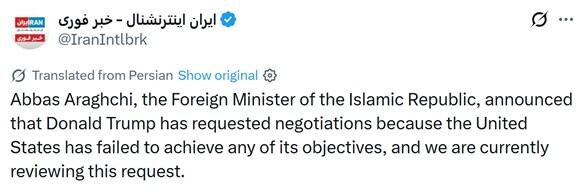
  • Trump says peace could come via telephone rather than face-to-face meetings, also warning Iranian oil infrastructure could explode from within unless flow resumes; Tehran later says Trump has requested new talks

  • Iranian FM has been sending written messages to US via Pakistani intermediaries 

  • Israel strikes deep into Lebanon in Beqaa Valley for first time of 3-week ceasefire.

US x Iran permanent peace deal by June 30, 2026?
Yes 42% · No 59%
View full market & trade on Polymarket

*  *  *

Bessent: ‘Rats’ Trapped by US Blockade

In the early evening of Monday, well after markets closed, Treasury Secretary Scott Bessent issued the following on X (below), describing IRGC leaders as now “trapped like drowning rats” amid the enduring US naval blockade of Iranian ports, which will soon result in gasoline shortages and anger – and potential protests leading to uprising (according to US desires and aims). Also here is where things stand on the stalled negotiations, and an early hint of the potential White House reaction, per WSJ:

Iran has presented regional mediators with a new offer to stop its attacks on ships in the Strait of Hormuz in exchange for a full end to the war, including the U.S.’s lifting of its naval blockade of Iranian ports and the postponement of nuclear negotiations, according to officials familiar with the matter.

The proposal, presented by Iranian Foreign Minister Abbas Araghchi during his tour of the region and Pakistan over the weekend, is designed to break the deadlock in the conflict and set talks back in motion, the people said. President Trump and his national-security team are skeptical of Iran’s offer, U.S. officials said. Trump previously said negotiations could happen over the phone instead of in person.

And: “Trump held discussions with aides Monday morning about the offer. While he didn’t reject it outright, officials said Trump sounded notes about Iran not dealing in good faith or being willing to meet his key demand: ending nuclear enrichment and vowing never to make a nuclear weapon.”

Rubio: ‘Will Not Tolerate’ Iran Control of Strait

The latest via WSJ on what Iran is proposing, centered on immediately lifting the US naval blockade on Iranian ports:

Iran has presented regional mediators with a new offer to stop its attacks in the Strait of Hormuz in exchange for a full end to the war and a lifting of the U.S. blockade of Iranian ports, according to officials familiar with the matter. The proposal, presented by Iranian Foreign Minister Abbas Araghchi during his tour of the region and Pakistan over the weekend, is designed to break the deadlock in the conflict and set talks back in motion, the people said. It would see discussions about Iran’s nuclear program shelved. Washington hasn’t responded to the proposal, one of the people said. Iran’s mission to the United Nations didn’t respond to a request for comment.

But US Secretary of State Marco Rubio has told Fox News on Monday that the US will not tolerate Iran controlling or establishing a toll system in the Strait of Hormuz. Rubio further asserted that the strait would remain open either through international pressure or a coalition-led effort.

Iranian Foreign Minister told Russia’s President Putin that US ‘destructive habits’, ‘unreasonable demands’ and frequent changes in positions are slowing diplomatic progress

Just days ago Iran began declaring that the first toll passage funds had been successfully transferred to the Central Bank of Iran, after Trump stated the US won’t allow a toll system. Rubio further said the US will not normalize the Iranians being essentially a gatekeeper, with countries seeking permission from Iran.

Putin Says He’s in Contact with Ayatollah in Araghchi Moscow Meeting

President Putin, FM Lavrov, and Iranian FM Araghchi have been meeting in Moscow, after warm greetings and amid competing narratives over the future of the Strait of Hormuz. The Russian leader said something surprising right out of the gate, at a moment Ayatollah Mojtaba Khamenei has not been seen since the US-Israeli war began: “Last week I received a message from the Supreme Leader of Iran,” he told Iran’s Araghchi

Additionally Putin pledged, “The people of Iran are courageously and heroically fighting for their sovereignty.” This certainly stands in sharp contrast from the US and Western consensus. Putin also stressed, “Russia will do everything that serves the interests of Iran and the region to achieve peace as soon as possible.” This after Tehran on Monday made clear that it sees the future of the Strait of Hormuz as being under Iranian military control – an earlier headline which pushed crude prices up, and within hours later on this as well:

Hours prior, Kremlin spokesman Dmitry Peskov described of Araghchi’s arrival, “the importance of this conversation is difficult to overestimate in terms of how the situation around Iran and in the Middle East is developing.” Araghchi to Putin: “It’s been proven to everybody that Tehran has friends and allies such as Russia… Allies that, in times of need, are standing next to Iran – and we are grateful to you for your support.”

Source: Kremlin handout

The moment Putin greeted the Iranian top diplomat and his team (below), and where things stand on Iran’s proposal…

Iran has reportedly sent a new proposal to the U.S. that would reopen the Strait of Hormuz, but only after an end to the war and guarantees it will not resume, according to sources and regional reports. Under the plan, broader talks on the nuclear program and maritime navigation would come later.

Meanwhile President Trump is expected to hold a situation room meeting soon on Monday, related to Iran and the Hormuz crisis with his top national security and foreign policy team.

IDF Hits Beqaa Valley for First Time of Lebanon Truce

A three-week Lebanon ceasefire is officially in place, but in reality it exists on paper or in name only, as Israel has intensified and expanded its attacks, now striking the distant Beqaa Valley for the first time since the truce began. “The IDF says it has launched a wave of airstrikes against Hezbollah infrastructure in the Beqaa Valley and several areas of southern Lebanon,” Israeli media reported Monday. “The strikes come following repeated Hezbollah attacks on IDF troops and Israel during the ceasefire, including a deadly drone attack yesterday,” according to The Times of Israel.

The latest coverage notes that “Israel has not struck in Lebanon’s eastern Beqaa Valley in some three weeks.” The IDF frames the escalation as a response to Hezbollah violations of the ceasefire, while Hezbollah argues Israeli ground forces are on Lebanese territory and therefore legitimate targets.

Meanwhile, Joseph Aoun told representatives from southern villages that negotiating with Israel “is not betrayal,“ but necessary for stability. The Maronite Catholic leader added that “Betrayal is carried out by those who take their country to war to serve foreign interests.”

Iran Offers New Path To Opening Strait

Running a little ahead of schedule, Sunday evening brought this week’s infusion of pre-Monday-open optimism about prospects of ending the US-Israel war on Iran. Axios’ Barak Ravid, a veteran of Israeli intelligence who routinely posts anonymously-sourced scoops, reported that Iran has presented a new proposal for opening the Strait of Hormuz and ending the shooting — though Iran’s concept includes a potential non-starter via a proposed postponement of nuclear negotiations. No details were reported, beyond the notion of either an extended ceasefire or permanent end of the war that would accompany a full reopening of the strait. 

Earlier on Sunday, President Trump said face-to-face discussions with the Iranians weren’t essential to ending the war. “If they want to talk, they can come to us, or they can call us. You know, ​there is a telephone. We have nice, secure lines,” he told Fox News. “They know what has to be in the ⁠agreement. It’s very simple: They cannot have a nuclear weapon; otherwise, there’s no reason to meet.”  

Sunday’s micro-dose of hope capped a weekend in which negotiations were perceived as grinding to a clear stalemate marked by a lack of warfare but also a continued choking of traffic through the vital Strait of Hormuz. On Saturday, Trump’s lead negotiators, Steve Witkoff and Trump son-in-law Jared Kushner, were poised to travel to Islamabad for another round of negotiations with the Iranians when Trump nixed their trip at the last minute.

Iran’s Fars news agency reported that Araghchi has “conveyed written messages regarding Iran’s red lines to the American side through Pakistani intermediaries.” 

Iranian Foreign Minister Shuttles Between Pakistan, Oman, Russia 

Iranian Foreign Minister Abbas Araghchi has been on the go. On Saturday, he left Pakistan after meeting with Pakistan’s military chief, Asim Munir, Prime Minister Shehbaz Sharif and Foreign Minister Ishaq Dar. On parting, Araghchi said he’d had a “very fruitful visit,” while cautioning it’s unclear “if the US is truly serious about diplomacy.”

Iran’s foreign minister travels in a jet emblazoned with “Minab 168,” referring to 168 elementary-schoolgirls killed in a US Tomahawk missile strike in the opening of the US-Israeli war on Iran (via RT)

Then he was off to Oman for talks centered on re-opening the strait — which lies between the two countries — then back to Pakistan. By Monday, Araghchi was in St Petersburg, Russia for discussions with President Putin. Commenting on the relationship via X, Iran’s envoy in Russia said: 

“Iran and Russia are present in a united front in the campaign of the world’s ​totalitarian forces against independent and justice-seeking countries, ​as well as countries that seek a ⁠world free from unilateralism and Western domination.” 

Trump: Iranian Oil Infrastructure In Peril From Limited Capacity

Trump told Fox News on Sunday that the US blockade on traffic to and from Iranian ports is putting major pressure on the country’s export infrastructure: 

“When you have, you know, lines of vast amounts of oil pouring through your system, if for any reason that line is closed because you can’t continue to put it into containers or ships, which has happened to them — they have no ships because of the blockade — what happens is that line explodes from within, both mechanically and in the earth.”

“It’s something that happens where it just explodes. And they say they only have about three days left before that happens. And when it explodes, you can never, regardless, you can never rebuild it the way it was.”

That approximate scenario has also been outlined by the Critical Threats Project at the American Enterprise Institute. “Once the tanks are filled, Iran would have to shut down its oil fields, which risks long-term damage to the fields,” AEI’s Annika Ganzeveld told the New York Post. A worst-case scenario doesn’t only imperil Iran’s economy, but also threatens to put more upward pressure on global energy prices. Analysts differ on how much time Iran has before a forced shutdown of production  — with estimates ranging from mere days to seven weeks. 

TankerTrackers.com on Sunday reported that Iran has loaded roughly 4.6 million barrels of oil at its terminals, without specifying the time-frame in which the feat had occurred. The outlet said another 4 million barrels have somehow evaded the US blockade. That volume of oil buys a few more precious days of storage capacity, the Wall Street Journal says. 

Meanwhile, citing claims made by the secretary-general of the Iran Shipping Association, FARS reported that “Iran’s maritime trade flow has not stopped, and ships are reaching ports by crossing the blockade.” The report also said the bolstering of alternative routes — including northern ports on the Caspian Sea and rail links to China and central Asia — had also buffered the country’s “economic resilience.” 

Iranian Leadership Divided On Deal Terms

Iran’s leadership is reportedly split on how flexible they should be on nuclear terms of a deal. Last year, at the encouragement of Israel and pro-Israel forces inside the United States, the Trump administration had adopted a maximalist position demanding that Israel agree to never again enrich nuclear material, even to levels far below weapon-grade. 

For many observers, this was seen as a demand that Israel knew Iran would never consent to, ensuring the all-out US-Israel war on Iran that Prime Minister Netanyahu himself admitted he had “yearned to do for 40 years.” It’s been the long-running conclusion of the US intelligence community that Iran has not been developing a nuclear weapon. Netanyahu has been warning of an imminent Iranian nuclear weapon for 34 years — since 1992.  

* * *

Tyler Durden
Mon, 04/27/2026 – 20:35

Upcoming Weather Shift “Far From Drought-Breaker” For America’s Parched Breadbasket

Upcoming Weather Shift “Far From Drought-Breaker” For America’s Parched Breadbasket

Some of the worst drought conditions in a generation are plaguing America’s breadbasket just as spring planting season gets underway. Institutional desks, including UBS, have ramped up warnings about drought, fertilizer shortages, and what these current-day issues could morph into for the food supply chain later this year.

The good news: parts of the central U.S. may finally see some weather relief, with several days of rain in the forecast. Whether that will be enough to materially improve soil moisture conditions remains the key question for agricultural desks this week.

“The upcoming weather pattern in the United States, fueled by a strong subtropical jet stream, will bring some beneficial rain to the drought-stricken South,” meteorologist Ben Noll wrote on X, adding, “But it will be far from a drought-breaker.”

Noll is correct: it will take many more rounds of storms to fully erase the drought, especially given what UBS analyst Jonathan Pingle told clients last week.

The National Oceanic and Atmospheric Administration’s Palmer Drought Severity Index hit its highest level for March since records started in 1895, and March was the third-driest month recorded, regardless of time of year, behind only the famed 1930s Dust Bowl: July and August 1934. Water levels on the Mississippi look fine, and seasonal lows are typically in the fall, but river levels in Memphis sit 24 feet below this time last year.

Here’s The Weather Channel’s forecast for rain this week across the Midwest and Southeast:

Tuesday

Wednesday

Thursday

Friday

Saturday

Better than nothing. 

Tyler Durden
Mon, 04/27/2026 – 20:30

Report Claims Iranian Jet Bombed American Base In Kuwait At War’s Start

Report Claims Iranian Jet Bombed American Base In Kuwait At War’s Start

Authored by Dave DeCamp via AntiWar.com,

Iranian attacks on US bases across the Middle East have caused far more damage than the Trump administration has publicly acknowledged, and an Iranian fighter jet was able to bomb at least one US base, NBC News reported on Saturday, citing unnamed US officials.

The administration has attempted to cover up the damage to US bases in the war, and has gone as far as requesting that Planet Labs and other satellite imagery companies black out war images, making it difficult to ascertain the damage.

The NBC report said that the Pentagon has also kept the information on the damage from Congress. “No one knows anything. And it’s not for lack of asking,” a Republican congressional aide told the outlet. “We have been asking for weeks and not getting specifics, even as the Pentagon is asking for a record high budget.”

Iranian missile and drone attacks have targeted US bases in seven Middle Eastern countries: Bahrain, Kuwait, Saudi Arabia, the UAE, Iraq, Jordan, and Qatar. US officials said that an Iranian F-5 fighter jet was able to bomb the US base at Camp Buehring in Kuwait despite it having air defenses, marking the first time in many years that an enemy fixed-wing aircraft struck a US military installation.

The US armed Iran with Northrop Grumman-made F-5 fighter jets before the 1979 Islamic Revolution, and Iran has developed its own version of the aircraft, known as the HESA Kowsar.

Kuwait was also the site of a March 1 Iranian drone attack that killed six US Army Reserve soldiers and injured more than 20. The drone targeted a makeshift operations center in Port Shuaiba, and according to survivors of the attack who spoke to CBS News, the facility was unprotected despite claims from US War Secretary Pete Hegseth that the drone was able to “squirt” through air defenses.

The Pentagon has confirmed the deaths of at least 13 US soldiers and the injuries of more than 400 in the war. The bases across the region were mostly evacuated since they were so vulnerable to attack, something The New York Times previously reported.

“Many of the 13 military bases in the region used by American troops are all but uninhabitable, with the ones in Kuwait, which is next door to Iran, suffering perhaps the most damage,” the Times reported on March 25.

The NBC report said that the headquarters of the US Navy’s Fifth Fleet in Bahrain “sustained serious damage” and that other US bases in the country also suffered serious damage that is likely repairable.

The report also cited the American Enterprise Institute (AEI), a Washington-based think tank, which said it assessed Iran hit more than 100 targets across 11 bases, and that the repairs would cost at least $5 billion, though the number doesn’t account for some of the radars, weapons systems, and other equipment that was destroyed.

Tyler Durden
Mon, 04/27/2026 – 19:15

“Let’s Get Ruthless”: Bulwark’s Bill Kristol Suggests Illiberal Means Are Needed To Save Liberal Democracy

“Let’s Get Ruthless”: Bulwark’s Bill Kristol Suggests Illiberal Means Are Needed To Save Liberal Democracy

Authored by Jonathan Turley,

“Let’s get ruthless.”

Those words are, unfortunately, nothing new in this age of rage.

In just the last few weeks, various liberal pundits and politicians have been calling for radical and even violent action.

Even comedian Margaret Cho publicly declared this week that “we need a feral, bloodthirsty, violent Democrat.”

However, these words were reposted by Bill Kristol, the founder of the Weekly Standard and the current editor-in-chief of The Bulwark. Kristol was a leading conservative figure in the Republican Party.

Kristol left the Republican Party and is now a vehemently anti-Trump writer. There are certainly good-faith reasons why some conservatives have broken with Trump on a variety of issues.

However, the original column was endorsing the Democratic plan to pack the Supreme Court with an instant liberal majority to force through a slew of political changes in the country.

Various Democrats have been pledging to not only impeach Trump (and a long list of other figures), but to pack the Supreme Court as soon as they regain power.

James Carville declared, “If the Democrats win the presidency and both houses of Congress, I think on day one, they should expand the Supreme Court to 13. F— it. Eat our dust. Don’t run on it. Don’t talk about it. Just do it.”

This Nike School of Constitutional Law is catching on with a wide array of pundits and professors. Just do it.

Years ago, Harvard professor Michael Klarman laid out a radical agenda to change the system to guarantee Republicans “will never win another election.” However, he warned that “the Supreme Court could strike down everything I just described.” Therefore, the court must be packed in advance to allow these changes to occur.

Former Obama Attorney General Eric Holder has put packing the Supreme Court front and center, explaining, “[We’re] talking about the acquisition and the use of power if there is a Democratic trifecta in 2028.”

Years ago, I wrote an academic piece on the possible expansion of the Supreme Court, but there is a world of difference between that and a court-packing plan. Under my proposal, the court’s expansion would take almost two decades to ensure that no president could pack the court.

It was not just the company that Kristol is keeping on the issue, or his endorsement of the long-anathema concept of court packing, but also his rationale for the move. Kristol cited the successful Democratic gerrymandering efforts in California and Virginia as triumphs that should now propel the left to pack the Court.

Kristol reposted the call for court packing from his colleague Jonathan Last: “Expanding the Supreme Court is no different from redistricting in California and Virginia,” he said. “It is a proportionate response to Republican attempts to degrade liberal democracy and move America toward a post-liberal order.”

Praising governors Gavin Newsom and Abigail Spanberger for their “ruthless” leadership in response to Republican gerrymandering, Kristol insisted that Democrats must meet “force with force” and must now pack the Supreme Court. Being ruthless, he argues, is the “only road to preserving liberal democracy.”

There is, of course, a considerable difference between altering political districts and packing the courts. Political gerrymandering has been around since the earliest days of the Republic.

The courts are not the same political fungible units. Indeed, the favorite term on the left is “illiberal democracy” to refer to democratic systems used to curtail rights and weaken checks and balances. Yet this illiberal means is being cited by Kristol as essential to save liberal democracy.

Liberal justices have spoken out against these calls for court packing.

The late Supreme Court Justice Ruth Bader Ginsburg said it would destroy the continuity and cohesion of the court.

She added, “If anything would make the court look partisan, it would be that — one side saying, ‘When we’re in power, we’re going to enlarge the number of judges, so we would have more people who would vote the way we want them to.’”

The political districts are precisely that: political. They are part of the two political branches in a tripartite system. It is the courts that keep these political branches within their proper constitutional orbits.

There was, of course, no movement to pack the court when a series of liberal majorities rewrote major areas of constitutional law in the 1960s and 1970s. These demands from figures like Sen. Elizabeth Warren were only heard when the court began to rule against their chosen outcomes.

Warren explained that the court had to be packed to bring its rulings in line with “widely held public opinion.”

Of course, Article III was designed precisely to blunt such pressures to rule according to “widely held public opinion.” The Supreme Court is a counter-majoritarian body that was created to protect rights against the passions or demands of the majority.

As I discuss in my book, “Rage and the Republic,” the founders sought to avoid “democratic despotism” and “mobocracy” by creating barriers to direct democratic powers. The Supreme Court is essential as a bulwark against such impulse politics. Those pushing for an instant liberal majority would convert the court into the type of partisan judicial bodies seen in states like Wisconsin where jurists are selected to robotically vote for party priorities.

There is a reason why “ruthless” was not an attribute cited by anyone in the constitutional convention to be fostered in our Republic. On the contrary, the system is designed to temper ruthless passions for reasoned debate.

The court itself may be the ultimate test of the lingering capacity for reason among our citizens. Of course, we can be ruthless and tear down our institutions on the 250th anniversary of our Republic.

No democratic system is ever immune from self-inflicted wounds. That is why Benjamin Franklin reminded us that this remains our Republic if we can keep it. This year, we can celebrate that Republic, or we can ruthlessly destroy it in a fit of blind rage.

Jonathan Turley is a law professor and the best-selling author of “Rage and the Republic: The Unfinished Story of the American Revolution.”

Tyler Durden
Mon, 04/27/2026 – 18:25