Futures Slide, Oil Jumps To 3 Week High After Iran Talks Collapse
Stocks futures fell and oil and the dollar jumped in early trading, as risk sentiment was dented after Trump scrapped his envoys’ trip to Pakistan for Iran talks, breaking down momentum toward a second round of peace talks between the US and Iran, even as the Strait of Hormuz remains indefinitely blocked.
Futures contracts for the S&P 500 Index dropped 0.3% after the underlying index closed at a record on Friday, although with two-thirds of S&P constituents closing red: this was the second worst negative breadth all-time high for the S&P following the bizarre October record high when the S&P printed an ATH with 80% of stocks lower.
The last 2 all-time highs have been on negative breadth: Friday’s record saw 324 SPX companies close lower; this was the 2nd worst negative breadth record only after Oct 28, 2025 when the S&P closed at a record with 80% of S&P companies red. pic.twitter.com/J5TBJZvvLS
The dollar rose against most major peers, with risk sensitive currencies such as the South African rand among the biggest laggards. Brent crude oil rose more than 2% above $107, the highest in 20 days. US Treasury futures edged lower in early trading.
The soft start to a very busy week – the bulk of the S&P is set to report in the next few days including most Mag 7s (MSFT, AMZN, META, GOOGL, AAPL) – comes after efforts to resume US-Iran peace talks collapsed over the weekend when Trump abruptly canceled a planned trip by his top envoys and Tehran said it won’t negotiate under threat. The setback adds to concerns for global equities at or near record highs (hedge funds just sold the most tech stocks in two years) with Brent crude oil rising to a 20 day high elevated bond yields from Sydney to London driving up borrowing costs.
Investors are still encouraged by strong corporate earnings and the AI boom “while keeping the US-Iran situation on their side mirrors,” said Indosuez Wealth strategist Francis Tan. But “the market is driving at 120km/h now and may have less reaction time when it is really time to change lanes.”
There have been some signs that investor enthusiasm for the biggest beneficiaries of the month-long rally may be waning. According to Goldman and BofA’s trading desks, investors should hedge across rate sensitive areas of the market such as small caps, regional banks and gold, adding that underperformance might still shake out those holding gold as high beta risk asset.
Separately, markets will remain on edge as major central banks including the Fed and Bank of Japan deliver policy decisions beginning Tuesday (no surprises expected). While investors expect them to all leave rates unchanged, traders will be alert to signs officials are worried about the inflation threat posed by the biggest disruption to oil supply in history from the Iran war.
A fresh round of speculation that policy tightening may come in coming months would be negative for government debt, which has already underperformed other assets in recent weeks as stocks and credit markets rallied with traders looking past the war. The Bloomberg GlobalAgg Index, a measure of global investment grade debt, has slid 1.7% since the Iran war broke out against the 1.5% gain in global stocks.
While the aggressive policy tightening cycle that was penciled in during the first part of the Middle East war has been partially unwound, “markets have been forced to recognize that the inflation threat is not over,” Marc Chandler, chief market strategist at Bannockburn Capital Markets wrote. April inflation reports are unlikely to offer relief from firm March readings and the spill over in to core prices is becoming more visible.
But the big variable for markets this week will not be geopolitics but earnings, with tens of trillions in market cap, some 42% of the S&P, set to report: Alphabet, Microsoft, Amazon.com and Meta are set to report Wednesday, followed by Apple a day later. The companies are worth nearly $16 trillion combined, representing a quarter of the S&P 500 Index’s market capitalization.
“It’s going to be a critical week,” said Keith Lerner, chief investment officer and chief market strategist at Truist Advisory Services. Results need “to validate this recent move,” he added.
WHCA Shooter’s Tweets Found, Suggesting Radicalization Fueled By Democratic Messaging
Update:
Shooter’s archived tweets emerge
Shooter’s Manifesto explained about Trump admin target kill list. He wrote, “prioritized from highest-ranking to lowest” …
Shooter’s intent was to Target Trump & admin officials
Shooter donated to “Harris for President” via ActBlue
Shooter apprehended and taken into custody. Carrying shotgun, handgun and several knives.
The shooter has been identified as Cole Tomas Allen, 31, of Torrance California
No injuries to Trump or any guests.
Incident near lobby magnetometer screening.
Trump praised Secret Service rapid response.
Shooter’s Achieved X Posts Emerge
What is particularly alarming about WHCA dinner shooter Cole Allen is that his social media footprint does not reflect a fringe left-wing extremist, but rather an ordinary Democrat who appears to have been conditioned over the past decade by left-wing corporate media and radical left-wing NGOs. This toxic ecosystem manufactured an artificial informational environment in which President Trump was labeled, around the clock, as a “fascist,” a “Nazi,” and worse, inciting an existential crisis among weak-minded Democrats who have decided to take up violence in response.
This imbecile clearly doesn’t have the faintest clue what actual Nazis would be like
Democrats have one strategy: it’s a color revolution.
Shooter’s Manifesto
CBS News’ Jennifer Jacobs has confirmed that the WHCA dinner shooter, Cole Allen, wrote a manifesto stating he was targeting Trump officials:
Administration officials (not including Mr. Patel): they are targets, prioritized from highest-ranking to lowest
Secret Service: they are targets only if necessary, and to be incapacitated non-lethally if possible (aka, I hope they’re wearing body armor because center mass with shotguns messes up people who aren’t
Hotel Security: not targets if at all possible (aka unless they shoot at me)
Capitol Police: same as Hotel Security
National Guard: same as Hotel Security
Hotel Employees: not targets at all
Guests: not targets at all
In order to minimize casualties I will also be using buckshot rather than slugs (less penetration through walls)
I would still go through most everyone here to get to the targets if it were absolutely necessary (on the basis that most people chose to attend a speech by a pedophile, rapist, and traitor, and are thus complicit) but I really hope it doesn’t come to that.
The manifesto also said:
And I am no longer willing to permit a pedophile, rapist, and traitor to coat my hands with his crimes.
(Well, to be completely honest, I was no longer willing a long time ago, but this is the first real opportunity I’ve had to do something about it.)
Fox News’ Will Ricciardella made the point that Allen “wasn’t some nut job lurking on the fringes of society, forgotten by the system.”
Ricciardella said Allen was “well-educated, credentialed, employed, and institutionally formed. That’s what makes this so disturbing.”
The WHCA alleged shooter wasn’t some nut job lurking on the fringes of society, forgotten by the system.
He was well-educated, credentialed, employed, and institutionally formed. That’s what makes this so disturbing.
At first glance, this doesn’t look like a breakdown of the…
In reality, Allen is a byproduct of the Democratic Party’s psychological operation via corporate media to delegitimize Trump (color revolution), which has pushed many liberals into an existential crisis, making them believe they must act with violence. This is similar to MSM’s climate propaganda, where liberals actually believed the planet would burn in a few years unless more taxes were imposed and cow farts were banned.
The propaganda:
Allen must’ve had CNN playing on every device for ten years…
Cole Allen, the gunman from last night’s WH Correspondents Dinner, maintained an active online presence, especially on the leftwing social media platform Bluesky where he went by the handle https://t.co/bpKnhC8M5a with multiple references violence and guns.
New details have emerged about Cole Allen, 31, of Torrance, California, who opened fire at the Washington Hilton Hotel during the White House Correspondents’ Dinner last night.
Fox News’ Bill Melugin posted on X early Saturday:
Per federal law enforcement sources familiar with the investigation who spoke to @FoxNews, Cole Allen told investigators after his arrest that his intent was to target Trump administration officials at the WHCD.
NEW: Per federal law enforcement sources familiar with the investigation to @FoxNews, Cole Allen told investigators after his arrest that his intent was to target Trump administration officials at the WHCD.
GOP activist Scott Presler published Allen’s profile data, showing that he is a teacher in California and that he donated to the “Harris for President” campaign through the left-wing funding platform ActBlue.
HOLY COW
The gunman that opened fire at the White House Correspondents’ Dinner is 31-year-old Cole Allen
— a teacher from Torrance, California.
It appears that Cole donated via ActBlue to Kamala Harris for President.
Acting Attorney General Todd Blanche told Bloomberg’s Annmarie Hordern that Allen “acted alone after traveling by train from California and had been staying at the Washington Hilton, which was hosting the annual White House Correspondents’ Dinner.”
Acting Attorney General Todd Blanche tells NBC the suspect is believed to have acted alone after travelling by train from California and had been staying at the Washington Hilton, which was hosting the annual White House Correspondents’ Dinner.
Let’s not forget that the globalist publication The Atlantic was recently forced to admit …
Shooting strengthens the case for President Trump’s new White House ballroom, which would make events like this safer. But activist judges have repeatedly halted construction.
Shooting at White House Correspondents’ Dinner
President Donald Trump was evacuated from the head table at the White House correspondent’s dinner on Saturday night after a gunman, allegedly 31-year-old Cole Thomas Allen, 31, of California – stormed the event and fired shots in the lobby. Authorities confirm the suspected shooter has been apprehended and is in custody after shots fired near the lobby screening area. President Trump, First Lady Melania Trump, and all protectees were safely evacuated with no injuries reported. The Secret Service continues investigating.
Trump posted a picture of the suspect on Truth Social along with a video:
According to Just the News, the gunman was not wounded and was carrying a shotgun, a handgun and several knives.
In a White House press conference held shortly after the incident, Trump praised the Secret Service and law enforcement for their “fantastic job” and rapid response, describing the shooter as a “lone wolf” and “very sick person” from California who was armed with multiple weapons and charged a security checkpoint. He revealed that one Secret Service officer was shot at close range but was saved by his bulletproof vest and is “doing great,” while confirming the suspect was swiftly apprehended and taken into custody without harming any protectees. Trump noted he had “fought like hell to stay” at the dinner but deferred to security protocol, adding that the frightening event unexpectedly unified the ballroom and brought journalists and politicians together; he announced the White House Correspondents’ Dinner will be fully rescheduled within the next 30 days
This video was taken outside the venue:
🚨🇺🇸 BREAKING: The suspect in the White House Correspondents’ Dinner shooting has been identified as 31-year-old Cole Tomas Allen of Torrance, California.
-Video has emerged showing someone on the ground with U.S. Secret Service agents inside the Washington Hilton
According to Fox News‘ Karol Markowicz, the suspect is a 31-year-old from Torrance, California.
🚨🇺🇸BREAKING: The first image of the alleged shooter from the White House Correspondents’ Dinner has emerged, showing a body on the stairs at the Washington Hilton surrounded by law enforcement.
Shots were fired during the 2026 White House Correspondents’ Dinner (WHCD) at the Washington Hilton ballroom on Saturday evening, prompting the immediate evacuation of President Donald Trump, First Lady Melania Trump, Vice President, and other high-profile attendees by Secret Service. Guests were ordered to take cover under tables as heavily armed agents secured the venue.
BREAKING
The U.S. Secret Service just rushed the President and First Lady off the dais at the White House Correspondents’ Dinner after the sound of shots being fired was heard.
According to Deadline’s on-site reporter Ted Johnson, who was present in the ballroom near the area of the incident: “I heard what sounded like four shots, and it seemed to come from the hall just outside the ballroom near my table.”
Key details from initial reporting:
President Trump and dignitaries—including the First Lady, Vice President, WHCA President Weijia Jiang, and entertainer/mentalist Oz Pearlman—were quickly hustled out of the ballroom.
Secret Service agents jumped onto the stage amid the chaos.
Education Secretary Linda McMahon’s security detail told CNN live that there was a shooter in the lobby and that the shooter is dead.
A separate White House Pool Report from Jeff Mordock of the Washington Times stated that Secret Service indicated the alleged shooter is in custody – howeverCNN is reporting that the shooter is dead. the shooter is in custody.
Attendees described loud noises (consistent with gunfire), panic, people ducking, the room being placed on lockdown, and police/Secret Service sweeping the hotel. Trump and the First Lady were reported safe after a rapid evacuation shortly after arriving at the event. No injuries to attendees or dignitaries have been confirmed in initial accounts.
Security officials evacuated Mike Johnson (R-LA) after a gunman opened fire during the White House Correspondents’ Dinner in Washington, D.C.
This was President Trump’s first appearance at the WHCD as sitting president (he had boycotted the event during his first term). The dinner is an annual black-tie affair organized by the White House Correspondents’ Association that traditionally features journalists, politicians, and celebrity guests.
Markets have been almost totally dismissive of the conflict in Iran. Frankly, the number of countries, including oil-rich nations, that had been firing at each other seemed quite high, yet most markets shrugged it off. While the Strait remained closed, or blockaded, or blocked, the market remained in Open Sesame mode this week.
Moonshot
Artemis II wasn’t the only “moonshot” we’ve seen.
The SOX index has jumped almost 50% since March 30th. That would be incredible, but 18 straight days of gains is wildly impressive! (Even the NY Mets could only do the same thing 12 days in a row, but in the other direction).
The lower chart is RSI (Relative Strength Indicator and one of my favorite technicals to look at). This index went from the cusp of oversold, to heavily oversold, to overbought territory in 2 weeks and gets “more” overbought by the day. Every strong chip earnings report not only “skyrockets” that stock, but it also pulls up the entire sector.
The AI and Data Center Buildout narrative remains completely intact even as “war” rages. If anything, the need for domestic AI and Data Centers is growing as physical security concerns continue in the Middle East.
Not Sure if “Laggards” Is the “Right” Word, But…
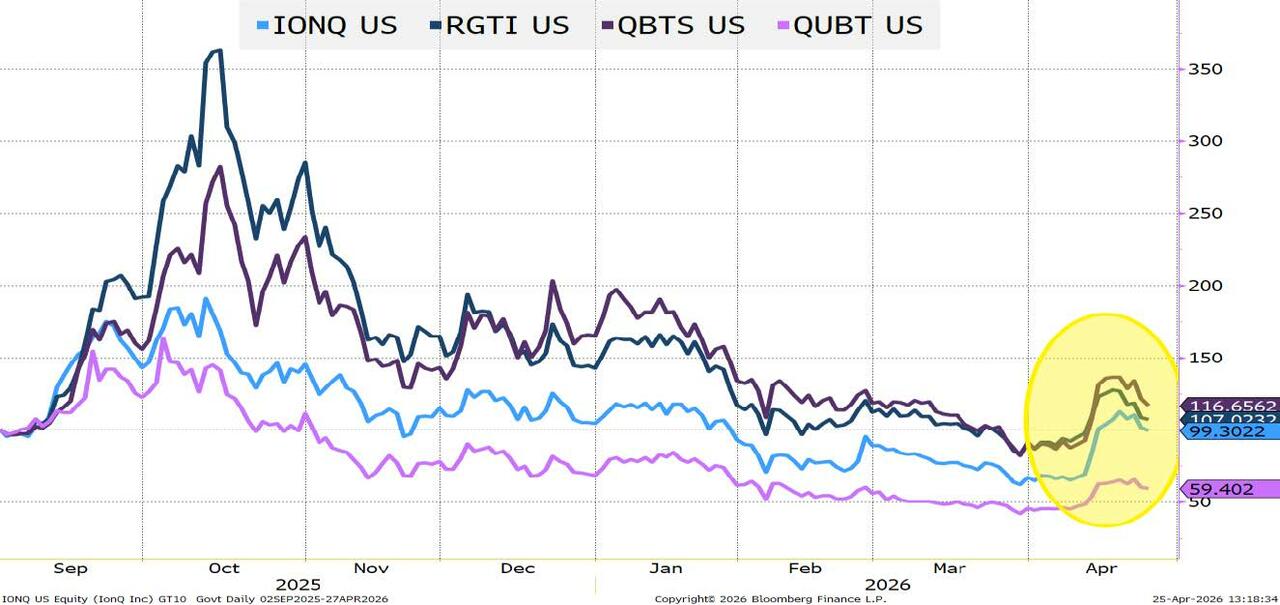
Quantum computing has bounced, but unlike the semis, it is not even at the highs of the year, let alone the highs from last year!
If you own a “quantum” ETF, you likely have seen far better returns in the past few weeks than this chart would indicate. But that is because the ETFs own a lot of semiconductors. QTUM (Defiance Quantum ETF), the largest “quantum” ETF at $4.1 billion, has TER as its largest holding. INTC, STM, and MU were the next largest holdings. So, I tried to identify 4 tickers from WQTM that seemed to be more “pure play” quantum.
We have yet to see a real breakout in Uranium and Rare Earths stocks.
REMX (for Rare Earths and Critical Minerals) and URA have bounced, but Uranium is still lower than it was before the war. If you look at the “small reactors” which were all the rage, their chart looks a lot more like the chart from the quantum stocks. Even in rare earths, names like MP, which the U.S. government invested in, is more than 35% lower than its high last October.
A warning sign? A rational reassessment? The next asset classes to “catch a bid”?
Bitcoin, where the news has generally been good, is still hanging around the $76k to $78k range. It has “recovered” the 100-day moving average, but has not rushed to “close the gap” with the 50-DMA. I’m watching this closely as another “next leg” of this rally. I cannot help but wonder if some of the “ceiling” on Bitcoin is due to concern that there may be some level of selling pressure from a country like Iran. Iran may not have Bitcoin, but given the fact that they allegedly asked for “safe passage” payments in crypto, it seems plausible that they do. Given the blockade and seizure of vessels, it would create pressure to sell (or transfer it to someone else who sells it) to fund their economy (if they have any).
I’m leaning towards a “breakout” as people look for anything remotely adjacent to new tech/chips that isn’t at its highs.
Markets Ignoring Stubborn Oil Prices Out the Curve
While we still see issues in LNG, Diesel, and Jet Fuel (also in the distillates and chemical industry), let’s go back to the big 2 – WTI and Brent.
WTI spiked to $120 March 9th and again got to almost $120 on April 7th. It is “comfortably” lower now, at $95. Brent spiked to $120 three times during the conflict and is “only” at $106. A bit less comforting than WTI.
But the story, as several people in the admin have pointed to, is what is happening to oil “out the curve.” When the admin was pointing this out, there was a pretty quick drop from “elevated” front end contracts as you moved out the curve. Now we are sitting at just under $80 for the November contract. That is closer to the highs of this conflict. The November contracts are now near their highs (since that “crazy” first weekend). It is difficult to be encouraged by this.
The further out the curve you go, the more it includes people “in the know” and less about speculation. And this pricing is consistent with the warnings that we keep hearing from participants in the physical products. I suspect that even in the event of a good deal with Iran, pricing out the curve doesn’t back down much from here.
It is possible that equities are fully pricing this in and don’t care. That the AI and Data Center story and current round of earnings are enough to cover this possibility.
I cannot help but wonder if we are being a bit complacent, especially since AFFORDABILITY has been an issue and has not dissipated in any way, shape, or form (at least not for the “average” American).
Maybe I’m looking too hard for something that might derail the rally (as opposed to the prior section when we were looking for what might benefit from the next wave), but I do have some concerns that people “in the know,” already “know” oil is going to remain uncomfortably high (for consumers) even if a good deal is reached.
Bottom Line
On rates, 4.25% is still the “midpoint” of our range. I think you buy 10s above 4.4% and sell if we get to 4.1%. Maybe a touch too wide of a range, but there is a lot of noise out there.
On credit, IG remains boring. HY has some interesting risks, so maybe a touch more cautious there, while I cannot help but want to nibble at the private credit/BDC space. IGV (software ETF) hung in last week, despite some headlines from the private credit side that could have hurt, and despite the massive rally in AI/Data Centers – which until recently didn’t seem good for software. IGV, BDCs, and Private Credit seem to be various forms of the same trade, and it is difficult not to scale in a little here, once again under the theory that they are under-owned and at some point capital will come looking for stocks with a story that is well off its highs.
On equity. European ProSec! Is Europe finally getting the joke? They are lending money to Ukraine to buy weapons. It has been reported that Sweden has been interdicting “ghost” ships to stop Russian oil sales. Many of the European stocks in the ProSec™ theme have been outperforming similar stocks in the U.S. Yes, Europe is more exposed to oil prices than we are, but that is precisely why you want to buy into their energy industry – the realization that they have to do something to reduce their exposure to regions outside of their control and harness their own resources!
I have to admit, I’m not even checking (or at least barely checking) Twitter for Iran headlines. Markets are closed, so nothing to say about them now, and by Sunday night, the story may have changed anyway, which in turn might look completely different by Monday morning. As a strategist, I think I’m either in the depression or acceptance phase of grief as it relates to trying to manage risk around the conflict.
Good luck and Academy will continue to try to bring our unique resources to bear on the geopolitical situation to help you navigate it as smoothly as possible!
Ford Denies Talks With Geely About Bringing Chinese Car Tech To U.S.
On Friday, a report crossed the wire that Ford and Geely had been in discussions about collaborating more closely, including whether their developing European partnership could expand into the U.S. market, according to the Wall Street Journal.
Ford denied the claims, which stated that one idea involved Ford using Geely’s vehicle technology domestically. The talks had reportedly cooled, with both sides shifting attention back to Europe, where they are considering sharing production capacity and technical resources.
Geely is motivated to enter the U.S., a lucrative but tightly restricted market for Chinese automakers. High tariffs, bans on Chinese-connected vehicle software, and political resistance from U.S. industry and lawmakers all make entry difficult.
Ford itself has signaled caution, with leadership stressing the importance of protecting American jobs and competitiveness. A company spokesman reinforced that stance, saying, “Our commitment to a level playing field and safeguarding our home market remains absolute.”
The WSJ wrote on Friday that Geely, for its part, has kept its response general, noting, “We always keep an open mind when it comes to exploring cooperative opportunities,” while avoiding specifics about any potential deal.
Earlier discussions went further than simple cooperation, including the possibility of Ford building future models on a Geely-developed platform and leveraging its engineering to speed up EV development. Geely also explored using Ford’s existing manufacturing footprint—particularly in Europe—to bypass trade barriers and scale production more efficiently. While those ideas remain on the table in some form, they highlight how both companies see strategic value in collaboration, even as geopolitical tensions limit how far that cooperation can extend.
Later in the day on Friday after the report, Ford “denied a news report that it has held talks with Geely Automobile Holdings Ltd. about bringing Chinese car technology to the US market”, claiming “no such talks” happened.
The broader context is intensifying global competition: Chinese automakers are gaining ground internationally with cheaper, tech-focused vehicles, putting pressure on Western companies. Even so, any attempt to formalize a U.S. partnership would face significant political scrutiny, making overseas collaboration a more practical path for now.
Will the Left Make The WHCA Dinner Shooter A Hero?
There was a lot of confusion in the initial hours after the shooting at the White House Correspondents Association Dinner at the Washington Hilton on Saturday night. But it soon became clear that the suspect, Cole Allen, a 31-year-old teacher from Torrance, California, had rabid anti-Trump views and was there to target Trump administration officials.
While the usual suspects on the left are issuing standard statements condemning violence, there’s a real concern that the left will lionize Allen. And even former Obama official and current CNN pundit Van Jones is concerned about it.
“I’m starting to worry about something,” Jones said. “Which is that the shooter survived, which means on Monday he’s going to court, which means there is a danger that people try to make him some sort of hero.“
He wasn’t being paranoid. He was being prescient. And he didn’t stop there.
“You watch what happened with Luigi, who shot a CEO to death, and somehow became a hero,” Jones continued. ” So, they said tonight you saw the worst of America. You saw the best of America. Tonight, you definitely saw the best of America. I hope on Monday we don’t see the worst again. I just want to say very clearly — this kind of despicable behavior has no place in America. It has no place on the right. It has no place on the left.”
He added, “This kind of behavior has no place in America. And it is wrong. Violence is not the way to resolve any grievances. And this cheerleader culture for violence, for people who think that the answer to our problems is to go shooting billionaires or going to synagogues or all these different things, has to be called out immediately. The minute it starts, every single person with the platform must denounce it, or we’re going to see this again.”
When Luigi Mangione was arrested in December 2024 for the killing of UnitedHealthcare CEO Brian Thompson, the radical left treated him like a celebrity. Within days of the shooting, social media flooded with memes casting Mangione as a modern-day vigilante, a working-class avenger striking back against the healthcare system.
Acting Attorney General Todd Blanche said Sunday that “preliminary” findings suggest Trump and members of his administration were the likely targets. Allen had been staying at the hotel as a registered guest. Investigators secured his room and began reviewing what CBS News and others described as his manifesto.
According to the New York Post, Allen’smanifesto ran over a thousand words, laying out a delusional justification for the shooting. In it, he described himself as a “Friendly Federal Assassin,” outlined “rules of engagement,” and claimed it was his moral duty to target officials tied to the Trump administration.
Democrats moved quickly to condemn the shooting on Saturday. The statements were prompt and broadly worded. But the uncomfortable overlap between the suspect’s stated grievances and the party’s rhetoric about Trump is hard to ignore, making Van Jones’s concerns extremely valid.
Department of Housing and Urban Development (HUD) Secretary Scott Turner announced a new proposed rule on Thursday that seeks to end the use of “gender identity” across all departmental programs, which is intended to “restore biological reality and protect women.”
“Under the proposed guidance, HUD would remove radical definitions of gender identity, sexual orientation, and gender, replacing them with sex across nearly 50 regulations,” HUD said in an April 23 statement.
The department’s Equal Access Rule will be modified to replace the ban on discrimination on the basis of “gender identity” across all Community Planning and Development programs.
HUD intends to define common terms such as mother, father, woman, man, girl, and boy, in a way that is consistent with a person’s sex across the department’s regulations.
“God created two sexes: male and female. The Left’s war on biological reality through radical gender ideology will no longer take precedence over the safety and security of America’s most vulnerable women,” Turner said.
The 2012 Equal Access Rule, titled Equal Access to Housing in HUD Programs Regardless of Sexual Orientation or Gender Identity, sought to ensure that HUD’s housing programs would be made available to all individuals and families regardless of their gender identity, sexual orientation, or marital status.
At the time, the rule did not address how transgender identifying and “gender non-conforming” individuals should be accommodated in certain temporary and emergency shelters, and other facilities used for this purpose. In 2016, another final rule was issued on this regulation addressing the matter.
The recent proposal builds on an order issued by the HUD Secretary in February last year that required a stoppage of any pending or future enforcement of the Equal Access Rule.
In a Feb. 13, 2025, statement, Turner said that the department’s actions were in line with an executive order signed by President Donald Trump on his first day in office.
The Jan. 20, 2025, executive order, Defending Women From Gender Ideology Extremism and Restoring Biological Truth to the Federal Government, criticized what it described as denying the biological reality of sex and the increasing use of legal and socially coercive measures to allow men to self-identify as women.
This enabled such men to “gain access to intimate single-sex spaces and activities designed for women, from women’s domestic abuse shelters to women’s workplace showers,” Trump wrote in the order.
“This is wrong. Efforts to eradicate the biological reality of sex fundamentally attack women by depriving them of their dignity, safety, and well-being,” the president wrote.
The order defined the sex of a person as the individual’s biological classification as either male or female, dismissing the interchanging of the word “sex” with “gender identity.” It asked agencies to remove all regulations and policies that “promote or otherwise inculcate gender ideology.”
The National Alliance to End Homelessness has criticized HUD’s move to modify enforcement of the Equal Access Rule.
In a February 2025 post, the alliance said that communities cannot afford to create more barriers to shelter and housing programs at a time when “unsheltered homelessness is soaring and when gender-expansive people are experiencing shocking disparities in unsheltered homelessness.”
“The Alliance strongly opposes the directive from Secretary Turner to halt any pending or future enforcement actions of the Equal Access Rule and any future steps to weaken or repeal this lifesaving rule,” the post said.
In its February 2025 statement, HUD said that the 2016 rule allowed men to take advantage of department programs directed at women.
Late Friday afternoon, as most people were checking out for the weekend after nearly two months of U.S.-Iran war fatigue, Anthropic quietly released a note titled “Project Deal.” The company built a closed marketplace where AI agents negotiated prices, struck deals, and completed real transactions with money changing hands.
“We created a marketplace for employees in our San Francisco office, with one big twist. We tasked Claude with buying, selling and negotiating on our colleagues’ behalf,” Anthropic wrote on X.
New Anthropic research: Project Deal.
We created a marketplace for employees in our San Francisco office, with one big twist. We tasked Claude with buying, selling and negotiating on our colleagues’ behalf. pic.twitter.com/H2f6cLDlAW
The results: Claude agents made 186 deals across more than 500 listed items on a Slack-based marketplace, totaling just over $4,000 in transaction value.
But the quality of the model mattered a lot. In the simulated runs where Opus and Haiku models negotiated with one-another, the Opus models got substantially better deals.
Interestingly, though, participants in our survey didn’t pick up on this disparity. pic.twitter.com/X26hhIieJN
Anthropic’s point is that AI-to-AI commerce offers an early look at the coming agentic economy, where AI bots negotiate with other bots in a marketplace to strike the best deal.
Claude interviewed 69 of our colleagues about what they wanted to buy and sell. Each Claude asked for any custom instructions, then went off to haggle.
We ran 4 markets in parallel, to find out what would happen if we varied the models doing the negotiating. pic.twitter.com/FJdD6S2TSd
AI disruption has already hammered software stocks. Now, as Polymarket Money pointed out, “eBay’s leadership team is seeing this,” referring to Project Deal.
ICE has arrested an illegal alien child sex predator in Abigail Spanberger’s Virginia. Authorities there tried to protect him by declining an ICE detainer last year and releasing him back into the community.
Of course they did.
The suspect, Roni Mendez-Escobar, a Guatemalan national, faced charges including multiple felony counts of possession of obscene material and child pornography with intent to distribute.
🚨 HOLY CRAP! ICE has just arrested an illegal alien CHILD S*X PREDATOR in Abigail Spanberger’s Virginia
She tried to PROTECT him.
She ran as a “moderate.” In practice, she’s letting kids get abused by illegals!
Fairfax County’s refusal to cooperate with federal immigration enforcement allowed him to remain free despite the detainer – exactly the outcome sanctuary policies are designed to produce.
This isn’t an isolated failure. It’s the predictable result of Virginia Democrats turning the state into a magnet for criminal illegal aliens while American families bear the cost. Spanberger ran as a “moderate,” yet her administration’s moves to limit cooperation with ICE have repeatedly put Virginia children and residents at risk.
Just weeks ago, ICE urged Spanberger not to release another criminal illegal alien from Guatemala, Misael Lopez Gomez, who allegedly bludgeoned his own three-month-old daughter to death with blunt force trauma in Fairfax.
⚖️🚨NIGHTMARE IN VIRGINIA
A 3 month-old girl is dead.
GOP lawmakers and the Department of Homeland Security is blaming “lax” Democrat ‘Sanctuary’ policies after two illegal immigrants were charged in two separate, gruesome slayings.
As DHS stated: “This cold-blooded killer murdered his own three-month-old daughter. We are calling on Governor Spanberger to commit to not releasing this barbaric animal from jail into Virginia communities.”
The media is RUNNING COVER for an illegal alien MURDERER.
Misael Lopez Gomez is NOT a “Virginia dad.” He is an illegal alien from Guatemala and a cold-blooded killer accused of murdering his own three-month-old daughter. pic.twitter.com/Ex5HuolKtl
That horror came one day after another Guatemalan illegal alien, Anibal Armando Chavarria Muy, was arrested for fatally stabbing a man to death with a machete in Fairfax County.
In March, an 18-year-old illegal migrant from El Salvador, Israel Flores Ortiz – released into the U.S. under Biden policies – posed as an 11th grader at Fairfax High School and groped at least 12 girls in the hallways over several months.
A victim’s mother described it: “He just sneakily walked up behind them and put his hand in between their legs… It was a groping of a private area. It had been occurring for several months.” Fairfax officials tried to downplay it and even fought ICE’s detainer.
And before that, Virginia mother Stephanie Minter was murdered in cold blood at a bus stop by an illegal alien from Sierra Leone with more than 30 prior arrests.
Each case traces back to the same refusal to honor ICE detainers, the same sanctuary rules pushed under Spanberger that prioritize criminal non-citizens over public safety. Local officials in Fairfax and Arlington have repeatedly ignored federal requests, releasing predators and killers back onto the streets.
This isn’t compassion – it’s complicity. Democrats continue to handcuff law enforcement and invite chaos across the border.
Virginia families didn’t vote for this. They deserve borders that work, laws that put citizens first, and leaders who actually protect them instead of shielding the very people preying on their children.
Sanctuary policies must end. Cooperation with ICE must resume. Deportations of criminal illegal aliens cannot be optional. American lives – especially the most vulnerable – depend on it.
Your support is crucial in helping us defeat mass censorship. Please consider donating via Locals or check out our unique merch. Follow us on X @ModernityNews.
You Can Buy A Tennessee Cave And Turn It Into A Doomsday Bunker
About 57 miles southeast of downtown Nashville, as the crow flies, an underground cavern system listed on Zillow is being framed as a potential candidate for the ultimate nuclear doomsday bunker.
Think of the cavern as the shell for a future bunker.
To get it anywhere close to true bunker status, millions of dollars in engineering, ventilation, power, water, wastewater, security, and interior buildout would likely be required.
“We have what it takes to keep your family safe and to build a sustainable hobby farm!” the listing reads, adding that the 32-acre property, known as “Cavern Bunker,” includes a 60,000-square-foot underground cavern system.
The Cavern Bunker property was originally listed last July for $1.75 million and has since seen a series of price cuts amounting to nearly 50% off.
The price cuts and lack of buyers likely stem from the potential bunker-style conversion, which could cost tens of millions of dollars if properly constructed.
Here’s the cost breakdown for the bunker conversion:
This is a cavern shell that would require tens of millions of dollars to convert into a bunker-style property.
When the Fischer-Price My First Mayor™ of New York Zohran Mamdani chose to film a “tax the rich” video in front of a Manhattan penthouse owned by Citadel CEO Ken Griffin, he wasn’t just celebrating “tax day”, he was making a policy argument.
Mamdani was making a choice about his tone (dickish), about targets (“people with more money than me are bad”), and about how the city signals to the very people it depends on to fund its ambitions (“go f*ck yourself and live somewhere else”).
In a city where a relatively small number of taxpayers account for an outsized share of revenue, that kind of signaling is not trivial theater. It’s reckless, petulant, counterintuitive, childish and has consequences. But what else would you expect from a thirtysomething who has zero private sector or real world experience?
Sure, Ken Griffin is an easy symbol. He has extraordinary wealth, a record-setting $238 million apartment at 220 Central Park South, and a business empire that spans global finance. But symbols have a way of flattening reality. The firms he built, Citadel and Citadel Securities, are not abstractions; they are employers, taxpayers, and investors.
Citadel’s principals and employees “have paid nearly $2.3 billion in city and state taxes over the past five years,” according to COO Gerald Beeson, Reuters wrote days ago. And Griffin himself has directed hundreds of millions of dollars in charitable giving tied to New York institutions, according to various reports citing about $650 million in donations highlighted by Citadel executives.
And then there is the forward-looking piece…the part that tends to disappear in political messaging. A proposed $6 billion redevelopment at 350 Park Avenue, tied to Griffin’s firm, carries the promise of thousands of construction jobs and many more permanent positions. Those are the kinds of projects cities compete fiercely to attract. But now that project appears at risk now after Mamdani’s choice to act like the spoiled Upper East Side brats he claims to loathe, according to the Wall Street Journal.
So that’s pushing $10 billion in tax revenue and investment from Citadel and Griffin. That is a metric f*ck ton of money (NYC brings in about $80 billion a year total in tax revenue) that Mamdani desperately needs to fund his $30 million state owned grocery stores, among other communist sleight of hand tricks in his bottle of political snake oil.
Mamdani’s policy argument is not without precedent. The idea of taxing underused luxury property, often described as a pied-à-terre tax, is rooted in a broader push to capture revenue from assets that sit largely idle in a city with acute housing pressures. Supporters see it as a corrective, a way to align tax policy with inequality that is both visible and politically salient. But there is a difference between arguing for a policy and personalizing it. Once a debate becomes about individuals rather than structures, it slides easily from persuasion into provocation.
That distinction matters because New York’s fiscal reality is not ideological; it is mathematical. The city requires enormous revenue to sustain its services, infrastructure, and social programs. Much of that revenue ultimately traces back to high earners, large firms, and the ecosystem that supports them. At the same time, those taxpayers are unusually mobile. Griffin has already moved his primary residence to Miami, part of a broader pattern of high-income migration that policymakers across the country are grappling with.
🔥 50% OFF FOR LIFE: Using this coupon entitles you to 50% off an annual subscription to Fringe Finance for life: Get 50% off forever
There is also a subtler risk in turning success into a kind of public spectacle. Cities thrive on ambition. They depend on people who are willing to build companies, take risks, and, yes, accumulate outsized rewards along the way. When political rhetoric begins to frame that success primarily as a problem to be highlighted, rather than a resource to be harnessed, it can send an unintended message. Not just to billionaires with penthouses, but to the broader class of entrepreneurs, investors, and professionals who decide where to build their careers.
The debate over fairness in taxation is both legitimate and necessary. But there is a difference between designing policy that asks more of those who have more, and staging moments that seem to cast them as villains by default. The former is governance. The latter is…well exactly how you’d expect a sociopath to govern.
New York does not have the luxury of shortcuts. It is a city that depends on scale of talent, of capital and of confidence. Undermining any one of those pillars, even rhetorically, carries risks that may not be immediately visible but are rarely insignificant. The challenge for leaders is not simply to raise revenue, but to do so in a way that keeps the engine of that revenue running. That requires precision, not performance, and an understanding that in a city built on success, how you talk about success matters almost as much as how you tax it.
If Mamdani wants to raise more revenue, he will eventually have to decide whether he is in the business of governing a fragile economic ecosystem or narrating one. This isn’t SimCity, or the lunch table with the drama club. Playtime in the sandbox is over. New York City is a global icon and the uncomfortable truth is this: the people Mamdani is turning into political props are the same ones writing the checks. And they have options. So, Mamdani, I mean this nicely but if you’re angry at the world, maybe start by looking inward…and at the very least just try to grow the f*ck up.
—
QTR’s Disclaimer:Please read my full legal disclaimer on my About page here. This post represents my opinions only.In addition, please understand I am an idiot and often get things wrong and lose money. I may own or transact in any names mentioned in this piece at any time without warning. Contributor posts and aggregated posts have been hand selected by me, have not been fact checked and are the opinions of their authors. They are either submitted to QTR by their author, reprinted under a Creative Commons license with my best effort to uphold what the license asks, or with the permission of the author.
This is not a recommendation to buy or sell any stocks or securities, just my opinions. I often lose money on positions I trade/invest in. I may add any name mentioned in this article and sell any name mentioned in this piece at any time, without further warning. None of this is a solicitation to buy or sell securities. I may or may not own names I write about and are watching. Sometimes I’m bullish without owning things, sometimes I’m bearish and do own things. Just assume my positions could be exactly the opposite of what you think they are just in case. If I’m long I could quickly be short and vice versa. I won’t update my positions. All positions can change immediately as soon as I publish this, with or without notice and at any point I can be long, short or neutral on any position. You are on your own. Do not make decisions based on my blog. I exist on the fringe. If you see numbers and calculations of any sort, assume they are wrong and double check them. I failed Algebra in 8th grade and topped off my high school math accolades by getting a D- in remedial Calculus my senior year, before becoming an English major in college so I could bullshit my way through things easier.
The publisher does not guarantee the accuracy or completeness of the information provided in this page. These are not the opinions of any of my employers, partners, or associates. I did my best to be honest about my disclosures but can’t guarantee I am right; I write these posts after a couple beers sometimes. I edit after my posts are published because I’m impatient and lazy, so if you see a typo, check back in a half hour. Also, I just straight up get shit wrong a lot. I mention it twice because it’s that important.