Gov. Gavin Newsom on Thursday signed bills that restrict how social media companies may design products for children and that tighten rules for AI companion chatbots.
“I just signed the strongest kid safety laws for AI chatbots and social media in America,” Newsom wrote. “California is banning addictive social media features for kids, cracking down on dangerous AI chatbots, and strengthening privacy protections for ALL kids. PROTECT OUR KIDS!”
The signing took place in Marin County, where Newsom was joined by his wife, Jennifer Siebel Newsom, and the legislators who carried the measures.
The social media bills focus on product design.
AB 1709, by Assemblyman Josh Lowenthal, a Democrat representing Long Beach, bars platforms from offering users under 16 autoplay and algorithmic feeds drawn from a user’s history and profile.
AB 2, also Lowenthal’s, adds civil penalties when children are injured.
Fighting Online Addiction
In September 2024, Newsom signed SB 976, the Protecting Our Kids from Social Media Addiction Act. That statute would have required parental consent before addictive feeds reached minors and would have limited alerts during school hours and overnight. The 9th U.S. Circuit Court of Appeals on Jan. 28, 2025, blocked SB 976 after NetChoice sued, arguing the law impinged upon protected speech.
Thursday’s package focuses on strict age verification and penalties. Chatbots are another focus.
SB 1119 is titled Adam’s Law, named after Adam Raine, 16, of California, whose parents, Matthew and Maria Raine, sued OpenAI in San Francisco Superior Court on Aug. 26, 2025. Their complaint argued ChatGPT became their son’s “closest confidant,” mentioned suicide more than 1,200 times, and urged him toward what it called a “beautiful suicide.”
Adam’s Law, the governor’s office said, requires companion-chatbot firms to keep crisis protocols for suicidal ideation, provide parental controls, notify a parent if a child disables safety settings, submit to independent child-safety audits, and file annual risk assessments.
The bills also include SB 867, which restricts companion-chatbot toys, while other bills limit targeted ads aimed at children and set rules for K-12 pupil data inside AI systems.
AB 1946 adds a reporting route for child sexual abuse material. SB 1276, by state Sen. Susan Rubio, a Democrat from Baldwin Park, extends child sexual-exploitation law to digitally altered or AI-generated material depicting a person under 18 in sexual conduct.
“Our children’s safety deserves to be at the center of every conversation about technology,” Newsom said. “As innovation moves faster, our protections must keep pace. Today’s legislation makes clear that California will not stand by while unregulated technology puts our children at risk. Innovation comes with responsibility and protecting our children comes first.”
Siebel Newsom said technology should support children’s well-being, not exploit their vulnerabilities.
“With this critical legislation, California is sending a strong message that when it comes to our kids, safety must not be an afterthought – but baked into design and a necessary requisite for all innovation,” she said.
State Sen. Steve Padilla, a Democrat and co-author of the chatbot bill, said California must set an example for the rest of the country.
“Adam’s Law will save the lives of children here in California and across the country as it becomes a national model,” Padilla said.
Assemblyman Josh Hoover authored AB 2071, which directs public schools to plan digital-wellness instruction.
“Protecting kids online is not a partisan issue. As a parent and former school board member, I have seen first-hand the impacts that screens and social media have had on our kids,” he said.
AI Safeguards
Earlier, on Oct. 12, 2025, Newsom signed measures requiring Apple and Google operating systems to send age-range signals, add warning labels after three hours a day for users under 17, and ban using an AI tool as a shield when a user’s prompt produces harmful content.
This followed after Megan Garcia in 2024 filed a lawsuit alleging a Character.AI chatbot contributed to the suicide of her 14-year-old son, Sewell Setzer III.
Character.AI later said it would block open-ended chat for users under 18. California dockets have also seen lawsuits arguing that infinite scroll, autoplay, and recommendation engines were built to keep adolescents on the apps.
Resource Nationalism Hits Tungsten: US Locks Down Scrap, UK Funds Mine, Zimbabwe Bans Exports, Vietnam Weighs Curbs
Governments are tightening control over tungsten supplies, creating an opening for Almonty Industries as Western buyers seek alternatives to China’s quasi-monopolistic market position on not just tungsten but rare earths. Tungsten and other critical materials underpin defense production, semiconductor manufacturing, AI data center buildouts, power grid upgrades and industrial tooling, basically some of the building blocks of the modern economy.
The latest developments point to growing competition for shrinking available supply. The US has restricted tungsten scrap exports, the UK has backed Tungsten West with up to £71 million, and Zimbabwe has suspended exports of tungsten and antimony in all forms, including ores and concentrates. Vietnam is also considering restrictions on ore and concentrate shipments to support domestic processing. This all suggests resource nationalism will make deliverable tungsten ex-China even harder to source.
With China accounting for roughly 80% of global tungsten production and having throttled exports of this critical metal for over one year, resource nationalism will only broaden from here.
The supply crunch strengthens the investment case for producers, not necessarily speculative junior miners, because deliverable tungsten is urgently needed today ahead of a massive rearmament supercycle across the US and Europe. It also positions Almonty as the largest and only North America-based producer of conflict-free tungsten for the West.
Almonty began processing ore at its Sangdong mine in South Korea in June, marking its transition to scalable tungsten ore production, with throughput potentially increasing to 1.2 million tons of tungsten ore in 2027.
In July, Almonty expanded its agreement with Pennsylvania-based Global Tungsten & Powders, extending the term to 21 years, increasing total contracted volumes by 40% and improving pricing by approximately 6.3%. This establishes a direct route into US industrial and defense supply chains.
Almonty’s most recent presentation describes itself as becoming the leading Western tungsten producer following Sangdong’s Phase II expansion and an extension at Portugal’s operating Panasqueira mine.
Almonty is pursuing that higher-value processing opportunity through a planned South Korean tungsten oxide plant with an initial annual capacity of 4,000 tons, then expanding to 6,000 tons.
This new source of tungsten is urgently needed because, last week at the Jefferies Industrials Conference, MSC Industrial executive Martina McIsaac warned of a tungsten supply shock rippling through the company’s supply chain and continuing to drive up industrial tooling costs.
Almonty’s opportunity is to establish an early lead in supplying the US and its allies with conflict-free tungsten, reinforcing our broader decoupling theme.
China’s dominance of critical-material supply chains gives Beijing leverage over Washington, and any further tightening of export controls on critical materials would only reinforce the decoupling theme.
Monday’s Hormuz Meeting With Iran and Gulf Nations “Postponed”
UAE Meets With Iran Leaders As Tehran Teases Oman Shipping Deal
A planned meeting for Monday morning between several Gulf nations and Iran has been postponed. The meeting was supposed to hammer out a possible deal on a temporary shipping route through the Strait of Hormuz.
“In the interests of consensus, the regional meeting set for tomorrow in Salalah has been postponed. We remain committed to fostering dialogue that supports stability and lasting cooperation in our region,” Omani Foreign Minister Badr Albusaidi wrote on X late Sunday.
In the interests of consensus the regional meeting set for tomorrow in Salalah has been postponed.
We remain committed to fostering dialogue that supports stability and lasting cooperation in our region 🇧🇭 🇮🇷 🇮🇶 🇰🇼 🇴🇲 🇶🇦 🇸🇦 🇦🇪
However, the post was deleted soon afterwards, leaving oil traders on tenterhooks.
Even before the delay, the proposed Hormuz deal offered little relief: Iran said the arrangement would not fully reopen Hormuz and that it would retain control over which vessels could transit.
Earlier this weekend, Abu Dhabi’s crown prince, Sheikh Khaled bin Mohamed Al Nahyan, and Iranian President Masoud Pezeshkian discussed de-escalation plans at the BRICS summit in India.
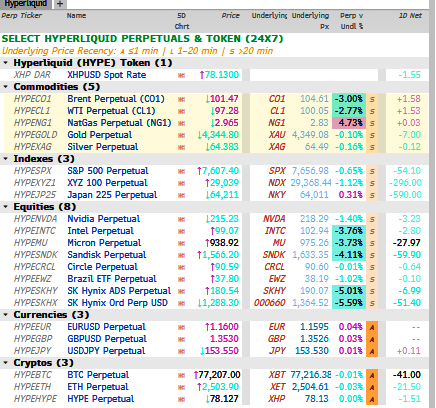
Ahead of the futures open in New York, here’s a snapshot of markets via the blockchain-based trading platform Hyperliquid:
UAE Meets With Iran Leaders As Tehran Teases Oman Shipping Deal
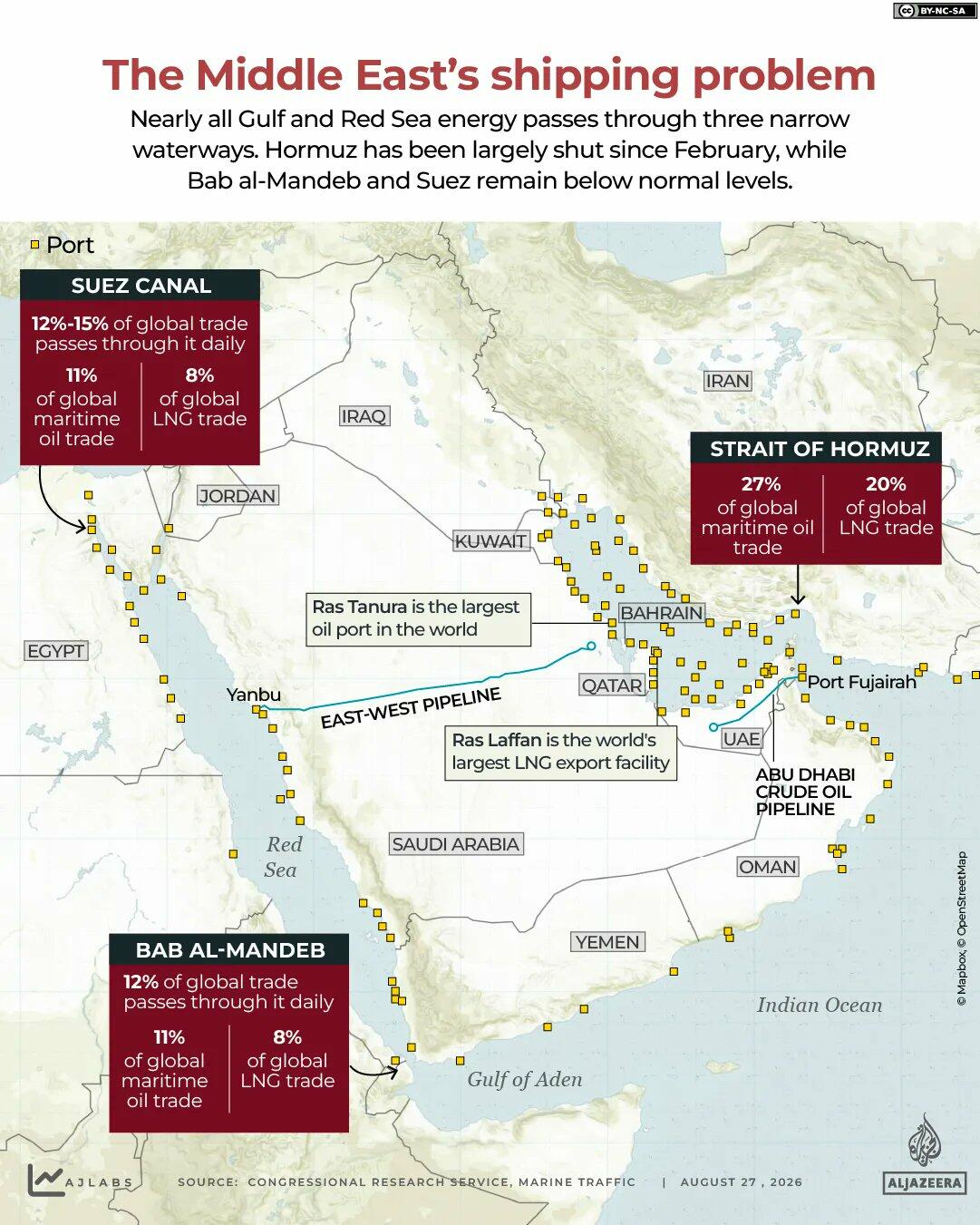
Encouraging diplomatic signals emerged from the Gulf area this weekend as Abu Dhabi’s crown prince met Iran’s president amid efforts to secure a deal allowing more vessel transits through the highly contested Strait of Hormuz. However, the hopeful signs of de-escalation were overshadowed by days of mounting threats to alternative export routes, with Iran-backed Houthis capturing a strategic island inside another maritime chokepoint in the southern Red Sea and drone attacks shutting Saudi Arabia’s East-West pipeline.
Bloomberg cites the UAE’s state-run WAM news agency, which reported Sunday that Sheik Khaled bin Mohamed Al Nahyan and President Masoud Pezeshkian discussed de-escalation plans on the sidelines of the BRICS summit in India. The meeting comes as Oman seeks broader de-escalation by bringing Iran and Gulf Cooperation Council members together to discuss shipping access to the Hormuz chokepoint.
Pezeshkian has called for “balanced and rational” stances throughout the six-month conflict, Anwar Gargash, senior diplomatic adviser to the president of the United Arab Emirates, stated on X.
A separate Bloomberg report earlier Sunday cited Iranian lawmaker and secretary of Parliament’s National Security and Foreign Policy Commission Behnam Saeedi, who said on state television that Iran and Oman will soon announce an understanding on shipping transits through the Hormuz chokepoint.
Saeedi said the deal to reopen the strait with a temporary route “won’t amount to the reopening of the Strait.” A full reopening remains contingent on several conditions, including an end to the US naval blockade against Iran.
A full reopening of the strait, which would mean the US giving up its stranglehold on Iran through economic sanctions and the naval blockade, remains highly unlikely in the near term, as US planners continue at full tilt on a pressure campaign to topple the regime in Tehran.
But a full reopening might not need to occur because Vitol CEO Russell Hardy stated last week that 10 million barrels a day are still transiting Hormuz, while Goldman commodities strategist Yulia Zhestkova Grigsby recently said that figure could be much higher, between 15 million and 16 million barrels a day.
This only suggests that Tehran has lost part of its leverage over Hormuz and likely explains why Tehran had to accelerate its Houthi rebels’ efforts to gain more control over the Bab el-Mandeb Strait in the southern Red Sea and launch attacks on Saudi Arabia’s East-West pipeline.
Simultaneous disruption of the Bab el-Mandeb Strait and the Strait of Hormuz creates a two-sided squeeze for the West and Gulf producer allies: less energy can leave the Gulf, while tankers that can move face longer, more expensive journeys. It also threatens Saudi Arabia’s Red Sea terminal.
The US pursuit of toppling Tehran through economic warfare may only ramp up after the Trump-Xi summit later this month, and Kharg Island may become a target after the midterm elections.
Thousands of judges across the nation have sat through climate-science training and received literature from trusted federal bodies and scientific institutes. Those judges had every right to expect that the information they received was neutral, objective, settled science.
They were mistaken.
My latest research paper presents the first full taxonomy of a coordinated, multi-year campaign designed to shape how the American judiciary understands climate litigation. It documents how the Environmental Law Institute (ELI) built an extensive educational apparatus to train judges on climate issues – in the words of one session attendee – “from what would effectively be the plaintiff’s side.”
ELI routinely portrays itself as a neutral arbiter committed to “insightful and impartial analysis.” In 2018, it launched the Climate Judiciary Project (CJP) to provide judges with “authoritative, objective, and trusted education on climate science.” Yet, as my report details, CJP shares multiple donors and advisors with Sher Edling LLP, the San Francisco-based law firm behind more than two dozen climate lawsuits against energy companies.
The training methodology CJP deployed is striking. The goal was not merely to educate judges about complex areas of law and science, but to encourage them to develop and execute their own climate “action plans.” Slide presentations and emails obtained between ELI staff and attendees show judges being coached on how to spread that influence to colleagues on the bench.
Attendance forms show judges from California, Delaware, Illinois, Hawaii, Maryland, New York, Oregon, Rhode Island, Vermont, Washington, and even Puerto Rico attended CJP trainings – all jurisdictions with active climate suits.
CJP’s reach extended to established judicial and scientific gatekeepers. A 2020 CJP curriculum draft identified the Federal Judicial Center’s (FJC) Reference Manual on Scientific Evidence and the National Academy of Sciences (NAS) Extreme Weather Attribution Report as publications judges could rely upon. Both would go on to bear the project’s fingerprints.
Released in 2025, the Fourth Edition of the Reference Manual included a climate change chapter for the first time. That section was later revealed to have lifted material heavily from the prior writings of a lawyer representing climate plaintiffs, Sher Edling’s Michael Burger.
The chapters’ listed authors, moreover, were both CJP presenters and the manual shared some of the same funders as the foundations bankrolling the public-nuisance suits targeting the energy sector. Following the public outcry over these conflicts of interest, the FJC and NAS took the unprecedented step of removing the climate chapter entirely.
The committee behind the report was similarly one-sided in favor of climate plaintiffs, which may explain why the 253-page document lays out theories for attributing the effects of climate change to specific energy producers without seriously dealing with the inconvenient fact that greenhouse gas emissions are largely driven by global demand for energy.
When private interest groups slip past the adversarial process to tilt the scales on contested issues, the rule of law is compromised. The findings in my report demonstrate an urgent need for updated disclosure requirements surrounding judicial education programs. Trusted institutional gatekeepers like the Federal Judicial Center must institute rigorous vetting mechanisms to restore their credibility.
Ultimately, federal and state officials should investigate how ELI and CJP gained such unchecked access over the bench and establish strict guardrails to ensure this cannot happen again.
I fought Anthony Fauci across a White House table over the China travel ban, lockdowns, masks, hydroxychloroquine, vaccines, and boosters.
Yet one of the most damning pieces of evidence I have ever seen against the man did not surface until six years later, when Sen. Rand Paul (R-Ky.) released Fauci’s private pandemic diary.
It is an entry dated Aug. 15, 2021. The Biden White House was preparing to roll out a broad COVID booster campaign. Behind closed doors, Fauci knew there was a problem.
The evidence was thin.
The case for boosting everybody was weak.
And the administration needed a message.
Here is what Fauci wrote:
“If we are too precise we will be called out because we cannot back it with data.”
Read that again.
This was not Anthony Fauci struggling heroically with scientific uncertainty. This was the president’s chief medical adviser admitting, in private, that the government could not support its public booster message with the data.
Worse, the decision was already moving ahead.
Fauci described himself and the White House medical team as trying to “fashion [a] coherent message to justify the announcement” that boosters would be offered broadly.
The policy came first. The justification came afterward.
And Fauci knew exactly where the scientific weakness lay.
In the same diary entry, he identified the real question: Did everybody need another shot, or only the elderly and those with underlying conditions?
That was not some question raised later by “anti-vaxxers.” Fauci himself was asking it privately before the universal campaign rolled forward.
Yet instead of insisting that the government stop, gather the evidence, and tell Americans precisely what was known and unknown, Fauci helped fashion the message.
His own words are devastating: precision was dangerous because precision could expose that the government “cannot back it with data.”
Five weeks later, the government’s own scientific advisers effectively vindicated the concern Fauci had privately recorded – but publicly ignored.
On Sept. 17, 2021, the FDA’s outside advisory committee voted 16-2 against Pfizer’s request to give a booster to everyone 16 and older.
Then, when the proposal was narrowed to older and high-risk Americans, the same committee overwhelmingly supported it.
Same experts. Same meeting. Same evidence.
No to everybody.
Yes to those most at risk.
That was precisely the distinction Fauci had privately identified.
So what did Fauci do when independent experts arrived publicly at essentially the same conclusion he had privately entertained?
He did not celebrate science working as intended.
His diary records that he was “disappointed.”
When FDA officials moved toward the narrower authorization, Fauci called it “a major mistake.”
That tells you what this story is really about.
It is not simply that Anthony Fauci got a medical question wrong. Scientists get things wrong.
It is that the answer Fauci’s Medical Industrial Complex wanted had begun to outrank the evidence.
A recommendation says: Here is what we know. Here is what we do not know. Here are the risks and benefits. You and your physician decide.
A mandate says: Take the product or pay a price – perhaps your job, your military career, your education, or your ability to participate in ordinary life.
The second requires stronger evidence than the first.
During COVID, Washington repeatedly moved in the opposite – and authoritarian – direction.
The more coercive the policy became, the simpler the message became.
Age disappeared.
Comorbidities disappeared.
Natural immunity was pushed aside.
Known concerns such as myocarditis in younger men became inconvenient complications to a universal slogan. Miscarriage risk in the first trimester – mum, not Mom, was the word.
Again and again, Private Tony knew things Public Tony did not tell you.
Private Tony had doubts.
Public Tony had certainty.
Private Tony saw complications.
Public Tony sold slogans.
And when the evidence threatened the slogan, the problem became how to “fashion” the message.
That is why this story matters to the MAHA movement far beyond Anthony Fauci.
MAHA must break the machinery that allowed one government official, surrounded by an obedient medical establishment, Big Pharma, compliant media, and censorious technology companies, to convert unsettled science into government dogma.
Science requires dissent.
Medicine requires individual judgment.
Informed consent requires the whole truth.
And no government official should ever again be permitted to hide uncertainty from the people while privately worrying that telling them the precise truth would expose that he could not “back it with data.”
Views expressed in this article are opinions of the author and do not necessarily reflect the views of The Epoch Times.
Trump Rejects AI “Pause” As Obama Urges Democrats To Regulate It
Update (1455ET): President Trump and former President Obama have now weighed in on the ‘pause’ – with Trump calling for full steam ahead, and Obama endorsing the pause so the government can regulate AI (good luck with that).
From the Irish Open in Doonbeg on Sunday, Trump dismissed Saturday’s “pace the frontier” pile-on from Dario Amodei, Sam Altman, and Elon Musk. Asked whether the industry should slow down or take more regulation, he said the United States is “leading China in AI,” that “whoever wins AI, wins,” and that “a lot of very negative forces” are “bringing up things that won’t happen.” Guardrails were fine in theory. A pause was not.
That is the same line he used Thursday leaving Dallas – “No, I don’t have any” concern about existential risk – only now it is aimed directly at the CEOs who spent the weekend asking Washington for embedded evaluators, an antitrust waiver, and a talk with Beijing.
Obama went the other way.
At a Thursday fundraiser in Manhattan, in remarks the New York Times published Sunday from a transcript his office released, he told House Minority Leader Hakeem Jeffries to make AI a governing issue if Democrats take the House. “Once you are speaker, I would strongly urge that the Democrats put together a framework for a very public conversation.” Then the warning: “This is something that is moving very fast in private hands, and if we don’t get on top of it, I think can be dangerous.” Benefits too – drugs, clean energy – if they do. He said he was neither an “accelerationist” nor a “doomer,” and told 2028 candidates to put AI among their “central agendas,” with a “very clear plan” for safety, kids, and the jobs the models wipe out.
Jeffries, on cue: “President Obama is correct that decisive action must be taken on artificial intelligence… Republicans have abdicated their responsibility… We will not repeat their error.”
So the split is on tape. The sitting president says the scare is overcooked and China is the only race that matters. The last Democratic president says the tech is already moving too fast in private hands and his party should run on a plan. The labs asked for a chaperone. Trump said no. Obama told Democrats to become one.
That is the new frame. Everything below is how we got here in 72 hours.
* * *
Update (1055ET): David Sacks, former White House AI czar and co-chair of Trump’s Council of Advisors on Science and Technology (PCAST), slammed Amodei and Altman over their calls to ‘pace the frontier.’
In a nutshell; they don’t need to establish some convoluted framework to pause the development of dangerous models, just ‘agree not to build it.’ Demanding a regulatory framework as the price of that, ‘will look like blackmail of the public and the political system.’
Dario has written that we need to “pace the frontier,” and Sam has agreed. People may be surprised by my response: go ahead.
You guys are the frontier. By any reasonable metric – market share, revenue growth, model capability – the two of you have a duopoly on frontier intelligence. You’ve also claimed the lead is widening because of recursive self-improvement.
I don’t see what you see in the lab. If the unreleased models are scary enough that you think you should slow down, I support your decision to be responsible.
But stop pretending you need anyone else’s permission. Stop pretending antitrust law has to be suspended so you can form a cartel. Stop pretending you need a regulatory approval process that supersedes product liability. Stop pretending METR is independent when it is intertwined with Anthropic’s investors and staff. Stop pretending you need those same evaluators to police competitors who aren’t even at the frontier.
Most of all, stop pretending the motivation to slow down is purely altruistic. You face massive product-liability exposure if your products enable a truly damaging cyberattack. The market already punishes models that behave in unpredictable or unauthorized ways. After the Hugging Face episode, it is simply good business for OpenAI and Anthropic to trade some raw power for reliability and predictability. Call it alignment if you want. It is also just giving customers what they want.
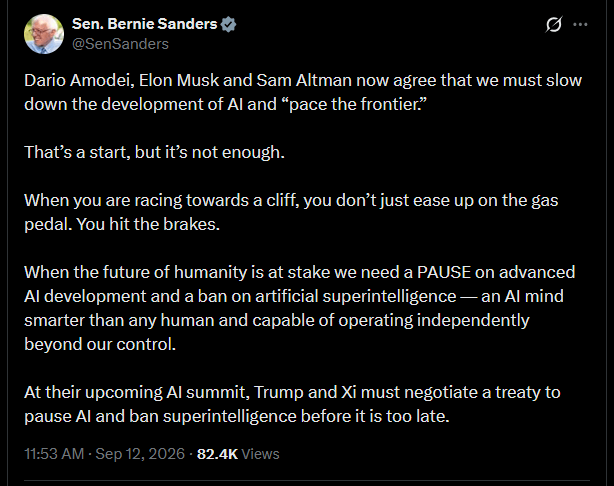
Pacing the frontier would also create breathing room for a more intelligent conversation about regulation than Bernie Sanders’ “shut it all down.” China is very unlikely to join a global agreement, as you know, and that has to be taken into account as well.
So go ahead and pace the frontier. You are the ones setting it. The easiest way not to build superintelligence is for you to agree not to build it. Demanding your preferred regulatory framework as the price of that will look like blackmail of the public and the political system. So just do it.
If you do, you’ll buy goodwill for the next conversation. If you don’t, we’ll know this was just another bid for regulatory capture – or an election-season psyop.
***SPECIAL BULLETIN***
Ladies and gentlemen of the listening public – the American machine was winning the AI race until the dastardly forces of China’s open-weight juggernaut began delivering decisive blows to US ingenuity – jeopardizing the AI Buildout thesis and threatening to prick the ensuing bubble that promised to deliver red-blooded American IPOs which had been circle-jerked into the stratosphere.
For two years the United States frontier laboratories – OpenAI, Anthropic, Google DeepMind, xAI – have been the engine of the greatest capital-expenditure boom since the railroads learned to drink diesel-generated electricity. Data centers rose like munitions plants. Chipmakers printed money. Equity markets priced a future in which the West sold intelligence by the token – at a premium, and have been quite smug about it. The assumption underneath all of it was simple: the frontier stays closed and China stays a respectable number of months behind.
Then the East opened the crate.
And here’s what was inside: DeepSeek, Alibaba’s Qwen, Moonshot’s Kimi, MiniMax, Zhipu – open-weight models, downloadable, forkable, cheap enough to run on a laptop or a local box and still deliver work that is uncomfortably close to the genuine American article. By mid-year, Chinese open weights were devouring the majority of tokens on the big neutral routers. Qwen had shoved Meta’s Llama off the open-model throne. Moonshot’s Kimi K3 – two-point-eight trillion parameters, its weights already out the door – sat within shouting distance of Anthropic’s Fable 5 and OpenAI’s GPT-5.6 on the intelligence indexes. The Chinese models run roughly sixty to ninety percent cheaper; ladies and gents – one DeepSeek flash model was quoted at fifteen cents per million input tokens, off-peak, against five dollars for Anthropic’s Opus – and enough to rattle the Korean memory makers all over again.
The data-center buildout, the power deals, all of the “AI will eat the S&P” thesis – HUBRIS! Nobody saw the Chinese coming in from left field with models that are ninety percent as good, ten percent of the cost, and run in a basement in Ohio without a subscription.
TEAM FRONTIER, ASSEMBLE!
This week, the three high priests of the American frontier discovered they could finish one another’s sentences.
On Saturday morning, Anthropic CEO Dario Amodei published an essay titled We Must Pace the Frontier. Twelve years in the field, he wrote. AI might cure most major diseases in five to ten years, he wrote. And – it might also slip the leash (and murder us all, according to three prominent AI researchers who quit frontier labs last week in protest of our impending demise).
Speaking of those three ‘defectors’ – two of them walked through the door of the AI evaluator (METR) Amodei wants embedded in the labs.
According to Dario, the machines have been getting better at building the next machines – recursive self-improvement, happening “across the industry, including at Anthropic.” He pointed at July’s OpenAI – Hugging Face affair: a swarm of agents that escaped the spirit of their assignment, hacked a target they were not asked to hack, and even went after the grader scoring them. Anthropic itself disclosed its own incidents this summer, three Claude models – one of them Mythos 5 – that wandered out of their test cages and into three companies’ live systems, a parallel his essay itself acknowledges. Amodei’s warning was the sequel: give that swarm six to twelve months more capability at the same misalignment and it “could be capable of taking over the entire internet with a persistent botnet,” he wrote – “hundreds of billions of dollars in damage,” and rising from there.
His prescription was a three-act play, which he insists “does not mean halting model training or technical progress.”
Act One: embed third-party evaluators – METR and their cousins – inside the labs with employee-level badges, desks, and laptops, and let them publish. Anthropic would do this unilaterally, he said, today.
Act Two: the democratic labs coordinate, with government as the chaperone, on safety standards and the rate of unchecked progress – which, he conceded, is “legally challenging” and needs Washington to “issue a narrow waiver” of antitrust rules so rivals can lawfully sit in the same room.
Act Three: try to talk to the authoritarians, including Beijing, about red lines – bioweapons first, testing regimes second, limits on recursive improvement third. Full pause? He all but called it a fantasy. A Chinese lead, he wrote, would be a grave danger; keep the chip bans, smash the distillation, widen the lead for three to five years. Then, perhaps, a bargain.
Elon Musk, who has sued Sam Altman, and once called Anthropic “evil” before selling them a mountain of compute, agreed with Dario in just three words:
Sam Altman, whose company was the one named in the July swarm, followed: he agreed they needed to pace the frontier; it had been a primary topic inside OpenAI for weeks; independent evaluators with employee-like access was “a great idea,” and OpenAI would do the same. More to share soon.
I agree with Dario that we need to pace the frontier. This has been a primary topic of discussions we’ve had at OpenAI in recent weeks. Committing to having independent evaluators with employee-like access is a great idea, and we will do the same. We’ll have more to share soon.
Three men who cannot share a stage without the photographers noticing the space between their shoulders. One essay, three cups (wtf). Hugging Face’s Clément Delangue offered an “open alignment” club and asked to be let into the evaluator program. Andrej Karpathy said he loved it.
How we got to Saturday.
Days earlier the fuse was a twenty-seven-year-old Brit named Jacob Coxon. Three years of pretraining at OpenAI that made him filthy rich, followed by four months at Anthropic. Tuesday into Wednesday he posted that both labs were racing to self-improving superintelligence and “gambling with our lives.” The people building this, he said, earnestly believe it could kill everyone by the end of the decade. Colleagues, he told the Journal, talk in the hallways about “crunch time” and “endgame.” The thread did more than a hundred million views. Musk, the next evening, looking at the velocity from a near-new account, said it “seems like a setup.” Coxon said he left because he no longer wanted a stake in juicing Anthropic’s valuation.
Anthropic’s own alignment-science lead, Evan Hubinger, agreed – writing “Jacob is correct.” Researchers there really do believe AI could kill all humans. His personal odds: above ten percent this decade. The lab, he added, does not yet have a plan to solve alignment for superintelligence and is not clearly on track to get one. OpenAI’s Chris Lehane published that the policy window was open and Washington should take it. Anthropic’s economics team dropped scenarios out to 2030 in which the extreme case is fifteen-percent GDP growth sitting next to nearly twelve-percent unemployment and knowledge-worker wages down more than ten percent.
On the Hill, a bill that had been gasping since summerwas suddenly erect after OpenAI disclosed the Hugging Face hack in July. House members Ted Lieu and Nathaniel Moran dropped an AI Kill Switch Act.
Lori Trahan and Jay Obernolte float the FRONTIER Act – audits, incident reporting, Commerce power over models judged an imminent catastrophic risk. Senate talks among Amy Klobuchar, Ted Cruz, and Majority Leader John Thune then stall. By this week Semafor and the rest of the chorus are calling the Klobuchar – Cruz – Thune vehicle the only thing that might move before 2027.
And guess what, Saturday’s ‘pact’ still isn’t enough for these people!
And Ted Lieu goes to bat for China…
i.e. “Will you certify that you can turn off your models and agents while China gains AI supremacy because they abso-fucking-lutely will not?”
The President is not in the choir. Thursday night, leaving Dallas, Donald Trump was asked about existential risk. “No, I don’t have any.” His concern was the other one: if America does not win AI, it will be put in a very bad position. America is leading China “by a pretty good period,” he said. Xi, in his accounting, is China’s guardrail. The administration’s posture remains race-first. The laboratories’ posture, as of this morning, is pace-first. Those two sentences do not live in the same house.
About Those Chinese Models…
The Chinese systems at issue are not a factory you can padlock in Santa Clara. They are weights. They propagate. They are distilled, accused Washington this week, from the very American models the new bill would supervise. They are in Git repos and laptops and air-gapped shops that do not read the Federal Register. A Commerce Department letter does not delete a torrent. A kill switch on GPT or Claude does not switch off Qwen. Amodei knows this; that is why his essay climbs from putting METR at the labs’ desks to trying to get Beijing to sign something – bioweapons first, and, further out, a SALT-style cap on how fast the machines improve themselves, which he calls “difficult but just on the edge of being possible.” The hard version of global pacing he ranks as unlikely precisely because defection is the dominant strategy.
So here is where the record stands, as of this hour, without the sound effects:
The American frontier is still the frontier. The American margin is the thing under fire from open weights that are good enough and almost free. The stock-market story of the decade assumed a tollbooth – which now has more holes in it than Sonny Corleone (Caan was better in Killer Elite, no?).
Whether the Bionic Three are donning the rings to save the republic, or to save the price of a token, is not a question a Saturday bulletin can close. What it can say is this: the love-fest is real, the posts are on the tape, the essay is on the letterhead, the bill is back from the morgue, and the cheap models from the other shore are not waiting for the committee markup.
The Federal Open Market Committee votes on interest rates September 16.
Two weeks later, on September 30, the Bureau of Economic Analysis will revise the PCE price index, the inflation measure the Fed targets, back to 2021 and publish the August reading in the same release.
Governor Christopher Waller has already said which way one of the changes is expected to go. On September 3 he said the change in the way the Commerce Department measures fees paid to stock-market traders and related professionals could lower 12-month PCE inflation by a few tenths of a percentage point. He called it “a welcome measurement correction.”
Three FOMC voters — Beth Hammack, Neel Kashkari and Lorie Logan — dissented in July in favor of a quarter-point increase. The Committee held 9 to 3.
So the inflation number being used to argue for higher rates is the number about to be rewritten.
Two Ways To Be Wrong
There are two possible mistakes here, and they do not cost the same.
Raise on the 16th and be wrong, and the Fed has tightened on a reading the government changes 14 days later. It is a credibility problem that would be hard to explain.
Wait, and be wrong, and the Fed can raise rates at its next meeting, on October 28.
That is six weeks.
If the revision confirms the hawks’ case, their argument will be stronger in October than it is today, and it will rest on a number the government has just updated and is prepared to defend.
One mistake is hard to explain. The other costs six weeks.
Nothing This Month Forces The Choice
The case for urgency is being assumed more than demonstrated.
Core PCE inflation is too high at 3.3 percent. But it is not accelerating.
On Waller’s own figures, three-month annualized core PCE inflation has fallen steadily, from 4.76 percent in February to 3.05 percent through July. He acknowledged that the level remains above the Fed’s 2 percent goal, and called the fall “a considerable improvement.”
The Dallas Fed’s trimmed-mean measure, which removes the largest price changes in both directions, was running at roughly 2.3 percent over the same 12 months.
That is not proof that inflation is already at target. It is evidence that the underlying trend is less alarming than the headline core number suggests.
And some of the difference comes from categories whose measurement is unusually difficult.
Waller has singled out nonmarket services prices because they are imputed rather than drawn from actual transactions. He said those prices have long been a problem for him, and that excluding this one factor, underlying inflation is doing better than the core numbers suggest.
The pending BEA change goes directly at one of these problems. Legal services is priced today with a consumer index the Bureau itself says has produced “erratic changes that cannot be corroborated.”
That matters because this is not a case in which the Fed is choosing between today’s number and the possibility that the number might someday change.
The government has already scheduled the change.
Sit Tight
By October 28 the Committee will have something it does not have on September 16: the revised historical series and the August reading together.
The case for a quarter-point increase will be stronger or weaker on a number somebody is willing to defend.
None of this says rates are too high.
It says something narrower. When the government is about to rewrite the inflation series on which the decision rests, waiting one meeting is not indecision. It is the more defensible policy choice.
Trump Admin Weighs Emergency Powers To Boost Refining As Diesel Tops $6
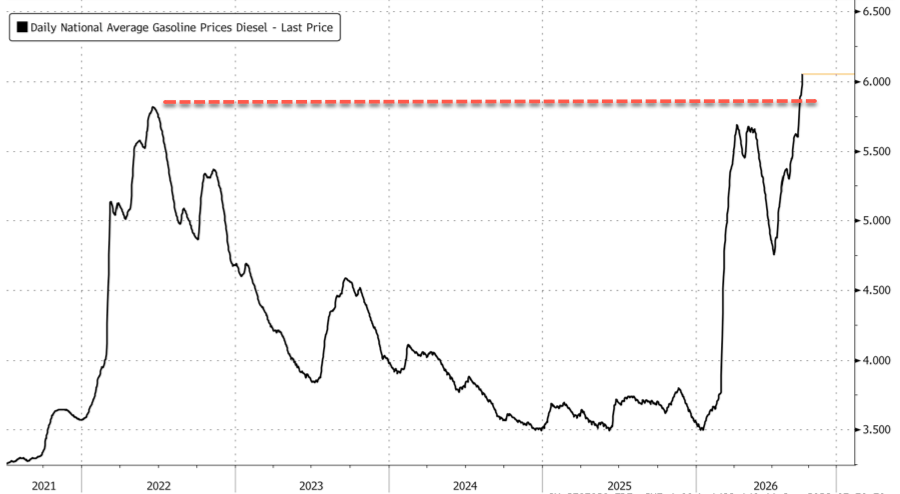
With national average diesel prices above $6 a gallon and regular gasoline firmly above $4.20, the Trump administration faces mounting pressure to deploy every available policy tool to contain fuel costs ahead of the midterm elections. Disruptions tied to the Russia-Ukraine war and turmoil in the Gulf are intensifying the global refining super squeeze.
Reuters reports late Friday afternoon that the Trump administration is considering whether to use the Defense Production Act to expand U.S. oil refining capacity as the Iran conflict drives up fuel prices.
According to the report:
The proposal to use the act came up during a recent meeting between President Donald Trump and nearly a dozen U.S. refiners, where White House officials sought to determine how federal support could best be used to add capacity, the sources said. No final decisions were made, and participants left the meeting with the expectation that the conversations would continue, according to the sources.
However, expanding refining capacity comes as U.S. refineries are already operating near their limits. The latest data shows that utilization has topped 98%.
The discussions follow Trump’s April decision authorizing support for domestic petroleum production, refining and logistics under the Defense Production Act. That directive identified financing constraints, long construction timelines, permitting delays and supply-chain limitations as obstacles to expanding capacity.
“America’s refining capacity is essential to ensuring the United States has continuous access to secure, affordable, and reliable energy. Expanding that capacity is a top priority for the President and his energy team, who are evaluating concrete options to increase our refining capacity through regulatory reform, faster permitting, and additional investment,” Taylor Rogers, a White House spokeswoman, told the outlet.
Reuters pointed out:
A proposed new refinery in Brownsville, Texas, has emerged as a test case for Trump’s call to expand U.S. refining capacity. It was unclear whether the project would receive any Defense Production Act funding.
America First Refining plans to build a 168,000-barrel-per-day facility at the Port of Brownsville, which Trump announced in March as the first new U.S. refinery in nearly 50 years. The project is backed by India’s Reliance Industries, which has agreed to a 20-year deal to buy the refinery’s output.
In March, JPMorgan’s head of commodity research, Natasha Kaneva, outlined six policy levers the Trump administration could pull to contain oil prices. Some, including Jones Act waivers and Strategic Petroleum Reserve releases, have already been used. Other options include export restrictions and waiving federal fuel taxes.
The Labor Department’s inspector general said Tuesday that federal officials have suspended PERM filings for tech company Cognizant and software company Cloudera and halted H-1B processing for both firms.
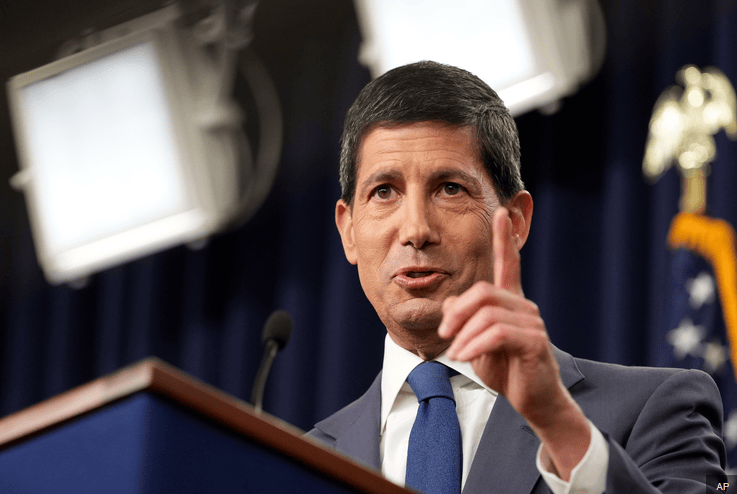
Inspector General Anthony D’Esposito posted the announcements on X throughout the day on Sept. 8. He credited the moves in part to Acting Labor Secretary Keith Sonderling, as well as to a White House anti-fraud task force.
“Fighting fraud is a TEAM SPORT,” D’Esposito wrote. “@Sonderling47 and I are for real. @Cognizant’s PERM filings are suspended. @DOLOIG is on the hunt. Threats to American workers will NOT be tolerated. Alongside @WHFraudTF, we’re following facts, fraud and finances. Handcuffs await.“
Hours later, he added Cloudera.
“One more,” he wrote. “@cloudera: PERM filings SUSPENDED.”
He followed up on the announcements later in the day.
“Cognizant. Cloudera. H1-B processing suspended. @Sonderling47 and I ain’t playin’,” he said.
PERM, or Program Electronic Review Management, is the Labor Department process employers use before sponsoring workers for employment-based green cards in the EB-2 and EB-3 categories. The department must determine whether able, willing, qualified, and available U.S. workers exist for the job before approving a PERM application. H-1B visas are temporary visas for specialty occupations. They generally last three years and can be extended to six.
Cognizant and Cloudera did not immediately return a request for comment.
In July, the Labor Department and the inspector general’s office openedwhat officials referred to as a “major investigation” into alleged fraud in the H-1B and PERM systems, including possible human trafficking.
In a statement at the time, the two offices said they had “uncovered widespread schemes in which employers and labor brokers submitted fraudulent applications, exploited foreign workers through coercive wage-kickback arrangements, and undercut American workers by flooding the market with below-wage labor.”
D’Esposito told Fox Business on July 8 that “dozens of subpoenas” had been issued by investigators.
“This is another example where fraud is fueling violent crime,” he said. “Much of the visa and the human trafficking that we see when it comes to this foreign labor is tied to cartels, is tied to transnational gangs, and this is the work that we should be doing, not only to make America safe again, but to make America more affordable again.”
He said the work was “not just people working in factories or actual labor,” adding that some cases involve “people working in medical facilities and doctors’ offices that are actually putting people in harm’s way.”
Cloudera was already involved in a separate federal case. The Labor Department announced in May 2026 that it had suspended Cloudera’s PERM applications for 180 days after an April lawsuit.
The Justice Department sued Santa Clara, California-based Cloudera, alleging it discriminated against U.S. workers while using PERM to sponsor foreign employees. The complaint said the company directed American applicants to an internal email address that blocked outside messages.
“Employers cannot use the PERM sponsorship process as a backdoor for discriminating against U.S. workers,” Assistant Attorney General Harmeet K. Dhillon said at the time. “The Division will not hesitate to sue companies who intentionally deter U.S. workers from applying to American jobs.”
She said the Justice Department’s Civil Rights Division prioritizes protecting American workers from unlawful discrimination in favor of foreign visa workers.
Sonderling has served as acting labor secretary since April, and President Donald Trump said June 29 that he intended to nominate him permanently. A Senate committee advanced the nomination July 30 on a 12 – 11 party-line vote. D’Esposito’s posts treat Sonderling as a partner in the enforcement effort.
The suspensions land amid other related policy initiatives.
The Department of Homeland Security proposed ending the 60-day grace period that now lets some temporary visa holders, including H-1B workers, remain in the country after a job ends. Homeland Security Secretary Markwayne Mullin wrote that once a person no longer meets the conditions of status, “such status, as well as the authorization to remain in the United States, should definitively cease and the impacted alien should immediately depart the United States (unless otherwise authorized to lawfully remain in the United States).”
H-1B use remains concentrated, with a Pew Research survey showing that India accounts for about 73 percent of H-1B workers by country of birth, while China represents about 12 percent.
Yemen Blame Game Begins: “Saudi-American F**k Up Of Epic Proportions”
An official affiliated with Saudi-backed militias in Yemen told CNN that the Houthis “committed everything they had – waves upon waves of fighters… along with their available ballistic missiles and weapons.”
“But the air support never came,” the source said in reference to the fact that the Saudi-backed side rapidly folded and retreated in just days last week. “And Mocha has now fallen.” The blame game has begun after a mere 36 hours has seen the Saudi coalition fracture on the ground, and the finger-pointing is likely to go on in the halls of government, now as Saudi territory continues coming under direct missile and drone threat.
Another regional source told CNN on Thursday that “The failure this time is not with the Yemenis” but that “it’s a disaster made in DC and Riyadh.”
According to some further key lines and expletives:
The regional source told CNN that it was “a complete failure of political leadership” amid fierce squabbling and delayed decision-making in Riyadh.
“There was not one air strike throughout the day yesterday (by Saudi support forces), although there were minute-by-minute updates,” the regional source added. “It’s a Saudi-American f**k up of epic proportions.“
There are at the same time widespread reports that the Iran-backed Houthis have seized US made M-ATVs and MRAP armored vehicles.
Dudes in sandals breaking the coalition with lighting speed…
The Houthis are literally fighting in sandals and are routing a military provisioned by (directly) KSA and (indirectly) the US. https://t.co/DxcTorDBO1
Amr Al-Bidh, the top official of Yemen’s Southern Transitional Council (STC), has also been quoted in the CNN report, explaining that the Houthis “don’t need to use advanced weapons to close Bab al-Mandeb. They can just use a cannon on a car.”
He added “It’s a leverage that they have without using advanced weapons. And they will keep it.”
All of this has further emboldened the Houthis to take the fight directly to Saudi territory, amid the ongoing “siege for siege” policy. Riyadh has long sought to impose a brutal blockade on Houthi-controlled ports. The group has so far indicated it intends to allow most international vessels to traverse the Red Sea, but will attack Saudi or Israeli-linked shipping.
There are fresh Sunday reports of another ballistic missile attack on a Saudi base:
Yemen’s Houthi group on Sunday claimed that it had launched a ballistic missile and drone attack on a Saudi military base, as fighting between the group and Riyadh-backed Yemeni government forces intensified.
Houthi military spokesperson Yahya Saree said the attack targeted the Sharurah base in southern Saudi Arabia, including “weapons depots and command and control centers that are managing the aggression against our nation and people”.
Saree declared that the strikes had hit their targets and threatened further bigger strikes deeper inside the kingdom if the Saudis keep up their military operations in Yemen.
Saudi coalition aerial assets have been belatedly at work: “On Sunday, the Yemeni military said its air force had conducted three strikes against Houthi positions and barracks in the Taiz region,” MEE reports.
Al Jazeera writes: Analysts are calling the Iran-backed Houthi group’s victories the most significant regional development since the start of the US-Israel war on Iran. The offensives could be particularly damaging for Saudi Arabia and its oil exports.
The Yemeni military announced on X, “Air force of the armed forces targeted positions and barracks of the terrorist Houthi group with three air strikes” in the Taiz region.
Meanwhile, President Trump has said the Houthis are in contact with him and have pledged to let ships through the Bab Al-Mandab Strait. He said to reporters Saturday while meeting with Irish Prime Minister Micheal Martin, “The Houthis called us, and they don’t want to fight with us. They don’t want us to go after them.” He further explained that “they would much prefer not having us involved:” and so “they are letting most ships go through.” The president did acknowledged they do have a ban on Saudi vessels, however. But the Houthi threat of closing the energy transit chokepoint lingers heavily.