US stock futures slumped for a 3rd consecutive day, unable to find traction, and trading at session lows with tech underperforming as Treasury yields pushed higher keeping risk appetite firmly in check ahead of the latest print on US factory prices and earnings from Oracle. As of 8:15am ET, S&P futures are down 0.2%, with Nasdaq futures lagging, and down 0.5%. Pre-market, MegaCap Tech stocks are mixed, led by AAPL and META +1.0%. Overnight, TSMC reported a 53% increase in monthly sales amid strong AI infrastructure demand. Incremental macro news flow were largely muted since yesterday’s close: Trump promised $5k division if GOP wins the midterm, which sparked fresh fiscal stability concerns and pushed yields to fresh 3 year highs, as the 10Y tops 4.88%. The USD reversed an earlier drop to trade at session highs as the Yen slumps. Commodities are mixed: Oil higher (WTI +1.7%), while precious metals are lower; base metals and Ags are higher. US economic data slate includes weekly jobless claims and August PPI (8:30 a.m.) and August existing home sales and July wholesale inventories (10 a.m.). Fed speakers remain in external communications blackout period ahead of Sept. 15-16 FOMC meeting

In premarket trading, Mag 7 stocks are mixed but fading fast: Meta rises 1.3% as JPMorgan upgrades to overweight, citing upside potential after the social media giant launched its AI assistant (Apple +1.1%, Alphabet +0.2%, Microsoft little changed, Amazon -0.1%, Nvidia -0.5%, Tesla -0.7%
- Copper stocks are falling after Reuters reported that the White House has not yet made a decision on refined copper tariffs as it weighs concerns of higher prices raising manufacturing costs against the potential benefits of encouraging more domestic mining, citing two people familiar with the matter.
- AeroVironment (AVAV) rises 4% after the drone maker reported revenue for the first quarter that beat the average analyst estimate.
- American Eagle (AEO) falls 14% after the apparel firm’s second-quarter total comparable sales fell short of the average analyst estimate. Analysts note that strength at its aerie brand was more than offset by weakness at AE.
- Cooper (COO) tumbles 16% after the healthcare supplies maker cut its adjusted earnings-per-share and revenue guidance for the full year. Analysts note weakness in the firm’s CooperVision unit weighing on its sales forecast.
- JetBlue (JBLU) falls 2% after the airline cut its available seat miles forecast for the third quarter.
- Kinetik (KNTK) climbs 4% as the energy pipeline company partly owned by Blackstone is in the early stages of exploring options, including a sale, according to people familiar with the matter.
- Macy’s (M) slips 1% as investors weigh much better-than-expected comparable sales and adjusted EPS in the second quarter against a less robust third-quarter guidance.
- Navan (NAVN) slumps 15% after the software company gave an outlook that analysts said pointed to weaker trends in the second half of the year, despite overall solid growth.
- Rackspace Technology (RXT) climbs 13% after the company said it had joined the Nvidia Cloud Partner Program.
In other corporate news Citadel Securities told regulators that prediction market contracts linked to publicly-traded companies should be overseen by the SEC. Boring Co. secured $3 billion in fresh funding backed by the UAE, valuing Elon Musk’s tunneling startup at $23 billion.
Sentiment remains muted as inflationary signs grow: Brent is now trading above $103 (with Shanghai trading at $115!) as Iran vowed it was prepared for a more intense war, LME copper futures hit new records, and global tanker freight rates reached all-time highs.
Investors are also bracing for a busy calendar that could provide fresh catalysts for markets. The packed agenda comes after global yields climbed to the highest in years as the war in the Middle East pushed oil prices higher, prompting traders to bet on tighter monetary policy across the globe.
First up is the latest European Central Bank interest rate decision, with a hike already priced in and the focus instead on guidance. Earnings from Oracle Corp. will offer a fresh read on the outlook for artificial intelligence.
Meanwhile, the August producer price index could offer clues on the course of inflation for the rest of the year and what it means for US rates. Today’s PPI number, followed by CPI on Friday, are key for market direction. With PPI components feeding directly into the Fed’s preferred inflation gauge and Fed’s Waller saying that the August data will heavily influence his decision, a hot print could materially reprice September rate-hike odds, currently at 61%. Stocks currently have greater sensitivity to bond yields, with S&P 500 equity risk premium relative to Treasury yields at lowest since 2002.
“Today’s PPI report matters, but probably not enough on its own to change the Fed’s decision next week,” said Santiago Mateo Yanguas at CaixaBank AM. “That said, a significant upside or downside surprise could still move markets today by shifting expectations for the rate path beyond the next meeting, particularly in Treasury yields and interest rate-sensitive sectors.”
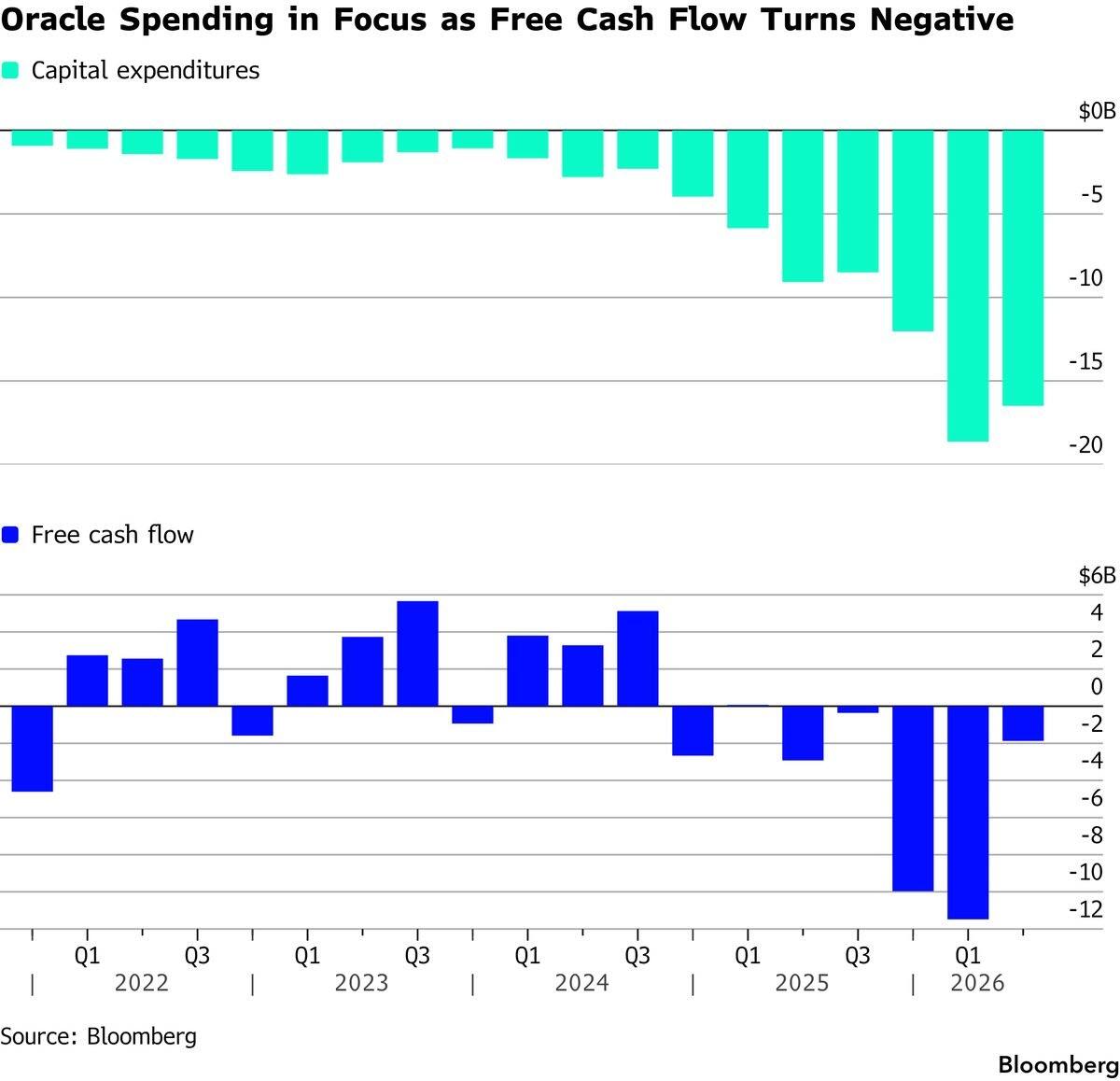
Oracle reports after the US close with its shares down 17% this year, sharply underperforming tech peers as traders punished the firm over concerns about heavy capital spending and leverage. While cloud unit sales are projected to have more than doubled in the first fiscal quarter, recent market moves show that strong earnings aren’t always enough to win investors over. Separate figures from Adobe Inc. will offer another window into how software giants are navigating the challenge from AI.

“While quarterly results may trigger short-term volatility, we see the underlying earnings trend as the more important driver of long-term equity performance,” said Francisco Simon at Santander Asset Management. “The structural growth story remains intact, and that is ultimately what matters.”
Meanwhile, markets largely shrugged off President Donald Trump’s promise to give adult US citizens a $5,000 dividend if Republicans retain control of both houses of Congress.
“Markets appear to assign a very low probability to the measure becoming law, given the significant fiscal cost and the political hurdles it would face in Congress,” said CaixaBank’s Yanguas. “Unless the proposal gains tangible legislative support, investors are likely to treat it more as campaign rhetoric.”
Still, while Trump’s offer was met with skepticism by the market, it adds to concerns about erratic policymaking at a time when Bessent is striving to keep yields down. Yesterday’s buyback announcement disappointed many who had expected more than the up to $6 billion announced: The “Treasury brought a pea shooter to a tank battle,” said Elias Haddad, Global Head of Markets Strategy at Brown Brothers Harriman.
Still, the ‘Trump dividend’ would cover the cost of a shiny new iPhone. Part of the sticker shock had been well flagged, with memory prices for smartphones surging as the AI buildout sucks up supply. Hyperscaler spending will be back in the spotlight after the close when Oracle reports — it’ll be a big test of market tolerance for AI spending given the company’s massive debt load.
There’s no signs of a slowdown in the AI buildout yet. TSMC posted the second fastest year-on-year monthly sales print for 2026, with the company struggling to meet overwhelming demand. Microsoft’s CFO said at an investor conference that Azure was supply constrained, while AI chipmakers in China are reportedly raising processor prices.
The upside in oil has also weighed on equities with the Stoxx 600 down 0.2% after erasing an earlier gain. European shares slipped for a third day ahead of an ECB meeting that’s expected to deliver an interest-rate increase and could offer clues on further policy tightening. Here are the biggest movers Thursday:
- FirstRand shares gained as much as 4.5%, the most since May, after the South African lender reported full-year results, which JPMorgan analysts said reflect “robust” momentum
- MP Evans Group gained as much as 6.5%, to the highest since May, after the Indonesian palm oil producer announced an acquisition of new land in Kota Bangun
- Genfit shares climbed as much as 12%, the most in over two months, after the biopharmaceutical firm outlined the commercial prospects for its non-invasive diagnostic test for MASH (metabolic dysfunction-associated steatohepatitis), sparking price-target upgrades
- D’Ieteren shares rose as much as 6.4%, the most in more than four months, after adjusted pretax profits rose in the first half
- Corbion advanced as much as 5.7%, to the highest since Feb. 2025, as Oddo BHF lifts its price target on the Dutch food ingredients firm to a joint Street-high
- AB Foods shares fell as much as 11%, the most since January, after the Primark owner reduced its profit guidance for the Sugar and Grocery divisions
- Genus shares fell as much as 9.8%, the most since February, after full-year revenue at the livestock breeding and genetics group missed analyst expectations
- Hemnet fell as much as 9.6%, the most since April, after the Swedish property listings platform announced it will pause its share buyback program of up to SEK600m in ordinary shares
- Fevertree Drinks fell as much as 6.5%, the most in more than a year, after the beverage company reported first-half earnings that came in shy of expectations
“We don’t think that the ECB would be more hawkish than current pricing,” noted Mohit Kumar at Jefferies. “We expect Lagarde to keep the future path of monetary policy data-dependent and not lean into a series of rate hikes.”
Asian stocks fell, tracking losses on Wall Street, as oil prices surged past $102 a barrel and intensified concerns that inflationary pressures would keep interest rates elevated. The MSCI Asia Pacific Index dropped as much as 1.3%, the most in a week, before paring some losses as chipmakers recovered from session lows. TSMC, Delta Electronics, Tencent and Alibaba were among the biggest drags on the gauge. South Korea’s Kospi closed down 0.3%, while most other benchmarks in Asia, including Taiwan and Hong Kong, traded lower. After being down much of the day, Japan’s Topix recovered and ended 0.2% higher, with Recruit Holdings contributing the most to the gains. “Oil price fluctuations and the upside of some of the near-term escalations that we’ve seen have really been some of the key risks that market has to fathom as we head toward the the end of this year,” said Yuting Shao, senior director for global macro strategy at Manulife Investment Management. Earlier this week, MSCI’s Asia stock gauge approached near June’s record high as sectors beyond technology drove the rally. But renewed Middle East tensions have driven oil prices higher, with Brent crude holding gains after Iran said it was prepared for a more intense war with the US.
In FX, the Bloomberg Dollar Spot Index is flat. The krone is the weakest of the G-10’s, falling 0.3% against the greenback.
In rates, the downside in Treasuries has pushed US 10-year yields up 3 bps to 4.87%, the highest since October 2023. Advancing energy prices weigh on Treasuries and front-end gilts, which have underperformed during London morning. With Treasury front-end yields about 1-2bp higher on the day and 10-year about 4bp higher near 4.855%, 2s10s and 5s30s spreads are about 2bp wider. Gilts lead the selloff in European government bonds with UK two-year borrowing costs rising to the highest since November 2023. US session highlights include August PPI data, 30-year bond auction and results of the 10- to 20-year buyback shortly after 2 p.m. New York time.
WTI crude oil futures remain higher by about 1.7% after rising as much as 1.9%; Brent crude topped $102 a barrel amid signs US war on Iran will be protracted
Treasury auction cycle concludes with $22 billion 30-year bond reopening; Wednesday’s 10-year note auction drew strong demand as measured by its clearing yield 1.5bp lower than indicated by the WI level at the bidding deadline. WI 30-year yield near 5.31% is 9.4bp higher than last month’s new-issue auction result, a 0.4bp tail. IG dollar issuance slate includes Kommunalbanken 3-year offering; 16 borrowers priced $23 billion of US investment-grade bonds Wednesday, pushing two-day volume above $61 billion. Issuers paid about 4bps in new issue concessions on deals that were 3.1 times covered.
In commodities, Brent crude futures rise over 2% and above $103 for the first time since July with Iran ready for a more intense war. Oil prices did fall earlier in the session, providing a modicum of support to bonds after Wednesday’s selloff but that proved short lived.Spot silver falls 1% while gold is little changed.
US economic data slate includes weekly jobless claims and August PPI (8:30 a.m.) and August existing home sales and July wholesale inventories (10 a.m.). Fed speakers remain in external communications blackout period ahead of Sept. 15-16 FOMC meeting
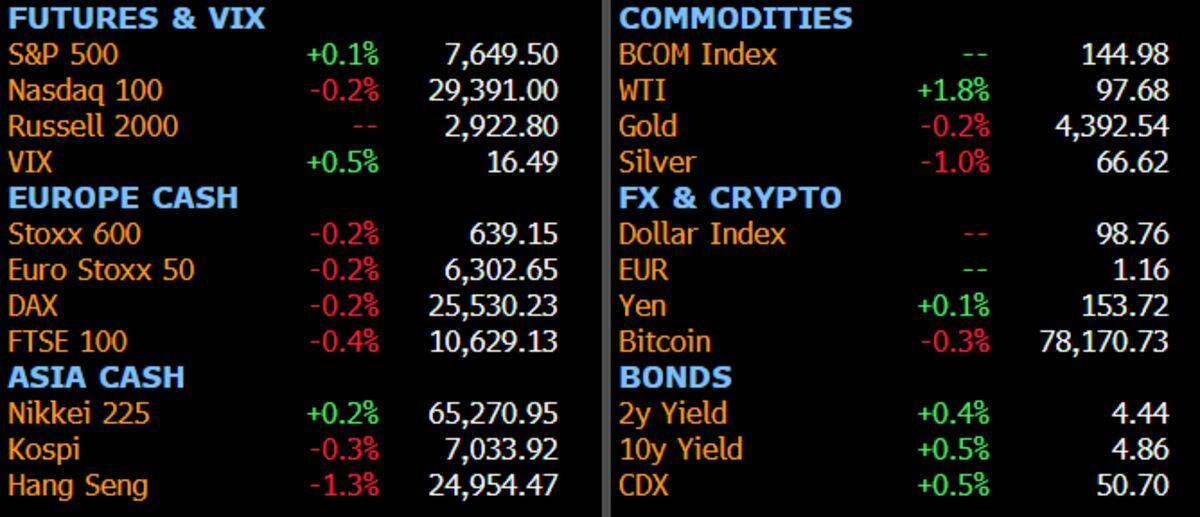
Market Snapshot

Top Overnight News
- Trump on Wednesday suggested his Iran war might end after the mid-terms, but some of his top advisors warn it could last the duration of his presidency, potentially extending the conflict past Inauguration Day in January 2029. WSJ
- Donald Trump promised $5,000 for every US adult if Republicans retain Congress, which must be spent in the US and will cost well over $1 trillion. The move signaled mounting concern over affordability and fiscal discipline as voters sour on the economy and Iran war. BBG
- US Treasury Secretary Bessent touted tax cuts, job increases, trade rebalance and Trump accounts during his speech at the RNC Midterm Convention.
- Within weeks of Iran’s closure of the Strait of Hormuz, once Saudi Arabia’s primary export route for oil, the kingdom turned to Plan B: bypassing the strait by ramping up exports through pipelines to Red Sea. NYT
- The South Korean government is nearing the announcement of a major energy investment project in the U.S. to support America’s artificial-intelligence build-out, a long-awaited development of the trade deal struck between Washington and Seoul last year. The deal, potentially worth more than $100 billion, envisions South Korea financing the construction of up to eight nuclear power plants and a natural-gas project. WSJ
- The popularity of high-risk bets among investors looking to cash in on South Korea’s artificial-intelligence boom has caused concern at the central bank. A surge of investment in leveraged exchange-traded funds tied to tech titans such as Samsung Electronics and SK Hynix generated significant volatility in the domestic stock market, the Bank of Korea said, calling for stronger oversight and regulation of leveraged ETFs as they risk sowing instability. WSJ
- The ECB is widely expected to raise rates for the second time since the Iran war sent energy prices soaring. The focus will be on signals from Christine Lagarde as markets see at least two more hikes. BBG
- The Bank of Japan may eventually be forced to raise interest rates rapidly if inflation accelerates given the country’s loose financial conditions, board member Kazuyuki Masu said, warning of price risks that solidify the chance of a September hike. In a closely watched speech ahead of next week’s policy meeting, Masu warned of broadening price pressures that have pushed underlying inflation “very close” to its 2% target. Reuters
- US PPI likely firmed in August after a renewed pickup in commodity prices. Consensus expects a 0.4% monthly increase. BBG
- TSM reported record monthly revenue for August on Thursday, as demand for chips used in artificial intelligence applications remained strong. The world’s largest contract chipmaker posted revenue of $514.8 billion New Taiwan dollars ($16.35 billion) for last month, up 53.3% from a year earlier and 10.1% from July. CNBC
- BofA Total Card Spending (w/e 5th Sept) +7.8% Y/Y (prev. +3.7% W/W). BofA said that the surge in spending growth was likely due to base effects from the shift in Labour Day timing and a rebound in gas prices.
- A US AI safety bill could be introduced next week, Semafor reported citing sources.
- A US Republican-led Senate subcommittee is investigating OpenAI’s handling of the Hugging Face breach in July, Axios reported.
- S&P500 EPS growth in Q2 2026 was ~30% year / year excluding the “other income” related to some private investment stakes. Earnings for the hyperscalers and the AI infrastructure companies benefiting from their capex spending increased by 54% year / year in Q2, accounting for about 50% of S&P 500 EPS growth during the quarter. However, earnings growth for the rest of the market has also been strong and accelerating. Excluding the Energy sector profits that were boosted by higher oil prices, the rest of the S&P 500 posted year/year EPS growth of 14%: GS FICC
A more detailed look at global markets courtesy of Newsquawk
APAC stocks were mostly lower following the losses stateside, where all major indices declined as yields and oil prices climbed, with Brent crude topping USD 100/bbl for the first time since July. ASX 200 underperformed amid broad-based weakness across sectors and with the downside led by materials, mining, resources, and tech. Nikkei 225 was pressured alongside a higher yield environment and ongoing rate hike expectations, while BoJ board member Masu also stuck to the hawkish hymn sheet. KOSPI declined at the open but was off today’s worst levels as SK Hynix rebounded from intraday lows. Hang Seng and Shanghai Comp conformed to the subdued mood across the region in the absence of bullish drivers and after the PBoC conducted open market operations, but at a paltry amount of CNY 3bln.
Top Asian News
- PBoC’s Lu Lei said the Bank will refine the RRR framework and conduct open-market operations more flexibly and precisely.
- Japanese MOF Official Sato said the government is not considering buying back JGBs at this point.
European bourses are mixed, with Italy’s and Spain’s main indices (IBEX 35/FTSE MIB +0.2%) outperforming while the FTSE 100 (-0.4%) is the slight laggard. Light in terms of newsflow this Thursday morning, with focus being on US data (PPI on Thursday, CPI on Friday) and the ECB. Sectors point to a mixed picture. Autos top the sector pile, followed by Travel & Leisure and Insurance. To the downside is Tech, with Basic Resources and Construction rounding out the sector laggards.
Top European News
- German HICP Final (Aug MM) 0.2% vs. Exp. 0.2% (Prev. 0.9%).
- German HICP Final (Aug YY) 2.9% vs. Exp. 2.9% (Prev. 2.8%).
- Norwegian Core CPI (Aug YY) 3.0% vs. Exp. 3% (Prev. 2.7%).
- Norwegian Core CPI (Aug MM) -0.5% vs. Exp. -0.4% (Prev. 0.8%).
- Swedish GDP (Jul MM) -0.8% (Prev. -0.2%).
- Italian Industrial Production (Jul MM) 0.7% vs. Exp. 0.3% (Prev. -1.1%).
- Italian Industrial Production (Jul YY) 0.0% vs. Exp. -0.6% (Prev. -0.6%).
- Spanish Industrial Production (Jul YY) 2.3% (Prev. 1.1%); M/M 0.6% (exp. 0.2%).
- UK RICS House Price Balance (Aug) -28 vs Exp. -30 (Prev. -30, Rev. -29).
FX
- Snapshot: G10s are mixed against the flat USD. The Kiwi incrementally gains, whilst the JPY posts slight losses. Ultimately, price action has been sideways this morning, with focus on US PPI and the ECB later.
- DXY trades sideways and holds within a 98.70 to 98.82 range. There has been a lack of pertinent newsflow for the USD this morning, and it ultimately awaits US PPI this afternoon. There may be added focus on today’s report, with traders looking for any clues heading into the CPI report on Friday. Jobless Claims are also on the docket. Yields continue to trudge higher, as energy benchmarks remain above USD 100/bbl. However, as mentioned in yesterday’s piece, the USD has largely ignored the higher yield environment. Much of this is likely due to the recent JPY strength, and also some fiscal-related fears creeping into markets. Moreover, markets will likely avoid making firm bets on the USD ahead of CPI (tomorrow) and the Fed next week.
- EUR trades within a 1.1629 to 1.1641 range, and holds near its 200-DMA at 1.1633. EUR action will be dictated by the ECB this afternoon, where the Bank is set to deliver a 25bps hike. Aside from the decision, focus will be on the updated staff projections (inflation to be upwardly revised), and any guidance for action later in the year. ING opines that President Lagarde could use her presser to push back on some of the markets’ hawkish bets, which currently price in another hike this year. However, the likelihood is that the President will reiterate her data-dependent and non-committal approach.
- JPY has been in focus for the past couple of weeks, with USD/JPY falling c. 4.5% since the start of the month. The pair is a bit more contained this morning, despite hawkish commentary from BoJ’s Masu, who stated that he expects to continue raising rates given current accommodative conditions. USD/JPY currently holds at the mid-point of a 153.28 to 153.74 range.
Fixed Income
- Despite a slightly firmer start for Bunds and USTs, as energy took a relative breather in late-APAC/early-European trade, fixed has reverted into the red and continues to falter as energy climbs once more with Brent above USD 102/bbl.
- USTs are once again below the 107-00 mark, and to an incremental WTD base of 106-29, which is also a contract low. Amidst this, yields are marginally firmer across the curve, with the 2yr to a 4.41% peak and the 10yr to 4.86%. Aside from the energy move, upside is a function of participants digesting commentary from President Trump at the RNC where he pledged a USD 5k dividend following a strong mid-term performance; while unlikely to occur, as it would need Congressional approval, the payment would cost in excess of USD 1tln and add further pressure to already strained public finances.
- Today, for the US, the docket is dominated by PPI and weekly claims. Note, the PPI release comes ahead of Friday’s CPI, which could well define the outcome of the September Fed. Thereafter, we look to supply and given, counterintuitively, the upside seen in yields on the Treasury buyback announcement on Wednesday, the 30yr tap today may garner extra attention. For reference, the 10yr (after the buyback announcement) was very strong, with the mentioned yield move beforehand potentially providing some additional concession into it.
- Bunds also lower, by just over 20 ticks at a 121.11 base, matching the low from Wednesday. Specifics for the region light, no move to final CPI earlier. Ahead, the docket is dominated by the ECB. A hike is widely expected, but the decision may not be a unanimous one. Additionally, we look for any deviation in the statement and/or Lagarde from the data-dependent, meeting-by-meeting approach, to a potential hawkish tilt given recent developments. On this, the 2027 & 2028 HICP forecasts will be key. However, recent moves in crude and TTF mean they are likely already somewhat stale and the expected upward revision to the forecasts is perhaps not sufficient. Something that may be elaborated on by Lagarde.
- The UK sells GBP 5bln 4.625% 2030 Treasury Gilt: b/c 3.24x, average yield 4.786%, tail 0.3bps.
- Italy sells EUR 7.75bln vs exp. EUR 6.5-7.75bln 3.00% 2029, 3.35% 2033 and 2.15% 2072 BTP.
Commodities
- WTI Oct and Brent Nov futures eke out mild gains, with prices continuing to be underpinned by the Middle Eastern situation, which shows no signs of abating. The former resides in a current USD 95.37-97.84/bbl range (vs yesterday’s 93.76-96.93/bbl range) whilst the latter trades in a USD 100.19-102.72/bbl range (vs yesterday’s 98.80-101.87/bbl parameter). Upside is somewhat capped by the delayed Private Inventory report, which showed a smaller draw than expected, with the DoE slated for today on account of Monday’s US holiday. Dutch TTF front-month has mounted EUR 80/MWh after finding an earlier base just above EUR 78/MWh, with prices continuing to be underpinned by Middle East supply woes alongside heating demand heading out of summer.
- Metals are subdued as higher energy prices keep the complex capped from a growth perspective, although participants await fresh drivers. Ahead, the ECB is unlikely to sway metals much, although US PPI could have an impact, particularly on precious metals. Spot gold resides in a narrow USD 4,388-4,435/oz range after finding support near yesterday’s USD 4,434/oz high. Note that yesterday, the bullion found support at its 100 DMA (today at 4,340/oz). 3M LME copper trades around record highs in a current USD 14,742.65- 14,870.78/t range.
- In terms of geopolitics, US President Trump said he thinks war with Iran will end immediately after the election and that they will win the war with Iran, while Iran said they are ready for a more intense war if required. Several explosions were heard yesterday in Iran’s Qeshm and Sirik, while an oil tanker was reportedly being targeted in the Strait of Hormuz. Meanwhile, mediator Pakistan warned Iran to restrain Yemen’s Houthi militants after a rise in attacks on Saudi Arabia, while Houthis attacked Saudi cities with ballistic missiles and drones, and Saudi Arabia reportedly conducted airstrikes in Yemen. Pakistan’s Foreign Minister said that there are no discussions right now regarding plans to act under the Makkah Defence Agreement, but when the time comes, they will act on the agreement.
- US Weekly Private Inventory Data (bbls): Crude -0.3mln (exp. -1.3mln), Gasoline -1.9mln (exp. -1.8mln), Distillate +2.0mln (exp. -0.2mln), Cushing -0.3mln.
- US Energy Secretary Wright said the current refining capacity is a bigger problem than crude oil supply.
- IEA’s Birol said their new report shows global coal demand is now set to rise by 1.2% in 2026.
- Russia’s Ryazan oil refinery (~350k BPD) has been idle since a September 6 drone attack, according to sources.
- Oman OSP for November-loading crude set at USD 119.30/bbl (prev. USD 87.84/bbl in October).
- Czech PM Babis said the EU should halt the ETS1 carbon allowances system and delay ETS2 due to the higher energy prices.
Trade/Tariffs
- US trade official said China is ramping up their purchases and is on track to fulfil farm purchases ahead of Chinese President Xi’s Washington visit, according to SCMP. It was separately reported that China bought 1mln tons of US soybeans ahead of Xi’s visit to the US, according to sources.
- The South Korean government is considering artificial intelligence investments as part of its trade agreement with the Trump administration, WSJ reported, with a deal that could potentially be worth in excess of USD 100bln.
- China’s MOFCOM said China and the US are in consultations on arrangement for a USD 30bln reciprocal tariff cut framework, Xinhua reported.
- China is extending the anti-dumping probe into pecans from both Mexico and the US.
Central Banks
- BoJ Board Member Masu said one‑ to two‑year real interest rates remain negative and that they need to keep the price trend from going above 2%, while he added that the BoJ is expected to continue raising interest rates given current accommodative financial conditions. Masu said Japan is no longer in deflation, so real interest rates should be moved out of negative territory as soon as possible, and noted that the policy rate is approaching the estimated neutral-rate range, so prices, employment and financial conditions must be monitored carefully. Furthermore, he said with Japan’s financial conditions still accommodative, the BoJ could be forced to raise rates rapidly if inflation accelerates, and that the BoJ must raise rates further and move its policy rate within the estimated neutral-rate range so it can conduct policy flexibly.
- In further comments, BoJ’s Masu said underlying inflation is gradually approaching 2%, but currently does not expect it to rise substantially above that level. When asked about a 50bps hike, Masu said the bank should proceed cautiously with hikes. On the Yen, Masu stated that they will closely assess the yen’s appreciation and rising crude oil and global food prices at next week’s policy meeting. Masu added that they have emergency market operations as a tool, but that is only saved for exceptional moves in JGB markets.
Geopolitics: Middle East
- US President Trump said they will win the war with Iran and that oil prices will go down as soon as they win, while he suggested calling the Hormuz Strait the Trump Strait. Trump said ‘may have to give them a shot at Pickaxe Mountain’ and advised Iran not to get cute as the US would have to hit them very hard.
- Top White House advisers have raised privately with US President Trump the prospect that the Iran conflict could last through the remainder of his term, according to WSJ.
- CBS reporter Jennifer Jacobs noted that multiple US military aircraft suffered damage in strikes the prior night on the Salti Air Base in Jordan.
- Several explosions were heard in Iran’s Qeshm and Sirik, with the sounds reportedly originating from the sea, according to Fars News Agency. Furthermore, IRNA cited official sources that stated areas in Sirik were hit by projectiles, although SNN reported that no points in Sirik have been targeted.
- Pakistan’s Foreign Office spokesperson said the Makkah defence agreement is a defensive alliance focused on deterrence, with expansion not currently planned until its foundations are solidified. The Ministry added that there are no discussions right now regarding plans to act under the Makkah Defence Agreement but that when the time comes, they will act on the agreement.
- An Iranian lawmaker said Iran can take “special measures” in response to the IAEA’s resolution and may consider action.
Geopolitics: Russia
- Russia’s Defence Ministry said they struck Ukraine’s Black Sea port of Chornomorsk and two ships near Odessa.
- Ukrainian President Zelensky said Ukrainian forces struck eight infrastructure targets supporting Russian military operations over the past 24 hours, including an oil refinery in Russia’s Yamalo-Nenets region and a seaport in Dagestan.
- Ukraine’s Air Force said attack drones targeted Zaporozhzhia and that drone groups were headed to Dnipro and Kamienske.
- Poland’s Operational Command said military aviation remains active and ground-based air defense and radar systems are on alert due to potential threats to Polish airspace from Russian drone activity in western Ukraine.
- NATO allies have reportedly caught Russian submarines training to debut a secret weapon which could disable critical undersea cables, without leaving evidence, Reuters reported.
US Event Calendar
- 8:30 am: Sep 5 Initial Jobless Claims, est. 205k, prior 206k
- 8:30 am: Aug 29 Continuing Claims, est. 1780k, prior 1779k
- 8:30 am: Aug PPI Final Demand MoM, est. 0.4%, prior 0%
- 8:30 am: Aug PPI Ex Food and Energy MoM, est. 0.3%, prior 0.2%
- 8:30 am: Aug PPI Final Demand YoY, est. 5.3%, prior 4.7%
- 8:30 am: Aug PPI Ex Food and Energy YoY, est. 4.6%, prior 4.2%
- 10:00 am: Aug Existing Home Sales, est. 3.98m, prior 4.06m
- 10:00 am: Jul F Wholesale Inventories MoM, est. 1.3%, prior 1.3%
DB’s Jim Reid concludes the overnight wrap
Markets had another eventful session yesterday, with stagflation fears mounting after Brent crude oil moved above $100/bbl for the first time since July. That was primarily driven by the latest strikes between the US and Iran, and the moves saw investors price in faster rate hikes and pushed bond yields to multi-year highs. On top of that, Treasuries saw further declines after the US Treasury Department confirmed they were buying back up to $6bn of longer-dated Treasuries, which fell short of some estimates. So by the close, that meant the 10yr Treasury yield (+5.2bps) hit a post-2023 high of 4.84%, whilst the 10yr bund yield (+7.6bps) hit a post-2011 high of 3.44%. And in turn, that pressured risk assets as well, with the STOXX 600 (-1.41%) posting its worst day in the last two months, whilst the S&P 500 (-0.48%) fell for a third day running. So even though we’re just over a week into September, it’s already living up to its reputation as one of the toughest months of the year for markets.
As in recent days, the main catalyst for the oil move was the latest US-Iran strikes. So on Tuesday evening, we heard that the US had destroyed five Iranian tankers. And then as we went to press yesterday morning, Iran said they’d targeted 2 US vessels and 8 oil tankers in the Persian Gulf in retaliation. For investors, that news raised fears about a further escalation, and Bloomberg also reported that a senior Iranian official said Iran was ready for a more intense war if the US continued its attacks. So that raised doubts that the Strait of Hormuz would reopen soon, and there was a separate WSJ report overnight that White House advisers had privately raised the prospect with President Trump that the war could continue for the remainder of his term. So Brent crude (+3.36%) jumped to $101.21/bbl by the close, its highest level since May. And investors also moved to price in a more protracted period of high oil prices, with the 6-month Brent future (+1.55%) rising to its highest since early June, at $86.09/bbl.
Whilst Brent crude rising above $100/bbl took up the main headlines, the inflation concerns were exacerbated by the latest moves in natural gas prices. In particular, European natural gas futures (+4.49%) closed at their highest level since 2022, at €79.25/MWh, and they even traded above €80/MWh at one point. That was partly driven by the US-Iran news, but prices took a further leg higher after the Governor of Russia’s Yamalo-Nenets autonomous district reported that there was a fire at an industrial site. That region is a major hub for Russian gas, and Ukraine said later that its drones had struck two gas condensate plants there. So the reports added to concerns about global gas supplies in the months ahead, particularly with the Strait of Hormuz still blocked.
With oil and gas prices still rising, that led to mounting speculation about faster rate hikes from central banks. So in the US, futures raised the probability of a September hike next week from 61% on Tuesday to 63% this morning. In part, that’s down to the inflationary impulse from energy, but the extent of the moves has also led to concerns about second-round effects, whereby inflation could broaden out away from energy. Meanwhile in Europe, investors also priced in a more hawkish path for the ECB, with an additional +9.0bps of hikes priced in by the June 2027 meeting, meaning that 86bps of further hikes are now priced by then. So that feeds into the concern we wrote about on Monday (link here), where several asset classes are vulnerable to the impact of building inflationary pressures and a faster tightening cycle from central banks.
Those commodity moves put upward pressure on bond yields, but the rise then accelerated after the US Treasury Department announced they’d be purchasing up to $6bn of longer-dated Treasuries in their initial buyback operation. As a reminder, the Treasury delivered a surprise announcement in mid-August that they’d “at least double” the size of these operations, having previously planned to buy back $2bn before. But we didn’t know exactly how big that would end up being, so there was some uncertainty about how the market would react. But ultimately, the $6bn announcement saw yields rise across the curve, having fallen short of some estimates beforehand. So the 2yr yield (+3.7bps) ended the session at 4.43%, its highest since July 2024, and the 10yr yield (+5.2bps) moved up to 4.84%, the highest since October 2023. Meanwhile, the 30yr yield (+4.3bps) was up to 5.29%, still slightly beneath its recent closing peak of 5.31% on August 17.
Over in Europe, there were even bigger moves in yields, given the continent’s greater exposure to higher energy prices. As a result, yields hit new multi-year highs across countries and maturities. For instance, the 2yr German yield (+7.2bps) rose to 3.06%, its highest since June 2024, whilst the 10yr bund yield (+7.6bps) hit another post-2011 high of 3.44%. Indeed, it now isn’t far away from the 2011 Euro Crisis peak of 3.49%, and if that’s exceeded, it would take yields up to levels not seen since 2009. Meanwhile in France, the 10yr OAT yield (+10.9bps) surged to a post-2008 high of 4.34%, and Italy’s 10yr BTP yield (+11.0bps) hit a post-2023 high of 4.29%. Here in the UK, there were fresh records too, with the 10yr yield (+8.9bps) at a post-2007 high of 5.26%, whilst the 30yr yield (+6.8bps) hit a post-1998 high of 5.87%.
Looking forward, European rates will stay in the spotlight today, as we have the ECB’s latest policy decision at 13:15 London time. For the decision, they’re widely expected to deliver a 25bp rate hike today, taking their deposit rate up to 2.5%. So that would be the second rate hike of this cycle, following on from the initial hike back in June. But given that a rate hike is already priced in today, the focus will instead be on the path forward, including their latest economic forecasts. Our European economists think that there’ll be small upward revisions to the GDP projections for 2026 and 2027, along with higher headline inflation for 2027 and 2028. Otherwise, their view is that the ECB won’t give formal guidance today, and will instead repeat the “data dependent, meeting by meeting, no precommitment” mantra. For more details, see their full preview here.
Ahead of all that, equities had a rough session yesterday, as the combination of geopolitical risk, higher energy prices and higher yields all weighed on the major indices. So in the US, that meant the S&P 500 (-0.48%) fell for a third day running. The breadth of the moves was even more negative, as the S&P saw 404 decliners, the most since June. Meanwhile, energy (+1.09%) was the only sector in the index to register an advance, up to a record high. Meanwhile in Europe, there were even bigger declines given the continent’s greater energy exposure, with the STOXX 600 (-1.41%) experiencing its worst session in two months, alongside bigger losses for the DAX (-1.66%) and the CAC 40 (-1.94%).
Overnight, that weakness has continued in Asian markets, with further rises in bond yields. That includes Australia’s 10yr yield (+6.6bps), which is up to a post-2011 high of 5.27%, whilst Japan’s 10yr yield (+5.4bps) is up to 2.93%. Meanwhile for equities, the major indices have lost ground across the region, with the S&P/ASX 200 (-1.43%) and the Hang Seng (-1.29%) posting the biggest declines, alongside smaller falls for the Nikkei (-0.54%), the CSI 300 (-0.42%), the Shanghai Comp (-0.35%) and the KOSPI (-0.36%). Nevertheless, there have been signs of stabilisation overnight, with S&P 500 futures (+0.16%) pointing to a modest recovery after three consecutive declines for the index. Finally, we also heard from the BoJ’s Masu overnight, who said that they’d “continue to raise the policy interest rate”, and that “What is most vital from now on is to ensure that the underlying inflation rate does not significantly exceed 2%.” So that cemented market expectations that the Bank of Japan would deliver another hike at their meeting next week.
Looking at the day ahead, the main highlight will be the ECB’s policy decision, along with President Lagarde’s subsequent press conference. Otherwise, US data releases include PPI inflation for August, the weekly initial jobless claims, and existing home sales for August.