Several US Warplanes Damaged In This Week’s Iranian Attack On Base In Jordan: Report
The Iranian ballistic missile attack on an American base in Jordan this week ranks as one of the single biggest missile volleys sent over Jordan since the start of the US-led war.
The Tuesday night into Wednesday attack targeted Muwaffaq Salti Air Base, multiple international reports say. Widely shared but unconfirmed social media videos appeared to show several direct impacts on the base. But at least some of the images have been authenticated by outlets like Dropsite News.
US Central Command (CENTCOM) sought to downplay the attack, saying initially that all troops were account for, but not immediately divulging whether casualties resulted.
Since then, the Pentagon has said that no deaths resulted from the strikes on Jordan, during which time over 30 Patriot missiles were deployed as an aerial defensive measure.
While the Pentagon has remained mum on specifics, officials have acknowledged light material damage at the base.
New reporting from CBS says that several US military aircraft were damaged in the attack, based on anonymous defense officials, with at least one warplane being knocked out of commission:
Multiple American military aircraft were damaged in Iranian strikes overnight Tuesday into Wednesday local time on Muwaffaq Salti Air Base in Jordan, people with direct knowledge of the matter told CBS News.
One A-10 Thunderbolt, an attack aircraft known as the Warthog, was struck and lost a wing, the sources said.
Roughly eight F-15s sustained light damage and were reportedly put back into service, according to the people familiar with the damage, who spoke to CBS News under the condition of anonymity because they were not authorized to speak publicly.
Video shared by Iran’s Tasnim News Agency purportedly shows multiple Iranian missiles striking Jordan’s Muwaffaq al-Salti Air Base as dozens of air-defense interceptors are fired. Drop Site has not independently verified the video. pic.twitter.com/YB0yMuSWLU
If the report is accurate, this means that clearly a number of missiles got through the dozens of Patriots launched to intercept. In summary…
Around eight F-15s reportedly suffered damage, while an A-10 Warthog was struck and lost a wing
US forces fired more than 30 Patriot missiles during the attack, costing over $126 million
Unconfirmed video: “The US Army is transferring Black Hawk helicopters from the American Muwaqqaf Al-Salti base in Jordan, including damaged helicopters.”
الجيش الأميركي ينقل مروحيات بلاك هوك من قاعدة موفق السلطي الأميركية بالأردن، بينها مروحيات متضررة. pic.twitter.com/mNO7PT0fjo
Dozens of expensive aircraft, including large refuelers, have been destroyed by Iran’s ‘retaliation’ throughout Operation Epic Fury as part of its ‘debasifaction’ campaign.
This has led to a broad retreat of US forces from ‘frontline’ Gulf bases, which may actually never be fully reconstituted again, or even rebuilt.
President Donald Trump expanded the number of Cabinet officials who can independently exercise emergency powers involving the nation’s energy supplies for the second time in six months.
An executive order issued Sept. 8 gives the interior secretary authority under the Defense Production Act that had previously rested largely with the energy secretary. Trump added the energy secretary alongside the commerce secretary under a similar provision in March.
Before March, the commerce secretary held authority under one provision intended to maximize energy supplies. Trump’s action Tuesday leaves the three officials independently authorized to act on energy-related matters under the Defense Production Act.
The Defense Production Act, created five years after the end of World War II, allows the president to tell private companies to give federal contracts priority over private-sector customers. It also allows the president to provide financial incentives to increase the supply of materials and technologies considered vital to national defense. Congress has reauthorized the law more than 50 times since its enactment in 1950.
The Interior Department oversees federal lands and waters containing significant energy and mineral resources. Its agencies administer onshore oil and gas leasing and production, while the interior secretary approves the five-year schedule for offshore oil and gas lease sales. The department’s energy portfolio also includes coal, critical minerals, geothermal energy, and wind and solar development on public lands.
The new order gives the interior and energy secretaries independent authority to require that certain energy-related contracts receive priority and to allocate energy resources when necessary to support national defense.
The order also establishes a process for resolving disagreements between the two departments. Energy-related disputes between the interior and energy secretaries will be referred to the National Energy Dominance Council. Disputes involving national defense infrastructure or military operations will be referred to the National Energy Dominance Council and the National Security Council while coordinating with the Department of War.
Interior Secretary Doug Burgum, a former North Dakota governor, also chairs the White House National Energy Dominance Council. In March, Burgum went to Venezuela to meet with leader Delcy Rodriguez to discuss investments and expansion of the country’s natural resources.
Nearly six months later, Trump announced a deal with Venezuela to take control of 65 billion barrels from Venezuela’s oil reserves. Trump said the deal was a partnership of private businesses and was brokered by Secretary of State Marco Rubio and Secretary of War Pete Hegseth while working with Rodriguez.
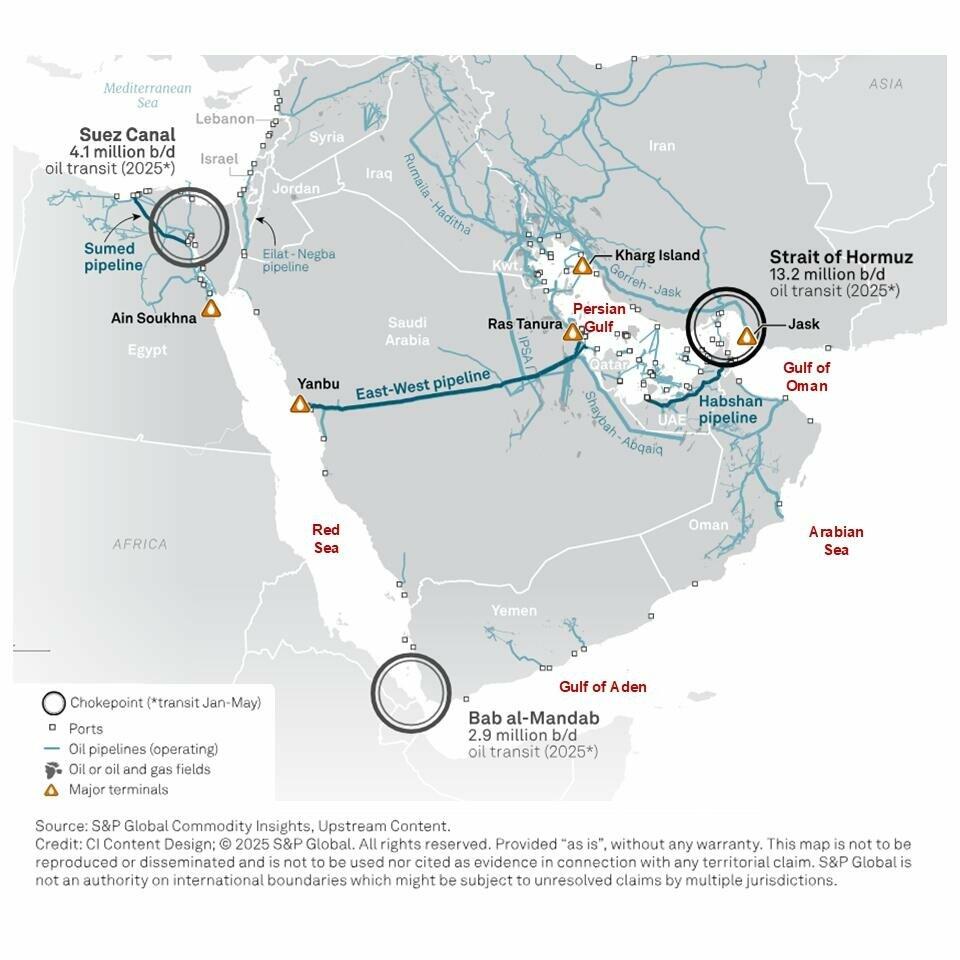
Huge Fire Along Saudi ‘Hormuz Bypass’ East-West Oil Pipeline After Alleged Houthi Strikes
Update(1815ET): While unconfirmed, this would mark a huge escalation of the Houthi entry into what’s been creeping all summer into a regional war:
Yemen’s armed forces targeted Saudi Arabia’s East-West oil pipeline; satellite data shows fires at six points along the route that transports crude oil from the Persian Gulf to the Red Sea. (IRIB News)
Reports earlier in the day revealed Houthi attacks on southern areas of the kingdom, but made no mention of the Iran-aligned group targeting the further north East-West oil pipeline – which has become vital as an alternative bypass to the contested Strait of Hormuz. Earlier today: Houthis Seize Yemeni Port Of Mocha, Gaining Greater Leverage Over Bab Al Mandab Strait
And now an extremely alarming situation for global energy flows:
If true, this is very serious. The East-West pipeline is Saudi Arabia’s critical bypass around the Strait of Hormuz. https://t.co/km3QMx0YRw
Analysts remain cautious about speaking in certainties at this early point…
“I want to stress that there is NOT YET concrete evidence to support that the Saudi East-West Pipeline has been hit. There is satellite imagery from multiple satellites that clearly indicate SOMETHING is going on, but there is not yet confirmation that it ACTUALLY has significant/catastrophic damage.”
It’s too early to make any hard claims, but the Copernicus browser Sentinel 3 shows a 80km long smoke trail. Larger than routine flaring. pic.twitter.com/enrSDAF7zc
Large smoke plumes south of Medina, as Iranian state media is quick to frame it as the result of a significant Houthi attack and escalation against the kingdom…
Satellite imagery captures fumes of smoke rising from Saudi Arabia’s East-West oil pipeline following an alleged strike by Yemen’s Armed Forces.
Update(1735ET): It looks like that Iranians have fired on more international vessels in the Strait of Hormuz on Thursday, with the United Kingdom Maritime Trade Operations (UKMTO) Centre within the last couple hours monitoring the below developing situation:
UKMTO says it has received a report of two vessels involved in a security incident 4nm West of Khasab Oman
The master of the vessel reports seeing four unknown projectiles hit two unknown vessels, causing fire on one vessel, and unsure of the status of the second vessel, 6nm north of his position.
Meanwhile…
WTI Crude back to $104
The IRGC taking shots at tankers ‘violating’ Iran’s passage protocol has of late become a nightly and daily reality. As Washington tries to find an offramp, and ratchets the ‘Economic D-day’ sanctions, this is Tehran squeezing back and saying not so fast, seeking to impose a deep political and economic cost on the Trump administration.
There could also be another ‘military answer’ on Iran from the US side as soon as tonight. The Pentagon had launched sporadic attacks on southern Iran earlier this week. But the US also seems hesitant and fearful over the prospect of runway escalation and inescapable quagmire.
* * *
Brent crude futures traded above $102 a barrel Thursday morning after Iran threatened to intensify attacks, renewing concerns over tanker flows through the Hormuz maritime chokepoint. The supply risk extends well beyond crude to mounting shortages of refined products, particularly diesel, as the US diesel crack spread trades around $102 a barrel.
President Trump’s indication yesterday that the conflict could continue beyond November’s midterm elections suggests limited near-term fuel pump relief for working-class folks, with the US national gasoline average above the politically sensitive $4-a-gallon threshold and diesel at a record high. Trump also announced overnight a proposal for a $5,000 “Trump dividend” check for every American adult if Republicans retain control of both chambers of Congress.
Following Goldman, HSBC raised its 2026 average Brent crude forecast to $90 a barrel from $80, citing continued disruptions to shipping through the critical Gulf waterway that are expected to keep global oil balances tighter for longer.
With Hormuz flows running at roughly 30% of pre-conflict levels, HSBC analysts see the market adjusting to a prolonged period of depressed tanker transit through the chokepoint. That outlook suggests sustained supply constraints through year-end.
“The key indicator to watch is whether this will put an end to the heavy shuttling of oil through the Strait of Hormuz,” said Arne Lohmann Rasmussen, chief analyst at Global Risk Management in Copenhagen. “It may not come to a complete halt, but combined with the more aggressive Houthis in the Red Sea and higher Chinese crude oil imports, the global oil market balance appears to be deteriorating again.”
Earlier this week, Vitol Group CEO Russell Hardy said about 10 million barrels a day have been crossing the waterway, roughly half of pre-war levels. He added that an exact figure is hard to quantify and that volumes aren’t guaranteed daily.
Goldman commodities strategist Yulia Zhestkova Grigsby sharply revised tanker-flow estimates through the Hormuz chokepoint to between 15 million and 16 million barrels per day, roughly two-thirds of pre-war levels. That’s mainly because the market is not counting ships that turn off their automatic identification systems to avoid detection by Iran.
Goldman’s Daan Struyven also noted one upside scenario this week that could push Brent to $120 if the conflict persists…
“The fundamental picture for products remains bullish with global inventories and reserves deteriorating,” said Darrell Fletcher, managing director for commodities at Bannockburn Capital Markets. Before ‘Operation Epic Furry’, about a fifth of the world’s oil and liquefied natural gas passed through Hormuz to global customers, mainly in Asia. The ongoing disruptions have sent NatGas prices in Europe above 81 euros on Thursday.
Beyond energy, a broad-based commodity rally has pushed agricultural products and metals higher, sending the Bloomberg Commodity Index to levels last seen in 2012. HSBC analysts spot a commodities cycle developing into a “super squeeze,” which suggests the move could be sustained.
Right-Wing Bolsonaro Overtakes Socialist Lula On Polymarket As Brazil Election Nears
Polymarket’s “Brazil Presidential Election” market, with nearly $150 million in trading volume, now favors right-wing Senator Flávio Bolsonaro over leftist President Luiz Inácio Lula da Silva ahead of October’s election. The shift follows polling data released earlier this week showing Bolsonaro pulling ahead in a hypothetical runoff, although the candidates remain statistically tied within the margin of error.
Bolsonaro took the lead on Polymarket around 8:20 a.m. ET, and by early Thursday afternoon, he stood at around 52.8% versus Lula’s 44%.
On Tuesday, the BTG Pactual/Nexus survey showed that Bolsonaro had edged ahead of Lula for the first time. This comes as a deepening Supreme Court scandal strengthens the conservative challenger’s campaign.
As the gap between Bolsonaro and Lula narrowed in recent weeks and the race became a toss-up, we pointed out an “explosive surge” in call open interest in the iShares MSCI Brazil ETF (EWZ).
On Thursday, Citi chief Latin America economist Ernesto Revilla told clients that Latin America is “poised for take-off,” as a right-wing political shift across the continent, a weaker dollar, firm commodity prices, and global supply-chain realignment were producing tailwinds for the region.
Also this week, Secretary of State Marco Rubio kicked off his South America tour on Tuesday, first meeting with Trump-backed Colombian President Abelardo de la Espriella to strengthen security and economic ties as several countries in the region shift toward right-wing governments.
A Bolsonaro victory would cement South America’s broader shift from unhinged left-wing regimes toward the common-sense right.
The Trump administration is proposing to change how the U.S. Census is conducted by excluding illegal immigrants from the population totals that are used to determine political representation.
The Census Bureau posted a proposed rule on Wednesday that said it also wants to prohibit the inclusion of questions about race and ethnicity or sexual orientation on the census in “short-form questionnaire or any questionnaire used for purposes of the enumeration.”
The proposed rule said that questions about race and sexual orientation have a “sensitive” nature and could impede responses, and removing them could lead to a higher rate of participation.
The proposed rule cites the definition of “usual residence” as a reason to exclude illegal immigrants.
It states, “Given the historical meaning of ‘usual residence’ as tied to allegiance, durable permission from the sovereign to settle within the United States, and establishment of domicile within the United States, the Census Bureau proposes to include lawful permanent residents within the apportionment base, while excluding from the apportionment base illegal aliens and aliens whose legal status is less durable and indefinite in length than lawful permanent resident status.”
The proposal would extend beyond unauthorized immigrants. It would also exclude foreign citizens whose legal status is “less durable and indefinite in length” than lawful permanent resident status.
The Census Bureau said it is considering using its “enormously broad access” to administrative records to determine an individual’s legal status.
The proposed restrictions on demographic questions would apply to the census conducted every 10 years, but not to the American Community Survey or other Census Bureau surveys.
The Census determines how the 435 seats in the House are divided among states, affects Electoral College representation, and the distribution of federal funding.
Excluding undocumented immigrants could reduce the representation of states with large immigrant populations, such as New York and California.
New York Attorney General Letitia James’s office said it was exploring legal options over the proposed changes in a post on X on Wednesday.
“The Constitution is clear. Every person living in the United States, regardless of immigration status, must be counted in the Census,” James’s office stated.
“We stopped the Trump administration’s Census attacks in 2020, and we’re exploring our legal options to fight back again.”
The White House didn’t respond to an email seeking comment.
Trump directed the Commerce Department to develop a plan for the U.S. Census that excluded undocumented immigrants in August 2025.
Trump said the count should use modern data, including information from the 2024 election, but did not specify whether he wanted an additional Census before 2030 or a change applying to future counts.
Fetterman Condemns Socialism In Surprise Video Message To GOP Convention
Pennsylvania’s Democratic senator made a surprise video appearance in Dallas on Wednesday night in front of a sea of Republicans at the GOP midterm convention.
In a short video message, Sen. John Fetterman (D-Pa.) condemned the rise of socialist politicians in the United States and welcomed his Republican counterpart, Sen. Dave McCormick, as the next speaker for the event.
“Yes, I’m a Democrat. Why am I here talking to you today? Because, well, I’m a common sense Democrat,” he told the crowd.
“I’m always going to stand with America. I’m always going to reject the extremes of socialism and that anti-American way of life.”
As Troy Myers reports for The Epoch Times, Fetterman has, for years, distanced himself from socialist policies promoted by people in his own party. His Wednesday appearance stoked further speculation that he may leave the party altogether. Democrats and Republicans are vying for the majority in Congress in the midterm elections on Nov. 3.
If the Democrats wish to achieve that, they will need to flip four seats in the Senate and hope that Fetterman doesn’t vote with Republicans or switch parties before he is up for reelection in 2028.
Fetterman described his close relationship – both professionally and personally – with McCormick, despite their being from opposite parties.
“Dave McCormick is the kind of senator that gets the job done, and he’s going to fight for Pennsylvania,” Fetterman said. “I’m proud to count him as my friend.”
Standing in front of a Pennsylvania steel mill in his video, the Democratic senator reaffirmed his and McCormick’s combined goals in working together, along with President Donald Trump, to boost the steel industry in their state.
“That’s exactly the kind of thing that will work together and will work with President Trump to fight and defend: the steel way of life right here in the Steel Valley,” Fetterman said.
As the notoriously casually dressed senator has distanced himself from his fellow Democrats in Congress, he’s seen a boost in support from Republicans in his state.
In fact, a recent New York Times/Philadelphia Inquirer/Siena University poll found that Fetterman has more support among Pennsylvania Republicans than McCormick does.
The rift between Fetterman and his Democratic colleagues from other states has widened in recent years over his support for Israel. The Pennsylvania senator has maintained a staunch support for the country since the horrific Oct. 7, 2023, attacks by Hamas.
He has said he will leave the Democratic party if it ever officially adopts an anti-Israel position.
“If they put that in our platform – no aid for Israel – and officially become the anti-Israel party, then yeah, that’s a red line for me,” Fetterman told NBC News July 16. “Democrats, we always should support Israel. That’s our special ally.”
On July 27, he specifically distanced himself from progressives and socialists in the party’s far-left wing.
“These people aren’t Democrats. That’s not a big tent situation,” he told reporters.
Fetterman has also repeatedly voted with Republicans on major issues such as rejecting a war powers resolution on July 23 and July 30 to end U.S. military operations in Iran. On this topic, he was the only Democrat to join the majority on the other side of the aisle.
Just inside the Turning Point USA Freedom Center in Phoenix, Arizona, there is a gold-framed painting, about three feet tall, glowing in a warm spotlight mounted on the wall.
Captured mid-throw is Charlie Kirk, lobbing red and white MAGA caps into a mass of ecstatic students, cheering against the brilliant-blue backdrop of a September afternoon.
His outstretched arm pulls taut the word “FREEDOM” across his white T-shirt. Rendered in commemorative brushstrokes: the moment Kirk’s “American Comeback Tour” arrived in Orem, Utah.
The same wall previously featured the faces of 36 Turning Point USA staffers who had showcased Kirk’s signature “grassroots humility,” “warrior spirit” and “persistent innovation.”
Kirk’s shocking absence continues to fill all six buildings at Turning Point headquarters.
His leather seat on the set of “The Charlie Kirk Show” sits permanently empty. On the glass table by his microphone rests a plush hand puppet and plastic moose positioned there by Kirk less than a month before he died so his two toddler-aged children would know he was thinking of them as they watched with their mother, Erika.
Most days, the children still come by to play. Team members help with childcare while Erika works from the office her husband once used; his chair, again, intentionally left vacant.
For a while, Kirk’s kids, now ages 4 and 2, got a new toy during every visit, chosen from a collection of gifts sent by well-wishers, affectionately called “daddy’s friends,” that took up entire rooms.
When I returned to Turning Point’s campus in August the makeshift tribute had been moved for remodeling. A new eight-foot fence circled the perimeter of the nonprofit company’s campus.
It was a year to the day since my first visit to Turning Point. In some ways it felt like entering a place frozen in amber. Enshrined memories converted every shelf into a time capsule.
As I came around a corner, I saw where Kirk stood a year ago after our interview beside a pair of front-page newspaper stories announcing the failed assassination attempt against President Donald Trump.
Now each department displays news clippings of Trump delivering Kirk’s eulogy.
A museum-like reverence hung in the air. But around Kirk’s empty chairs, team members pulsed with a restless determination to do everything they could to keep their founder’s vision alive.
“You’ve got to prove that you can actually make an impact, that you can do things that we were working towards prior to his assassination,” Turning Point Action COO Tyler Bowyer told me.
At Erika’s insistence, Kirk’s producers Andrew Kolvet and Blake Neff emerged from behind the scenes to take over his daily program, doing their best to opine on the issues as Kirk would if he were here.
Meanwhile, the political infrastructure Kirk told me was Turning Point’s “lifeblood” has expanded at a pace Bowyer and Turning Point USA COO Justin Streiff are struggling to match amid maximum turnout at chapter leadership summits, record-breaking renewals for school chapters and a landslide GOP primary win in Arizona’s gubernatorial election.
While Turning Point’s activist machine remains a vehicle for the conservative empire Kirk built, it also finds itself at the nexus of forces tearing the American right apart in the wake of his death.
In interviews with the Deseret News, the leaders at Turning Point recognized Kirk as irreplaceable. His influence was unique, they said, because it ran so much deeper than the political fights that made him famous. They hope his legacy will be quieter; a movement of strong marriages, big families and full churches; something akin to a revival.
It is not lost on them that this effect might be impossible to replicate. The void Kirk left can only be filled one way, they agreed: young people putting down their phones, and picking up the mic.
It was an unusually warm 90 degrees in Orem as Kirk sat down beneath his trademark “prove me wrong” tent at the bottom of an outdoor amphitheater overflowing with around 3,000 fans and curious onlookers.
Back in 2018, when Kirk first decided that college debates would form the core of his youth outreach, he could barely turn out 300 students. By 2025, scenes of Kirk scoring viral clips on the quad were ubiquitous.
Kirk had just finished lowering his mic after clarifying a question from his interlocutor about gun violence when a “pop” rang out. The blood, and the chaos that followed, were immediately uploaded across the internet.
Read the rest from Deseret here…Meanwhile, as the Epoch Timesnotes further…
Impact Reverberates
For many, Kirk’s death became the modern-day equivalent of the 1963 assassination of U.S. President John F. Kennedy – an unforgettable moment of intense personal and national significance.
“It was traumatic, I think, for the entire country – of all ages, but really for Gen Z and millennials,” Kolvet said. Those groups born after 1981 grew up watching Kirk’s videos on the internet, logging billions of views.
“After his death, it was almost like round two,” Kolvet said. “Everybody rediscovered all the videos again – and a wider audience did.”
Through debates and public speeches since early adulthood, Kirk became a driving force in U.S. politics. He was credited with lassoing young voters for Trump’s election wins in 2016 and 2024. He also had contact with foreign leaders, such as Israeli Prime Minister Benjamin Netanyahu.
His regular themes were faith in Jesus Christ, advocacy for traditional marriages and parenthood, and his belief that America is the greatest nation to ever exist.
But Kirk’s blunt declarations about race, gender, and politics also stoked controversy. Defenders say Kirk debated passionately but civilly, and they alleged that some critics misconstrued his remarks.
Challenges loom for those continuing Kirk’s crusade. High on their list is building TPUSA further and educating younger voters about the dangers of socialism.
At the same time, pursuing justice and the truth about Kirk’s assassination have become part of the organization’s mission, too, Kolvet said.
TPUSA tries to ignore the conspiracy theories that still swirl, he said, dismissing those as “distractions.” But questions, as well as wild speculation, continue to be raised with each stage of the criminal case against alleged gunman Tyler Robinson.
U.S. Vice President JD Vance, a friend of Kirk, said during an Aug. 20 podcast that it “enrages” him when people make accusations implicating people close to Kirk such as his widow, who now heads TPUSA.
Prosecutors allege that Robinson, 23, assassinated Kirk over political differences. Yet Kirk had once stated: “We heal our divides by talking to people we disagree with. … You heal the country when you allow disagreement.”
Turning Point Surges
Within weeks of Kirk’s slaying, 120,000 students inquired about starting a new Turning Point chapter, according to TPUSA.
Following that initial surge, growth has continued at a more manageable rate, Kolvet said, while still tallying large increases.
TPUSA reported a 300 percent jump in church partnerships, a 200 percent increase in Club America groups at high schools, and 64 percent more college chapters, he said.
More than 3,500 schools are represented, according to the group’s website.
A TPUSA women’s gathering drew 3,000 attendees to San Antonio in June.
The next month, a chapter leadership gathering in Washington attracted 2,500 young people. That was double the previous year’s total, Kolvet said, noting that two-thirds of those participants became involved with TPUSA after Kirk’s death.
More than 1,200 employees and 1 million donors – 95 percent of whom gave $1,000 or less – support the group’s activities, he said.
Kolvet cited other indirect trends that could reflect Kirk’s influence: surges in church attendance, baptisms, and Bible sales.
And across the nation, young people emulating Kirk’s “happy warrior” style sometimes make headlines. In Indiana, an angry woman confronted a 17-year-old girl who was sitting at a TPUSA table and handing out plain red, white, and blue bracelets.
Despite the woman hurling profanity and insults, the teen didn’t back down.
“There’s story after story like that,” Kolvet said. “It’s really inspiring. … That’s an amazing legacy that just continues rolling on.”
Concerns as Midterms Approach
Longtime Florida political analyst Susan MacManus, a retired professor, said the aftermath of Kirk’s death did seem to “turn down the temperature” in politics—at first.
However, the atmosphere seems to be getting uglier again, she said, as the crucial Nov. 3 midterm elections approach.
All 435 U.S. House districts and 33 of the 50 Senate seats are up for grabs. Republicans now hold a slim majority in both chambers. If they lose too many races to Democrats in November, Trump’s second-term agenda could be greatly hampered.
“I’m fearful that we’re moving away from people trying to get along – and back toward the nastiness,” she said.
On one side, MacManus said, she sees people who “glorify” political violence or vitriol; on the other, people in “Kirk mode” are calling for “a more peaceful environment and dialog.”
She senses a strong commitment in the people who want to follow Kirk’s example and his “life model,” as well as his views on what constitutes good governance.
Many fans of Kirk adopted the slogan “I am Charlie,” showing that they were stepping up to fill the void left by his death.
“[They seem dedicated to] making sure that our voice is heard and that our way of doing politics is heard,” MacManus said. “And we won’t back down.”
Opposition Still Obvious
Try as they might, people who try to spread positive messaging have their work cut out for them in an election year, when inflammatory language seems to be on the rise, she said.
And TPUSA still sometimes encounters violent or disruptive opposition at its events.
At the June women’s summit in San Antonio, TPUSA’s video journalists documented police clashing with protesters outside the venue. They also reported that one person dressed like Kirk was mimicking his assassination.
Meanwhile, legislative attempts to honor Kirk have at times become political hot potatoes.
Although lawmakers in 20 states – chiefly Republicans – proposed Kirk-inspired laws, a designated “Charlie Kirk Day,” or physical memorials, many of the measures hit snags. While Democrats often joined Republicans in condemning Kirk’s assassination, they typically opposed honoring him.
Some of the proposals did succeed, such as a Kansas law allowing students to sue schools over interfering with free speech and a Tennessee law urging “the positive impacts of religion” to be taught in American history courses.
Carolina Estevez, a New Jersey psychologist, explained why pro- and anti-Kirk factions could both become more entrenched in their views.
“His death changed him from a political communicator to a political symbol, and symbols frequently last longer than arguments,” she said.
A political assassination such as Kirk’s “may increase in-group solidarity,” she said, noting that the victim may be seen as a symbol of “perceived threats” to the whole group.
Wildaliz Caro, a licensed clinical psychologist in Cherry Hill, New Jersey, said, “The continued influence of Charlie Kirk may well rely on collective memory.”
“After a leader dies, movements tend to simplify their image,” she said. “Complex individuals are now simply symbols of something much bigger: grievance, identity, or cause … supporters respond not just to what he said, but to what he has come to mean.”
As a result, the opposing factions may have an even harder time relating to each other, Caro said.
Socratic Method
However, Kirk knew how to connect with different types of people.
“Charlie was a bridge-builder with the generations,” Kolvet said. “He could speak ‘Boomer,’ but he could speak Gen Z. … He understood how to speak to donors and to the political class, but he understood how to speak to kids, too.”
Kirk decided against going to college. Instead, he schooled himself in religion, history, politics, and philosophy—forming the foundation for the way he lived and the way he approached debates.
“He created a model, a way to think about things, the way to argue through things, a way to defend our values in America, unapologetically, courageously, full-throated,” Kolvet said.
Kirk explained his methods in podcasts, including during an episode of The Charlie Kirk Show on Aug. 18, 2025—less than a month before he was killed.
A listener wanted to know how conservatives can talk to liberals without devolving into name-calling.
Kirk advised: “Always make sure they’re the ones freaking out … and use the Socratic method.”
The method is named after the ancient Greek philosopher Socrates. After a person made an assertion, he would ask questions that eventually could reveal contradictions in the responder’s own logic.
Some people will refuse to change their minds no matter what. But others who seem to be staunch can be persuaded by using the Socratic method persistently “to get toward some approximation of truth,” Kirk said.
And, Kirk said, debaters ought to remember: “You’re not just debating a person. You’re performing for the audience of everyone else. And I try to do that at our prove-me-wrong events.”
Kirk seemed to have a special ability to inspire people who were open-minded and free thinkers, Kolvet said. Those people would walk away with “a fire in [their] belly that was just so contagious.”
Opposing Spread of Socialism
Through its Pick Up the Mic initiative, TPUSA is moving its founder’s legacy forward.
“Charlie Kirk built a movement from under a tent with one table, one mic, and a line of students stepping forward to debate. Now the tent is back, and a new generation of TPUSA chapters is bringing that presence to the center of campus,” the group’s website says, calling this “free speech in action.”
Kolvet predicted that 40 years from now, the “crop of young leaders that he inspired are going to go on and do great things, and they will be the firewall for freedom that this country needs.”
Before he died, Kirk made it clear to those leaders-in-training that they must stand firm against the spread of socialism.
“We’re doing our part to tell young people that free market capitalism is the most moral, proven, and effective system,” Kolvet said. “It’s lifted more people out of poverty across the world than any other economic system has.”
In contrast, socialism leads to stagnation, despair, and seizure of private property under communist rule—the antithesis of the American bedrock of “life, liberty, and the pursuit of happiness.”
“It’s tempting to go down this other path, but it doesn’t work, and that’s the problem,” Kolvet said. “And so, we are winning that debate with our people, but there’s a lot of people that still need to be reached and still need to hear that message.”
Justice for Kirk
Another important objective for TPUSA is fighting against “Charlie Kirk trutherism” – the rejection of officials’ accounts about what happened the day he was killed.
A “cottage industry” has sprung up around that skepticism, Kolvet said.
The antidote is for the justice system to handle the alleged gunman’s case properly and in the open, he said, noting, “Getting justice for Charlie is actually really, really important for the country.”
While it’s healthy to question government, “there has to be a foundation of rule of law, of justice, of facts, evidence, logic that undergirds all of our institutions,” he said.
Pursuing justice for Kirk “feels like a battle for truth itself,” Kolvet said.
“It’s part of a larger mission of fighting for the country. … We want to make sure that we don’t lose all faith in our institutions, right?” he said.
Balancing all those considerations is challenging, but Kolvet said he believes that “God is doing a work through Charlie’s life.”
“Charlie’s life will continue to be one of the most important and pivotal expressions of God’s providential hand on this country for years to come,” he said.
“And I believe, on some level, I’m comforted by the fact that, yes, we can choose to be a part of that.”
Melania Trump’s Team Finally Breaks Silence On Natalie Harp Frenzy
A key advisor to First Lady Melania Trump has broken his silence against the nonstop media frenzy surrounding President Donald Trump and loyal White House aide Natalie Harp.
The speculation, circulating for weeks across mainstream and tabloid outlets, concerns whether Trump’s working relationship with the 35-year-old aide exceeds professional norms – fueled by Harp’s near-constant presence at his side in the Oval Office, at public events and on weekend golf outings, and by the first lady’s own scarcity. Melania has appeared in public on roughly 40 days this year, regularly skipping events her husband attends.
Marc Beckman, exclusive senior advisor to the first lady, didn’t mince words in an interview released Wednesday, Sept. 9 on host Stella Escobedo’s YouTube show, the Daily Mail reports.
Escobedo set up the question by accusing the press of being “endlessly obsessed with garbage tabloid gossip of Natalie Harp, who, by the way, is a hardworking White House aide to President Trump, a cancer survivor who POTUS helped get off label treatment for and saved her life.”
“The liberal media is ridiculous,” Beckman said. “They don’t know anything about the first lady’s personal and private life. They don’t even take the time to put us on air to cover these incredible achievements that our first lady has accomplished.”
First Lady Melania Trump’s exclusive senior advisor, @MarcBeckman, responds to tabloid gossip about White House aide Natalie Harp.
MSM would rather focus on gossip than cover our First Lady’s real achievements helping America’s youth. pic.twitter.com/FXl1HQzRPK
Beckman then defended Harp and blasted the press for its obsession with tabloid-style rumors about the Trump family instead of real reporting.
“What they need to do is look in the mirror because they’re all attacking this hardworking, very talented, very intelligent person in Natalie Harp,” he said. “And they’re obsessed with the gossip about this first family. And I can tell you firsthand that it’s time for them to become journalists and stop looking at the gossip.”
Harp, the 35-year-old special assistant to President Trump, has spent years flying under the radar as one of the president’s most constant aides. Insiders call her the “human printer” because she packs a portable printer everywhere, churning out hard copies of news articles, social-media posts and anything else Trump wants to see on paper, according to the anti-Trump publication The Bulwark.
That low profile shattered last month when Sen. Jon Ossoff (D-GA) name-dropped her at a Georgia campaign rally, accusing Trump of preferring to “build his ballroom and travel with Natalie on their apparently defenseless flying palace gifted by the Emir of Qatar” rather than fully attend to his official duties.
“The media doesn’t know about the first lady’s private life. Period. The media doesn’t know about the first family’s life. Period,” Beckman added. “And what they do is they harp on the issues of gossip rather than going ahead and covering the substantial achievements that this First Lady and the President also have conducted during this past year and a half.”
It is the second time in three weeks Beckman has been deployed to answer for the first lady. Last month he went on “Fox & Friends” to explain why Melania had publicly denied any connection to Jeffrey Epstein, saying she had decided “enough is enough” and had “debunked all of the lies surrounding her and Epstein.” The pitch was the same then as now: cover the accomplishments, drop the rumors.
Harp first caught Trump’s eye in 2019 when she publicly credited his Right to Try legislation with opening the door to experimental treatment for bone cancer, the New York Times reports. She spoke at the 2020 Republican National Convention, worked at One America News from 2020 to 2022, and joined the campaign before moving to the White House staff.
Beckman’s remarks come after Trump gave sizable holiday gifts to four White House aides, including Harp, according to new financial disclosures released by the administration.
The gifts of $45,000 each to Harp, communications adviser Margo Martin, and deputy director of Oval Office operations Chamberlain Harris – as well as a $20,000 gift for director of Oval Office operations Walt Nauta – were noted in the staffers’ annual financial disclosure forms published by the administration last week. The payments have drawn ethical and legal scrutiny over whether a president can make personal cash gifts of that size to his own employees.
Trump Warns ‘Activity’ Seen At Iran’s Pickaxe Mountain Nuclear Site: ‘Don’t Get Cute’
This week there’s been more mainstream reporting and chatter centered on Iran’s Pickaxe Mountain. The nuclear development site has been of special interest and focus to the Trump administration due to how immensely fortified it is, meaning the Iranians can conduct uranium enrichment activities deep under the mountain if they so desire.
The US and IAEA are essentially operating blind on this, and that’s exactly how the Iranians want it of course. A Thursday Bloomberg report begins: “The United Nations atomic watchdog said it’s observed construction activity at Iran’s Pickaxe Mountain, a heavily-fortified site suspected of housing nuclear-related activities.”
It should be noted that Tehran has long complained that IAEA officials have leaked sensitive information to Israeli spies and leaders. The Iranians see it as a compromised organization.
Bloomberg continues, also referencing its own prior reporting: “The International Atomic Energy Agency has yet to inspect inside the tunnel complex but remote imagery indicates new movement at the site just south of Tehran’s main uranium-enrichment plant, IAEA Director General Rafael Mariano Grossi said Thursday in an interview with Bloomberg Television.”
President Trump has on at least two occasions drawn attention to the new reporting this week.
“We notice there’s a little activity at Pickaxe. I would advise Iran not to get cute because we will have to hit them very hard,” Trump said in a speech at Wednesday night’s midterm Republican convention.
Before this, Trump has threatened major attack on the mountain, though some pundits and analysts have speculated that it would take nothing less than dropping a tactical nuke in order to destroy or at least severely damage the fortification.
Some crazy hawks appear to lately be calling for just such a nuclear escalation from Washington, amid persisting frustration over fierce Iranian resistance and lack of ‘options’ the Trump administration has left itself with, also with negotiations at this point appearing totally abandoned.
Pentagon build Iran NUCLEAR PICKAXE MOUNTAIN in New Mexico
Trump’s Wednesday warning to Tehran was coupled with this surprising statement about the war extending to after the November midterm elections: “I think the war will end immediately after the election because they can’t hold out any longer,” the president told reporters.
He has continued to warn – amid growing public pushback over an unpopular extended war – that Iran can never have a nuclear weapon. However even the CIA has long assessed that there’s no clear or high-level evidence that Tehran is actually bent on achieving weapons status. But if anything, the war itself may have pushed the country in the direction of getting a nuke.
Head of Real Estate Nadeem Meghji is leaving Blackstone less than a year after taking sole control of its real-estate business, according to a new report from the Wall Street Journal.
The official explanation is a desire to spend more time with family. That may be entirely true. But when the head of one of the world’s largest real-estate investment businesses decides to leave after nearly two decades, and less than a year of becoming the boss of real estate, I think investors are entitled to wonder whether the timing tells us something.
His departure follows that of former co-head Kathleen McCarthy in 2025 and comes amid a broader turnover of senior real-estate executives over the past several years. Blackstone has named David Levine and Giovanni Cutaia as his successors, emphasizing the depth and continuity of its leadership bench.
Now that the corporate line is out of the way, the question the ole’ Q-Man finds interesting is this: why leave now, after just being promoted to a position you’ve ostensibly worked your entire career for? Surely when Meghji began low on the totem pole at Blackstone the goal was to find himself at the top of management, reaping all the perks that come with it. So why stay for less than a year?
The company line could be all there is to it. He could just want to spend more time with family. That’s a commendable aspiration as well. But just from a human psychology standpoint, people generally do not leave extraordinarily lucrative jobs when they believe the next few years are about to be the best few years of their careers. They can, and there are legitimate personal reasons to do so. But the financial incentives at this level are enormous.
If an executive believes the business is about to enter a spectacular upswing, with compensation and equity awards potentially worth millions more, walking away becomes a much more expensive decision. Look, family is important….so is millions more in compensation you can use to take care of said family.
I am not suggesting Meghji is forfeiting a specific amount of money. I have no knowledge of his personal finances or the terms of his departure. The point is simply that basic human psychology dictates to me that senior executives understand the value of staying through a major recovery. If they believe the next leg higher is right around the corner, the incentive to remain is usually substantial. BREIT’s investor material suggests there is a long track ahead of recovery for real estate:
There is another reason the timing catches my attention: executives also tend to find it difficult to leave during the absolute worst moments of a crisis. Departing while a business is visibly on fire can look like abandoning ship, particularly when employees, investors and clients are looking for leadership.
The more natural window is often after the immediate emergency has passed, when conditions have stabilized enough that a departure can be presented as an orderly transition.
It could be argued that this “eye of the storm” is where Blackstone’s real-estate business is today. BREIT, the firm’s giant nontraded real-estate investment trust, endured a prolonged redemption crisis beginning in late 2022. Investors wanted their money back faster than the fund could comfortably provide it, and withdrawals were restricted for more than a year.
Those pressures have since eased. According to the Journal, BREIT began meeting all redemption requests in early 2024, recorded its first positive quarterly net inflow in four years during the second quarter of 2026, and delivered an 11% net return over the past 12 months.
Those are meaningful improvements. Why leave at a point where BREIT appears to finally have stabilized and potentially be on an upswing?
I have to ask: what if BREIT is sitting in the eye of the storm rather than safely on the other side of it. The first phase of the real-estate problem was obvious: rates rose, property values came under pressure, financing became more expensive and investors wanted liquidity. The next phase could be more complicated, particularly if interest rates remain elevated and the private-credit problems I have been writing about begin to feed back into commercial real estate.
Real estate is a leveraged asset class. Higher financing costs do not disappear simply because a fund reports a positive return or redemption requests normalize. Loans still mature. Properties still need refinancing. Borrowers still have to justify valuations against a cost of capital that may be materially higher than the one prevailing when many of these investments were made. And now we’re talking about rate hikes instead of rate cuts (though tomorrow’s CPI report will give us more clarity on that).
Private credit, which has been falling apart for the better part of the last 12-18 months, is not some unrelated corner of the financial system. It is increasingly part of the machinery financing businesses and assets across the economy. If credit conditions tighten, lenders become more selective or investors begin demanding liquidity from private vehicles, the consequences can spill into real estate through refinancing availability, transaction volumes and asset prices.
🔥 85% OFF FOREVER IF YOU SUBSCRIBE TODAY: I am again offering an 85% discount to anyone that wants to become a Fringe Finance annual subscriber today. It’s a discount you can keep and stays applied for as long as you wish to remain a subscriber: Get 85% off forever
That does not mean BREIT is about to experience another redemption crisis. It does mean that a period of relative calm should not automatically be confused with a durable recovery. And it means that the private credit portion of Blackstone’s business is worth watching closely.
Blackstone, of course, has enormous resources and a long history of making money during dislocations. The firm manages more than $600 billion in real-estate assets, and its investing BREP funds have substantial capital available. A difficult market can create opportunities for a manager with that kind of scale. But there is a difference between saying Blackstone can eventually profit from distress and saying the next couple of years will necessarily be easy for its existing portfolio.
That distinction matters when evaluating the departure of the person who has been running the business. I am not claiming Meghji is leaving because he sees something bad coming. I do not know that, and the publicly reported facts do not establish it. His stated personal reasons may be exactly what they appear to be. The departure does not, in and of itself, prove anything about BREIT’s valuations, liquidity or future returns.
But I’ll reserve my right to not reflexively dismiss the timing as meaningless. And I’ll also reserve my right fall back on the basics of incentives and psychology.
Whether it means something or not, a senior executive leaving after a long career, shortly after assuming sole leadership, following a period of industry distress and amid an uncertain refinancing environment is a development worth a second mention. The fact that the business has recently stabilized makes the timing more interesting, not less.
Maybe Meghji simply decided he had made enough money and wanted to enjoy his life. Good for him if that is the case. But if I were an investor trying to decide whether commercial real estate was about to enter a new golden age, I would not look at the departure of Blackstone’s real-estate chief and conclude that it was an obvious vote of confidence.
I’ll pass on one thing I’ve learned in my two decades following Wall Street, including a decade working on short/skeptical research. Sometimes the most important thing an executive tells you isn’t what the PR/IR team writes for him or her to say in an official statement on the way out. It’s that they decided now was the time to leave in the first place.