Mamdani Turns City Hall Into A Socialist Union-Organizing-Machine
New York City has established a government office to assist worker in unionizing, following an executive order announced by Mayor Zohran Mamdani on Labor Day. The Mayor’s Office of Worker Power aims to help workers “get informed, connected and organized” to facilitate union formation. City Hall has not yet released information on the office’s budget or staffing levels, both of which are important considerations when creating a new government entity.
“Every day, working New Yorkers show up, do their jobs, and keep this city running. Too often, they have no say in the conditions they work under,” Mamdani said in a statement.
“The Mayor’s Office of Worker Power will make sure workers have a seat at the table before exploitation becomes a crisis and violations become routine. We’re connecting workers to their rights, to each other and to the organizations ready to stand with them. Because when workers have power, this city works better for everyone.”
The office’s stated functions include holding hearings on workplace issues, drafting policy proposals based on employee testimony, distributing information about workers’ rights, and connecting employees with outside groups equipped to help them organize.
Tony Perlstein, a former dockworker, union organizer, and deputy director of communications for the Center for Popular Democracy, will run the office. He will report to Deputy Mayor for Economic Justice Julie Su.
“This office allows us to get ahead of exploitation instead of simply responding to it,” Su said in a statement.
“By building relationships with workers, unions and worker centers, we can understand what is happening on the ground and act before problems become crises.”
The City Reporter, which broke the story, said the office follows the blueprint of the Emergency Workplace Organizing Committee, a joint project of the Democratic Socialists of America and United Electrical Workers.
Critics have zeroed in on a provision in the executive order that goes well beyond hearings and pamphlets. It directs city agencies, including the Department of Consumer and Worker Protection, the Taxi and Limousine Commission, and the Commission on Human Rights, to develop “directed investigation procedures” for workplace violations. These agencies used to wait for a complaint before opening a case. Under the new order, they can target businesses that employ large numbers of low-wage workers, carry a documented history of labor violations, or show other signs the city considers evidence of poor compliance, whether or not anyone has filed a complaint against them.
And that has plenty of people concerned.
“It’s remarkable that the Mamdani administration conflates being forced to pay a union with being protected from exploitation,” Manhattan Institute fellow Ken Girardin said. “The city shouldn’t be putting its thumb on the scale to squeeze more dues out of workers.”
Ashley Ranslow, New York State director for the National Federation of Independent Businesses, called the office “deeply concerning.”
“Federal laws already protect workers rights to organize,” Ranslow said.
Her larger worry concerns what proactive enforcement looks like in practice: small businesses facing scrutiny, she said, “even if there are no complaints filed against them.”
Ranslow argued City Hall has inserted itself into a relationship that was never its business. “City government should not be interfering with a process that is between employees and the employer,” she said. “Small businesses should be supported, especially in a place like New York City where it’s unaffordable to keep the doors open and lights on, instead of having the deck stacked against them.”
A recent CUNY report has discovered that the level of unionization in the city is more than twice the national average, revealing the office to be nothing more than a solution to a problem that doesn’t exist, a structure designed to create grievances even though the labor market has already clearly shifted in favor of organized labor.
Israel Shutters UK Consulate For Leading New European Sanctions Against West Bank Settlers
The UK is a lead nation among a dozen countries that jointly announced Tuesday they are imposing sanctions on trade with Israeli settlements in the West Bank.
The additional nations are Ireland, Denmark, Finland, France, Canada, Iceland, Norway, Poland, Portugal, Spain and Sweden. UK Foreign Secretary Ed Miliband informed parliament about the new measure, saying “Today I announce that the official view of the British government is that the occupation [of the West Bank] is unlawful.”
“The government believes the unlawfulness of the occupation should be reflected in the economic relationships we choose to have with the occupied territories,” he added.
Miliband declared that Israeli “terrorists” are conducting ethnic cleansing in the West Bank, which follows a series of deadly incidents involving fanatical settlers widely reported over the last weeks and months. He sought to demonstrate that the sanctions action would underscore that “Britain is not silent in the face of deep injustice and nor is it powerless.”
Israel’s response was almost immediate, with Israeli foreign minister Gideon Saar quickly announcing the closure of the UK consulate in Jerusalem. Saar blasted Miliband for what he’s calling “outrageous lies” and charged that London was “systematically working against the state of Israel.”
While the United States is not expected to sign on to this European initiative, or voice political support for it, Washington does have sanctions on some individual Jewish settler leaders and groups. However, various international bodies and rights groups have long seen such prior US designations as a positive, but largely symbolic step.
According to an outline of Miliband’s words before parliament, he listed the following new legal actions impacting Israeli West Bank settlements and associated entities:
An import ban on goods from illegal settlements in the occupied territories.
A comprehensive sanctions regime against providing services such as construction or financing for Israeli settlements.
A ban on the advertising in the UK of illegal settlement properties.
Personal sanctions against key individuals accused of promoting settler violence.
A new ban for arms licenses and other exports that “materially contribute to the occupation”.
Another key part of Israel’s retaliation has been to list a dozen British election officials who will now be barred from entering the country.
Video shows Israeli “settlers” entering Palestinian property in Turmus Ayya during U.S. Ambassador to Israel Mike Huckabee’s visit to meet an American citizen.
The list includes 11 members of parliament… and a lawyer, Fahad Ansari, who has represented Hamas’s political wing in court in the UK as it attempts to remove itself from the list of proscribed terrorist organizations.
Responding to the Foreign Ministry’s announcement, Ansari says on X that he is “neither British nor an MP but do take this as a badge of honour.”
The banned MPs are listed as follows:
Jeremy Corbyn, Your Party co-founder
Zarah Sultana, Your Party co-founder
Naz Shah, Labour Party
Diane Abbot, Labour Party
John McDonnell, Labour Party
Richard Burgon, Labour Party
Hannah Spencer, Green Party
Carla Denyer, Green Party
Sian Berry, Green Party
Ellie Chowns, Green Party
Adrian Ramsay, Green Party
All of this is likely going to ratchet the pressure on the US Embassy and the State Department. Last week, even US ambassador to Israel Mike Huckabee last week called out Israeli settler violence in the West Bank an “act of terror.”
The U.S. has condemned the siege of Palestinian homes in the West Bank by Israeli settlers, who have cut off water, electricity and essential supplies to residents.
U.S. Ambassador to Israel Mike Huckabee on Thursday called the settlers’ actions an “act of terror,” adding to… pic.twitter.com/pOrwgURCHZ
It’s unprecedented and unexpected that a self-identified outspoken Zionist and Evangelical pastor like Huckabee would make such an announcement.
He’s lately been touring some West Bank areas, describing this as on behalf of US citizens “who live in Turmus Ayya and other communities across this region” who are “disturbed by people who have created extraordinary challenges that are unfair and illegal.”
Also, while most Americans might tend to assume that the entirety of the West Bank is Muslim, it has also long had an ancient and significant minority of Christians, chiefly Palestinian Orthodox Christians.
The Christian town of Taybeh has been under repeat attack all summer…
Israeli settlers have attacked the historic Christian village of Taybeh in the occupied West Bank on Tuesday, setting fields on fire and targeting Palestinian homes.
Local sources reported that the settlers opened fire on houses and threw Molotov cocktails pic.twitter.com/h3Jouvumga
The last all-Christian West Bank town of Taybeh has also this summer come under repeat attack by Jewish settlers. The Israeli government itself has had to send IDF troops to protect the enclave from settler attacks. Perhaps such instances have started to get the attention of US officials, but it’s also likely that they will stop at just paying lip service to the issue.
In Putin Call, Trump Seeks Swift End To Ukraine War & Restoration Of US-Russia Ties
On Tuesday morning President Trump and his Russian counterpart President Putin held a “positive” phone call regarding finding an end to the Ukraine war, the Kremlin side has stated.
Russian president aide Yury Ushakov has been the first to provide a readout, with little revealed from the US side in the immediate aftermath. The phone call was“constructive and frank” and lasted exactly one hour, but remains “strictly confidential.”
Likely the White House will also be equally scant in what information it chooses to release, given the sensitivity of the timing, coming just off the weekend shuttle diplomacy by Trump’s envoys Steve Witkoff and Jared Kushner.
Their rare, direct meeting with Putin on Saturday lasted than three hours, after which they traveled to Ukraine to meet with Zelensky, in what was a much more chummy atmosphere, naturally.
Ushakov in his fresh comments described of that prior meeting, “Overall, the visit of the aforementioned American representatives was assessed positively.” He further said “European narratives about a Russian threat” were discussed in the call – an issue now “being used to justify support for Ukraine and increased European military spending.”
The readout indicates, “Putin supported Trump’s commitment to building a constructive Russia–US partnership and emphasized that Russia has no hostile plans toward Europe.”
Perhaps the most important part of the Russian readout is seen in the following:
Trump said he wants a breakthrough on Ukraine during his presidency and stressed that ending the conflict could open the way to a major restoration of Russia–US relations.
The only additional information that the Kremlin aide provided was that Trump and Putin agreed that work through direct contact as well as diplomatic channels would “continue”.
The Witkoff-Kushner trip had come a little under two weeks after CIA Director John Ratcliffe unexpectedly traveled to Moscow and reportedly floated a trilateral summit involving Trump, Putin, and Zelensky.
U.S. President Donald Trump told Russian President Vladimir Putin on Tuesday in a phone call that he wanted a swift end to the war in Ukraine, something that would allow U.S.-Russia ties to be fully restored, the Kremlin said. —Reuters
The diplomatic push comes as intensifying attacks by both sides around the Black Sea raise the risk of a global food crisis next year. Meanwhile, Ukrainian attacks on Russian energy infrastructure, combined with disrupted Persian Gulf flows, are pushing the global refined-products market toward crisis, creating twin food and energy risks.
Reporter: On Ukraine, people are being kidnapped on the streets. Have you seen those videos? If you haven’t seen them, can I send them to your staff?
Trump: Show them, and I will put them out. I know about the videos. I heard about it very strongly. pic.twitter.com/YPfJF8e7Up
Despite the public-facing Washington rhetoric, the Iran quagmire… war… “excursion” has not been going so well as the US seems desperate for a final exit and end to the war. So Trump likely wants a “win” ahead of the November midterm elections, hence the sudden revival of pushing Ukraine talks.
Strategy repurchased $176 million worth of its STRC preferred stock and doubled the size of its digital securities repurchase program to $2 billion, while pausing on new Bitcoin buys.
Michael Saylor’s Strategy, the largest corporate Bitcoin treasury, skipped its weekly Bitcoin acquisition to repurchase $176 million of its preferred STRC stock.
Strategy repurchased 1.8 million STRC shares for an aggregate $176.3 million between Aug. 31 and Sept. 7, according to a Tuesday filing with the US Securities and Exchange Commission.
The company also doubled the size of its Digital Credit Securities Repurchase Program to $2 billion. With no new purchases, Strategy’s holdings sit at 845,050 Bitcoin (BTC), acquired for a total of $63.6 billion, at an average purchase price of $75,412 apiece.
While STRC’s share price was largely flat in premarket activity on Tuesday, trading at $97.70, or a 2.3% discount from its intended $100 par value, the company’s Nasdaq-traded MSTR common stock was down more than 3% at last look, according to Yahoo Finance.
STRC is one of Strategy’s main vehicles to fund its Bitcoin accumulation. Trading below par limits Strategy’s ability to raise funds through STRC sales and may force the company to further increase its dividend rate.
Strategy unveiled a capital framework on June 29 to allow Bitcoin sales to fund dividends and increased the annual dividend rate on its STRC preferred stock to 12%.
BTC treasury challenger Strive steps purchases
While Strategy opted to pause its Bitcoin buying last week, other companies stepped up purchases of the biggest crypto by market cap.
Strive, the fifth-largest corporate Bitcoin treasury, acquired 1,375 Bitcoin for $109 million, at an average cost of $79,281 per BTC, bringing its total holdings to 24,531 Bitcoin, CEO Matt Cole revealed on Monday. Ahead of Tuesday’s market open, the company’s Nasdaq-traded ASST shares were down more than 2.5%, after more than doubling in the past month.
France-listed Bitcoin treasury Capital B also revealed a $25 million Bitcoin acquisition on Monday, its largest in nearly a year, pushing the French company ahead of H100 Group among publicly traded BTC holders.
Americans Feel Better About Jobs, Worse About Finances In Latest NY Fed Survey Amid Subdued Inflation Expectations
Unlike some recent extremely volatile months, especially in the first half of 2026, consumers expectations for inflation in August barely budged from July, as disclosed today by the latest NY Fed Survey, which showed that inflation expectations in one year were unchanged at 3.6%, estimates for inflation in five years were also flat at 3.0% for the 12th month in a row, while estimates for inflation in three years dipped to 3.2%, from 3.3%.
According to the report, median inflation uncertainty—or the uncertainty expressed regarding future inflation outcomes—increased at the one- and five-year horizons and decreased at three-year horizon.
Taking a closer look at the component, median home price growth expectations decreased by 0.2% point to 3.0%, just below its 12-month trailing average of 3.1%. The decrease was driven by those living in the Northeast.
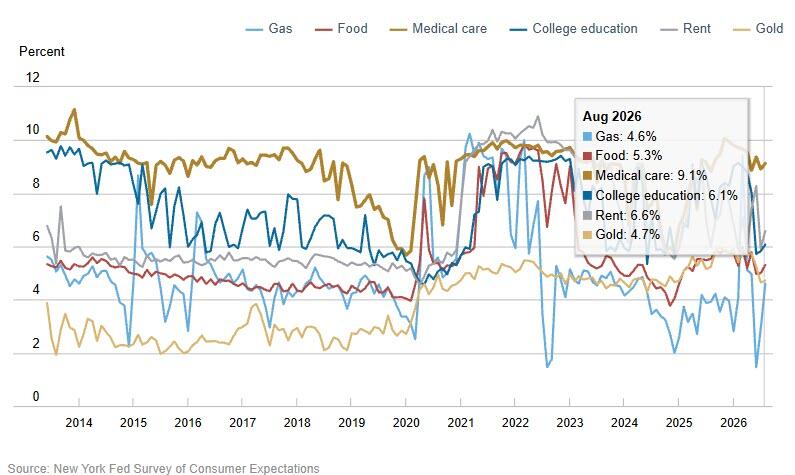
Among commodities, median year-ahead expected price changes increased by 1.7% points to 4.6% for gas, by 0.3% to 5.3% for food, and by 0.2% point to 9.1% for medical care. Median year-ahead expected price changes increased by 0.3% to 6.1% for the cost of college education and by 0.7 % point to 6.6% for rent.
While inflation expectations were tame, the view on financial wellbeing was split. On one hand, with less than three months ahead of mid-term congressional elections, the proportion of Americans reporting their financial situation was much worse or somewhat worse than a year ago rose to 38.6% last month, up from 37.6% in July. Those who expected their finances to get much worse or somewhat worse in the year ahead also climbed to 32.6% from 30.3%.
On the other hand, perspectives on the labor market improved: workers’ perceived probability of losing their job in the next year fell to 13.8%, the lowest reading since February. The likelihood of leaving a post voluntarily – a positive indicator – rose for the second straight month to 19.5%, above its 12-month averageof 18.4 percent.
Both trends were driven by respondents with a high school degree at most and a household income under $100,000 per year.
On the other hand, average unemployment expectations – the probability that the unemployment rate will be higher one year from now – increased by 1.6% to 44.4%, its highest reading since April 2020.
At the same time, the mean perceived probability of finding a job if one’s current job was lost decreased by 0.8% to 45.4% .
There was some deterioration in household leverage too, as a larger percentage of consumers, 13.16% vs 12.00% in the prior month, expect to not be able to make minimum debt payments over the next three months
Despite this seeming deterioration in household finances, the mean perceived probability that US stock prices will be higher 12 months from now was 40.9%, fractionally below the multi-year high in July, but far above the recent average.
Some more results from the latest report:
Labor Market
Median one-year-ahead earnings growth expectations ticked up by 0.1 percentage point to 2.9% in August. The series remains above its 12-month trailing average of 2.6%.
Mean unemployment expectations—or the mean probability that the U.S. unemployment rate will be higher one year from now—increased by 1.6 percentage points to 44.4%, its highest reading since April 2020. The increase was broad-based across age, education, and income groups.
The mean perceived probability of losing one’s job in the next 12 months decreased by 0.4 percentage point to 13.8%, its lowest reading since February 2026. The mean probability of leaving one’s job voluntarily, or the expected quit rate, in the next 12 months increased by 0.9 percentage point to 19.5%, above the series’ 12-month trailing average of 18.4%. The decrease in job loss and increase in quit expectations were both driven by those with at most a high school degree and those with annual household incomes under $100,000.
The mean perceived probability of finding a job if one’s current job was lost decreased by 0.8 percentage point to 45.4%, just below the series 12-month trailing average of 45.5%.
Household Finance
The median expected growth in household income remained unchanged at 3.0% in August. The series has been moving in a narrow range between 2.8% and 3.0% since June 2025.
Median one-year-ahead household spending growth expectations increased by 0.3 percentage point to 5.2%, above its 12-month trailing average of 5.0%.
Perceptions of credit access compared to a year ago declined, with the net share of households reporting it is harder to get credit increasing. Expectations for future credit availability also deteriorated, with a larger share of respondents expecting it will be harder to obtain credit in the year ahead and a smaller share expecting it will be easier.
The average perceived probability of missing a minimum debt payment over the next three months increased by 1.2 percentage points to 13.2%, just above its 12-month trailing average of 12.7%.
The median expectation regarding a year-ahead change in taxes at current income level increased by 0.5 percentage point to 3.5%, its highest reading since December 2025.
Median year-ahead expected growth in government debt increased by 0.6 percentage point to 9.7%, remaining above its 12-month trailing average of 8.8%.
The mean perceived probability that the average interest rate on savings accounts will be higher in 12 months increased by 0.6 percentage point to 28.8%.
Perceptions and expectations about households’ financial situations both deteriorated with larger shares of households reporting a worse financial situation compared to a year ago and expecting a worse financial situation a year from now, and smaller shares of households reporting or expecting a better financial situation.
The New York Fed data comes days after a surprise increase in job gains in August signaled the labor market remained resilient despite uncertainties caused by the war on Iran and persistent inflation. Payrolls rose 162,000, above all estimates in a Bloomberg survey, while the unemployment rate held steady at 4.1%. The data reinforced Fed views of a stable job market. The next key readings are Thursday’s PPI report followed by the CPI on Friday.
the Fed is set to meet in Washington Sept. 15-16, after leaving interest rates steady over five straight meetings. At their last gathering, three officials favored a quarter-point hike. A growing chorus of officials has questioned whether the current level of interest rates will be high enough to tame inflation.
Russia will remain a key crude oil supplier to India, Russia’s Ambassador to India, Denis Alipov, said in an interview with Asian News International, in which he also criticized the planned U.S. legislation to slap tariffs on countries importing Russian oil.
#WATCH | Delhi: On being asked how confident Moscow is about the India-Russia energy cooperation, Russian Ambassador to India, Denis Alipov, says, “The question is – how confident is India? India has shown that it’s able to stand its ground and defend its national interests. And… pic.twitter.com/gOZ3HFA4TR
Russia has become India’s single-biggest oil supplier in recent years, after the U.S., the UK, and the EU banned Russian oil imports and moved to increase sanction pressure on Russia following the invasion of Ukraine.
U.S. Congress is trying to pass a “bill from hell” against Russia, sponsored by late Senator Lindsey Graham. The bill that proposes to give President Donald Trump authority to impose 100% tariffs on the biggest buyers of Russian oil and gas passed the Senate 86-11, but appears deadlocked in the House, amid disagreements among Republicans and concerns among Democrats that President Trump would have new authority to slap tariffs.
It’s unlikely that the bill passes in the House before the mid-term elections in November, analysts say.
Amid this background, Russia remains and will remain a key oil supplier to India, Moscow’s envoy to the world’s third-largest crude importer said.
“We would be ready to supply as much oil as India needs. Unfortunately, those who impose sanctions and tariffs have taken the path of pressure tactics instead of honest cooperation, which prevents those countries from offering a better deal to India in oil than us,” Alipov told ANI.
“The world will not cope if Russian oil is excluded. The energy markets cannot afford that. Russian oil will stay in the market for India and other countries. We are interested in supplying oil to India. India is interested in buying that oil,” the Ambassador said.
Meanwhile, India’s crude oil imports from Russia are estimated to have eased in August from July’s record high, as Ukrainian attacks on Russian export infrastructure and competition from China for Russia’s barrels have dented Indian intake of Moscow’s oil.
The U.S. Embassy in Cuba has issued a health alert, warning Americans about a rise in gastrointestinal illnesses caused by the island nation’s water and energy grid collapses.
“The U.S. Embassy has noted a significant increase in diarrheal illness across Cuba, associated with the continuing degradation of the water and energy infrastructure,” the Sept. 4 alert reads.
The embassy stated that the degradation affected the country’s water supply, food storage, and temperature control, sparking infections such as E. coli, norovirus, Shigella, and other gastrointestinal pathogens.
Americans are urged to “be cautious” around meat, poultry, seafood, eggs, dairy, and other perishable foods that have not been stored properly.
People are also encouraged to stay away from foods that have been at room temperature for a long time, avoid eating raw or improperly washed vegetables, and be careful before they eat any cooked food that has cooled and then is reheated.
Frequent hand washing was also encouraged.
Embassy officials encouraged people to stay hydrated and “seek medical attention for persistent or severe diarrhea, bloody stools, high fever, significant abdominal pain, repeated vomiting, signs of dehydration, or symptoms not improving.”
On Aug. 28, U.S. embassy officials warned that Cuba’s water delivery infrastructure was growing increasingly unstable as some neighborhoods reported going long periods without receiving water from the regime.
Officials suggested that the water issues and power outages were caused by the communist regime’s “mismanagement of public infrastructure” across the entire island.
“Water often only flows to residences when city power is on for a sufficient amount of time,” the August alert reads.
Eight months ago, the Trump administration started a fuel blockade on Cuba to force negotiations around returning democracy to the island, including allowing Cuban exiles to return to vote for the first time since the communist takeover in 1959.
The blockade cut off oil deliveries to Cuba from Venezuela’s socialist regime. The island faces an energy crisis that has left about 10 million people in the dark multiple times this year.
Energy authorities reported two nationwide grid collapses in March and three in July, along with several partial outages.
U.N.-appointed human rights experts said in February that the fuel blockade was a serious violation of international law.
However, in March, U.S. Secretary of State Marco Rubio said Cuba’s grid has long been unreliable due to years of neglect by the regime.
“They were having blackouts last year,” Rubio said. “They’re having blackouts because they have equipment from the 1950s in their grid that they’ve never maintained and never upgraded, because they’re incompetent.”
Canada’s Counter-Tariffs Take Effect As Trump Targets Bombardier And Midterm Battlegrounds
Canada’s retaliatory tariffs on U.S. goods took effect at 12:01 a.m. Tuesday – raising duties of 15%, 25%, and 50% on hundreds of American products after last month’s collapse of bilateral talks. Ottawa says the package matches the United States “dollar for dollar, rate for rate.” Finance Canada values the covered U.S. imports at $27.6 billion; some U.S. accounts put the figure nearer $20 billion. Either way, it is a small share of total two-way trade – and a large share of the political risk.
The list is drawn from goods already hit by U.S. Section 338 and Section 232 tariffs. Section 338, a long-dormant provision of the Tariff Act of 1930, had not previously been used by a president to impose duties; Trump invoked it in July to levy 50% on selected Canadian goods after talks failed, and those U.S. duties took effect August 22. Canada’s matching rates now apply as follows: 50% on most steel and aluminum products (up from an earlier 25% Canadian counter-duty), plus furniture and clothing; 25% on appliances, dairy including cheese, and some metal derivatives; 15% on selected electronics, tools, and machinery. Goods already in transit when the rules took effect are exempt. The surtaxes apply to U.S.-origin goods under Canadian marking rules, not merely to shipments that happen to cross the border.
Seafood and fish were on Ottawa’s original list at 25% but were pulled on August 27 after warnings from Canada’s Atlantic processors and Maine’s lobster industry. About half of Maine’s fall catch is processed in New Brunswick; a tariff on those lobsters would have hit both sides. Finance Canada called the change “select adjustments… based on feedback” while adding other items, including copper wire and charcoal, to keep the dollar-for-dollar total. Sen. Susan Collins (R-ME) applauded the retreat – evidence that the targeting was political, and that it can be walked back when the politics cut the wrong way.
Prime Minister Mark Carney has framed the response as measured but non-negotiable. Canadian officials have described the country as under economic assault and have pledged not to match every rhetorical escalation. The practical strategy is twofold: impose a politically targeted list at home, and shop for other markets abroad.
Why Michigan and Ohio matter more than the headline total
Heading into November midterms, Canada’s new tariffs are designed to land in states that do a high volume of business with Canada, and which have competitive races. Ohio shipped the largest dollar volume of newly covered goods. Michigan, Indiana, Pennsylvania, and Wisconsin follow close behind. Michigan sends roughly a third of its merchandise exports to Canada; auto parts often cross the Detroit-Windsor corridor more than once before a vehicle is finished. The new Gordie Howe International Bridge was meant to ease that flow. It now sits at the center of a fight over who pays the tariff.
Those same industrial states host competitive House and Senate races. Michigan’s Senate contest between Republican Mike Rogers and Democrat Abdul El-Sayed is one of several Great Lakes races that will test whether tariff costs show up at the ballot box; it is not the only possible pivot for Senate control. Ohio’s Republican-held Senate seat is also in play. Canadian ministers have said openly that the product list was chosen to concentrate pressure where U.S. politics would feel it. Industry Minister Mélanie Joly, at the August announcement, said Canada was “targeting products that will target states in the U.S.” and added: “we’re being wise and strategic to put political pressure. And that’s why we think it’s the right thing to do right now.”
Trade groups on both sides warn that the first-round dollar amounts understate the damage. Integrated supply chains mean a duty on steel, parts, or appliances shows up as higher costs for factories and households on both sides of the border. Brad Wood, senior director for trade and innovation at the National Foreign Trade Council, called the cycle “bad for Canadian businesses and consumers, and bad for American businesses and consumers,” and said each new layer is another barrier the two governments will eventually have to unwind.
Trump’s next pressure points: autos, Bombardier, and Lake America
Washington has not treated Canada’s move as the last word. President Trump has already threatened higher auto tariffs in 2027 and, last week, floated cutting off bilateral trade altogether. On Sunday he attacked what he called Canada’s “dollar imbalance.”
Hours before the Canadian tariffs took effect, Trump turned to Bombardier. In a Truth Social post he declared “NO MORE SELLING BOMBARDIER IN THE UNITED STATES,” called the company’s products “not good enough,” and said that if it wants the U.S. market it “must build here.” He closed with a list of commands: buy American, fly American airliners, drink American liquor, and “SAIL ON LAKE AMERICA.”
Bombardier did not answer the president by name. It noted that aerospace is a major U.S. export industry, that it builds wings and other components in California and Texas, and that it supports tens of thousands of American jobs through plants and a supply chain spanning dozens of states. About 55% of its 2025 revenue came from U.S. customers. The White House has not said how a sales ban would be enforced on aircraft already certified by the FAA.
The Bombardier fight is not new. Trump threatened decertification and a 50% aircraft tariff earlier this year over Gulfstream certification in Canada. Ottawa later certified several Gulfstream models. In 2018 a first-term Commerce Department case against Bombardier airliners produced a huge preliminary duty that the U.S. International Trade Commission later rejected.
Trump has also rewritten the map. On August 27 he signed an executive order directing the Interior Department to update geographic systems immediately from Lake Ontario to Lake America; Great Lakes placards went up in the Oval Office.
Carney hit back, saying “We know that America is changing. Their trading relationships, their foreign policies, their national monuments, their hydronyms. Canadians also know that naming reality means calling it Lake Ontario – then, now and always.“
Supreme Tariff Tiff
Canada aside – on February 20, the Supreme Court ruled 6-3 that Trump could not use the International Emergency Economic Powers Act (IEEPA) to impose his sweeping “reciprocal” and emergency tariffs. Chief Justice John Roberts wrote that IEEPA contains no reference to tariffs and that no prior president had read such a power into the statute. Section 232 metal tariffs were left standing. The administration has since rebuilt parts of the program under other authorities, including Section 338 for Canada and a forthcoming roster of duties against other countries accused of “excess capacity” and persistent surpluses with the United States. Trump has also threatened to block trade with countries that export more to the United States than they import. A consumer-price report due this week will test how much earlier tariff rounds have already fed inflation.
Ottawa’s hedge: Europe, and a quiet channel to Beijing
Carney will attend Ursula von der Leyen’s State of the Union address in Strasbourg on September 16 and speak to the European Parliament on September 17 – the first foreign head of government invited into that ritual. He has said Canada will open “intense discussions” this fall on a deeper economic and security partnership with the EU, already its second-largest trading partner under CETA.
In parallel, Canadian and Chinese defence officials held a coordination dialogue on September 4, the first such formal talks in more than eight years. Beijing announced the meeting; Ottawa later confirmed working-level military-to-military contact. The optics – reopening a channel closed after the 2018 detentions of two Canadians, while NATO and EU ties remain the stated priority – have already drawn criticism at home.
The immediate economic hit from Tuesday’s list is limited by design. The larger question is whether a two-month window before U.S. midterms produces a deal or another round.
It’s more of the same to start this Tuesday, and less too: and that isn’t good news.
Japanese Q2 GDP came in at 0.4% q-o-q, 1.3% y-o-y at the second read, backing the BOJ hiking rates again on September 18 – but is it really going to be ‘one and done’? The 2-year JGB yield is at 1.84% today, close to a new multi-decade high, and vs. the more usual 0% seen for years, while the 10-year is at 2.91%, off recent highs.
Alongside suspicions of further FX market intervention, USD/JPY swung from 154.37 to 153.21, with market chatter of a test of 152 next: recall it was at 160.35 at the start of the month. That’s quite the volatility shock for some books and for those who thought the Yen Carry trade was going to stay one way even after the recent warning from Bessent. Finance Minister Katayama said she will maintain an orderly currency market: but following whose order(s)?
The US and Canada return from a long weekend to a trade war. Trump is threatening to ban US sales of Bombardier’s Canadian-built jets unless production moves south of the border; Canada is set to impose counter tariffs. Showing the direction of travel, the press announced Canada had resumed defense talks with China after an eight-year hiatus, which as one Korean paper puts it, “reflects [an] effort to diversify partnerships amid strained US relations and defence procurement shifts.” How would that work with NATO and the EU unless the latter is dominated by a Germany run by the pro-Beijing AfD? The symbolism, and stakes, matter far more than that benign action, but as the FT argues, Canada “is fated” to keep trying to strike a better deal with the US.
Oil is close to $100 as the Financial Times quotes traders that attacks on shipping and eroding inventories mean “something has to break” soon, and Qatar warned of an “industrial catastrophe” if this crisis continues – and in logistics, things can go non-linear. US diesel is already at a record high, and the Middle East press reports bunker fuel for ships is running out in some places. Tellingly, Japanese shipping companies are considering a return to sails and kites to cut fuel consumption. That fits given Letters of Marque are a thing again now.
Meanwhile, the Houthis struck Saudi Aramco facilities; the UN envoy warned of a wider conflict in Yemen; Israel hit Hezbollah after ceasefire violations; the IAEA’s Grossi said the inspecting body is “completely blind” on Iran’s nuke program; and Iran floated a Hormuz exclusion zone with Oman “in days”, as the Wall Street Journal claims its oil dollars are gone, plunging it “into crisis – and pushing it to escalate. Markets are starting to accept that disruption is going to linger well into 2027. The question is how much worse things could get as well as better.
In Russia, Trump’s peace envoys reportedly found that Putin was still unwilling to compromise on Ukraine, which is little surprise, despite their official statement that there was “movement” towards three-way talks, as Zelenskyy stated the US wants to explore Russia-Ukraine winter de-escalation steps – like stopping attacks on oil refineries(?) That’s as the EU is urging the UK, Canada, Japan, and Norway to “step up to the plate” on funding Ukraine as Kyiv faces a $27bn budget gap in 2026, as it puts €200m into Greenland to try to counter Trump’s approach – but protecting that territory from all interested parties will take many multiples of that sum annually. For its part, Russia just opened a road to North Korea border, showing how they are working more closely together.
In geoeconomics, China’s Huawei goes to trial in the US over sanctions and trade secrets eight years after the first allegations were made against it, as Brussels floated an EU ‘anti-China’ procurement rule where national capitals would be urged (is urging a rule?) to reduce their “strategic dependence” on Beijing when issuing public contracts. At the same time, Germany is reportedly worried that France’s Palantir rival risks creating a new dependency for it – on Paris.
Chinese export growth was a staggering 25% y-o-y in US dollar terms while imports were up 28.2%. The trade surplus rose again to a new record high of CNY809.3bn, up 11.9% y-o-y. We will have to wait to parse the detailed China-EU trade numbers ahead of the looming European decision on whether to start Trump-style trade protections vs. Beijing.
On top of all that, Trump posted a slew of messages, including: the ‘moon is ours’, meaning American; of himself in a spaceship; and of what claim to be proposed designs of a new Space Force uniform based on those from the 1997 movie ‘Starship Troopers’…
… which were based on those of the Wehrmacht, SS, and Gestapo as a more-is-more satire: the new look certainly smacks of Grand Moff Tarkin as much as Grand Macro Strategy.
Houthis Pummel Southwest Saudi Arabia With Ballistic Missiles, As Yemen Air & Ground War Erupts
The heaviest fighting since the Iran war began is taking place in Yemen currently, also involving significant overnight attacks on Saudi energy and military sites by the Houthis.
The Houthis have since unveiled new operations, in a Tuesday statement saying the Iran-aligned group is targeting critical Saudi oil and military infrastructure. Widely circulating local videos suggest the attacks on multiple sites were in some case simultaneous and overwhelming.
“In response to this brutal aggression and in confronting comprehensive escalation with comprehensive escalation, the YAF carried out a large-scale … operation, targeting Aramco facilities in Abha and Najran, the Economic City, Aramco in Jizan, and Khamis Mushait Air Base, using dozens of ballistic missiles and drones,” said the Houthi statement.
“The strikes, by God’s grace, were accurate and direct and caused significant damage to those facilities,” it added.
The kingdom’s Energy Ministry has indeed acknowledged fires and operations stoppages at several sites as a result, as well as damage and injured personnel.
“Several energy sector facilities and installations in the southern region of the kingdom were targeted this morning,” the energy ministry stated.
“The attacks caused fires at several locations, leading to a temporary halt in some operations. Specialized field teams have begun containing the fires, securing the sites, and assessing the damage,” the statement said. Aramco sites have been targeted on multiple occasions this summer, resulting in operations halts, particularly at key sites near the Yemeni border. Damage is still being assessed at the Aramco Jisan oil facilities, which were targeted yet again.
Also military and supply missions were hit, with the Houthi statement also indicating the destruction of Saudi military equipment and convoys of Saudi-backed forces of the internationally-recognized government.
For anyone putting a lot of faith in those pipelines that bypass Hormuz…
⚡️BREAKING: Houthis have released footage of Striking Saudi Arabia’s Supply Lines to Pro-Saudi Forces in Yemen with Ballistic Missiles pic.twitter.com/b3JQ78LQrK
“Arms trucks coming from Saudi Arabia were targeted and caught fire at the Al-Wadiah military camp,” the Houthis stated.
In response later on Tuesday, Saudi airstrikes have reportedly resumed on Yemen in the governorates of Al-Jawf, Al-Bayda, Ma’rib, Taiz, and Al-Hudaydah. Already the death toll is mounting from these renewed strikes:
Houthi rebels in Yemenaccused Saudi Arabia of striking a prison on Monday in the country’s north, killing seven, including a child, as tensions escalate between the Iran-backed group and Saudi-backed Yemeni forces.
The strike on the Central Corrective Facility in the strategic city of Hazm in Jawf province also wounded at least seven people, including a woman, said Anees al-Asbahi, a spokesman for the Houthi-run health ministry.
The prison’s warden told the Houthi al-Masirah news channel 35 prisoners and a woman who was visiting her husband were trapped under the rubble.
The Saudi side has meanwhile said that dozens were injured in the Houthi attacks. Major General Turki Al-Maliki, spokesman for the Saudi-led Coalition Forces, blasted the new Houthi aggression as “dangerous” and “senseless” – and announced that at lest 73 people have been wounded, including women and children.
🚨BREAKING: Yemeni Drone Strike Impacts Near Saudi Arabia’s King Khalid Airbase
Stunned lookers in Khamis Mushait film the attack.
This is part of the largest ongoing missile & drone attack on Saudi Arabia from Yemen in years. A retaliatory campaign after strikes on Yemen. pic.twitter.com/SO1YVgl92K
Houthi military spokesperson Brig. Gen. Yahya Saree accused Saudi Arabia of launching airstrikes and “committing massacres” in Jawf, as well as deploying a reconnaissance drone and supplying mercenaries with various weaponry.
“The ongoing Saudi aggression against Yemen will not go unanswered or unpunished,” he said.
The aerial war is additionally heating up: “Saree said later Monday that Houthi forces downed a total of four reconnaissance drones belonging to Saudi Arabia over the past 24 hours, including one that was spotted Monday morning in Bayda province,” as cited in The Associated Press.
Another test of the Mecca Agreement, which says an armed attack on any one of the three states will be regarded as an attack on all three. https://t.co/4V6lbh9LMN
Oil prices on world markets continue to steadily inch higher, rising more than 1% as a result of Tuesday’s Saudi-Yemen escalation.
The Saudi coalition says it aims to liberate the country’s capital of Sanaa from the Iran-backed rebels. “The decision has been made to retake Sana’a. There are surprises we will not reveal now,” the Deputy Defense Minister Major General Samir Al-Sabri told state-run Yemen TV.
The Yemeni army further released a statement saying that “From today, we declare that our goal is clear and unequivocal: to liberate Yemen from the grip of the terrorist Houthi militias and restore Sana’a as a capital for all Yemenis.“
This appears a return to the kind of bull-blown war in Yemen which marked the latter half of the last decade. But this time it’s more complicated and dangerous in terms of regional spillover, given it comes in the context of the Iran conflict, the Strait of Hormuz crisis, and Houthi efforts to close Red Sea shipping to the Saudis, Israelis, and their allies.
Trump acknowledges 1) oil prices are high, 2) it’s because of the war with Iran, 3) the war has not ended, 4) the US has not won, yet. pic.twitter.com/gcsfqYmu0E
Saudi Arabia has carried out new attacks in Yemen against al-Jubah district in Marib, in the Houthi-controlled part of the country, according to a news report in Houthi-run media.
Forces loyal to Yemen’s internationally recognised government have launched a counteroffensive against the Houthi rebels, with officials saying they aim to recapture the capital Sanaa from the Iran-backed group.
The Houthis say they repelled an offensive in al-Jawf, and at least seven people were killed in an air strike on a prison in the town of al-Hazm, pledging that the “aggression will not go unpunished”.
Saudi Foreign Minister Prince Faisal bin Farhan Al Saud has described Yemen’s Houthi rebels as “selfish” for putting their own interests above the welfare of the country’s people. “The Houthis choose to prioritise their narrow interests over the interests of Yemen and resort to violence,” he said at a news conference in the Russian capital.
Russia’s Foreign Minister Sergey Lavrov has told his Saudi counterpart, Prince Faisal bin Farhan Al Saud, in Moscow that Russia is ready to help resolve the spiralling situation in the Middle East.
Saudi-led forces in Yemen bombed Al-Jawf Central Prison:
US President Trump posted, “Oil prices will drop precipitously, like everything else is dropping (but more!), when we WIN the war with Iran. Three Dollars a gallon, but ultimately, below Two Dollars a gallon. It will all happen quickly, and Iran will never have a Nuclear Weapon. MAGA!”
Iranian President Pezeshkian said Iran has always opposed war but will continue to resist aggression with full force until the aggressors are made to regret their actions.
Iran’s top national security official Rezaei said Washington has received a clear warning from Iran’s new missiles and that economic warfare will be met with a maritime exclusion zone across the Persian Gulf to the blockade perimeter, while he added that the operational posture toward US warships and bases has been fundamentally recalibrated.
Tasnim analysis suggests that commentary from Iranian official Rezaei signals that Iran is considering expanding the geographic scope of its maritime confrontation into the northern Indian Ocean.
Saudi Energy Minister said a number of energy facilities and utilities were hit and that some operations have been temporarily halted. This was later confirmed by the Houthis, in which they added that they struck the Khamis Mushait Air Base in retaliation to recent Saudi airstrikes. The group warned that further attacks on Yemen will be met with broader strikes on Saudi.