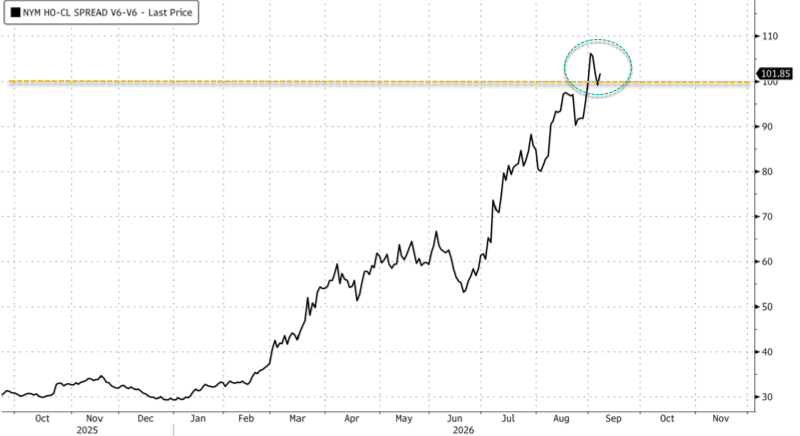
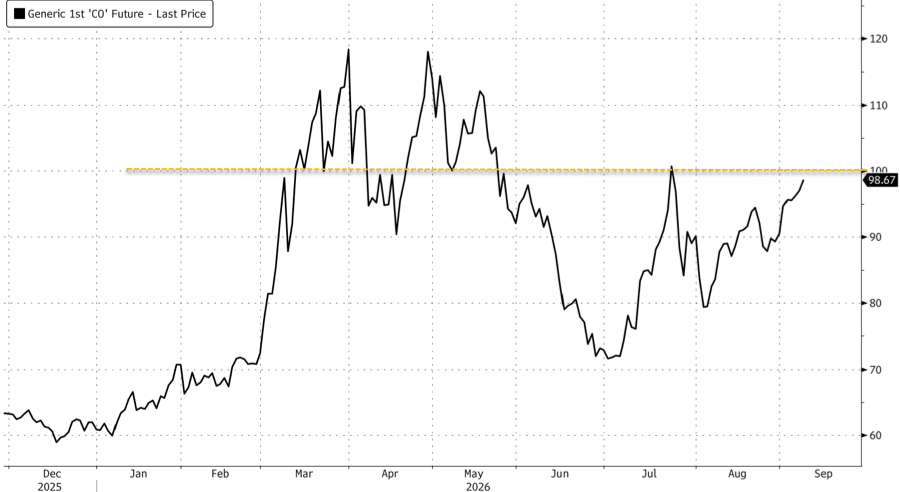
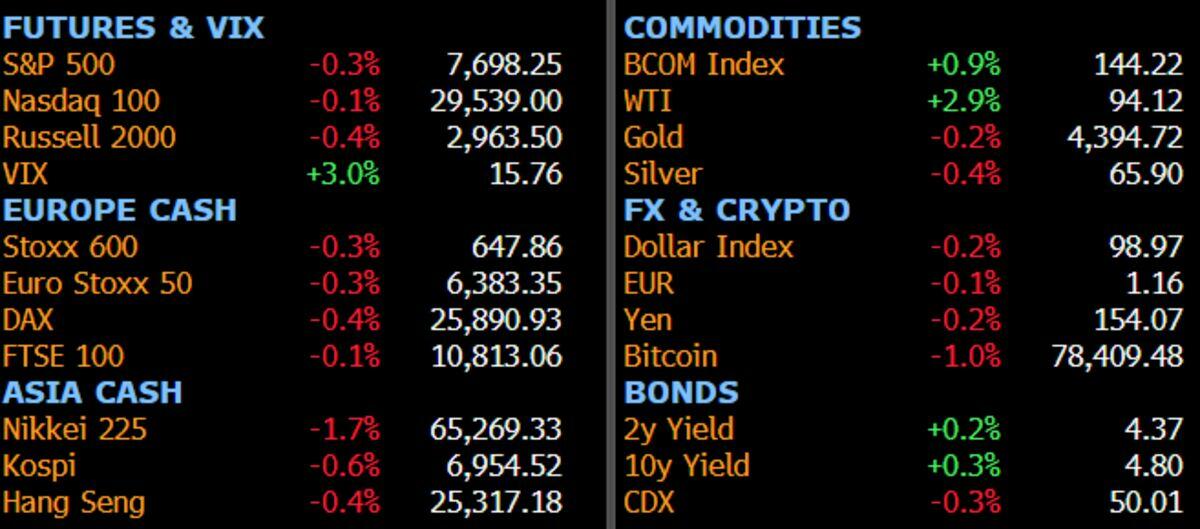
US futures fell as Brent crude approached $100 a barrel, chasing Shanghai crude which is now trading above $102, reinforcing expectations that central banks will have to raise interest rates to contain inflation while a key CPI print looms on Friday. As of 8:15am, S&P 500 futures were 0.3% lower while Nasdaq futures were fractionally negative after reversing an earlier rise. In premarket trading, Mag 7 stocks are mostly lower:
Stocks in Europe and Asia were also weaker. Brent traded around $99 after Saudi Arabia said operations at facilities in the kingdom’s south were halted by attacks. As discussed here, strong Chinese purchases added to tightness in oil markets. The dollar gained as the yen erased gains of as much as 1% deriving support from expectations of more restrictive Bank of Japan policy, which had pushed the USDJPY as low as 152, levels last seen in February. Treasuries slipped ahead of a $58 billion auction of three-year notes. Today’s US economic data slate includes August NY Fed 1-year inflation expectations (11 a.m.) and July consumer credit (3 p.m.). Fed speaker slate is blank during Sept. 5-17 external communications blackout period around the Sept. 15-16 FOMC meeting.

In premarket trading, Mag 7 stocks are mostly lower: Nvidia +0.3%, Tesla +0.2%, Alphabet -0.7%, Apple -0.4%, Amazon -0.9%, Microsoft -0.8%, Meta Platforms -0.5%
- Best Buy (BBY) slips 2% after DA Davidson cut the recommendation on the consumer electronics retailer to neutral, citing the stock’s valuation following a 35% year-to-date gain.
- Bloom Energy (BE) rises 6% and Everpure (P) gains 2% after S&P Dow Jones Indices said the companies will join the S&P 500 Index.
- Boston Scientific (BSX) slips 2% after the company said that the cyber attack that recently affected operations is likely to have a material impact on third quarter and fiscal 2026 results.
- Herbalife (HLF) rises 7% after the maker of dietary supplements announced a $250 million share buyback.
- Ionis Pharmaceuticals (IONS) falls 10% and Amgen (AMGN) slumps 5% after Novartis AG said its heart medication, pelacarsen, failed in a final-stage study.
- Pharvaris (PHVS) soars 25% after a Phase 3 trial of its deucrictibant extended-release tablet for the prevention of hereditary angioedema attacks met its primary and secondary endpoints.
- Rigetti Computing (RGTI) rises 5% after the quantum computing firm signed a $100 million pact with the US Department of Commerce to accelerate superconducting quantum computing R&D.
- Roivant (ROIV) gains 20% after the drugmaker said a mid-stage study of its inhaled drug, mosliciguat, met its primary endpoint in the treatment for a lung disease.
- Sigma Lithium (SGML) drops 16% after a Brazilian court ordered the suspension of all environmental permits for an operating subsidiary of the company and the complete halt of mining activities for the firm’s Grota do Cirilo lithium project.
- Sweetgreen (SG) is up 5% after KeyBanc raised its recommendation on the salad restaurant chain to overweight, calling it a compelling turnaround opportunity.
In other corporate news, Brookfield landed a $1 billion commitment from the UK’s Nuclear Liabilities Fund to invest across several strategies, as the New York-based firm builds a new division that packages and sells multi-asset portfolios. Volkswagen is considering offloading motorcycle manufacturer Ducati as part of a sweeping overhaul of its portfolio. Novartis shares plunged after its del-desiran treatment for a muscle-wasting disease failed to meet the primary endpoint in a phase 3 trial; it’s the third drug setback in a week for the Swiss drugmaker.
Fear of upheaval in the Middle East is driving markets in the early part of a week that builds toward Friday’s US inflation print, data that may be decisive in whether the Federal Reserve raises rates or holds them steady this month. September hikes by the European Central Bank and BOJ are largely priced in.
“We are likely to be in some sort of period of digestion, because we are going through a pretty meaningful adjustment in terms of central bank policy around the world,” Anastasia Amoroso at Partners Group told Bloomberg TV. “So we might give a little bit of those gains back or at least some consolidation here.”
Stock futures are lower as traders return to their desks after the Labor Day holiday, with markets facing multiple tests including PPI and CPI prints, Oracle earnings and a conference season that includes tech events on both coasts. On top of that, a flare-up in Middle East hostilities and an escalating trade war between the US and Canada are adding risk.
As BBG notes, stocks have been trading sideways for a month, caught between strong earnings and mounting macro risks. Events like next week’s Fed decision carry binary outcomes that argue for some protection, according to today’s Taking Stock column. Fed officials have made it clear that Friday’s inflation print will be key for rates. While the bond market sees a 60% chance of a hike next week, such a move isn’t fully priced in until December. In fact, Fed funds futures signal the most uncertainty in years.
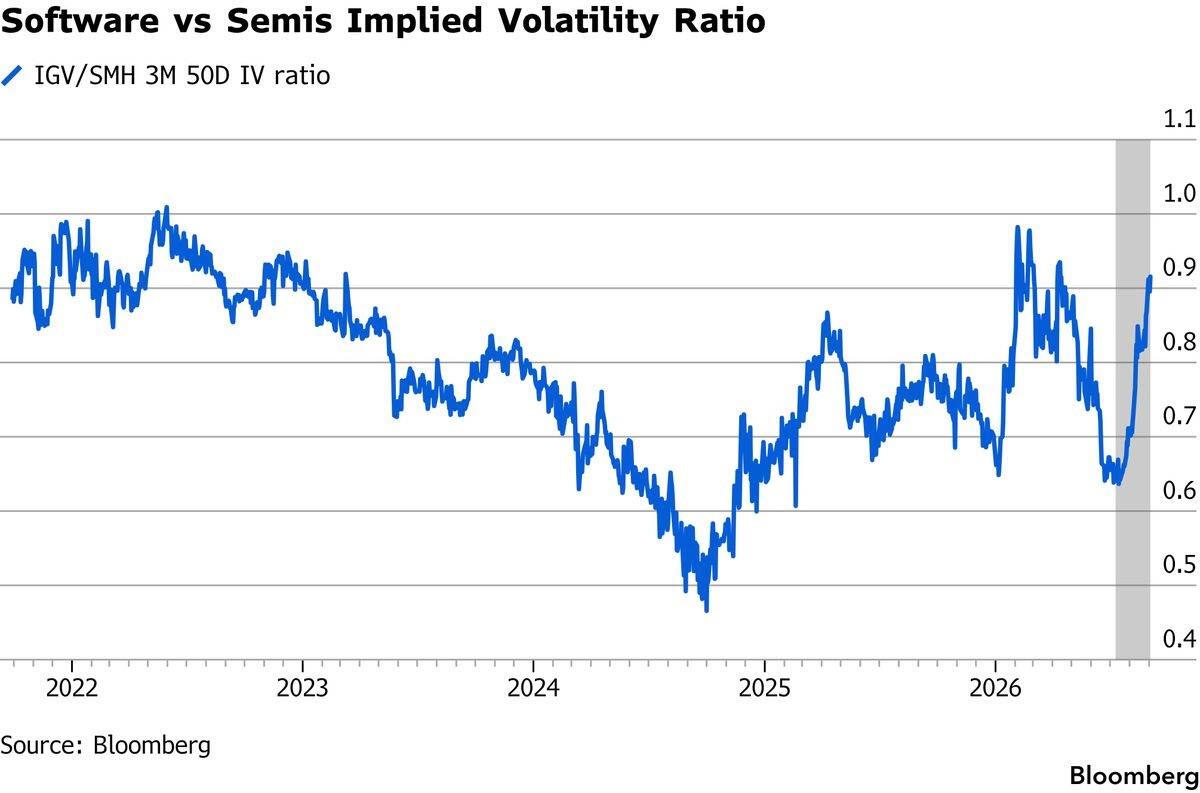
The tech trade is also in focus, with traders looking to Oracle earnings and conference comments for clues on current dynamics within the sector. Of note, software implied volatility has firmed up recently versus other areas of the tech complex. The implied volatility ratio of software vs semiconductors has been unstable this year as option volumes and open interest have exploded in both groups.

In AI, there’s been a rapid change in narrative around AGI, or Artificial General Intelligence. OpenAI’s rollout of GPT-6 on Thursday prompted Nvidia’s Jensen Huang to proclaim that “AGI has arrived,” sparking a renewed melt-up in Asian tech stocks and especially SoftBank which is a big backer of OpenAi. Still, the definition of AGI is nebulous, and not everyone is convinced. JonesTrading chief strategist Mike O’Rourke noted that the whole AGI conversation “was started by self-interested promotional individuals,” which damages credibility.

Elsewhere, ByteDance is readying an AI model geared for real-time spatial video generation, taking on Meta and Alphabet. An experimental lung disease drug developed using AI showed promise in reversing biological signs of aging. Anthropic is said to have walked away from $6 billion Decart purchase.
Global stocks may now be poised for a period of consolidation given the outlook for tightening, said Anastasia Amoroso, chief investment strategist at Partners Group. “We are likely to be in some sort of period of digestion, because we are going through a pretty meaningful adjustment in terms of central bank policy around the world,” Anastasia Amoroso at Partners Group told Bloomberg TV. “So we might give a little bit of those gains back or at least some consolidation here.”
Other assets have been active, with Yen strength triggering stop-loss orders, volatility gauges ticking up and copper hitting all-time highs. Oil prices are rising and Brent is grinding closer to $100/bbl after attacks halted several facilities in Saudi Arabia. That sent global bonds, European stocks, US futures and gold lower. German 10-year yields hit the highest since 2011, a UK 30-year sale is set for the highest borrowing costs since at least 1998, and Amazon has mandated banks for a four-part sterling-denominated sale.
Copper’s rally added to the inflationary pressure from commodities. The metal hit a record for a second straight session, with constrained near-term supplies and expectations of US tariffs on imports of refined metal buoying prices.
In geopolitics, Canada imposed tariffs of 15% to 50% on hundreds of products from the US, risking a wider trade war. Trump threatened to bar Bombardier Jets, while the manufacturer noted it creates tens of thousands of US jobs.
The Stoxx 600 is falling by 0.4%, with health care the underperformer owing to a big drop for Swiss pharma group Novartis. Banks, insurance and tech stocks are weaker too.
Asian stocks fell, reversing earlier gains, as inflationary concerns reemerged after oil prices neared the $100 a barrel level. The MSCI Asia Pacific Index retreated 0.9% after climbing as much as 0.6% earlier in the session. Japan’s Topix led declines as a sharp rally in the yen put downward pressure on exporters. South Korea’s Kospi closed lower, erasing gains of as much as 2.5% led by the tech sector. Stocks also fell in Hong Kong, Singapore, India and Australia.
“The catalyst for the turnaround is the news coming out of the Middle East that the Houthis have targeted more Saudi oil infrastructure,” said Tony Sycamore, analyst at IG Australia. “It’s all about oil being back in the driver’s seat.” There’s also fear of a “potential rate hike in America that’s kind of really pushing these Asian stocks,” said Sycamore.
In FX, the Bloomberg Dollar Spot Index is little changed while the yen has continued its rally to put its 2026 high in sight. USDJPY last traded around 154, erasing earlier gains having hit a session low of 152.89.
In rates, Treasuries hold small losses led by long-end tenors as US trading resumes after Monday’s holiday, pressured by Brent crude oil approaching $100 a barrel after Saudi Arabia said operations at several energy facilities were halted by fresh attacks. Supply considerations also are in play, including the 3-year note auction and anticipated seasonal rebound in corporate new-issue activity. Also, details of Thursday’s expanded Treasury buyback in the 10- to 20-year bucket are slated to be announced Wednesday, US long-end yields are about 2bp higher on the day with 2s10s and 5s30s spreads wider by around half a basis point. 10-year, higher by 1.6bp near 4.8%, lags bunds and gilts in the sector by 3bp and 2bp. Treasury issuance resumes with $58 billion 3-year new-issue auction at 1 p.m. New York time; $39 billion 10-year note and $22 billion 30-year bond reopenings follow on Wednesday and Thursday. WI 3-year yield near 4.47% is ~18bp cheaper than last month’s sale, which stopped through by half a basis point, and exceeds 3-year auction results since June 2024. IG dollar issuance slate already includes a handful of offerings; dealers expect a cumulative $70 billion this week and $215 billion this month, including at least one jumbo and capital-raising for AI data infrastructure.
Stretched positioning in bonds means that a short-term pullback in yields may be on the cards soon, noted Mohit Kumar at Jefferies International. A trigger could come from Friday’s inflation data or next week’s Fed decision, he said.
“If we do get a benign CPI print, which is our view, we could see a round of position covering, which would lead to a rates rally,” Kumar said. “Any pullback in rates is likely to support risky assets.”
In commodities, oil prices are rising and Brent is grinding closer to $100/bbl after attacks halted several facilities in Saudi Arabia. That sent global bonds, European stocks, US futures and gold lower. German 10-year yields hit the highest since 2011, a UK 30-year sale is set for the highest borrowing costs since at least 1998, and Amazon has mandated banks for a four-part sterling-denominated sale. WTI crude oil futures trade are up 2.5%, near session highs. Gold erased its rise too as oil prices rallied, falling below $4,400/oz.
Today’s US economic data slate includes August NY Fed 1-year inflation expectations (11 a.m.) and July consumer credit (3 p.m.). Fed speaker slate is blank during Sept. 5-17 external communications blackout period around the Sept. 15-16 FOMC meeting
Market Snapshot

Top Overnight News
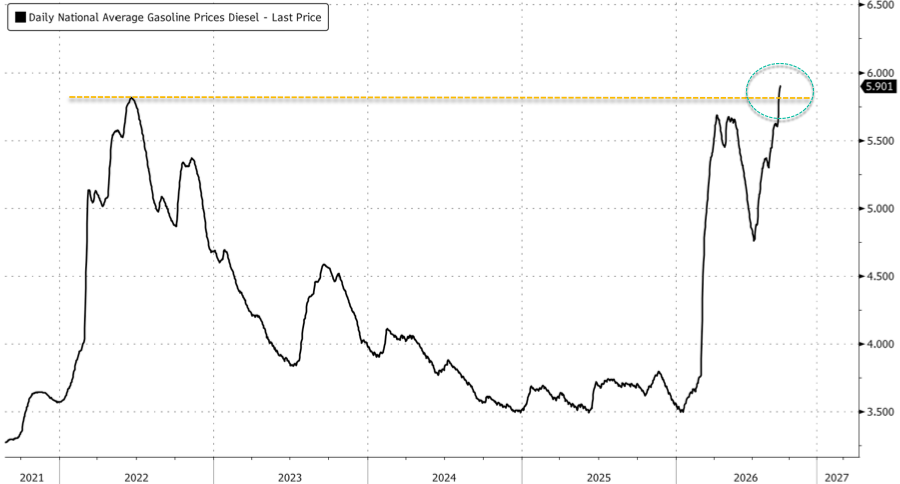
- The war in Iran has now cost U.S. consumers $100 billion in higher energy prices, and the bill is rising another $1 million about every two minutes, per a real-time estimate from Brown University as of Monday morning. Inflation shows up across the entire economy, and the recent surge in diesel prices threatens to have a dramatic impact on freight and travel in the weeks and months to come. Axios
- Yemen’s Tehran-backed Houthis attacked four cities in the south of U.S. ally Saudi Arabia on Tuesday, wounding more than 70 people and setting oil installations ablaze in what appeared to be a major expansion of the six-month-old Middle East war. They used drones and missiles to strike a Saudi airbase in the southern city of Khamis Mushait, and targets belonging to Saudi Arabia’s state oil company in nearby Abha, Najran on the Yemeni border and Jazan, a major Red Sea port city that houses a large refinery and power plant. Reuters
- In offices across the military and in the intelligence community, there have been recent quiet discussions about cutting the number of people and facilities typically stationed in the Middle East if the Trump administration succeeds in ending the Iran conflict. CNN
- New Canadian tariffs targeting roughly $20 billion in U.S. imports officially snapped into place on Tuesday, the latest escalation in an increasingly costly trade war that has ensnarled two longtime allies. NYT
- Japanese workers’ nominal wages rose at the fastest pace in nearly three decades on the back of strong corporate earnings and a tight labor market, in data likely to keep the Bank of Japan on course for further monetary tightening. BBG
- Two hawks on the Bank of Japan’s monetary policy board are calling more strongly for the central bank to accelerate its interest rate increases, pushing it to do more to rein in inflation before their terms end next July. Nikkei
- China’s export growth accelerated in August, swelling its trade surplus near $806 billion for the year. Its surplus with the US surged almost 44% to more than $29 billion. BBG
- China’s car exports stayed robust in August as BYD and other automakers shipped a record number of vehicles overseas, in sharp contrast to a sluggish domestic market where their sales fell for the 11th month in a row. Passenger vehicle exports jumped 77.5% from a year earlier to 894,000 units in August, easing from an increase of 88.2% a month earlier. Reuters.
- Goldman raised its oil price outlook by $5 a barrel, forecasting Brent at $85 by December and $80 in 2027 on expectations Middle East shipping disruptions will persist. BBG
Labor Day Recap
- On the geopolitical front, the US launched strikes against three Iranian crude oil tankers on Saturday in retaliation for the IRGC targeting US Navy warships with ballistic missiles. Iran’s navy also said it targeted three oil tankers that were travelling through unauthorised routes in the Strait of Hormuz and three additional US vessels in other areas. Since the weekend, the Iranian Foreign Ministry Spokesperson said a deal with Oman regarding the Strait of Hormuz will be registered soon, while the FT reported that Saudi Aramco’s oil facilities in Jizan were hit, which caused upside in energy benchmarks.
- European bourses were lower across the board, given the upside seen in energy benchmarks.
- In the FX space, G10s were firmer against the greenback, with the JPY the clear outperformer, while the EUR was steady despite the AfD victory in Saxony-Anholt.
- In the metals space, spot gold was choppy but was helped amid data from China that the PBoC boosted its gold reserves for a 22nd straight month.
A more detailed look at global markets coutesy of Newsquawk
APAC stocks traded mixed in the absence of a lead from Wall Street and as attention turned to several data releases from the region, including Japanese GDP and Chinese trade data. ASX 200 underperformed with sentiment not helped by a deterioration in the Westpac Consumer Sentiment and NAB Business Confidence surveys. Nikkei 225 was choppy amid recent currency strength and as the latest data, including upward GDP revisions and hot Labour Cash Earnings, solidified the case for a BoJ rate hike next week.
KOSPI outperformed on tech momentum and after South Korean GDP matched initial estimates. Hang Seng and Shanghai Comp were mixed as the Hong Kong benchmark was dragged lower by weakness in the local tech and biopharma stocks, while the mainland was kept afloat as participants digested the ultimately mixed Chinese trade data, in which Exports and Imports accelerated and continued to show strong double-digit percentage growth, but missed estimates.
Top Asian News
- Japanese Finance Minister Katayama said they will bolster efforts to secure funding for a consumption tax cut on food and will communicate fully with markets and the public to gain credibility in their fiscal policy. Furthermore, she said they won’t comment on specific FX levels and there is no change to their forex stance since the Japan-US joint intervention, while they will closely communicate with the US to achieve orderly forex markets.
- Japan LDP policy chief Kobayashi will retain post and Japan’s Ishin party seeks a special mission post in reshuffle, according to Japanese press.
European bourses are softer across the board, Euro Stoxx 50 -0.4%, with clear underperformance in the SMI, -1.4% (see Novartis below). The disappointing risk tone comes amid upside in energy prices. The Saudi Energy Minister said a number of energy facilities and utilities were hit, resulting in operations being temporarily halted. This was later confirmed in a Yemeni Houthis statement.
Sectors point to a mixed picture. Food, Beverages & Tobacco is the clear outperformer, with Optimised Personal Care and Chemicals rounding out the top 3 sector gainers. On the other hand, Health Care is the laggard, with Banks and Insurance completing the underperformers. Another setback for Novartis (-8.9%) this morning, after it announced that its del-desiran failed to meet the primary endpoints in its late-stage trial. Other key movers: Computacenter (-0.2%), strong H1 metrics and raises its FY26 outlook; Sandoz (+1.8%), confirms its 2028 outlook and set out new 2030 guidance and targets 100 biosimilars by 2040; Infineon (-3.6%), downgraded to equal weight at Morgan Stanley; Schneider Electric (-0.2%), downgraded to neutral at Santander.
Top European News
- German Trade Balance (Jul) 21.3B vs. Exp. 16B (Prev. 15.4B).
- German Exports (Jul MM) -0.8% vs. Exp. 0% (Prev. 0.9%).
- German Imports (Jul MM) -5.7% (Prev. 4.4%).
- French Trade Balance (Jul) -6.7B vs. Exp. -6B (Prev. -5.8B).
- UK BRC Retail Sales Monitor (Aug YY) 0.5% vs. Exp. 1.2% (Prev. 1.0%).
FX
- Snapshot: G10s are mixed against the USD. JPY continues to extend on recent strength, whilst the Kiwi is the clear underperformer this morning amidst the downbeat risk tone. Also factoring in is the mixed Chinese Trade data, which rose from the prior, albeit less than consensus.
- DXY is incrementally firmer this morning, and holds within a 98.71-99.00 range. Overnight, the USD was mildly pressured, but then picked up in early European trade alongside a pick-up in yields. US-specific news flow has been lacking as participants return from holiday, but focus will be on trade updates between the US and Canada. On that note, Canada’s retaliatory tariffs against US goods took effect, as scheduled. The Loonie is a touch firmer vs USD this morning, but likely benefiting from the surge in energy prices rather than any trade-related optimism.
- The Yen story remains much more pertinent for the USD. Recent thin liquidity (due to Labor Day) has allowed the JPY to take more ground against the USD, with USD/JPY briefly dipping below the 153.00 mark. The pair is now trading at levels not seen since early February of this year. As mentioned in Monday’s FX update, the recent hawkish BoJ repricing, potential intervention/rate check, and increased possibility of larger GPIF purchases have lifted the JPY over the past couple of weeks.
- Also helping the outperformance today is the firmer-than-expected Labour Cash Earnings and an upward Q2 GDP revision. There were also comments from Japanese Finance Minister Katayama, who stated there was no change to their forex stance since the Japan-US joint intervention and that they will closely communicate with the US to achieve orderly forex markets.
- EUR is a touch lower this morning, pressured by the ongoing strength in the energy space. The ECB will hike rates by 25bps this Thursday, though the outlook beyond September remains more uncertain. If oil prices continue to lift energy prices, and second-round effects begin to filter through into the Eurozone economy, another hike in December could be likely. The single currency currently holds around 1.1611, with the high of the day a couple pips above its 200-DMA (1.1633).
Fixed Income
- Despite some slight respite being found overnight, fixed income is back in the red as energy extends to fresh highs and Brent surpasses the USD 99.0/bbl handle, bringing a return back to USD 100/bbl into view. As such, yields are bid across the globe and the curve, with the UK feeling this most keenly given its energy sensitivity and after AMZN filing for GBP-denominated issuance.
- Continuing with Gilts, the benchmark opened higher by around 13 ticks, taking initial respite from the brief overnight pause and potentially reports that PM Burnham is set to meet with businesses next week to reassure them into the budget. However, that swiftly faded with Gilts now down by over 10 ticks and at an 85.56 base following the Amazon update. For the curve, the 2yr is 4bps higher at 4.61%, but off the 4.69% recent peak from last week. While the 10yr is c. 3bps higher, and similarly off last week’s 5.29% near 20yr peak.
- Bunds lower, by about 10 ticks at the time of writing and just off worst in 121.65-95 confines. Pressure a function of the discussed energy upside on Saudi and Houthi updates this morning (see Commodities/headline feed). For Germany, the docket features Green supply which should pass without issue. More pertinently, we continue to await a concrete response from Chancellor Merz on the strength of AfD, something that will become increasingly acute into more regional elections this month. Before that though, the ECB looms on Thursday, and while a 25bps hike is all but priced, the market will be keenly attentive to any dovish/hawkish signal from the statement/forecasts/presser, particularly at the short-end of the curve.
- USTs are also under pressure on the resumption of cash trade after the US holiday on Monday. Currently, it finds itself lower by a handful of ticks and at a 107-09+ base, approaching Monday’s 107-08 trough. The docket today features supply and updates from President Trump as the scheduled highlights; though, geopolitics may well dominate.
- Amazon (AMZN) to sell GBP-denominated bonds; 3yr, 6yr, 12yr & 19yr.
- Germany sells EUR 1.374bln vs exp. 1.5bln 2.30% 2033 and 2.60% 2041 Green Bund.
- Japan sells JPY 1.9tln 5-year JGBs; b/c 3.42x (prev. 4.15x), average yield 2.239% (prev. 2.020%), Tail in price 0.04 (prev. 0.02).
- The Netherlands sells EUR 3bln vs exp. 2.5-3bln 2.75% 2036 DSL: Avg. yield 3.463% (prev. 3.206%).
- Australia sells AUD 400mln in 5.00% June 2036 Bonds: b/c 5.76x, avg. yield 5.1874%.
Commodities
- Firmer trade across energy once again as geopolitical tensions remain high, and with hardly any signs of peace between the US and Iran (more details below). WTI Oct resides towards the top of a USD 90.87-94.73/bbl range (vs Friday’s USD 88.72-92.17/bbl band), while Brent Nov sits towards the upper end of a USD 96.78-99.46/bbl range (vs yesterday’s USD 95.97-98.06/bbl band). Dutch TTF front-month resides just above the EUR 74/MWh mark after finding earlier support at EUR 73/MWh and then resistance at EUR 74.50/MWh.
- Precious metals are subdued as higher energy prices keep the USD underpinned. Spot gold resides towards the bottom of a USD 4,388-4,443/oz range (vs yesterday’s USD 4,381-4,435/oz band), while spot silver sits towards the lower end of a USD 65.69-67.19/oz range (vs yesterday’s USD 65.40-66.74/oz band).
- Base metals are mostly firmer despite the aforementioned crude prices and effect on the USD, with supply concerns and tariff fears cited by desks, alongside ongoing hopes of Chinese stimulus. 3M LME copper resides near record highs in a current USD 14.51k-14.64k/t range.
- In terms of the main geopolitical updates, Iran warned that economic warfare will be met with a maritime exclusion zone from the Persian Gulf to the blockade perimeter, and said it has the ability to strike ships participating in the US blockade. Further, Yemeni forces launched ballistic missile and drone attacks on targets in Saudi Arabia, including around Khamis Mushait, Abha airport and King Khalid Airbase. Houthi spokesperson warned that further attacks on Yemen will be met with broader strikes on Saudi Arabia. Saudi Energy Minister confirmed that several energy facilities and utilities were hit; are temporarily halting some operations. Further, Tasnim analysis suggests that recent Iranian commentary indicates that Iran is considering expanding the geographic scope of its maritime confrontation into the northern Indian Ocean.
- Iraqi Oil Minister said they will soon announce refinery development and construction opportunities for investors.
- Russia’s Kremlin spokesperson said cooperation between India and Russia on rare earth explorations are being discussed.
Trade/Tariffs
- Canada’s retaliatory tariffs against US goods took effect, as scheduled.
- US President Trump called for a stop to US sales of Canada’s Bombardier aircraft.
- Japanese Chief Cabinet Secretary Kihara said China’s anti-dumping move targeting Japan defies practice and they will act to prevent an undue impact from China’s actions.
Central Banks
- RBA’s Hauser said that the RBA stands ready to raise rates again if needed, the question is whether more is needed on interest rates.
- RBA’s Assistant Governor Hunter said the board is concerned about inflation and has low tolerance, adding the board may have to raise rates if there is a sense inflation will be stronger.
Geopolitics: Middle East
- US President Trump posted, “Oil prices will drop precipitously, like everything else is dropping (but more!), when we WIN the war with Iran. Three Dollars a gallon, but ultimately, below Two Dollars a gallon. It will all happen quickly, and Iran will never have a Nuclear Weapon. MAGA!”
- Iranian President Pezeshkian said Iran has always opposed war but will continue to resist aggression with full force until the aggressors are made to regret their actions.
- Iran’s top national security official Rezaei said Washington has received a clear warning from Iran’s new missiles and that economic warfare will be met with a maritime exclusion zone across the Persian Gulf to the blockade perimeter, while he added that the operational posture toward US warships and bases has been fundamentally recalibrated.
- Tasnim analysis suggests that commentary from Iranian official Rezaei signals that Iran is considering expanding the geographic scope of its maritime confrontation into the northern Indian Ocean.
- Saudi Energy Minister said a number of energy facilities and utilities were hit and that some operations have been temporarily halted. This was later confirmed by the Houthis, in which they added that they struck the Khamis Mushait Air Base in retaliation to recent Saudi airstrikes. The group warned that further attacks on Yemen will be met with broader strikes on Saudi.
Geopolitics: Russia-Ukraine
- Russia’s Defence Ministry said Russian forces struck energy infrastructure and drone-manufacturing facilities in Odessa and the Odessa region.
- Russian Foreign Minister Lavrov rejected a proposal to halt strikes on civilian supply vessels in the Black Sea, Interfax reported.
- Ukrainian President Zelensky said he hopes to meet US President Trump later in September to discuss the winter air defence package.
Crypto
- Bitcoin has extended on Monday’s losses and currently trades at the lower end of its USD 78.2k-USD79.5k range.
- Republican senators have suggested that the bipartisan crypto regulatory bill is likely to fail next week, Semafor reported.
US Event Calendar
- 6:00 am: United States Aug NFIB Small Business Optimism, est. 99.3, prior 99.8
- 11:00am: NY Fed 1-Yr Inflation Expectations, est 3.60%
- 3:00pm: Consumer Credit
DB’s Jim Reid concludes the overnight wrap
Today kicks off the “home straight” to the end of the year after yesterday’s Labor Day holiday where markets were understandably quiet with what focus there was on oil and German politics. Brent (+0.75%) continued to edge higher which helped the 10yr bund (+4.8bps) close at another post-2011 high of 3.39% with equities fairly subdued. US equity futures have just ticked very slightly into positive territory this morning after being slightly below for most of the session yesterday when the cash market was closed. Elsewhere the Yen is up half a percent to 153.52 and to the highest level since February.
This has likely been helped by Japan’s real wages increasing by +2.4% year-on-year in July, exceeding expectations of +1.8% and marking the strongest growth since May 2021. This also represents the seventh consecutive month of wage gains, indicating a gradual improvement in income trends. Meanwhile, total cash earnings rose +4.7%, the largest increase since January 1997, accelerating from a revised +4.0% increase in June. The stronger-than-expected wage data reinforces the overwhelming case for the Bank of Japan (BOJ) to raise interest rates at next week’s policy meeting, following its previous hike three months ago, and supports the prospect of further monetary policy tightening in the months ahead. Q2 GDP has also been revised up overnight, moving from 1.1% annualised to 1.4%. However, expectations were at 1.8%.
In the rest of Asia, the KOSPI (+1.54%) is being driven by the tech rebound again, while the Nikkei is close to flat. The Hang Seng (-0.27%) and Shanghai Comp (+0.32%) are moving in different directions with the ASX (-0.84%) the largest decliner.
In a low energy 24 hours the Middle East story has rumbled on as concerns about fresh US-Iran hostilities pushed oil prices higher still. In part, that followed the tanker attacks over the weekend, but it was also reported that the Houthi rebels had hit Saudi Arabian oil infrastructure yesterday. So that helped push Brent crude (+0.75%) to a 6-week high of $97.00/bbl, with WTI also up +1.33% to $92.70/bbl. Brent is up another +0.62% this morning. And there was no sign of respite on the gas front either, with European natural gas futures (+1.93%) also rising back to €73.34/MWh. So that exacerbated fears about European inflation, with the 1yr Euro inflation swap (+10.6bps) up to its highest level since May 2026, at 3.37%.
With inflation fears mounting, that lifted European bond yields across the continent. So by the close, the German 2yr yield (+5.6bps) was back up to 3.00%, which is its highest level since June 2024. And further out the curve, the 10yr yield (+4.8bps) was up to a post-2011 high of 3.39%. Moreover, those moves were echoed elsewhere, with yields on 10yr OATs (+5.5bps), BTPs (+5.6bps) and gilts (+4.2bps) all rising as well.
That rise in yields came as traders grew increasingly confident in future ECB rate hikes this year. In fact, investors were pricing 48bps of further hikes by the ECB’s December meeting at the close, up +2bps on the day. And as a reminder, our own European economics team also revised their ECB forecasts last week, so they expect the ECB to hike this week, and follow that up with another hike at the December meeting. See here for more on their view.
Amidst all that, European equities were fairly steady, despite the rise in energy prices and the slightly hawkish rates repricing. The STOXX 600 ultimately closed up a whisker (+0.003%), with gains for France’s CAC 40 (+0.33%), alongside declines for the FTSE 100 (-0.08%) and the DAX (-0.15%). Sentiment was bolstered by positive revisions to the Q2 GDP numbers in the Eurozone, which were revised up to a +0.6% print from +0.4% at the preliminary reading. However, there was some weakness in Germany, where data showed industrial production fell -1.1% on the month (vs. +0.2% expected).
Staying on Europe, German politics remained front and centre yesterday after the AfD came first in Saxony-Anhalt’s state election, winning 43.8% of the total votes, and just a few seats short of an absolute majority. Following the result, Chancellor Merz said in a press conference that he would double down on the reform course, with no indication of planned changes despite Merz saying he was “deeply shocked” by his CDU’s weak performance.
Early morning data from China indicated continued strength in trade activity, providing support for economic growth despite uneven domestic demand. Exports surged +25.0% y/y in August (v/s +25.9% expected), accelerating from +23.9% in the previous month. Imports also remained robust, rising +28.2%, up from a revised +27.6% previously, although slightly below forecasts for a +31.0% increase. As a result, China’s trade surplus expanded to $119.09 billion, compared with $112.34 billion in the prior month and broadly in line with market expectations of $119.10 billion.
Finally on the inflation theme, copper hit an all-time high (+0.57%) on the London Metal Exchange yesterday, rising above $14,415 per ton. That comes amidst ongoing supply concerns, and the prospect of potential US tariffs on copper. So one to watch going forward.
Finally in another research advert, Henry published his latest market dislocations report yesterday. This month, he looked at why the current cross-asset equilibrium remains unsustainable, and how several asset classes are vulnerable to the impact of building inflationary pressures and a faster tightening cycle from central banks. See the full report here.
Looking at the day ahead, US markets are back open with the NFIB’s small business optimism index for August, the NY Fed’s Survey of Consumer Expectations, and July consumer credit data releases. In Europe, we’ll also get Germany’s July trade balance and France’s July current account. Finally, Canada’s counter-tariffs on US imports are set to enter force today