US stock futures slipped in cautious, low volume trading as the latest Middle East escalation pushed oil prices higher, lifting bond yields in Europe and Asia. As of 9:00am ET, S&P futures were down 0.2% with Nasdaq futures modestly in the red despite solid performance for tech stocks earlier in the session, which helped the Kospi surge more than 4.6% – its second biggest jump since the Situational Awareness takeover by Citadel – and Nikkei jumped almost 2% as OpenAI’s GPT-6 Astra debut reinvigorates the Asian semiconductor rally. Taiex climbs about 1.5% and ChiNext soars 2.6% (as discussed overnight, China may be the next Gamma Squeeze target). Hang Seng underperformed peers with a 1% loss as Chinese tech stocks retreat in Hong Kong. Brent crude rose above $97 a barrel following the largest exchange of tanker attacks yet between Iran and the US. Traders also assessed reports of hits on Saudi Arabian oil infrastructure and a potential accord between Iran and Oman to manage shipping through the Strait of Hormuz. In FX, the yen strengthened to its highest level since February, surpassing the peak reached after July’s intervention. The dollar fell 0.2%. Cash trading in Treasuries and US equities was closed for Labor Day. US markets are closed for Labor Day.

In corporate news, an Amazon.com Inc. cargo plane overran a runway at Miami International Airport and burst into flames on Sunday, killing at least five people and temporarily shutting down the airport’s runways.
- Jaguar Land Rover Automotive Plc will slash some 4,000 jobs as Britain’s largest carmaker grapples with US tariffs, the fallout of a crippling cyberattack and intense competition.
- Novo Nordisk A/S stopped two more trials for its experimental heart disease medicine, in a further blow to the drug’s prospects.
- Abu Dhabi National Oil Co. is in talks with the biggest refining companies in Thailand and Africa to invest in their businesses.
- Uber Technologies Inc. has hired banks to hold calls with investors this week for a debut euro bond sale.
- Novartis AG suffered a second trial disappointment within a week after the Swiss pharma group’s potential blockbuster heart drug failed in a final-stage study.
US cash trading and individual stock futures are shut today for the Labor day weekend. For anyone catching up after a break, Friday’s US jobs report did the early work on this week’s story. Payrolls rose 162,000, blowing past estimates, and pushed the market-implied odds of a Federal Reserve rate hike on Sept. 16 to a little above 60% from around 50% before the print.

That leaves Friday’s CPI (and to an extent Thursday’s PPI) as the real swing factor for a Fed that’s held steady for five straight meetings. The European Central Bank adds its own test Thursday, with markets pricing a near-certain quarter-point hike to a 2.50% deposit rate. Between the two central banks and Friday’s CPI, this is the week Europe has to trade around.
“Markets will be adjusting their positioning heading into the Fed’s blackout period. The risk is the Fed turning hawkish and that will be reflected in equities,” said Geoff Yu, a senior macro strategist at BNY. “Bond markets will remain nervy and we remain focused on fixed-income volatility.”
While economic data will likely be the biggest catalyst for markets this week, earnings will also help shape the outlook for key equity sectors. Results from Oracle Corp. and Adobe Inc. on Thursday will give investors a fresh read on AI infrastructure demand and the threat the technology poses to software makers. For now, the earnings backdrop remains supportive. Investors should buy any dips in equities given a robust earnings outlook, said JPM strategists. Even moderate central bank tightening would be unlikely to derail the positive backdrop for stocks unless inflation expectations change materially, said the team led by Mislav Matejka. “As corporate profits remain on an uptrend, any bout of weakness in equity prices would leave them cheaper,” the strategists wrote. “We believe one should continue using the dips to add.”
The Stoxx 600 struggled for direction, with economically sensitive sectors among the biggest decliners as inflation concerns drove bond yields higher. Novartis AG shares fell 2.6% after a heart drug failed in a final-stage study. Energy stocks outperformed, while the real estate and insurance sectors were among the biggest laggards. Here are the biggest movers Monday:
- Nordex shares rose as much as 12%, the most in over four months, after being upgraded to buy at BofA Global Research
- SigmaRoc rose as much as 13%, the most since March 2021, after the lime and minerals group released its interim results and announced the acquisition of Lithuanian dolomite business AB Dolomitas
- Lottomatica shares gained as much as 8.2%, hitting the highest since June, after the Italian gaming company quantified the boost to online earnings it expects from the proposed acquisition of Spanish rival Cirsa Enterprises
- Infineon shares rose as much as 3.9% as MP Capital Markets upgraded the stock to buy from hold
- Burkhalter shares rose as much as 6.7%, the most since March 2022, after the Swiss building technology services company reported results
- Novartis shares fell as much as 3.9% after the Swiss pharma group’s potential blockbuster heart drug, pelacarsen, failed in a final-stage study
- Schindler dropped as much as 3.6% after Goldman Sachs gave the elevator and escalator specialist its only sell rating, downgrading from neutral, citing lower growth and earnings progression compared to the wider sector
- Tomra shares fell as much as 10%, while Norwegian-listed peer Envipco also slumps, after France abandoned plans to impose a mandatory deposit return system for plastic bottles, introducing doubts over a potential growth catalyst for the stocks
- Hollywood Bowl shares dropped as much as 6%, the most since May 2025, after analysts at Deutsche Bank cut their price target and warned the summer drought created “less-than-ideal conditions” for the provider of indoor family entertainment
German establishment politics, and specifically Merkel’s pro-immigration legacy, suffered a crushing blow over the weekend, after the conservative Alternative for Germany scored its best-ever result in a state election on Sunday, delivering a powerful blow to liberal Chancellor Friedrich Merz. The AfD secured 44% of the vote in Saxony-Anhalt. In the UK, the government signaled it won’t provide financial support to limit job losses expected to be announced at Jaguar Land Rover this week.

South Korea’s memory heavyweights were standouts in Asia as the release of OpenAI’s GPT-6 model continued to fuel renewed enthusiasm for AI. Driving the tech rally is OpenAI’s plan to release a new model, GPT-6, pitched as a milestone toward artificial general intelligence. That pushed the Philadelphia Semiconductor Index up 3.4% on Wall Street Friday and has SK Hynix and Samsung leading the advance in Asia Monday. The enthusiasm isn’t universal though. Hong Kong’s Hang Seng and its tech gauge both slipped into the red despite the Nikkei and Kospi seeing solid gains.
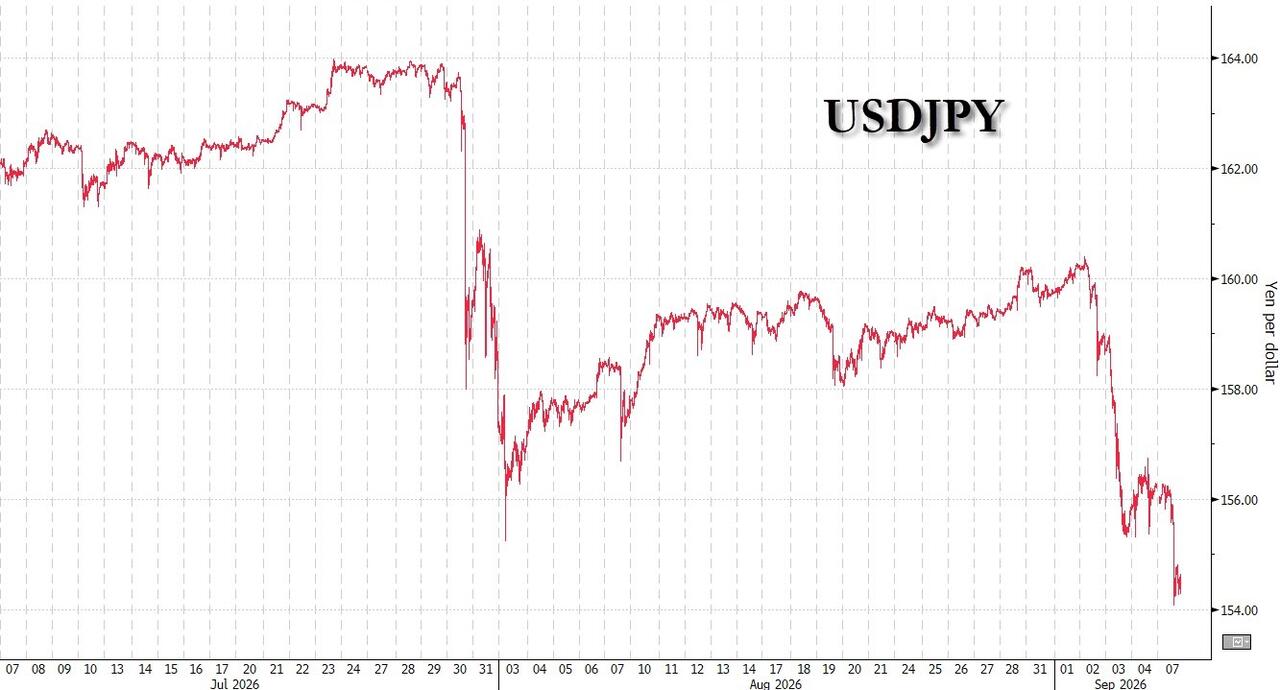
The dollar initially ticked higher, but then retreated following another surge in the yen which pushed the USDJPY as low as 154, down almost 200 pips overnight. The Korean won extended winning streak to around two-year high. T-note futures are about 1/32 softer near 107-14 with cash Treasuries closed for Labor Day. Bund futures are ~15 ticks lower after German far-right party AfD wins state election. Aussie curve bear flattens with 3-year yield ~3 bps higher. WTI crude futures climb 1% to near $92.40; gold sheds almost $30 to below $4,400-handle.
The notable overnight mover was again the yen, which strengthened to its highest level since February, surpassing the peak reached after coordinated intervention by Japan and the US. The Japanese currency suddenly extended gains, up as much as 1.4% to 154.06 against the dollar in London trading. There was no clear driver for the move, with some traders pointing to the US holiday helping to exaggerate the moves while others mentioned the break of the key 155 per dollar level as a reason. The yen’s break below 155 is significant given the level previously acted as a floor following past intervention episodes,” said Masahiko Loo, senior fixed income strategist at State Street Investment Management.
Large stop-loss orders below the 155-per-dollar level were triggered and options dealers were forced to sell dollars, adding to the yen’s gains, according to a trader familiar with the transactions who asked not to be identified because they aren’t authorized to speak publicly.
China, separately, said it’s injecting 300 billion yuan ($45 billion) into its largest banks and insurers, its biggest recapitalization in almost two decades, with only a modest share reaction so far.
In commodities, oil advances, with Brent futures are trading at a 6 week high, above $97 a barrel, after US attacks on Iranian tankers and Tehran’s threat of a new restricted zone outside the Strait of Hormuz. Over the weekend, Iran said it hit three US-linked ships in retaliation for American attacks on Iranian tankers. The US military earlier said it struck three Iranian crude tankers, in response to the IRGC targeting two US Navy warships with ballistic missiles. European natural gas prices surge. Meanwhile, Ukraine is resigned to Russia’s war dragging on through another tough winter.

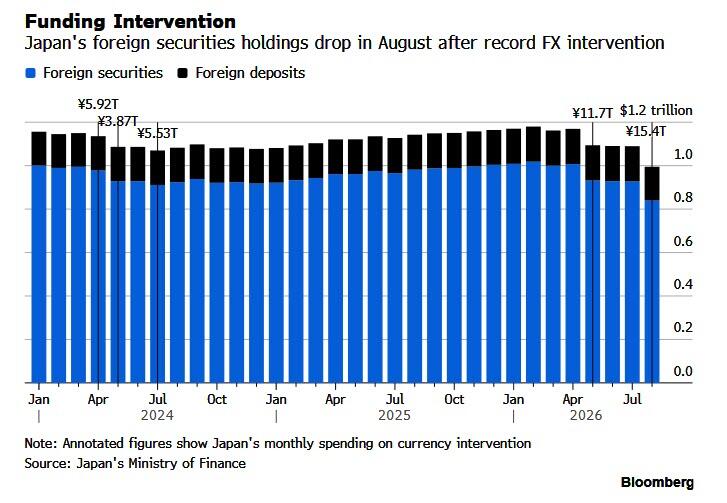
In rates, japan likely sold a portion of its holdings of foreign securities, including US Treasuries, to finance its record currency intervention over the past month. Treasury futures edge down. There’s no trading of cash Treasuries worldwide on Monday because of a US public holiday.
Market Snapshot

Top Overnight News
- Saudi Aramco’s oil facilities in the Saudi Arabian city of Jizan have been attacked only a month after a separate strike temporarily knocked out some production at its refinery.: FT
- Iran says US energy companies’ facilities are ‘exposed’: RTRS
- UAE says its energy exports will not be ‘held hostage’ by Iran war: RTRS
- Several Qatari liquefied natural gas tankers are heading back toward the Persian Gulf, a sign the supplier may be positioning vessels for a resumption of exports through the Strait of Hormuz: BBG
- The Alternative for Germany scored its best-ever result in a state election on Sunday amid growing public discontent with the political establishment, delivering a powerful blow to Chancellor Friedrich Merz: BBG
- AI could pose ‘existential’ risk to humanity, UN rights chief warns: RTRS
- From dance floor to war: China readies humanoid robots for combat: RTRS
- Japan likely sold a portion of its holdings of foreign securities, including US Treasuries, to finance its record currency intervention over the past month, despite concern in Washington over the impact of Treasury sales on long-term yields: BBG
- The South Korean won advanced to its strongest level in nearly two years Monday, helped by a rally in semiconductor stocks and continued foreign inflows into the country’s benchmark equity index: BBG
- Nepal rescuers focus on 900 hydropower workers, 121 could be trapped in tunnels, officials say: RTRS
- German industrial production declined the most in almost a year, marking an unexpected setback to the recovery of Europe’s biggest economy: RTRS
- Fed’s Hammack (2026 voter) said on Friday that Fed policy is not restrictive and inflation is too high, while she stated local contact views indicate now is the time for a Fed hike to control inflation.
- Huawei launches new foldable smartphone; Xiaomi and Apple set to follow: RTRS
- Warning signs abound for Republicans as midterm campaign begins final sprint: RTRS
- President Trump said on Friday that they are taking action to help cattle ranchers and signed an order that allows ranchers to process their own beef, while small, medium, and large ranchers can sell to consumers, and he also stated that meatpackers have been charging unsustainable prices.
- There were multiple casualties after an Amazon (AMZN) cargo plane overran the runway and struck vehicles whilst landing at Miami International Airport, while the Miami-Dade County Sheriff announced that at least five people have been confirmed dead.
Iran Headlines
- US launched strikes against three Iranian crude oil tankers on Saturday, which destroyed one, in retaliation for the IRGC targeting US Navy warships with ballistic missiles.
- Iran’s navy said it targeted three oil tankers that were travelling through unauthorised routes in the Strait of Hormuz and three additional US vessels in other areas.
- US President Trump said on Friday that they do intermittent strikes in Iran and that the Iran issue is a military conflict, while he added that they may hit Pickaxe Mountain very soon. Trump warned that if anything goes badly with Iran, they may hit them hard and have essentially taken over Iran. He also claimed there have been no shootings for days and there are no mines in the Strait.
- US Energy Secretary Wright said a nuclear deal with Iran may not be achievable in the near term and military action may be needed to address threats from Iran, according to ABC News.
- Iran’s top security official Rezaei said Iran and Oman will sign agreed Strait of Hormuz passage maps in the coming days and that Iran will commit to keeping the Strait of Hormuz open when the US neither threatens Iran nor attacks it. Rezaei also stated that they will announce in the coming days and weeks a restricted zone outside the Strait of Hormuz that starts from the US Navy’s blockade line and extends through the strait into the Persian Gulf, and any ship identified entering this zone with the intention of passing through the strait will be added to the sanctions list. Furthermore, he said that Iran tested an Iranian anti-ship missile above a US warship for the first time and claimed the missile created ‘hell’ for the Americans ‘and they fled’.
- Iranian Parliamentary Speaker Ghalibaf warned that Iran’s response to any attack against its interests and security would be faster, heavier and more painful.
- Iran’s Foreign Ministry said the US-led war is disrupting global oil trade and costs, while it added that US aggression is causing instability in the Strait of Hormuz.
- Israeli military announced that it struck southern Lebanon after Hezbollah launched drones towards Israeli soldiers in the security zone. Israel’s army also issued an evacuation warning to residents of a building in Deir Zahrani, southern Lebanon.
- Israeli Finance Minister Smotrich said PM Netanyahu ordered the evacuation of certain settlement outposts in the West Bank. It was separately reported that Israel conducted an airstrike on eastern Gaza City with four missiles.
- Joint statement by UAE, Saudi Arabia, Qatar, Jordan, Indonesia, Pakistan, Turkey and Egypt Foreign Ministers strongly condemned statements made by Israel’s National Security Minister Ben-Gvir and Defence Minister Katz regarding the displacement of Palestinians.
- Yemeni armed forces said they thwarted an attempt by Houthis to infiltrate the Dabab front, while they announced that warplanes struck Houthi positions in Balhaf and south of Hodeidah.
A more detailed look at global markets courtesy of newsquawk
APAC stocks traded mixed as the region reflected on the recent strong US jobs data and subsequent Fed rate hike bets, as well as the US and Iran tit-for-tat attacks on vessels in the Strait of Hormuz. ASX 200 was little changed as resilience in the energy, resources, materials and mining sectors is offset by underperformance in tech, utilities and telecoms, but with downside in the index cushioned by support at around the 9,000 level. Nikkei 225 gapped above the 66,000 level with tech-related stocks heavily represented in the list of biggest gainers in the index. KOSPI outperformed amid firm gains in the semiconductor giants, including SK Hynix, which is said to be sharply increasing the production share of its sixth-generation 10nm-class 1c DRAM. Hang Seng and Shanghai Comp lagged with the Hong Kong benchmark pressured amid underperformance in the likes of Baidu and Xiaomi, while the big banks also declined after reports that ICBC and AgBank plan large A-share placements to raise CNY 100bln and CNY 160bln, respectively, as part of a Beijing-led CNY 360bln capital injection in financials.
Top Asian News
- US President Trump said on Friday that he will be hosting a state dinner for Chinese President Xi when he comes and that China has very little involvement with Iran.
- China’s Finance Ministry announced it will lead a capital injection of CNY 360bln in state banks and insurers, with ICBC (601398 CH) planning to raise CNY 100bln to bolster its capital, and Agricultural Bank of China (601288 CH) to raise CNY 160bln through a private placement of A shares, while the insurers include China Life Insurance (601628 CH), China Taiping Insurance (966 HK) and People’s Insurance Company of China (601319 CH).
- China unveiled a plan to strengthen rural investment and will boost rural revitalisation investments to boost agricultural productivity, while it will enhance bond and credit support for qualified agricultural initiatives.
European stocks were subdued and oil crept higher after tit-for-tat tanker strikes between the US and Iran. Novartis AG shares fell 2.6% after a heart drug failed in a final-stage study. The Stoxx Europe 600 Index was little changed by 1:10 p.m. in London. Energy stocks outperformed, while the real estate and insurance sectors were among the biggest laggards.
Top European News
- UK Chancellor Healey said Britain’s economic growth must extend beyond the largest cities as he prepares to outline his economic agenda in a major speech on Monday. He is reportedly to set to announce a GBP 150mln fund for northern firms, aiming to boost growth.
- UK recruiters saw hiring pick up for the first time in four years in August, according to the FT citing a survey by KPMG and the Recruitment and Employment Confederation.
- Hundreds of masked anti-immigration protesters blocked roads leading to Britain’s busiest ferry port in Dover on Saturday.
- German Chancellor Merz warned about further losses of industrial jobs and said that they are losing industrial jobs on a large scale, although he welcomed the latest agreement on Volkswagen’s supervisory board.
- Germany’s far-right AfD is set to win the election in the eastern German state of Saxony-Anhalt with 44.5% of the vote.
- German police discovered 12 explosive devices near overhead powerlines in two districts in east Germany, which is the latest spate of incidents targeting Germany’s electricity infrastructure.
- Greek PM Mitsotakis unveiled a package of economic measures including tax breaks and wage increases for pensioners and employees, with the measures costing EUR 3.5bln by 2030.
- Fitch raised Portugal’s sovereign rating from A to A+; Outlook Stable.
Tariffs/trade
- US President Trump said Canada’s dollar imbalance with the US is unacceptable.
- US President Trump said on Friday that they have the right to put tariffs on nations like Switzerland and have the right not to trade with financial elite countries, while he also stated that he gets along very well with Mexico’s President.
- Japanese Trade Minister Akazawa said progress was made on the USD 550bln investment initiative that was set up as part of a trade deal with the US.
FX
- DXY struggled for direction after ultimately fading the knee-jerk uplift from the stronger-than-expected NFP report on Friday, with price action not helped amid the holiday closures in North America on Monday and with the Fed currently on a blackout period, while market participants will have to wait till much later in the week for US CPI data.
- EUR/USD traded little changed just above the 1.1600 level, with the single currency unfazed by news that the German far-right AfD is set for a big election win in the eastern state of Saxony-Anhalt, but will fall short of achieving a majority. Separately, German Chancellor Merz warned about further losses of industrial jobs.
- GBP/USD marginally softened although held on to the 1.3500 status, with participants looking ahead to comments from UK Chancellor Healey, who will outline his economic agenda in a speech today.
- USD/JPY was range-bound on both sides of the 156.00 level in the absence of fresh catalysts from the US or Japan to begin the week, with both their central banks scheduled for key meetings next week.
- Antipodeans conformed to the uneventful trade across the FX space amid the ultimately mixed risk appetite and with no tier-1 data to spur price action.
- PBoC set USD/CNY mid-point at 6.7795 vs Exp. 6.7086 (prev. 6.7787)
Fixed Income
- 10yr UST futures lacked direction after whipsawing in the aftermath of last Friday’s blockbuster jobs report, while price action is contained with US cash markets closed on Monday for Labor Day.
- Bund futures trickled lower and returned to beneath the 123.00 level amid mild gains in oil prices and with German Industrial Production data due later, while there was little impact from news that Germany’s far-right was set for a major victory after elections in the eastern state of Saxony-Anhalt.
- 10yr JGB futures were subdued in the absence of any major fresh drivers or tier-1 data from Japan.
Commodities
- Crude futures mildly gained after the US and Iran conducted tit-for-tat attacks on vessels in the Strait of Hormuz during the weekend, but with upside capped as it was also reported that Iran’s top security official Rezaei said Tehran will declare a restricted zone near the Strait of Hormuz and announce a new shipping route agreed on with Oman in the coming days and weeks.
- Major OPEC+ countries stuck with the plan to keep oil output quotas unchanged for October.
- Iraq raised oil export capacity to over 3mln bpd, according to state media.
- US Energy Secretary Wright said the Trump administration is focused on boosting crude and fuel supplies rather than curbing US exports, as a way to reduce prices. Wright also said that US Navy escorts that are assisting tankers across the Strait of Hormuz are vital in sustaining crude flows and suggested they will continue to do so until Iran backs down.
- Russia’s Vostok Oil project loaded its first crude for shipment via the Northern Sea route.
- Iran is to increase gasoline prices for heavy consumers using more than 110 litres per month, effective on Tuesday.
- Spot gold retested the USD 4,400/oz level to the downside following last week’s stronger-than-expected US jobs data, which supports the case for the Fed to hike rates this month.
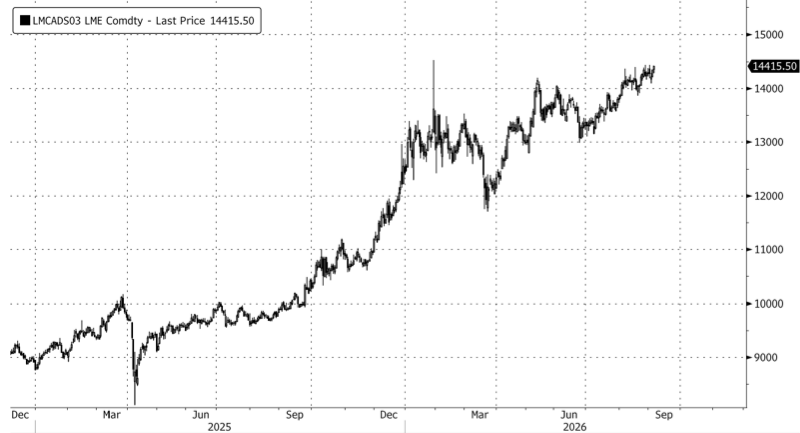
- Copper futures ultimately declined with early indecision on the recent key market themes including US data, Fed rate expectations and ongoing geopolitical tensions.
Geopolitics: Ukraine
- Ukrainian President Zelensky sees no quick end to the war with Russia following a meeting with US envoys Witkoff and Kushner, and is seeking a package from allies that would cover defence reinforcements, as well as energy, including US LNG.
- Russian President Putin ordered troops not to fire on Kyiv for three days during US envoys Witkoff and Kushner’s visit to Ukraine’s capital, according to Kremlin spokesman Peskov. However, it was reported that Russia and Ukraine exchanged a wave of strikes prior to the US envoys’ visit to Kyiv.
- Russian Kremlin aide said talks between Russia and the US were highly useful and lasted for over three hours, but gave no indication of a breakthrough.
- White House official said US and Russian officials discussed substantive plans for the next steps in talks aimed at ending Russia’s war in Ukraine, which will be announced in the coming weeks.
- France’s far-right National Rally chief Bardella wants Ukraine to pay for Europe’s help and said France’s unconditional support for Ukraine should be replaced by a more transactional relationship.
Geopolitics: Other
- North Korean leader Kim said North Korea’s navy nuclear armament will put nuclear combat systems to practical use and will restrain the enemy’s invading fleet, while he added that their new warship can carry out annihilating retaliatory strikes on the enemy at any time.
DB’s Jim Reid concludes the overnight wrap
Morning all. Tough times in our house this weekend with 8 nine-year-old boys sleeping over for our twin’s birthday party. They were very noisy. However, we were kept awake not by them but by an illegal rave in a field a few hundred yards away. I say we but my hearing isn’t the best so I didn’t hear it. My wife has the hearing of an owl and couldn’t sleep through it and felt that I should be woken up to be made aware of the noise I couldn’t hear. So I could do with the weekend to start again. Thankfully it’s US Labor Day so it should be relatively quiet.
I was asked to do an op-ed for the FT today on the recent yield sell-off in bond market. As I said in the piece, the moves over the summer are just another leg to the normalisation trade that has been going on post Covid. In the unlikely event that you’d been on a desert island since just before the GFC and came back ashore today, I’m sure you’d look at current yields as pretty normal given all the spot info and history of bond markets you had at your disposal. I also don’t think the recent concerns are fiscal related, even if the higher yields go the more worries we will have further down the line for several countries. Finally while the pressures that have been there for higher yields are likely to continue, we have to accept that bonds are being bonds again. That is the coupon is helping maintain returns even in the face of yield rises. For example, its been nearly 4 years since the UK mini-budget crisis and 10yr Gilt yields are +65bps than the peak, while index returns are up around 12%. Clearly not spectacular but its getting harder to get outright negative returns in government bonds over the medium-term. So while the news flow will likely to continue to be negative, at least bonds are being bonds again. See my op-ed at the FT here for more.
The main headline this morning is Germany’s political landscape shifting further to the right after the AfD secured around 44% of the vote in the Saxony-Anhalt state election yesterday, its strongest result in any German election to date and more than double its support from 2021. Chancellor Friedrich Merz’s CDU slumped to roughly 17%, its weakest showing in the state, as voters expressed growing frustration over economic stagnation, energy costs and migration policy. While the AfD fell just short of an outright parliamentary majority, the result nonetheless marks a major symbolic breakthrough for a party that remains shunned by mainstream rivals under Germany’s long-standing political “firewall”. The outcome will intensify pressure on the federal government and is likely to reinforce concerns about political fragmentation. More broadly, it underlines how anti-establishment and populist parties continue to gain traction across parts of Europe despite robust labour markets and relatively subdued inflation.
The main focus in the Iran conflict over the weekend was a tit-for-tat escalation targeting commercial shipping in and around the Gulf. According to Reuters and other major news agencies, several tanker incidents and maritime attacks heightened concerns about the security of energy supplies moving through the Strait of Hormuz, with both sides accusing each other of responsibility. Brent is up +1.05% this morning to $97.29/bbl so we remain a distance from a resolution.
Elsewhere in overnight markets, tech is lifting most boats with the KOSPI (+4.18%) leading gains, followed by the Nikkei (+1.87%). Chinese equities are mixed, with the CSI 300 (+0.19%) edging higher, while the Hang Seng (-0.97%) and Shanghai Composite (-0.34%) are underperforming and bucking the broader regional trend. S&P 500 futures (-0.11%) are trading slightly lower but activity will be light today due to the Labor Day holiday. The Yen is fairly flat after another hectic week of intervention stories.
Looking forward now and the coming week offers a busy mix of central bank decisions, inflation data and growth indicators across the major economies. The main global focus will undoubtedly be on the US inflation reports (including CPI on Friday) and the ECB policy meeting (Thursday) with the former likely to heavily influence the FOMC next week. Elsewhere, investors will look to China’s trade (tomorrow) and inflation data (Wednesday), UK monthly GDP (Friday), and industrial production releases in Germany (today) and France (Wednesday). Corporate earnings are relatively light but Oracle (Thursday), Adobe and Inditex are among the notable releases.
As noted above, the biggest event is likely to be the US August CPI report (Friday), arriving just days before the September 16 FOMC meeting. The release follows a stronger-than-expected August employment report last Friday that reinforced the view that the labour market remains resilient. Nonfarm payrolls rose by 162k, with a further 55k of upward revisions to the previous two months. Private-sector hiring remained firm (127k) and job gains continued to broaden beyond healthcare, while measures of labour demand improved further.
Although the unemployment rate edged up to 4.14%, the broader U-6 measure fell to 7.7% and participation increased to 61.6%, suggesting the labour market remains on a relatively stable footing. Overall, the report corrected some of the softer signals seen in July and supports the view that employment growth remains at or slightly above breakeven levels.
Attention now turns to inflation. Our US economists expect headline CPI (Friday) to rise by +0.38% month-on-month in August, up from +0.07% previously, while core CPI is expected to print at +0.21% month-on-month, broadly unchanged from July’s +0.22%. Higher gasoline prices are likely to support the headline reading, while core inflation should continue to benefit from gradually moderating shelter costs. If realised, the forecasts would leave headline CPI broadly unchanged at 3.38% on a year-on-year basis while core inflation edges 10 bps lower to 2.38%.
Ahead of that, the PPI (Thursday) will provide another important input into the inflation outlook. Our US economists expect PPI to imply a +0.21% month-on-month increase in core PCE, down from +0.25% in July, leaving the annual rate broadly stable. The remainder of the US calendar is relatively quiet, with markets closed today for the Labor Day holiday. However, the preliminary University of Michigan consumer sentiment survey (Friday) will also attract attention. Our US economists expect sentiment to improve to 52.5 from 51.7 in August, while the survey’s inflation expectations measures will be closely watched.
In Europe, the ECB policy decision (Thursday) will be the key event. Our European economists expect a 25bp rate increase, taking the deposit rate to 2.50%, and investors will focus on any guidance regarding the likelihood of further tightening. Our economists now expect an additional hike in December with the reasons explained in their preview note here. They have also upgraded their 2026 and 2027 economic forecasts by 0.3pp and 0.1pp to 0.8% and 1.2% respectively. See their note on it here. Economic data will also be closely monitored, including German industrial production (today) and trade data (tomorrow), French industrial production (Wednesday), and UK monthly GDP (Friday). Inflation releases from Sweden (today) and Norway and Denmark (Thursday) will provide additional insight into regional price pressures.
In Asia, China will dominate the calendar. Our economists expect the August trade balance (tomorrow) to show stronger activity, with exports and imports forecast to grow a significant 27% and 29% year-on-year respectively. Inflation data (Wednesday) are expected to show CPI accelerating to 0.8% year-on-year from 0.5%, while PPI inflation moderates to 3.2% from 3.5%. In Japan, key releases include labour cash earnings and the Economy Watchers survey (tomorrow), followed by PPI data (Friday). A reminder that the BoJ has an important meeting on Friday week, less than 36 hours after the FOMC conclusion.
Beyond the economic calendar, the US Treasury’s expanded long-end buyback programme begins on Wednesday, increasing support operations in longer-dated maturities. In politics, the US Republican Party will hold its first midterm national convention in Dallas on Wednesday and Thursday, while Canada’s counter-tariffs on US imports come into force tomorrow. Corporate earnings highlights include Inditex (Wednesday) and Adobe and Oracle (Thursday). Oracle will be the key given all the focus on AI capex.
Recapping last week now and risk assets struggled to gain much traction, as a fresh rise in energy prices raised fears about more persistent inflation. That came amidst no signs of progress on reopening the Strait of Hormuz, with Brent crude oil up +7.80% last week (+0.80% Friday) to $96.28/bbl, their highest in six weeks. Moreover, the relentless rise in European natural gas futures continued, with a 4th consecutive weekly gain (+7.42%) last week (+0.20% Friday) to €72.00/MWh. So for Europe in particular, investors were pricing in a growing probability of a more inflationary shock.
That backdrop helped push yields up to multi-year highs around the world. For instance in Germany, the 10yr bund yield was up +6.1bps last week (-0.4bps Friday) to 3.34%, and it even reached a post-2011 high of 3.37% on Wednesday. Meanwhile in the US, the 10yr yield was up +6.3bps last week (+1.4bps Friday) to 4.78%, and on Tuesday it closed at 4.80%, its highest since October 2023.
The yield moves got further momentum on Friday from a very strong US jobs report, which showed payrolls up by +162k in August (vs. +55k expected). In addition, there were +55k of upward revisions to the previous two months, and the unemployment rate held steady at 4.1%. So that raised investors’ confidence that the Fed would likely hike rates at their September meeting, with futures pricing in a 62% chance of a hike by the close on Friday.
With inflationary pressures mounting and yields rising further, that generally put pressure on risk assets around the world. That was particularly clear in Europe, where the STOXX 600 fell -0.81% last week (+0.12% Friday), whilst the DAX fell -1.97% (+0.17% Friday). Elsewhere, Japan’s Nikkei also fell -2.09% (+1.26% Friday), while the MSCI EM index rose +0.24% (+1.35% Friday). In the US, equities saw a relative outperformance, but even there, the S&P 500 was still barely up last week with a +0.09% gain (-0.38% Friday). That slight risk-off tone was seen in credit as well, as US IG (+2bps) and HY (+7bps) spreads both widened, as did Euro IG (+2bps) and HY (+8bps) spreads.