Zelensky Calls On Trump To Topple Chechen Leader After Maduro
Suddenly everyone wants to enter the regime change business, as various country names and ‘rogue’ leaders are now being casually thrown around in conversations of “who’s next” for Trump to take out.
Ukrainian President Volodymyr Zelensky has joined in. He’s now urging the United States to pressure Russia by “carrying out some sort of operation” against Chechen head Ramzan Kadyrov (and staunch Putin-ally) from power.
Zelensky drew direct comparisons with Trump overthrowing Venezuelan leader Nicolás Maduro. According to the quite provocative Wednesday comments, Zelensky said that removing Kadyrov would make Russian President Vladimir Putin “think twice” about keeping the war in Ukraine going.
“They need to put pressure on Russia. They have the tools, they know how. And when they really want to, they can find them,” Zelensky said of the US under Trump.
“Here’s an example with Maduro. They carried out an operation… Everyone can see the result, the whole world can see. They did it promptly. Let them carry out some sort of operation with, what’s his name – Kadyrov,” Zelensky said.
Earlier, Zelensky went so far as to “joke” that Putin himself should also be targeted in a Washington decapitation operation.
“If you can do that with dictators, then the United States knows what to do next,” he said at a presser from his capital over the weekend, while laughing and smiling.
Such rhetoric, especially if it persists, could make Russia do some decapitation strikes of its own. Its forces have increasingly been targeting Kiev with missiles and drones, and even recently struck government buildings, and not far from Zelensky’s presidential offices.
As for the Chechen issue, hundreds of thousands of troops from Russia’s Muslim-majority republic of Chechnya have been fighting in Ukraine.
Meanwhile, a counter-threat…
Kadyrov: If the order is given, Zelensky and his cronies will end up in Grozny even faster than Maduro ended up in the U.S. pic.twitter.com/x3L7UIoUob
Kadyrov has ruled there since 2007, and has throughout the Ukraine conflict remained among Putin’s most vocal supporters.
He has been not infrequently photographed with Putin, and large contingency of Chechen troops have held pro-Kremlin parades and displays of military power of late.
We live in a world that has engineered distance between us and the physical limits our ancestors once lived inside of. The constraints that shaped generations before us—weather, harvest, transport, salt, fuel, season, strength, distance, labor, time—have been replaced by one dominant modern restraint: money.
Money has become our proxy for limits, the translation layer between desire and reality. But somewhere along the way, we started believing the translation was the terrain. Constraints didn’t disappear—we outsourced them to systems so efficient we stopped noticing their fragility at all.
My husband grew up in a town with no road connecting it to the outside world. When his family wanted to slaughter a pig, they didn’t reach for salt in a pantry. They first rode horses to the salt flats, mined the salt by hand, carried it home, and then began curing the meat. Their survival depended on terrain, season, muscle, and community. Nothing was guaranteed. Everything required presence.
Here in the United States, scarcity is rarely part of our daily friction anymore, so we forget to respect its possibility at all.
But silver is reminding us now.
Not a Price Rally—A Resource Alarm
The world is treating silver like a financial headline. Analysts debate whether it will hit $45 or $125 an ounce in 2026. But the real story isn’t about price movements; it’s about access to metal that physically exists.
Silver is not just money—it is matter, manufacturing, and infrastructure.
Unlike dollars, you can’t print more silver when you need it. Unlike gold, silver is consumed at an industrial scale because it is required for the defining industries of our time:
• Solar panels
• Electric vehicles
• Semiconductors
• Advanced electronics
• Artificial intelligence (AI) data centers
• Critical defense systems
You can build a financial system with paper promises, but you cannot build the future’s physical economy without metal.
China’s Jan. 1 Licensing Regime
On Jan. 1, 2026, China activated a licensing structure that authorizes only 44 domestic companies to export silver. This mirrors the same strategic resource playbook China previously used for rare-earth metals:
• Restrict exports
• Consolidate control into state-aligned entities
• Prioritize domestic supply
• Control refined production rather than raw extraction
This isn’t a supply hiccup—it is mineral nationalism.
And refined silver—the form required for manufacturing—is now subject to state gatekeeping.
Inventories Reveal Reality
In late December 2025, physical silver on the Shanghai Gold Exchange traded at a record premium to U.S. paper futures. Normally, arbitrage would close that spread quickly.
It didn’t.
Because physical metal is tightening, it is no longer moving freely.
Shanghai inventories have dropped to levels not seen in a decade. London vault holdings are down dramatically from pandemic highs. Futures have entered backwardation—buyers paying more for metal now than later. Lease rates have surged, signaling institutions scrambling for metal they cannot easily source.
And here is the key truth: Paper markets for silver now dramatically exceed the supply of physical metal available.
That imbalance works—until someone demands delivery.
And industry will always demand delivery.
Dec. 26 Was Containment, Not Correction
When silver’s paper price dipped on Dec. 26, 2025, it wasn’t profit-taking. It was a forced liquidation event triggered by emergency margin hikes after large holders claimed registered inventory. It was not a market correction; it was containment.
Because here is the truth markets keep avoiding: You can cash-settle a contract. You cannot cash-settle a solar panel, a semiconductor, or a microchip.
Industry needs atoms, not arguments.
We Live Inside Physics, Not Policy
We are addicted to having everything we want the moment we want it. We think politicians can sign papers and declare that every grid will be electric by 2030, as if energy is summoned by legislation rather than mined, manufactured, transported, stored, and built from finite materials.
But the Earth does not negotiate with impatience.
Policy does not override physics.
Technology does not run on forecasts.
It runs on resources.
And silver is the resource tightening fastest.
How Will We Receive the Reminder?
The math is obvious.
In 2026, we will discover what was real all along.
The Earth we are all connected to is physical, finite, and unshakably real, no matter how much of life we now operate from our phones, over Zoom, or through AI.
The minerals beneath our feet are real.
The land that feeds us is real.
The planet that provides everything we build, eat, power, and depend on is real.
The question is not whether the physical world will remind us of its terms—but how we choose to receive the message when it arrives.
As I watch the signs of this tightening, I will remember what is real:
My family.
My husband.
My land.
My friends.
My community.
My skills.
And my ability to lead.
Sure, we can all generate clicks, comments, and interactions in the increasingly digital world we now spend more time inside of. But when the rubber hits the road, we are deeply interconnected with the Earth.
The homes we live in came from nature. The food we eat comes from nature. The energy grid, the cars we drive, the metals in our phones, the data centers powering AI—all of it depends on this extraordinary planet and what it provides.
It’s easy to forget that. It’s easy to act as if we live inside boxes, disconnected from the natural world.
But those boxes came from nature itself.
And it would serve us well to remember.
Views expressed in this article are opinions of the author and do not necessarily reflect the views of The Epoch Times or ZeroHedge.
U-Haul Growth Index: Newsom’s California Dead Last For Six Straight Years
Moving company U-Haul has released its annual migration ranking, which continues to show a sustained outflow from high-tax, crime-ridden, Democrat-run states toward lower-tax states where law and order are cherished.
Right off the bat, the report’s authors note that “Florida ranks 2nd for net gain of one-way customers; California last for sixth year in a row.”
U-Haul just released its annual “Growth Index” for all 50 states. For the 6th straight year, California is ranked 50th. We have the highest rate of people moving out versus moving in.
Newsom has turned the greatest state in the country into the most popular state to leave.
The U-Haul Growth Index compares one-way truck and trailer rentals into a state versus out of a state, allowing researchers to calculate net migration, which reflects relocation trends nationwide.
This real-time tracker shows that Texas reclaimed the title of the No. 1 growth state for the seventh time in a decade. Florida ranked No. 2, followed by North Carolina at No. 3, Tennessee at No. 4, and South Carolina at No. 5. The common denominator among these states is that politicians are considered more based and grounded in reality than the far-left activists running blue states into the ground (cough, cough Tim Walz).
Conversely, the behavior-based migration indicator shows that blue states such as California ranked dead last – in other words, more people left than arrived. Illinois, New Jersey, New York, Massachusetts, and Maryland also landed at the bottom of the list. The common denominator among these states is that their political leadership focuses on being left-wing activists rather than proper stewardship of their respective states.
“Blue-to-red state migration, a hotly debated political topic that became more pronounced after the pandemic of 2020, continues to be a discernable trend,” U-Haul wrote in the report.
The Supreme Court of Wyoming, on Jan. 6, ruled that two state laws banning the procedure and the availability of abortion medication were unconstitutional.
The court, in the case of State v. Johnson, held that the two laws in question—the Life is a Human Right Act of 2023, which bans abortion procedures, and the state’s abortion drug ban—violated Article 1, Section 38 of the Constitution of Wyoming. That provision of the state constitution was added by a statewide referendum in 2012, which states, “Each competent adult shall have the right to make his or her own health care decisions.”
“All five Wyoming Supreme Court justices agreed that the decision whether to terminate or continue a pregnancy is a woman’s own health care decision protected by Article 1, Section 38,” wrote the court in a summary of its opinion and announcement of the decision.
The court added that “all five justices also concluded that an adult’s right to make his or her own health care decisions is a fundamental right because of the very specific language used,” even though the referendum was passed in response to the Patient Protection and Affordable Care Act, known more commonly as “Obamacare.”
The court, however, split four to one on deciding whether the laws in question could be struck down.
“Four justices (Boomgaarden, Fox, Jarosh, and Fenn) voted to strike down the 2023 abortion laws. Justice Gray voted to uphold the laws,” the court’s summary read.
The court noted that even though Article 1, Section 38 was passed in response to Obamacare, the language of the provision was inflexible, writing, “The Court recognized it cannot add words to the Wyoming Constitution. … But lawmakers could ask Wyoming voters to consider a constitutional amendment that would more clearly address this issue.”
Lower courts, when reviewing the case, also struck down the laws.
Wyoming is a heavily conservative state that is dominated by the Republican Party, and pro-life sentiment is widespread. Following the ruling, Governor of Wyoming Mark Gordon called for a referendum to amend the constitution and invalidate the ruling.
“This ruling may settle, for now, a legal question, but it does not settle the moral one, nor does it reflect where many Wyoming citizens stand, including myself. It is time for this issue to go before the people for a vote,” Gordon wrote in a statement published on social media. “I call on the legislature to pass and place a clear constitutional amendment on my desk.”
The lead plaintiff in the case, Wellspring Health Access in Casper, Wyoming, celebrated the ruling.
“Our clinic will remain open and ready to provide compassionate reproductive health care, including abortions, and our patients in Wyoming will be able to obtain this care without having to travel out of state,” said Julie Burkhart, the organization’s president, in a statement.
The EU, so desperate to exert their dictatorial powers, to feel the exhilarating rush of adrenaline from smashing someone’s face with the butt of a rifle, has revealed itself. It is that rarest of all birds, both fascist and communist in its outlook on the world. Having been able to conquer most of Western Europe with a simple change in immigration policy it is heady with success, brazen and anxious to lead the entire world from a small office in Brussels.
The aggressive, hostile EU is like a drunk trolling a bar looking for a fight. It chose to make Ukraine its sidekick, someone already subject to Russian aggression, who could be sent out to make loud claims and kick the bullies in the knees, while the EU sat back, waiting for an opportunity to bring big brother into the fray. Big brother, in this case, is NATO.
The EU has no army. To liken it to the United States, it would be as if there were no American troops, but National Guard from every state and even some foreign guard units to throw at their enemies. The EU supports Ukraine and threaten every day to intervene in that conflict to help Ukraine, but the EU has no money, it has no troops. Their intent is to take funds from all of their member states and give that to Ukraine to help fight Russia. It’s like the IRS extracting taxes to give to Somalian day care centers (an issue that needs resolution here).
While the Ukrainian people have my sympathy and I wish nothing other than that this war would end and Ukraine could live in peace, have elections and elect their leaders, the EU is against that. They’ve done all they can to prevent peace and now threaten Russia with an extension of the war.
All of this relies on NATO, the bulk of that force being made up of American military units. NATO was designed to deter the Soviet Union from being able to gain a foothold in Europe from which to strike the US. To that extent is has article 5 promises to enter the war on behalf of any member state that suffers from Soviet aggression and has laid somewhat dormant since the collapse of the Soviet Union.
It’s a different world, now, and these peons who run the EU and NATO believe that because big brother might be able to beat up some drunk in a bar, inciting violence to invoke it is stupid. But that’s the course they’ve chosen. Only now, they seem to believe that they are the puppet masters of the world. It’s bold, I have to give them that, but anyone can see through their tactics.
The latest move is to defend both Denmark and Greenland, but with what troops? NATO troops. Okay. So, largely an American-based group is going to go to war with America to protect Greenland under Danish control to establish the superiority of the EU?
Hubris is all that comes to mind. It’s radical and dangerous, but the EU has become used to standing on quicksand throwing rocks at those on shore, threatening them with lawsuits if they don’t come and help them gather rocks. There’s no limit to the illogical nature of their reasoning.
What it has done effectively, though, is it has placed them at odds both with Russia and the United States. This is what happens when local featherweights are given power, any power. They exaggerate their value by their associations with larger organizations until they come to believe that they are the masters of their masters. They become a Rasputin of sorts on the global stage. It’s the same with the WEF, the WHO, etc. If they can corrupt leaders of nations they can effectively control those nations with bribes and threats.
Holdouts like Hungary and Viktor Orban threaten that control. They submit to punishment rather than being bought off and any resistance is characterized as pro-Russian. That Orban has been able to survive the constant drumbeat of harassment from the EU is a miracle and recent polls show that the EU just might win the propaganda war it has unleashed on Orban. If it does, and Orban is defeated in April, it will be the end of Europe as it was once known. They will simply be the Greater Middle East, but with nukes.
That all of this is built on propaganda and censoring opposition views should alarm the world. The tactics are clearly both fascist and communist. The EU is the instigator of violence and world wars, but hold no territory of their own. They are a bureaucratic assembly, nothing more. NATO is the same, yet they preen around like the drivers of world policy, the headmaster to whom all nations must answer.
If the US thought it was safe from the warmongering of the EU it’s mistaken. The EU criticizes Russia and attempts to rally the world against it, just as it criticizes the US and is trying to rally the world against it. They pretend to be the champions of the victimized while they attempt to victimize.
What they should recognize, that the world recognizes already, is that they have used strategery to place themselves on a war footing with both the US and Russia. What they should be worried about, is that they may be the catalyst for a renewed alliance between those two nations against it, their now common enemy.
DORAL, Fla.—Zarai Maza survived a torched vehicle and a horrific car crash after peacefully protesting the Venezuelan regime, an unacceptable act in her home country, where speaking out could cost you your life or those of your family members.
She said she believes that the Venezuelan dictatorship was trying to kill her over her activism.
“They started the persecution against me in 2014, and it lasted until 2017,” Maza said. “They made three assassination attempts against my life, and after the last one, I was in the hospital. I couldn’t remember anything.”
Holding back tears, Maza said the last encounter started off as a normal taxi ride. She recalled waking up in a hospital with no memory of what happened and no feeling in her body.
She moved to Florida in 2017, and after two years of physical therapy in the United States, she regained her ability to walk upright again.
She is among the millions of Venezuelans who have fled the brutal regime, which turned a prosperous country into a repressive, failed socialist nation. And like many Venezuelans at home and abroad, Maza cheered the U.S. military operation that captured Nicolás Maduro, the country’s leader, and his wife on Jan. 3 and brought them to New York City to face federal charges including narco-terrorism.
The pair pleaded not guilty to all charges on Jan. 5. If convicted, they face life in prison.
The Epoch Times spoke to dozens of Venezuelan expatriates, who shared grisly stories of survival, persecution, murder, harassment, and intimidation and explained how they rebuilt their lives after surviving the dictatorship. Their experiences are a sample of many accounts of how socialism not only ripped Venezuelan families apart, but also brought their country to ruin.
President Donald Trump said the United States will maintain control of Venezuela until a “safe, proper, and judicious transition” to a new government occurs, noting that U.S. oil companies would be involved in rebuilding the country’s economy.
Some Venezuelan expats told The Epoch Times that they may go back if the United States can help fix their country.
A Survivor Story
Maza is a human rights advocate and the founder and executive director of the Guardians of Human Rights Foundation, based in Doral, Florida. Her work as an activist goes back to about 2010, when she still lived in her home country and attended the Central University of Venezuela—before she faced three attempts on her life, which she believes were orchestrated by the Maduro regime.
Over the years in Venezuela, many of her fellow students and professors were unjustly imprisoned, she said. In clear anguish, she described the first attempt on her life during a peaceful protest on campus, when the Bolivarian National Guard of Venezuela came after her and others.
“I think that no American can imagine the fear that you can feel for just being—standing in a place,” Maza said.
She made it to an SUV with her mother, but then their vehicle was torched. Maza said her mother kicked the window out so they could escape the burning car. Maza later told The Epoch Times that her mother has since also fled Venezuela “for protection” and currently lives in the United States.
Maza stopped short of describing the second attempt on her life, saying that the memories were too painful.
“Imagine that you can’t be in any place of the area that you live [in], that you love, that you grew up [in],” she said. “They are after you in any place. … It almost makes me break.”
In the third attempt on her life, a vehicle caused Maza’s taxi to crash and flip, with her spine taking the brunt of the damage.
“I couldn’t move or feel my body,” Maza said. “I was 25 years old, just trying to fight for my country at that time. … I didn’t realize how bad and far these people can go just to maintain [their] power.”
Her symptoms—physical and mental—linger.
“There’s still things that I live with. … I don’t have enough strength in my hands,” Maza said, making a weak fist.
“Even now, when I’m in any place, and here comes a motorcycle, and I listen to the sound,” she said, trailing off.
Maza said it took years for her to be able to sleep comfortably at night after she moved to the United States.
Carlos Higuerey came to the United States in 2018, after years of working for a state-run employer and a string of family deaths that he blames on the regime.
He said he worked as an accountant for 12 years at Venezuela’s state-owned oil and gas company, with access to information that he described as secretive and corrupt. Some of his family members also had ties to opposition politics in Venezuela, linking him to what his employers would call “escuálido”—those who oppose the government—or “Chavismo.”
The first death in Higuerey’s family occurred in 2010, when his father passed away.
“My father had to take pills, but [at] this time in Venezuela, you cannot find the pills because the government expropriates all pharmacies,” he told The Epoch Times. “I buried people, a lot of people, for this reason.”
Within 10 days of his father’s death, his aunt and uncle were murdered inside their home, which Higuerey said he believes was orchestrated by the regime over political differences.
“There was blood on the walls,“ he said. ”It was a horror movie. It was horrible.”
When asked who would do that, he replied without hesitation, “The government.”
Just five months after his father, uncle, and aunt died, Higuerey said his brother was also killed over politics. After facing years of pressure and dealing with family members being murdered, he decided to take a break in 2018 and traveled to the United States.
At the time, he did not know that this trip would become a years-long stay.
“When I came here, the next day, I’m checking my phone,“ Higuerey said. ”I see a message [from] my neighbors. My sister was kidnapped.”
He said the neighbors witnessed government agents take her. The agents were really after Higuerey, for the secrets he knew about the oil company, he said. Although his sister was freed the next day, Higuerey said he faced a soul-crushing choice.
“I took the decision that I don’t want to come back to Venezuela,“ he said. ”I don’t want to feel under depression. I’m broke inside. I’m broke inside.”
Why Trump Soured On Machado: It Has Nothing To Do With The Nobel Prize
The fact that the Trump administration chose to anoint Delcy Rodríguez, who served as Nicolás Maduro’s staunchly loyal (or so he thought) Vice President, as the new leader of the country has left many wondering why he passed over Maria Corina Machado.
Machado, as a longtime Venezuelan opposition and democracy activist, had made headlines last month when she traveled to Norway to receive the Nobel Peace Prize. Given that President Trump had apparently expected to receive it, recently boasting of “ending seven wars” – she tried to soften the awkwardness of the situation by the symbolic gesture of ‘dedicating’ it to Trump.
But in a fresh Fox News interview, Machado took shots Delcy Rodríguez, who was formally sworn in on Tuesday, describing that she does not represent democratic aspirations or true reform.
“So this is very alarming. This is something that has to be followed carefully, I’m sure, by the United States government and by the Venezuelan people,” Machado said. “And certainly we believe that this transition should move forward.”
She said of the woman who has been Maduro’s number two since 2018:
“Delcy Rodriguez, as you know, is one of the main architects of torture, persecution, corruption, narco trafficking,” Machado said.
“She’s the main ally and liaison with Russia, China, Iran, certainly not an individual that could be trusted by international investors. And she’s really rejected, repudiated by the Venezuelan people.”
Machado too must be really questioning why she was clearly dropped from consideration in terms of new Venezuelan leadership.
One analyst says that despite the amusing and distracting nature of Trump’s apparent obsession with the Nobel, choosing Rodriquez really has nothing to do with this at all.
Daniel DePetris of Defense Priorities explained in the following astute X thread [emphasis ZH]:
Why Trump soured on Machado, and it has nothing to do with his obsession about the Nobel Peace Prize…
Trying to install Machado (or Gonzalez) atop the Chavismo system, which remains intact, was untenable. It was never going to work. She had zero support from the people who actually held the levers of power.
So going through with such a scheme would require a re-ordering of the Venezuelan political system and the crafting of a new one from scratch. That, in turn, would require a much deeper U.S. commitment—far deeper than Trump and most Americans are willing to tolerate.
Working within the system and giving Delcy Rodriguez a chance is frankly easier. And because Trump doesn’t really care about democracy to begin with, it was the best—or least worst—option available to him. This will make a lot of democracy proponents livid, of course.
For some reason, highly qualified people don’t understand this.
For most of the Western public, Machado was a complete unknown even up to the eve of her winning the Nobel award. Giving her the prize seemed politically manufactured in the first place as she was viewed by elites in Europe and the West as a prime ‘option’ for new Venezuelan president.
While Trump did decapitate the regime, some pundits are saying it should not be understood as full-on regime change, given the same governing system has remained in place. Trump has frequently cited the lessons of Iraq – and apparently is at least prudent enough to not attempt to place American officials directly over entire government ministries, as the US once did in the Middle East. Regardless, there is still a lot of blowback which likely awaits just around the corner.
The Iranian military warned on 7 Wednesday that Tehran could potentially launch a pre-emptive attack on Israel in response to the escalatory rhetoric recently from both Tel Aviv and Washington. “Iran views the escalation of hostile rhetoric against the Iranian nation as a threat and will not leave its continuation unanswered,” said the Iranian army’s Commander in Chief Amir Hatami.
“Any act of aggression against Iran will have far-reaching consequences … Iran will act with full force to defend the its independence, territorial integrity, and political system,” he added. “The readiness of Iran’s armed forces today is far higher than before the [12-day] war. Any enemy miscalculation would be met with a more decisive response,” he went on to say, warning that “the hands of any aggressor would be cut off.” The military chief’s statement followed violent and escalatory rhetoric from US Senator Lindsey Graham on Tuesday.
Graham told Fox News that US President Donald Trump will assassinate Iran’s Supreme Leader Ali Khamenei if Iranian authorities continue ‘suppressing protests.’
“Donald Trump is not Barack Obama; he is not turning his back on the people of Iran … To the Ayatollah and his thugs, if you keep killing your people in defiance of President Trump, you’re gonna wake up dead … Iran is on the verge of falling,” Graham said. “Help is on the way,” he added.
The interview came hours after Iran’s Supreme National Defense Council issued a warning also signaling potential pre-emptive action in response to growing threats.
“Within the framework of legitimate self-defense, the Islamic Republic of Iran does not confine its response merely to reactive measures, and considers clear indications of threat to be part of the broader security equation,” the council said.
“The intensification of threatening rhetoric and intervention – going beyond verbal positioning – can be understood as hostile conduct. Any path that continues in this direction will be met with an appropriate, firm, and decisive response, and full responsibility for the consequences will lie with the architects of this course,” it added.
The new threat coincides with protests that erupted across several cities and provinces in Iran nearly two weeks ago due to a collapse in currency and difficult living conditions resulting from years of harsh US sanctions. Many of the protests have turned violent, with armed rioters attacking security forces repeatedly in recent days.
Over a dozen people have been killed, including police and security members. Counterprotests are also taking place, and thousands of Iranians have taken to the streets to reject violence against security forces and call for peaceful expression.
Since the protests began, Trump has repeatedly threatened to attack the Islamic Republic. “We’re watching it very closely. If they start killing people like they have in the past, I think they’re going to get hit very hard by the US,” Trump said recently, after vowing days earlier that Washington will “rescue” Iranian protesters.
The Mossad also publicly urged Iranians to go out in the streets, saying, “we are with you.” According to a report by Israel’s Channel 12, Tel Aviv is preparing for the possibility of a “sudden” conflict with Iran.
Senator Graham:
To the Ayatollahs: you need to understand—if you keep killing your people who are demanding a better life—Donald J. Trump is going to kill you.
Change is coming to Iran. It’ll be the biggest change in the history of the Mideast to get rid of this Nazi regime.… pic.twitter.com/DuS55xpHFz
Israeli Prime Minister Benjamin Netanyahu visited the US recently and discussed potential new strikes on the Islamic Republic with Trump. During a press conference last week, the US president said he would potentially support a new Israeli attack.
Iran has ruled out any new nuclear talks with Washington until it drops its demands for a curb on the Iranian missile program and an end to uranium enrichment. Reports from the past few months have said the Islamic Republic is working to build up and enhance its stockpile of ballistic missiles, which caused extensive damage across Israel and hit multiple key military sites during the 12-day war in June.
A cross-party group of roughly a dozen senators is close to finalizing an agreement that would restore enhanced Affordable Care Act tax credits that expired Jan. 1, according to negotiators familiar with the talks. Draft legislative text could be released as early as Monday.
“We could realistically be there, probably Monday,” said Sen. Bernie Moreno (R-ME), a key Republican negotiator, speaking Wednesday.
The developing deal would extend the subsidies for two years, while imposing new restrictions designed to limit eligibility and curb abuses. Among the changes under discussion: income caps that would cut off subsidies for households earning more than roughly 700% of the federal poverty level, and a new requirement that enrollees pay at least $5 per month toward their premiums.
Senators are also weighing tougher enforcement against insurers accused of enrolling people in subsidized coverage without their knowledge. Under the proposal, insurance companies that add so-called “phantom enrollees” could face steep new fines.
Sen. Susan Collins (R-ME) said she was “encouraged” by the group’s progress and agreed that a deal appears close. Two people granted anonymity to discuss the private negotiations likewise described the talks as nearing a conclusion.
The package wouldn’t stop at subsidies. Negotiators are also discussing new cost-sharing reduction measures and expanded access to health savings accounts. According to Moreno, Americans receiving Obamacare subsidies would have the option in the second year of the extension to divert that money into a pre-funded health savings account instead.
Still, the path to passage remains uncertain.
Even if the Senate group locks in an agreement, there’s no guarantee it can muster the votes to get the bill through Congress. Lawmakers have been keeping party leadership informed and are scheduled to brief House members on the proposal later this week.
Not everyone involved is convinced the finish line is near.
Sen. Dick Durbin (D-IL) cautioned that there are “still some major stumbling blocks” left to resolve.
One unresolved flashpoint is abortion. Moreno declined to say how negotiators would address concerns that the tax credits could indirectly subsidize abortion coverage. He insisted the framework, as described, would not alter existing policy and said abortion remains a “peripheral” issue in the talks.
“We’re trying to resolve how we ensure compliance with the spirit” of the Hyde Amendment, Moreno said, referring to the long-standing restriction barring taxpayer funding for abortions.
For now, senators are racing the calendar — and their own internal divisions — to see whether a bipartisan Obamacare revival can survive its latest rewrite.
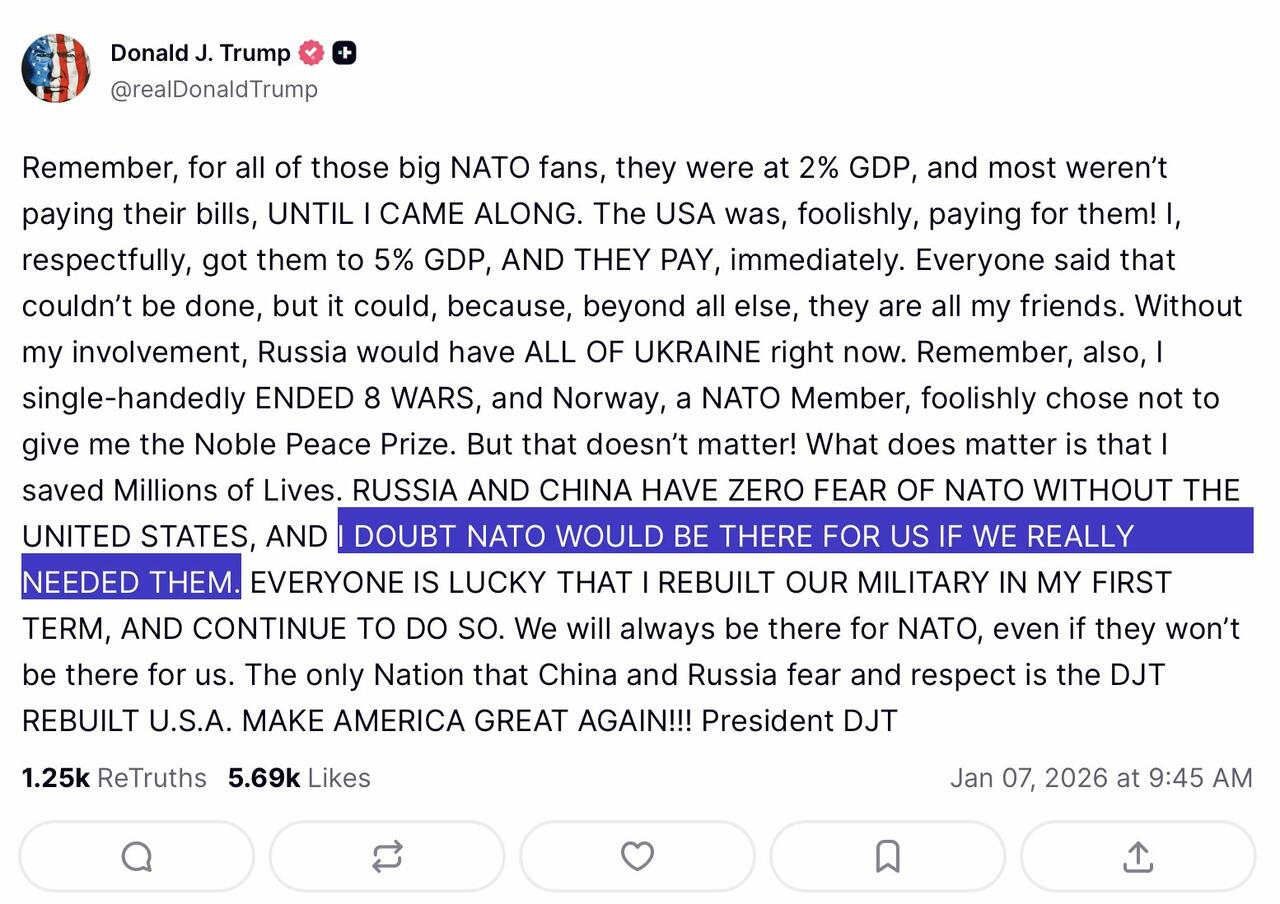
Trump Warns NATO: Without America There Is No Alliance
President Trump says that Russia and China “have zero fear of NATO” without the US being in the alliance, in a Wednesday Truth Social post, which comes not only as the White House says it intends to acquire Greenland – which has set up a diplomatic fight with European NATO allies – but also soon on the heels of the ultra controversial US military ouster of Venezuela’s Maduro.
Trump in the post expressed doubt that “NATO would be there for us if we really needed them” and simultaneously touted that “We will always be there for NATO, even if they won’t be there for us.”
He focused his explanation on Ukraine, saying that “Without my involvement, Russia would have ALL OF UKRAINE right now” – in reference to the nearly four year long Russian-Ukraine war, which has a definite and deep NATO vs. Moscow proxy war element to it.
He continued: “Everyone is lucky that I rebuilt our military in my first term, and continue to do so.”
Trump’s main sentiment actually echoes the words of his top advisory official Stephen Miller, who the day prior was discussing that no one gave fellow NATO-member Denmark the ‘right’ to control Greenland.
Miller had expressed: “The US is the power of Nato. For the US to secure the Arctic region to protect and defend Nato and Nato interests, obviously Greenland should be part of the US. And so that’s a conversation that we’re going to have as a country. That’s a process we’re going to have as a community of nations.”
Despite the somewhat absurd diplomatic circus surrounding the lingering Greenland question, which has of course remained highly entertaining, both Trump and Miller actually have an indisputable point on America’s role in the Western military alliance.
If Washington were to ever pull out of NATO, the military alliance would simply become one only on paper – akin to a mere ‘EU Army’. Indeed Russia and China would not at all ‘fear’ NATO – and maybe they don’t fear it too much already (though there’s probably some significant fear and anxiety in dealing with a United States under highly unpredictable Donald Trump).
The quiet part in all this – and not often enough discussed – is that NATO has left a legacy of ashes and destruction in many places it has intervened over several decades – from Belgrade (in 1999) to the regime change war against Libya’s Gaddafi, and involvement in the Afghan forever war. For example, NATO still touts its ‘successful’ so-called ‘responsibility to protect’ mission in Libya, but now Libya is divided into at least three rival power centers, and there may yet be new civil war on the horizon. Another result was that ISIS popped up there, where it wasn’t before.