China has pushed further into heavy unmanned aviation with the first flight of the Changying-8 (CY-8), which it claims is the world’s heaviest cargo drone.
The aircraft combines high payload capacity with short-runway performance, targeting logistics operations across remote, high-altitude, and island regions.
The newly tested Changying-8 (CY-8) blends high payload capacity with short runway performance, signaling a push toward flexible, all-terrain aerial supply systems.
The aircraft completed its first test flight on Tuesday in Zhengzhou, located in central China’s Henan province.
It lifted off after a short ground run of 280 meters and stayed airborne for about 30 minutes.
According to state broadcaster CCTV, engineers used the flight to verify key onboard systems, including avionics, propulsion, and intelligent flight controls.
Built for heavy payloads
The CY-8 stands out for its size and carrying capability. It reaches a maximum take-off weight of 7 tonnes. The drone itself weighs 3.5 tonnes and can carry an equal load.
Its airframe stretches 17 meters long with a wingspan of 25 meters. Engineers designed a fully enclosed cargo bay with a volume of 18 cubic meters.
The aircraft includes both front and rear access doors, allowing faster turnaround during loading and unloading operations.
CCTV described the platform as an “unmanned aerial heavy truck.” The drone relies on twin turboprop engines and supports short take-off and landing operations.
This design allows it to operate on basic runways with limited infrastructure.
“This cargo drone is highly adaptable to its environment, uses twin turboprop engines, and has the ability to take off and land on simple runways in high-altitude areas, as well as perform short take-offs and landings,” said Cai Hangqing, chairman of Beijing Northern Changying UAV Technology, as reported by SCMP.
Developers built the CY-8 to support both civilian and military roles. The drone can switch payload configurations quickly, making it suitable for a wide range of missions.
CCTV reported that operators can deploy it for emergency communications, weather modification, and electronic reconnaissance.
It can also support logistics, disaster relief, and supply delivery in difficult terrain.
The drone’s design focuses heavily on high-altitude performance.
It can operate in regions such as the Tibetan Plateau, where elevations range between 4,000 and 5,000 meters.
Engineers also optimized it for island operations, enabling use on short and simple airstrips.
The CY-8 requires less than 500 meters for take-off and landing.
It also offers a range of more than 1,850 miles, extending its operational reach across remote or strategically sensitive areas.
Expanding global competition
China’s latest drone arrives as competition intensifies in the heavy cargo UAV segment.
Beijing continues to invest in uncrewed systems capable of operating in extreme environments.
Other Chinese projects are already in progress. Air White Whale is developing the W5000, a larger 10-tonne-class cargo drone.
A scaled prototype recently completed its maiden flight.
China has also tested a heavy-lift unmanned helicopter, the Boying T1400. That platform targets operations from mountainous regions to maritime zones.
The United States is advancing similar systems.
California-based Sabrewing developed the RH-1-A Rhaegal cargo drone, which completed its first hover flight in 2022.
A larger variant is expected to reach a maximum take-off weight of 6.25 tonnes.
Unlike the CY-8, Sabrewing’s design uses vertical take-off and landing. This removes the need for runways and enables operations in confined spaces.
The company has already secured collaborative orders from the US Air Force.
China plans to continue flight testing of the CY-8. The developer aims to move toward full-scale production before the end of the year.
First Valero Refinery, Now Largest U.S. Gasoline Pipeline Damaged In Georgia
Colonial Pipeline’s Line 1, the largest U.S. gasoline pipeline running from Houston toward the East Coast, has halted operations after a third-party work crew damaged a section of the line in Georgia.
Bloomberg reported that the line stopped shipping fuel after the damage occurred on Tuesday in Paulding County, Georgia.
“Line 1 is out of service while our team coordinates response and repair efforts,” Colonial said in a statement cited by the outlet.
The outage hits a critical fuel artery that carries about 1.5 million barrels per day of gasoline from Houston to North Carolina, supplying an East Coast market that remains heavily dependent on pipeline deliveries due to limited local refining capacity.
While the rest of Colonial’s pipeline system remains operational, any prolonged shutdown risks further tightening fuel supplies at a time when the war in Iran has pushed the U.S. national average price for regular gasoline to the politically sensitive level of $4 per gallon.
Let’s remind readers that the 380,000-barrel-per-day Port Arthur, Texas, Valero refinery experienced an explosion last week at its 47,000-bpd unit 243 diesel hydrotreater. The good news is that the refinery has since restarted operations.
First a refinery, now a pipeline. One has to wonder whether these “industrial accidents” are early signs of sabotage, particularly at a time when energy infrastructure is being destroyed across Russia, Ukraine, and the Middle East.
Brookfield Infrastructure owned Colonial pipeline down
Is it me or are we seeing tit for tat moves against energy infrastructure? First refineries, now a pipeline. pic.twitter.com/X0B6yyMs68
Four U.S. senators from both sides of the aisle are planning to visit Taiwan, Japan, and South Korea within the coming days to strengthen U.S. alliances that they see as critical to challenging China’s sphere of influence.
Sen. Jeanne Shaheen (D-N.H.), who serves as the ranking Democrat member of the Senate Foreign Relations Committee, announced the trip on March 28.
Sens. John Curtis (R-Utah), Thom Tillis (R-N.C.), and Jacky Rosen (D-Nev.) will join her on a trip to Taipei, Taiwan; Tokyo; and Seoul, South Korea, ahead of U.S. President Donald Trump’s May summit with Chinese leader Xi Jinping in Beijing.
The trip could cause friction with Chinese leadership, which opposes other countries having relations with Taiwan and sees such activities as a challenge to Beijing’s claim of sovereignty over the independent island.
While Taiwan is backed by the United States for its democracy, Trump’s recent floating of potential arms sales to Taiwan in discussions with Xi has highlighted implications about the future of U.S. policy toward the island.
“This bipartisan delegation demonstrates Congress’s commitment to these alliances and partnerships is unwavering and will endure well beyond any one administration,” Shaheen said in a statement.
The U.S. lawmakers are planning to meet with both political leaders and defense officials during their trip as a display of reassurance to the United States’s Asian allies.
“Our alliance with Taiwan is one of the most strategically and morally significant partnerships America has in the Indo-Pacific,” Curtis said in a statement.
Taiwan’s economic relationship with the United States has been a key concern for the Trump administration, as Washington relies on the island for computer chip production.
Taiwan’s semiconductor production drove a trade imbalance of nearly $127 billion during the first 11 months of 2025. In February, the Trump administration reached a deal with the island that removed 99 percent of its trade barriers with the United States.
A bipartisan group of U.S. lawmakers during a visit to Taiwan last year called for the United States to partner more closely with the self-governing island.
That trip resulted in conversations that were “optimistic and forward-looking,” Sen. Chris Coons (D-Del.) said at the time. Coons visited Taipei last April with Sens. Pete Ricketts (R-Neb.) and Ted Budd (R-N.C.).
There were also discussions about potential military action against Taiwan by China.
“Of course, there is the possibility that Xi Jinping would decide that this is the right time for the Chinese Communist Party to take aggressive action,” Coons said.
“I think it’s exactly the wrong thing for them to do. I think they would find a forceful and united response.”
Activist Mayor Of Boise Forced To Take Down Pride Flag Flown For A Decade
Conservative states across the US have taken action in recent months to begin the arduous process of removing the stain of the woke movement from America’s streets and public buildings. For the last decade, the far-left ideological crusade has left its mark everywhere while using “marginalized” identity groups as a moral shield.
Though they claim to be acting as a civil rights movement, the reality is that “Pride” and LGBT activist groups are entirely political. The pride flag is a political, ideological and some would argue religious symbol of cultural dominance planted across the country as a means to claim ownership.
The State of Idaho is no longer tolerating this insurgency. On Tuesday, Mayor Lauren McLean was forced to remove the Progress Pride flag from display in Downtown Boise after Governor Brad Little signed HB 561. The bill, brought by Rep. Ted Hill, R-Eagle, limits local governments to flying only the American flag, state flags, official military flags, recognized tribal flags, and the official flag of an Idaho university or college.
The response from Democrats has been dramatic, to say the least, with a somber proclamation of “Transgender Day” to mourn the loss of the pride flag. Idaho also recently passed one of the strictest laws in the nation against transgenders using incorrect bathrooms and public facilities.
Initial laws passed by the state in 2025 required that only “official flags” be flown on public land and government buildings. However, McLean and city officials attempted to bypass the law by making the pride flag an “official” flag of Boise. Governor Little closed the loophole and instituted fines of $2000 per day for those cities that refuse to cooperate.
Leftist officials held a bizarre ceremony for the removal of the pride flag, which once again shines a light on the cult-like nature of the woke movement.
BREAKING: Boise mayor forced to take city hall’s LGBTQ+ flag down after law passes pic.twitter.com/PUdjgSgETf
Similar reactions have taken place in cities across the US where pride flag have been forced on the populace by city officials and were then removed by the state government.
Boise, Idaho, has flown a Pride flag outside City Hall for more than a decade, primarily during “Pride Month” in June and related events. However, in the last four years under Democrat Mayor Lauren McClean, the flag has stayed flying year-round, often displayed alongside other flags like the U.S., Idaho, City of Boise, and POW/MIA flags.
The presence of radical left symbolism in the middle of one of the reddest states in the US is a reminder that there are progressive controlled cities and leftist activists everywhere. They are not relegated to blue states, and unlike conservatives, they are highly aggressive in their efforts to claim territory and maintain power.
This is often expressed in the concept of “visibility”, which leftists mention often. It’s the idea that the “rights” of activist groups are not being respected unless they are allowed to shove their political symbols in the faces of everyone on a regular basis.
It’s not enough that the public tolerates these groups. The public must be forced to see them at all times, until people accept their activist ideology as sacrosanct. The best possible path forward for Americans is to do the opposite and erase woke visibility as much as possible. Civil rights are not a free license to impose fringe ideological views on the rest of the population.
Oil Spikes As Trump Vows To Hit Iran “Extremely Hard Over Next 2-3 Weeks”, Threatens To Send It “Back To The Stone Ages”
Summary
Trump declares ‘core strategic objectives met’, threatens 2-3 more weeks of bombing, no mention of ceasefire
Iranian President Masoud Pezeshkian has released an open letter to the American people, questioning whether Washington is truly putting “America First” or merely acting as a “proxy for Israel” willing to fight “to the last American soldier.”
Air defenses have been activated in Dubai, taking out 5 ballistic missiles and 35 drones launched from Iran
Iran’s new Ayatollah tweets “I emphatically declare that the consistent policy of the Islamic Republic of Iran, following on the path of Imam Khomeini and the martyred Leader, is to continue supporting the Resistance against the Zionist-US enemy.”
“Not true”: Iran rejects Trump claim that the “new regime president” asked for ceasefire (which has been Pezeshkian since 2024)
UAE mulls becoming first Gulf country to directly joint US-Israeli war against Iran, lobbies for firm UNSC security resolution.
Trump to Reuters: will be “out of Iran pretty quickly” and could return for “spot hits” if needed. Also says he’s open to exiting ‘paper tiger’ NATO after Iran war is over, angry over lack of help in Hormuz crisis.
Oil tanker leased to QatarEnergy was struck by an Iranian cruise missile in Qatari waters Wednesday.
IRGC has newly vowed to keep attacking with “full intensity and power” – suggesting this is far from over, as ceasefire talks remain theater lacking in much substance. Ayatollah praises Hezbollah in written statement.
Oil Spikes As Trump Vows To Hit Iran “Extremely Hard Over Next 2-3 Weeks”, Threatens To Send It “Back To The Stone Ages”
After 48 hours of messaging triumphalism about US achievements, escalatory warnings tied to the Strait and energy targets, frustration with allies, and signals of de-escalation with a shortened timeline for reduced US involvement… President Trump addressed the nation tonight about the war in Iran.
Trump began by stating that the US is targeting the world’s number 1 State-Sponsor of terror – Iran.
There have been many “swift, decisive, overwhelming victories on the battlefield” in Operation Epic Fury against Iran, he continued.
Trump describes the military operations as “quick, lethal, violent” and “respected” all over the world.
*TRUMP: IRAN’S NAVY IS GONE, AIR FORCE IN RUINS
*TRUMP: MOST OF IRAN’S LEADERS ARE DEAD
*TRUMP: IRAN’S ABILITY TO LAUNCH MISSILES AND DRONES CURTAILED
*TRUMP: DON’T NEED OIL FROM MIDDLE EAST
*TRUMP: WILL NEVER LET IRAN HAVE NUCLEAR WEAPON
Trump went to explain why he took us to war in Iran, focusing strongly on preventing Iran’s nuclear capabilities, and correcting prior Presidents’ mistakes.
“Essentially I did what no other president was willing to do.”
Then came the quasi-mission accomplished moment:
*TRUMP: CORE STRATEGIC OBJECTIVES IN IRAN NEARING COMPLETION
*TRUMP: THESE STRATEGIC OBJECTIVES NEARING COMPLETION
*TRUMP: MUST COMPLETE MISSION IN IRAN
*TRUMP: WE WILL FINISH THE JOB VERY FAST
*TRUMP: GETTING VERY CLOSE TO FINISHING JOB IN IRAN
*TRUMP: WE ARE ON TRACK TO COMPLETE ALL MILITARY OBJECTIVES
Hormuz is not America’s problem…
Trump again says that other countries who rely on oil coming through the Strait of Hormuz to take control of it: “We will be helpful, but they should take the lead.”
*TRUMP: US HAS PLENTY OF GAS
*TRUMP: WE IMPORT ALMOST NO OIL THROUGH HORMUZ
*TRUMP: COUNTRIES THAT GET OIL THROUGH HORMUZ MUST TAKE LEAD
*TRUMP: COUNTRIES RECEIVING OIL VIA HORMUZ MUST CHERISH IT
*TRUMP ON HORMUZ: WILL OPEN NATURALLY WHEN CONFLICT OVER
And the clarification for American voters:
Trump pins the runup in gas prices entirely on “the Iranian regime launching deranged terror attacks against commercial oil tankers in neighboring countries that have nothing to do with the conflict.”
*TRUMP: INCREASE IN GASOLINE PRICES DUE TO IRAN ATTACK ON TANKERS
*TRUMP: SHORT-TERM GAS PRICE INCREASE DUE TO IRAN’S ATTACKS
*TRUMP: US NEVER BEEN BETTER PREPARED ECONOMICALLY
*TRUMP: WE’RE IN GREAT SHAPE FOR THE FUTURE
*TRUMP: OIL PRODUCTION WILL SOON BE SUBSTANTIALLY HIGHER
*TRUMP: ECONOMY WILL SOON COME ROARING BACK
Then came the threats:
*TRUMP: WE WILL NOT LET MID EAST ALLIES GET HURT OR FAIL
*TRUMP: WILL HIT IRAN EXTREMELY HARD OVER NEXT 2-3 WEEKS
*TRUMP: WILL BRING IRAN BACK TO STONE AGE WHERE THEY BELONG
*TRUMP: NEW LEADERS IN IRAN LESS RADICAL, MORE REASONABLE
*TRUMP: IF THERE IS NO DEAL, WILL HIT IRAN’S ELECTRIC PLANTS
*TRUMP: WE HAVE NOT HIT THEIR OIL EVEN THOUGH EASIEST TARGET
*TRUMP: WILL HIT IRAN WITH MISSILES IF WE SEE THEM MAKE A MOVE
*TRUMP: WE HAVE ALL THE CARDS THEY HAVE NONE
And ended on an optimistic note:
*TRUMP: ON THE CUSP OF ENDING IRAN’S THREAT TO AMERICA
Oil had been selling off heading into Trump’s address, with traders looking for clearer signals on whether Washington will end the war in the coming weeks, but started to rally strongly as Trump began speaking as traders did not hear the ‘mission accomplished’ they were hoping for, erasing all of yesterday’s ceasefire chatter…
Not what many were expecting…
“In a triumph of hope against experience, some oil traders had been looking for clarity from Trump’s speech. He has provided no direction, repeating past comments and mixing bravado and threats with the prospect of an imminent end. That has pushed Brent and WTI higher,” said Bloomberg’s Clara Ferreira Marques.
and not one mention of the word ‘ceasefire’ or ‘uranium’.
For crude traders, producers and users, the main takeaway from Trump’s remarks is that the global oil-supply crunch triggered by Iran’s closure of the Strait of Hormuz is probably set to persist through April.
Each day the waterway’s been shuttered has translated into the loss of about 11 million barrels, according to an earlier Bloomberg tally.
* * * Grandma was right
* * *
Trump To (almost) Declare “Mission Accomplished”
Trump will use his primetime 9pm ET Oval Office address Wednesday night to declare – against a backdrop of deteriorating poll numbers -that the month-long war in Iran is winding down, and that others need to resolve the Strait of Hormuz blockade, Politico reported. The president telegraphed that message in interviews, social media posts and public comments over the past 24 hours, laying the groundwork for a speech that is expected to claim that all military objectives have been met, according to six people familiar with the planning and granted anonymity to speak candidly. He also intends to slam NATO allies for the biggest unresolved matter of the war, Iran’s ongoing restrictions of shipping traffic through the Strait of Hormuz.
Steve Bannon, Trump’s former White House chief strategist, said the president will essentially declare victory, laying out what he’s achieved in Iran and what he will do before the U.S. leaves along with “dumping on the NATO allies – it’s their issue. Two, three weeks, definable objectives. ‘I came, I saw, I conquered’ — and we are hanging around a couple of weeks to conquer some more — maybe even then a ceasefire, while reiterating that the Hormuz situation is the Gulf Emirates’ and the Europeans’ to solve, and declare victory,” he added.
With the conflict ongoing, the speech offers Trump an opportunity to lay out the war’s objectives, what amounts to victory and how he intends to move forward if ceasefire talks sputter. The president’s decision to deliver a major address about the war’s endgame, coming as an additional 2,500 U.S. Marines make their way to the region, may be primarily an attempt to assuage voters’ concerns and Wall Street’s unease about energy markets and the knock-on effects of the strait closure.
“This is a big challenge for President Trump because it’s not his natural environment. It cannot be confrontational. It needs to be reassuring,” one of the people familiar said. “It needs to be very direct because he’s not just communicating with the American people but the Iranians, our allies in the region and our allies in Europe.”
The president’s first primetime address since the war began comes about two weeks ahead of an oft-repeated four-to-six-week timeline for military operations in Iran.
Although Trump has made several public statements declaring that indirect talks with Iran are making progress, there is still little evidence that the two countries are anywhere close to an agreement – and some in the Iranian regime continue to insist that no talks are happening at all. In a social media post Wednesday morning, Trump asserted that Iran “has asked…for a CEASEFIRE!” But he added a key condition for accepting: “We will consider when Hormuz Strait is open, free, and clear.”
* * *
Iran President Releases Open Letter To American People,
Iranian President Masoud Pezeshkian has released an open letter to the American people, questioning whether Washington is truly putting “America First” or merely acting as a “proxy for Israel” willing to fight “to the last American soldier.”
In the Wednesday message, which traces the roots of US-Iran tensions back to the 1953 coup while condemning recent bombings of Iranian infrastructure, Pezeshkian notes that Tehran harbors no enmity toward ordinary Americans. Instead, he urges the U.S. populace to look past “manufactured narratives,” arguing that the perceived Iranian threat is an invention of the military-industrial complex and Israeli political interests.
In the name of God, the Compassionate, the Merciful
To the people of the United States of America, and to all those who, amid a flood of distortions and manufactured narratives, continue to seek the truth and aspire to a better life:
Iran—by this very name, character, and identity—is one of the oldest continuous civilizations in human history. Despite its historical and geographical advantages at various times, Iran has never, in its modern history, chosen the path of aggression, expansion, colonialism, or domination. Even after enduring occupation, invasion, and sustained pressure from global powers—and despite possessing military superiority over many of its neighbors—Iran has never initiated a war. Yet it has resolutely and bravely repelled those who have attacked it.
The Iranian people harbor no enmity toward other nations, including the people of America, Europe, or neighboring countries. Even in the face of repeated foreign interventions and pressures throughout their proud history, Iranians have consistently drawn a clear distinction between governments and the peoples they govern. This is a deeply rooted principle in Iranian culture and collective consciousness—not a temporary political stance.
For this reason, portraying Iran as a threat is neither consistent with historical reality nor with present-day observable facts. Such a perception is the product of political and economic whims of the powerful— the need to manufacture an enemy in order to justify pressure, maintain military dominance, sustain the arms industry, and control strategic markets. In such an environment, if a threat does not exist, it is invented.
Within this same framework, the United States has concentrated the largest number of its forces, bases, and military capabilities around Iran—a country that, at least since the founding of the United States, has never initiated a war. Recent American aggressions launched from these very bases have demonstrated how threatening such a military presence truly is. Naturally, no country confronted with such conditions would forgo strengthening its defensive capabilities. What Iran has done—and continues to do—is a measured response grounded in legitimate self-defense, and by no means an initiation of war or aggression.
Relations between Iran and the United States were not originally hostile, and early interactions between the Iranian and American people were not marred with hostility or tension. The turning point, however, was the 1953 coup d’état—an illegal American intervention aimed at preventing the nationalization of Iran’s own resources. That coup disrupted Iran’s democratic process, reinstated dictatorship, and sowed deep distrust among Iranians toward U.S. policies. This distrust deepened further with America’s support for the Shah’s regime, its backing of Saddam Hussein during the imposed war of the 1980s, the imposition of the longest and most comprehensive sanctions in modern history, and ultimately, unprovoked military aggression—twice, in the midst of negotiations—against Iran.
Yet all these pressures have failed to weaken Iran. On the contrary, the country has grown stronger in many areas: literacy rates have tripled—from roughly 30% before the Islamic Revolution to over 90% today; higher education has expanded dramatically; significant advances have been achieved in modern technology; healthcare services have improved; and infrastructure has developed at a pace and scale incomparable to the past. These are measurable, observable realities that stand independent of fabricated narratives.
At the same time, the destructive and inhumane impact of sanctions, war, and aggression on the lives of the resilient Iranian people must not be underestimated. The continuation of military aggression and recent bombings profoundly affect people’s lives, attitudes, and perspectives. This reflects a fundamental human truth: when war inflicts irreparable harm on lives, homes, cities, and futures, people will not remain indifferent toward those responsible.
This raises a fundamental question: Exactly which of the American people’s interests are truly being served by this war? Was there any objective threat from Iran to justify such behavior? Does the massacre of innocent children, the destruction of cancer-treatment pharmaceutical facilities, or boasting about bombing a country “back to the stone ages” serve any purpose other than further damaging the United States’ global standing?
Iran pursued negotiations, reached an agreement, and fulfilled all its commitments. The decision to withdraw from that agreement, escalate toward confrontation, and launch two acts of aggression in the midst of negotiations were destructive choices made by the U.S. government—choices that served the delusions of a foreign aggressor.
Attacking Iran’s vital infrastructure—including energy and industrial facilities—directly targets the Iranian people. Beyond constituting a war crime, such actions carry consequences that extend far beyond Iran’s borders. They generate instability, increase human and economic costs, and perpetuate cycles of tension, planting seeds of resentment that will endure for years. This is not a demonstration of strength; it is a sign of strategic bewilderment and an inability to achieve a sustainable solution.
Is it not also the case that America has entered this aggression as a proxy for Israel, influenced and manipulated by that regime? Is it not true that Israel, by manufacturing an Iranian threat, seeks to divert global attention away from its crimes toward the Palestinians? Is it not evident that Israel now aims to fight Iran to the last American soldier and the last American taxpayer dollar—shifting the burden of its delusions onto Iran, the region, and the United States itself in pursuit of illegitimate interests?
Is “America First” truly among the priorities of the U.S. government today?
I invite you to look beyond the machinery of misinformation—an integral part of this aggression—and instead speak with those who have visited Iran. Observe the many accomplished Iranian immigrants—educated in Iran—who now teach and conduct research at the world’s most prestigious universities, or contribute to the most advanced technology firms in the West. Do these realities align with the distortions you are being told about Iran and its people?
Today, the world stands at crossroads. Continuing along the path of confrontation is more costly and futile than ever before. The choice between confrontation and engagement is both real and consequential; its outcome will shape the future for generations to come. Throughout its millennia of proud history, Iran has outlasted many aggressors. All that remains of them are tarnished names in history, while Iran endures—resilient, dignified, and proud.
* * *
Air Defenses Activated in Dubai
Stocks were spooked with 90 minutes to go in Wednesday trading, as this morning’s Trumpian optimism melted like a popsicle in July. Not only has fighting intensified throughout the day, the UAE Ministry of Defence officially stated that air defense systems intercepted 5 ballistic missiles and 35 drones launched from Iran.
🇦🇪 فيديو الدفاع الجوي الإماراتي يقول “الهدف تم تدميره” .. ما أقدر أتجاوزه!
يرسل قشعريرة في القلب لما نشوف الفريق يشتغل بكفاءة عالية لحمايتنا. فخورين جداً. 💪
I simply can’t get over this video of UAE air defense saying “Target Destroyed”. It sends chills to my heart seeing our… pic.twitter.com/XgatfMNopp
US, Iran Discussing Ceasefire In Exchange for Iran reopening the Strait of Hormu: Axios
Ahead of Trump’s address tonight at 9pm ET, Axios reports citing three sources that the US and Iran are discussing a potential deal that would involve a ceasefire in exchange for Iran reopening the Strait of Hormuz “The officials did not say whether those discussions had taken place directly or only through mediators, and they cautioned that it was unclear whether a deal could be reached. But the officials said President Trump was discussing the possibility with officials inside and outside the administration.”As a reminder, earlier in the day Trump claimed on Wednesday that Iran had asked the U.S. for a ceasefire, but stressed he would only consider it if the strait was reopened. In response, Iran countered that it had not requested a ceasefire.
🚨Three U.S. officials told me discussions are taking place about a possible ceasefire with Iran in return for the reopening of the Hormuz strait. The officials said it is unclear if a deal can be reached https://t.co/an8vwqcEj6
Iranian Supreme Leader Vows To “Continue Supporting The Resistance Against The Zionist-US Enemy”
Amid speculation that he is dead or badly wounded, moments ago Iran’s new supreme leader Ayatollah Mojtaba Khamenei said on X that he “emphatically declare that the consistent policy of the Islamic Republic of Iran, following on the path of Imam Khomeini and the martyred Leader, is to continue supporting the Resistance against the Zionist-US enemy.”
* * *
Iran: Not True that Iran Requested a Ceasefire
Iran has again rejected Trump’s narrative, after he hours ago claimed that “Iran’s New Regime President” has just “asked the United States of America for a CEASEFIRE!” Iran’s Foreign Ministry has responded by saying “there is no truth” to “Trump’s statements that Iran requested a ceasefire.” The Iran FM spox statement continues:
“No decision has been made yet. We have many considerations. Our conditions for ending the war are very clear. We do not accept a ceasefire; We seek a complete end.”
As a reminder, President Masoud Pezeshkian has been Iran’s president since July 2024 – and he’s made public appearances in Tehran, even over the last days. There is not a “new regime president”.
Additionally, Trump is now threatening to bomb Iran “back to the stone age” if Hormuz is not reopened, but just yesterday suggested he’s fine with it staying closed and that ultimately others should open it.
Here’s a clue that the new president of Iran has not in fact begged for a CEASEFIRE:
President Trump has issued new words to Reuters on his highly anticipated speech tonight (9pm ET):
The United States will be “out of Iran pretty quickly” and could return for “spot hits” if needed, President Donald Trump tells Reuters, hours before he was scheduled to make a primetime address to the nation.
Trump also says he would state in the speech that he is considering withdrawing the US from the NATO alliance.
There’s expected to be heavy focus on chastising NATO. If this is indeed the Bush-style ‘mission accomplished’ moment, it may be that he’s ready to blame Western allies for the closure of the Hormuz Strait – a problem which didn’t exist before Operation Epic Fury.
Trump: Iran President has Asked for Ceasefire
President Trump on Truth Social has claimed the US has been directly asked for ceasefire; however, he coupled this with the typical threat of bombing Iran “back to the Stone Ages!!!” Here’s what he said (note: Iran does not have a new president):
Iran’s New Regime President, much less Radicalized and far more intelligent than his predecessors, has just asked the United States of America for a CEASEFIRE! We will consider when Hormuz Strait is open, free, and clear. Until then, we are blasting Iran into oblivion or, as they say, back to the Stone Ages!!! President DJT
And yet the Hormuz question lingers, after just yesterday Trump strangely said the vital energy shipping waterway would “automatically open”. Oil prices initially dumped on the Trump message, and quickly rebounded – perhaps based on the latter part of Trump’s statement. A lot would have to happen – for one Washington is likely to require that Tehran giving up charging a some $2 million fee for tankers to make safe passage. Oil unimpressed…
First Gulf Country to Directly Join War?
The small but wealthy country of United Arab Emirates appears to be edging toward open confrontation, with Arab officials saying it is preparing to join the US and allied powers in forcibly reopening the Strait of Hormuz after absorbing Iranian strikes. If so, the move would mark the first time a Persian Gulf state formally enters the conflict as a combatant. Behind the scenes Abu Dhabi is reportedly pushing hard at the UN, lobbying for a Security Council resolution to legitimize military action, while simultaneously urging Washington and its European and Asian partners to assemble a coalition willing to act, according to The Wall Street Journal.
At the same time, the UAE is quietly assessing what it can bring to the fight, from mine-clearing operations to broader logistical and naval support aimed at securing the vital shipping lane. But the ambitions don’t stop there, amid an opportunity to settle old grievances and a territory dispute. Gulf sources say the Emiratis are also floating a far more aggressive idea: that the US should seize key islands in the waterway, including Abu Musa – held by Iran for decades but claimed by the UAE.
However, the fine print is important here…
Headline: The UAE is “ready to join the fight” to open Strait of Hormuz!
In an interview with The Telegraph newspaper, the president described the alliance as “paper tiger” and, when asked if he would reconsider American membership in the bloc, Trump responded: “Oh yes, I would say [it’s] beyond reconsideration.”
“I was never swayed by NATO. I always knew they were a paper tiger, and Putin knows that too, by the way,” he said, in the remarks published Wednesday. He’s of course angry at refusal of allies to join a military campaign to force back open the Strait of Hormuz.
“Beyond not being there, it was actually hard to believe. And I didn’t do a big sale. I just said, ‘Hey’, you know, I didn’t insist too much. I just think it should be automatic,” he continued. “We’ve been there automatically, including Ukraine. Ukraine wasn’t our problem. It was a test, and we were there for them, and we would always have been there for them. They weren’t there for us.”
And here’s what Secretary of State Marco Rubio told Al Jazeera on Monday: “If NATO is just about us defending Europe if they’re attacked but then denying us basing rights when we need them, that’s not a very good arrangement. That’s a hard one to stay engaged in and say this is good for the United States. So all of that is going to have to be reexamined.”
Oil Tanker in Qatari Waters Struck; Kuwait Airport Hit Again
A tanker leased to QatarEnergy was struck by an Iranian cruise missile in Qatari waters on Wednesday, in another escalation spilling directly into critical energy corridors. According to Qatar’s defense ministry, three missiles were launched from Iran, with two intercepted but the third slamming into the Aqua 1 fuel oil tanker. While there were no casualties and damage remained above the waterline, the hit came just 17 nautical miles off Ras Laffan, home to the world’s largest gas facility, as Reuters has detailed. Bloomberg has noted, “Since the start of the war in Iran, UKMTO has reported 16 attacks on vessels operating in the Persian Gulf, Strait of Hormuz and Gulf of Oman.”
Elsewhere, Kuwait reported a “large fire” at fuel tanks near its international airport following another Iranian strike. This marks the seventh time of the war that the international travel hub was hit, and the last time it took emergency crews well over two days to put out the fires.
The Pentagon continues moving thousands of Marines, Special Forces, and Airborne troops into the region. This is not enough for a full ground invasion force, but could be preparation for a campaign to cut Iran from its strategic islands, such as oil export hub Kharg Island…
As I said here during this term, whenever Trump builds up forces in a region, it leads to escalation despite whatever conflicting statements he makes. Right now, we’re seeing a buildup for ground ops targeting Iranian islands, and I still believe we’re moving in that direction. https://t.co/lzjb6aKBYk
Meanwhile, diplomacy continues to look like theater. Iranian Foreign Minister Abbas Araghchi said he has “no faith” in talks with Washington, confirming that while messages have been exchanged – but that “no negotiations are under way.” On the battlefield, Iran’s IRGC claims its latest barrage – spanning more than 100 heavy missiles, attack drones, and roughly 200 smaller rockets – hit targets across Israel and US military positions in the Gulf. Installations in Bahrain and Kuwait have also been hit, the group said, claiming that US helicopter was destroyed. The IRGC has newly vowed to keep attacking with “full intensity and power” – suggesting this is far from over.
Ayatollah Breaks Silence with Message Praising Hezbollah
The new, younger Ayatollah Khamenei – who may have been wounded in the early days of US-Israeli strikes, hasn’t been seen in any public way, not even on TV, throughout the war. There have not so much as been any official recent images of him circulated.
But Mojtaba Khamenei has apparently been issuing some limited written statements, mainly encouraging foreign proxies in their joining the war against US and Israeli forces in the region. State media has indicated he’s not making public appearances given the ongoing relentless bombing campaign and the Islamic Republic’s wartime footing.
The 56-year old Khamenei has on Wednesday praised Hezbollah for joining the war against Israel. Hezbollah has been launching hundreds of rockets on northern and central Israel, amid an emerging ground campaign in southern Lebanon, also as Israel bombs Beirut from the air. In the new words carried by Iranian state media, he praised Hezbollah for its “perseverance, steadfastness and patience” against “the most ruthless enemies of the Islamic world.”
Texas Congressman Keith Self has dropped a bombshell on the growing reality of Sharia-adherent communities taking root inside the United States. Far from some future hypothetical, these enclaves are here, now, and operating openly in his own district.
Self laid it out plainly: “Sharia is alive, well, and operating in Plano, Texas. Right now, as I speak, there is an existing Sharia-adherent enclave run by the East Plano Islamic Center in my congressional district. It’s been functioning for 12 years right in our midst. This is not a hypothetical or future threat. It is here, now and operational.”
He continued: “It is a parallel society, a de facto Sharia enclave operating in defiance of full assimilation into American law situated immediately adjacent to the very law enforcement facilities meant to protect our communities.”
Texas Congressman Keith Self confirms Muslims are practicing Sharia Law and building ‘Muslim only’ communities
He says Islamic Centers are being strategically planned next to our police training facilities
The congressman highlighted a disturbing pattern: “Alarmingly, as a matter of fact, a pattern of Islamic centers being built next to police training facilities is emerging. There’s also one in Irving, Texas. Intimidation, is clearly the intent.”
Mass immigration without any expectation of assimilation has created no-go zones and parallel legal systems on U.S. soil. While open-borders globalists in Washington and blue-city mayors bend over backward to accommodate every cultural demand, everyday Americans are left watching their neighborhoods transform into something unrecognizable.
This Texas development fits the same pattern of demographic replacement and cultural takeover we’ve already highlighted recently in New York City.
Overflowing mosques force hundreds of Muslim men to spill onto public sidewalks and streets for Friday prayers — blocking roads and turning working-class neighborhoods into scenes straight out of an Islamic nation.
Back in February, a mass Ramadan prayer took over Times Square, complete with chants of “Allahu Akbar” echoing through one of America’s most iconic landmarks while thousands laid out prayer mats in the middle of the street.
The message is crystal clear: what starts as “diversity” and “religious freedom” quickly becomes dominance. Public spaces get repurposed, local laws get ignored, and law enforcement finds itself staring down facilities deliberately built to send a message.
Plano and Irving are not anomalies — they are the logical extension of years of unchecked migration and elite refusal to demand loyalty to American values.
Congressman Self’s exposure comes at a critical moment. With Trump in the White House and America First policies gaining ground, there is finally political will to confront these threats head-on. Mass deportations, strict assimilation requirements, and an end to sanctuary policies aren’t just good ideas — they are national security necessities. Parallel societies have no place in a sovereign republic.
The alternative is the slow erosion of the rule of law, one enclave at a time, until the country is unrecognizable. Texans — and Americans everywhere — are right to demand action before Sharia-adherent zones spread any further. This isn’t about faith; it’s about sovereignty. One nation, one set of laws. Anything less is surrender.
Your support is crucial in helping us defeat mass censorship. Please consider donating via Locals or check out our unique merch. Follow us on X @ModernityNews.
Minnesota Judges Enabling Somali Fraud Epidemic With Slaps On Wrist
The Feeding Our Future fraud is the largest pandemic-relief theft in American history – $250 million stolen, mostly by Somali immigrants who fabricated meal counts and pocketed federal child nutrition funds.
The prosecutions have dragged on for years.
Now that sentences are finally coming down, a troubling pattern is emerging: the punishments don’t seem to fit the crime.
U.S. District Judge Nancy Brasel — nominated to the bench in 2018 through a package deal between the first Trump administration and Minnesota’s Senate Democrats — has been at the center of two recent sentencing decisions that have taxpayers seething.
On March 29, she sentenced Abdul Abubakar Ali to one year and one day in prison. Ali ran a shell company called Youth Inventors Lab under Feeding Our Future’s sponsorship, orchestrated $3 million in fraud, submitted fake invoices claiming more than one million meals served, and served none. Federal sentencing guidelines recommended 30 to 37 months. Prosecutors asked for two and a half years. Brasel gave him a sentence of just one year and a day. That extra day is not accidental — it’s the legal threshold that makes Ali eligible for transition to a halfway house on good behavior.
One day later, Brasel sentenced Zamzam Jama to six months. Jama stole $5.6 million — nearly twice what Ali took — and was the first of six Jama family defendants associated with a Rochester restaurant to face sentencing; all were linked to the same fraud network. Prosecutors requested 16 months. Sentencing guidelines called for 10 to 16 months. Brasel issued a downward departure and handed Jama a sentence of just half a year. Jama must also pay $491,000 in restitution — a mere fraction of the $5.6 million she stole — and serve one year of probation.
When reports of widespread abuse went viral last year due to the investigations by independent journalist Nick Shirley, Gov. Tim Walz insisted on maintaining control of the investigation.
“This [was] on my watch,” the governor said at the time. “I am accountable for this, and more importantly, I am the one that will fix it.”
Unfortunately, federal judges in Minnesota are failing to give the fraudsters the sentences they deserve, and this will hardly serve as a deterrent to stop the fraud.
The contrast with how other jurisdictions handle similar fraud is actually quite jarring. Earlier this month, a North Carolina federal court sentenced four people in a $12.7 million Medicaid kickback scheme that exploited substance abuse patients. The ringleaders — who falsified records to deceive auditors — each received six years. Another defendant got two years, and another two and a half years. U.S. Attorney Ellis Boyle even mentioned the Minnesota fraud in response to these sentences.
“This is shocking Minnesota-Somali-style fraud right here in North Carolina. For too long, government has allowed grifters to steal taxpayer dollars with impunity. Here, these vultures exploited particularly susceptible drug abusers trying to recover their lives and dignity. Shameful abuse, no remorse. They better learn, and everyone should get the message. Cheaters. Never. Win.”
The math is simple and damning.
In North Carolina, fraud leaders who stole $12.7 million each were sentenced to six years.
In Minnesota, a fraudster who stole $5.6 million got six months, and another who ran a $3 million scheme got just over a year.
The deterrent value of the Minnesota sentences is approximately zero.
The question that hangs over all of this is whether the judiciary in Minnesota has become the final link in a chain of institutional permissiveness. Walz’s administration looked the other way while $250 million vanished. Minnesota Democrats who depend on Somali-American voter turnout had every political incentive to keep the issue quiet. And now a federal judge is handing out sentences so light they barely register as consequences. The message sent to anyone considering the next fraud scheme is that Minnesota is still open for business.
U.S. electricity prices have risen significantly in recent years, though “national trends mask stark differences” in state prices, according to an April 1 analysis by Lawrence Berkeley National Laboratory and The Brattle Group.
Whether you take a “crisis” or “more nuanced view” of the increases – the analysis offers both – one thing is likely, according to the report: “Record levels of [investor-owned utility] rate increase requests & regulatory approvals suggest additional near-term price increases absent policy/market actions.”
There were $18 billion in rate increases proposed last year, according to the analysis, and about two-thirds of utility rate proposals were approved from 2021-2025.
IOU revenue increase requests in 2025 “exceeded any point since the mid-1980s, suggesting continued price increases in near term as regulators consider the requests,” the analysis said.
In the “crisis view” of electricity price drivers, national prices have surged since 2019 through 2025, up 33%. There are larger increases in California, the Northeast and parts of the Mid-Atlantic. A third of U.S. households spend more than 5% of their income on electricity, according the report.
The “nuanced” view notes that price increases have largely tracked inflation, and 29 states saw a decline in inflation-adjusted prices from 2019-2025. In most areas, electricity burdens are lower than they were in 2019.
Residential customers “have faced larger recent retail electricity price increases than have commercial and industrial customers,” the analysis said.
From 2019 to 2025 the nominal price of a kilowatt-hour rose 33% for residential customers, 26% for commercial and 27% for industrial. All-sector average retail electricity prices increased 5.3% in 2025 compared to 2024, they said.
“Residential retail electricity price increases have been significant: broadly in line with some other household expenditures but higher than others,” researchers said.
The average U.S. residential price of electricity, in nominal dollars, went from 13 cents/kWh in 2019 to 17.3 cents/kWh in 2025. Commercial customers saw prices increase from 10.7 cents/kWh to 13.4 cents/kWh. And industrial prices went from 6.8 cents/kWh to 8.6 cents/kWh.
The primary drivers of recent price increases include fuel and wholesale supply, distribution costs, the cost of new generation, transmission costs, storm recovery and capacity prices, the report said.
Pentagon Prepares A-10 Warthog Surge As Mideast Fleet Set To Double
The Department of War is preparing to double its fleet of Fairchild Republic A-10 Thunderbolt IIs, better known in the aviation community as “Warthogs,” in the Middle East in the very near term, The New York Times reported Wednesday.
The surge of additional Warthogs, as many as 18, on top of the roughly dozen A-10s already operating in the region, has already been used to sink Iranian boats in the Hormuz chokepoint and strike Iran-backed militias in Iraq, according to the NYT, citing DoW officials. The expanded fleet suggests a broader aviation campaign in and around Hormuz and could even play a critical role in supporting a potential seizure of Kharg Island, Iran’s main oil hub in the northern Persian Gulf.
As of early 2026, the US Air Force had 162 A-10s remaining in its inventory. Air & Space Forces Magazine reported the service had 219 A-10s as of late 2024, then cut 57 aircraft in fiscal 2025, leaving 162 going into fiscal 2026.
The surge in A-10s suggests that as many as 30 could soon be operating in the Gulf region, representing about 18.5% of the USAF’s fleet.
The A-10’s most fearsome weapon is the 30mm GAU-8/A seven-barrel Gatling gun, which fires at an astonishing 3,900 rounds per minute. Typical A-10 armament also includes:
AGM-65 Maverick missiles
Laser- and GPS-guided bombs Mk-82 500-lb and Mk-84 2,000-lb bombs
Unguided and laser-guided 2.75-inch rockets
AIM-9 Sidewinder missiles
Chaff, flares, and jammer pods for self-protection
The NYT cited flight-tracking data indicating that US-based A-10s heading to the region have been stopping at Royal Air Force Lakenheath, a base in England, before continuing on to the Gulf region.
#BREAKING 12 US A-10C Thunderbolt II ‘Warthogs’ just landed at RAF Lakenheath in the UK en route to the Middle East for Operation Epic Fury. pic.twitter.com/ZcBXcStozP
“The planes could be used to help U.S. ground forces seize territory near the Strait of Hormuz, the crucial waterway Iran has effectively closed, or Kharg Island, Iran’s main oil hub in the northern Persian Gulf,” the outlet said.
Earlier this month, Zoltan Pozsar of Ex Uno Plures noted that the Trump administration is “methodically building a portfolio of assets” from Venezuela to the Panama Canal to Iran’s oil flows and the Strait of Hormuz, a strategy aimed at reasserting American dominance, securing the empire for years to come, and tightening the screws on Beijing after last year’s rare earths stunt.
“Iran and Kharg Island are next. Iran is a Chinese vassal and so Kharg Island is basically a Chinese asset. Iran and Kharg Island will soon be a U.S. asset. The same with the SoH – it will soon be a U.S. asset,” Pozsar noted.
And this.
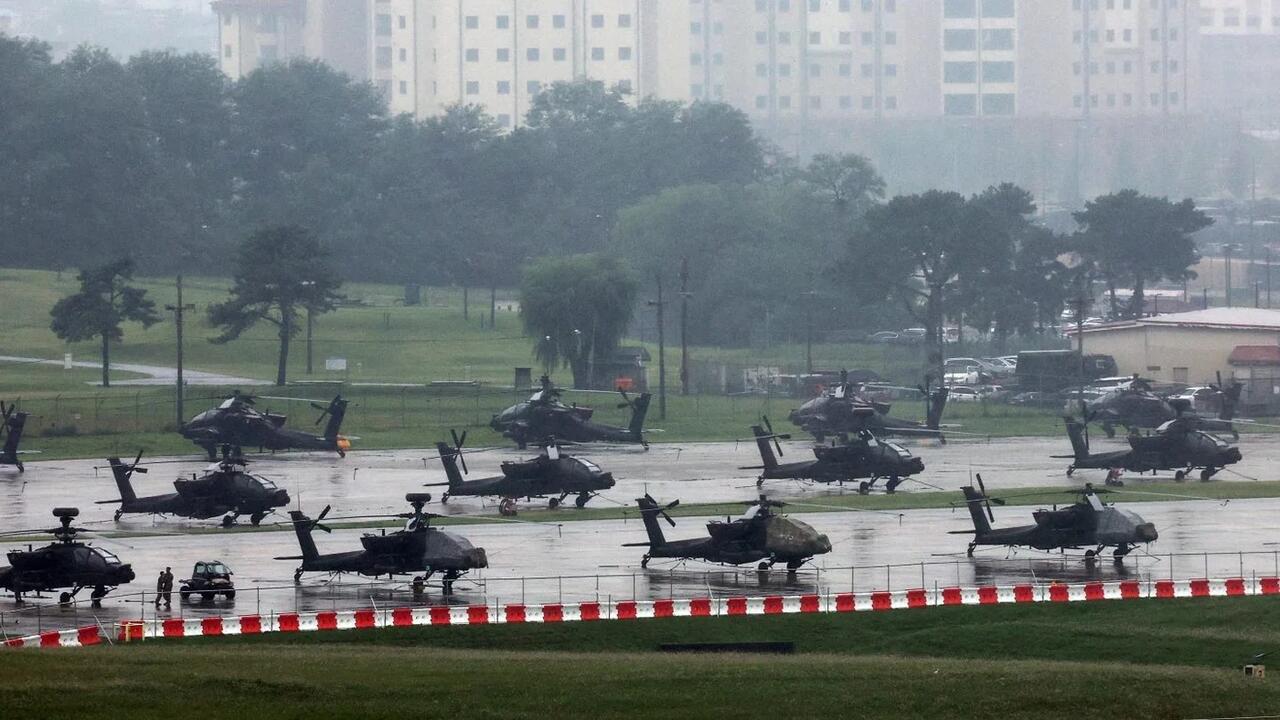
In case you missed… Every Army Base and Army National Guard Base in America was training and testing on Black Hawk and Apaches today. Every one. Normal when you’re definitely not invading a country. pic.twitter.com/nxMsr8w86i
Notice Fort Cavazos, TX, the largest Blackhawk base in the country. Nothing. Most blackhawks have been shipped, a few remain for training, and a lot of training happening 24-7 pic.twitter.com/cLMw7AabhZ
The surge in A-10s suggests the US is preparing for a dirtier, more prolonged campaign centered on Hormuz, coastal targets, and possibly a seizure or raid of Kharg Island or others.
Watch Live: NASA’s Artemis II Rocket On Way To Moon
Watch Live (successful launch at 6:35 p.m. EST):
NASA’s Artemis II mission is finally set to launch three Americans and one Canadian atop the Space Launch System rocket on a lunar mission not seen in more than 50 years.
The Artemis II mission is scheduled for launch at 6:24 p.m. EST on Wednesday from Kennedy Space Center in Florida.
The fueling process for the Artemis II rocket has picked up speed. The rocket is now more quickly filling with liquid oxygen and liquid hydrogen.
When the core stage is completely full, it will contain 196,000 gallons of liquid oxygen and 537,000 gallons of liquid hydrogen. pic.twitter.com/wejiCveeNb
The crew of four, including NASA astronauts Reid Wiseman (commander), Victor Glover (pilot), and Christina Koch (mission specialist), along with Canadian Space Agency astronaut Jeremy Hansen (mission specialist), will circumnavigate the moon in a 10-day flight aboard the new Orion spacecraft.
Three hours and 30 minutes after liftoff, if everything goes to plan, the Orion spacecraft and its service module will separate from the second stage of the rocket, perform a manual flight test high in Earth orbit, and prepare for a translunar injection, in other words, a trip to the moon, during which Orion’s service module will fire its engines and catapult the four astronauts to 25,000 mph on a three-day journey into lunar orbit.
Artemis II will enter the moon’s gravitational field about four days into the mission and then begin its U-turn, enabling a flyby around the far side more than 12 hours later. If today’s launch goes according to plan, that flyby of the moon will take place next Monday.
“No one has ever seen this full crater on the far side of the moon, and so this would be really neat,” Hansen said. “I’m excited to have a look at it. It’s just enormous, super complex, and you could probably stare at it for hours.”
The flyby will set the astronauts up on a “free-return trajectory” that will essentially slingshot them around the far side and back to Earth without burning additional fuel.
By April 10, Artemis II is forecast to re-enter Earth’s atmosphere, nine days and one hour after liftoff, and splash down off the coast of Southern California.
A successful mission sets NASA up for a crewed 2028 lunar surface mission.