The Army has awarded a $464.8 million contract for a laser weapon designed to destroy the type of drones that Iran has launched against U.S. troops and partner nations in the Middle East for more than five months.
The service has selected the LOCUST X3 laser made by AeroVironment, Inc. for its Enduring-High Energy Laser program, according to a company news release.
The 30-kilowatt laser is specifically designed to counter mid-sized drones that the U.S. military refers to as Group 3 unmanned aerial systems, said John Garrity, vice president of directed energy systems at AeroVironment, Inc. One such unmanned aerial system that has frequently been used against U.S. troops in the Middle East is Iran’s Shahed-136 one-way attack drone.
“LOCUST X3 is intended to be the Group 3 killer,” Garrity told reporters on Aug. 7. “When we talk about Group 3, that’s just one of the more prevalent threats that you see in warfare today, seen in conflicts in Iran and in Ukraine with Shahed drones.”
The laser allows U.S. troops to destroy drones at greater ranges than other types of weapons, and the LOCUST X3 can bring down targets in seconds, Garrity said. Those attributes allow the weapon to rapidly destroy drone swarms.
“When you talk about a LOCUST laser weapon system, you’re able to put effects on target at wide ranges at the speed of light,” Garrity said. “If you’re able to kill off drones in single-digit seconds or less, depending on the range and the type of material, you’re able to jump between targets quite effectively and efficiently.”
The laser is also meant to destroy smaller drones, which the military calls Group 1 and 2 unmanned aerial systems, he said.
“Unfortunately, all three classes of those drones can do a tremendous amount of harm to our assets and our servicemen and women,” Garrity said.
The LOCUST X3 is meant to be “the apex predator” of the Army’s layered defenses against small to mid-level drones, said Aaron Westman, senior director for business development at AeroVironment, Inc.
“It can really kill a lot of threats,” Westman said during the media roundtable. “Its job is to really, let’s say, thin the herd to be able to kill high volumes of threats.”
That allows the military to save its more expensive interceptors for specific threats so that its system of layered defenses “doesn’t run out of bullets,” Westman said.
Currently, the U.S. military’s inventory of ground-based air defense missiles has been so depleted during the Iran war that experts estimate it will take years to replenish all the interceptors that have been fired.
Westman added that a missile can miss its target, but with a laser, “as long as you can see something, you can hit it.”
AeroVironment, Inc. will deliver dozens of LOCUST X3 lasers to the Army over the next few years as part of the contract, a company news release says. The laser is designed to be mounted on vehicles, such as the Joint Light Tactical Vehicle. Efforts are ongoing to determine if the laser can also be mounted on the Infantry Squad Vehicle.
An Army spokesperson previously told Task & Purpose that if the laser were approved and fielded as planned, it would become the service’s first directed-energy program of record.
Over time, the company expects to field higher power versions of the lasers, Garrity said.
Earlier versions of the LOCUST laser have already been fielded, with some laser systems deployed within the continental United States, Garrity said. One feature common to the company’s lasers is that they use an Xbox controller.
“To a young soldier, sailor, airman, guardian that’s using these systems, it’s not unlike what they’re using at their own house for video games,” Garrity said.
Trump Admin Weighs Child Care Subsidies For Stay-At-Home Parents
The Trump administration is drafting a rule that would allow some married couples with a stay-at-home parent to receive federal child care subsidies, an initiative reportedly championed by Vice President JD Vance, according to the New York Times.
The proposal would use the existing Child Care and Development Fund (CCDF), which has traditionally helped lower-income parents pay for child care while they work, attend school or receive job training. Federal guidance currently ties CCDF assistance largely to those activities.
Under the proposal, a married couple meeting income requirements could qualify when one spouse works at least 35 hours a week and the other cares for their child at home. The subsidy would effectively help compensate for income forgone by the stay-at-home parent. Unmarried couples with a stay-at-home parent and nonworking single parents would not qualify under the draft.
The Times reports that the change reflects a broader effort within the administration to support families that choose parental care over commercial day care. Vance has previously argued that “Young children are clearly happier and healthier when they spend the day at home with a parent.”
Critics warn that expanding eligibility without adding funding could reduce assistance available to working parents and threaten child care providers that depend on subsidy payments. Joshua McCabe of the Niskanen Center said, “Expanding the eligibility without increasing funding would mean more parents competing for the same dollars, and leaving more parents — particularly single working parents — worse off.”
Krystal Gastineau, a Colorado child-care center owner who said about half of the children she serves receive subsidies, warned that the proposal could pull funding away from providers: “If they could, I think parents would choose to take the money and stay home.” She added, “That would take away a major source of income.”
Supporters argue that federal policy should treat parental care more like paid child care and give families greater flexibility. The proposal could potentially be implemented without new legislation, although questions have reportedly been raised about its legality, particularly the preference for married couples, as well as possible fraud risks.
The draft still requires White House approval and a public-comment period and could change before becoming final.
The federal government is urging the U.S. Supreme Court to side with gun owners challenging state and local bans on AR-15-style rifles.
In a brief filed Friday, Solicitor General D. John Sauer asked the justices to overturn rulings from the U.S. Courts of Appeals for the Second and Seventh Circuits, which upheld AR-15 bans in Connecticut and Cook County, Illinois, respectively.
“The AR-15 rifle is unquestionably in common use among law-abiding citizens for lawful purposes,” the federal government argued.
The cases, Viramontes v. Cook County and Grant v. Higgins, have been consolidated for Supreme Court review.
Connecticut has prohibited what it deemed “assault weapons” since 1993. It significantly expanded the ban after the 2012 shooting at Sandy Hook Elementary School, describing AR-15-style rifles as particularly dangerous and preferred by mass shooters.
Cook County, which covers the city of Chicago, adopted its current firearm ordinance in 2006, prohibiting the possession, sale, and transfer of a list of semiautomatic weapons.
The ‘Common Use’ Debate
At the center of the dispute is whether AR-15-style rifles qualify as weapons “in common use” for lawful purposes and therefore fall under Second Amendment protection.
The idea dates back to the Supreme Court’s 1939 decision upholding a federal ban on short-barreled shotguns because those weapons were not “in common use.”
The Court relied on the same concept in 2008 to invalidate a ban on handguns in the nation’s capital, affirming that they are “the most popular weapon chosen by Americans for self-defense in the home.”
Most recently, the Court referred to the common-use test in 2022 when it struck down a New York law requiring people to show a special need before receiving a license to carry a handgun in public.
Connecticut argues that AR-15-style rifles do not meet the Supreme Court’s legal standard.
“Americans do not commonly own assault weapons for self-defense,” state lawyers argued in an earlier Supreme Court filing, adding that the weapons are “neither used nor useful for that purpose.”
The gun owners challenging the bans, however, argue that AR-15s easily pass the common-use test.
“If the most popular rifle in the country is not in common use,” the challengers said in their petition, “it is hard to see what that phrase could possibly mean.”
The Justice Department is siding with challengers in the debate.
“Today, AR-15s are lawful at the federal level and in 40 States, with law-abiding citizens using them for lawful purposes such as self-defense, target shooting, and hunting,” the government said.
“Legislatures may not ban arms in common use among law-abiding citizens for lawful purposes.”
DOJ Counters Pro-Ban Arguments
Sauer also rejected arguments that AR-15-style rifles can be banned because of their military origins, firepower, or use in mass shootings.
“When it comes to lethal arms, rifles such as AR-15s are not ‘especially dangerous,'” the government argued.
Handguns are easier to carry and conceal and are used in crimes far more often than rifles, the government said. Yet the Supreme Court has already ruled that handguns cannot be broadly banned.
The government also rejected the argument that AR-15 bans are acceptable because people can still use handguns for self-defense.
Sauer compared that reasoning to banning one type of First Amendment-protected speech simply because another remains available.
Allowing a government to ban rifles because handguns remain legal would be “like saying books can be banned because people can always read newspapers,” he wrote, quoting an analogy Justice Brett Kavanaugh made as an appeals court judge.
How Courts Could Judge ‘Common Use’
The government also proposed a way for courts to determine whether a weapon is in common use without relying solely on estimates of how many people own it.
A longstanding ban adopted by Congress and most states could be evidence that a type of weapon is not commonly and lawfully possessed, the brief said.
The opposite would also be true. A firearm that has remained widely legal for decades would weigh in favor of constitutional protection.
The government argued that both the legal history and ownership figures favor the AR-15.
The AR-15 was developed by ArmaLite in 1956 and has been commercially available for decades. Industry estimates suggest that between 28 million and 32 million AR-15-style rifles are in circulation in the United States.
In 1994, Congress adopted a narrow ban on certain new semiautomatic firearms but did not prohibit possession of previously manufactured rifles. That ban expired in 2004.
The respondents’ briefs are due Oct. 21. The Supreme Court has scheduled oral argument for Dec. 2.
A ruling is expected before the Court concludes its 2026-2027 term, typically in late June.
Biggest ‘Go Woke, Get Broke’ Story Of A Generation: S&P Nukes Nike From Elite Blue-Chip Index
S&P Dow Jones Indices announced Friday that Nike is being booted from the S&P 100 after nearly two decades, another sign of how America’s most exclusive blue-chip benchmark is being reshaped by the artificial-intelligence spending boom. But that’s not the entire story…
Perhaps what really happened with Nike is that it lost its way. Instead of focusing on basketball shoes and athletic leisure, it pursued the whole woke culture, which damaged the brand.
Injected itself into far-left politics.
And this …
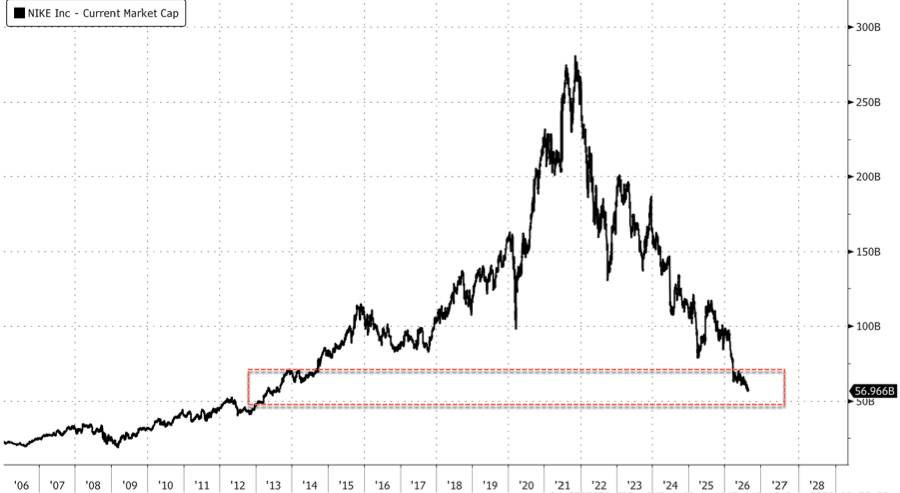
BREAKING: Nike is set to be removed from the S&P 100 after nearly 18 years.
The stock is now down almost 80% from its 2021 peak, turning one of the market’s most iconic consumer brands into one of its biggest recent disappointments. pic.twitter.com/3uJNIxcg4j
S&P Dow Jones Indices noted that Nike will remain in the broader S&P 500.
Nike’s peak was in late 2021, when it sported a $280 billion market cap that has since crashed to as low as $56 billion following Friday’s close, its lowest market capitalization since 2013.
No longer a growth story?
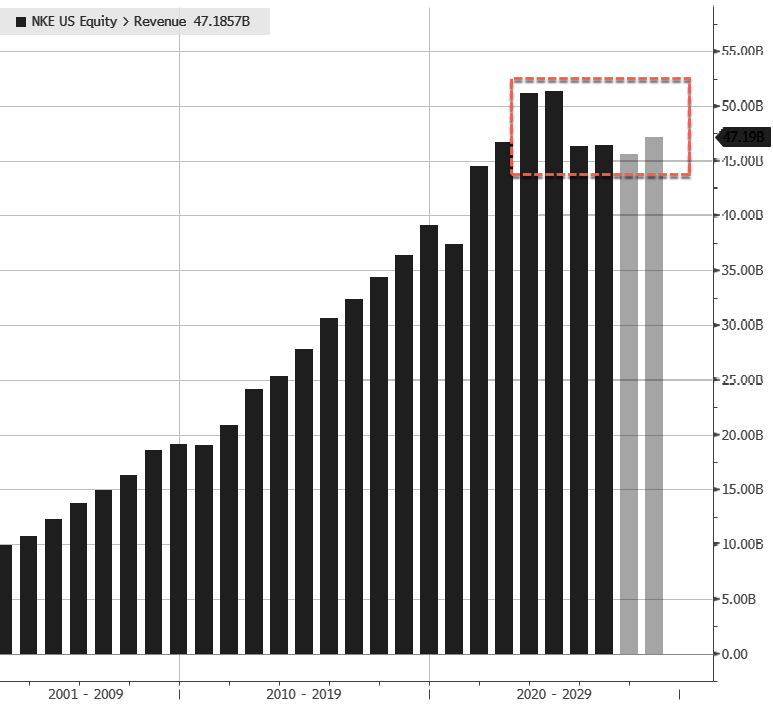
Nike’s upcoming demotion from the S&P 100, set to take effect on Sept. 21, comes after a series of missteps as the sportswear giant struggles to revive sales and has lost market share to rivals including On and Hoka.
Perhaps management should not have focused on left-wing cultural issues but instead on clothing and sneakers.
Michael Cohen, a key witness in the New York criminal and civil cases against President Donald Trump, has “fully recanted” his testimony in both cases, the Republican president announced Friday via Truth Social.
Previously known as Trump’s longtime fixer, Cohen was used by New York Attorney General Letitia James in her controversial civil lawsuit against the Trump Organization and by Manhattan District Attorney Alvin Bragg in his so-called hush money case against Trump.
The civil case against the Trump Organization culminated in a $364 million fine over claims Trump inflated his asset values to secure more favorable loans for his business. The fine was tossed by the New York Appellate Division, which ruled the amount violated Trump’s Eighth Amendment rights.
In his Truth Social post, Trump said Cohen was “pressured” and “coerced” into saying “things that were not true.”
The fallout between Trump and Cohen began after the 2016 election, after Cohen started cooperating with federal prosecutors.
Cohen was sentenced to three years in prison and served more than a year behind bars after pleading guilty to multiple charges, including making false statements to Congress.
Trump and Cohen have made amends in recent months, particularly after Cohen came forward saying he was pressured by New York prosecutors to testify against Trump.
Trump thanked Cohen “for having the Wisdom and Courage to step forward and do the right thing!”
“His Act of Bravery is a Great Credit to the Justice System in New York City and State,” Trump added, before demanding that the cases be dismissed.
“I am sure it was not easy for him! Now we are asking that any remnant of those Politically Weaponized Cases against me be immediately terminated and dismissed.”
The president said that James and Bragg “broke the law in order to do this in order to prevent me from becoming the President of the United States. Such a thing can never be allowed to happen again!”
Trump appeared to be referring to a Jan. 16, 2026, Substack post in which Cohen accused prosecutors from James’ and Bragg’s offices of pressuring and coercing him to provide testimony that would help them build their cases against Trump.
TRUMP: Reposts Michael Cohen article claiming political power corrupts justice, citing insider warning pic.twitter.com/FlydWGDuBI
“From the time I first began meeting with lawyers from the Manhattan DA’s Office and the New York Attorney General’s Office in connection with their investigations of President Trump, and through the trials themselves, I felt pressured and coerced to only provide information and testimony that would satisfy the government’s desire to build the cases against and secure a judgment and convictions against President Trump.”
He later added:
“I experienced a similar dynamic in the Attorney General’s civil case. Letitia James made it publicly known during her 2018 campaign for attorney general that, if elected, she would go after President Trump. Her office made clear that the testimony they wanted from me was testimony that would help them do just that. Again, I felt compelled and coerced to deliver what they were seeking.”
A GoFundMe In Support of Lindsay Clancy Nears $1.2 Million After Mistrial
A Massachusetts jury deliberated for roughly 38 hours over seven days and failed to reach a unanimous verdict in the case against Lindsay Clancy, resulting in Judge William Sullivan declaring a mistrial on Friday due to a holdout juror.
Clancy has admitted to strangling her three children, Cora, 5, Dawson, 3, and Callan, 8 months, with exercise bands inside the family’s home in Duxbury, Mass., in January 2023 after sending her husband out to pick up dinner. She then cut her own wrists and neck, then jumped from a window, which left her paralyzed from the waist down.
Reddington built his case on a claim of severe postpartum psychosis, worsened, he argued, by a combination of prescription medications. Prosecutors rejected that framing entirely and argued Clancy understood what she was doing and planned the killings in advance. Clancy had not been diagnosed with psychosis before the murders and reportedly had not told any doctor she was hearing voices.
Judge Sullivan has scheduled a status and trial assignment hearing for Sept. 29.
Lindsay Clancy’s supporters are clearly expecting a new trial. The Musgrove Family Fund, a GoFundMe campaign supporting Clancy’s parents, Michael and Paula Musgrove, surpassed$1.16 million in donations from more than 33,000 donors within hours of the mistrial. Organizer Brandee Mulligan, a 42-year-old mother of three, raised the fund’s goal to $3 million that same day and told supporters the extended legal process means the Musgroves will need help for a while longer.
“The original purpose of this fundraiser hasn’t changed – it’s simply to take one thing off their plate while they continue to show up for their family. If they have to keep showing up longer, I want to make sure the support does too.”
The Musgroves left Wallingford, Connecticut, and moved roughly 150 miles to stay near Duxbury. Clancy’s sister, Allison Ozga, appeared at the proceedings alongside them. GoFundMe’s page states the Musgroves are the named beneficiaries who receive the money themselves, that Mulligan has no access to any of it, and that both the parents and Reddington knew about the campaign before it went live.
Mulligan, who is from Wisconsin and launched the fund on Aug. 11, previously told the Daily Mail that she had no contact with the Musgroves when she first created it and “did it without even asking permission.” A GoFundMe spokesperson has confirmed the campaign is verified and that all funds go to Mike Musgrove as the intended beneficiary.
“In January 2023, Lindsay Clancy was accused of killing her three young children in the family’s Duxbury, Massachusetts home,” the GoFundMe page reads. “More than three years later, her case is now being tried in court. Throughout those three years, Lindsay’s parents, Mike and Paula Musgrove, have continued to show up for their daughter.”
“And that is who this fundraiser is for, Mike and Paula, who have spent years traveling back and forth, staying in hotels, attending court proceedings and ultimately relocating from Connecticut to Massachusetts so they could remain close to Lindsay,” the page continues. “Their lives have largely been put on hold while they have continued doing what parents do: showing up for their child during the unimaginable. That has come at an enormous financial cost. This fundraiser is not asking anyone to agree on Lindsay, her case, or what the outcome of her trial should be. People will have different feelings about all of those things.”
The new donations range from five dollars to three hundred, one-time gifts sitting beside recurring monthly pledges, though some of the biggest donations to the fund are in the thousands. One anonymous donor gave $5,000.
One donor wrote that their heart was with Lindsay and her parents and that they could not imagine the pain the family has endured. Another, on a fifth contribution, wrote that they could not imagine what Lindsay and her family are feeling right now.
The fund’s success has spawned imitators on the platform, both for and against the family, including pages titled “Lindsay Clancy is an awful person!” and “Against the Musgrove Family Fund.” GoFundMe told CT Insider it is monitoring and “reviewing” all Clancy-related fundraisers, and that “any found to be in violation of our terms of service will be removed.”
Copycat
The trial appears to have produced at least one copycat. Corie A. Walsh, 38, of Frankfort, Illinois, was charged Friday with three counts of first-degree murder after her 2-year-old son Barrett was found hanging in the basement of the family home, a ligature around his neck. A 17-year-old neighbor was performing CPR when police arrived. Officers found Walsh upstairs in a bathtub, surrounded by bloody water, with cuts to her wrists and thighs. Her three other children were unharmed. Her husband was out of town.
Prosecutors said in a court proffer that Walsh “had recently become very invested in the Lindsay Clancy murder trial” and had been “actively discussing the case via group text message with her friends” until hours before her son was found. The boy died Tuesday afternoon, while the Clancy jury was still deliberating. Walsh told officers she killed him because he was the “devil” and the “anti-Christ.”
Private credit’s reckoning is not arriving with one grand, spectacular crash. It is arriving slowly and steadily, one loan at a time.
For years, one of private credit’s great attractions was the remarkable stability (or perceived stability) of its valuations. Public bonds could fall ten points in a week. Leveraged loans could gap lower after a bad earnings report. But private loans somehow possessed the soothing ability to remain at 98, 99 or 100 cents on the dollar through almost anything, all while paying investors a healthy yield.
Incredible, right? Another financial fairy tale…a proverbial unicorn sh*tting rainbows.
Until reality eventually reared it’s head, and now, to the surprise of no one, we are finding out unicorns don’t exist. Imagine that. We are learning that the absence of volatility in a reported mark does not mean the absence of deterioration in the underlying loan. And that is increasingly where the private credit story gets heinous…and why I’ve been writing about it for 2 years now.
The opacity is unlike any other corner of markets. Some borrowers can weaken for months, even years, while their loans remain marked at levels suggesting that most or all of the money is still coming back.
Eventually, though, something happens that makes the deterioration impossible to finesse away. A borrower stops paying interest. A hoped for refinancing disappears. The sponsor declines to put in more equity. A rescue transaction collapses. Or, most decisively, like we are seeing more and more, the underlying company files for bankruptcy.
That is when the soothing stability of private credit can suddenly disappear. A loan that sat near par through months of worsening fundamentals can plunge to 50, 20, five cents or even zero in remarkably short order. The economic deterioration may have been happening all along. The mark simply waited until reality became too difficult to ignore. You then get headlines like this one from Bloomberg yesterday.
And increasingly, the pattern looks familiar. A company struggles, leverage stays high, liquidity deteriorates and interest becomes harder to pay. Yet there is always a reason not to mark the loan too aggressively. Maybe EBITDA recovers. Maybe rates fall. Maybe the sponsor writes another check. Maybe there is a refinancing, an asset sale or a transformational M&A deal just around the corner. Maybe the guy responsible for marking down the loan has set his “out of office” email response to inform people he is taking 2 month vacation on his yacht in Malta.
🔥 85% OFF FOREVER IF YOU SUBSCRIBE TODAY: I am again offering an 85% discount to anyone that wants to become a Fringe Finance annual subscriber today. It’s a discount you can keep and stays applied for as long as you wish to remain a subscriber: Get 85% off forever
Hope, conveniently, has a fair value. It’s always 100 cents on the dollar or damn close to it. But then…painstakingly and eventually…reality catches up and 100 cents quickly becomes 20 cents. Or zero cents.
The latest example is Loparex, a borrower held by Blue Owl Capital Corp., or OBDC. According to Bloomberg, at the end of 2025, its first lien debt was still carried around par and its second lien debt at roughly 88 cents on the dollar. By June, OBDC was carrying portions of the second lien at about five cents and one first lien position at roughly 22 cents. Loparex was also put on nonaccrual. Moody’s has since deemed the company in default and said a Chapter 11 filing is a possibility.
Perhaps recoveries ultimately exceed those marks. That happens in restructurings. But the interesting number is not five cents. It is 88 cents.
The loan did not suddenly become troubled on the day somebody changed the valuation. Loparex had been struggling with its debt load for years, including a 2024 distressed exchange that S&P considered tantamount to default. Yet the second lien still ended 2025 marked at roughly 88.
This gets to the central problem with private credit valuations that I have been harping on non-stop for years. These loans generally do not trade in liquid markets, so managers rely on models, comparable companies, third party valuation firms and their own judgment. That is unavoidable. But it also means that valuation becomes most subjective precisely when the underlying credit becomes most uncertain. If an executive were so inclined, he could figure out a way to model a bankrupt hot dog cart at a $1 trillion valuation. Like the Fed, printing cash, it’s all just made up bullsh*t out of thin air manipulated in seconds on a spreadsheet.
And that’s all good and well. But bankruptcy has a nasty habit of pissing in the proforma punchbowl. Once a company actually files bankruptcy, the comfortable range of hypothetical outcomes (hereinafter referred to as “bulls*it”) gets much narrower. Creditors, restructuring advisers and courts start converting theoretical enterprise values into actual recoveries. At that point, extending and pretending gets considerably harder.
Bankruptcy does not necessarily create the loss. It can simply make the loss impossible to avoid recognizing.
QTR’s Disclaimer:Please read my full legal disclaimer on my About page here. This post represents my opinions only.In addition, please understand I am an idiot and very often get things wrong and lose money. I may own or transact in any names mentioned in this piece at any time without warning, meaning if I’m long I could sell or if I’m short I could cover at any time.
Contributor posts, guest posts and curated posts have been hand selected by me, but have not been fact checked and are the opinions of their authors. They are either submitted to QTR by their author or reprinted under a Creative Commons license with my best effort to uphold what the license asks, or with the permission of the author.
I cannot guarantee the accuracy of any or all facts and figures included in this article though I made an effort to get them right. I have been wrong before and will be wrong again, and encourage you to always double check, do your own research and speak to a licensed financial professional, which I am not.
This is not a recommendation to buy or sell any stocks or securities, just my opinions. I often lose money on positions I trade/invest in. I may add any name mentioned in this article and sell any name mentioned in this piece at any time, without further warning. None of this is a solicitation to buy or sell securities. I may or may not own names I write about and are watching. Sometimes I’m bullish without owning things, sometimes I’m bearish and do own things I’m bearish on. Just assume my positions could be exactly the opposite of what you think they are just in case. If I’m long I could quickly be short and vice versa. I won’t update my positions.
Any of my positions can change immediately as soon as I publish, with or without notice and at any point I can be long, short or neutral on any position. You are on your own. Do not make decisions based on my blog. I exist on the fringe. If you see numbers and calculations of any sort, assume they are wrong and double check them. I failed Algebra in 8th grade and topped off my high school math accolades by getting a D- in remedial Calculus my senior year, before becoming an English major in college so I could bullsh*t my way through things easier. Hence, why I am a writer.
The publisher does not guarantee the accuracy or completeness of the information provided in this page. These are not the opinions of any of my employers, partners, or associates. I did my best to be honest about my disclosures but can’t guarantee I am right; I write these posts after a couple beers sometimes. Many times I edit after my posts are published because I’m impatient and lazy, so if you see a typo, check back in a half hour.
Also, again I just straight up get sh*t wrong a lot. I mention it multiple times because it’s that important you understand.
They/Them Communist Activist Declares Ozempic “Fascist” Plot To “Genocide Fat People”
America’s socialist leadership increasingly looks less like a political movement and more like a circus where the clowns run the show.
Its most radical theorists openly advocate dismantling capitalism and the institutions underpinning the Western order while romanticizing communist regimes defined by nation-killing economic ruin and political repression. Rather than building a credible working-class movement, these clowns have marginalized themselves through far-left extremism and become objects of national ridicule.
The latest clown show comes from Da’Shaun L. Harrison, an Atlanta-based writer, activist, and self-described Afropessimist, anarcho-communist, abolitionist, and trans theorist who uses they/them pronouns.
Recently, at the Socialism 2026 conference, Harrison called the political deployment of GLP-1 drugs “fascistic” because they exist in “a world fixated on genociding fat people.”
“The political deployment of GLP-1s is fascistic, not because individuals take them, but because the conditions under which they become necessary are shaped by a world fixated on genociding fat people,” Harrison continued.
To explain why GLP-1s are fascistic, Harrison turned to Frantz Fanon and “Black flesh under colonial surveillance.”
🚨 Da’Shaun L. Harrison at Socialism 2026 argues that the political deployment of GLP-1 drugs is “fascistic” because they exist in “a world fixated on genociding fat people.”
“The political deployment of GLP-1s is fascistic, not because individuals take them, but because the… pic.twitter.com/CMxfUTUq0e
If Harrison wants to really own his own words, then every diet, every gym, every bariatric surgery, and every doctor who says folks are overweight should be viewed as a war criminal. Make this far-left activist eat his own words.
Diplomatic Blitz: Witkoff, Kushner Hold “Substantial” Ukraine Talks After Putin Meeting
President Trump’s diplomatic sprint shifted from Moscow to Kiev over the weekend, with White House special envoy Steve Witkoff and presidential son-in-law Jared Kushner arriving in Ukraine for talks with senior officials. The visit came one day after the pair met with Russian President Vladimir Putin.
Russian state media outlet TASS cited Kremlin spokesman Dmitry Peskov, who said Putin’s meeting with Witkoff and Kushner had created an “atmosphere of trust, at least through this channel of communication.“
“The very fact that the meeting is taking place means that an atmosphere of trust does indeed exist, at least through this channel of communication, and that it is strengthening. As a rule, however, expanded exchanges of such welcoming remarks emerge when there are messages that the head of state considers necessary to convey,” Peskov explained to the outlet.
A White House official said Witkoff and Kushner’s three-hour meeting with Putin “discussed substantive plans for next steps, which will be announced in the coming weeks.”
Last week, Reuters cited Kremlin aide Yuri Ushakov, who said Putin, Trump, and Chinese President Xi Jinping may hold a trilateral meeting at the next Asia-Pacific Economic Cooperation summit in November.
After the Moscow meeting on Saturday, Witkoff and Kushner traveled to Ukraine for the first time during Trump’s second term as part of his pledge to bring the conflict to an end.
Steve Witkoff and Jared Kushner arrived in Ukraine by train.
Bloomberg reported early Sunday that Witkoff and Kushner’s first round of talks with Ukrainian President Volodymyr Zelenskyy and other high-level officials had ended.
Witkoff was quoted by the outlet as describing his talks with Ukrainian officials as “substantial,” although no further details about what was discussed were released.
“We all want to end the war, and we are on the same page here,” Zelenskyy said in brief remarks to reporters after the first meeting. “Every such meeting gets us closer to peace.”
Steve Witkoff to Zelensky:
We’re having a great time here, and the hospitality is unsurpassed.
The President wanted Jared and I to come here.
We had a great trip, took the train, and as you said, it was a delightful trip. pic.twitter.com/QTFxcdlwdT
Zelenskyy was expected to speak to the reporters later in the day alongside the US envoys.
The push for a diplomatic end to the four-and-a-half-year conflict began with CIA Director John Ratcliffe’s unexpected visit to Moscow nearly two weeks ago.
Ahead of the weekend meetings, Bloomberg reporters were increasingly less optimistic about a breakthrough peace deal, saying the prospects for ending the war remained low.
Iran Vows ‘Faster, More Painful’ Response To US Attacks After Weekend Sea Battle
Iran’s Parliament Speaker Mohammad Bagher Ghalibaf on Sunday announced a heightened military posture in the war with the US, saying that new attacks on the country will “meet a faster, heavier and more painful response.“
“If they haven’t understood by now, they should understand before it’s too late that the rules of the game have changed and that from now on, any violation of Iran’s interests and security will receive a ‘faster, heavier, and more painful’ response,” Ghalibaf said in a post on Telegram. He has warned that Iranian retaliation will no longer be “proportionate”.
Ghalibaf also conceded that Iran faces severe economic pressures amid US-led sweeping sanctions and the campaign of ‘strangulation’ and isolation efforts.
“Severe fluctuations in the exchange rate, inflation, unemployment, and market management are fundamental challenges that have put serious pressure on people’s livelihoods,” Ghalibaf said.
He also laid out that the Islamic Republic must aim to bolster domestic production and use technology to “devise short-term and permanent solutions.” Iran’s military has all along touted that it never stopped manufacturing missiles and drones, even as US-Israeli bombs decimated many industrial sites.
Ghalibaf’s words come a day after the Islamic Revolutionary Guard Corps (IRGC) said it attacked three American military ships and three oil tankers using an “unauthorized” route in the Strait of Hormuz. Also, in the latest:
Iran said Sunday it struck an unmanned U.S. vessel trying to enter the Strait of Hormuz, a claim that the U.S. military dismissed as a “total lie.”
The US military earlier on Saturday had struck three Iranian oil tankers, M/T Downy, M/T Stark 1, and M/T Kylo – in a major first of the conflict (that is, a US attack on civilian vessels).
The Iranian parliament speaker continues to try and troll Trump and Bessent on X:
Wheels up. Warm-ups before liftoff:
Diesel ATH: Short it
Your biggest creditor dumping: Good luck with Yentervention++
NOR cutting $80B: Rename Norway to Americaway
Low recruitment: Debt-to-Service w/ DO[Israel’s]W, per your puppeteers
Washington is meanwhile touting more and more energy flow through the Strait of Hormuz, while also appealing for other nations to help:
US Energy Secretary Chris Wright says on average nine million barrels of oil a day are getting through the Strait of Hormuz that should help relieve pressure on rising energy prices.
Wright told CNN with oil also moving through pipelines in the region, “we’re probably two-thirds or more of pre-conflict flows”.
Those flows, however, depend on the presence of the US Navy to help escort tankers and provide some protection against possible Iranian attacks. Wright said he expected other countries will eventually support the Navy’s efforts.
But events like this weekend are likely going to continue to escalate the crisis. “There’s going to be more clashes between the Iranians and the Americans. There can be miscalculations. There can be more civilian casualties” especially on the Iranian side, Sina Azodi, the director of the Middle East studies program at George Washington University, has explained.
The “small potatoes” conflict according to the Commander-in-Chief…
Reporter: Can you explain to the American people, if this is not a war, what exactly is it?
Trump: A lot of people don’t call it a war. I call it a military conflict because it’s small potatoes for us. It’s not a big thing.
“The [US] secretary of defense can send more troops to the region, but I don’t think the Iranians are going to back down. They’re going to resist that blockade and impose further costs on the United States,” the analyst said.
Indeed every escalation step ordered by Washington has typically resulted in the Iranians ‘answering’ with significant missile and drone attacks on US bases in the Gulf, and as far away as Jordan. Some analysts are calling this a successful ‘debasification’ campaign that has existed since the war’s start.