47.2 F
Chicago
Sunday, November 8, 2026
Home Blog Page 803

Moscow Repels Another Large-Scale Ukrainian Drone Attack, Flights Briefly Grounded

0
Moscow Repels Another Large-Scale Ukrainian Drone Attack, Flights Briefly Grounded

Russian officials are describing a large-scale Ukrainian drone attack targeting the capital of Moscow on Sunday. While not the first time, such aerial assaults so deep in Russian territory have remained somewhat rare.

Moscow Mayor Sergei Sobyanin said Sunday afternoon that Russian air defenses intercepted 13 drones headed for the capital, as regional officials reported a sweeping wave of UAV attacks across western Russia – including hundreds of UAVs in total.

Standard Ukrainian drone, via the General Staff of the Armed Forces of Ukraine

In mid-afternoon local time, Sobyanin announced that a drone approaching Moscow had been shot down. Within an hour later he described that air defenses had destroyed a total of 13 UAVs targeting the capital area. Emergency crews were dispatched to sites where debris fell, he detailed in the aftermath.

State-aligned outlet RIA Novosti reported that Domodedovo airport briefly halted arrivals and departures amid the threat before operations resumed.

The past year has seen increasing delays and stoppages at major aviation hubs across the Moscow region, leading to frequent delays and flight cancelations, also as frustration among Russian travelers grows.

In the border area Bryansk Oblast, Governor Aleksandr Bogomaz described the region had been under sustained drone assault since early morning. He said 120 UAVs had been downed over the territory.

As for details of the assault on southern Russia – which has become almost a nightly reality – Russia’s Defense Ministry stated that in the morning hours, air defenses intercepted 102 Ukrainian fixed-wing drones over Bryansk, Kaluga, and Tula oblasts, as well as over the Moscow region – including three allegedly flying toward the capital.

Repeat drone attacks on Moscow could result in the Russian military upping its own attacks on the Ukrainian capital, which will leave Kyiv Oblast further without power, after already being subject to rolling blackouts.

Winter has hit hard in Ukraine, given that in many places there have been subzero temperatures, and amid persisting power and gas outages. Some locales have even experienced water outages, creating dire humanitarian circumstances.

Tyler Durden
Sun, 02/15/2026 – 15:45

The AI Transition: Even Dinosaurs Weren’t Stupid Enough To Create Their Own Extinction Event

0
The AI Transition: Even Dinosaurs Weren’t Stupid Enough To Create Their Own Extinction Event

By Peter Tchir of Academy Securities

A Bridge Too Far? The AI TRANSITioN?

Last weekend we discussed Molotov Cocktails, Volatility, Stability, & Faux Liquidity. In a nutshell, it was about:

  • The transition from one steady state to another steady state can be volatile.
    • A rules-based world, dependent on trade, to a ProSec-based world where each country operates more independently.
    • The transition from a pre-AI world to an AI world.
  • Faux liquidity – or our assessment that market structure is set up to produce bigger moves than the headlines or news warrant.

We got to discuss many of these things on Bloomberg TV on Friday, where Academy was part of the first half hour. While the focus was on AI, I kept arguing that geopolitics and this transition from one stable system to another stable system was also likely playing a major role in this week’s price action. Of all the things I regret saying, or not saying, I flubbed the final question on Walmart’s multiple. It isn’t something I focus on, and my answer was weak. I wish I’d highlighted that Walmart is the sort of company that should do well – big enough to navigate the changing global trade system and well positioned enough to extract the maximum benefit from AI-related efficiencies.

In any case, we certainly have a lot to follow up on based on this past week’s volatility and rapidly evolving narrative.

A Bridge Too Far?

One heck of a movie, and one of the few that comes to mind where the “good guys” lose. They put up an epic struggle, but don’t achieve their goal.

As you know I am Canadian, so you can choose to take this with a grain of salt, but I believe that this week’s “Truth Social” post about the new bridge, almost completed, fits the “bridge too far” narrative.

  • There was a lot of concern about imposing tariffs on countries that had been deemed to be blocking the U.S. “taking” Greenland. Not just from foreign countries, but there also seemed to be some degree of backlash and concern domestically. Not “just” from economists (which were front and center during Liberation Day). Nothing broke, and nothing really changed, but it seemed to set the stage for what happened this week.
  • On Sunday night (or early Monday morning) the President posted some complaints about the new bridge being built. The Gordie Howe Bridge. He is legendary both in Canada and Detroit. As we’ve become used to there was a mix of fact and fiction, and some weirdness (like China going to take away the Stanley Cup – which no Canadian team has won since 1993).
  • He went down the path of ownership. But it quickly came out that Michigan will have ownership, once the bridge costs are paid for (which were heavily skewed towards being paid by Canada). The argument of “ownership” also looked “flimsy” as people discovered that the Ambassador Bridge (the current connecting bridge) is privately owned by an American company (or family). I’ve used that bridge a lot, and it leaves a lot to be desired. One thing that I think of a lot is how great the new Tappan Zee Bridge is (technically the Mario Cuomo Bridge). It is a beautiful bridge and it has changed traffic patterns for the better. I don’t even know how old the bridge is now, but I still feel a sense of awe (and even pride) when driving across that bridge. I’m not sure the Gordie Howe Bridge is anywhere near as impressive as the new Tappan Zee Bridge, but it certainly has to be an improvement (and additive).
  • I’ve left out a myriad of other allegations around this to focus on the pertinent point. Michigan, with the approval (and support) of U.S. Presidents (including President Trump) has engaged in a project that they viewed would help their economy. Out of the blue, that is being challenged?

Now maybe it is pure coincidence, but this week, the House of Representatives voted to stop the tariffs between the U.S. and Canada. There is no way this won’t get stopped with a veto (assuming it gets passed the Senate), but this is the first time during this administration that we saw Republicans go against the President even as they were warned about reprisals such as “being primaried.”

We’ve had some questions about the American Brand. Tourism to the U.S. from abroad is down (not horrific, but down). We have yet to notice a discernible change in consumer tastes abroad, but many of these “bridges too far” have occurred only recently.

While I’m not sure much will come of it, France announced on January 26th that civil servants would have to use Visio by 2027, instead of Zoom.

While we have “goods” trade deficits with many (even most countries), we have “services” surpluses.

We’ve always argued that the total trade balance is most important (goods and services).

  • While I don’t see it tracked anywhere, “profitability” of trade is even more relevant and what little evidence there is points to the fact that from most countries, the U.S. imports low margin products and exports higher margin products (or services as the case may be).
  • That is NOT inconsistent with ProSec which prioritizes domestic (or trade with close allies) for “things” that are vital for national security in a wholistic way (rather than purely military).

We’ve also argued that tariffs put pressure on the system slowly. It is the cumulative effect of tariffs that matter (especially when the rates themselves seemed subject to change at any moment). As we move into the 10th month of higher tariff revenue (around $30 billion per month) the cumulative effect seems to be appearing (lots of reports this week citing amounts eaten by exporters, versus paid by importers, or passed on to customers).

Now maybe it is pure coincidence, but this week, stories circulated about reducing tariffs on steel and aluminum. There were some denials but this makes sense – as it will take the U.S. time to crank up production and it is “confusing” how to apply this, as both steel and aluminum are a part of so many products.

Markets like some degree of certainty. Even if the certainty is somewhat variable. The market has grown to accept the volatility and the “maximalist negotiating leverage” game. 

But have we crossed a bridge, where that game no longer functions like it has for the previous 6 months or so?

U.S. stocks underperformed most other indices last week, especially when converted to dollars.

I think we have seen enough Molotov Cocktails lobbed domestically and internationally (from all sorts of directions and parties) that this volatility extends and resolves itself in lower valuations, especially domestically, as the U.S. has outperformed by so much for so long.

The AI TRANSITioN?

I was trying to find a font that had more of a computer/sci-fi “vibe”. I wanted to use one of The Far Side’s dinosaur cartoons where a couple of dinosaurs are laughing at a mammal while one looks mildly concerned about some snowflakes that are falling (but we probably needed some actual copyright permission to do that – though I urge you to search The Far Side for dinosaurs).

I guess I was thinking about that because Even the Dinosaurs Weren’t Stupid Enough to Create Their Own Extinction Event. They were not smart, and they did become extinct, but they didn’t do it to themselves.

So, we will use this little picture to symbolize what may have happened last week (and I’m pretty sure we don’t need any copyright permission from Grok).

We have been talking about the little I (or i-shaped) economy. Arguing that maybe it is a k-shaped economy rather than a K-shaped economy. We’ve also been talking about the “working poor” in recent pieces (The Fed, Electricity, & Affordability).

You could almost convince me that it is an h-shaped economy, but that might be too negative.

But for now, I think the K in the K-shaped economy just cracked. Let’s look at this “cracking” of the K in two ways.

The first from “margin compression” and even “margin differential” compression:

  • High margin, low physical asset businesses are likely to face margin pressures. I don’t think we are close to the day where AI can create products that remotely compete with the biggest and best software programs – but they could face margin pressures as they head off any potential competition at the pass. The selling may already be overdone, but we could see some margin compression continuing in sectors that don’t have as big of a “moat” as previously thought. Installed base is still a very powerful “moat” and the market may have forgotten that, but margin pressure is likely to be a story that becomes a recurring theme to pressure markets.
  • Low margin business, especially those with large “physical” undertakings (property, plant, and equipment, shipping, logistics, etc.) may benefit and see margin expansion. These are the sorts of business that can see margins expand as they get benefits from efficiencies delivered by AI (I should have done a better job on this on Friday’s TV appearance).
  • So, the high margin sectors that the market owns heavily could see margins shrink, while the low margin businesses that many investors are underweight in could see margins expand. Both the margin expansion and compression come from the same force – rapidly improving AI. This rotation could have some staying power. Call this the margin differential compression trade. It will adjust what are the appropriate multiples for different companies and different industries.

Weirdly, that might be the more benign way to think about this.

  • White collar job losses.
    • The FT published an article where Mustafa Suleyman, the CEO of Microsoft AI, predicted (according to a Grok summary) that most tasks in white-collar professions – such as those performed by lawyers, accountants, project managers, and others working at computers – will be fully automated by AI within the next 12 to 18 months. There seem to be a lot of takes on his words that are even worse than what he said, though what he said doesn’t seem great. Presumably, at least some people on the upward sloping part of the K have white-collar jobs?
      • I did manage to write a T-Report this weekend, rather than giving up, but…
    • If you haven’t seen, or I’m the first person to suggest checking out Something Big Is Happening, I recommend it. It is another, I think I can say, “dire” warning about potential job losses.

We’ve been living in a “no hire, no fire” economy. Anyone who had been proclaiming massive job losses from AI was viewed as a tin foil hat wearing “doomer.”

Most people were explaining that AI would:

  • Enhance what people could do, so those who harnessed it would benefit greatly.
  • The counterpoint to this, recently, has become that since AI is getting so easy to use, don’t even bother, because by the next generation, we won’t need to have a clue on how to use AI, to use it.
  • Create some job losses but create many more jobs. Ironically AI prompter is one of them, but see the above comment.
  • Basically, the argument has been that AI, like many other technological advances, would be a big net benefit to humankind (and not a self-made extinction event).

That narrative, like the K, seems to have cracked in the past few weeks.

  • Will that change how people spend their money? This narrative has appeared rather “suddenly” and has an “alarmist” ring to it. Maybe, like the initial concerns about DeepSeek, it will fall by the wayside.
    • The risk is that, even before job losses occur, people will change their spending behavior out of fear of those job losses.

I’m not in this camp, but the concern that “Someone’s Efficiency is at the cost of Your Job” was almost palpable this week.

Probably overdone, but if the upward sloping leg of the K has been driving the economy and spending, we might want to be very careful (in our investing and spending).

Yet another reason to be cautious on risk as we make it through this “transition.”

The Fed

I remain convinced that:

  • We will have 75 bps of cuts by the end of the September meeting. That there is a far higher chance of one more Powell cut (March or April) than the market is pricing in. The market moved in our direction this week, but plenty of room still to price in what we are positioning for.
  • 10-year yields will be sub 4%. 10s closed at 4.05% on Friday.

This has nothing to do with the rest of today’s report, but I didn’t want anyone to think we’ve stopped pounding the table on these trades. Though in some ways it has a lot to do with everything in today’s report if we’re right about the volatility and its disruptive nature.

Two Last Things

  • The Supreme Court is likely to rule, at least partially, against the U.S. government on the IEEPA tariffs.
    • Countries that have set up trade deals are unlikely to be impacted as the trade deals themselves should overrule the IEEPA tariffs (to the extent there were any). Though there isn’t a lot of evidence that agreements in principle have turned into formal documents.
    • The admin has many other ways to attack tariffs other than under IEEPA, especially for tariffs in the 15% and lower range.
    • It is likely the admin, on any losses, will make it very difficult to collect money paid on tariffs that were deemed illegal. Do you really want to sue the government or do you just view it as a sunk cost?
    • I don’t think the ruling will have much of an impact, though I’m rethinking that, as the reaction might be different if we really did go “a bridge too far” this week.
  • Expect nuclear arms proliferation.
    • Ukraine gave up what nukes it had and it was invaded by Russia (which does have nukes and has muted any military response to their actions).
    • Iran has been attacked before, and the U.S. is positioning forces capable of launching another major attack.
    • North Korea, with a backwards economy, and few friends, is largely left alone (while executing cybercrimes to fund themselves). Would the world tolerate such blatant cyber activity if they didn’t have nukes?
    • France has discussed the possibility of working with other nations about sharing (in some form) either technology or weapons.
    • Nuclear energy will be important to the world for ProSec, and I’d be shocked if nuclear weapons didn’t play an important role in smaller nations figuring out how to ensure their sovereignty. So probably bad for humankind and extinction events, but good for uranium and others in the nuclear fuel business.

Bottom Line

More of the same. We could get some bounces.

  • Some markets are at or near being oversold.
  • We could get pleasant surprises with Iran or Russia.
  • There are likely to be new “pronouncements” from the administration in their efforts to run hot heading into the midterms – and I continue to believe people are not pricing in the Fed as aggressively as they should. I also remain a huge fan of the ProSec™ trade. Not in the least because many of the industries that fit the trade criteria are in the camp of stocks that have been underinvested in and are positioned to do well.

I wasn’t even depressed when I started writing this report. Sorry if this report did nothing to brighten your day, but this is the dark spot my thoughts led me to.

Though I do remain skeptical of the ability for AI to change things so quickly that we are hurt before we can reap the benefits.

There, at least we ended on a positive note, and for those on holiday on Monday, do enjoy! It is difficult to believe it is only the middle of February.

Tyler Durden
Sun, 02/15/2026 – 15:10

Pentagon Gaming Out “Sustained, Weeks-Long Military Campaign” Against Iran Which Could Open Pandora’s Box

0
Pentagon Gaming Out “Sustained, Weeks-Long Military Campaign” Against Iran Which Could Open Pandora’s Box

The Pentagon is preparing for a “sustained, weeks-long military campaign” against Iran if President Trump gives the green light, according to fresh reporting in Reuters which cites two US officials.

The scenario under review envisions a far broader conflict than last June’s 12-day war, when the US and Israel launched strikes on the Islamic Republic. But some who better remember the recent Iraq and Afghan wars say it won’t just be “weeks” – but any major Iran action has the likelihood of becoming a much lengthier and bloodier than envisioned quagmire.

Anadolu Agency via Getty Images

The report comes after Washington and Tehran resumed indirect talks in Oman last week – also as Israel is pressing for Iran to dismantle not only its nuclear program but also its ballistic missile arsenal – the same capability Tehran used to strike back at Tel Aviv in June.

Even as some White House officials have touted the idea of ‘limited’ strikes on Iran, akin to the swift and easy Venezuela operation which ousted Nicolás Maduro, Pentagon planners are being more realistic in admitting immediate Iranian retaliation would sustain the conflict, making it “more complex”.

From the heart of the Reuters article…

The planning under way this time is more complex, the officials said. In a sustained campaign, the U.S. military could hit Iranian state and security facilities, not just nuclear infrastructure, one of the officials said. The official declined to provide specific details.

Experts say the risks to U.S. forces would be far greater in such an operation against Iran, which boasts a formidable arsenal of missiles. Retaliatory Iranian strikes also increase the risk of a regional conflict.

The same official said the United States fully expected Iran to retaliate, leading to back-and-forth strikes and reprisals over time.

Trump of course ran on a campaign to end the forever wars and to not start any new ones, especially in the Middle East, where Washington has had a horrible and blood-stained track record. ‘Blowback’ also defined the period of the ‘global war on terror’ – as groups like ISIS arose in the wake of toppling Saddam Hussein and destabilizing places like Libya and Syria.

Whether Trump is pursuing diplomacy or using negotiations as cover for renewed military action remains an open question, and talks based on Oman are expected to continue this coming week.

White House spokesperson Anna Kelly said the president has “all options on the table” and will decide on war based on national security interests, also at a moment Congress is as usual asleep at the wheel, despite a couple of efforts to reign in War Powers which have quickly failed.

As for the ‘option’ of a large-scale attack, Pentagon leadership is still cautious on this, given US assets are still being put in place in the CENTOM region, also as a second carrier – the USS Gerald R. Ford – is still en route from the Caribbean.

“Defensively, we’ve got to make sure, before we do anything [that US defenses are in order,” said Gen. Joseph Votel, former head of US Central Command. “So we are prepared for the inevitable response that comes back against US interests or against our partners.” The NY Times has also lately described the effort as “putting one’s house in order.”

Are US dialogue and peace efforts for real this time? Or another ruse to lull the Iranians into thinking it want suffer surprise attack…

Meanwhile, a note via Peter Tchir’s Academy Securities: 

“I do believe that before any kinetic action occurs, there would need to be greater consultation with regional allies. For now, the Arab Gulf countries are more comfortable with the weakened devil they know in Tehran than potential chaos in the region, a disruption in oil prices, and investor jitters, not to mention the probability that any Iranian retaliation is likely to include attacks on their soil.” – Linda Weissgold, Former CIA Deputy Director for Analysis

But again, this notion that a military campaign would just take “weeks” (and not months or even years)… is precisely the lie that was floated about the Iraq and Afghan interventions – both which turned into two decade plus nightmares.

Tyler Durden
Sun, 02/15/2026 – 14:35

As Demand Grows, US Nuclear Energy Industry Faces Looming Crunch In Reactor Fuel Supply

0
As Demand Grows, US Nuclear Energy Industry Faces Looming Crunch In Reactor Fuel Supply

Authored by John Haughey via The Epoch Times,

The Department of Energy (DOE) has invested billions in incentivizing domestic production of enriched uranium for the commercial development of advanced nuclear reactors, including $2.7 billion issued last month to three companies to build centrifuges and processing plants necessary to produce fuel for reactor cores.

Yet, a fuel crunch that could hobble President Donald Trump’s “nuclear renaissance” initiatives looms as soon as 2028, several experts warned during the two-day U.S. Nuclear Industry Council’s 13th annual Advanced Reactors Summit in Seattle that concluded Feb. 12. 

“If America wants to lead in advanced reactors, we have to do the nuclear fuel here. Make no mistake about that,” Centrus Energy Senior Vice President Patrick Brown told more than 400 nuclear industry professionals on Feb.12.

“Unfortunately, we’re really building from zero.”

Right now, he said, less than 1 percent of the nuclear fuel that the nation’s 94 commercial reactors annually consume is produced domestically, and that is exclusively dedicated to the Pentagon. The nation’s commercial nuclear energy industry is “completely reliant on foreign imports” of enriched uranium, he said, primarily from Kazakhstan and Canada.

Those imports include up to 5 percent from Russia that won’t be available soon. In response to Russia’s invasion of Ukraine in 2022, Congress in 2023 banned U.S. companies from importing Russian uranium. That ban goes into effect on Jan. 1, 2028.

Brown said with the global nuclear fuel market already constrained, domestic industry’s scramble to revive enrichment—a process American companies invented and once dominated—is now a race to have supply available to meet demand as new reactors come online.

Because that demand—spurred by the president’s May 2025 executive orders to license 10 new reactors by 2030 and quadruple commercial nuclear energy output by 2050—is likely to outpace domestic fuel production until the early 2030s, he said a timing shortage will emerge in 2028. 

“That’s when we’ll see that the problem is there’s not enough non-Russian supply” of enriched uranium to replace even the relatively small amount it now produces in a tight market where restrictions on one supplier impacts the entire market.

“Fortunately,” Brown said, the industry and the Trump administration recognize there is an approaching gap between burgeoning demand and static supply, and has deemed restoring domestic capacity to enrich uranium a national security priority akin to “a second Manhattan Project.”

The entrance of Urenco’s uranium enrichment plant in Gronau, Germany. Urenco USA also operates a commercial enrichment plant in New Mexico and is among the few companies in the United States authorized to do so. Volker Hartmann/DDP/AFP via Getty Images

Industry Must Respond

The nation’s domestic nuclear fuel supply chain got a $2.7 billion boost when the Department of Energy on Jan. 5 issued awards to three domestic companies to enrich low-enriched uranium and high-assay low-enriched uranium.

Securing $900 million awards each to build uranium enrichment plants are California-based General Matter in a former Paducah gaseous diffusion plant in western Kentucky, North Carolina-headquartered Orano Group’s Federal Services operation in Oak Ridge, Tennessee, and Maryland-based Centrus Energy’s uranium enrichment plant in Piketon, Ohio.

Brown said unlike the array of demonstration projects the Department of Energy is sponsoring, such as the Energy Reactor Pilot Program that has 10 companies vying for federal funding if they can demonstrate functionality of their designs by July 4, 2026, enriching uranium is not a new process.

“We’re not here to do science experiments, right?” he said. “We’re here to go big or go home. We’re not going home. The era of demonstration is over. We are moving onto large-scale commercial production.”

Centrus is already licensed to produce low-enriched uranium and high-assay low-enriched uranium in its Ohio plant, he said. Its Technology and Manufacturing Center in Oak Ridge, Tennessee, is the only domestic manufacturer of centrifuges needed for the enrichment process. It’s ready to gradually scale-up production.

“We have the site. We have the facility,” Brown said. “We have the room to expand” at the Piketon plant, which is demonstrating with 18 centrifuges what could be replicated by thousands. “Our technologies are proven and are actively producing [high-assay low-enriched uranium] today,” he said.

The Department of Energy award is designed to induce a long-term “demand signal” for investors and utilities, he said, by assuring them there will be ample domestic supply of enriched uranium available should they incorporate nuclear power into their grid expansion plans.

However, Brown said, the Piketon plant and other projects nationwide are not expected to reach peak production until the early 2030s, meaning there could be more demand than supply until production can catch up.

While the Department of Energy funding is critical in seeding domestic capacity to be self-sufficient in producing nuclear fuels, how swiftly that can be achieved is now up to the industry itself, he said, encouraging operators to begin negotiating “off take” agreements with Centrus and others engaged in uranium enrichment so they can secure their fuel supply and processors can commit to ramping up with confirmed orders.

“This is the chicken-and-the-egg problem that [the Department of Energy] was trying to solve. They said, ‘Build the capacity and the advanced reactor development will come while we’re building it,’” Brown said. “That’s the message. So we need firm contracts to proceed to build further. So let us know. We’re ready.”

Tyler Durden
Sun, 02/15/2026 – 14:00

Border Patrol Fired Army Lasers At Party Balloons, Forcing El Paso Air Traffic Shutdown

0
Border Patrol Fired Army Lasers At Party Balloons, Forcing El Paso Air Traffic Shutdown

On Wednesday, after the FAA suddenly shut down airspace over El Paso, Transportation Secretary Sean Duffy announced the unsettling move was prompted by a “cartel drone incursion,” and assured Americans that “the threat has been neutralized.”

However, that shutdown, which impeded everything from commercial air traffic to medevac helicopter flights, was actually caused by a trigger-happy border Border Patrol unit firing a US Army laser weapon at a party balloon, not far from El Paso International Airport. 

The introduction of the weapon into a border-security role without FAA approval may have violated federal law. The proposal for arming the border patrol with the anti-drone weapon was first presented to Deputy Defense Secretary Steve Feinberg in the spring of 2025, sources tell the New York Times. The goal was the interdiction of drones used to smuggle drugs across the frontier. According to two people, Pentagon staff cautioned that the idea would require approval of the FAA and Transportation Department, but Feinberg said the Pentagon was free to do what it wanted with the weapons. The Pentagon called their account “a total fabrication.” 

In a Feb 6 email obtained by the Times, the FAA’s chief lawyer warned a DOD official that putting the weapon into the border-enforcement mix without restricting the airspace “a grave risk of fatalities or permanent injuries” to civilians flying overhead. 

CPB officers reportedly fired an AeroVironment LOCUST laser counter-drone weapon on loan from the US Army (AeroVironment photo)

In the predawn hours on Monday, Feb 9, as military service members observed, Customs and Border Protection officers fired the laser weapon at what they assumed was a drone near Fort Bliss, but it was actually a metallic party balloon. Around 5pm that day, a DOD official emailed an FAA lawyer, reiterating the Pentagon’s stance that prior FAA approval wasn’t needed, and that the laser weapons would continue to be employed on the border, adding that he “looked forward” to a meeting to discuss the topic. 

FAA officials were said to be outraged. Early Tuesday evening, the FAA warned the Pentagon and National Security Council that an FAA-mandated shutdown of airspace near El Paso was imminent. Then came the extraordinary order from FAA administrator Bryan Bedford that airspace above El Paso would be closed for 10 days. The “temporary flight restriction notice” forbid any flights below 18,000 feet in the affected area. An angry El Paso Mayor Renard Johnson said the “unnecessary” airspace shutdown, which lasted a few hours, caused “chaos and confusion,” including the diversion of medevac flights to Las Cruces, New Mexico. Bedford rescinded the order on Wednesday.  

The laser weapon was fired a balloon approaching Fort Bliss, which is immediately adjacent to El Paso International Airport

The incident has intensified pre-existing tension between the DOD and the FAA, which goes back to the disastrous January 2025 collision between an American Airlines jet and a US Army Black Hawk helicopter that killed 67 people. At least two near-misses with Army helicopters followed. 

While it’s been widely and credibly reported that CPB fired at a party balloon, the administration has yet to officially rescind its claims about a “cartel drone incursion.” Meanwhile, the safety question hangs heavy in the air. In October 2024, an official at US Northern Command said safety concerns were, at the time, keeping lasers off the table where drone interdiction was concerned: 

“The biggest thing right now is the impact of the laser when it moves beyond its target. You know, how far is it going? What’s that going to do? How long does the laser need to remain on target before it begins to inflict damage and so on, right?” 

It’s far from clear if those questions have since been satisfactorily answered. To the extent they’re still being sorted out, maybe that process shouldn’t be taking place next to El Paso International Airport. 

Tyler Durden
Sun, 02/15/2026 – 13:25

The Weak Dollar Narrative

0
The Weak Dollar Narrative

Authored by Lance Roberts via RealInvestmentAdvice.com,

We have spent a lot of time over the last year debunking “narratives,” which are dangerous to investors, as “narratives” create a rationalization for overpaying for assets. Nonetheless, Wall Street loves a simple story and is happy to jump on a trend with momentum, selling products to unwitting consumers. A good example of that lately has been the “weak dollar” narrative, which has pushed investors to chase foreign assets. The negative correlation between a weak dollar and rising international stock exposure appears to be a free return. Unsurprisingly, the story spreads fast because performance charts look clean during a dollar slide.

Reuters recently reported that the US dollar hit a four-year low in late January after President Donald Trump said the “value of the dollar” was “great.” Reuters tied the move to rate cut expectations, policy volatility, and concerns about fiscal deficits and central bank independence. However, in reality, President Trump was more correct than not, as Commerce Secretary Howard Lutnick confirmed the dollar trading at a more “neutral level,” as shown below.

There are two very important points to take away from the chart above.

  1. The dollar has been in a very strong uptrend since the Financial Crisis and remains there.

  2. Despite the recent pullback in the dollar, it is trading at its “Neutral Value” and is at the same level it was in 1970. Such certainly does not support the “debasement” or “demise of the US Dollar” narratives.

What is true is that the decline in the value of the dollar, after its strong surge starting in 2021, does make foreign assets more appealing as investors seek a hedge against a weaker dollar. However, while the “purveyors of perpetual doom” claim this is evidence of the end of the US Dollar dominance, the recent decline in the dollar, as shown above, is simply part of its long history of rallies and declines as the dollar adjusts to flows as foreign governments seek to balance their currencies against the US Dollar.

If you take a look at the dollar chart above, you will notice that it trades in a band above and below 100 (the “neutral value.) This is because the US Dollar is measured against a “basket” of foreign currencies. It is crucial to understand that foreign governments manage their currency against the dollar through a “peg” or a managed band to reduce exchange rate swings and support trade. As such, foreign central banks set a target rate versus the dollar and defend that target by buying or selling dollars from foreign exchange reserves. This is why, when the dollar was “above neutral,” foreign central banks like China reduced their holdings of US Treasuries to strengthen the Yuan.

When demand for the local currency rises, the central bank buys dollars and sells local currency to keep the rate from rising. When demand falls, the central bank sells dollars and buys local currency to keep the rate from falling too much. Many countries also align short-term interest rates, capital controls, and bank liquidity rules with the peg, since rate differentials and hot money flows pressure the exchange rate.

There are several very important reasons why all countries need a stable currency relative to the dollar:

  1. It helps exporters price goods with less uncertainty,

  2. Supports long-term contracts,

  3. Limits imported inflation on energy and commodity prices priced in dollars, and

  4. Lowers currency risk for foreign investors.

The trade-off is less monetary policy freedom, greater reserve requirements, and a higher risk of sharp adjustments when the peg level no longer aligns with inflation, growth, or external deficits.

However, none of this supports any commentary about the “death of the dollar,” or the failure of fiat currencies in general. What those commentaries do is push portfolio behavior. When the dollar falls, international stock exposure often rises in the allocation model. The risk lies in the assumption that a weak dollar stays in place indefinitely.

Looking at the chart above, it is clear that currency trends reverse when positioning crowds in either direction. A weak-dollar narrative encourages investors to pay less attention to valuation, earnings, and country-level fundamentals, leaving portfolios exposed when the thesis breaks.

A Potential For A Dollar Rally

Currency markets move on expectations more than anything else. Yes, interest rates, economic growth, and inflation can all impact the dollar, but it is more about the “expectations” of those variables for the dollar, trade, etc., that move the price. Therefore, investors need to be on the lookout for factors that could reverse expectations. Currently, several conditions are forming that could begin to reverse those expectations.

First, positioning and technicals matter. From a long-term technical perspective, the U.S. Dollar Index is attempting to stabilize after a 2025 downside move. As shown, using a 3-year price momentum measure, the dollar is as oversold now as it was at previous dollar bottoms. The current move lower is becoming increasingly stretched, reducing the catalyst needed to trigger a sharp reversal.

A weak dollar trend also encourages leverage through unhedged international stock exposure. As shown, investors have piled into global sector funds (excluding technology) over the past year to boost returns. However, the last time we saw that kind of exposure shift was in 2021, just before the counter-trend rally in the dollar that hit returns fast.

Second, relative economic growth still supports the U.S. over international economies. As we noted previously,

“While investors are exceedingly bullish on the stock market, forecasts for 2026 are sobering. Even the IMF, which recently produced its global growth estimates, has the US economy growing at 2% for the next two years, and the Eurozone near 1%.”.

Relative growth drives capital flows, and capital flows drive currencies. Therefore, when U.S. growth beats expectations while other regions disappoint, the weak-dollar theme loses its power.

Lastly, policy messaging still matters. Reuters reported that Treasury Secretary Scott Bessent reaffirmed “a strong dollar policy.” Furthermore, the expected monetary policy under Kevin Warsh, the new Federal Reserve chairman, is also dollar-bullish. While a single statement does not set a multi-month trend, repeated statements and eventual actions will shift short-term psychology toward a stronger dollar view.

Most crucially, a dollar rally does not require booming U.S. growth. A dollar rally only requires growth and rates to look less negative than they’re priced, and the current oversold conditions lower that hurdle.

The International Valuation Risk

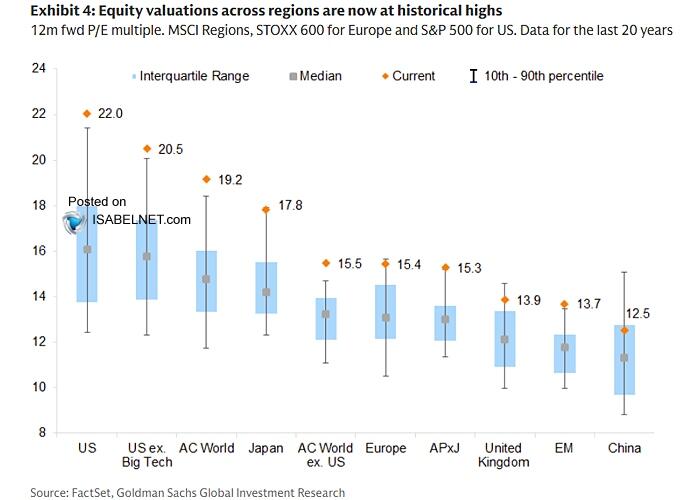
Investors often stack a second argument on top of the weak dollar story. International markets look cheaper than the U.S.; therefore, international stock exposure offers better value. The problem lies in relative valuation, when we should really look at each market’s valuation relative to its own history and earnings path. As shown, when you do that, those markets trade at historically high valuations.

MSCI data shows the MSCI EAFE Index (ex-US) forward P/E at 15.3 as of January 30, 2026. The level looks reasonable in isolation; however, the key issue is what investors receive for that multiple. Given that earnings growth rates, margins, and sector mix are vastly weaker than in the U.S., overvaluation will matter in those countries, just as it does in the U.S.

On the U.S. side, FactSet reported S&P 500 analysts project 2026 earnings growth of 14.1 percent and a forward 12-month P/E of 21.5, below 22.0 at the end of the fourth quarter. The U.S. multiple still sits above long-run averages, yet the direction matters, as the U.S. has cheapened at the margin while earnings expectations have remained resilient and profit margins have improved.

International markets also carry concentration risk. A significant portion of EAFE performance is tied to financials, industrials, and exporters, all of which are sensitive to global trade cycles and demand from China. Those forces can change quickly, but when the weak-dollar narrative drives the trade, investors often ignore the macro risk.

A currency-driven bid also inflates valuation abroad. A weak dollar lifts translated returns and encourages inflows, which in turn raise price multiples. However, when the dollar turns higher, international stock exposure faces a double drag as currency hedging reverses. When that translation turns negative, the valuation premium compresses as flows reverse.

While international stock exposure is fine, and there are certainly periods when it performs better than domestic markets, over the last 17 years it has trailed domestic markets by a large margin. Such is because, at the end of the day, it isn’t about dollar weakness; it is about earnings growth, profit margins, and future expectations. Currently, that growth remains in the U.S.

Investment Tactics Dollar Reversal

As shown, the move in Emerging Market Stocks (EEM) has been extremely sharp, making it much more exposed to a deep reversal if the dollar rallies.

Therefore, investors should treat international stock exposure as a tool, not a narrative. The goal, as always, is to maintain diversification but only to the point where you can control risk. Once it becomes a momentum chase, that risk control fails.

  • Start with position sizing. Set a strategic range for international stock exposure based on your risk tolerance and drawdown limits. Critically, keep that range stable and don’t allow the recent weakness in the dollar to dictate long-term weights.

  • Use rules-based rebalancing. When foreign equities run above target due to a weak dollar surge, trim toward policy weight. When foreign equities lag, add slowly. Rebalancing reduces the damage of an unexpected reversal.

  • Add currency awareness. Consider a split allocation between hedged and unhedged developed exposure. Hedged exposure reduces the impact of a dollar rally, while unhedged exposure keeps diversification benefits when the weak dollar resumes. MSCI publishes a 100% hedged EAFE benchmark that helps investors compare results across hedged and unhedged frameworks.

  • Focus on earnings quality as fundamentals will always matter in the end. Continue to favor markets and sectors with stable cash flows, strong balance sheets, and pricing power, as those traits matter when currencies swing and financial conditions tighten.

  • Avoid valuation shortcuts. Do not rely on “cheaper than the U.S.” Use local history and earnings trends. If international multiples rise while earnings lag, reduce exposure, even if the weak-dollar story remains popular.

  • Finally, stress test the portfolio. Model a 5 percent to 10 percent dollar rally and a 10 percent drawdown in foreign equities at the same time. If the model shows unacceptable damage, reduce unhedged international stock exposure before the market enforces the change.

The weak-dollar narrative is just a narrative, and a reversal will arrive again. That is just how markets operate. The question is whether your process will protect you or hurt you when that reversal comes.


Tyler Durden
Sun, 02/15/2026 – 10:30

Munich Security Conference A ‘Circus’ – Iran Says After Exiled Shah’s Son Invited

0
Munich Security Conference A ‘Circus’ – Iran Says After Exiled Shah’s Son Invited

The Munich Security Conference, once regarded as a heavyweight diplomatic forum, has devolved into a spectacle that favors “performance over substance,” Iranian Foreign Minister Abbas Araghchi complained after his country was snubbed.

Organizers barred senior Iranian officials from attending this year’s gathering after deadly protests and unrest shook the country last month, threatening the stability of the Islamic Republic. Tehran has lashed out:

“Sad to see the usually serious Munich Security Conference turned into the ‘Munich Circus’ when it comes to Iran,” FM Araghchi wrote Saturday in a series of posts on X.

Iran’s former crown prince and now self-styled key opposition figure Reza Pahlavi, via AFP.

“The EU appears confused, rooted in an inability to understand what is happening inside Iran… An aimless EU has lost all geopolitical weight in our region,” he added.

“Europe’s overall trajectory is dire, to say the least,” Araghchi said, branding the bloc “an empty-handed and peripheral” actor irrelevant to serious negotiations – particularly over Iran’s nuclear program.

Instead of inviting Iran – which has permanent representation at the United Nations – the Munich Security Conference invited Reza Pahlavi. He is the exiled son of Iran’s former US-backed shah ousted in the 1979 Islamic Revolution.

Pahlavi has supporters in the West, including among some Iranians in the diaspora, but the reality remains is that he is barely known among the Iranian populace. For the over 90 millions Iranians in the Islamic Republic, he’s not in reality a recognizable figure – but his last name is simply connected with history from a half century ago.

As expected Pahlavi used the platform to push for regime change and to appear at a rally. He went so far as to tell Reuters that Washington should bomb Iran rather than negotiate with it.

He claims that he can lead Iran into a “secular democracy” – though ironically his name is connected with the historic monarchy which is remembered by Iranians today for its harsh repression and overseeing a system of extreme poverty for the non-royal masses.

He’s long worked with Washington-backed opposition groups, and he has lobbied the White House to officially back him as a legitimate ruler of Tehran, but it remains unclear to the degree he might have the current Trump’s administration’s ear.

Tyler Durden
Sun, 02/15/2026 – 09:55

Fetterman Reveals His Parents Are Trump Supporters, Refuses To Call MAGA Voters ‘Nazis’

0
Fetterman Reveals His Parents Are Trump Supporters, Refuses To Call MAGA Voters ‘Nazis’

Authored by Steve Watson via modernity.news,

Pennsylvania Senator John Fetterman has once again set himself apart from the radical elements in his party by admitting that his own parents support President Trump—and using that as a reason to reject the Democrats’ over-the-top attacks on MAGA voters.

In a recent interview with Politico’s Dasha Burns, Fetterman again explained why he won’t join the chorus labeling Trump supporters as threats to democracy, emphasizing personal connections over partisan hysteria.

Burns asked Fetterman directly about Trump’s praise for him as the “most sensible Democrat,” questioning if it’s a “badge of honor or kryptonite for a Democrat in 2026.”

Fetterman responded, “My parents would appreciate it.”

He continued, “I know, and I love a lot of people that vote for Trump. And that’s part of why I refuse to call these people Nazis, or they’re brownshirts, or they’re trying to destroy our democracy.”

Fetterman made it clear he’s not engaging in that rhetoric, stating, “I’m not defending the president, but I will say he hasn’t defied a single court order yet. He hasn’t. And there was the big freak out that he was going to run in 28.”

“And I’m like, no, he’s not going to run. That’s not going to happen. And now, of course he’s not going to run,” the Senator added.

When Burns pressed on his relationship with Trump, Fetterman said, “If I have something to say it’s not going to be, you know, in an insult. It’s not going to be extreme things…when you have members of Congress calling him a piece of shit.”

“And I think it’s crazy, it’s like you just don’t, you know, I’ll always talk and speak, you know, with respect, because I really want to find a way forward.”

This admission underscores Fetterman’s ongoing pushback against his party’s extremes, a stance that has increasingly isolated him from Democratic insiders.

As we previously reported, Democrat extremists are already plotting to primary Fetterman ahead of his 2028 reelection bid, viewing his moderate positions as a betrayal. Despite his popularity in Pennsylvania, including strong support from Republicans, party officials are contemplating challenges because he won’t fully embrace their radical agenda.

Fetterman recently warned Democrats that socialism and far-left ideas are electoral poison, stating that such policies “pushed our party over the cliff” and led to recent losses. He called for “common sense” to prevail, highlighting the party’s shift toward figures like New York City’s socialist mayor Zohran Mamdani as a warning sign.

Fetterman has also urged his colleagues to dial back the constant outrage, telling them to stop turning everything into a “national freak out.” He criticized Democrats for overreacting to issues like the firing of Jimmy Kimmel and risking government shutdowns over partisan squabbles, emphasizing that “people need to just chill a little about a lot of things.”

These repeated calls for moderation have earned Fetterman bipartisan respect, even as they fuel internal Democratic discord. His refusal to demonize Trump voters, rooted in his own family’s views, exposes the growing divide between the party’s base and its leadership’s ideological purity tests.

Republicans stand to benefit from this chaos, as Fetterman’s crossover appeal could complicate Democratic efforts in swing states like Pennsylvania. If pushed too far, he might even consider running independently, further splintering the left.

Fetterman’s approach highlights a rare willingness to prioritize respect and practicality over division, a move that contrasts sharply with the Democrats’ ongoing embrace of extremism. As the party grapples with its identity, his voice serves as a reminder that alienating everyday Americans—including Trump supporters—only weakens their position.

Your support is crucial in helping us defeat mass censorship. Please consider donating via Locals or check out our unique merch. Follow us on X @ModernityNews.

Tyler Durden
Sun, 02/15/2026 – 09:20

Germany’s “Two-Speed Europe” Proposal Is The EU’s Adaptation To Great Power Geopolitics

0
Germany’s “Two-Speed Europe” Proposal Is The EU’s Adaptation To Great Power Geopolitics

Authored by Andrew Korybko via Substack,

German Finance Minister Lars Klingbeil recently declared that “Now is the time for a two-speed Europe. Germany, together with France and other partners, will therefore now take the lead in making Europe stronger and more independent. As the six biggest economies in Europe, we can now be the driving force.” Apart from those two, this exclusive tier will also include Italy, Spain, the Netherlands, and Poland. The goal is to optimize decision-making by going around the EU’s consensus requirement.

According to the Washington Post, Klingbeil also sent a letter to his counterparts from the aforesaid countries announcing his intent for them to prioritize “a savings and investment union to improve financing conditions for businesses; strengthening the euro’s role as an international currency; better cooperation on defense spending; and securing resilient supply chains for critical raw materials.” His “two-speed Europe” proposal essentially functions as the EU’s adaptation to Great Power geopolitics.

Trump returned this approach to the fore of International Relations after authorizing the capture Venezuelan President Nicolas Maduro and the seizure of a Russian-flagged tanker in the Atlantic. The resumption of Great Powers prioritizing their national interests without being concerned anymore about accusations of violating international law bodes ill for the EU’s interests. After all, the US now wants EU member Denmark’s territory of Greenland, and the EU can’t stop the US even if it really wanted to.

This newfound self-consciousness of EU powerlessness has been brewing for a while, especially since the bloc was coerced by Trump’s tariff threats into agreeing to a lopsided trade deal with the US last summer, apparently inspired its de facto German leader to finally take action to rectify it to a degree. To be sure, the EU will probably never be able to restore its “strategic autonomy” vis-à-vis the US, but it could still possibly function more cohesively for making itself more competitive on the world stage.

For that to happen, member states will have to surrender more of their sovereignty to Brussels, thus furthering Germany’s long-running goal of federalizing the EU under its de facto leadership. This goal is being pursued through multiple means, including the EU’s planned transformation into a military union and creating a bigger pool of common debt through more funding for Ukraine. The challenge is that the EU’s consensus requirement for such major decisions allows smaller states like Hungary to stop this.

Therein lies the importance of Germany assembling an exclusive tier of EU members for making such decisions amongst themselves and then coercing their smaller peers into following suit through the momentum unleashed by them creating tangible facts on the ground. The clock is ticking since Poland’s ruling liberal-globalist coalition might be replaced by a conservative-populist one after fall 2027’s next parliamentary elections, however, ergo why Germany wants to get as much done as soon as possible.

These plans could be foiled even before then if Poland’s conservative president vetoes legislation associated with it since the ruling liberal-globalist coalition lacks the two-thirds majority to overrule him. Any moves by this exclusive tier that don’t require legislative approval to advance the EU’s de facto federalization could also be challenged by Poland’s Constitutional Tribunal and Supreme Court, which are at the center of a highly partisan dispute, thus possibly delaying implementation till the next elections.

Poland’s role in this German-proposed process is pivotal. Participation and tangible progress could create facts on the ground that are difficult to reverse even if the government changes after fall 2027. Likewise, resistance through the means described above could impede the aforesaid progress and possibly avert the associated consequences. If a conservative-populist coalition comes to power in Poland, it might then assemble regional allies to collectively and thus more effectively oppose these plans.

In that scenario, the EU could bifurcate into German- and Polish-led tiers, the first representing its legacy members and the second its new ones. Just like the German-led tier plans to make decisions amongst themselves and then coerce their smaller peers into following suit, so too could the Polish-led one do the same vis-à-vis their larger peers. These dynamics could result in the EU’s de facto dissolution into two distinct blocs that only remain united through their inherited policies like freedom of movement.

It’s therefore ironic that Germany considers its “two-speed Europe” proposal to be an adaptation to Great Power geopolitics that’ll enable the EU to function more cohesively for making itself more competitive on the world stage when this proposal actually risks dealing a deathblow to the EU as it now exists. The odds are still in Germany’s favor, but they could decisively shift after fall 2027’s next parliamentary elections in Poland, which are shaping up to be consequential for the entire continent.

Tyler Durden
Sun, 02/15/2026 – 08:10

From “Don’t Be Evil” To Drone King: Eric Schmidt Warns Ukraine’s “No Man’s Land” Is Future Of War

0
From “Don’t Be Evil” To Drone King: Eric Schmidt Warns Ukraine’s “No Man’s Land” Is Future Of War

Google’s old motto, “Don’t be evil,” was retired for very good reasons about eight years ago.

Former CEO Eric Schmidt has found a new obsession and is linked to a covert drone production pipeline that has supplied hundreds of FPV drones to Ukrainian front-line units, reinforcing his warning in a new Financial Times op-ed that “Ukraine’s no man’s land is the future of war.”

“Future wars are going to be defined by unmanned weapons,” Schmidt wrote in the op-ed.

He said, “The winner of those drone battles will then be able to advance with unmanned ground and maritime vehicles, which move slowly but can carry heavier payloads.”

Schmidt described a stretch on the first line as “no man’s land.”

He explained:

Ukraine is ready for the next stage of warfare, with swarms of drones operated remotely and increasingly automated with AI targeting.

No man’s land has expanded as each side pulls its most valuable personnel back from the front while new generations of drones achieve longer ranges and increased lethality through better batteries, sensors and aerodynamics. Automating operations so personnel can operate safely behind the lines has become an urgent Ukrainian priority, with plans to move drone pilots even farther from the front in 2026.

The combination of unblockable satellite communications, cheap spectrum networks and accurate GPS targeting means the only way to fight will be through drone vs drone combat. Drones share data in real time, meaning that many inexpensive platforms can act as a single weapon. They will carry air-to-air missiles to defeat attackers, just like a fighter jet does, but will be cheaper and more abundant.

Within this kill zone, reportedly extending for miles – and in some assessments, approximately 15 miles or more wide – FPV drones and ground robots dominate, with AI kill chains that, in some cases, reduce or remove direct human-in-the-loop to kill.

Schmidt continued:

When the war in Ukraine is eventually settled, the result may be a tense peace that offers as many lessons for western nations as the conflict itself. In the future, a “drone wall” could be established along the division between Russia and Ukraine, where omnipresent automated drones monitor the border like an intelligent electric fence. Because these drones are valuable enemy targets, they will need to be armed to repel attackers, creating a hard border that is miles high and miles wide.

Numerous publications have documented the rise of Schmidt’s secretive military drone company, White Stork, including a 2025 Forbes report.

A separate report from Aviation Weekly said that Schmidt’s drone company “will expand production to deliver hundreds of thousands of drones to Ukraine this year and more in 2026.”

And while humans are still embedded in the kill chain, we must share the gamification of war story that Ukraine’s Unmanned Systems Forces have been using since last year, even keeping an online “killboard” that lets anyone track confirmed Russian losses from Ukrainian drone strikes in near real time.

Related:

And what’s happening in the US to prepare for the emerging FPV drone threat:

Our assessment of what appears to be driving Schmidt from his “Don’t be evil” days at Google to his current status as a war profiteer is that he has left his Silicon Valley bubble and realized the world is becoming extraordinarily dangerous as America’s unipolarity fractures into a bipolar system.

His time in Ukraine has given him an early look at 2030s warfare; it is therefore plausible he will try to apply his lessons from Ukraine and return to the US to sell a border “drone wall,” although Anduril Industries is already well-positioned in that mission set.

Tyler Durden
Sun, 02/15/2026 – 07:35