72.2 F
Chicago
Wednesday, September 30, 2026
Home Blog Page 829

Silver Coins: Memories Of Sound Money

0
Silver Coins: Memories Of Sound Money

Authored by Jeffrey Tucker via The Epoch Times,

The financial press reports that people are swarming the coin shops these days, grabbing as much as possible. This is exactly what one would expect given the wild and parabolic increases in the silver price over the last month, moving from $30 to $75 in the period of one year.

Such increases tend to focus the mind and incentivize regular people to join in the fun.

Silver tends toward these wild manias, suffering from neglect for years before taking off out of seemingly nowhere. That said, I did call it in these pages. “Now Is the time for silver,” I wrote in June of 2025.

The wild bull market seems to reflect new levels of demand from AI and solar panels. There is no better conductor of electricity or temperature. Nothing from the lab can come close. There is also the perception that supplies are dwindling. Put it together—supply and demand—and the magic just happens.

If you are among those who are stocking up on coins—not merely calling your broker about silver ETFs—you might take a few minutes to look more carefully at the dates of these coins.

The year was 1965, the great turning point. The last 90 percent silver circulating coins (dimes, quarters, half-dollars) were dated 1964, and everyday “silver coinage” ended with that date for most denominations.

How significant was this? It was huge.

Silver coins were about real money in the hands of real people, not bankers and not politicians. They were a guarantor of freedom, one even mentioned in the U.S. Constitution “No State shall… coin Money; emit Bills of Credit; make any Thing but gold and silver Coin a Tender in Payment of Debts,” says Article I, Section 10, Clause 1.

The Founders knew the meaning of sound money, and made it a mandatory matter that any state that is part of the great union had to adhere to the silver standard. Much later, all money and coinage power were transferred to the federal government, making the point mute. But then of course the federal government made an enormous error.

Why did this happen? Lyndon Johnson had taken over the Presidency after the assassination of John F. Kennedy. Kennedy had hoped to impose a nationwide silver standard as a means of restraining the central bank. After he was killed, the goal was sidelined. The money in our pockets was wrecked. From being made of the real deal, they all eventually became what is known as “baloney sandwich” coins—nothing but tokens.

The rest of the world followed. Why? There is really only one reason. Governments, banks, and corporate finance did not like the restraints imposed by precious metals. It was seen as too costly and restrictive whereas coining mere symbols seemed to be a savings. There was a welfare state to create and fund, plus a big war building in Southeast Asia. In such times, governments need resources that hard money simply does not allow.

Another critical point about these times: this was the turning point in public confidence in government. The assassination of Kennedy was a devastating blow, especially in the way that so few actually ever believed the official story about how and why it happened. Government never recovered its credibility. The destruction of the money was the telltale sign that something had gone seriously wrong.

Confidence in government peaked at 77 percent in 1964 and then began its long slide. It sits at 17 percent today.

Chart source: Pew Research

This is an astonishing and undeniable trend about which few will publicly speculate. The bigger government gets, the more it takes on, the less the public trusts it to do the right thing. This is because the people are not stupid. They follow the evidence of their senses. And keep in mind that the main trends happened long before independent media was hard at work to pull back the curtain on power, as it is today.

Daily we discover more depths of corruption, thanks mostly to independent reporters and scrupulous reporting from The Epoch Times. A video detailing the mind-blowing corruption in Minnesota has reached more than 100 million views, making the legacy media irrelevant by comparison. The COVID period was also another decisive turning point: scientists with power ruled your life in the name of health while taking away the means to obtain health.

The slide can only continue in the future, and it is likely that the only kind of politician who stands a chance of getting elected is one who promises to overthrow the system as it is. This is our lives now, just the way things work in a society of low trust.

The beauty in holding and jangling pre-1965 silver is nostalgia for a time when government was somewhat restrained, corporate finance was built by hard work and real capital, people were highly educated, and freedom itself was baked into our coinage. Plus, silver just feels great in one’s hand, adopting the temperature of the room and the holder as if a magic trick is happening right before you.

I long for the days of real money and probably you do too. And it raises the question: how can we get it back? I wish I had the answer but plenty of people are not waiting for government to make it happen. Much of the demand for silver these days stems from what’s called “safe haven” demand. You just know that even if or when fiat money fails, this silver will still be accepted in payment.

Who doesn’t feel safer and more secure with a few large bags of pre-1965 dimes and quarters on hand? This was the last period in which the United States minted real money as opposed to symbols made of paper and tin. That was more than half a century ago, and public nostalgia for this period of our national life has reached new highs.

Someone just asked me of the chances that government will in the future demand that we all turn in our silver, the same way they did in 1933 for gold. One supposes it is possible, and you can imagine the rationale: industry needs supply to make the AI revolution and the energy transition possible. Certainly they have the power to do so.

That said, how many will comply? In 1933, plenty of people did not assent with the demand to turn in gold and instead found other safe havens for it. The same would be true today for silver. Plus, I seriously doubt that any president or Congress would risk what remains of credibility by undertaking such an action. There would be real risk of revolution.

We aren’t likely going back to a silver standard but people are adopting it in their own lives, even choosing the old-world money over crypto currency certainly over fiat which is only falling in value. Remember that one version of the history of the world dollar comes from the Spanish coin “thaler.” That memory is alive and well in every coin shop in this country, and in the bags of silver you might be accumulating now, just in case.

Tyler Durden
Tue, 12/30/2025 – 14:20

FOMC Minutes Confirm ‘Most’ Fed Officials Expect More Rate-Cuts, Divisions Remain

0
FOMC Minutes Confirm ‘Most’ Fed Officials Expect More Rate-Cuts, Divisions Remain

Since the last FOMC meeting on Dec 10th (which resulted in a more-dovish-than-expected 25bps rate cut along with 3 dissents), precious metals have been the biggest gainers (as the dollar weakened) while crude oil has been a laggard. Stocks small bid, bonds unch…

Source: Bloomberg

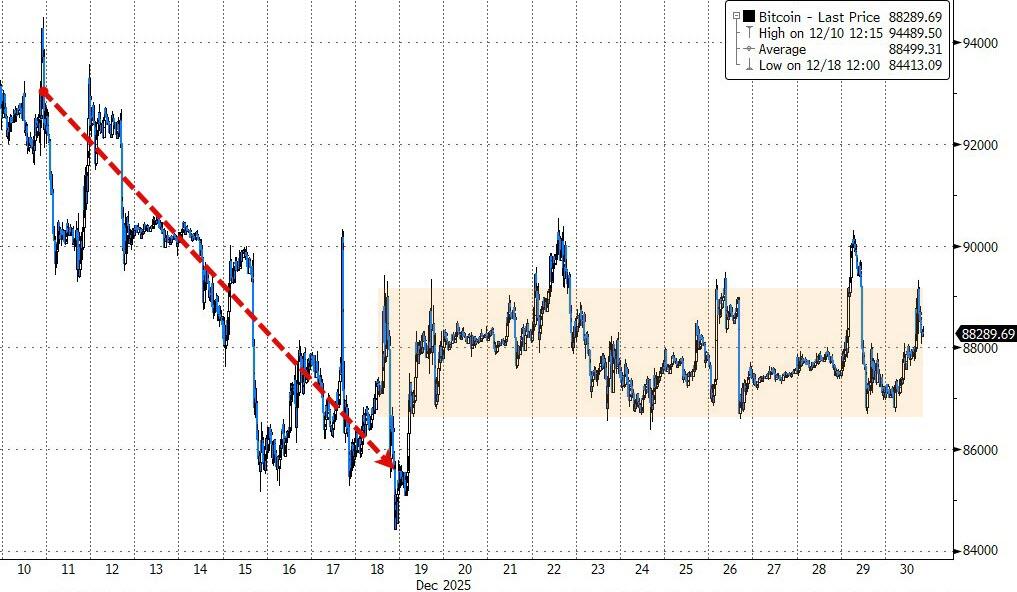
Crypto has notably decoupled from gold and stocks…

Source: Bloomberg

Rate-cut odds have risen significantly, most notably March…

Source: Bloomberg

With a very divided Fed having been exposed (the most dissents in 37 years), the outlook is unclear, but the demanding markets are not…

“I joke that the equity market is like a kid in a candy store, braving a sugar high for more policy accommodation, a more dovish Fed — but it doesn’t know what’s good for it,” said Amanda Agati, PNC Asset Management Group’s chief investment officer said on Bloomberg Television on Tuesday.

“The bond market is the adult in the room taking away the last lollipop. It is maybe the first time in observable market history that we’re seeing the market react to the deficit and debt level concern. I think there’s continued upward pressure on long yields, for sure.”

Given the lack of major catalysts and with news flow and trading volumes generally low, investors will focus on the Fed’s release of meeting minutes as the market remains notably more dovish than The Fed’s Dots…

“Markets are looking to the minutes for clearer signals on the Federal Reserve’s policy trajectory in 2026, at a time when year-end liquidity is thin, and price action may be amplified,” Tickmill Group’s Joseph Dahrieh says in a note.

If the minutes lean decisively towards further interest-rate cuts in 2026, this could weigh on the dollar and Treasury yields, he added.

A more balanced or cautious tone about rate cuts could provide near-term support.

“How divided?” and “What about ‘Not QE’?”

So what did The Fed want us to know?

The minutes underscored the deep split on the 19-member policymaking committee over what constitutes the biggest threat to the economy: weak hiring or stubbornly-elevated inflation.

Most officials see additional interest rate cuts as appropriate if inflation declines over time as expected.

Yet, some officials made clear they believe rates should remain on hold “for some time” after the December gathering.

The minutes showed that even some Fed officials who supported the rate cut did so with reservations.

“A few of those who supported lowering the policy rate at this meeting indicated that the decision was finely balanced or that they could have supported keeping the target range unchanged,” the minutes said.

But, that statement suggests the division was not as deep as some have suggested.

The minutes continued to point to considerable differences among policymakers over whether inflation or unemployment posed the greater peril to the US economy.

“Most participants noted that a move toward a more neutral policy stance would help forestall the possibility of a major deterioration in labor market conditions,” the minutes noted.

At the same time, it continued, “several participants pointed to the risk of higher inflation becoming entrenched and suggested that lowering the policy rate further in the context of elevated inflation readings could be misinterpreted as implying diminished policymaker commitment to the 2% inflation objective.”

Finally, the Minutes confirmed that participants judged that reserve balances had “declined to ample levels” – making it appropriate to initiate purchases of shorter-term Treasury securities to maintain an ample supply of reserves over time.

For now, the markets are unmoved by any of this with rate-cut odds unchanged and stocks aggressively going nowhere.

Read the full FOMC Minutes below:

Tyler Durden
Tue, 12/30/2025 – 14:05

Trump Admin Launches $50 Billion Rural Health Transformation Program

0
Trump Admin Launches $50 Billion Rural Health Transformation Program

Authored by Kimberley Hayek via The Epoch Times,

The Trump administration plans to distribute between $147 million and $281 million to each U.S. state in 2026 through a widespread rural health program designed to provide better access to medical care in rural areas.

The effort, which is one aspect of the One Big Beautiful Bill Act, earmarks $50 billion across five fiscal years, making available $10 billion annually from 2026 to 2030 to all 50 states. Centers for Medicare & Medicaid Services Administrator Mehmet Oz revealed the plan Monday, underscoring its goal to reverse the trend of long-term declines in rural health metrics while avoiding building out costly new infrastructure.

“This is a massive effort to change the unfortunate reality that has overtaken rural healthcare in America, which is that your ZIP code has started to predict your life expectancy,” Oz told reporters. He said the money will also go toward other pilot projects across the country.

Administration officials said that half the funds will be divided evenly between the states, with the other $25 billion apportioned according to rural healthcare infrastructure, state-led reforms, and application-based proposals. Funds could be reclaimed if states fail to meet benchmarks or neglect their committed reforms.

“The purpose of this $50 billion investment in rural healthcare is not to pay off bills,” Oz said.

“The purpose of this $50 billion investment is to allow us to right-size the system and to deal with the fundamental hindrances of improvement in rural healthcare.”

The announcement comes as rural hospitals have been at the center of Medicaid overhaul discussions.

“We have an unstable market that is causing lots of potential peril to Americans who need our help the most,” Oz told reporters in June.

This rural push aligns with Trump’s fiscal 2026 “skinny budget“ for the Department of Health and Human Services, cutting discretionary spending by 33 percent to $80.4 billion and axing 20,000 jobs.

Those reforms combine multiple agencies into a new Administration for a Healthy America, which integrates rural programs and redirects any savings from the streamlining to HHS Secretary Robert F. Kennedy Jr.’s priorities, including environmental health, mental health services, and chronic disease prevention.

The administration has also highlighted $14 billion in identified Medicaid fraud, waste, and abuse through the Department of Government Efficiency, as highlighted by Oz earlier this year.

“There’s about $14 billion we’ve identified with DOGE, of folks who are duly enrolled wrongly in multiple states for Medicaid,” Oz told Fox News’s “Sunday Morning Futures” in May.

Complementary measures include agreements with nine pharmaceutical firms to cut drug costs and expanded coverage models for select weight-loss medications in a bid to help rural patients.

Tyler Durden
Tue, 12/30/2025 – 13:45

“Massive Abuse”: HUD Audit Flags $5B In Improper Housing Assistance During Biden’s Term

0
“Massive Abuse”: HUD Audit Flags $5B In Improper Housing Assistance During Biden’s Term

A new report from the US Department of Housing and Urban Development has found that more than $5 billion in federal rental assistance during fiscal year 2024 went to potentially ineligible recipients, including nearly 30,000 deceased individuals and thousands of non-citizens, according to MSN and the NY Post.

The audit, conducted by HUD’s Office of the Chief Financial Officer, reviewed nearly $50 billion in housing aid and identified $5.8 billion — about 11% — as “questionable.” More than 200,000 tenants were flagged, including 29,715 listed as deceased, 9,472 non-citizens, and 165,393 households receiving payments above local eligibility limits, particularly in large metro areas such as New Orleans. Officials said suspicious payments appeared nationwide, with heavy concentrations in New York, California and Washington, DC.

“A massive abuse of taxpayer dollars not only occurred under President Biden’s watch, but was effectively incentivized by his administration’s failure to implement strong financial controls resulting in billions worth of potential improper payments,” HUD Secretary Scott Turner said. “HUD will continue investigating the shocking results and will take appropriate action to hold bad actors accountable.”

Marcia Fudge

The Post writes that the report faults federal directives that pushed funds out quickly “with minimal oversight,” while relying heavily on local housing authorities and contractors to verify eligibility. HUD said it is now reviewing funding for agencies involved and may suspend or revoke payments.

“HUD is implementing processes and procedures to revoke or pause funding as part of its efforts to hold bad actors accountable,” one official said. “Additionally, the Department could make criminal referrals and exercise other enforcement actions once it has confirmed fraud occurred.”

A HUD official also revealed that the department is implementing processes and procedures to revoke or pause funding as part of its accountability efforts. 

HUD disbursed just under $50 billion in federal rental assistance to non-federal entities (i.e., housing authorities, contract administrators, and landlords) during FY 2024, including more than $16 billion in Project-Based Rental Assistance (PBRA) and over $33 billion in Tenant-Based Rental Assistance (TBRA), serving more than four million households. This disbursement of funding design along with complex eligibility and program requirements, increased the risk of payment errors and highlights the necessity for more robust monitoring and verification tools for the rental assistance programs.

The directive from the Biden Administration to push funding out the door with minimal oversight and the design of HUD’s rental assistance programs placed substantial trust and responsibility in these non-federal entities, such as housing authorities, contract administrators, and landlords, to accurately assess tenant eligibility for two of the most complex rental assistance programs. 

The report also accuses the Biden administration of not providing HUD “with effective tools, technology, or access to the evidence necessary to verify whether these entities were properly enforcing the intricate rules governing rental assistance.” 

The findings follow earlier warnings. A 2022 HUD Inspector General audit said the agency “needed significant improvement” in its antifraud systems and lacked clear procedures for reporting suspected fraud.

In February 2024, prosecutors charged 70 current and former New York City Housing Authority employees in what US Attorney Damian Williams called “the largest single-day bribery takedown in the history of the Justice Department,” involving millions in kickbacks and corrupt contracts. NYCHA, which receives billions in HUD funding annually, said: “NYCHA partners with law enforcement to root out the corruption that directly led to the 2024 arrests… Each of the 70 cases brought by DOI has led to a conviction.”

Former HUD Secretary Marcia Fudge and former Deputy Secretary Adrianne Todman did not respond to requests for comment.

Tyler Durden
Tue, 12/30/2025 – 13:25

Ron Paul Praises Trump Taking A Step Toward Liberty

0
Ron Paul Praises Trump Taking A Step Toward Liberty

Authored by Ron Paul,

President Trump recently signed an executive order changing marijuana’s Controlled Substances Act classification from Schedule I to Schedule III.

Schedule I is supposed to include especially dangerous drugs that are likely to be abused and have no medical purpose.

Whatever one thinks of the wisdom and morality of using marijuana, the fact is it is less addictive, and quite possibly safer, than alcohol.

Many Americans who live in one of the 40 states that have legalized medicinal marijuana use it for a variety of ailments.

Reclassifying marijuana does not repeal federal laws criminalizing its use. The reclassifying does, though, facilitate research into marijuana’s medical benefits.

It also enables marijuana businesses that are legal under state laws to take ordinary deductions on their taxes. While President Trump’s executive order is a step forward, those who support advancing liberty must continue to press for repeal of all federal drug laws.

The Constitution does not give the federal government any authority to outlaw marijuana or any other “illicit” substance.

At least supporters of alcohol prohibition understood that a constitutional amendment was needed to impose a national ban on alcohol. The war on drugs has been a primary excuse for violations of liberties including unconstitutional searches and seizures, “no-knock raids,” bank reports to the federal government on those making large cash deposits, and draconian mandatory minimum sentences. The drug war has also been used to justify foreign interventions — such as President Trump’s current actions against Venezuela.

Defenders of the drug war say it is necessary because the drug trade is controlled by violent criminals — even though this is the inevitable result of outlawing a product people wish to consume. The most important reason to end the drug war is that government has no moral right to stop adults from engaging in a peaceful (even if unwise) behavior like smoking marijuana. Laws prohibiting drug use have no place in a free society. These laws are rooted in the idea that our rights are merely gifts from the government conditioned on our “good “behavior. A government that can stop people from smoking marijuana is a government that can also mandate what vaccines we receive and how our children are educated.

Of course, in a free society, an individual who uses drugs would be responsible for the consequences of his choices, and those who oppose drug use could exercise their right to try to persuade others to abstain from drug use.

When I campaigned to return to Congress in 1996, both Republicans (in the primary) and Democrats (in the general election) focused on attacking my position on drugs.

In response, I explained that the federal government has no authority to outlaw drugs and that the police state being built to stop drug use threatens all our liberty. The responsibility for combatting drug use belongs elsewhere, such as with churches and family members. I summed up my position as not pro-drug, but pro-liberty. In the end, I won that race. The people have been ahead of politicians in understanding the folly of the drug war.

All of us who value liberty must oppose the drug war. We should speak out for replacing various mandates and punishments of the drug war with increased respect for individual rights. We should also be steadfast that the end goal be a complete ending of the federal government’s drug prohibition.

Tyler Durden
Tue, 12/30/2025 – 11:45

Gas Prices Drop For 5th Consecutive Week; Lowest NYE Level Since COVID

0
Gas Prices Drop For 5th Consecutive Week; Lowest NYE Level Since COVID

Authored by Rob Sabo via The Epoch Times,

Gas prices continued their sharp downward trend throughout December, falling by nearly 23 cents over the month to a national average of $2.75 per gallon on Dec. 29—the lowest level recorded since 2021, according to a report by fuel price comparison app GasBuddy.

The national average price of diesel fuel, meanwhile, was $3.52 per gallon, a dip of more than $0.05 from a week earlier, GasBuddy reported.

Increased domestic production, along with a late-year ramp-up in production by members of OPEC+, a coalition of oil-exporting nations, has led to increased domestic and global supply, despite ongoing sanctions against oil-rich countries such as Russia and Venezuela.

According to Patrick De Haan, GasBuddy’s head of petroleum analysis, the national average price for gasoline has declined in all but a handful of U.S. states.

“Oil prices have remained relatively low even amid the U.S. blockade on Venezuela’s oil exports,” De Haan said in a statement.

“With refineries running at seasonally high output and gasoline inventories building, most states—outside of price-cycling markets—have continued to see declines, with some stations in nearly a dozen states now dipping below the $2-per-gallon mark.”

He said the trend could continue for a while before prices ultimately bottom out, likely in January or February.

U.S. crude oil producers’ output of nearly 17 million barrels per day (bpd) for mid-December was about 12 percent higher than the 15.2 million bpd produced in late October, the Energy Information Administration (EIA) reported. Meanwhile, eight members of OPEC+ announced in October they would increase oil production by an additional 137,000 barrels per day beginning in December.

Global petroleum inventories rose on average by 1.8 million bpd in the second and third quarters of 2025, EIA analysts said. China accounted for about 1.1 billion barrels per day of the inventory growth.

However, the relief at the pump may be short-lived. The price of U.S. crude jumped by 2.1 percent during Dec. 29 trading to settle at just under $58 per barrel. Brent crude, the international standard, was up by 1.88 percent and finished the day’s session at $61.78 per barrel.

The GasBuddy report compiled data from more than 12 million price reports from more than 150,000 gas stations throughout the United States. Average gasoline prices were lowest in Oklahoma at $2.17 per gallon, followed by Colorado and Texas at $2.33 per gallon each. All three states had the lowest average prices for diesel fuel as well, at $2.92, $2.99, and $3.02, respectively.

Average prices for a gallon of gas were highest in Hawaii at $4.36 and California at $4.20. Diesel fuel was highest in both states at $5.16 and $4.88 per gallon, respectively.

Regionally, gas prices were highest across the West Coast at $3.76 per gallon for the week ending Dec. 22, EIA reported. Prices were lowest in the Gulf Coast region at $2.44.

Tyler Durden
Tue, 12/30/2025 – 11:05

IRS CEO Says 94% Of Middle-Class Taxpayers Will See Tax Relief Next Year

0
IRS CEO Says 94% Of Middle-Class Taxpayers Will See Tax Relief Next Year

Authored by Jack Phillips via The Epoch Times (emphasis ours),

The CEO of the IRS said during an interview on Dec. 23 that 94 percent of middle-class Americans will see some form of tax relief next year.

The sign outside the Internal Revenue Service building in Washington. AP Photo/Patrick Semansky, File

“You’re going to look at probably 94 percent-plus of middle-class Americans getting a boost, your tax rates coming down, and getting the benefit going forward,” said IRS CEO Frank Bisignano, who is also the commissioner of the Social Security Administration, during an interview with Fox Business.

He said that Social Security recipients will see “up to a $6,000 benefit as [the Trump administration is] committed to the benefits of Social Security not being taxed.”

Bisignano’s comments come after Treasury Secretary Scott Bessent and White House economic adviser Kevin Hassett have both projected significant refunds in the 2026 tax year because of legislation that was signed into law over the summer by President Donald Trump.

Bisignano was named as the first CEO of the federal tax revenue agency, which is a position that the Trump administration created in October.

Trump also said in a year-end speech that many American families could save between $11,000 and $20,000 per year under the tax and spending package.

Hassett has been floated as a possible successor to current Federal Reserve Chairman Jerome Powell.

The Trump administration has been teasing proposals to address cost-of-living concerns, including tax refunds and dividend checks derived from tariffs. Since the elections last month, in which Democrats secured victories in several states and municipalities, Republicans have intensified their focus on the economy. During a recent speech, Trump unveiled a $1,776 bonus to U.S. troops.

Democrats, including Senate Minority Leader Chuck Schumer (D-N.Y.), have been critical of the Trump administration’s economic policies, saying that the White House is out of touch.

In a Dec. 18 post on X, for example, the Democratic leader said that Trump “lives in a bubble completely disconnected from the reality everyday Americans are seeing and feeling” and that Americans “are feeling squeezed harder and harder every day.”

Meanwhile, the administration received a boost on Dec. 17 as the Labor Department released its consumer price index report for November, showing an overall drop in inflation. And the U.S. gross domestic product grew at a rapid rate of 4.3 percent in the third quarter of 2025, according to a report issued on Dec. 23 by the federal Bureau of Economic Analysis.

Next year’s tax-filing season starts Jan. 28, 2026, and ends on April 15, 2026.

Tyler Durden
Tue, 12/30/2025 – 10:30

Tchaikovsky’s Swan Lake Just Played On Russia’s Doomsday Shortwave Radio Station

0
Tchaikovsky’s Swan Lake Just Played On Russia’s Doomsday Shortwave Radio Station

X users are reporting that a mysterious Russian shortwave radio signal, nicknamed “The Buzzer” and informally known as the “doomsday radio station,” that has been continuously broadcasting since the late 1970s, has just transmitted the classical piece Swan Lake by Pyotr Ilyich Tchaikovsky.

UVB-76 is transmitted on 4625 kHz and is occasionally interrupted by Russian voice messages, often containing names, numbers, or coded phrases. These voice messages are rare, irregular, and often nonsensical, making the transmission of Swan Lake highly abnormal.

Western military analysts associate UVB-76 with Russia’s military communications and strategic command infrastructure. It reportedly remains operational as a fail-safe in the event that satellites, fiber, or cellular networks are disrupted.

The broadcasting of Swan Lake, a four-act ballet composed by Pyotr Ilyich Tchaikovsky and premiered in 1877 in Moscow, on UVB-76 could be interpreted as a mistake or operator error, a test transmission, accidental audio bleed from equipment at the transmitter site, or even signal hijacking.

Earlier, Russia showcased the deployment of its nuclear-capable hypersonic Oreshnik missile system in its close ally, Belarus.

Fun fact, Swan Lake was repeatedly broadcast across Soviet state television during the August Coup in August 1991.

European outlet NEXTA asked, “So how should we interpret the latest transmission? A soundtrack for the flight of the Oreshnik?”

Tyler Durden
Tue, 12/30/2025 – 10:10

Jennings: “Until Somebody In Power Goes To Jail”, Blue State Fraud Won’t Stop

0
Jennings: “Until Somebody In Power Goes To Jail”, Blue State Fraud Won’t Stop

Authored by Steve Watson via Modernity.news,

In a heated CNN clash, conservative commentator Scott Jennings called out the lack of real accountability in Democrat-run states, demanding elected officials face consequences for enabling billion-dollar scams.

Jennings addressed the rot in blue states where massive fraud schemes have flourished under lax oversight. Facing pushback from host Abby Phillip, Jennings insisted that prosecuting small-time operators isn’t enough—real change demands jailing those at the top who allowed it all to happen.

The discussion centered on the sprawling welfare fraud in Minnesota, but Jennings expanded it to a nationwide indictment of blue state governance. When Phillip defended ongoing probes, saying, “This idea that nothing is being done, that no one is being held accountable, that this was just left to run rampant, is completely false,” Jennings countered sharply.

“Well, some people have been held accountable. But I think in the opinion of most Republicans, not nearly enough,” he replied.

He then delivered the core demand: “And truthfully, until somebody in a position of power, until somebody in a position in Minnesota, elected position, who was in charge of administering this or having some oversight over it, goes to jail, it’s honestly never going to stop.”

Jennings broadened the scope: “Look what’s going on in blue states across the country: 9 billion in Minnesota, 70 billion in fraud in California, cooking the crime stats in Washington, D.C.”

Driving the point home, he asked, “When is someone in a position of power going to go to jail for the rampant fraud?” and added, “You can put all the low-level people in jail you want, but until somebody in charge goes to jail, it won’t stop!”

The scandal Jennings spotlighted involves Somali-led operations in Minneapolis, where billions in federal welfare funds—intended for children and the vulnerable—were siphoned through fake daycares and shell companies.

Estimates peg the theft at $9 billion in Minnesota alone, part of a larger pattern tied to unvetted immigration and weak enforcement. The Trump administration’s DOJ is now intensifying efforts, with door-to-door probes by Homeland Security targeting suspected sites.

This surge follows viral exposures, including a video by Youtuber Nick Shirley touring dozens of Somali-run daycares implicated in the schemes.

Attorney General Pam Bondi has charged 98 individuals in Minnesota fraud cases, with over 60 convictions. More probes are underway, signaling an end to the free pass for blue state elites.

This isn’t isolated—it’s the byproduct of years of open borders flooding communities with unassimilated groups, creating ripe ground for abuse. As Jennings laid bare, without holding powerful Democrats accountable, the cycle of theft from American taxpayers continues.

Your support is crucial in helping us defeat mass censorship. Please consider donating via Locals or check out our unique merch. Follow us on X @ModernityNews.

Tyler Durden
Tue, 12/30/2025 – 09:50

CIA Drone Carried Out First Known Land Strike On Venezuela 

0
CIA Drone Carried Out First Known Land Strike On Venezuela 

The CIA is reported to have carried out a bombing operation within Venezuelan territory, CNN and The New York Times report in follow-up to President Trump touting that the US had knocked out “a big facility”.

CNN while citing unnamed sources, reports that the CIA conducted a drone strike on a remote dock along Venezuela’s coastline, after the US suspected the site was being used to store and transport illegal drugs, and which were supposedly bound for America.

Illustrative: MQ-9 Reaper Drone

Reports indicate the location was unoccupied at the time of the strike, which occurred earlier this month. The New York Times published a similar account based on anonymous sources, specifying that the operation took place last Wednesday.

As we detailed, President Trump had on Friday in a radio interview disclosed something which missed the attention of the US and global media. He let slip that a large land site had been knocked out by a strike from US forces in the Caribbean.

Trump may have actually assumed the attack which he disclosed publicly for the first time was already being reported on, but it had not. He was being interviewed by John Catsimatidis, the Republican billionaire who owns the WABC radio station in New York on his The Cats & Cosby Show, and the two were talking about the Venezuela campaign. 

“They have a big plant or a big facility where the ships come from,” Trump said, though he did not explicitly identify the exact location or even country attacked. “Two nights ago we knocked that out.”

Interestingly, the remarks generated almost no headlines for much of that weekend. But by Monday he expanded on those remarks during a press conference, saying the target was located on Venezuela’s coast and that a “major explosion” occurred at a dock where boats were supposedly loaded with drugs.

“There was a major explosion in the dock area where they load the boats up with drugs,” he told reporters at Mar-a-Lago, his club and residence in Florida.

“They load the boats up with drugs. So we hit all the boats, and now we hit the area. It’s the implementation area, that’s where they implement, and that is no longer around.”

But even after this, neither CIA, nor White House, nor Pentagon would comment. Even more strange was that Venezuelan officials themselves have also remained silent, issuing no public statements regarding the alleged attack. It is perhaps the case they don’t want the population to panic, or else don’t want to give acknowledgement of a successful land strike by Washington.

Speculation has persisted an effort to identify which facility was hit and what damage was done. Some analysts have highlighted a ‘mystery’ explosion at an industrial zone in San Francisco municipality, Zulia state, given the timing fits (Wednesday, Dec. 24).

San Francisco Venezuela’s second largest city, in the northwest corner of the country, and near the coast. However, local reports also suggest the likelihood the fire was sparked by an electrical accident.

But it is also clear the CIA is active in Venezuela, given White House authorized lethal CIA missions targeting the Latin American country in October – though these may have been occurring long before then.

The American president has also ordered a naval blockade targeting Venezuelan oil exports, with US forces already having seized two tankers transporting Venezuelan crude in international waters, while a third ship reportedly avoided boarding and continued into the Atlantic.

The Pentagon is seeking to enforce what has been described as a “quarantine” of Venezuelan oil over the coming months to further strain the country’s economy. Amid all of this, there’s a likelihood of yet more land strikes to come.

Tyler Durden
Tue, 12/30/2025 – 09:35