63.5 F
Chicago
Thursday, October 1, 2026
Home Blog Page 864

How Social Security Has Evolved

0
How Social Security Has Evolved

Authored by Tom Margenau via The Epoch Times (emphasis ours),

I continually remind my readers that they shouldn’t worry too much when they read or hear reports of Social Security’s imminent collapse. Once Congress works up the nerve to deal with the issue (and once the American people accept the fact that the program needs reform), they will get around to passing amendments to the Social Security laws that will keep the program solvent for generations to come. (If you want to learn more about possible reforms to Social Security, spend 15 bucks and get my little guidebook called “Social Security: Simple and Smart.”)

Almost every year since the Social Security Act was passed in 1935, there have been amendments to that original law. Everett Collection/Shutterstock

And here is something else you should know. Change is nothing new to Social Security. Almost every year since the Social Security Act was passed in 1935, there have been amendments to that original law. For many years, they have been simply minor technical adjustments. But some years, they include major changes to the program. Here is a brief summary of how the Social Security program has evolved over the years.

The Social Security Act of 1935

The original law provided benefits only for a retired worker age 65 or older.

The 1939 Social Security Amendments

Even before the first monthly benefits were paid in 1940, these amendments added many provisions to the original law. They included benefits for a dependent wife 65 and older and for the minor children of a retiree. They also added the first survivor’s benefits: for a widow age 65 or older; for the minor children of a deceased worker; for a widowed mother of any age caring for those children; and for dependent parents of a deceased worker.

The 1950 Social Security Amendments

Congress must have realized the 1939 amendments were sexist because this year they added benefits for a dependent husband of a retired woman and for a dependent widower age 65 or older. They also provided benefits for a retiree’s dependent wife of any age as long as she was caring for his minor child. And for the first time, Congress recognized that not all marriages last forever. They included benefits for a divorced or widowed mother caring for the minor child of a deceased worker, but only if she was married at least 20 years.

The 1956 Social Security Amendments

These amendments added a major new Social Security program: disability benefits. This first law offered monthly benefits only for disabled people over age 50. But in a few years, disability benefits were made available to people of all ages. Provisions were also added to pay monthly benefits to disabled adult children of retired, disabled and deceased workers. And for the first time, Congress recognized that not all senior citizens wanted to wait until age 65 to claim benefits. Initially, they offered earlier benefits only to women. They provided reduced retirement benefits for women between the ages of 62 and 64 and reduced spousal benefits for dependent wives and widows between the ages of 62 and 64.

The 1961 Social Security Amendments

Finally, Congress authorized reduced retirement benefits for men. These changes also provided for reduced benefits for dependent widowers between ages 62 and 64.

The 1965 Social Security Amendments

For the first time, benefits were offered to divorced wives if they were at least 62 years old and if they had been married for at least 20 years. (The 1950 amendments had provided benefits only for divorced widows.) The 1965 amendments also added the Medicare program. But Medicare is NOT a Social Security program and an entirely separate funding mechanism was established for these health care benefits, so I am not including Medicare changes in the rest of this column.)

The 1972 Social Security Amendments

The concept of a “delayed retirement bonus” was added for the first time to offer an incentive to workers who wait to file for retirement benefits until beyond age 65. Over the years, this bonus has been liberalized.

The 1977 Social Security Amendments

Congress must have heard women complaining that having to be married to some philandering jerk for 20 years to get some of his Social Security was too long. So this year, they lowered the length of marriage requirement for divorced spouses to 10 years.

1983 Social Security Amendments

When these changes were implemented, the Social Security system was much closer to insolvency than it is today. These amendments bumped up the retirement age from 65 to 67. A minor tax increase was implemented. And Social Security benefit, payments to children over age 18 were eliminated. Also, for the first time, Social Security benefits became taxable.

1996 Social Security Amendments

The earnings penalty provisions were eliminated for anyone over full retirement age and were liberalized for people between the ages of 62 and the FRA. Provisions in these amendments also led to the “file and suspend” and “restricted application” loopholes in the law that allowed some retirees to get unintended benefits out of the program. Those loopholes were finally closed several years ago.

Tyler Durden
Thu, 12/18/2025 – 07:20

Futures Rise After 4-Days Of Declines Ahead Of CPI, Central Bank Bonanza

0
Futures Rise After 4-Days Of Declines Ahead Of CPI, Central Bank Bonanza

Stocks rebounded from Wednesday’s tech-led rout after an upbeat forecast from Micron helped put the brakes on a tech-driven selloff on a busy day for data and central bank meetings. As of 7:15am ET, S&P and Nasdaq  futures rose 0.6% following four down days. In premarket trading, Micron shares soared 11% after reporting blowout earnings. Europe’s Stoxx 600 index rose 0.2%, while Asian shares slid. The tech slide, combined with dovish comments from a Federal Reserve official, helped boost Treasuries. The yield on the 10-year was down two basis points at 4.13% even as the BBG dollar index recovered from an earlier loss to trade 0.05% higher. Oil rose modestly to trade +0.4% at $56.18/barrel. Among key events for financial markets Thursday are the release of US inflation data for November, along with monetary policy decisions from the European Central Bank and Bank of England.

In premarket trading Mag 7 stocks are mostly higher (Tesla +1.4%, Nvidia  +1.4%, Alphabet +1.1%, Amazon +0.8%, Meta +0.7%, Microsoft +0.7%, Apple -0.2%).

  • Insmed (INSM) falls 20% after the biotech said its Phase 2b BiRCh study of brensocatib in patients with chronic rhinosinusitis without nasal polyps failed to meet primary or secondary efficacy goals, prompting immediate discontinuation of the CRSsNP program.
  • Instacart (CART) is down 6.6% after Reuters reported that the Federal Trade Commission has sent the grocery delivery company a civil investigative demand.
  • Lululemon (LULU) rises +6.2% after Elliott is said to build a $BN+ stake.
  • Micron (MU) jumps 11% after guiding current quarter earnings to be some 80% higher than consensus estimates, as the firm benefits from the relentless demand for memory chips used in data centers, and the sharp price increase that goes with it. Among memory peers, Sandisk (SNDK) 6.1%, Western Digital (WDC) +3.6% and Seagate (STX) +3.4%.
  • PayPal (PYPL) drops 1.7% as Morgan Stanley downgrades the digital payments company to underweight and sets its price target to a new Street-low, citing slow progress on key strategic imperatives.
  • Sable Offshore Corp. (SOC) jumps 41% after the company said the US Department of Transportation’s Pipeline and Hazardous Materials Safety Administration determined the pipeline connecting the Santa Ynez Unit to Pentland Station terminal in California constitutes an interstate pipeline.

Today’s Micron-driven bounce follows Nasdaq’s nearly 2% slide on Wednesday when investors again questioned whether companies at the vanguard of the AI boom can keep justifying their nosebleed valuations amid record spending.

“Investors still see limited disclosure of AI-driven revenues, profits or cash flows,” said Frank Thormann, a fund manager at Schroders Investment Management. “The result is a growing concern that AI may not be delivering returns commensurate with the enthusiasm.”

A mini-Santa rally to end the year likely hinges on whether inflation data confirms Powell’s expectation that core goods prices are nearly at a peak. Longer-term, inflation coming down while jobs remain subdued “should weaken FOMC hawks’ resistance to rate cuts,” according to Bloomberg Economics.

Still, investors remain nervous about AI. About 57% of participants in a Deutsche Bank survey said a potential plunge in AI valuations is the biggest risk to market stability in 2026. And there’s a long list of other things that could go wrong, suggesting drawdowns and volatility spikes are likely, especially given an investor base that is so determined to chase the market higher.

Traders are now waiting for Thursday’s US inflation reading for pointers on the path for interest rates, though the data run the risk of being less reliable than usual due to government-shutdown disruptions. The November CPI report will offer only a partial snapshot of inflation, without monthly changes for most of the price categories. Much of the October price information was unable to be collected and November data gathering was also delayed by the government closure.

Data aside, Trump said he plans to announce the new Fed chair soon, and that it will be “someone who believes in lower interest rates.” He also used his address to the nation to talk about housing reforms, which he said are coming in the new year.

European stocks edged upwards as investors awaited rate decisions from the European Central Bank and Bank of England. Retailers outperform, led by H&M, which is on track to close at more than a year-high, while automakers lag. Stoxx 600 rose 0.2% to 580.70 with 214 members down, 366 up, and 20 little changed. Here are some of the biggest movers on Thursday:

  • Rational shares gain as much as 4.9%, hitting a five-week high, after UBS analysts said the maker of food appliances and kitchen accessories is “back on the menu,” predicting a return to high single-digit organic growth in FY26 can support a re-rating in the shares.
  • Whitbread shares rise as much as 5.2% after stakeholder Corvex Management called for a strategic review of the company’s direction and capital allocation.
  • Rentokil Initial shares rise as much as 3.9% as BofA Global Research raises its recommendation to buy from neutral and names it one of the bank’s “25 stocks for 2026” on its US growth.
  • H&M shares rise as much as 2.6% to trade at their highest level since September 2024, after being upgraded by Oddo BHF, with analysts raising estimates and attaching a higher multiple on the fashion retailer.
  • Currys shares climb as much as 15%, the most since September, after the electronics retailer reported earnings ahead of analysts’ expectations, driven by stronger performance in the Nordics as the UK business grapples with increases in staffing costs.
  • Aeroports de Paris shares fall as much as 8.6% as the French Transport Regulatory Authority rejects the firm’s proposed airport charges, leading Oddo BHF to downgrade to underperform.
  • Hemnet shares slide as much as 8.7%, pulling back from a five-week high, after analysts at Nordea cut their price target on the Swedish property advertising platform to a Street-low.
  • Evolution shares drop as much as 3.1% following a double-downgrade to underweight from overweight at Barclays, which sees continued pressure on the Swedish gambling operator’s earnings.

Earlier in the session, Asian stocks dropped with momentum kamikaze-central, South Korea, leading a broad selloff on concerns over the artificial intelligence sector. Hang Seng nurses a modest loss after tech stocks fall, and ChiNext drops more than 1%.  The MSCI Asia Pacific Index fell 0.4%, tracking a US tech selloff and declining for a third time in four days. LG Chem and LG Energy were among the biggest drags. South Korea’s Kospi slumped 1.5%, while benchmarks in Tokyo and Taiwan were also in the red.

In FX, the dollar is mixed against FX majors. Kiwi dollar slips despite a small GDP beat. The yen hovers around 155.80/USD and offshore yuan is marginally stronger.

In rates, treasury 10-year yields drop 2bps to 4.13%. Australian 3-year yields drop 3 bps after the AOFM cuts bond issuance plans for fiscal year 2026. JGB futures grind modestly higher ahead of Friday’s widely expected BOJ rate hike

In commodities, WTI crude futures inch lower, trading around $55 a barrel. Spot gold falls roughly $12 to ~$4,327/oz, while Bitcoin is up 1.3% .

Looking to the day ahead now, and the highlights will be the ECB and Bank of England policy decisions. Over in the US, we’ll also get the CPI report for November, and the weekly initial jobless claims. Speakers include ECB’s Lagarde & BoE’s Bailey, Supply from US, Earnings from Carnival, Nike & FedEx.

Market Snapshot

  • S&P 500 mini +0.6%
  • Nasdaq 100 mini +0.6%
  • Russell 2000 mini +0.3%
  • Stoxx Europe 600 +0.3%
  • DAX +0.1%
  • CAC 40 +0.3%
  • 10-year Treasury yield -2 basis points at 4.13%
  • VIX -0.2 points at 17.38
  • Bloomberg Dollar Index little changed at 1208.22,
  • euro -0.2% at $1.1723
  • WTI crude +0.4% at $56.18/barrel

Top Overnight News

  • Trump Defends Handling of Economy, Announces Military Dividend: WSJ
  • How China reverse engineered chipbuilding giant ASML and built its ‘Manhattan Project’ to rival the West in AI chips: RTRS
  • White House official said Trump is expected to address marijuana rescheduling on Thursday.
  • Trump said he will soon announce the next Fed chair and that the new Fed chair will believe in lowering interest rates by a lot, while Trump also stated that he will announce aggressive housing reforms in the new year and said more than a million service members will get a special dividend of USD 1,776 before Christmas.
  • Trump Told by Alan Dershowitz Constitutionality of Third Term Is Unclear: WSJ
  • The House voted 216-211 to pass the Republican health care bill without an extension of the ACA subsidy, which now goes to the Senate. It was separately reported that the Senate voted 77-22 to pass the USD 901bln bill setting defence policy and spending for the 2026 fiscal year, which goes to President Trump for signing
  • US approves $11.1 billion arms package for Taiwan, largest ever: RTRS
  • FBI Deputy Director Dan Bongino Says He Will Leave in January
  • Elliott Said to Build a $1 Billion-Plus Stake in Lululemon: BBG
  • Warner Demands Larry Ellison’s Personal Guarantee in Paramount Bid: WSJ
  • ECB to Hold With Economy on Sturdier Footing: BBG
  • Sweden Holds Rate at 1.75% as Growth Builds, Inflation Cools: BBG
  • BP Appoints First Outsider as CEO After Ousting Auchincloss: BBG
  • All That Cheap Chinese Stuff Is Now Europe’s Problem: WSJ
  • Fed’s Bostic (2027 voter, retiring) said GDP growth is solid and expects that trend to continue into next year, while he added it is less clear what will happen on the employment side.
  • America’s Largest Landowner Bets It Can Replace Met Coal With Pine Trees: WSJ
  • Frustration Grows as Hunt for Brown Shooter Drags On: WSJ

Trade/Tariffs

  • French President Macron said numbers on Mercosur trade deal does not add up right now and talks are not yet over.
  • Chinese Commerce Ministry, on talks with the EU on EV tariffs, said they are still being negotiated.
  • Chinese Commerce Ministry, on EU rare earth export licenses, said some Chinese licence applications have been approved.
  • Chinese Commerce Ministry, on EU’s FRS (Foreign Subsidies Regulation) Investigation, said it has severely impacted Chinese firms business and investment operations in the EU.
  • China’s Commerce Ministry, on steel licences, said it involves some 300 products; designed to strengthen monitoring and tracking of exports.
  • US President Trump said they used to have the worst trade deals anywhere in the world and were laughed at, but they’re not laughing anymore. said:. Much of the success has been due to tariffs. One year ago, the country was dead and ready to fail, and now its the hottest anywhere in the world.
  • Japan government said consultation committee for the USD 550bln US-bound investment package held its meeting on Thursday.

A more detailed look at global markets courtesy of Newsquawk

European bourses are broadly in the green, in contrast to a mostly subdued APAC session as markets await policy decisions from the BoE an the ECB.
European sectors are trading mixed. Retail (+1.0%), Financial Services (+0.4%) and Real Estate (+0.4%) lead. Retail has been underpinned by gains in Curry’s (+8.6%) after Co. posted strong half year growth. At the other end of the spectrum, Autos (-0.6%), Banks (-0.5%) and Travel & Leisure (-0.3%) lag.

Top European News

  • Inditex PT to Street-High at Jefferies
  • M&A Watch Europe: BNP Paribas, Rheinmetall, BP, Nexi, Aena

APAC stocks were mostly lower following on from the tech-led selling stateside and ahead of US inflation data and a slew of upcoming central bank decisions.
ASX 200 was flat with the index constrained by weakness in energy, gold miners and industrials. Nikkei 225 briefly dipped beneath the 49,000 level amid tech woes and anticipation of a BoJ rate hike when the central bank concludes its 2-day policy meeting tomorrow. Hang Seng and Shanghai Comp were mixed as tech-related headwinds dampened risk sentiment in Hong Kong, although the mainland kept afloat after the PBoC’s open market operations, in which it opted to utilise both 7- and 14-day reverse repos.

Top Asian News

  • Japan’s Chief Cabinet Secretary Kihara said watching market moves, including long-term rates closely.
  • South Korea’s Finance Minister said concerned of FX volatility widening, adds closely monitoring impacts from diverging monetary policies abroad on local markets.
  • South Korea Vice Finance Minister sees herd behaviour in markets, adds KRW declines seem more excessive compared to the economy’s fundamentals.

Central Banks

  • Norges Bank maintains its Key Policy Rate at 4.00% as expected; if the economy evolves broadly as currently projected, the policy rate will be reduced further in the course of the coming year. If the policy rate is lowered too quickly, inflation could remain above target for too long. With a gradual decline in wage growth ahead, inflation is projected to move down and be close to 2 percent in 2028. Sees 2026 Key Policy Rate at 3.9% (prev. forecast 3.9%). Sees 2027 Key Policy Rate at 3.4% (prev. forecast 3.5%).
  • Norges Bank’s Bache said NOK is weaker than previously assumed, raising inflation prospects slightly.
  • Riksbank maintains its rate at 1.75% as expected; reiterates rate is expected to remain at this level for some time to come. Although inflation has varied somewhat from month to month, it has overall developed in line with the Riksbank’s forecast in September and approached 2 per cent. Indicators continue to support the view of inflationary pressures in line with the target going forward.
  • Riksbank’s Thedeen said policy rate will stay at this level at some time going forward, with this view covering the horizon for the Bank’s rate path.
  • China Securities Times reported PBoC rate cut room shrinks amid shift of focus to policy mix, and noted aggressive RRR cuts are less needed.

FX

  • DXY traded little changed with price action contained ahead of US CPI data due later today and following comments from a couple of Fed speakers, including Waller who stated that the Fed is 50bps-100bps over neutral and there is no rush to cut rates given the outlook, but added that they can continue to bring the rate down. Furthermore, the attention overnight turned to US President Trump’s primetime address, where he announced more than a million service members will get a special dividend of USD 1,776 before Christmas and flagged aggressive housing reforms in the new year, but which had little impact on the currency.
  • EUR/USD traded sideways beneath the 1.1750 level with a lack of catalysts as participants awaited the ECB meeting.
  • GBP/USD struggled for direction after weakening yesterday on the softer-than-expected UK CPI data, which solidified the bets for a 25bps BoE rate cut later today.
  • USD/JPY remained afloat after reversing the declines seen earlier in the week, despite the expectations of a looming BoJ rate hike as the central bank begins its 2-day conclave.
  • Antipodeans marginally softened amid the lacklustre risk appetite and quiet overnight data calendar, while there was very little support seen following mixed New Zealand GDP data.
  • PBoC set USD/CNY mid-point at 7.0583 vs exp. 7.0403 (Prev. 7.0573)

Fixed Income

  • 10yr UST futures kept afloat but with the upside limited following yesterday’s choppy performance amid commentary from Fed’s Waller and an average 20-year bond auction, while participants await the incoming US inflation data.
  • Bund futures rebounded off the prior day’s trough in rangebound trade with few catalysts ahead of the ECB meeting.
  • 10yr JGB futures edged higher amid the downbeat mood in risk assets, although gains were capped as the BoJ kick-started its 2-day policy meeting.

Commodities

  • Crude futures were initially boosted amid the US blockade against Venezuela and recent reports of potential new US energy sanctions on Russia, although futures later pared much of the gains alongside US President Trump’s primetime address to the nation, given that there was no mention of the blockade or Russian sanctions.
  • Qatar lowered the February term price for Al Shaheen oil to USD 0.53/bbl above Dubai.
  • Dubai set official crude differential to GME Oman for March at USD 0.10/bbl discount.
  • Venezuela is running out of oil storage space amid tanker curbs, with its main oil storage and tankers sitting at terminals quickly filling up and may be at maximum capacity in about 10 days, which could force state-owned Petróleos de Venezuela SA, whose production is close to 1mln bpd a day, to shut-in wells, according to Bloomberg.
  • Israeli PM Netanyahu said he has approved the country’s largest ever gas deal with Egypt valued at USD 35bln.
  • Spot gold was lacklustre amid a steady dollar and with early weakness in other metal prices, including silver, which pulled back from record levels, before paring its losses.
  • Copper futures saw early pressure amid the subdued risk appetite but has since bounced off intraday lows.

Geopolitics

  • Ukrainian President Zelensky said Moscow clearly shows it is ready for war in 2026, and the US says Russia wants to end the war, but Moscow is sending opposite signals. Furthermore, he said the summit in Brussels should show there is no point for Russia to continue the war because Ukraine will have the financial means to defend itself.
  • US and Russia are to hold talks on the Ukraine war in Miami this weekend, according to Politico. US Envoy Witkoff and President Trump’s son-in-law Kushner are to represent the US, while the plans remain in flux, but if they go ahead this weekend, the administration will present the outcome of the most recent round of discussions to Russian officials, who have not shifted much on their demands.
  • Ukrainian attack damaged a ship in the southern Russian port of Rostov-on-Don, while there were deaths among the crew, according to the regional governor.

OTHER

  • US military said it conducted a strike on a vessel in the eastern Pacific, which killed four men.
  • Venezuela requested a UN Security Council meeting to discuss ongoing US aggression. It was separately reported that Venezuela’s Navy were escorting vessels following the blockade threat, while Washington was aware of escorts and mulls course of action, according to NYT.
  • Taiwan’s Defence Ministry announced that the US government initiated a congressional notification procedure for arms sales to Taiwan totalling USD 11.1bln, while the Taiwan Presidential Office said they express sincere gratitude for the new US arms sale package and noted that Taiwan will continue to promote defence reforms, as well as demonstrate its determination to defend itself and safeguard peace through strength.

DB’s Jim Reid concludes the overnight wrap

Markets failed to see much Christmas cheer yesterday, with the S&P 500 (-1.16%) posting a fourth consecutive decline from its record high last week. The selloff had multiple drivers, but doubts about AI valuations were top of mind, with Oracle (-5.40%) falling to a six-month low after the FT reported that Blue Owl Capital wouldn’t back a $10bn deal for Oracle’s data centre in Michigan.Moreover, fixed income mostly struggled as inflation concerns crept back in, with 10yr Treasury yields (+0.8bps) inching higher, whilst 10yr bund yields (+1.9bps) reached their highest since the fiscal stimulus announcement in March, at 2.86%. So it was a rough day across the board, and the major equity indices in Asia have also lost ground overnight.

Interestingly, it had appeared yesterday as though markets might finally stabilise. But the first loss of momentum came after that FT report, which heightened concerns around a potential AI bubble, and meant that Oracle’s 5yr credit default swaps climbed to 156bps, their highest since the GFC. The other problem is the AI fears are interacting with growing concerns around the US outlook, particularly after we found out the unemployment rate hit a 4-year high in November. So tech stocks led yesterday’s declines, with the Mag 7 (-2.12%) having its worst day in over a month, led by a -3.81% slump for Nvidia, and other cyclical sectors also struggled. Defensive stocks fared relatively better, with energy (+2.21%) the best performing sector after Brent crude (+1.29%) recovered to $59.68/bbl following Trump’s blockade of sanctioned tankers for Venezuela.

Looking forward, the focus will be back on US data today, as the delayed CPI report for November is out at 13:30 London time, which will be important for whether the Fed have the space to keep cutting rates in 2026. This is going to be a slightly unusual report, as the government shutdown meant the October data wasn’t collected, so we won’t get the usual monthly change that we normally focus on with US inflation. That means the focus will instead be on the year-on-year rates, and how those compare to the previous print in September. In terms of what to expect, our US economists think that headline CPI had an average increase of +0.24% over October and November, which would keep the year-on-year rate at +3.0%. Then for core CPI, they expect a similar average increase of +0.26% over the last two months, which would also keep the year-on-year rate at +3.0%. See their preview here for more details.

In the meantime, investors are still looking at who might become the next Fed Chair, with Trump saying in his latest address that it would be announced in the new year and would be “someone who believes in lower interest rates”. Over the last 48 hours, speculation around Governor Chris Waller has rise significantly, with the initial catalyst being a WSJ report on Tuesday that Waller would be interviewed. Indeed, Waller even briefly moved into second place on Polymarket yesterday, overtaking former Fed Governor Kevin Warsh. However, that reversed later on and as we go to press this morning, NEC Director Kevin Hassett (52%) is still in the lead, followed by Warsh (25%) and then Waller (14%). We actually heard from Waller as well yesterday, who said that the US labour market was “very soft”, and that rates were probably 50-100bps from neutral. So those comments meant US Treasury yields pared back some of their initial increase, only closing up +0.8bps at 4.15%, having peaked at 4.18% shortly before the US open.

Meanwhile in Europe, central banks are also in the spotlight as we have the ECB’s latest decision today. They’re widely expected to keep their deposit rate at 2%, where it’s been since June. However, last week saw growing speculation about a potential hike next year, as Isabel Schnabel of the Executive Board said that “I’m rather comfortable” with expectations that the next move would be a hike. So talk about a hike has risen up the agenda, and on Wednesday last week, pricing for a 2026 hike moved as high as 50% on an intraday basis. For now, however, our European economists interpret the recent data and ECB commentary as consistent with an extension of the current pause. Their view is it implies a lower chance of more cuts, rather than a greater chance of imminent hikes. For more info, see their full preview here, where they also discuss what would be needed to hike rates next year, and what could push the ECB into cutting again.

Staying on central banks, the Bank of England are also announcing their latest decision today, where a 25bp cut to 3.75% is widely expected. In fact, there was further momentum behind that yesterday after the UK CPI print was beneath every economist’s estimate on Bloomberg, at +3.2% in November (vs. +3.5% expected). Moreover, core CPI also fell back to +3.2% (vs. +3.4% expected). So investors dialled up the likelihood of a cut today to 98% by last night’s close, and there was a big rally in gilts too, with the 2yr yield (-6.0bps) falling to 3.69% , its lowest since August 2024. Meanwhile, the pound weakened by -0.35% against the US dollar, which supported the FTSE 100 (+0.92%) given the multinationals in the index benefit from the weaker pound. For more info on the BoE’s decision, see our UK economist’s preview here.

Despite the gains for UK equities, the mood was more downbeat across the rest of Europe, with the STOXX 600 (-0.002%) posting an incredibly small decline. Sentiment wasn’t helped by the latest German data, as the Ifo’s business climate indicator unexpectedly fell to a 7-month low of 87.6 in December (vs. 88.2 expected). In addition, yields moved higher across the continent, with 10yr bund yields (+1.9bps) rising to 2.86%, their highest level since March, right after plans to relax the debt brake were announced.

Overnight in Asia, the downbeat mood from the US session has mostly continued, with losses for the Nikkei (-0.86%), the KOSPI (-1.32%), the Hang Seng (-0.22%) and the CSI 300 (-0.24%). By contrast, the Shanghai Comp (+0.42%) is one of the few to be advancing this morning. Meanwhile, we have seen US equity futures begin to stabilise, with those on the S&P 500 (+0.13%) and the NASDAQ 100 (+0.35%) rising after chipmaker Micron gave an upbeat forecast for this quarter.

To the day ahead now, and the highlights will be the ECB and Bank of England policy decisions. Over in the US, we’ll also get the CPI report for November, and the weekly initial jobless claims.


Tyler Durden
Thu, 12/18/2025 – 06:58

It’s Affordability, Stupid?

0
It’s Affordability, Stupid?

Authored by Victor Davis Hanson via American Greatness,

The recent Democratic cry of “affordability” is ironic in many ways.

The left-wing narrative of Trump hyperinflation was one of desperation and came only after previous memes had failed to resonate.

The 2025 generic “dictator,” “fascist,” and “Nazi” smear points never helped the left much.

Nor did the nihilist government shutdown over the “Obamacare crisis” work other than perhaps to depress fourth-quarter GDP.

Nor did the earlier spring 2025 melodramatic predictions of an impending “Trade War,” “Recession,” and stock-market “Meltdown resonate.”

Nor did the “Gestapo,” “SS,” and “Nazi” ICE smears become effective talking points.

The “illegal orders” and “unconstitutional use of force” in destroying narcotraffickers’ shipments in transit of lethal drugs were mostly empty rhetoric.

Then the Democrats got smart and remembered how Trump had won in 2024.

He ran and triumphed on pointing out that gasoline had gone sky-high under Biden, who drained the Strategic Petroleum Reserve, put federal oil and gas lands off-limits, and wasted hundreds of billions on green subsidies.

Biden entered office with Trump’s national gas average of $2.39 a gallon and promptly doubled it to $5—until it settled down to a four-year average of $3.35-40 a gallon. That was roughly 35-40 cents higher than the present $3.00 Trump national average.

Biden’s four-year inflation had cumulatively hit 21.5% and it climbed much higher when staples like key foods, insurance, housing, energy, cars, etc., were tabulated separately.

Trump thundered that he had left Biden with a 2020 near-historically low 1.2-4% inflation rate—and then Biden’s four years had more than quadrupled it to an average of 5.2% per year.

In any case, in the 2024 campaign, the case was made that Biden had added $8 trillion to the national debt while making staples unaffordable to the middle class. Trump easily won on that economics/affordability issue.

The affordability case was seemingly closed, given that the Democrats never had an answer for Biden’s misery indices and thus turned to the other smears mentioned above.

But then a funny thing happened.

Trump had entered office with a monthly inflation rate of 3%, but did not somehow immediately lower it.

And the rate remains. After ten months of Trump’s tenure, it was still at the same 3%.

Yet suddenly, the left cried, “Affordability!”

Apparently, Trump was culpable because in months he had yet to undo all the damage Biden had inflicted over four years, despite the fact that Trump’s inflation was already 2.2 points less than the Biden four-year yearly average—and headed downward.

But the public was exhausted by high prices and wanted Trump not just to lower dramatically the average Biden inflation rate but also to reduce the Biden 21.5 aggregate inflation and to do so immediately.

The Trump team did not believe anyone would believe this yarn for a number of reasons.

One, no one could credibly believe that the party responsible for hyperinflation could dare to blame its successor for not immediately, in ten months, cleaning up the mess that Democrats had wrought over four years.

Two, Trump had enacted a series of dramatic initiatives that may soon not only lower inflation but could create a veritable boom from some $10 trillion in promised foreign investment. More deregulation, extended tax cuts, and additional reductions are in the big beautiful bill.

The administration has been fast-tracking new federal fossil fuel leasing, pipeline construction, and incentives for greater production of oil and gas, and massive natural gas exports. The borders are closed. Two million illegal aliens have left the U.S., lessening social welfare costs and increasing labor opportunities for U.S. citizens.

By year’s end, some $200-300 billion in 2025 tariff revenue will be collected, coupled with increased domestic opportunities for U.S. business expansion.

So, apparently, the Trump administration thought that the public was aware that mid- to long-term remedies were underway that would fuel the economy in mid-2025.

Thus, did they assume “affordability” was not yet really an issue and needed little explanation, given the good news to come was already self-evident?

Or, they were so consumed with foreign affairs—and indeed, dramatic successes abroad—that they thought such good news would naturally become force multipliers of the implicitly bright economic forecasts.

Indeed, efforts to end the Ukraine war, the elimination of the immediate threat of an Iranian nuclear bomb, and a ceasefire in the Middle East were in sharp contrast to the prior four years, when two theater wars broke out on Biden’s watch after the disastrous misadventure in Kabul.

Finally, all Israeli hostages who were still alive returned. Hamas, Hezbollah, the Houthis, and Iran’s military have all suffered terrible damage.

Each month, there seems to be a new announcement of more favorable trade agreements with major commercial partners.

Once dismal military recruitment is now at a historic high. There is not a reduction but a veritable end of all illegal immigration.

Trump tried to fashion cease-fires in wars all over the world: the Congo-Rwanda, India-Pakistan, Cambodia-Thailand, Azerbaijan-Armenia, and Ethiopia-Egypt.

So why did Trump people not see the left gaining some traction on the affordability issue?

The administration has so far not fully absorbed three realities.

  • One, their likely successful economic stimuli and reforms will not kick in fully until mid-2026. So they needed to argue for a little more patience or to explain in detail exactly how, why, and when the economy will correct the Biden catastrophe.

  • Two, they did not pound home enough the difference between Trump’s economic legacy in 2020, the ensuing Biden four-year failure, and now his own ten-month new efforts to build upon what he had once accomplished.

  • Third, even foreign successes, ironically, can detract from the economy. True, good coverage of a Trump ascendant abroad helped him at home. But when the economy is demagogued as “unaffordable,” Trump’s attention overseas is used as proof that he doesn’t care about those at home.

In other words, in an election cycle, a presidential Nobel Peace Prize is worth less than a one percent inflation rate.

There is a year left before the midterms. If the Democrats win the House, they will stall the entire Trump agenda. They will impeach him in their first month. And they will subpoena and wage lawfare against all major Trump appointees in hopes of either bankrupting them or putting them in jail.

Obviously, to continue the MAGA counter-revolution, all emphasis should be on the economy. Every policy initiative should be discussed in terms of its economic utility, from ending illegal immigration to recording oil pumping to foreign investment.

Detail matters.

Trashing Biden is far less effective than comparing the actual data of his four-year averages with Trump’s own first-term stats so far: gas prices, the inflation rate, illegal entries, deportations, foreign investment, and other economic indicators.

Foreign policy must be presented in domestic and preferably economic terms: blowing up a narco-trafficking boat saves thousands of lives.

Providing NATO leadership offers leverage with the far more hostile EU—as in “decide whether as Europe-NATO you wish for an American presence, or as Europe-EU you do not like us and wish us gone—but not both.”

What is the dollar effect of deportation on job growth and higher wages for Americans, or on vastly reduced entitlement costs?

In sum, the economy is already better than Biden’s yearly averages. Events are in play that will create substantial national wealth soon, which will make the middle class better off. And successes abroad translate to an enhanced economy at home.

But all that in a unified fashion has to be hammered home rather than assumed.

Tyler Durden
Wed, 12/17/2025 – 16:20

Wall Street’s $4 Quadrillion Backbone To Roll-Out Tokenized US Treasuries

0
Wall Street’s $4 Quadrillion Backbone To Roll-Out Tokenized US Treasuries

Authored by Jesse Coghlan via CoinTelegraph.com,

The Depository Trust and Clearing Corporation said it is set to bring tokenized US Treasurys onchain, and plans to expand to a “broad spectrum” of assets in the future.

The DTCC said on Wednesday that it plans to “enable a subset of US Treasury securities” custodied at its subsidiary, the Depository Trust Company, to be minted on the Canton Network, a permissioned blockchain created by the fintech company Digital Asset.

“This collaboration creates a roadmap to bring real-world, high-value tokenization use cases to market, starting with US Treasury securities and eventually expanding to a broad spectrum of DTC-eligible assets across network providers,” said DTCC CEO Frank LaSalla.

The DTCC runs crucial market infrastructure for clearing, settlement and trading of US securities and reported that its subsidiaries processed $3.7 quadrillion in securities transactions last year.

Frank LaSalla speaking with CNBC’s “Crypto World” on Friday after receiving the SEC’s no-action letter. Source: YouTube

The company received a rare “no-action” letter from the Securities and Exchange Commission on Thursday that greenlit a securities tokenization service “on pre-approved blockchains for three years,” and confirmed that the agency won’t take enforcement action against DTCC if its product operates as described.

More securities to be tokenized

The trio is working to launch a minimum viable product in a controlled environment by the first half of 2026, and the DTCC stated that it will “increase the size and scope of the project in the months that follow based upon client interest.”

It added that the whole partnership roadmap between the three companies would “unfold over multiple years,” but for now it aims to provide access to “digitized financial instruments in a secure and regulated environment.”

The DTCC said last week that the SEC’s letter “applies to a defined set of highly liquid assets,” including US Treasury bills, bonds and notes, exchange-traded funds (ETF) tracking major indexes and the Russell 1000, which tracks the 1,000 largest public US companies.

The company added that it would also join the Canton Network’s governance and would take up the position of co-chair alongside Euroclear on the blockchain’s backing organization, the Canton Foundation.

Markets are moving onchain, but analyst expects a slow burn

SEC chair Paul Atkins said on Friday after his agency gave DTCC a no-action letter that the company’s initiative “marks an important step towards onchain capital markets.”

“US financial markets are poised to move onchain,” he said, adding the SEC “is prioritizing innovation and embracing new technologies to enable this onchain future.”

The same day, NYDIG global head of research Greg Cipolaro said that the tokenization of securities won’t immediately be a major boon to the crypto market, but that could change if tokenized assets are allowed to better integrate on blockchains.

Cipolaro said that traditional finance structures are still required on tokenized assets; their designs can “differ greatly,” and most are hosted on private blockchains like Canton, meaning not all can work with the wider decentralized financial system.

“In the future, one could see these RWAs being part of DeFi (composability), either as collateral for borrowing, an asset to be lent out, or for trading,” he added. “This will take time as technology develops, infrastructure is built out, and rules and regulations evolve.”

Tyler Durden
Wed, 12/17/2025 – 15:40

DOD Flirting With Aviation Disaster: 2nd Near-Collision With USAF Tanker Off Venezuela

0
DOD Flirting With Aviation Disaster: 2nd Near-Collision With USAF Tanker Off Venezuela

Just one day after almost killing everyone aboard a passenger jet, the US Air Force narrowly dodged another near-disaster off the coast of Venezuela — this time with a business jet. For many, the two frightening incidents intensify a perception that the administration’s militarism against Venezuela is as reckless as it is unwarranted and unconstitutional.

Within a day of each other, two midair disasters nearly unfolded off Venezuela involving USAF refueling tankers, like this KC-45 Pegasus (USAF Photo)

For those who missed our reporting on the first near-disaster, on Saturday, a JetBlue Airbus A320 heading to New York’s JFK Airport from the Caribbean island of Curaçao was forced to take evasive action when the pilots suddenly found themselves staring down an approaching USAF refueling tanker at the same altitude and only two or three miles away.

“It was an air-to-air refueler from the United States Air Force…We had to stop our climb and actually descend to avoid hitting them,” the JetBlue pilot told air traffic controllers. “They don’t have their transponder turned on. It’s outrageous.” (A transponder is a device that helps make aircraft appear on the radars of controllers and other aircraft.) The controller replied, “I don’t have anything on my scope.” Here’s a reconstruction of that incident, overlaying radar and audio: 

Now comes news that, on Saturday, the passengers and pilots on a Dassault Falcon 900EX business jet heading to Miami from Aruba had their own brush with death via an Air Force tanker. In this case, an air traffic controller alerted the Falcon pilot and directed him to a new course: “Turn right heading 020. An unidentified traffic, 12 o’clock, closing 10 miles, level not known.”  

After spotting the aircraft, the rattled Falcon pilot informed the controller. “We just got that traffic. I don’t know how we didn’t get an RA for that,” he said, referring to a Resolution Advisory, a command generated by an on-board Traffic Alert and Collision Avoidance System (TCAS). “They were really close — and you turned us into them.” The controller explained that the unidentified craft “keep[s] turning irregular.” 

As it climbed out of Aruba, a Dassault 900EX like this one was almost destroyed by a KC-46 tanker operating off Venezuela

Trying to gather as much information as possible about the unidentified craft, the controller asked the Falcon pilot if he could discern its altitude or type. “Somewhere around 26 [thousand feet]. We were climbing right into him.. It was big, maybe like a triple-7, [767], something like that. It was a wide-body.” It’s not clear how CNN confirmed it was an Air Force tanker, but Russ Niles at AvBrief.com similarly concluded that it appeared to be a KC-46 tanker. While there’s no indication of how many were aboard the Falcon 900EX, it’s typically configured to carry 10 to 14 passengers.  

In November, the Federal Aviation Administration warned US carriers about potential dangers from “heightened military activity” at “all altitudes” in and around Venezuela. “Threats could pose a potential risk to aircraft at all altitudes, including during overflight, the arrival and departure phases of flight, and/or airports and aircraft on the ground,” the FAA said in a Notice to Airmen (NOTAM). In response, several airlines cancelled flights in and out of Venezuela. 

Seeking to rein in the administration’s widening military activity around Venezuela, resolutions are advancing in both the House and Senate that would bar the Pentagon from engaging in hostilities there without congressional approval. The House version, may be voted on as early as Thursday, counts Republicans Thomas Massie, Marjorie Taylor Greene and Don Bacon among its cosponsors. Republican Rand Paul helped introduce a similar measure in the Senate, saying, “The American people do not want to be dragged into endless war with Venezuela without public debate or a vote. We ought to defend what the Constitution demands: deliberation before war.”

At the urging of long-hawkish Secretary of State Marco Rubio, Trump has ordered many aggressive moves in and around Venezuela: 

  • Attacking boats purported to be carrying illicit drugs, killing at least 95 people. Compounding the controversy over using the military to summarily execute alleged drug offenders who likely weren’t even heading to the United States, at least one of the strikes included subsequent fire on survivors clinging to the wreckage. 
  • Ordering a “total and complete blockade” of all sanctioned oil tankers going into and out of Venezuela. That order on Tuesday came after last week’s interception and seizure of a tanker near the country’s coast, which prompted supertankers bound for Venezuela to make U-turns.  
  • Repeatedly threatening land warfare, recently telling reporters that, following on the boat attacks, “very soon we’re going to start doing it on land too.” 
  • Flying B-52 bombers near the coastline and F-18 fighters deep inside the Gulf of Venezuela. 
  • Reportedly authorizing covert operations to overthrow President Nicolas Maduro, seemingly betraying his campaign promises to be a “peace president” and to resist the Deep State’s long-running obsession with regime change.   

Tyler Durden
Wed, 12/17/2025 – 15:20

Gavin Newsom Singles Out CZ, Ross Ulbricht, Arthur Hayes As Trump’s “Criminal Cronies”

0
Gavin Newsom Singles Out CZ, Ross Ulbricht, Arthur Hayes As Trump’s “Criminal Cronies”

Authored by Vismaya V via Decrypt.co,

California Governor Gavin Newsom has launched a website tracking what he calls President Donald Trump’s “criminal cronies,” a list that includes Trump himself alongside convicted drug lords, January 6 insurrectionists, and several prominent crypto figures who have received presidential pardons.

The tracker, unveiled Tuesday, spotlights Binance founder Changpeng Zhao, Silk Road creator Ross Ulbricht, and BitMEX co-founders Arthur Hayes, Benjamin Delo, Gregory Dwyer, and Samuel Reed, among the recipients of Trump’s pardons.

“Governor Newsom is driving crime down—and Donald Trump is pardoning drug lords and driving criminals into government,” Newsom’s office said in a statement announcing the website, alongside new data showing violent crime declining across California’s major cities.

The crypto-heavy pardon list comes amid mounting Democratic concerns about Trump’s crypto dealings and potential conflicts of interest, entangling U.S. governance with private crypto interests.

Newsom supports “responsible crypto and blockchain innovation while prioritizing consumer protection, not fraud,” according to his office, positioning California as a counterweight to what Democrats characterize as Trump’s alleged corruption.

The launch came the same week that Decrypt asked President Trump whether he would consider pardoning Samourai Wallet developer Keonne Rodriguez.

“I’ll look at it,” the president said, leaving open the possibility of further crypto-related pardons.

CZ’s “full and unconditional” pardon

Changpeng Zhao’s “full and unconditional pardon” came after pleading guilty to money laundering charges for allowing illicit funds, including money flowing to “terrorists, cybercriminals, and child abusers,” through Binance’s platform, said Newsom.

Newsom’s site notes that Binance “was an important supporter of the Trump family’s own business,” World Liberty Financial, and mocks Trump’s claim that he doesn’t know Zhao, joking, “Maybe Sneaky Pete used the autopen while Trump slept?”

Last week, World Liberty Financial’s USD1 stablecoin became part of Binance’s core infrastructure, with Binance denying any connection between Zhao’s pardon and the expanded integration of USD1, calling such suggestions “false and defamatory.”

Silk Road and BitMEX

Ross Ulbricht, the founder of Silk Road, the now-shuttered dark web marketplace that facilitated over $214 million in illegal drug sales (often via Bitcoin), received a pardon for his 2015 conviction on narcotics and money-laundering conspiracy charges.

The BitMEX co-founders all received pardons in March after pleading guilty to violating the Bank Secrecy Act. Trump also pardoned HDR Global Trading Limited, the corporation that owns the cryptocurrency exchange.

Decrypt has contacted the White House, CZ and Arthur Hayes for additional comment.

Democrats vs. Trump

Newsom’s site highlights what it calls Trump’s “crypto corruption,” claiming that the president’s family has “raked in at least $800 million dollars in crypto” since the start of 2025. The site also alleges that Trump’s SEC suspended an investigation into Tron founder Justin Sun “just weeks after Sun invested $75 million into Trump’s crypto company World Liberty Financial,” as well as accusing the president of “cashing in” on his TRUMP meme coin by offering tours of the White House to investors.

This isn’t the first time that Newsom has shone a spotlight on Trump’s crypto activities; in September, the California Governor said on the “Pivot” podcast he would release his own meme coin called “Trump Corruption Coin,” mocking the president’s TRUMP meme coin.

His website joins a widening chorus of Democratic criticism aimed at Trump’s connections with crypto projects.

Senator Elizabeth Warren’s letter this week to Treasury Secretary Scott Bessent and Attorney General Pam Bondi highlighted decentralized exchange PancakeSwap’s role in facilitating trading of USD1, and its reported use by North Korean backers to launder stolen crypto funds.

Meanwhile, House Democrats recently labeled the Trump White House “the world’s most corrupt crypto startup operation,” citing reports that the family earned more than $800 million in crypto ventures this year.

Tyler Durden
Wed, 12/17/2025 – 15:00

Ford To Lay Off 1,600 Workers As Kentucky EV Battery Plant Pivots To Data Center Storage

0
Ford To Lay Off 1,600 Workers As Kentucky EV Battery Plant Pivots To Data Center Storage

Ford will lay off all 1,600 workers at its newly built electric-vehicle battery plant in Glendale, Kentucky, as it pivots away from EV production and converts the facility to make battery-storage systems for data centers, utilities, and renewable-energy developers, according to WDRB.

The company said Monday it plans to begin shipping battery energy-storage systems from plants in Kentucky and Michigan in late 2027, calling the move a shift toward “higher-return opportunities,” according to the Wall Street Journal. Ford estimates the transition away from its EV strategy will cost $19.5 billion and disclosed that it has lost about $13 billion on EVs since 2023.

“Instead of plowing billions into the future knowing these large EVs will never make money, we are pivoting,” CEO Jim Farley told the Journal.

In a video message to employees, Michael Adams, CEO of BlueOval SK—the former Ford–SK On joint venture—said the move would mark “the end of all BlueOval SK positions in Kentucky.” Workers will continue to receive pay and benefits for 60 days, though no firm layoff date was given. Ford said it plans to hire about 2,100 workers for the revamped facility and that displaced employees will be eligible to apply.

WDRB writes that the Hardin County project was originally pitched as a $5.8 billion investment to supply batteries for Ford’s EVs, including the F-150 Lightning. But slowing EV demand, excess capacity, and changes in emissions policy forced a rethink. Ford recently canceled production of the electric pickup and paused work on a second battery plant next door, which remains unfinished.

Industry analysts say the problem goes deeper than demand. “They built the wrong kind of battery and the wrong chemistry for that here in Kentucky,” said WSJ automotive reporter Chris Otts, adding that retooling the plant requires a full overhaul and years of lead time.

Ford and SK On formally ended their partnership last week. Ford will take full ownership of the Kentucky plants, while SK On will run a nearly completed Tennessee facility focused on similar energy-storage products. Under Ford’s revised plan, the Glendale site is expected to operate at just 23% of its original planned capacity when production begins in 2027.

Kentucky Gov. Andy Beshear said the state is renegotiating its incentive agreement with Ford and prioritizing support for displaced workers through job fairs and other resources. Republican state lawmakers representing the area said they would closely monitor Ford’s commitments as the project shifts toward grid-scale energy storage.

Tyler Durden
Wed, 12/17/2025 – 14:40

Trump Orders Full Blockade Of Sanctioned Oil Tankers Off ‘Terrorist’ Venezuela

0
Trump Orders Full Blockade Of Sanctioned Oil Tankers Off ‘Terrorist’ Venezuela

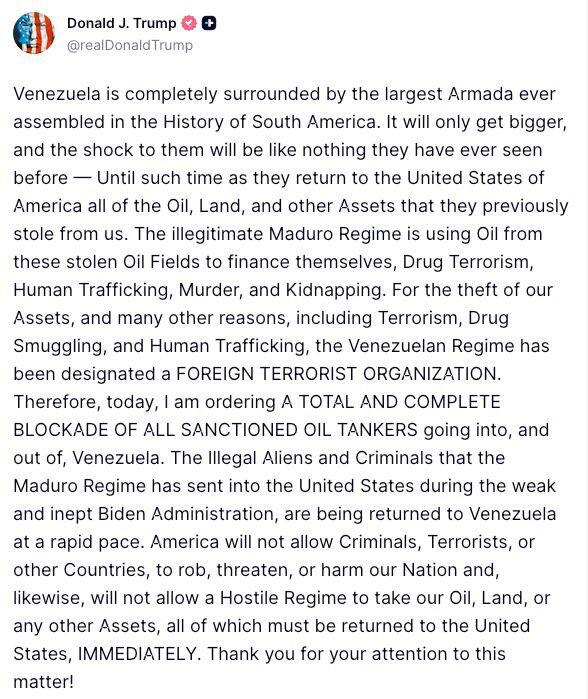
Update (2035ET): On Tuesday evening Trump revealed he has ordered a “total and complete blockade” of all sanctioned oil tankers going into and out of Venezuela. This, he said on Truth Social, is based on Venezuela’s leadership having been declared a “foreign terrorist organization”. 

He further boasted of the country having been “completely surrounded” with the “largest Armada ever assembled in the History of South America.”

“For the theft of our Assets, and many other reasons, including Terrorism, Drug Smuggling, and Human Trafficking, the Venezuelan Regime has been designated a FOREIGN TERRORIST ORGANIZATION. Therefore, today, I am ordering A TOTAL AND COMPLETE BLOCKADE OF ALL SANCTIONED OIL TANKERS going into, and out of, Venezuela,” Trump said. 

He then warned, “It [the blockade] will only get bigger, and the shock to them will be like nothing they have ever seen before — Until such time as they return to the United States of America all of the Oil, Land, and other Assets that they previously stole from us.” Minutes after the announcement:

WTI OIL UP AS MUCH AS 1.6% AS TRUMP RAISES VENEZUELA PRESSURE

This is expected to impact some 800,000-9000,0000 barrels of oil per day, which is forecast to increase prices by some $2-$3 in the short term.

Some initial Congressional reaction and fierce pushback as Washington is on a war-footing:

The full Trump message on Truth Social:

The House is set to finally vote on a proposed War Powers resolution related to Venezuela on Thursday.

* * *

Update (1314ET):

By now, readers are well familiar with the Trump administration’s use of gunboat diplomacy in the Caribbean off Venezuela’s coast. That has ranged from blowing up suspected drug-running boats to seizing one massive shadow fleet tanker tied to sanctioned oil flows.

The strategy is very simple: follow the money. By targeting the maritime arteries that finance the Maduro regime, Trump’s Pentagon is applying direct pressure aimed at regime change in Caracas.

Another artery being clogged is inbound supertankers to Venezuela, with a new Bloomberg report on Tuesday morning specifying that four tankers reversed course following the seizure of the Skipper last week by U.S. special forces.

Here’s more from the media outlet:

The vessels are the Panama-flagged Bella 1, which was sanctioned by the U.S. for its involvement in the illicit transport of Iranian oil, and the tankers Seeker 8, Karina, and Eurovictory, according to data from maritime intelligence firm Kpler.

Ship movements show that the Seeker 8, the Karina, and the Eurovictory all turned around on Dec. 11 — a day after U.S. forces seized a vessel off Venezuela’s coast. The Bella 1 reversed course on Tuesday near the Caribbean island of Antigua and Barbuda, the data tracked by Bloomberg show.

Related:

If the Trump administration wanted to broaden the foreign policy strategy, the playbook would likely include a mix of maritime, financial, legal, and continued military posturing short of a hot war while steadily ratcheting up pressure on the Maduro regime.

. . . 

President Trump’s gunboat diplomacy in the Caribbean, off Venezuela’s coast, has the effect of a maritime blockade, disrupting oil flows to Cuba and to global markets via shadow-fleet tankers. The Trump administration calculates that choking off this oil trade could trigger cascading economic stress, first in Cuba and then in Venezuela, ultimately accelerating the end goal of regime change in Caracas.

The latest report from Axios shows that the Trump administration’s seizure of a shadow-fleet tanker in the Caribbean is only in the early innings, with 18 sanctioned oil-laden ships currently in Venezuelan waters.

Last week, a US Special Forces unit seized the tanker Skipper, which was carrying crude contracted by Cubametales, Cuba’s state-run oil trading firm.

The tanker was part of a dark fleet that shipped crude from Venezuela to Cuba and onward to Asia.

Samir Madani, co-founder of the firm Tanker Trackers, told Axios that of the 18 sanctioned oil-laden ships off the country’s coast, eight are classified as “Very Large Crude Carriers” (VLCCs), such as Skipper, which can carry nearly 2 million barrels of Venezuelan crude. “It’s quite a buffet for the U.S. to choose from,” he said.

Given the unprecedented US naval presence in the Caribbean, mainly offshore of Venezuela in international waters, the Trump administration’s theory of gunboat diplomacy centers on cutting off all support to Cuba. To do that, it follows the money, starting with oil flows via dark tanker fleets. Once those oil flows are disrupted, Venezuela falls, and then Cuba follows.

Related:

Axios quoted one Trump adviser as saying, “We have to wait for them to move. They’re sitting at the dock. Once they move, we’ll go to court, get a warrant, and then get them,” adding, “But if they make us wait too long, we might get a warrant to get them there,” in Venezuelan waters.

And gunboat diplomacy it is.

Tyler Durden
Wed, 12/17/2025 – 04:35

Iran’s Economy Struggles Amid High Inflation

0
Iran’s Economy Struggles Amid High Inflation

Since early December 2025, a wave of protests has swept across Iran, ranging from human rights campaigns in major urban areas to labor strikes in industrial hubs.

As Statista’s Tristan Gaudiat reports, part of the growing popular unrest concerns the accelerating use of the death penalty by the Iranian regime (more than 1,000 executions documented so far in 2025), while the country’s economic situation has significantly deteriorated.

Iran is currently facing one of its most severe economic and social crises of the decade, as the country grapples with near-zero GDP growth, soaring inflation and escalating social and geopolitical tensions.

According to the IMF‘s latest projection (October 2025), Iran’s real GDP is expected to grow by just 0.6 percent in 2025, a sharp decline from previous years (+3.7 percent in 2024, +5.3 percent in 2023).

Inflation, meanwhile, is forecast to surge to 43.3 percent, one of the highest rates in the world, as the national currency (rial) continues its dramatic depreciation.

Infographic: Iran's Economy Struggles Amid High Inflation | Statista

You will find more infographics at Statista


This grim outlook underscores the depth of Iran’s economic issues, driven by a combination of chronic mismanagement, systemic corruption and the impact of international sanctions.

The escalation of the conflict with Israel and the United States this year has further deteriorated the situation.

After a brief but intense war in June 2025, causing billions of dollars in damage in Iran, the United States imposed additional sanctions, targeting Iran’s oil, banking and shipping sectors.

The reimposition of the United Nations’ “snapback” sanctions in late 2025 has also added to the pressure.

Tyler Durden
Wed, 12/17/2025 – 04:15

The Folly Of Establishing A US Military Base In Damascus

0
The Folly Of Establishing A US Military Base In Damascus

Authored by José Niño via The Libertarian Institute

Recent reports indicate the United States is preparing to establish a military presence at an airbase in Damascus, allegedly to facilitate a security agreement between Syria and Israel. This development represents yet another misguided expansion of American military overreach in a region where Washington has already caused tremendous damage through decades of failed interventionist policies.

The United States currently operates approximately 750 to 877 military installations across roughly eighty countries worldwide. This staggering number represents about 70 to 85% of all foreign military bases globally. To put this in perspective, the next eighteen countries with foreign bases combined maintain only 370 installations total. Russia has just twenty-nine foreign bases, and China operates merely six. The American empire of bases already dwarfs every other nation combined, and the financial burden is crushing. Washington spends approximately $65 billion annually just to build and maintain these overseas installations, with total spending on foreign bases and personnel reaching over $94 billion per year.

These figures are not abstract accounting entries. They translate directly into American lives placed in volatile environments, as demonstrated by the recent insider attack in the ancient Syrian city of Palmyra, where a purported “ISIS infiltrator” embedded in local government security forces turned his weapon on a joint U.S. Syrian patrol, killing two U.S. soldiers and one U.S. civilian during what was described as a routine field tour. The incident underscores how the sprawling U.S. basing network increasingly exposes American personnel to unpredictable and lethal blowback in unstable theaters far from home.

Syria itself already hosts between 1,500 and 2,000 American troops, primarily concentrated in the northeastern Hasakah province and at the Al Tanf base in the Syrian Desert. The Pentagon recently announced plans to reduce this presence to fewer than 1,000 personnel and consolidated operations from eight installations to just three. Yet now, despite this supposed drawdown, Washington reportedly plans to establish a new presence in Damascus itself, either at Mezzeh Air Base or Al Seen Military Airport. This contradictory expansion reveals the hollow nature of promises to reduce American military commitments abroad.

Since the fall of Bashar al Assad in December 2024, Israel has conducted hundreds of airstrikes on Syrian military and civilian infrastructure while occupying parts of southern Syria including Quneitra and Daraa. Israel has systematically violated the 1974 disengagement agreement and expanded control over buffer zones. These actions align disturbingly well with the Yinon Plan, a 1982 Israeli strategic document by Israeli foreign policy official Oded Yinon that envisions the dissolution of surrounding Arab states into smaller ethnic and religious entities. The plan explicitly calls for fragmenting Syria along its ethnic and religious lines to prevent a strong centralized government that could challenge Israeli interests.

A permanent American military presence in Damascus would effectively serve as a tripwire guaranteeing continued U.S. involvement in securing Israeli strategic objectives in the Levant. Rather than protecting American interests or enhancing national security, such a base would entrench Washington deeper into regional conflicts that have consistently proven disastrous for both American taxpayers and Middle Eastern populations.

The human cost of American intervention in Syria should give any policymaker pause. The Syrian proxy war has resulted in between 617,000 and 656,000 deaths, including civilians, rebels, and government forces. More than 7.4 million people remain internally displaced within Syria, while approximately 6.3 million Syrian refugees live abroad. This catastrophic toll stems partly from Operation Timber Sycamore, the CIA covert program that ran from 2012 to 2017 to train and equip Syrian rebel forces.

Timber Sycamore represented a joint effort involving American intelligence services along with Saudi Arabia, Jordan, Qatar, Turkey, and the United Kingdom. The CIA ran secret training camps in Jordan and Turkey, providing rebels with small arms, ammunition, trucks, and eventually advanced weaponry like BGM 71 TOW anti-tank missiles. Saudi Arabia provided significant funding while the United States supplied training and logistical support.

The program proved to be counterproductive. Jordanian intelligence officers stole and sold millions of dollars worth of weapons intended for rebels on the black market. Even worse, U.S.-supplied weapons regularly fell into the hands of the al Nusra Front, al-Qaeda’s Syrian affiliate, and ISIS itself. The program strengthened the very extremists Washington was ostensibly fighting.

The failure of Timber Sycamore illustrates a fundamental problem with American interventionism in Syria. Washington has pursued regime change in Damascus in various forms for decades, yet these efforts have consistently backfired, creating power vacuums filled by jihadist groups and prolonging devastating conflicts. The current enthusiasm for establishing a military presence in Damascus suggests American policymakers have learned absolutely nothing from these failures.

The figure now leading Syria exemplifies the moral bankruptcy of this entire enterprise. Ahmed al Sharaa, better known by his nom de guerre Abu Mohammad al Julani, currently serves as president of Syria’s interim government. This represents a stunning rehabilitation for a man who founded al Nusra Front in 2012 as an al-Qaeda affiliate and later formed Hayat Tahrir al Sham (HTS) by merging various rebel factions. Under the name Abu Mohammad al Julani, he was designated a Specially Designated Global Terrorist by the United States on July 24, 2013, with a $10 million bounty maintained on his head.

Al Sharaa’s terrorist designation stemmed from his leadership of al Nusra Front, which perpetrated numerous war crimes including suicide bombings, forced conversions, ethnic cleansing, and sectarian massacres against Christian, Alawite, Shia, and Druze minorities. He fought with al-Qaeda in Iraq, spent time imprisoned at Camp Bucca between 2006 and 2010, and was dispatched to Syria by Abu Bakr al Baghdadi in 2011 with $50,000 to establish al Nusra. His close associates have faced accusations from the United States of overseeing torture, kidnappings, trafficking, ransom schemes, and displacing residents to seize property. The New York Times reported that his group was accused of initially operating under al-Qaeda’s umbrella.

Yet in November 2025, the United Nations Security Council adopted resolution 2799, removing al Sharaa and Interior Minister Anas Khattab from the ISIL and al-Qaeda sanctions list. The U.S. Treasury Department followed suit, delisting him from the Specially Designated Global Terrorist registry. This reversal came after the State Department revoked HTS’s Foreign Terrorist Organization designation in July 2025. Washington essentially decided that a former al-Qaeda commander who oversaw sectarian massacres was now a legitimate partner worthy of American military support. This absurd rehabilitation demonstrates how completely untethered American foreign policy has become from any coherent moral framework or strategic logic.

Critics rightly question whether al Sharaa has truly broken from his extremist roots or merely engaged in calculated political rebranding. The speed with which Washington embraced him as a legitimate leader suggests American policymakers care far more about advancing Israeli interests and maintaining regional influence than about genuine counterterrorism or protecting religious minorities.

The United States needs to pursue a fundamentally different approach to foreign policy. Rather than establishing yet another military base to advance Israeli strategic objectives in Syria, Washington should implement a comprehensive drawdown of overseas military commitments. The hundreds of foreign bases it maintains abroad represent an unsustainable burden that diverts resources from genuine national security priorities like border security and stability in the Western Hemisphere. American taxpayers deserve better than footing the bill for an empire that consistently fails to advance their interests while enriching defense contractors and serving foreign powers.

Syria offers a perfect case study in the futility of American interventionism. Decades of attempts at regime change through covert programs like Timber Sycamore and direct military presence have produced nothing but chaos, empowered jihadist groups, created millions of refugees, and cost hundreds of thousands of lives. The rehabilitation of a former al-Qaeda commander into Syria’s president illustrates how divorced American policy has become from any coherent strategy or values.

Rather than doubling down on failed policies, the United States should pursue strategic restraint, scale back its sprawling network of foreign bases, and allow regional powers to sort out their own affairs without American military involvement. That represents the path toward a more sustainable, affordable, and morally defensible foreign policy. The Damascus base proposal deserves to be rejected outright as yet another wasteful expansion of an already overextended military empire.

Tyler Durden
Wed, 12/17/2025 – 03:30