41.8 F
Chicago
Sunday, November 8, 2026
Home Blog Page 865

Global Energy Transition Threatened By Critical Transformer Shortages

0
Global Energy Transition Threatened By Critical Transformer Shortages

By Haley Zaremba of Oilprice.com

The global clean energy transition has passed a tipping point as renewable energies have simply become too cheap to fail. Worldwide, nations both rich and poor are rushing to install more and more wind and solar capacity to keep up with rising energy demand rates driven by global economic development and the age of AI. But while countries have been investing heavily into increased production capacity, investments in critical grid infrastructure have not kept pace, leading to a major energy transition bottleneck and a potential threat to energy security for an increasing number of countries.

The United States and Europe are both facing critical transformer shortages and aging and inadequate grid infrastructure, and the threat that this shortage poses to energy security is already being felt through historic blackouts such as last year’s cascading grid failure in Spain and Portugal. While these setbacks have raised the profile of infrastructure investing in European policy spheres, “ambition is not yet being matched by action from governments, policy-makers, investors and businesses,” according to a recent report from the World Economic Forum. 

In the United States, specialists foresee a yearslong transformer crunch, with little to no relief forthcoming. While companies have rushed to ramp up production of power transformers and distribution transformers, keeping up with skyrocketing demand is an impossibly tall order. Wood Mackenzie estimates that, since 2019, U.S. demand for power transformers has jumped by 116 percent, while demand for distribution transformers has shot up 41 percent. 

“This surging transformer demand has created a significant supply deficit, with domestic manufacturing capacity unable to keep pace,” Wood Mackenzie Senior Analyst Ben Boucher. “Utilities are routinely turning to the import market to meet project timelines. In 2025, imports will account for an estimated 80% of US power transformer supply and 50% of the distribution transformer supply. This market imbalance is escalating costs and lead times and is delaying our ability to bring generating plants online in pace with the surging energy demand.”

However, some experts disagree with this takeaway, arguing that the transformer “shortage” is overblown if not fabricated, and the issue lies in self-inflicted procurement problems. There’s room for debate because the issue is a complex one stretching over many different economic sectors and supply chains. Whether the problem is one of supply or one of procurement, however, the impact is the same – major bottlenecks for new electricity with potential pitfalls for national energy security. 

“Over the past few years, what started as a squeeze has gradually morphed into a crisis,” Power Magazine recently reported. The Power article contends that this growing crisis has been “furnished by years of underinvestment in domestic manufacturing, a sudden surge in post-pandemic construction and electrification, and volatility in grain-oriented electrical steel (GOES) and copper markets, which steadily pushed lead times for large power and generator step-up (GSU) transformers beyond historical norms.”

And those driving factors are showing little signs of changing, indicating that delay times for transformer delivery are going to continue to stretch on. Even though demand for these products is now growing exponentially, this spike is coming in the wake of years of lackluster demand, and would-be investors are still warming up to the idea that they’ll get a return on their investment in the sector. 

Hitachi, one major producer of such transformers, for example, has strategically only invested in transformer development when the purchase of those components is already guaranteed and buyer-backed.  “Nobody wants to overinvest” in new production facilities, according to Hitachi Energy CEO Andreas Schierenbeck.

Through these kinds of up-front deals, Hitachi has planned $1 billion in new manufacturing capacity across the United States. However, Schierenbeck told news outlet Semafor this week that these deals are “probably not enough to close the gap between supply and demand… There are still customers who are just in the old world with transactional behavior, and they’ll have to be lucky to get a slot.”

Tyler Durden
Mon, 01/26/2026 – 06:30

Brussels Discipline Machine: How von der Leyen Survived, And Parliament Paid The Price

0
Brussels Discipline Machine: How von der Leyen Survived, And Parliament Paid The Price

Submitted by Thomas Kolbe

Ursula von der Leyen survived her fourth vote of no confidence in the European Parliament on Thursday. In the process, the EPP Group has increasingly resorted to drastic measures to enforce internal discipline and ensure a uniform voting outcome within its ranks.

EU Commission President Ursula von der Leyen once again survived a no-confidence vote in the European Parliament on Thursday at noon. In Strasbourg, 165 members voted in favor of the motion, 390 voted against it, and 10 abstained.

The latest initiative from within the Parliament was introduced by Patriots for Europe (PfE), the right-conservative parliamentary group. The main point of criticism that led to the motion of no confidence was the free trade agreement between the EU and the Mercosur states of South America. More broadly, the group expressed dissatisfaction with the Commission’s trade policy, which it claims systematically ignores national interests—particularly those of European agriculture.

This marks the fourth no-confidence motion against von der Leyen within six months. The initiators have alternated between the right-wing groups Patriots for Europe and the European Conservatives and Reformists (ECR), as well as the left-wing parliamentary group “The Left.”

Von der Leyen continues to face accusations of a lack of transparency during the COVID period. She has also repeatedly been criticized for the absence of democratic legitimacy in conducting trade negotiations with the United States on behalf of EU member states, as well as for her strong focus on supporting Ukraine—an emphasis that critics argue comes at the expense of the interests of EU member countries.

Parliamentary Discipline in the European Parliament

In light of the steadily growing conservative right in Parliament, von der Leyen has increasingly become a projection surface for criticism of the centralization of political power in Brussels. The core factions supporting the Commission President—primarily the EPP (European People’s Party) under the leadership of CSU politician Manfred Weber, along with the Progressive Alliance of Socialists and Democrats (S&D), Renew Europe, and parts of the liberal and Green groups—are finding it increasingly difficult to shield her from public criticism.

With each publicly staged no-confidence motion, another piece of Ursula von der Leyen’s political substance erodes. She has been weakened since the scandal surrounding her deleted text messages in the Pfizer affair.

For this reason, EPP Group leader Manfred Weber resorted in advance of the no-confidence vote to “disciplinary” measures, significantly restricting the rights of members of his parliamentary group in the event of dissenting votes (as previously reported by Tichy’s Einblick).

In addition to explicit threats of sanctions against dissenters, reports from Brussels indicate that an internal communications strategy was deployed to reinforce group discipline. Weber repeatedly made clear that he expects “closed majorities” and branded dissenting votes as “destructive to the political center.”

Weber also once again emphasized that dissenters were doing the business of Vladimir Putin—a familiar political talking point that has by now largely lost its effectiveness.

With his leadership style, the Union politician has positioned himself as one of the standard-bearers of an increasingly unrestrained party bloc, one that appears unable to counter the growing competition from the national-conservative camp with substantive arguments. Whether in the case of Schleswig-Holstein’s Minister President Daniel Günther and the associated threats of censorship, or—as now with Weber—in the Union’s handling of a political credibility crisis and economic recession, opposition voices are increasingly suppressed. Step by step, the party is conforming to a repressive system of political control.

The catalogue of sanctions established by Weber to enforce group discipline included, among other measures, the withdrawal of rapporteur positions. In addition, members were internally threatened with disadvantages such as the loss of group support in committee work and reduced influence over delegation decisions, in order to eliminate any incentive for dissenting votes.

Absence from votes—or even support for the no-confidence motion against von der Leyen—was also set to result in exclusion from delegation trips and internal working groups. Absenteeism was viewed as particularly critical by the EPP leadership, as it can be interpreted as a political statement—an implicit rejection of the group leadership and its strategic line.

Ostracizing Freedom of Conscience

Through this approach, Weber promotes the political ostracization of dissenters—freely elected representatives who vote according to their conscience. Critics see this practice not merely as an instrumental push toward party conformity, but as a structural undermining of the principle of the free mandate in the European Parliament, especially given that Parliament already possesses few independent legislative initiative rights.

Formally, the mandate remains free; in practice, however, Weber’s actions significantly devalue it. Members deemed “undesirable” risk not only political isolation, but also the loss of real opportunities to shape policy within the EU legislature. This weakens their mandate far beyond symbolic sanctions.

This approach follows a pattern that Weber has progressively intensified in past votes. Even during earlier no-confidence motions, he threatened dissenters with post-hoc sanctions in a disciplinary tone. Previous votes—such as those in October or July—already showed that EPP members who adopted more cautious or critical positions toward key Commission decisions were placed under scrutiny. In line with his strategy, Weber moved aggressively against any deviation in order to preserve a unified political image of the EPP.

This behavior is not only unethical and, from a parliamentary perspective, dishonest; it also inflicts significant damage on the European Parliament itself. The Parliament—already a representative body without its own right of legislative initiative—loses further prestige as a result of Weber’s measures. It increasingly appears as a democratic fig leaf for a technocratically operating Commission, drifting ever further away from democratic principles under the banner of internal party discipline.

* * * 

About the author: Thomas Kolbe, a German graduate economist, has worked for 25 years as a journalist and media producer for clients from various industries and business associations. As a publicist, he focuses on economic processes and observes geopolitical events from the perspective of the capital markets. His publications follow a philosophy that focuses on the individual and their right to self-determination.

Tyler Durden
Mon, 01/26/2026 – 05:00

Venezuela Continues To Top Global Inflation Forecasts In 2026

0
Venezuela Continues To Top Global Inflation Forecasts In 2026

In 2026, U.S. inflation is projected to decline to 2.4%, ultimately remaining above the Fed’s target. Many European and Asian countries, meanwhile, are expected to see sub-2% increases in prices. Countries facing instability, like Venezuela and Sudan, will brace for significantly higher price pressures.

This graphic, via Visual Capitalist’s Dorothy Neufeld, shows the 2026 inflation forecast for global economies, based on data from the International Monetary Fund.

Ranked: The 2026 Inflation Forecast

Below, we show inflation projections for 2026 across 190 economies:

Rank Country Inflation Rate Forecast 2026 (%) Region
1 🇻🇪 Venezuela 682.1 South America
2 🇸🇩 Sudan 54.6 Africa
3 🇮🇷 Iran 41.6 Middle East
4 🇲🇲 Myanmar 28.0 Asia
5 🇧🇮 Burundi 26.3 Africa
6 🇭🇹 Haiti 26.2 North America
7 🇹🇷 Türkiye 24.7 Asia
8 🇲🇼 Malawi 24.1 Africa
9 🇳🇬 Nigeria 22.0 Africa
10 🇾🇪 Yemen 18.5 Middle East
11 🇿🇼 Zimbabwe 18.2 Africa
12 🇦🇷 Argentina 16.4 South America
13 🇦🇴 Angola 16.3 Africa
14 🇸🇸 South Sudan 15.8 Africa
15 🇪🇬 Egypt 11.8 Africa
16 🇰🇿 Kazakhstan 11.2 Asia
17 🇸🇱 Sierra Leone 10.5 Africa
18 🇬🇭 Ghana 9.9 Africa
19 🇸🇷 Suriname 9.6 South America
20 🇪🇹 Ethiopia 9.4 Africa
21 🇿🇲 Zambia 9.2 Africa
22 🇧🇩 Bangladesh 8.7 Asia
23 🇲🇳 Mongolia 8.1 Asia
24 🇱🇷 Liberia 7.7 Africa
25 🇺🇦 Ukraine 7.6 Europe
26 🇧🇾 Belarus 7.5 Europe
27 🇺🇿 Uzbekistan 7.3 Asia
28 🇲🇬 Madagascar 7.2 Africa
29 🇨🇩 DR Congo 7.1 Africa
30 🇸🇹 São Tomé and Príncipe 7.0 Africa
31 🇰🇬 Kyrgyz Republic 6.9 Asia
32 🇷🇴 Romania 6.7 Europe
33 🇹🇳 Tunisia 6.1 Africa
34 🇵🇰 Pakistan 6.0 Asia
35 🇲🇭 Marshall Islands 5.9 Oceania
36 🇱🇦 Lao P.D.R. 5.5 Asia
37 🇲🇩 Moldova 5.5 Europe
38 🇲🇿 Mozambique 5.4 Africa
39 🇰🇪 Kenya 5.2 Africa
40 🇷🇺 Russian Federation 5.2 Asia
41 🇹🇲 Turkmenistan 5.0 Asia
42 🇯🇲 Jamaica 5.0 North America
43 🇬🇲 Gambia 4.9 Africa
44 🇱🇸 Lesotho 4.8 Africa
45 🇧🇼 Botswana 4.7 Africa
46 🇷🇼 Rwanda 4.7 Africa
47 🇵🇬 Papua New Guinea 4.6 Oceania
48 🇹🇬 Togo 4.5 Africa
49 🇦🇿 Azerbaijan 4.5 Asia
50 🇹🇯 Tajikistan 4.5 Asia
51 🇳🇷 Nauru 4.5 Oceania
52 🇺🇾 Uruguay 4.5 South America
53 🇬🇾 Guyana 4.4 South America
54 🇺🇬 Uganda 4.3 Africa
55 🇪🇪 Estonia 4.3 Europe
56 🇳🇵 Nepal 4.2 Asia
57 🇩🇴 Dominican Republic 4.2 North America
58 🇭🇳 Honduras 4.2 North America
59 🇸🇿 Eswatini 4.0 Africa
60 🇮🇳 India 4.0 Asia
61 🇷🇸 Serbia 4.0 Europe
62 🇧🇷 Brazil 4.0 South America
63 🇩🇿 Algeria 3.9 Africa
64 🇿🇦 South Africa 3.7 Africa
65 🇸🇧 Solomon Islands 3.7 Oceania
66 🇵🇾 Paraguay 3.7 South America
67 🇹🇩 Chad 3.6 Africa
68 🇲🇺 Mauritius 3.6 Africa
69 🇳🇦 Namibia 3.6 Africa
70 🇲🇷 Mauritania 3.5 Africa
71 🇸🇴 Somalia 3.5 Africa
72 🇹🇿 Tanzania 3.5 Africa
73 🇭🇺 Hungary 3.5 Europe
74 🇰🇮 Kiribati 3.5 Oceania
75 🇨🇴 Colombia 3.5 South America
76 🇧🇹 Bhutan 3.4 Asia
77 🇬🇪 Georgia 3.4 Asia
78 🇧🇬 Bulgaria 3.4 Europe
79 🇫🇲 Micronesia 3.4 Oceania
80 🇨🇲 Cameroon 3.3 Africa
81 🇨🇫 Central African Republic 3.3 Africa
82 🇸🇰 Slovak Republic 3.3 Europe
83 🇬🇹 Guatemala 3.3 North America
84 🇲🇽 Mexico 3.3 North America
85 🇨🇬 Congo 3.2 Africa
86 🇳🇪 Niger 3.2 Africa
87 🇻🇳 Vietnam 3.2 Asia
88 🇼🇸 Samoa 3.2 Oceania
89 🇮🇸 Iceland 3.1 Europe
90 🇱🇹 Lithuania 3.1 Europe
91 🇨🇱 Chile 3.1 South America
92 🇬🇳 Guinea 3.0 Africa
93 🇲🇰 North Macedonia 3.0 Europe
94 🇦🇺 Australia 3.0 Oceania
95 🇬🇶 Equatorial Guinea 2.9 Africa
96 🇮🇩 Indonesia 2.9 Asia
97 🇵🇼 Palau 2.9 Oceania
98 🇦🇲 Armenia 2.8 Asia
99 🇦🇱 Albania 2.8 Europe
100 🇭🇷 Croatia 2.8 Europe
101 🇵🇱 Poland 2.8 Europe
102 🇪🇨 Ecuador 2.8 South America
103 🇽🇰 Kosovo 2.7 Europe
104 🇳🇮 Nicaragua 2.7 North America
105 🇵🇭 Philippines 2.6 Asia
106 🇧🇦 Bosnia and Herzegovina 2.6 Europe
107 🇱🇻 Latvia 2.6 Europe
108 🇯🇴 Jordan 2.6 Middle East
109 🇶🇦 Qatar 2.6 Middle East
110 🇬🇦 Gabon 2.5 Africa
111 🇲🇻 Maldives 2.5 Asia
112 🇬🇷 Greece 2.5 Europe
113 🇬🇧 United Kingdom 2.5 Europe
114 🇮🇶 Iraq 2.5 Middle East
115 🇧🇧 Barbados 2.5 North America
116 🇧🇫 Burkina Faso 2.4 Africa
117 🇳🇱 Netherlands 2.4 Europe
118 🇳🇴 Norway 2.4 Europe
119 🇸🇮 Slovenia 2.4 Europe
120 🇦🇬 Antigua and Barbuda 2.4 North America
121 🇺🇸 United States 2.4 North America
122 🇦🇹 Austria 2.3 Europe
123 🇨🇿 Czech Republic 2.3 Europe
124 🇲🇪 Montenegro 2.3 Europe
125 🇩🇲 Dominica 2.3 North America
126 🇹🇻 Tuvalu 2.3 Oceania
127 🇲🇾 Malaysia 2.2 Asia
128 🇱🇺 Luxembourg 2.2 Europe
129 🇮🇱 Israel 2.2 Middle East
130 🇰🇼 Kuwait 2.2 Middle East
131 🇵🇷 Puerto Rico 2.2 North America
132 🇹🇹 Trinidad and Tobago 2.2 North America
133 🇹🇴 Tonga 2.2 Oceania
134 🇻🇺 Vanuatu 2.2 Oceania
135 🇭🇰 Hong Kong SAR 2.1 Asia
136 🇯🇵 Japan 2.1 Asia
137 🇩🇰 Denmark 2.1 Europe
138 🇵🇹 Portugal 2.1 Europe
139 🇰🇳 Saint Kitts and Nevis 2.1 North America
140 🇻🇨 Saint Vincent and the Grenadines 2.1 North America
141 🇳🇿 New Zealand 2.1 Oceania
142 🇦🇼 Aruba 2.1 South America
143 🇧🇯 Benin 2 Africa
144 🇨🇻 Cabo Verde 2.0 Africa
145 🇬🇼 Guinea-Bissau 2.0 Africa
146 🇲🇱 Mali 2.0 Africa
147 🇸🇳 Senegal 2.0 Africa
148 🇮🇹 Italy 2.0 Europe
149 🇲🇹 Malta 2.0 Europe
150 🇸🇲 San Marino 2.0 Europe
151 🇪🇸 Spain 2.0 Europe
152 🇸🇦 Saudi Arabia 2.0 Middle East
153 🇦🇪 United Arab Emirates 2.0 Middle East
154 🇨🇦 Canada 2.0 North America
155 🇨🇷 Costa Rica 2.0 North America
156 🇵🇦 Panama 2.0 North America
157 🇰🇲 Comoros 1.9 Africa
158 🇫🇮 Finland 1.9 Europe
159 🇧🇿 Belize 1.9 North America
160 🇵🇪 Peru 1.9 South America
161 🇲🇦 Morocco 1.8 Africa
162 🇰🇭 Cambodia 1.8 Asia
163 🇰🇷 South Korea 1.8 Asia
164 🇹🇱 Timor-Leste 1.8 Asia
165 🇦🇩 Andorra 1.8 Europe
166 🇩🇪 Germany 1.8 Europe
167 🇮🇪 Ireland 1.7 Europe
168 🇱🇾 Libya 1.6 Africa
169 🇹🇼 Taiwan 1.6 Asia
170 🇸🇪 Sweden 1.6 Europe
171 🇨🇮 Côte d’Ivoire 1.5 Africa
172 🇫🇷 France 1.5 Europe
173 🇴🇲 Oman 1.5 Middle East
174 🇱🇨 Saint Lucia 1.5 North America
175 🇩🇯 Djibouti 1.4 Africa
176 🇸🇬 Singapore 1.3 Asia
177 🇧🇪 Belgium 1.3 Europe
178 🇨🇾 Cyprus 1.3 Europe
179 🇲🇴 Macao SAR 1.2 Asia
180 🇸🇨 Seychelles 1.1 Africa
181 🇬🇩 Grenada 1.1 North America
182 🇫🇯 Fiji 1.1 Oceania
183 🇧🇸 Bahamas 1.0 North America
184 🇸🇻 El Salvador 1.0 North America
185 🇧🇭 Bahrain 0.8 Middle East
186 🇨🇳 China 0.7 Asia
187 🇹🇭 Thailand 0.7 Asia
188 🇧🇳 Brunei Darussalam 0.6 Asia
189 🇱🇮 Liechtenstein 0.6 Europe
190 🇨🇭 Switzerland 0.6 Europe

Venezuela continues to face the highest inflation worldwide by a huge margin, with inflation set to increase 682.1% in 2026. (Note these forecasts were released before President Nicolas Maduro’s capture and U.S. plans to take over Venezuelan oil production).

Moreover, conflict-ridden countries including Sudan, Iran, and Myanmar, face inflation rates exceeding 25%.

In the U.S., inflation is expected to trend lower, though several risks could influence the outlook. While tariff front-loading muted inflationary effects in 2025, pass-through effects could meaningfully affect consumer prices in 2026.

Meanwhile, several economies, from Italy and Spain to Senegal and Saudi Arabia are expected to see inflation reach a 2% target.

In contrast, Switzerland and Liechtenstein are projected to see the lowest inflation globally, at 0.6%. For Switzerland, a strong Swiss franc has led import prices to drop, mirroring a trend seen in the past two years.

Additionally, consumer prices in Thailand and China are set to rise just 0.7% amid deflationary pressures.

To learn more about this topic, check out this graphic on interest rate projections across advanced economies.

Tyler Durden
Mon, 01/26/2026 – 04:15

Ethereum Prepares For Quantum Era With New Security Team And Funding

0
Ethereum Prepares For Quantum Era With New Security Team And Funding

Authored by Amin Haqshanas via CoinTelegraph.com,

The Ethereum Foundation has made post-quantum security a central focus of the network’s long-term roadmap, announcing the formation of a dedicated Post Quantum (PQ) team.

The new team will be led by Thomas Coratger, a cryptographic engineer at the Ethereum Foundation, with support from Emile, a cryptographer closely associated with leanVM, according to crypto researcher Justin Drake.

“After years of quiet R&D, EF management has officially declared PQ security a top strategic priority,” Drake said in a Saturday post on X. “It’s now 2026, timelines are accelerating. Time to go full PQ.”

The researcher described leanVM, a specialized, minimalist zero-knowledge proof virtual machine (zkVM), as a potential building block of Ethereum’s post-quantum strategy.

EF backs post-quantum push with developer sessions, funding

Drake outlined several near-term steps aimed at preparing the ecosystem. A biweekly developer session focused on post-quantum transactions is set to begin next month, led by Ethereum researcher Antonio Sanso. The sessions will concentrate on user-facing protections, including protocol-level cryptographic tools, account abstraction pathways and longer-term work on aggregating transaction signatures using leanVM.

The Ethereum Foundation is also backing its push with new funding. Drake announced a $1 million Poseidon Prize to strengthen the Poseidon hash function, alongside another $1 million initiative known as the Proximity Prize, both aimed at advancing post-quantum cryptography.

Ethereum prepares for quantum era. Source: Justin Drake

On the engineering front, Drake said multi-client post-quantum consensus development networks are already live, with multiple teams participating and coordinating through weekly interoperability calls.

Furthermore, the foundation will host a dedicated post-quantum event in October, followed by a post-quantum day in late March ahead of EthCC. Educational efforts, including video content and materials aimed at enterprises, are also underway.

Coinbase forms board to assess quantum risks

The announcement comes amid growing sensitivity in crypto markets to quantum risk. On Wednesday, Coinbase revealed that it has established an independent advisory board to evaluate how advances in quantum computing could impact the cryptography securing major blockchain networks, including Bitcoin and Ethereum.

The board brings together experts from academia and industry in quantum computing, cryptography, and blockchain security, and will publish public research and guidance for developers, organizations, and users. Its first position paper is expected in early 2027.

Tyler Durden
Mon, 01/26/2026 – 03:30

Visualizing Life Expectancy In The World’s Largest Economies

0
Visualizing Life Expectancy In The World’s Largest Economies

Despite living in the world’s largest economy, Americans have shorter life expectancies than residents of many other wealthy nations.

People in Japan – the world’s fourth-largest economy – live about five years longer on average.

Meanwhile, residents in countries like France and Italy outlive Americans by roughly four years.

This graphic, via Visual Capitalist’s Dorothy Neufeld, shows life expectancy by country across the world’s 30 largest economies, based on data from the United Nations.

GDP data was drawn from the International Monetary Fund.

A Closer Look at Life Expectancy by Country

Below, we rank countries based on GDP in 2025, including their life expectancies at birth:

With an average life expectancy of 80 years, Americans live shorter lives than those in many other major economies. This gap is driven by several factors, including limited access to healthcare, high obesity rates, and elevated homicide rates.

Notably, the U.S. is the only G10 country without universal healthcare. It also has some of the highest healthcare costs among wealthy nations, at $14,885 per person, roughly double the OECD average.

China, the world’s second-largest economy, has an average life expectancy of 79 years, up from 68 in 1990. In recent years, national policies have focused on improving disease prevention and expanding medical insurance coverage.

India’s life expectancy stands at 73 years, among the lowest of the top 30 economies by GDP. Life expectancy also varies significantly by caste, with lower-caste individuals shown to live about four years fewer on average than those in higher castes.

However, India has recorded some of the largest gains in life expectancy globally over the past six decades. Since 1965, the average lifespan has increased by 27 years. In particular, this reflects growing advancements in healthcare, child mortality, and enhanced nutrition, further aided by strong economic growth.

To learn more about this topic, check out this graphic on the countries with the longest life expectancies.

Tyler Durden
Mon, 01/26/2026 – 02:45

The EU’s Green Crackdown Threatens European Industry Amid Deindustrialization

0
The EU’s Green Crackdown Threatens European Industry Amid Deindustrialization

Submitted by Thomas Kolbe

Brussels and Berlin are increasing regulatory pressure on European industry. With the tightening of the EU Industrial Emissions Directive, agriculture is now moving even further into the crosshairs of climate regulation. That the EU is increasingly isolating itself on the international stage seems to concern no one.

If this year’s World Economic Forum in Davos delivered one clear message, it was this: the U.S. delegation led by President Donald Trump gave Europe’s climate-socialist economic transformation a red card. In stark terms, the U.S. President made it clear that the European path—the regulatory attempt at a net-zero economy with zero CO₂ emissions—has already failed in American eyes, and they have hit the brakes.

Now that the German cabinet is transposing the EU-mandated tightening of the Industrial Emissions Directive into national law, extending it to agricultural operations after parliamentary approval (Apollo News reported), the impression solidifies: the politically induced crisis of European industry—the slow deindustrialization of Europe’s key industrial hubs—is still treated in the political leadership’s economic models as a minor issue, a collateral damage on the road to the green utopia.

Artificial state demand is now being used to try to refill freed industrial capacities—whether through military production or subsidized eco-projects, which fail under cost pressures or simply go unrequested.

Regulatory Pressure by Design

Specifically, the new EU directive will place roughly 30 percent of poultry and pig farms under industrial emissions regulation. As if the sector were not already on the brink of collapse under existing regulatory pressure, the next attack on these operations is now being orchestrated.

Across the EU, about 50,000 operations will be required to implement binding environmental management systems, audited on cycles of one to three years. In Germany alone, 13,000 facilities are subject to EU compliance. Farms with at least 1,200 fattening pigs or 700 breeding sows, as well as poultry operations with around 40,000 broilers or 21,400 laying hens, will now be direct targets of the tightened rules.

Under the threat of heavy fines of at least three percent of EU-generated annual revenue for violations, the European Union is attempting to enforce the Green Deal by brute force. The goal is to ensure the reduction of harmful emissions in air, water, and soil, while promoting resource efficiency and a decarbonized circular economy by 2050.

For German Environment Minister Carsten Schneider (SPD), the directive’s tightening is a cause for celebration. He cited the policy’s successes over the past decade, which have already led to significant CO₂ reductions and fostered greener production in Europe. That technological progress primarily arises from competition and market-driven dynamics hardly factors into today’s political central planning.

High ideological fortresses have been erected, completely obscuring the view of economic reality.

For affected farms, the implementation means one thing above all: a massive increase in documentation, approval, and compliance obligations. They will now be subject to regular emission measurements and detailed reporting, which will be submitted to state environmental authorities and fed into EU-wide registers and public portals—suddenly, transparency matters. This transparency requirement creates intense public pressure on farms to comply swiftly and fully, regardless of how the additional costs will be financed.

Industry experts estimate compliance costs—for example, ammonia emission reductions—between €100,000 and €500,000 per barn, depending on size and technology. If BAT requirements (“Best Available Techniques”) must be retrofitted annually, these burdens can quickly escalate into millions.

Previously, the EU directive applied mainly to sectors such as chemicals, steel, cement, refineries, and energy facilities, targeting primarily large installations with high emissions and throughput. Government officials repeatedly stress that the tightened regulatory pressure applies only to large operations. In reality, both the Supply Chain Act and the new directive create significant pressure along entire supply chains. Large companies are forced to pass their environmental obligations onto smaller suppliers, extending inspection and compliance mechanisms across the entire value chain.

Political Paralysis

Remarkably, European politics remains unfazed by the ongoing deindustrialization of its economic base, stubbornly defending its course. As the industrial foundation erodes, so too does the EU’s geopolitical influence. Every industrial operation that succumbs to regulatory pressure and rising energy costs and relocates takes valuable know-how with it. Value chains destabilize, high factor incomes vanish, and the state faces growing fiscal pressure.

The response to this visible disaster—which led to around 24,000 corporate insolvencies last year—remains predictable: a transparent media performance delivered by government representatives. The Chancellor’s well-meaning calls for bureaucracy reduction are repeated with increasing emphasis, not least in view of five upcoming state elections this year. Bureaucracy reduction has become a standard political phrase with no real consequences.

The underlying strategy becomes clear: publicly, the government positions itself as problem-solver, buying time while steadfastly pursuing the set goal of green transformation.

German policymakers could easily reverse this destructive course. Germany is the EU’s largest net contributor, and key levers of power are held by Christian Democrats in Berlin, Brussels, and the European Parliament.

The only way out of this self-imposed trap would be a return to a fully deregulated free market economy—combined with a political rapprochement with Russian energy flows. Yet the spirit of central planning and presumed industrial control continues to dominate.

Ever-Increasing Bureaucracy

Growing regulation inevitably demands an expanding administrative apparatus. Over the past five years, public sector employment has risen by about two percent annually—roughly 100,000 additional positions. Against this backdrop, the Chancellor’s repeated calls for bureaucracy reduction appear a media tactic farce.

Documentation, proof, and auditing obligations in German industry have taken on Kafkaesque dimensions. In the past three years alone, some 325,000 additional positions had to be created in companies to handle the growing administrative burden flowing from Brussels and Berlin. In effect, the state is outsourcing its own bureaucracy to the private sector.

These political decisions exert tangible pressure on companies. Berlin and Brussels are responding to international competition and U.S. deregulation with policies that intensify existing industrial challenges rather than solving them.

* * *

About the author: Thomas Kolbe, born in 1978 in Neuss/ Germany, is a graduate economist. For over 25 years, he has worked as a journalist and media producer for clients from various industries and business associations. As a publicist, he focuses on economic processes and observes geopolitical events from the perspective of the capital markets. His publications follow a philosophy that focuses on the individual and their right to self-determination.

Tyler Durden
Mon, 01/26/2026 – 02:00

America Can’t Secure Its Future On Imported Minerals

0
America Can’t Secure Its Future On Imported Minerals

Authored by Jack Bergman via RealClearPolitics.com,

If the past few years taught us anything, it’s that national security no longer stops at the water’s edge or the factory gate. It runs through the mines, mills, refineries, and logistics networks that supply the metals inside our jets, ships, satellites, power grid, and the next generation of energy technologies.

Copper, nickel, cobalt, and other critical minerals aren’t just components of consumer gadgets; they are the sinews of American strength. And yet, for far too long, we have treated domestic mineral production like an afterthought, outsourcing supply to geopolitical rivals and fragile supply chains while hoping global markets will behave.

That is a strategic gamble we cannot afford.

Consider copper and nickel. Copper is the metal of electrification, essential to everything from radar systems to transformers to the wiring that hardens our bases and powers missile-defense sites. Nickel strengthens steel and is vital for advanced batteries and armor. Demand is climbing as our military modernizes and our economy electrifies. Meanwhile, a handful of countries dominate key stages of mining and processing, creating single points of failure that adversaries can exploit and crises can choke. We wouldn’t outsource fighter jet production to a rival power; why would we outsource the metals that make those jets possible?

A national strategy to close that vulnerability must include responsible American mining. Fortunately, this administration understands the importance of a reliable supply chain and domestic mineral production. In just a few days, Congress is expected to consider legislation to reverse a ban on exploration and mining in an area of northeastern Minnesota rich in natural resources, including copper and nickel. This region contains 95% of our nation’s nickel resources, nearly 90% of our cobalt, and about a third of our copper. Bottom line: This bill is key to unlocking the power of American domestic production to secure our national security.

To be clear, this bill doesn’t greenlight any mine. It simply lifts an unnecessary and harmful ban and allows projects in the area to pursue federal and state permitting once they have the proper permissions to even pursue that path. Due to the many safeguards in place to ensure that mining is done safely and securely, the process is appropriately complicated.

Minnesota’s Iron Range has helped arm and build America for more than 140 years. The region sits atop the world’s largest known undeveloped deposits of copper-nickel resources, which are fundamental to bolstering our nation’s security into the future. If we don’t develop them responsibly here, we will end up buying the same metals from places with weaker protections for workers, communities, and the environment – and with far less regard for U.S. security.

From a security standpoint, domestic mining does three critical things at once.

  1. It reduces exposure to geopolitical blackmail. When access to a critical input can be throttled by one chokepoint abroad, you don’t have a market; you have a vulnerability. Bringing supplies home or to trusted allies closes those gaps.

  2. It also shortens and hardens supply chains. Fewer ocean crossings and fewer handoffs mean fewer opportunities for disruption, whether from war, piracy, sanctions, or natural disasters.

  3. And lastly, it improves traceability. Our military and manufacturers need to know where materials come from and under what conditions. U.S. standards deliver that confidence. Domestic production lets us audit, certify, and, if necessary, intervene.

None of this dismisses local concerns from some. Residents in northern Minnesota cherish clean water and public lands, and so do miners and manufacturers who live there. The answer is not to walk away; it is to show, with data and enforcement, that projects will protect watersheds, honor community input, and deliver transparent, measurable results.

At stake is more than the price of copper or nickel. It’s whether the United States can control the foundations of its own power in an era when control matters again.

We can either keep betting that global supply chains will always bend to our needs, or we can do the work of securing them here at home. Projects in northeastern Minnesota are not just economic opportunities; they are strategic assets.

Let’s treat them that way by permitting responsibility, producing cleanly, and building an American metals base worthy of the nation it defends.

Congressman Jack Bergman represents the First District of Michigan and is a retired U.S. Marine Corps lieutenant general.

Views expressed in this article are opinions of the author and do not necessarily reflect the views of ZeroHedge.

Tyler Durden
Sun, 01/25/2026 – 23:20

China’s Sacked Top General Accused Of Leaking Nuclear Secrets To US: Report

0
China’s Sacked Top General Accused Of Leaking Nuclear Secrets To US: Report

On Saturday morning the world woke up to news that China’s most senior military officer, who is second only to Xi Jinping, has been put under investigation over alleged “grave violations of discipline and the law.”  The detained Gen. Zhang Youxia is a vice chairman of the Central Military Commission, the Communist Party body that controls China’s armed forces, and this was a major shock given he is widely regarded as President Xi’s closest ally within the military, until now.

Another shock is just what he is being investigated for. While all the initial speculation focused on corruption, The Wall Street Journal on Sunday reveals the top general is accused of leaking information about the country’s nuclear-weapons program the United States. However, this has not yet been confirmed through official Chinese statements or sources.

Source: Russian Presidential & Information Office

He is also accused of taking bribes in exchange for official actions, including elevating an officer to the post of defense minister, according to individuals familiar with a senior-level briefing on the allegations cited in this latest Wall Street Journal report.

The accusation of passing Chinese nuclear secrets to the United States is alone quite the bombshell, obviously rising to the level of treason, which could elicit the death penalty – as this represents the most severe crime against national security.

Below are some key lines from the WSJ report, which cites its unnamed exclusive sources:

But the people familiar with the briefing—which hasn’t been reported until now—said Zhang is under investigation for allegedly forming political cliques, a phrase describing efforts to build networks of influence that undermine party unity, and abusing his authority within the Communist Party’s top military decision-making body, known as the Central Military Commission.

Authorities are also scrutinizing his oversight of a powerful agency responsible for the research, development and procurement of military hardware. Those familiar with the briefing said Zhang was alleged to have accepted huge sums of money in exchange for official promotions in this big-budget procurement system. 

The most shocking allegation disclosed during the closed-door briefing, the people said, was that Zhang had leaked core technical data on China’s nuclear weapons to the U.S.

The reference to “undermining party unity” has by now become familiar in President Xi’s ongoing purge of CCP sectors seen as potentially disloyal, or networks of power which present a challenge. In October this was largely the basis for the expulsion of nine senior generals, which marked one of the largest such crackdowns of top military officials in decades. 

Currently there are reports that mobile devices have been confiscated within military ranks and among officials seen as close or under the influence of Gen. Zhang.

The WSJ report is receiving significant pushback from Chinese pundits and sources:

WSJ’s chief China’s correspondent Lingling Wei describes, “And this is far from the end. With thousands of officers having risen through the ranks under Zhang Youxia and Liu Zhenli, these individuals now recognize they are primary targets for a systemic purge.” She reports that “Mobile devices have been seized across ranks and all units are now on high alert.”

Analyst Christopher Johnson, head of China Strategies Group, has meanwhile told WSJ of Zhang’s rapid fall, “This move is unprecedented in the history of the Chinese military and represents the total annihilation of the high command.”

Tyler Durden
Sun, 01/25/2026 – 22:45

JD Vance Notes Something Very Important About Minneapolis Chaos

0
JD Vance Notes Something Very Important About Minneapolis Chaos

Authored by ‘sundance’ via The Last Refuge,

Last week CPB commander Greg Bovino was asked what makes Minneapolis different from other cities where ICE enforcement operations have taken place. Bovino noted in the Minneapolis region there is no separation between the extremists on the ground and the people in local government.

Today, Vice President JD Vance concurs and expands on that sentiment:

[Source]

What Vice-President Vance says here is very important. 

The regional government is a stakeholder in maintaining the chaos on the streets. 

Why? 

Because for two decades a cancer of rampant financial fraud has been permitted to spread throughout the Minneapolis region and has now reached the stage of visible metastasis.

Shortly after the George Floyd shooting, some of us started looking into a background issue where it seemed like local police and Floyd had a knowledgeable relationship with each other prior to the encounter on the street.  The initial contact between Floyd and police was about Floyd passing off a counterfeit $20 bill to a business that was not part of the approved money laundering operation.

When you follow that trail, you end up in a really weird place where it seemed like millions of counterfeit dollars were entering the country through Mexico, going by rail into the U.S. mainland and then transitioning through the Minneapolis region. I stopped researching it {SEE HERE} when I discovered that Floyd and police officer Chauvin were friends, and worked together at one of the laundry businesses; a nightclub.

The corrupt activity in the Minneapolis area has been going on for around two decades.  There are two basic components, local financial fraud and govt financial fraud. 

  • The local fraud represented millions and involved counterfeit goods/money and laundering operations. 

  • The government assisted financial fraud represents billions and involves abuses of federal tax monies.

After 20 years of this activity almost all elements of the economic and social structure are now compromised.  As we have seen in the last several weeks, the HHS/CMS fraud is extensive and that illegal activity is impossible to exist without the knowledge, aid and assistance of the regional and municipal government officials.

Fraudulent day cares, fraudulent healthcare services, fraudulent transport companies, fraudulent “Health Outreach Workers” and various governmental offices all involved in bilking taxpayers for billions upon billions.  At the same time there is a massive money laundering operation in the underground economy.

After two decades of this unchecked corruption, there’s no way to guess how much of the regional economic activity is actually dependent on the financial fraud.  My best estimate is that over fifty percent of all economic activity -in the entire region- is based on fraud.

The Immigration and Customs Enforcement actions are the surface level issue for the regional and state government.  However, it is the widespread financial fraud that turns the activity of the leftist agitators on the street into a useful tool for the regional officials to manipulate in order to hide the true financial fraud that surrounds the area.

The “local authorities” are working with the “far left agitators” because the Minneapolis region is a network of codependent fraud.

The police are compromised. The judges and courts are compromised. The local municipal officials are compromised. The mayor’s office is compromised, and the corruption issue spreads out to the state level when Governor Tim Walz previously shut down audits of the financial crimes and then state officials ignored whistleblowers.

All of the private and public institutions -within the system of regional and state government- are connected to a statewide network of financial fraud, from counterfeit money laundering to exploitation of federal government benefits; it is all connected to the same network of fraud.

It was the ease and ability to conduct fraud that attracted the Somali migrants and the criminal aliens.  These people came for the money. ICE coming to arrest the aliens has put a spotlight on the reason why they aggregated in the Minneapolis region.

How this can be corrected is anyone’s guess.

Follow the money trail and you will discover this real reason for the state and local officials to support the anarchy in the streets.  They all want the federal government to leave.

Arrest Records Here…

Tyler Durden
Sun, 01/25/2026 – 22:10

Centrus To Invest $560 Million for High-Rate Manufacturing Plan

0
Centrus To Invest $560 Million for High-Rate Manufacturing Plan

Centrus Energy, which has long been one of our favorite stocks throughout 2025 and into 2026, is redirecting over 60% of the $900 million Department of Energy (DOE) funding award back into the economy to secure the US domestic nuclear fuel chain.

Centrus will invest $560 million into their Oak Ridge, Tennessee, centrifuge production facility to convert it to a high-rate manufacturing plant with the goal of quickly addressing the lack of domestic enrichment and get new centrifuge cascades online before 2029. The investment is expected to create over 400 jobs in Oak Ridge, and is likely only the first of many announcements.

Centrus centrifuges

Centrus has long differentiated itself from its competition in the uranium enrichment business by highlighting their all-American supply chain and production facility, which also enables them to produce the high-demand unobligated enriched uranium. This is often compared to the commercial-scale competition from Urenco, which has been operating for years out of New Mexico. Urenco uses European centrifuge technology developed by a consortium of the UK and Dutch governments, along with German utility companies.

The US still remains incapable of supporting even its current domestic commercial nuclear fleet, requiring imports of over 99% of raw uranium ore (U3O8) and about 75% of enrichment services.

Relying heavily on countries like Canada and Kazakhstan for U3O8, and a combination of Russia and Europe for enrichment services, this has led to the current table-pounding by Secretary Wright and President Trump to reinvigorate the nuclear fuel chain at every stage. The recent $2.7 billion enrichment award from the DOE is a major part of this effort.

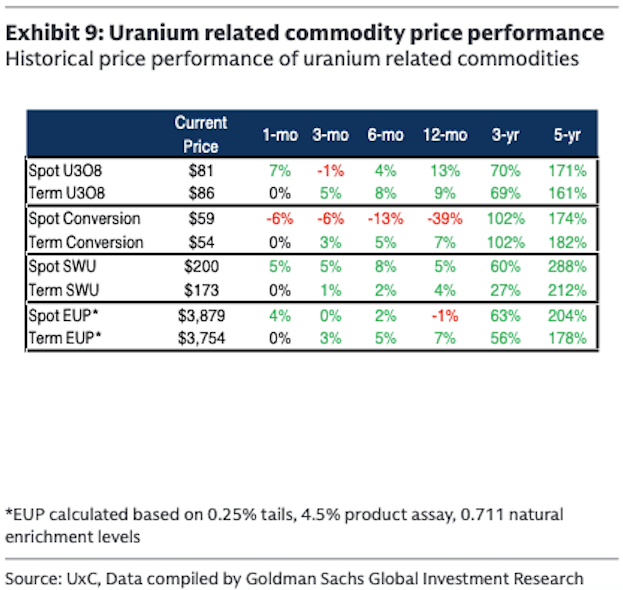
As also noted by Goldman Sachs, the tightening of supply from Russia for U3O8 and conversion/enrichment services has sent prices almost straight up over the past few years since the start of the Ukraine-Russia war. 

The other two awardees of the recent enrichment contract, General Matter and Orano, have yet to provide explicit details as to where the $900 million will be spent.

Like USAR, which we learned had received a massive $1+ billion investment from the US government, Centrus (ticker LEU) is one of the most shorted names in the market, with 25% of its float shorted…

… and we expect to see a major squeeze when it opens for trading tomorrow, especially since it is one of the most popular retail-held stocks according to JPMorgan; in fact just on Friday we listed it as one of the 20 most likely stocks according to JPM to rip in a major short squeeze.

Tyler Durden
Sun, 01/25/2026 – 21:35