45.2 F
Chicago
Sunday, November 8, 2026
Home Blog Page 895

The Wrong Solution: AI Productivity, Employment, & UBI

0
The Wrong Solution: AI Productivity, Employment, & UBI

Authored by Lance Roberts via RealInvestmentAdvice.com,

It is expected that AI productivity increases will vastly transform the U.S. economy. Firms are utilizing AI productivity enhancements to automate repetitive tasks, and research and coding functions have already been implemented. The obvious problem is that when machines perform functions once done by humans, what are the humans supposed to do for income? This increase in AI productivity is measurable across various sectors, as supply chains operate more efficiently, data analysis accelerates, and customer service utilizes automated agents to streamline tasks. Manufacturing, once considered a stable sector of the economy, is increasingly using robotics to reduce labor costs. Professional services are also increasingly displacing workers in medical, legal, and other areas of the service economy to improve output (read: profits) per worker.

This is not a new thing. It has been accelerating since the invention of the fax machine and phone answering devices. The use of AI productivity-enhancing technology is becoming increasingly apparent. But as shown, the shift by corporations to focus on worker productivity is ongoing.

Recent corporate statements confirm this shift. At a 2025 financial conference, JPMorgan Chase reported that AI adoption doubled productivity gains in certain operations from 3% to 6%, with some roles seeing efficiency increases of 40% to 50%. Other banks said AI allows them to accomplish more work with the same headcount.

In theory, the promise of AI productivity increases is alluring. While firms can produce more with fewer inputs, humans will have more time to pursue education, leisure, and spend time with their families, increasing overall health and happiness. Again, that is theory, and the subject of today’s commentary.

Productivity Set To Surge

The strict definition of “productivity” is the output per unit of input. In other words, if output rises, it should correspond to an increase in employee compensation, as economic demand leads to the production of more products. Since 1947, a correlation has existed between economic output and the 3-month average of the annual rate of change in employee compensation.

Between 2004 and the pandemic, annual labor productivity growth averaged just 1.5% per year, significantly below the pace required for sustained real wage improvement. Recent gains measured in 2023 showed a temporary uptick; however, whether this marks a trend driven by AI rather than short-term business cycles remains unclear.

Furthermore, emerging research suggests that AI has the potential to deliver significant productivity improvements. A study of generative AI usage found that average workers using tools like ChatGPT completed tasks 40% faster with higher quality, implying substantial productivity enhancements when AI is integrated into work processes. The Federal Reserve Bank of St. Louis estimated that generative AI contributed a roughly 1.1% boost to aggregate productivity, with individual workers saving multiple hours per week on routine tasks. Lastly, a TIME-published analysis of Anthropic research suggests that AI has the potential to double U.S. labor productivity growth, increasing it by approximately 1.8% if widespread adoption occurs.

These projections also align with broader institutional forecasts. The IMF reports that AI could significantly impact nearly 40% of jobs worldwide, presenting both opportunities and risks for income growth and inequality. Yet, productivity gains alone do not automatically lead to wage increases or employment growth.

The Problem

The problem arises when productivity increases without a corresponding demand for labor. AI operates without downtime, 24/7, and does not require traditional wages, benefits, or breaks. If AI performs tasks that previously employed millions of workers, the question of how displaced workers earn income becomes central. Corporate leaders acknowledge this challenge. Federal Reserve Chair Jerome Powell has highlighted the unpredictability of AI’s impact, noting that productivity gains may come with labor market disruptions that current policy tools are ill-equipped to manage.

Historical examples show how technological shifts displace workers in the short term. For instance, during the “Industrial Revolution,” artisans lost jobs to mechanized production. Horse‑drawn carriage drivers disappeared with the advent of automobiles. Yes, workers eventually moved into new fields, but the transition involved hardship and community upheaval. Automation in prior eras often created new kinds of jobs, but the pace and breadth of AI disruption could set this wave apart. Instead of merely replacing manual labor, AI now substitutes for tasks across both blue-collar and white-collar jobs. Research by Oxford economists Carl Frey and Michael Osborne highlighted that many occupations have tasks that are susceptible to automation, and could disappear entirely.

Compounding the challenge, since the late 1970s, productivity gains started diverging from typical worker compensation. According to the Economic Policy Institute, productivity growth far outpaced wage growth for the median worker, signaling that gains from technology and economic expansion have accrued disproportionately to capital owners and high‑skill labor. This productivity-pay gap signals that, even before AI’s full impact arrives, workers were not sharing equitably in productivity-driven prosperity.

The pace of technological change means millions of Americans face an uncertain labor market. Young workers entering the workforce find fewer traditional hiring pathways and rising expectations around digital and AI‑related skills. Older workers frequently lack the time or resources to retrain in rapidly shifting skill environments. Across age groups, employers deploying AI experience reduced labor costs and increased productivity, which simultaneously puts pressure on wages and job security.

The reality is stark. The economy may grow, but how the gains are distributed will determine whether everyday Americans thrive or struggle. Without structural policy interventions, technological displacement risks widening income inequality and weakening labor market attachment. The promise of more leisure, education, and family time from productivity gains remains theoretical. If workers lack stable incomes, employment opportunities, or bridging support, the rest won’t matter.

But, this is where the “cries for UBI” become most vocal.

The Wrong Solution

Legendary investor Howard Marks has described AI’s impact on employment as “terrifying.” He emphasized that work provides purpose and identity beyond mere income. Notably, he stated that “…financial support alone will not replace the psychological and social benefits of employment.” That is a crucially important statement, which we now have the data to support. Universal Basic Income (UBI) is the default proposal to offset the impacts of increased AI productivity. The logic sounds simple enough: “If AI displaces workers, send checks to households to replace lost wages and economic stability returns.”

The problem is that the evidence does not support this conclusion.

Following the pandemic-driven shutdown of the economy, we sent checks to households, which was a form of Universal Basic Income. Many articles espoused the benefits of such an operation, but the results were far less appealing. Surging inflation eroded the benefits of the stimulus and left Americans far worse off than they would have been otherwise. However, other real-time tests have also yielded less than promising outcomes.

We previously discussed one of the UBI experiments, which found predictable results. Short-term relief did not translate into higher employment, improved skills, or long-term income growth. Cash transfers temporarily increased consumption but did not raise productivity, increase labor force participation, or improve economic mobility.

“Participants in the study generally did not use the extra time to seek new or better jobs—even though younger participants were slightly more likely to pursue additional education. There was no clear indication that the participants in the study were more likely to take the risk of starting a new business, although Vivalt points out that there was a significant uptick in “precursors” to entrepreneurialism. Instead, the largest increases were in categories that the researchers termed social and solo leisure activities.”

The Argument magazine also reviewed multiple studies on guaranteed income and reached a similar conclusion. While recipients reported lower stress and higher short-term satisfaction, these gains faded quickly. Employment outcomes showed little improvement, job search intensity declined in several cases, and participation in education and retraining did not rise significantly.

In other words, giving people money without purpose helped much less than promised.

The core flaw in UBI is structural, as it treats income as the problem. Employment is the real issue. Yes, work provides wages, but it also offers skill development, social structure, and a sense of purpose, along with long-term stability. A simple check replaces none of those, and unfortunately, as 2020 shows, when producers realize that checks are being sent, they raise prices to capitalize on it. In other words, an artificial increase in incomes will quickly be absorbed by higher prices (inflation), effectively rendering the UBI useless.

Here is the most critical point.

“An economy cannot function on transfers alone; production must precede consumption. UBI reverses this order.“

Cost also matters. A national UBI program large enough to offset AI-driven displacement would require trillions of dollars annually. Funding such a program would either require higher taxes, debt expansion, or both. While each option will reduce future growth, higher taxes reduce investment incentives, while increased debt raises interest costs and crowds out private capital. Neither path supports long-term prosperity.

UBI also weakens the labor signal. Wages communicate where labor is needed, and training follows opportunity. UBI dulls this signal by separating income from work, and, over time, workforce attachment erodes, skills decay, and reentry into employment becomes increasingly complex. This dynamic showed up repeatedly in pilot programs.

Most importantly, UBI avoids the hard work of reform. It sidesteps education reform, workforce retraining, mobility assistance, and pro-growth labor policy. It accepts displacement as inevitable and permanent. History shows this approach fails, and past technological shifts succeeded because workers moved into new roles. In other words, policy supported adaptation, not withdrawal.

AI productivity gains will demand active solutions, not government gifts. Skill development, apprenticeships, employer-based training, wage insurance, and mobility support. These tools address displacement directly, while UBI does not.

Defaulting to UBI is an admission of policy failure and signals surrender to the disruption rather than managing it. The United States grew prosperous by expanding opportunity, not replacing work with checks. That lesson remains relevant today as AI continues to reshape the economy.

Tyler Durden
Fri, 01/16/2026 – 14:20

LIS Technologies Launches $1.4 Billion Laser Uranium Enrichment Project In Tennessee

0
LIS Technologies Launches $1.4 Billion Laser Uranium Enrichment Project In Tennessee

LIS Technologies announced a $1.4 billion uranium enrichment project in Oakridge, Tennessee at the former iconic K-25 site, which until 1987 was a massive gaseous diffusion facility built for the Manhattan Project to enrich uranium-235 for atomic bombs. The company will set up shop on the 206-acre on Duct Island, which will be renamed to LIST Island.

Following the renaming of the 206-acre Duct Island to LIST Island and its redevelopment to house the Company’s commercial laser-based uranium enrichment headquarters, Oak Ridge, TN is expected to become the site of the world’s first US-origin commercial laser uranium enrichment facility, supporting U.S. utilities, next-generation reactor developers, and national defense requirements while helping to reestablish a resilient domestic nuclear fuel supply chain.

“Tennessee continues to lead the nation in advancing American energy independence, which is why innovative companies like LIS Technologies recognize our efforts through projects like this,” said Tennessee Governor Bill Lee. “By creating the Nuclear Energy Fund, we have uniquely positioned our state at the forefront of cutting-edge R&D, and I look forward to the positive impact this project will have for Tennesseans across our state.”

The company intends to break ground and begin site preparation and civil construction in 2026 subject to licensing, permitting, and final investment decisions.

LIST is targeting initial commercial operations before 2030, positioning its laser enrichment facility to meet accelerating demand for domestically sourced uranium enrichment.

LIST has partnered with Nano Nuclear to vertically integrate the nuclear fuel chain with reactor development and deployment. The companies are working together to commercialize the Kronos, Zeus, and Loki reactors and supply the necessary fuel for them to operate.

LIS Technology Inc., the only U.S.-origin and patented technology for laser uranium enrichment, Meets with Tennessee Governor Bill Lee. Nano Nuclear CEO Jay Yu is also present. 

As the push for US nuclear development goes into high gear, the 3rd-generation laser enrichment technology from LIST could be used to produce low enriched uranium (LEU) and high-assay LEU (HALEU) for use in both traditional commercial reactors and advanced reactors throughout the US. The Department of Energy is pursuing the revitalization of the nuclear supply chain due to a current heavy reliance on foreign imports to fuel the nation’s reactor fleet. LIST’s major advantage over its peers in the laser enrichment field is that its process is the only US-origin technology in development. 

LIST states they will pursue site characterization and the initial phases of construction during this calendar year. It is then anticipated the company will begin discussions with the NRC to submit an application for the new nuclear fuel facility.

Nano Nuclear, a developer of small modular reactors, first invested in LIST in 2024, which included an enriched uranium supply agreement between the two companies and a potential for future collaboration on fuel fabrication facilities. Nano is still exploring the potential for entering the fabrication market, but has yet to make any announcements regarding land acquisition or regulatory engagement.

Nano recently entered into an engineering agreement with Ameresco for eventual commercialization of their reactor designs, and most recently started the process for preparing the Loki design for use in space applications. Nano Nuclear acquired the Kronos and Loki designs from the now-defunct Ultra Safe Nuclear Corp during bankruptcy proceedings at the end of 2024.

Nano claims the Kronos design is in a high technical readiness state and is one of the leading high-temperature gas-cooled reactor designs in development. It is expected to enter commercial production by the end of the decade.

Tyler Durden
Fri, 01/16/2026 – 14:00

Democrats Fight To Keep Insurrection Myth Alive In New J6 Committee

0
Democrats Fight To Keep Insurrection Myth Alive In New J6 Committee

Authored by Jonathan Turley,

The new J6 Committee has started its hearings and, unlike the prior Committee, Republicans have allowed Democrats to select members to sit in opposition. That has led to sharp exchanges, but one of the more interesting occurred between Rep. Harriet Hageman (R., Wyo.) and Jamie Raskin (D., Md.). After Hageman got a witness to admit that no one was charged with incitement, Raskin made the clearly false statement that a few defendants charged with seditious conspiracy was the same thing as incitement. It is not.

Rep. Raskin triggered the confrontation by making a clearly false claim about one of those charged by the Biden Administration: “I would just commend to everybody the testimony of Pamela Hemphill, who was a convicted insurrectionist that was pardoned. She rejected her pardon.”

In reality, Hemphill was charged (like most of the rioters) with relatively minor misdemeanors. She pleaded guilty to one count of demonstrating, picketing, or parading in a Capitol building and received just 60 days in prison, 36 months of probation, and a $500 fine for restitution. She was never charged with insurrection or any felony.

Rep. Hageman pounced on the comment and asked former Justice Department prosecutor Michael Romano whether any January 6 protester had actually been convicted under the federal insurrection statute.

Romano tried to dodge the question but admitted that no one, not Trump nor any rioter, was ever charged with insurrection. Notably, after January 6th, there was a great amount of coverage on Trump and his aides being possibly charged with insurrection or incitement. Despite some of us noting that the speech was clearly protected under the First Amendment, the press portrayed such a charge as credible and heaped coverage on District of Columbia Attorney General Karl Racine, who announced that he was considering arresting Trump, Donald Trump Jr., Rudy Giuliani, and U.S. Rep. Mo Brooks and charging them with incitement. It never happened. The reason is obvious. It could not be legally maintained.

While the FBI launched a massive national investigation, it did not find evidence of an insurrection. While a few were charged with seditious conspiracy, no one was charged with insurrection.

The Supreme Court later reduced charges further by rejecting obstruction charges in some cases.

Yet that did not stop members and the media from repeating the false mantra that this was an insurrection, despite some of us immediately rejecting it as legally unsustainable. Indeed, Democrats used the false claim to seek to disqualify Trump and dozens of Republicans from ballots.

Now back to the hearing.

Hageman asked the witness, “Mr. Romano, did you prosecute anyone related to January 6th for engaging in an insurrection?” she asked. Romano responded, “No, congresswoman.”

That is when Raskin objected and tried to interrupt the confirmation that, in fact, there never was an insurrection or any such charges.

Hageman persisted, “So, Mr. Raskin’s statement that someone was a ‘convicted insurrectionist’ is actually inaccurate, isn’t that correct?”

When Romano again tried to pivot, she pressed further, “She wasn’t a convicted insurrectionist, was she?”

“For the crime of insurrection, no,” he admitted.

Raskin shouted, “Do you accept seditious conspiracy as insurrection?”

It was a telling statement.

For the record, I have long been a critic of sedition crimes. As I discuss in my book “The Indispensable Right: Free Speech in an Age of Rage,”sedition was a noxious import from Great Britain. British judges had balked at the effort to accuse citizens of treason for things like telling bawdy jokes about the queen in some pub.

However, putting that aside, the handful of charges for seditious conspiracy are not legally the same or even close to an insurrection charge. Rep. Raskin, a former law professor, must know that.

The provision in 18 U.S.C. 2384 has long been controversial because it is so sweeping and includes any effort “by force to prevent, hinder, or delay the execution of any law.” While the provision can also entail an intent to overthrow the country, the provision covers any interference with federal proceedings or laws.

Ironically, Raskin opposes the invocation of the Insurrection Act in cities like Minneapolis on the basis of the interference with federal officials in the enforcement of federal law. However, he seems to view this provision as endlessly malleable, so that anyone accused of hindering the execution of a federal law is an insurrectionist.

After January 6th, Justice Department official Michael Sherwin publicly declared that “our office wanted to ensure that there was shock and awe” in hitting people with a maximal level of charges. Yet, despite that “shock and awe” effort, not a single charge for insurrection was ever brought — an inconvenient truth for members like Raskin.

None of this excuses the outrageous riot that occurred on that terrible day. However, seeking to conform the criminal code to the political narrative serves neither the Congress nor the public.

Tyler Durden
Fri, 01/16/2026 – 13:40

ACLU And Celebs Release Cringe Appeal To Allow Men In Women’s Sports

0
ACLU And Celebs Release Cringe Appeal To Allow Men In Women’s Sports

Authored by Steve Watson via Modernity.news,

The American Civil Liberties Union has rolled out a new campaign pushing for biological males to compete in women’s sports, just as the Supreme Court takes up cases that could finally protect female athletes from unfair competition.

Featuring ‘stars’ including Megan Rapinoe and Naomi Watts, the ad frames this as a fight for “freedom,” when in reality it’s just another leftist assault on women’s rights and fair play.

The ACLU’s “More Than A Game” ad, launched during women’s basketball games on January 12, features celebrities and young people delivering lines like: “When you’re young, you believe that you can do anything. And then the world tries to set limits for you. Tell you what’s allowed, what is normal, who you’re supposed to be.”

It continues: “But on the field, the track, the court, here you get to be exactly who you want. Because at our core, we still are kids that just want to play. The go big game changers. The living, breathing fabric of this country.”

The ad closes with: “Supporting trans youth isn’t just about sports. It’s about freedom on and off the field. It’s more than a game.”

The campaign ties directly to Supreme Court cases challenging bans on transgender girls in school sports in West Virginia and Idaho.

Rapinoe has stated: “I am not going to be tricked into sacrificing hard fought civil rights protections because of anti-trans rhetoric. All women will be harmed if the Court rules against the young trans people at the center of these cases and I wanted to make unambiguously clear that I am on the side of equality and justice.”

Watts, whose child reportedly identifies as transgender, adds in the ad: “It’s about freedom.”

Of course, this completely ignores the real victims: female athletes robbed of opportunities, safety, and medals by males leveraging biological edges.

This push comes right after the Olympics finally acknowledged what everyone knows: men have inherent advantages over women in sports, leading to a ban on transgender athletes in women’s events. As we previously highlighted, the IOC’s policy shift was a win for science and fairness, highlighting decades of evidence that no amount of ideology can erase.

Former Olympic swimmer Sharron Davies, who spoke at a Supreme Court rally against male inclusion in women’s sports, slammed the ACLU’s arguments in one case, noting males’ inherent advantages like bone structure and reduced injury risk. “We cannot remove male physical advantage. NO male belongs in female sport. It’s cheating,” she posted. Davies emphasized: “The Supreme Court’s trans athlete ruling matters to women everywhere.”

Tennis legend Martina Navratilova blasted human rights groups like the ACLU for prioritizing trans demands over women’s rights: “Unreal how all these ‘human rights’ organizations are so willingly chucking women’s rights out the window…”

XX-XY Athletics, a brand championing women’s sports, fired back at the ACLU directly: “The only rights being violated when males compete in women’s sports are those of the women. You are fighting for the wrong side here.” They shared footage from rallies, underscoring the fight to keep sports fair.

Leftist campaigns like this one expose the hypocrisy: claiming to empower women while stripping them of hard-won spaces. Real freedom means safeguarding biology-based categories, not bowing to ridiculous woke pressure that endangers girls’ dreams and safety.

As the Supreme Court deliberates, this could be a turning point—rejecting the erasure of women’s rights in favor of common-sense protections for female athletes.

Your support is crucial in helping us defeat mass censorship. Please consider donating via Locals or check out our unique merch. Follow us on X @ModernityNews.

Tyler Durden
Fri, 01/16/2026 – 13:00

Shale Pioneer Harold Hamm Steps Back From Bakken After Decades

0
Shale Pioneer Harold Hamm Steps Back From Bakken After Decades

Harold Hamm says low oil prices are forcing a step he hasn’t taken in decades: shutting down drilling in North Dakota’s Bakken, according to Bloomberg.

“This will be the first time in over 30 years that Harold Hamm has not had an operation with drilling rigs in North Dakota,” he said. “That tells you a whole lot right there: There’s no need to drill it when margins are basically gone.”

The decision underscores how far conditions have shifted in the region that once defined the US shale boom. The Bakken was where Hamm showed that fracking could unlock oil long thought unreachable, helping transform the US into the world’s leading producer and reshaping global energy markets.

Bloomberg writes that the pullback reflects pressure across the industry. Even as Hamm backs President Donald Trump, producers are feeling the strain from policies aimed at pushing oil prices lower to fight inflation, at the expense of profitability.

Costs are rising just as prices fall. BloombergNEF estimates that a typical Bakken well now needs about $58 a barrel to break even, nearly 4% higher than a year ago. At the same time, US benchmark crude has slid about 25% over the past year to roughly $59, weighed down by fears of oversupply and expectations of more barrels entering the market, including from Venezuela.

Drilling activity has dropped nationwide, with US rig counts down 15% over the past year and the biggest reductions coming from the Permian Basin.

“A lot of people are assessing their activity in all the basins,” Hamm said.

He made clear the pause may not be permanent. “We’re price takers, as you’re aware — not price makers,” he said with a laugh. “See what we can get.”

Tyler Durden
Fri, 01/16/2026 – 12:00

Another $3.5 Billion For Gas Power Generation

0
Another $3.5 Billion For Gas Power Generation

Talen Energy is following in the footsteps of utility peers Vistra and Constellation by spending billions of dollars acquiring gas generation assets to expand their capacity and grow market share in the growing power demand market.

After spending about $3.5 billion to acquire gas generation capacity in Pennsylvania and Ohio back in July 2025, the company announced it spent another $3.5 billion to acquire two more gas facilities in Ohio. With the newly announced 2.6 GW added to last year’s 2.9 GW, Talen is getting just as aggressive as others with acquiring as much capacity as possible.

We previously discussed Vistra’s stock price popping after they purchased multiple gas plants for $4 billion, adding 5.5 GW to their portfolio across the US. The PJM market seems to be a focus of much of the capacity expansion efforts due to the extreme strain on the grid with data centers growing like weeds in places like northern Virginia. That acquisition is also in addition to their $2 billion Q4 purchase of seven gas plants for 2.6 GW.

Acquisitions by Talen and Vistra are still dwarfed by Constellation’s massive acquisition of Calpine announced one year ago. Acquiring 23 GW of mostly gas power, Constellation paid about $30 billion to further expand their generation capabilities. Constellation also currently holds ownership of the most commercial nuclear reactions in the US.

The frantic scramble to acquire as much capacity as possible, as quickly as possible, is due to the desperation for answering the demand from the US grid as it struggles to keep up with new demand growth not seen in decades due to electrification and AI data centers.

While it is far from being as dangerous as coal plants to the environment, gas generation is far from being considered as friendly as renewable and carbon-free sources like wind, solar, geothermal, and nuclear. This is one of the main reasons nuclear energy has come back into the conversation as more people than ever now approve of the use and construction of new nuclear power plants.

But, with data centers being built right now, the only way to meet their current demands is with gas and existing nuclear while the industry prepares to transfer to new and advanced nuclear in the future, most likely after 2030. There is a general concern that the nuclear bullishness of the Trump administration could be overridden by a left-wing government should parties switch after the next election, but due to nuclear being one of the most “purple” means a power production, those fears could be mostly over blown. 

Regardless, Energy Secretary Chris Wright is promoting and pushing nuclear developments harder than anyone since Admiral Rickover, with the near-term potential to bring at least three new reactor designs critical by July 4 of this year.

Tyler Durden
Fri, 01/16/2026 – 11:25

Underwater Auto Trade-Ins Reach Record Highs: Edmunds

0
Underwater Auto Trade-Ins Reach Record Highs: Edmunds

Authored by Rob Sabo via The Epoch Times,

A record number of automobile owners are carrying negative equity of $10,000 to more than $15,000 into trade-ins on new vehicles, according to online vehicle data analytics website Edmunds.

In the fourth quarter of 2025, a record high of 27 percent of vehicle trade-ins involved negative equity of at least $10,000, Edmunds reported on Jan. 15. Just more than 17 percent of trade-ins involved loans with $10,000 to $15,000 of negative equity, while 9.2 percent of trade-ins had loan balances exceeding $15,000.

Negative equity on auto loans is commonly referred to as being “upside down” or “underwater,” a situation where the vehicle is worth less than what’s currently owed on the loan. Nearly 30 percent of all vehicles traded in during the fourth quarter of last year carried some amount of negative equity, Edmunds said. It’s the highest amount of underwater loans on record since the first quarter of 2021, when nearly 32 percent of trade-ins carried negative equity.

The average negative equity of $7,214 that was rolled over into new auto loans in the fourth quarter was the highest amount ever recorded.

Ivan Drury, director of insights at Edmunds, said carrying negative equity into a new auto loan can be a difficult cycle to escape.

“Rolling debt forward may offer short-term relief, but it often leaves buyers with higher payments, and fewer options the next time they’re in the market,” Drury said in the report.

“Avoiding that cycle generally comes down to fundamentals: understanding how much a vehicle is worth relative to what’s owed, choosing purchases that hold their value and align with long-term needs, and recognizing that focusing only on monthly payments can obscure the true cost of a purchase.”

The all-time highs on upside down loans come at a time when more Americans are being approved for auto loans. According to Cox Automotive, the overall approval rates for auto loans in December 2025 jumped 90 basis points from a month earlier, to roughly 74 percent. Loans to riskier subprime borrowers—applicants with fair to poor credit scores—dipped slightly, to just more than 14 percent, Cox Automotive noted. However, subprime lending was still up by 230 basis points from year-ago figures.

Jonathan Gregory, senior manager for Cox Automotive’s economic and industry insights team, said borrowers should take a broad view of total ownership costs when evaluating loan offers.

“Ongoing improvement in credit access, especially in both the new and used markets, continues to offer financing opportunities,” Gregory said in a Jan. 12 analysis.

“While approval rates increased, the slight decline in down payments combined with longer loan terms may indicate stretched affordability.”

The amount of down payment borrowers brought to auto loans dipped slightly in December, to 13.3 percent, Cox Automotive noted.

Edmunds said the imbalance in auto loans largely stems from loans taken out during the COVID-19 pandemic, when chip shortages led to a dearth of new-vehicle inventory and pushed automobile prices higher. As those borrowers seek to upgrade their vehicles, more are finding themselves significantly underwater, Edmunds said.

“Loans that originated when prices were elevated are now aging into a market where values are no longer inflated, making the gap between what many buyers owe and what their vehicle is worth more apparent,” the report states.

“Combined with higher borrowing costs in today’s market, that dynamic has left more buyers facing steeper financial trade-offs when it comes time to replace a vehicle.”

Tyler Durden
Fri, 01/16/2026 – 11:05

Canada’s PM Carney Praises “New World Order”; Opens Door To Chinese EVs

0
Canada’s PM Carney Praises “New World Order”; Opens Door To Chinese EVs

The invasion of Chinese electric vehicles into North America is set to accelerate after Canadian Prime Minister Mark Carney agreed to roll back the triple-digit tariffs previously imposed on Chinese EVs. The move sharply diverges from President Trump’s America First policy, which aims to revitalize the North American auto industry. While Chinese EVs remain effectively blocked from US import, there has been a noticeable increase in BYD Motor vehicles on highways in Mexico.

Canadian Prime Minister Mark Carney, who appears to have deep ties with Beijing, was the first prime minister to visit China since 2017 and is seeking a major thaw in relations after years of tense diplomatic and trade ties.

Carney’s move abandons the 100% tariffs on Chinese EVs imposed by former Prime Minister Justin Trudeau in 2024, replacing them with a 6.1% rate capped at 49,000 Chinese EVs. In 2023, China exported 41,678 EVs to Canada. The shift in trade policy will certainly capture the Trump administration’s attention.

“In order for Canada to build our own competitive EV sector, we need to learn from innovative partners, access their supply chains and increase local demand,” Carney told reporters after talks with President Xi Jinping.

Carney may have given the wrong answer. Logically, if Canada wanted to build out an EV sector, it would turn to American expertise, such as Tesla, Rivian, Lucid, or even legacy Detroit automakers. Instead, that does not appear to be the case, raising questions about where Carney’s allegiance truly lies, whether with the East or the West.

A recent report via The Bureau’s Sam Cooper only suggests Carney’s allegiance points towards Beijing…

And there it is…

“The world has changed much since that last visit, I believe the progress that we have made in the partnership sets us up well for the new world order,” declared the Prime Minister of Canada.

Also during his Beijing trip, Carney told Zhao Leji, the third-highest ranking member of the CCP, “We’re heartened by the leadership of President Xi Jinping and the speed with which our relationship has progressed,” Reuters reported.

He added that recent trade friction forced Beijing to slap 100% duties on Canadian canola oil – also known as rapeseed oil – as well as other ag products, with 25% on pork and seafood.

“China used to be the largest market for Canadian canola seed,” Carney said. “We want to not just return to those levels, but to surpass them.”

It appears Carney has not learned the lesson from Europe, where flooding the market with Chinese EVs helped decimate automakers across the continent.

Tyler Durden
Fri, 01/16/2026 – 11:00

Trump Says Wants To Keep “Hassett Where He Is” Sending Warsh Fed Chair Odds Soaring; Gold Slides

0
Trump Says Wants To Keep “Hassett Where He Is” Sending Warsh Fed Chair Odds Soaring; Gold Slides

In a strong hint ahead of Trump’s decision later this month who the next Fed chair will be, the president appears to have hobbled the chances of one of the Kevins when he said that Kevin Hassett was “fantastic on TV today”, and Trump wants to “keep him where he is” since “Fed officials don’t talk much” while Hassett is “good at talking.”

“I actually want to keep you where you are, if you want to know the truth,” Trump told Hassett during a White House event.

“If I move him, these Fed guys — certainly the one we have now — they don’t talk much. I would lose you. It’s a serious concern to me.”

The news promptly sent Kevin Warsh’s Polymarket up to 54% from 34% previously making him the favorite, while Hassett tumbled from a 34% chance to be nominated to a 16% chance, below Chris Waller whose odds also jumped, from 9% to 18%.

And since Warsh is generally viewed more hawkish than Hassett, we have seen an instant jump in the Dollar index…

.. and a slide in gold.

…as rate-cut expectations plunge…

Tyler Durden
Fri, 01/16/2026 – 10:51

US Industrial Production Surged To End 2025

0
US Industrial Production Surged To End 2025

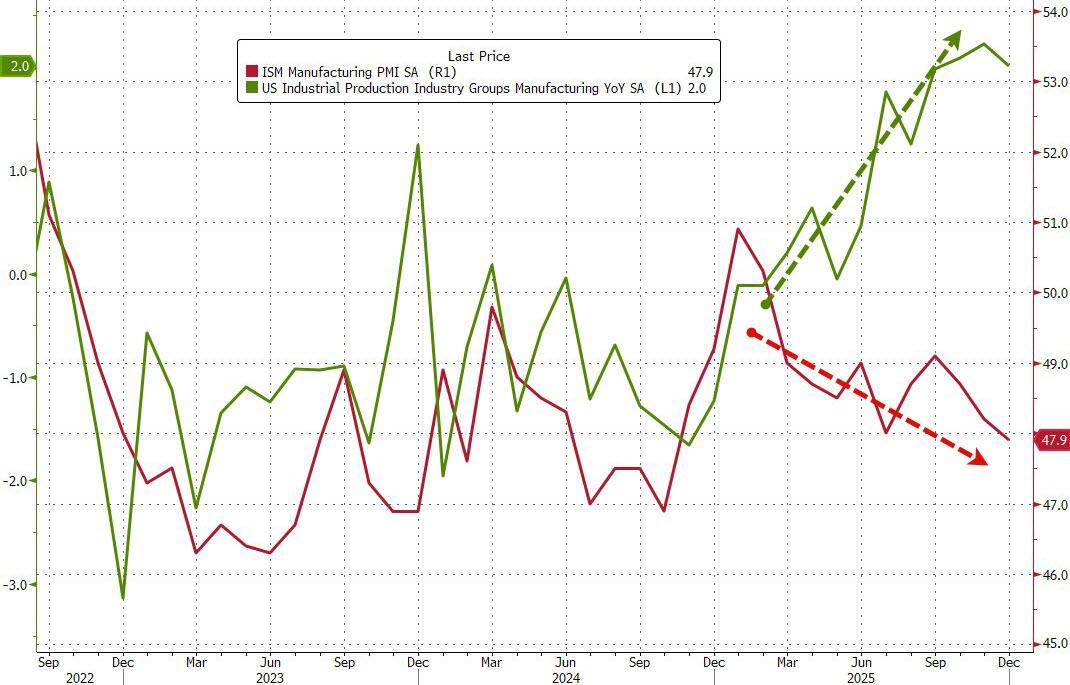
While ‘soft’ survey data has been disappointing, hard macro data has been resilient and Industrial Production ended 2025 on a bright note with a 0.4% MoM surge in December (considerably better than the +0.1% MoM expected) complementing November’s 0.4% MoM rise. This left industrial production up 2% YoY…

Source: Bloomberg

The index for utilities increased 2.6 percent in December, supported by a rise of 12.0 percent in the index for natural gas…

US Manufacturing output also rose more than expected, +0.2% MoM vs -0.1% MoM exp.

Source: Bloomberg

Capacity Utilization also rebounded in December, seemingly breaking the downtrend…

Source: Bloomberg

This ‘positive’ macro news seems at odds to the soft survey data that suggests the end of the world.

Finally, rate-cut expectations are lower still following this ‘good’ news.

Tyler Durden
Fri, 01/16/2026 – 09:23