Having broken hand held above 160/USD, this morning (as the G20 meeting comes to an end), the yen is suddenly spiking higher, prompting desk chatter of another intervention…
There was no obvious news or macro catalyst for such a move, and for now, there is no follow through but it appears 160 is the new line in the sand for the Bessent/BoJ plunged protectors.
Some traders suggested it was a simple stop-hunt (which could still be instigated by ‘authorities’).
Tokenmaxxing Turns To Layoffmaxxing: Uber Slashes Thousands In “Significant” Overhaul
Bloomberg obtained a letter from Uber Technologies CEO Dara Khosrowshahi to employees announcing “significant organizational changes” across the company aimed at reallocating spending toward delivery, artificial intelligence, and an increasingly expensive robotaxi buildout.
“Today, we’re making several significant organizational changes across Uber. We are removing layers, simplifying team structures, refining our global location strategy, and focusing our people and investments against the biggest opportunities ahead of us,” Khosrowshahi wrote in the letter.
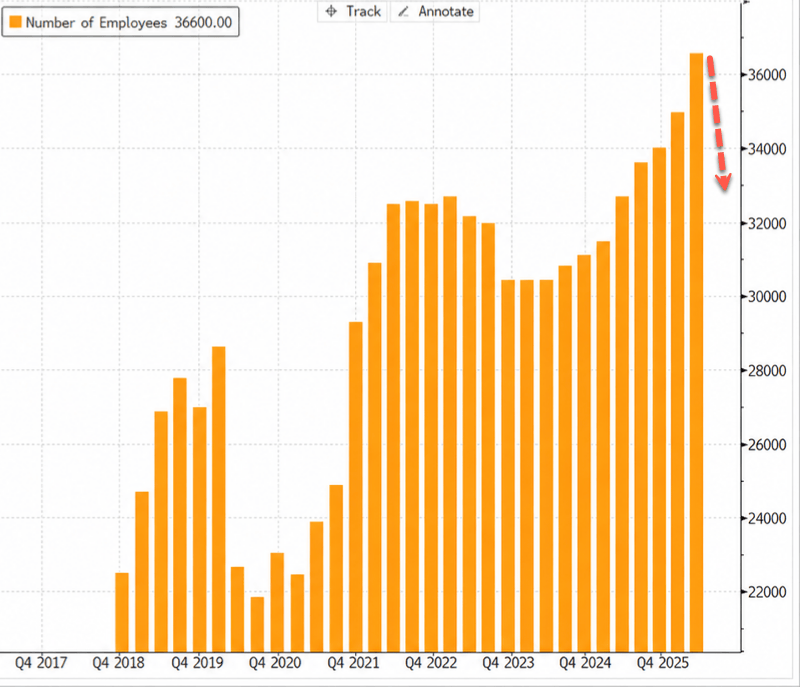
The latest Bloomberg data show that, as of 2Q26, Uber employed 36,600 people across its global workforce, meaning a 10% cut equates to about 3,600 workers.
Uber will eliminate nearly half of its teams with only one or two members and reduce by 20% the number of employees positioned seven or more organizational layers below the CEO. In other words, the restructuring is impacting white-collar workers that AI agents can likely replace.
The company is also combining engineering and science teams while consolidating its separate restaurant, retail, and white-label delivery operations.
There was a report earlier this year that Uber had blown through its AI budget within the first few months of the year after encouraging employees to use frontier models as aggressively as possible.
Savings from the restructuring will be reinvested in Uber’s core ride-sharing and delivery platforms, as well as the company’s effort to build what Khosrowshahi called an “autonomous future.”
Uber has pledged to invest more than $10 billion in robotaxi partnerships over the coming years as it seeks to become the dominant top player for summoning autonomous vehicles. The company has already invested in Avride, Lucid, Nuro and Rivian while reducing stakes elsewhere to free up capital.
WAYMO IS FIGHTING THE ROBOTAXI WAR WITH AN EXPENSIVE & CLUNKY PROOF OF CONCEPT COMPARED TO A SLEEK TESLA MODEL
Eight boxy Waymos. One million dollars.
Each one a $125,000 science project: lidar hats, radar arrays, custom compute, a chassis that still costs more than some… pic.twitter.com/jkYTD78rJ3
Today, we’re making a number of significant organizational changes across Uber. We are removing layers, simplifying team structures, refining our global location strategy, and focusing our people and investments against the biggest opportunities ahead of us. As a result, we will be reducing the size of our team by about 10%. Everyone whose role has been affected has already been notified, except in countries where we will follow the required local process.
This wasn’t a decision we made lightly, because it will have a real impact on our teammates and friends who have worked hard for Uber. It’s important to say that these changes are about how we’re organized and what we’re prioritizing, not about anyone’s contributions to Uber, which we always value.
I’m sure you’re asking, ‘Why, and why now?’—particularly since our business is performing so well. Over the last 5+ years, Uber has grown by orders of magnitude, with our top line nearly tripling. We’ve built new products, expanded into new businesses, reached more consumers and supported more earners, and become a much larger and stronger company. But that growth has also brought complexity: more layers, more coordination, more fragmented ownership, and in some cases structures that made sense when businesses were smaller but no longer serve us well at our current scale.
Our opportunity from here is enormous: we have the chance to bring Uber to hundreds of millions more people; to invest even more in drivers, couriers and merchants; and to innovate across our core businesses and build the autonomous future.
To do those things, we need to make deliberate choices about where we put our people, our time, and our capital.
The changes we’re making today are designed to do two things: make Uber simpler and faster, and create more capacity to invest in our future. A leaner organization will mean clearer ownership, faster decisions, and more time spent building rather than coordinating. It will also generate savings that we intend to reinvest in growth, innovation, and the capabilities that will matter most over the coming years.
It’s our job as leaders to make these difficult calls, and to give you transparency into our thinking and our decision-making process. Here’s what we are doing and why:
Organizational health: In Pulse surveys and conversations with many of you, we’ve heard that too much work requires coordination across teams, debates take too long, and decision-making rights are unclear. I’m sure many of you have felt that you spend too much time “aligning” rather than building, shipping, or serving customers. To improve this, we have reduced roles primarily focused on coordination, and have clarified the remit of the coordination roles that remain. We also cut down the number of management layers by broadening manager scopes, particularly where we had “micro-teams” of only 1-2 reports. In all, we’ve reduced the number of employees who sit 7+ layers from the CEO by 20% and the number of micro-teams by nearly 50%. The outcome is a simpler org chart geared toward building versus managing.
Team simplification: We brought together teams where fragmentation was creating duplication and slowing decisions. The most significant example of this is Mac’s decision to combine our three current Delivery Ops teams (across Restaurants, Retail, and Direct) into single-threaded teams at the global, regional, and country levels. Running these three businesses separately made sense in their early days, but that structure is no longer serving us at scale. Bringing the P&Ls together under single owners will reduce overlap, clarify accountability, and allow GMs to allocate capital more efficiently and effectively based on their strategic imperatives. Another example of this: in Tech, we’re combining our Core Services Engineering and Science teams, mirroring the structure we already have on Mobility and Delivery.
Location strategy: The benefits of sitting together, collaborating in person, and solving problems as a team are clearer than ever in our post-Covid world. With that in mind, we’re establishing clearer principles for where roles and teams should be based, with the goal of concentrating teams in a smaller number of key hubs. Global teams will be concentrated in our largest global hubs, NY and SF; regional teams in designated regional hubs; local teams in country hubs; and tech teams in tech hubs. We’ll prioritize co-location between managers and their teams wherever possible, particularly for earlier-career employees. We are also asking the vast majority of remote employees to move to an office, and going forward, only ~1% of employees will be remote. We’ll also continue to reinforce compliance with our hybrid work policy, which requires three days a week in the office. You can read more about our location strategy here.
I realize this is a lot of change, but we decided it was better to make one big shift rather than multiple small ones. We also know organizational changes can be hugely distracting, and our job is to create an environment that allows you to focus and do your best work. With these decisions now made, our focus is on the future.
We have tremendous momentum, significant financial capacity, and opportunities in front of us that are larger than at any point since I joined the company. The decisions we’re making today are difficult, but they will help us build an even stronger Uber for the years ahead.
You can read more about the changes across the company here, and please be sure to read specific follow-up information you’ll receive from your leaders about what this means for your team, so we can all keep building together.
Uber on,
Dara
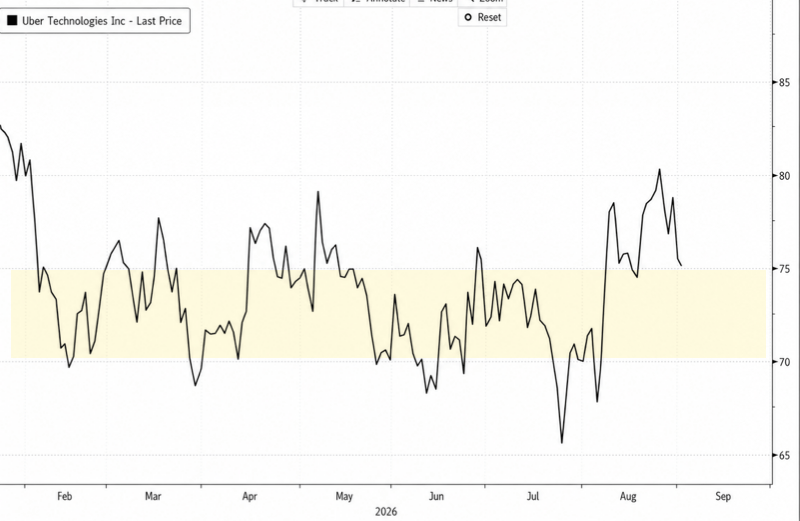
The restructuring follows a subdued stretch for Uber shares this year, which were down 8% year-to-date through Tuesday’s close after trading largely range-bound between $70 and $80.
The market welcomed the cost-cutting measures, with shares gaining nearly 2% in premarket trading in New York.
It was carried out to justify the German economy’s evolution to war footing, distract from the resultant problems, and legitimize a future serious escalation against Russia.
Germany blamed Russia for last month’s incident in Leipzig when one explosives-laden drone was found on the tarmac in proximity to Ukrainian cargo planes, another reportedly collided with a separate cargo plane as it tried to land but failed to explode, and a third was later found close to the premises. Putin condemned their claim, shared his opinion that it was a false flag due to them planting evidence, and speculated that the motive was to distract from domestic problems by fearmongering about Russia.
While skeptics might roll their eyes, the Leipzig incident has all the hallmarks of a false flag.
For starters, Germany is implying cartoonish incompetence on the part of Russia. The public is supposed to believe that the most skilled drone operators in the world, who were tasked with what would have been the most sensational HybridWar attack on NATO ever, left a drone on the tarmac, got unlucky when another failed to explode after it hit a landing cargo plane, and left another nearby. That’s difficult to believe.
The second point to make in support of Putin’s hypothesis is that something similar happened last fall when unknown drones forced major airports in Scandinavia to temporarily ground all flights. Zelensky predictably blamed Russia and called for closing the Danish Straits to its shipping. As with the Leipzig incident, no evidence was ever shared in support of that claim, but it served as the precedent to blame Russia for mysterious drone-related incidents in Europe in order to justify more escalations against it.
And finally, while Zelensky’s proposed escalation ultimately never came to fruition (most likely to avoid a hot NATO-Russian war), an escalation of some sort might follow the Leipzig incident. It was argued here in late August that NATO would expect to gain more from a serious escalation with Russia than the inverse, which could take the form of resuming summer’s failed drone campaign against Russia at scale indefinitely in pursuit of its deindustrialization and demilitarization. That might be attempted next year.
To recap the explanation of Putin’s false flag hypothesis, last fall’s Russian drone scare in Scandinavia served as the pretext for blaming the Kremlin for future such incidents without evidence, which Germany has now done with the Leipzig one. The narrative of Russian drone operators’ incompetence is difficult to believe, however, but it’s still being pushed to justify the Germany economy’s evolution to war footing, distract from the resultant problems, and legitimize a future serious escalation against Russia.
As was written, this could take the form of resuming summer’s failed drone campaign against Russia at scale indefinitely in pursuit of its deindustrialization and demilitarization, but that risks crossing Russia’s nuclear threshold per its updated doctrine. At the very least, Putin would once again mildly “escalate to de-escalate” against Ukraine, but there’s always a chance that everything spirals out of control. It would therefore be best for Germany to eschew escalation just like the Scandinavian states ultimately did.
Bloomberg Agri Index Posts Biggest Monthly Jump Since Arab Spring Riots As Food-Crisis Risks Mount
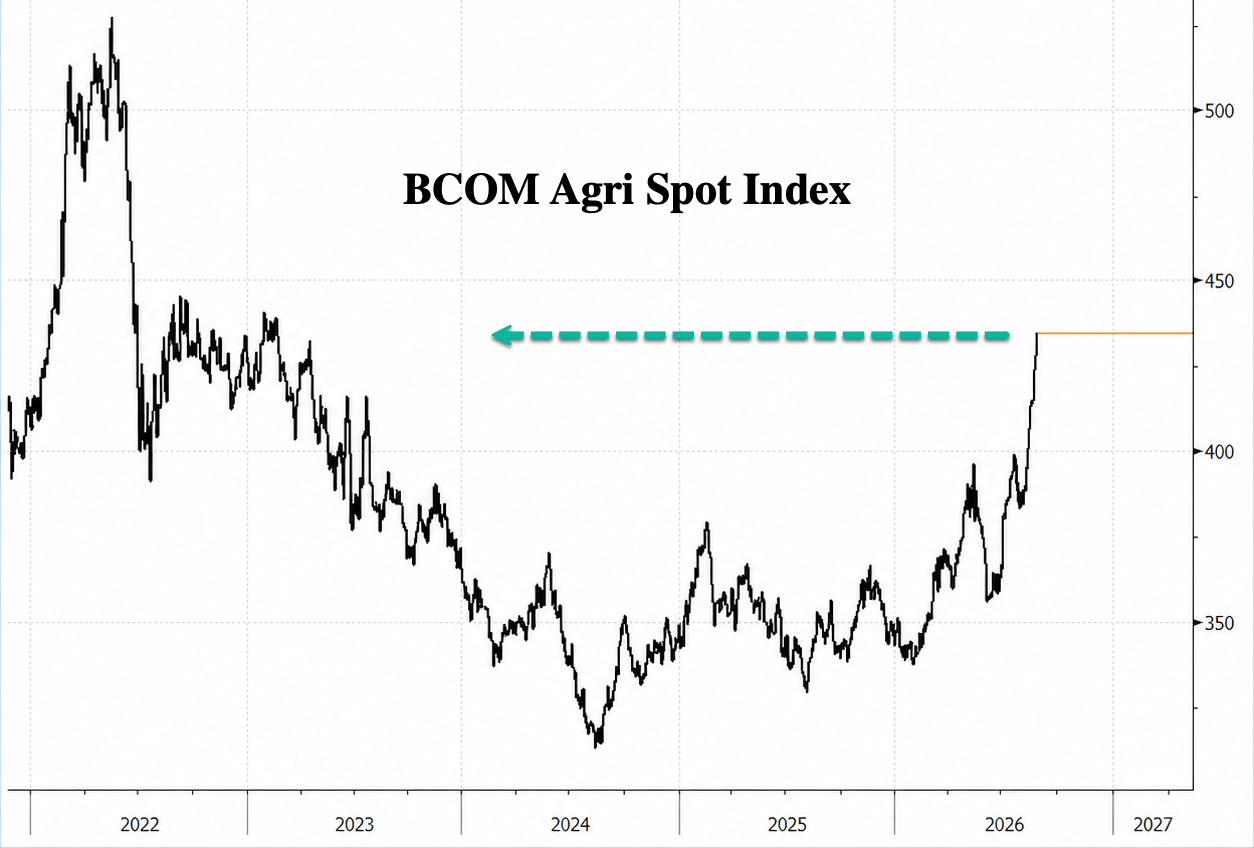
The Bloomberg Agriculture Spot Index (BCOMAGSP) posted its largest monthly gain since the chaotic days of the Arab Spring riots and is nearing a breakout above its 2023 highs, signaling a broad-based acceleration in agricultural commodity prices. The upside momentum comes as Wall Street increasingly warns that a perfect storm of factors, from El Niño and higher fertilizer and diesel prices to disruptions in the Black Sea and the Strait of Hormuz, could push the global food system toward another crisis.
From veteran commodities strategist Jeff Currie turning bullish and UBS urging clients last week to “position for a commodity upcycle” to warnings from Barclays analyst Craig Rye and JPMorgan analyst Nora Szentivanyi, the message from Wall Street is becoming increasingly harder and harder to ignore: Agricultural prices are breaking out, raising the risk that today’s physical commodity squeeze develops into a worldwide food crisis next year.
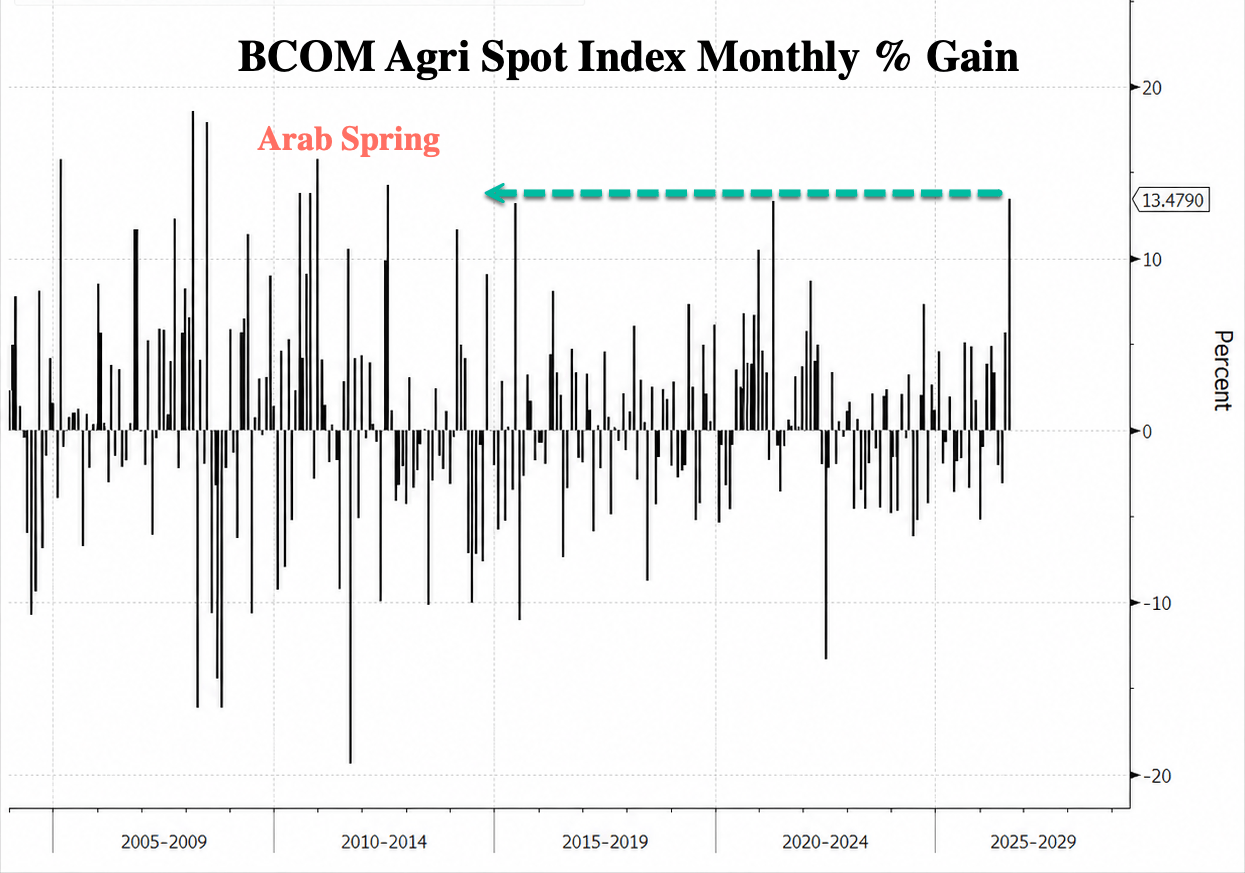
For August, BCOMAGSP logged an impressive 13.5% gain, its largest monthly increase since July 2012’s 14.3% gain – around the time of Arab Spring spread across Egypt, Libya, Yemen, Syria, and Bahrain.
BCOMAGSP is up 39% from its 2024 low. If the upside momentum continues, the index, which tracks major crops and soft commodities, is poised to take out its 2023 highs.
1. Hormuz tanker strikes send Brent above $92. Two oil tankers were struck in the Strait of Hormuz overnight. Brent traded around $92.20, up roughly 2%, while WTI traded between $87.80 and $88.00, up approximately 2.3% to 2.6%.
2. Gold falls below $4,400 as the 10-year yield approaches 4.79%. Spot and futures gold traded between approximately $4,370 and $4,400, down roughly 1.3% to 1.9% following Warsh’s hawkish Jackson Hole remarks. Markets are pricing in approximately 60% odds of a September hike.
3. Silver breaks into the $65 range, while palladium fares worse. Silver traded between approximately $64.70 and $65.40, down 2.4% to 2.7%; palladium traded around $1,340, down roughly 2.8%; and platinum traded around $1,768, down approximately 1.5%. Gold and silver are selling off together with rising yields, suggesting this is not an isolated gold ETF liquidation.
4. Chinese refiners bid ESPO to a $7 premium over Brent.
6. Long-term uranium hits another all-time high at approximately $96.50 per pound. The blended UxC and TradeTech long-term U3O8 price reached $96.50, while the UxC long-term price rose $2 to $96. Spot uranium traded between approximately $89.60 and $89.75, up roughly $3.
7. Distillate tightness remains the underreported oil story. Heating oil traded around $4.46, up 1.1%, while gasoline gained only 0.4% to approximately $3.09. Older but still relevant research continues to circulate showing US distillate inventories at 23-year lows and 13% to 14% below seasonal norms. Crude inventories are 6% below the five-year average following an eight-week, 47.5-million-barrel draw.
8. US Henry Hub remains weak at $2.92, while TTF and UK gas surge. NYMEX natural gas traded around $2.92, down 0.3%; TTF traded around €71.50, up 2.4%; and UK gas surged approximately 7%. US natural gas remains the orphan of the energy complex.
10. Copper slips roughly 1% despite the oil shock, highlighting the split between growth concerns and physical tightness. COMEX copper traded between approximately $6.51 and $6.61, down roughly 1.2%. Prices remain near cycle highs, with an August peak of approximately $6.75 and LME copper near $14,400 per ton. The physical-tightness and US inventory-migration story from August is fading into a rates- and growth-driven market.
11. Long-term breakouts in wheat and soybeans remain in play. Chicago wheat gained approximately 1.5% to 2%, trading between roughly 772 and 785, while soybeans gained around 1%, trading between approximately 1,288 and 1,301. Soft-commodity commentary indicates that wheat, soybeans and sugar have made long-term bullish breakouts, while cotton remains offered.
12. The ISM Manufacturing PMI is today’s key event risk for the entire commodity complex. Foreign-exchange and commodity desks have flagged the ISM report as the session’s primary catalyst on top of Warsh and Hormuz. A strong print could increase the odds of another rate hike, inflicting further pain on gold and silver while producing a mixed response in copper. A weak print could trigger a risk-off move that still lifts oil if interpreted as stagflationary.
13. Trump’s SPR-for-Venezuelan-oil proposal and the country’s 65 billion barrels of reserves.
14. UAE refinery returns to full capacity after sustaining wartime damage.
15. Ukraine strikes the Ust-Luga oil terminal on the Baltic Sea.
16. Retail investors continue buying the gold dip, while CTAs and broader positioning appear offered.
Bessent Blames China For Derailing G20 Joint Communique
The Group of 20 finance meetings in Asheville, North Carolina, concluded on Tuesday after four days of discussions among finance ministers and central bank chiefs on global trade. The news late Tuesday was that China had derailed the group’s efforts to issue a joint communiqué by refusing to endorse specific language targeting trade surpluses and export-dependent economic models.
“The country with the world’s largest and unsustainable current account surplus, the People’s Republic of China, was the dissenter,” Treasury Secretary Scott Bessent told reporters.
Bessent added, “Non-market-based economies pushing out a never-ending spring of cheap exports is not sustainable.”
US and European officials told the Financial Times that Beijing objected to language intended to support the smooth functioning of global supply chains for energy, food, fertilizer and critical minerals.
Asked why China had opposed the language agreed upon by the group, a senior US official explained: “They are guilty. If we are worried about persistent distortions, they are the worst offenders. For the G20 to have something at 19-1 is unbelievable.”
The dispute over the communiqué, an official joint statement agreed to by all G20 members after a meeting that typically summarizes areas of agreement, economic concerns, policy commitments or priorities, and areas requiring further cooperation, offers another glimpse into the widening economic fracture between Beijing and the West. China’s staggering $1.2 trillion trade surplus in 2025 was up 20% from the previous year, as its heavily subsidized exports flood the West, such as cheap EVs produced by BYD Motors.
What the breakdown suggests is that Beijing remains unwilling to rebalance an economic model built around industrial overcapacity, state-directed financing, weak household consumption and relentless exports. For the US and Europe, the concern is becoming a national security priority as industrial bases are hollowedout while governments attempt to rebuild domestic supply chains.
“It came down to a few words. As we have seen with the Chinese, they try to slow things down and methodically change the nomenclature. We’re not going for that,” a senior US official told the FT. “They need to seriously reconsider this. If they can’t even agree on words, they certainly won’t be able to deliver on any action.”
China also objected to any mention of “critical minerals,” according to the officials.
Last year, Beijing introduced sweeping new global export controls on critical materials after Trump slapped tariffs on China. Two critical materials subject to export restrictions, tungsten and germanium, among others, have only led to severe tightening across global physical markets.
President Donald Trump and President Xi Jinping are set to meet on Sept. 24 in Washington, DC, as increasing hostilities have already emerged over Bessent’s economic campaign against Iran and sanctions against Chinese entities. A Politico report last week detailed how US lawmakers are pressing Bessent to target large Chinese banks over Iran. Any such effort could come after the Trump-Xi meeting.
If Bessent targeted Chinese banks over their involvement with Tehran, we would expect Beijing to further tighten supplies of critical materials to the West, which is why we launched our decoupling theme, focusing on the top ex-China miner.
FBI Now Says Past Prostitution And Theft May Not Disqualify Applicants
The FBI has reportedly loosened some of its automatic disqualifiers for prospective employees, allowing applicants with certain past conduct to be considered on a case-by-case basis, according to The Times Of India.
Under the revised standards, previously hiring a sex worker is no longer necessarily disqualifying. Applicants may still be eligible if it happened fewer than three times and the most recent incident was more than 10 years ago.
The change partly accounts for cases in which prostitution was legal where it occurred. However, soliciting prostitution while holding certain positions of trust, including jobs in law enforcement, education, health care, finance or law, can still result in automatic rejection.
The Times of India article says that past theft from an employer may also be overlooked if it occurred more than three years ago.
The FBI has also reportedly changed how it treats incidents involving bestiality or animal cruelty, allowing consideration when the conduct occurred before the applicant turned 18.
The bureau pushed back on suggestions that it is lowering its overall standards or opening the door to applicants with histories of criminal sexual behavior. An FBI spokesperson said the changes partly address applicants who suffered sexual abuse and whose experiences could complicate polygraph questions involving prostitution, bestiality or similar subjects through no fault of their own.
The FBI maintains that it continues to impose some of the federal government’s strictest suitability requirements.
Remarkably, these were exactly the causes blamed in many tabletop exercises, including Food Chain Reaction Game 2015 – keynoted by none other than John Podesta – which, unsurprisingly, demanded “better global governance.”
But the genesis of this “new” food crisis, being used to justify an acceleration of gene-edited crops and other unpopular measures advancing the technocratic takeover of food, lies not in Russian aggression or CO2, but in bad policies and economic warfare against farmers for generations.
The Food Crisis is Coming from Inside the House
Though several novels could be dedicated to the systematic strangulation of British agriculture, I will highlight only a select few to paint the rough picture:
Inheritance Tax
While the UK’s general inheritance tax (IHT) sits at 40%, farms historically have been shielded from this by an “Agricultural Property Relief” policy. Family farms were handed down from one generation to the next, as has been done by humans since the dawn of time.
That ended on April 6, 2026.
IHT relief for agricultural property was capped this year to £2.5 million – which really doesn’t go far considering the value of farmland and requisite equipment. Everything thereafter is subject to an effective IHT of 20% on farm land and assets that are already running on a very thin margin. This is how a cash-poor, asset-rich farm gets sold to pay the tax bill.
This is staggeringly bad policy, forcing experienced farmers off their land. It is also, in my view, wholly immoral – but we’ll set that aside.
Unplugging the Life Support
The UK has cut off financial support from farms. Britain once paid farmers to grow food. The EU turned that into a land cheque called the Basic Payment Scheme (BPS). After Brexit, this subsidy to producers (now called ‘delinked payments’) was set to expire gradually over time, shifting instead to a “Sustainable Farming Incentive.”
While the BPS began at £180-£230/ha, resulting in an average payment of £28,400/year, the delinked payments are this year (2026) capped at £600. Yetthe SFI “replacing” it was shut down in 2025 when its budget was exhausted. Thousands of producers were left out to dry:
“We’d spent months putting the application together, we’d paid over £1,000 in agent’s fees, we were just doing the final checks. Then the government shut the applications down, without any warning.
“For us it is tens of thousands of pounds of lost income. We now have a massive black hole in our budget for this year,” added Mrs Godwin.
These payments to farmers to ensure food security, which began post-WW2 and upon which farmers became dependent, have been unceremoniously eroded. This, alone, has been a disaster for British producers, pushing many into a cash flow crisis.
Shutting Down Farms
Now that the farms were unprofitable, the UK went further, actively incentivizing some producers to stop farming their land and shed their livestock. This was achieved through a new Land Use plan which even the Guardian was forced to summarize as “taking farms out of food production:”
The January 2025 blueprint set specific goals: more than 10% of England’s farmland should stop producing food by 2050, with grassland for livestock taking the largest cut. Farms were incentivized to transition to hosting agritourism activities like glamping (glamour camping) or, worse yet, solar farms.
Right about now you might be shaking your head, “They set a goal of stopping farms from growing food?” Yes. Yes, they did.
The Knepp Castle Estate is one such example. Their homepage tells the story quite clearly. Where once winter wheat, barley, oats, maize were grown, and 600 dairy cows and sheep were raised, now one finds yurts available for rental:
Food security explicitly took a backseat to the 30×30 plan, as adopted at COP15, and the idea that land should be released back to nature and “rewilded.”
But … Putin’s Carbon Footprint!
Now, with yields indeed at historic lows, we see the headlines blaming Russia and climate change. We hear the National Farmers’ Union president Tom Bradshaw saying it “does feel like there is going to be some shortages,” and, in the same breath, that many producers may not have the cash to plant next year.
And yet, somehow, this entirely relevant backstory is lost, eclipsed by the administration’s rush to adopt gene-edited food and drone-surveilled precision agriculture.
They did not need to ban traditional farming. They simply made the farm economically unviable, paid producers to do anything other than produce, and are now calling the missing food a “climate emergency.”
While the British have been quite explicit about the process, fundamentally their actions have been unexceptional:
Don’t let them call this climate change. This food crisis was engineered through policy, and is now being marketed as weather.
And that is all the more reason we should be growing more food and redoubling efforts at creating lasting food security for our families and communities.
Mainstream Media Runs Spin Campaign As Deportations To Haiti Increase
When the Trump Administration ended Temporary Protection Status for migrants from 11 different countries, the mainstream media’s attention immediately gravitated to only one: Haiti.
It was the numerous problems surrounding the NGO and Biden organized surge of 15,000+ Haitian migrants into Springfield, OH that captured the interest of the American public during the election campaign of 2024. The mass migrant shift, representing nearly 30% of Springfield’s total population, looked like a calculated foreign invasion, not the random immigration of desperate refugees.
Evidence of extensive cash flows to migrants also raised eyebrows (along with local accusations of disappearing pets). The entire situation was odd. Everything about immigration under Joe Biden and the Democrats resembled a strategic operation rather than an act of benevolence to save needy foreigners.
Haitian migrants, for some reason, remain one of the most aggressively contested groups for the political left when it comes to deportations. And, now that protection status has been removed, the sob stories from progressive outlets are ample. The problem is, most of these news stories rely on false claims or the omission of important details. Their only goal is to inspire outrage.
Recently the Miami Herald took on the subject of deportations to Haiti, painting a rather grim picture of children and innocent long time residents of the US being hijacked and dumped in a strange, dangerous and unfamiliar land.
The Herald title reads: “ICE sends second deportation flight to Haiti in a week. There are kids aboard”
It seems to suggest that little children are being thrown on planes and kicked to the curb in Haiti. Of course, the paper admits later in the article that these children were accompanied by their families. In other words, families were deported, not “children”.
This is a tactic commonly used by the leftist media over the past two years. Stories of children being “kidnapped by ICE” have been circulated numerous times. And, in every case it turned out that a parent or parents in the US illegally were apprehended and the children were taken to be reunited with them (or deported with them). As it should be.
The Herald strategically maneuvers to manipulate public empathy:
“The youngest person aboard the ICE Air flight was a 3-year-old born in the U.S., according to information shared with the Miami Herald after the passenger arrived. The deported parents of the children condemned the move, telling the Herald that they found it “scandalous” that children born in the U.S. were being sent to Haiti. They also condemned the Haitian government for agreeing to take them back when the government is not prepared to accept returnees.
One of the children, a little boy, played with a toy as his parents reluctantly spoke…”
Why is it supposed to be sad when foreigners overstaying their welcome in the US have to go home? It’s hard to say, but the establishment media acts as if the implications are apparent. Kids staying with their parents is a good thing, right? Anchor babies aside, these children don’t belong in the US either.
The story that got a rebuttal from ICE, however, was the deportation of a professional boxer living in Florida by the name of Jay Dabelus. Dabelus was born in the Bahamas and his parents held Haitian nationality. He lived in the US for 20 years, and 16 of those years were spent under TPS guidelines.
Why in all that time did he never try to get a green card? It’s hard to say, but this is a common story among illegals living in the US for long periods – most of them got comfortable and just didn’t bother. The Herald describes Dabelus’ situation as if he has no ties to Haiti:
“I don’t know anything about Haiti,” he said, speaking in English. “I was born in The Bahamas and had been living in the USA for twenty-something years.”
“I don’t have any resources, family members or people to aid me, so I am just trying to see how I can go,” he said. “I got my high school diploma. Everything that I have and have received in life is from Florida, from the United States.”
The story, which was also apparently picked up by the Associated Press, caught the attention of DHS. ICE had some important details to add. Dabelus has a Haitian citizenship and a Haitian passport. In other words, the guy belongs in Haiti. Who cares if he’s a boxer?
Yes. ICE removed Jay Dabelus to Haiti. What the Associated Press conveniently left out of this gotcha piece is that he has dual citizenship in Bahamas AND Haiti.
An immigration judge ordered Dabelus removed from the country years ago, but he had a HAITIAN passport and stayed in… pic.twitter.com/onxahTlTxB
— U.S. Immigration and Customs Enforcement (@ICEgov) September 1, 2026
The mainstream media has been consistently running interference for illegal aliens for years, turning non-stories into supposed tragedies whenever a migrant is sent back home. The headlines should simply read: More migrants sent back to where they are supposed to be. Instead, the public is flooded with tales of despair and injustice at the very notion that some people don’t belong in the US.
The event in the Swedish capital was attended by the leaders of both nations, French President Emmanuel Macron and Swedish Prime Minister Ulf Kristersson, who also agreed to deepen their defense cooperation more broadly.
The ships ordered by the Swedes will be manufactured by French state-controlled defense manufacturer Naval Group at its main surface shipyard in Lorient, located on Brittany’s Atlantic coast, Macron said in an Aug. 31 post on X.
“This is the excellence of our defense industry that is recognized,” Macron said, adding that it was also emblematic of “two nations that share a common vision of European sovereignty and security.”
“From the Baltic to the Atlantic, we are strengthening together our capacity to protect Europe and building a more sovereign, more powerful, more credible European defense.”
Macron thanked Sweden for showing confidence in France.
Kristersson said in a post on the same platform that delivery of the frigates would start from 2030, adding that Stockholm and Paris had also signed “a framework agreement on a strategic platform for defense cooperation between our countries.”
“The agreements strengthen the operational Swedish-French security policy cooperation, as well as in the field of defense materiel and industrial development,” he said, adding that the move strengthened Swedish security.
He also welcomed closer cooperation in “the Baltic Sea region and the Arctic, in NATO’s Forward Land Forces Finland, support for Ukraine, [and] countering Russian hybrid threats.”
The ships will cost Sweden 4.3 billion euros ($4.9 billion) and will be of the Frégate de Défense et d’Intervention (Defense and Intervention Frigate) (FDI) type, with a length of 400 feet and a displacement of 4,500 metric tons.
Such vessels are already in use by both the French and Greek navies, according to a Swedish government statement announcing the deal. The statement said the vessels will be equipped with advanced air defense capabilities, including Franco-Italian Aster 30 surface-to-air missiles and the Anglo-Italian-developed CAMM-ER surface-to-air missiles, among other weaponry.
They will additionally be armed with several Swedish systems, including RBS15 long-range anti-ship missiles, Torped 47 anti-submarine torpedoes, Giraffe 1X radar, 57- and 40-mm guns, and Trackfire, a remotely operated, fully stabilized weapon station.
All the Swedish-made elements will be manufactured by either Saab or BAE Bofors, with the new ships’ main focus on air defense and anti-submarine warfare.
Of the broader agreement, Macron said in a speech at the ceremony: “We are building a new strategic framework. We are giving ourselves the means to act together.”
“We have joint exercises and deployments. We share capabilities, and we have Franco-Swedish industrial partnerships,” he said, adding that this “demonstrates the strength and importance of this European pillar of defense and how Franco-Swedish cooperation is becoming, well, an essential element of this European pillar.”
Sweden and France are member states of both NATO and the European Union.
The move comes at a time when defense spending is ramping up across the continent, driven by the ongoing war in Ukraine, NATO’s recent expansion, and the United States’ stated desire to pivot from the Atlantic to the Pacific.
Sweden became the newest member of NATO in 2024, after ditching a long-maintained policy of nonalignment, keeping itself out of military alliances for some 200 years.
Stockholm changed its stance on the alliance following the 2022 Russian invasion of Ukraine, as did the neighboring nation of Finland, which joined NATO in 2023.
On Aug. 28, Stockholm agreed to help surveil and protect Finnish territory until at least the end of the year, amid increased tensions in the Baltic region.
The European Commission has designated Reddit and Roblox as very large online platforms and ChatGPT as a very large online search engine under its Digital Services Act (DSA), subjecting these online services to higher scrutiny in the region.
The DSA sets rules for online services used by EU citizens, including social media networks, app stores, digital marketplaces, and online travel platforms.
Platforms or search engines that have more than 45 million monthly users in the European Union are classified as Very Large Online Platforms or Very Large Online Search Engines.
ChatGPT, Reddit, and Roblox have “declared that they reach at least 45 million average monthly users in the EU and thus meet the threshold for designation,” the commission said in an Aug. 31 statement.
Once this designation is applied, these services must fulfill certain obligations, including establishing a point of contact for European authorities, reporting criminal offenses, and ensuring transparency in advertising and content moderation decisions.
The services must also identify, analyze, and assess “systemic risks” in their offerings, including those related to public security, electoral processes, public health, the protection of minors, illegal content, mental and physical well-being, and fundamental rights such as freedom of expression and media freedom.
ChatGPT is an artificial intelligence system that engages with user prompts, including by searching the web, which qualifies it as an online search engine, the commission said. Since Reddit and Roblox – a gaming and creation platform – allow users to disseminate third-party content, the commission deemed them online platforms under the DSA.
Services designated as very large online platforms or very large online search engines are also required to share their data with the commission and national authorities to enable monitoring and assessment of these services for DSA compliance. The services must establish an internal compliance function to ensure identified risks in their offerings are mitigated.
The recent designations require ChatGPT, Reddit, and Roblox to comply with additional DSA obligations by January 2027.
The Epoch Times reached out to Reddit, Roblox, and OpenAI, the owner of ChatGPT, for comment but did not receive a response by publication time.
The commission’s very-large-online-platform designation was previously challenged by Amazon in 2023. However, in a November 2025 decision, the Court of Justice of the EU’s General Court declined to annul the designation.
At the time, Amazon said it was disappointed in the ruling.
“The Very Large Online Platform status was designed to address systemic risks posed by very large companies with advertising as their primary revenue and that distribute speech and information,” the company said in a statement.
“The Amazon Store, as an online marketplace, does not pose any such systemic risks; it only sells goods, and it doesn’t disseminate or amplify information, views or opinions.”
Amazon Store continues to be listed as a very large online platform by the European Commission.
In total, the EU has now designated 28 services as very large search engines and online platforms under DSA, the commission said in its recent statement. This includes Apple’s App Store, AliExpress, TikTok, WhatsApp, X, Wikipedia, and Facebook.
Henna Virkkunen, executive vice-president for tech sovereignty, security, and democracy at the European Commission, said that the latest designations will hold ChatGPT, Reddit, and Roblox to a “higher standard of scrutiny and accountability in the European Union, in line with their large impact on our citizens and society.”
“We continue to watch the digital landscape closely and will not hesitate to designate any platform that meets the threshold for enhanced supervision under the Digital Services Act,” Virkkunen said.
Meanwhile, President Donald Trump has taken a strong stance against the EU’s rules for American tech companies.
In a July 24 Truth Social post, Trump announced a formal investigation into the EU’s trade practices, threatening to impose new tariffs after the bloc levied billions of dollars in fines on U.S. businesses.
The comments came after the European Commission fined Google 890 million euros (approx. $1 billion) for violating the Digital Markets Act, a complementary regulation to the DSA that targets online platforms.
Trump said that fines on Google and other U.S. tech companies will be reversed.
“The European Union will pay a very big price for this illegal and highly unethical conduct, which I have consistently warned them about,” Trump said.