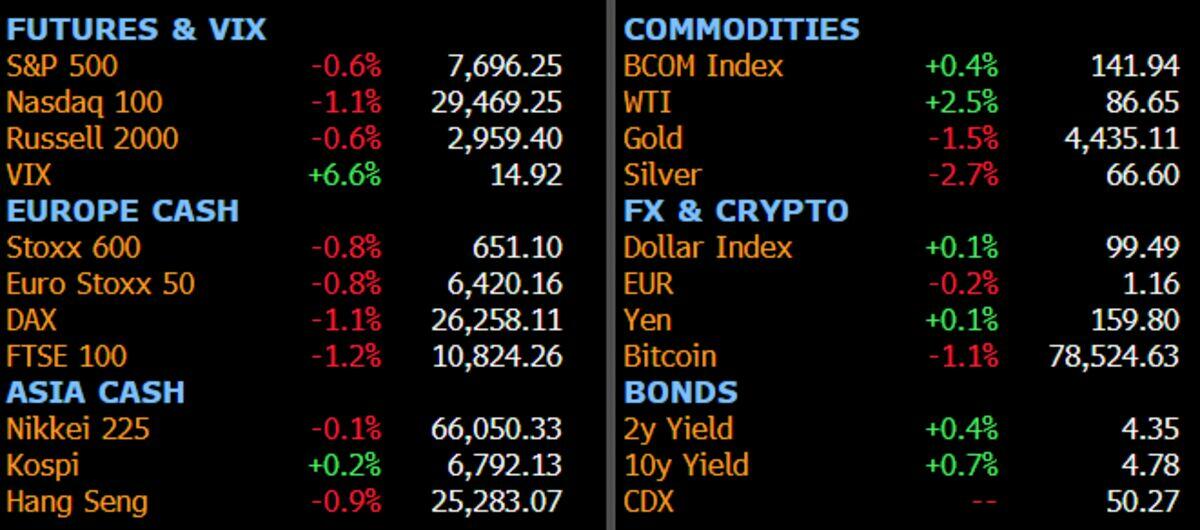
Stock futures are set to start the new month on the backfoot – having weathered a variety of challenges to post a gain for August – with tech lagging as a global selloff pushes yields to the highest level since 2008. As of 8:00am ET, S&P futures are down 0.6%, while Nasdaq futures slide 1.2% following a reports of a strike by Micron’s labor unions in Taiwan, sending the stock 2% lower in pre-market. Semis / Memory are down 1.4% and 2.2%, respectively, with neither Mag7 nor Software seeing a pre-mkt bid. Defensives and Energy are poised to outperform today as small-caps lead large-caps, despite the meltup in rates and oil. Treasury Yields are 2-4 bps higher as part of a general steepening of the curve which has sent US 10Y yield to 4.79% and 10Y JGBs above 3.00% for the first time since 1996. The Dollar is stronger, too. Reports of two supertankers being hit by projectiles are driving oil prices sharply higher and pushing WTI above $87, the highest since July 27. Metals are weaker with Precious metals lagging Base; gold is off ~6% from its Aug high and is 9% above its $4k major support. Ags remain bid after returning ~13% in Aug: the BCOMAG Index is making multi-year highs, last seen in 2022/23. Today’s macro data focus is on ISM-Mfg and JOLTS, with ISM the more important to make sure the growth story remains intact and supportive of the broadening trade. Keep an eye on the ISM Prices Paid as inflation is more critical to markets than growth, going into the Sep 16 Fed Mtg.

In premarket trading, Mag 7 names are all lower (Apple -0.1%, Alphabet -0.7%, Amazon -1.3%, Meta -1%, Microsoft -1.1%, Nvidia -1.3%, Tesla -1.2%
- Capricor Therapeutics (CAPR) rises 4% after Piper Sandler upgraded the biotech company to overweight, optimistic about the prospects for deramiocel, a treatment for Duchenne muscular dystrophy
- Charter Communications (CHTR) inches 1% lower after the cable operator said CFO Jessica Fischer will step down in mid October to relocate for another professional opportunity.
- Duolingo (DUOL) is up 6% after Evercore ISI upgraded the language-learning software company to outperform, noting investor opportunity following severe weakness in the stock, which is down more than 70% off a peak hit in mid-2025.
- Fervo Energy (FRVO) jumps 13% on a Wall Street Journal report that the geothermal company has signed a deal to sell power to Alphabet’s Google.
- GoPro (GPRO) soars 76%, with the stock set to extend gains after rallying more than 46% Monday.
- Kroger (KR) slips 1% after Citi analyst Paul Lejuez cut his price target on the grocer to a Street-low $57 from $61, and adds a downside 30-day catalyst watch on the stock ahead of Kroger’s Sept. 11 earnings report.
- Medtronic (MDT) gains 4% after the medical device maker boosted its organic revenue forecast for the full year.
- Micron Technology (MU) dips about 2% after the Taipei-based Liberty Times reported that Micron will deliver its highest incentive pay plan to its Taiwan-based employees in response to a potential strike by its labor union.
- NIO ADRs (NIO) slip 1% after the carmaker reported vehicle deliveries for August that were largely flat from the previous month.
- Robinhood Markets (HOOD) rises 2% after Morgan Stanley raised its recommendation on the exchange to overweight on growth from prediction markets.
In other corporate news, Western Union and its Australian division are being investigated by the country’s financial crimes agency over concerns about whether its anti-money laundering and terrorism financing controls are effective. Airbnb is testing taking a smaller cut of rental fees from hosts, seeking to fight back against a trend of customers booking directly outside of its platform. Apple claimed in a court filing that OpenAI is actively destroying crucial evidence in an escalation of its legal battle against the AI company.
A global bond selloff has sent global yields to the highest level in years and was most pronounced in Asia, where 10-year Japanese yields hit the highest level this century.
The move came as US Treasury Secretary Scott Bessent pressed the Bank of Japan to tighten policy amid fresh weakness in the yen. US Treasuries also fell across the curve, with the 10-year rate touching its highest since January 2025. Thirty-year yields extended their stint above 5%, already the longest since 2006. UK gilts sharply underperformed in Europe.
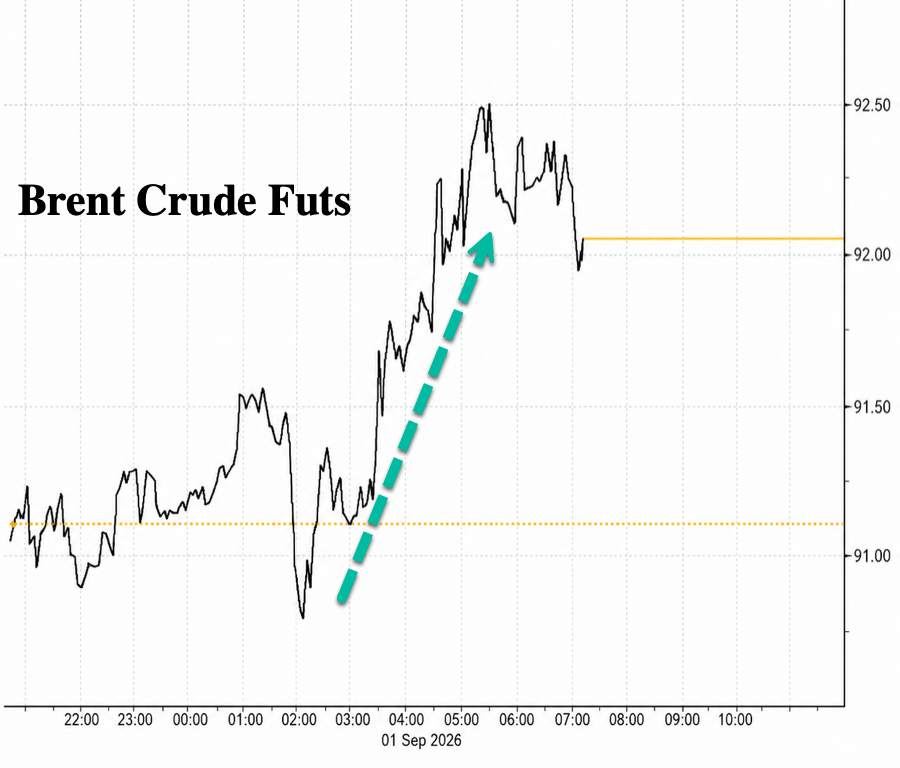
The bond selloff was further pressured by the ascent in energy prices: continued disruptions to energy flows through the Strait of Hormuz sent Brent crude above $92. In the latest escalation in the Middle East, two oil supertankers were struck by unknown projectiles in quick succession while transiting the waterway, according to maritime security consultants Marisks.
Investors are demanding ever greater compensation to hold bonds as concerns about government spending, persistent inflation and surging corporate borrowing to finance the AI buildout intensify. Against this backdrop, traders now price the odds of a September Fed hike at around 70%. Equity investors “should be much more worried about rising long-term bond yields, particularly in the US,” said Joachim Klement, a strategist at Panmure Liberum. “Continued inflation pressures and the more hawkish stance of Kevin Warsh in Jackson Hole last week all point to continued increases.”
The risk-off start to September doesn’t bode well for what is historically the year’s toughest month for the S&P 500. The index has lost 0.88% on average in September over the past three decades.

Positioning, performance dispersion and seasonality make for a tricky setup in the weeks to come. Recent risk events including Nvidia earnings and the Fed’s Jackson Hole symposium kept market sentiment mixed and eroded breadth without derailing the uptrend. Citadel Securities’ Scott Rubner notes near-term asymmetry for US equities has changed into September. He describes a summer characterized by exceptional earnings, a clean up of leverage and positioning, a collapse in volatility, the return of retail investors and systematic investors rebuilding exposure. Rubner views the month ahead as an opportunity to reduce exposure and add cheap protection, but not the beginning of a broader bearish tilt.
Short-term S&P 500 option volatility has fallen to near the lows of the past year. Meanwhile longer term contracts are signaling a bit more concern, with the spread on 1-year and 1-month volatility widening to the 96% percentile over the past year.
Ahead of Friday’s US payrolls report, job openings data for July due later Tuesday are expected to reaffirm the picture of a stable labor market, with limited layoffs. Next week’s inflation data will be more significant for the Fed’s next steps after Warsh made clear that the central bank’s focus for now is on the price-stability side of its mandate, according to Laura Cooper at Nuveen.
The rise in real yields has “a little bit more room to run,” Cooper told Bloomberg TV. “The key catalyst going forward will be that August inflation print. Payrolls are less of a concern.”
Elsewhere, companies are rushing to file for IPOs before Anthropic’s megadeal, which is expected to absorb market attention in coming weeks. Sticking with Anthropic, it’s said to have agreed to a $35 billion computing deal with Lambda, a cloud provider backed by Nvidia, part of an effort to quickly expand its AI capacity.

Inflationary pressures continue to surface – “foodflation” as measured by the Bloomberg Agriculture Spot Index just posted the biggest monthly gain since July 2012. Goldman Sachs’s Robert Kaplan says he would be raising interest rates in September assuming there aren’t any surprises, though he would strive to keep an open mind. Trump called for a federal tax credit to benefit the movie and television industry, saying it would help bring the production of Hollywood blockbusters back to the US.
Tuesday’s weakness extended to Europe, where declines in auto stocks and mining shares put the Stoxx 600 on course for its lowest close since July. Euro-area inflation quickened to the highest level in almost three years, cementing the case for a rate hike next week. Here are the biggest movers Tuesday:
- Novartis gains as much as 5.6%, the most since April 2025, after the Swiss drugmaker showed positive trial data for its experimental multiple sclerosis pill, which analysts say holds blockbuster potential if other trials play out well
- Drax Group shares rally as much as 5.6% after securing their second upgrade in a week as Goldman Sachs raises its recommendation to buy from neutral, citing “an attractive cash generation story with options for upside”
- Reckitt Benckiser rises as much as 5.9% after a US jury sided with the company’s Mead Johnson unit in a bellwether trial among a group of cases alleging that formula for premature babies is linked to a deadly bowel disease
- Air Liquide shares gain as much as 4.2% after activist investor Elliott Investment Management built a stake in the industrial gas supplier as it pushes the firm to improve margins, according to people familiar with the matter
- Technip Energies shares rise as much as 9.2%, the most since March, after a report said the French engineering group is taking part in a tender organized by SpaceX to build a rocket fuel production plant in Louisiana
- DFDS rises as much as 6.6%, the most since mid-August, as RBC sets a new Street-high price target on the shipping and logistics firm and says there’s “further recovery potential ahead”
- Dormakaba shares rise as much as 6.4%, briefly hitting their highest level since April, after the maker of security systems reported results and outlined plans to simplify the group’s ownership structure
- Bodycote shares rise as much as 4.8% and trade at their highest level in five years after Veritas agreed to buy the company with a bid that surpassed a rival offer from CVC. Shares are trading above the latest offer price
- Partners Group shares fall as much as 8.6% after the private markets company lowered its FY26 guidance for performance income and appointed Roberto Cagnati and Juri Jenkner as co-CEOs, effective Jan. 1, 2027
- Ashtead Technology drops as much as 4.9%, to the lowest since mid January, after the oil field services provider releases first-half resultsn which Panmure Liberum says confirm issues raised in recent profit warning
- Standard Life drops as much as 3.7% after being downgraded to neutral at UBS following what the broker says has been a “justified” period of outperformance versus UK life peers and the wider European insurance sector
Asian stocks rose, poised for their longest daily winning streak since January, as MediaTek climbed on a new investment deal with Nvidia. The MSCI Asia Pacific Index advanced as much as 0.6% before paring more than half of its gains. It’s still on track to rise for a sixth straight day. MediaTek shares jumped by about 10% after Nvidia announced a $3.5 billion investment in the Taiwanese chip designer. TSMC, SK Hynix and Toyota also helped boost the regional gauge. Taiwan’s Taiex climbed 1.8%. Japan’s Topix also rose, along with key indexes in the Philippines and Indonesia. Stocks slumped across rest of the region with global bond yields climbing back to the highest level in almost two decades on inflation concerns and bets on Federal Reserve rate hikes. Renewed fighting in the Middle East has driven oil prices higher again and weighed on sentiment. Traders have boosted the odds of a September Fed rate hike to 66% from just 34% after Fed Chair Kevin Warsh spoke about reining in inflation on Friday, according to data compiled by Bloomberg based on swaps. Japan’s Finance Minister Satsuki Katayama played down reports of Bessent’s pressure on the BOJ.
In FX, the Bloomberg Dollar Spot Index is up 0.1% with the greenback firmer versus almost all G10 peers.
In rates, the US 10-year yield is at its highest level since January 2025, with borrowing costs up across the curve, as treasuries hold curve-steepening losses in early US session — with 5- and 10-year yields reaching YTD highs — as oil prices add to Monday’s increases on growing concern about supply disruptions in the Strait of Hormuz. US yields are 1bp-3bp cheaper across tenors with 2s10s curve steeper by about 1.6bp, 5s30s by less than a basis point; 5-year topped 4.53%, 10-year 4.79%, highest levels since January 2025. IG dollar issuance slate already includes several deals following several moribund sessions at the end of August, including Monday’s single offering. Dealers expected about $10 billion this week and around $215 billion for September. The selling pressure in Europe has been pronounced with the German 10-year yield at its highest level since 2011 on a day where Eurozone inflation printed its highest reading in almost three years. The UK equivalent yield is at levels not seen since 2008. Bunds have similar losses while gilts, reopening after Monday’s UK holiday, tumble as traders price in two 25bp hikes by the Bank of England by February. Focal points of US session include ISM manufacturing and JOLTS job openings reports and potential for a heavy slate of new corporate bonds.
In commodities, Brent is up 2% following a report that two oil supertankers hit by projectiles in the Strait of Hormuz. This has sapped enthusiasm for risk assets with US futures lower across the board. WTI crude oil futures are up about 2.5% near session highs as hostilities resume between the US and Iran. Gold is down 1.5% and hovering just above its 100DMA. Bitcoin is down 1.2%.
Today’s economic data calendar includes August final S&P Global US manufacturing PMI (9:45am), August ISM manufacturing and July construction spending and JOLTS job openings (10am) and August Dallas Fed services activity (10:30am). The Fed speaker slate includes Governor Barr on economic outlook and financial inclusion at 9:05am.
Market Snapshot

Top Overnight News
- Global bond yields surged Tuesday as renewed tension between the U.S. and Iran reinforced inflation expectations, which increased the prospect of interest-rate hikes in the coming months. The 10-year U.S. Treasury yield rose to 4.792%, the highest since January 2025, according to LSEG data. 30-Year Treasuries are on their worst run since 2006. The 10-year Japanese government bond yield crossed 3% to hit a 30-year high. The 10-year German Bund yield reached 3.364%, unseen since 2011. WSJ / BBG
- Two oil supertankers attempting to exit the Strait of Hormuz were struck late Monday by projectiles in quick succession, maritime security consultant Marisks said, the latest sign of renewed hostilities around the critical waterway. BBG
- Iranian President Masoud Pezeshkian told the Shanghai Cooperation Organization Summit on Tuesday that Tehran would immediately reciprocate if Washington agreed to return to its commitments under the interim deal signed in June. CNBC
- Anthropic has signed a cloud-computing deal worth $35 billion with Nvidia backed cloud provider Lambda, with Nvidia itself holding the lease on the data center, according to people familiar with the deal. The data center is being developed by Hut 8, a bitcoin miner and data-center developer, in Nueces County, Texas. Nvidia signed an agreement with Hut 8 a few weeks ago to secure the capacity, the people said. WSJ
- China’s factory activity expanded more than forecast in August after three straight months of slowdown, according to a private survey, showing resilience among the country’s export-oriented firms despite a broader slowdown in the economy. The RatingDog China manufacturing purchasing managers index rose to 51.5 from 50.9 in July, according to a statement on Tuesday. It’s been above the 50-threshold separating expansion from contraction for nine months, the longest upswing in five years. BBG
- South Korea’s exports for Aug came in ahead of expectations at +68.7% (vs. the Street +63%). BBG
- South Korea’s key policy chief Kim Yong-beom resigned. He had drawn criticism over the rapid introduction of single-stock leveraged ETFs and his proposal for a citizen dividend from the AI boom. BBG
-
- Eurozone CPI was inline w/the Street on the headline at +3.3% (up from +2.9% in Jul), but core ran a bit cooler at +2.4% (vs. the Street +2.5% and down from +2.5% in Jul). BBG
- Micron’s Taiwanese labour unions are reportedly moving toward a possible strike unless the Co. agrees to reform its bonus system.
- Shipping costs at risk of rising further as the White House escalates its crackdown on immigrant commercial truck drivers Both the Department of Homeland Security and the Transportation Department are demanding licensing data across the U.S. about immigrants driving trucks, in a hunt for what they say is a rash of drivers with improper certifications. WSJ
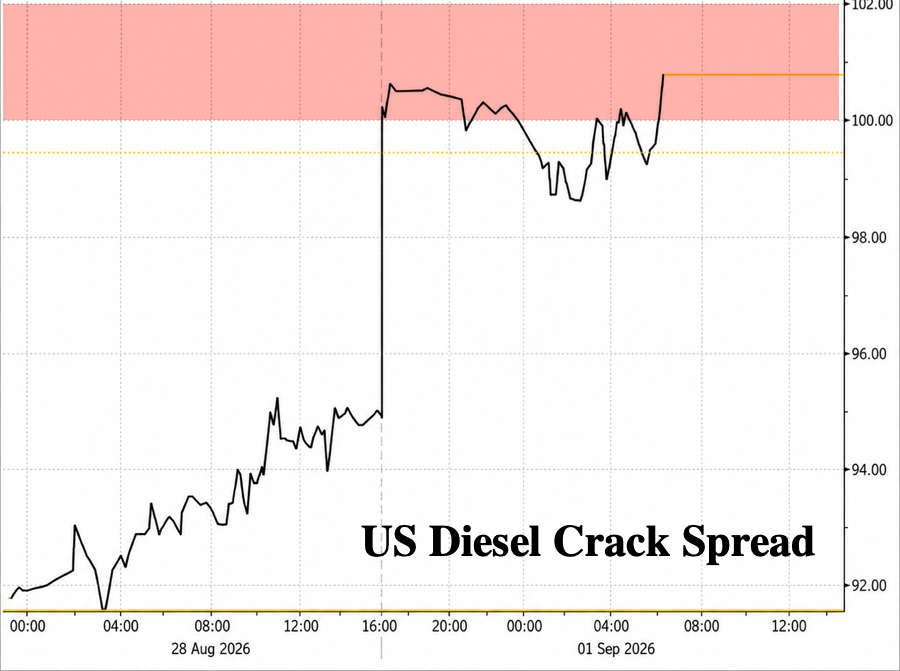
- “Diesel remains at the epicenter of the rally, accounting for over 40% of the $40/bbl increase in average global refined product wholesale prices since February…Global exports of refined products declined 6mb/d (25%) year-over-year (yoy), with the Persian Gulf and Russia accounting for 75% of the decline.” – Goldman Delta One
Middle East News
- Two oil supertankers were reportedly hit by projectiles in the Strait of Hormuz, according to Marisks. Bloomberg reported that the VLCC Sidr was hit, and the Senegal Prosperity was also struck, transiting north-east and east of Khasab, Oman, respectively. Earlier, UKMTO noted that it received a report of an incident 17nm east of Khasab, Oman, in which a tanker reported being struck by three unknown projectiles while completing outbound transit of the Strait of Hormuz. UKMTO also received a report of an incident involving a tanker and military forces in the Indian ocean.
- The Iranian President said that “we will abide by the agreement if America does and that Iran will immediately reciprocate if the US fulfils its commitments under an interim deal signed in June”, Al Jazeera reported citing ISNA.
- Iran’s Foreign Ministry spokesperson Baghaei said Europe cannot claim strategic autonomy while following Washington’s orders, stressing that true autonomy means making independent decisions.
- Pakistan’s Deputy PM and Foreign Minister met with Iran’s Foreign Minister Araghchi in an informal manner in Bishek at the holding room of the SCO Council of Head of States, according to journalist Anas Mallick.
- Gulf Corporation Council condemned Iran’s attacks on Jordan, saying they pose a direct threat to the security and stability of the region, according to Al Jazeera.
- Yemeni armed forces targeted early on Tuesday the bases of Saudi and Emirati mercenaries in Al Makha and Al Khuwakh located in the southwest of the country, according to IRIB.
- Hapag-Lloyd’s (HLAG GY) CEO said it is reasonable to expect the Strait of Hormuz will remain blocked for the foreseeable future.
A more detailed look at global markets courtesy of Newsquawk
APAC stocks traded with a mild negative bias amid higher prices and yields following the recent geopolitical flare-up, although some of the losses were stemmed as participants also digested recent data. ASX 200 was pressured amid underperformance in the consumer, tech and telecom sectors, while Australia’s 10yr yield was at its highest since 2011, but with downside in the index stemmed amid strength in the commodity-related industries and after better-than-expected data. Nikkei 225 traded indecisively but was off earlier lows and briefly turned positive as headwinds from higher yields were partially offset by better-than-expected Company Sales and Profits data, while a Ministry of Finance senior official said the BoJ is expected to steer monetary policy aligned with the economy and not influenced by the US, in response to a recent report that US Treasury Secretary Bessent told Japanese officials that rate hikes are needed. KOSPI initially dropped but then gradually returned to flat territory amid light pertinent newsflow and with indecisive performances in the tech heavyweights. Hang Seng and Shanghai Comp were somewhat mixed as the Hong Kong benchmark underperformed amid weakness in some big platform names and property stocks, while sentiment was also not helped by a weak debut for fast fashion retailer Shein. Conversely, the downside in the mainland was cushioned by stronger-than-expected RatingDog Manufacturing PMI data.
Top Asian News
- US Treasury Secretary Bessent told Japanese officials that rate hikes are needed, according to NHK.
- A Japanese MoF senior official said they expect the BoJ to steer monetary policy aligned with the economy and not influenced by the US.
- Japanese Chief Cabinet Secretary Kihara said he is closely watching market moves and that rising interest rate costs risks fiscal rigidity. Will re-examine the fiscal scale and control the annual issuance of JGBs.
- Japan’s Economy Minister Kiuchi said he aims to appropriately control total bond issuance, adding that he cannot yet provide details on next fiscal year’s budget and declines to comment on foreign officials’ remarks.
- Fitch said China’s mortgage easing is unlikely to significantly revive housing demand as high inventories and weak buyer confidence continue to weigh on the property market.
- China issued new guidelines requiring automakers operating overseas to price vehicles and components lawfully.
- Chinese Finance Ministry is to set a 20% tax level on foreign individuals’ dividend income.
European bourses are underwater on Tuesday (Euro Stoxx 50 -0.9%) as the continued rise in global bond yields weigh on equities. The upside in energy prices isn’t helping either, with the latest that two supertankers were hit in the Strait of Hormuz. These confluence of factors (rising yields and energy prices) have constantly been seen throughout the Iran war, which has resulted in European underperformance. Sectors have a negative bias. Energy, unsurprisingly, tops the sector pile. Optimised Personal Care and Chemicals round out the sector leaders. To the downside is Travel & Leisure, with Financial Services and Basic Resources completing the sector laggards.
Top European News
- UK PM Burnham will signal fresh measures to help voters with the cost of living on Tuesday, while decisions on welfare are likely to be delayed into next year, according to FT.
FX
- Yields driving action across FX today with all major currencies weaker against the Buck (DXY +0.2%). Recent updates sparked a typical geopolitical risk-off reaction with DXY reaching a new 99.63 peak and looking to return to that 99.70 peak seen after Warsh on Friday. The driver was reports via Maritime Risk firm Marisks, which said two oil supertankers were hit by projectiles in the Strait of Hormuz. Despite the number of bullish USD factors today, downside risks could emerge again via renewed USD debasement fears, Treasury action to curtail yields, or a soft Payrolls print this Friday.
- Continued upside in energy benchmarks (TTF Oct’26 at EUR 71/MWh) continue to weigh on European currencies with all CEE, Euro and Sterling weaker against the Buck. No EUR move to this morning’s Final EZ Manufacturing PMIs, which saw the EZ majors confirmed in expansion while headline inflation ticked higher to 3.3% as expected. EUR/USD looking to return to the 1.1577 trough which it printed post-Warsh; should this breach, the 100DMA @1.1570 could be tested. For CEE, ING writes this morning that recent hawkish repricing should limit further weakening vs. EUR.
- Cable stopped just short of 1.3530, a zone which has proven support since mid-Aug; the pair also falling through the 21DMA for the third session in a row. All other significant DMAs are below, around the 1.3450 zone.UK yields are in focus with the 10yr at highs of 5.23%, well above the OBR’s March assumption of 4.5%. A former Treasury official notes that these moves, if applied across the curve, are a GBP 6bln increase in debt interest by 2029/30. Parliament is back from recess today with the PM’s Spokesperson scheduled at noon and Burnham himself after 15:30 BST, though no major policy announcements are expected.
Fixed Income
- Global fixed benchmarks are in the red this morning, continuing the action seen on Monday. Overnight, JGBs were hit amidst higher energy prices, ongoing fiscal concerns and after Treasury Sec Bessent directly urged the BoJ to hike in September. Despite all this, the 10yr auction was well received, with a 3% yield seemingly enough to feed investor appetite, at least for now.
- USTs (-5 ticks) are off by a handful of ticks, Bunds (-46 ticks) follow suit whilst Gilts (-105 ticks) are the clear underperformer on its return from holiday – in catchup trade to peers. In the European morning, the move lower has extended, with energy prices taking another leg higher on reports that two oil supertankers were hit by projectiles.
- As mentioned above, global yields have soared to multi-year highs amid higher oil prices, and hawkish Fed repricing. This has spurred somewhat of a negative feedback loop, with higher yields only exacerbating fiscal/debt concerns. The US10yr resides beyond the 4.75% mark (highest since Jan’25), whilst the GE10yr (3.36%) holds at multi-decade highs.
- Aside from energy-dynamics, Bunds have had domestic data to digest. In the morning, German Retail Sales fell more than expected – though spurred little reaction at the time. Thereafter, the EZ-wide Manufacturing PMI saw an incremental revision lower. The report suggested that “a further softening of producer price increases, even in the midst of sustained oil market volatility, helps to alleviate broader inflation worries. That said, the pace of disinflation is starting to level off”. The inflation picture continues to support an ECB rate hike in September, with headline inflation ticking higher to 3.3% Y/Y from 2.9%.
- In the UK, Gilts are the clear underperformer this morning; the UK10yr (5.25%) has reached levels not seen since the GFC. This would be a significant worry heading into the Autumn Budget, which local press is beginning to increase its coverage on. An ex-Treasury official suggested that the 20yr Gilt is 70bps above what is assumed at the Spring Forecast. They noted that if this increase was applied across the curve, it would result in a GBP 6bln debt increase by 2029/30. Therefore, it is clear that PM Burnham and his Chancellor Healey will require a significant decline in yields soon, to allow them to implement some of their key commitments; energy relief, cost of living measures and transport caps. To remind, the Autumn budget will be delivered on 28 October 2026.
- Germany sells EUR 4.281bln vs exp. EUR 5.5bln 2.90% 2031 Bobl: b/c 1.56x (prev. 1.48x), average yield 3.09% (prev. 2.89%), retention 22.16% (prev. 24.1%).
- Japan sells JPY 1.99tln 10yr JGBs, b/c 3.29x (prev. 2.56x), average yield 2.995% (prev. 2.840%), Tail in price 0.12 vs prev. 0.46.
- Australia sells AUD 300mln in 4.75% June 2054 bonds: avg. yield 5.6657%, b/c 3.68x.
Commodities
- Crude futures remain underpinned after yesterday’s gains on the weekend US-Iran flare-up. Price action this morning has been supported by further shipping-related developments. Yesterday, the UKMTO reported an incident involving a tanker and military forces in the Indian Ocean off Oman, while this morning reports citing Marisks suggested that two oil supertankers had been hit by projectiles in the Strait of Hormuz, although details remain limited. On the diplomatic front, some downside in oil was seen earlier after the Iranian President struck a less escalatory tone and suggested that “Iran will immediately reciprocate if the US fulfils its commitments under an interim deal signed in June”.
- WTI Oct and Brent Nov futures have ultimately been on a steady grind higher, barring the aforementioned dip on the Iranian President’s comments. WTI resides towards the top of a USD 86.13-88.13/bbl range (vs Monday’s USD 84.11-86.79/bbl band), while Brent sits towards the upper band of USD 90.70-92.55/bbl (vs yesterday’s 89.03-91.52/bbl range).
- Dutch TTF has also been on an upward trajectory after initially finding resistance just under EUR 71.25/MWh, before encountering support near EUR 69.75/MWh, and then moving back to highs.
- Precious metals have been hampered as DXY rises with oil prices once again, whilst demand is likely not helped by Bloomberg reports that Indian PM Modi has told Indians to avoid buying gold unless necessary. Spot gold fell under yesterday’s low (USD 4,396/oz) and trades near a current intraday trough at USD 4,370/oz (vs high 4,461/oz), just above its 100 DMA (4,366/oz). Spot silver is back around USD 65/oz after hitting recent highs of USD 71.17/oz two trading sessions ago.
- Base metals are more mixed as the LME returns from its long weekend and plays catch-up. 3M LME copper has been edging lower to trade towards the bottom end of a USD 14,262.43- 14,450.13/t, with price action in line with global peers as COMEX copper posts intraday losses of some 0.7% at the time of writing.
- US President Trump said they will fill up the strategic reserve and will want to do it with Venezuelan oil.
- Venezuelan oil company North American Blue Energy Partners plans to dispatch over 50 drilling rigs in Venezuela in the next few years, according to WSJ.
- Iraq set the floor prices for crude oil cargoes offered via tender for September loadings outside of Hormuz, according to a pricing document.
- Indian PM Modi has told Indians to avoid buying gold unless necessary, Bloomberg reported.
Trade/Tariffs
- US VP Vance said we want to have a positive relationship with China, adding we also recognise that China is a competitor, according to Fox News.
- Brazilian and US officials spoke virtually to discuss tariffs imposed by the Trump administration and agreed to hold further meetings at a later date, according to Reuters
Central Banks
- ECB’s Kocher said that an ECB hike is needed if upside risks are confirmed in the projection.
- ECB’s Rehn warned that conflict of attrition in Iran could keep inflation high, according to FT.
Geopolitics
- US Treasury Secretary Bessent told Russia’s Finance Minister Siluanov the US will not provide Russia with economic relief until the Ukraine war ends, according to a source familiar with the bilateral meeting.
- The UK government said Chancellor Healey called on allies to step up their pressure on Russia and set out new action to stop Russian President Putin evading sanctions to fund his illegal war. The Chancellor will double the maximum fine available to the OFSI from 50% to 100% of the value of a sanctions breach.
- Russian Foreign Ministry said a Black Sea ceasefire would only push prospects for a peaceful settlement further away, IFX reported.
- Ukraine said Russia struck port infrastructure in the southern Odessa area.
- Explosions were reportedly heard in Ukraine’s capital of Kyiv.
- Ukraine’s Air Force said UAVs were detected heading towards Zaporizhzhia.
- Poland intercepted a Russian reconnaissance plane over the Baltic Sea.
- Russia’s Foreign Ministry said Moscow will take countermeasures if US weapons are deployed in Japan, Al Jazeera reported.
- Iran and Chinese Foreign Ministers reportedly held talks in Kyrgyzstan during the Shanghai Cooperation Organization summit, Al Jazeera reported.
US Event Calendar
DB’s Jim Reid concludes the overnight wrap
As it’s the start of the month, Henry will shortly release our usual review on how markets fared in August. Recent years have often brought a late-summer wobble, but this August was the exception, as robust data took risk assets to new heights. That meant the S&P 500 hit fresh records, but it wasn’t all plain sailing, with longer-dated bond yields reaching multi-year highs. In part, that was thanks to the wider risk-on tone. But inflation concerns also played a role, particularly given the lack of progress on reopening the Strait of Hormuz. And as all that was happening, concerns about financial repression also saw gold prices (+9.67%) bounce back as well. See the full report in your inboxes shortly.
Markets finished August on a softer note with equities and bonds weighed down on Monday by the weekend escalation between the US and Iran, having also lost ground last Friday following a hawkish speech from Fed Chair Warsh at Jackson Hole. This pushed 10yr Treasury yields to their highest since January 2025 at 4.75% by yesterday’s close, and 10yr yields are trading another +3.4bps higher overnight. With a September Fed hike now two-thirds priced, US rates will see their next major test with the US August jobs report on Friday, while this week’s other highlights include the ISM indices (today and Thursday) for the US and today’s August inflation print for the Eurozone.
The bond sell-off has also been a global affair. This morning 10yr JGB yields have touched the 3% level for the first time since 1996 (+5.5bps to 2.99% as I type) while 10yr Aussie bonds are +9.5bps higher at a post-2011 high of 5.18%. Meanwhile, yesterday saw 10yr bund yields rise to their highest since 2011 (+4.6bps to 3.32%) and 10yr OAT yields to their highest since 2008 (+5.0bps to 4.18%).
In terms of the drivers of higher yields, yesterday’s main culprit was the weekend escalation in the Middle East that saw the US and Iran exchange strikes for the first time since late July. The US struck IRGC targets on Larak island in the Strait of Hormuz, with Iran responding with attacks on the UAE and Jordan. Trump said yesterday that the US would respond to Iran’s latest attacks against US facilities in the region, though he also sought to downplay the escalation, saying that strikes against Iran will be limited and that “this is a relatively little war for us”. Meanwhile, Iran’s foreign minister Araghchi said that the US must return to the terms of the June memorandum of understanding if the sides are to “exit this situation”.
With resolution between the US and Iran looking increasingly distant, Brent crude rose +2.71% yesterday to $90.49/bbl. It is trading another +1.09% higher this morning. Meanwhile, European natural gas prices (+4.23%) rose to their highest level since January 2023 at €69.81/MWh, adding to the pressure on EGB yields mentioned above.
In the US, Monday’s rise in yields came as Treasury Secretary Bessent suggested that “we’ll be talking… more in the coming weeks or months” about a fiscal consolidation package, having previously suggested the administration could unveil a new fiscal proposal by this week. Bessent also played down the view that he “was trying to change direction of bonds”. Monday’s +3.1bps rise in 10yr Treasury yields followed a +4.3bps increase on Friday, while 2yr yields (-0.2bps) were stable on Monday after spiking by +11.2bps on Friday following Fed Chair Warsh’s speech at the Jackson Hole symposium.
Warsh’s Jackson Hole speech marked a notable communication shift, delivering greater specificity in terms of views on the economy and a decidedly hawkish lean. The Fed Chair corrected the arguable July press conference missteps, reaffirming 2% PCE as the target, fed funds as the primary policy tool and the Fed’s ability to act despite ongoing task forces. Notably, his inflation assessment focused on several specific hawkish points, while he also acknowledged that there were “few signs of policy restraint” and concluded by saying that “we have work to do” unless “underlying inflation is moving to our objective, clearly and at sufficient speed”.
Fed funds futures repriced hawkishly in response to Warsh’s comments, with September Fed hike pricing rising from just 36% last Thursday to 58% on Friday and to 67% this morning, while 60bps of hikes are now priced by next June. Our US economists believe the burden is on incoming data to surprise meaningfully to the downside to avoid a 25bp rate hike in September. In turn, they continue to expect that the Fed will hike 50bps this year, with increases at the September and December meetings. See their Jackson Hole reaction here.
Following on the heels of Warsh’s forceful Jackson Hole speech, the data docket picks up this week with the main event being Friday’s August employment report in the US. Our US economists expect headline payrolls to rebound to +65k after the -23k decline in July, and see the unemployment rate staying at 4.1%, with average hourly earnings rising by +0.4% MoM (+0.1% in July). Other labour market indicators due include today’s July JOLTS report, which should continue to paint the picture of a “low hiring / low firing” environment, and ADP private payrolls tomorrow.
We’ll also get the latest signal on economic activity, with the final August manufacturing PMIs (today) and services PMIs (Thursday), which will be accompanied by the respective ISM readings in the US. Note that the ISM surveys have been pointing to strong economic momentum in the US, with the one notable exception being weakness in the ISM services employment component.
The August PMI data out of Asia this morning showed China’s private manufacturing sector expanding at a faster pace in August, with the Caixin Manufacturing PMI rising to a two-month high of 51.5, up from 50.9 in July (51.0 expected). Stronger output and an increase in new orders pointed to improving demand conditions across the sector. Meanwhile, the S&P Global Australia Manufacturing PMI was unchanged at 52.0.
Over in Europe, this week’s data highlight comes with today’s Eurozone August HICP print. Based on the country releases so far, which included a +2.9% print for Germany yesterday (vs. +3.1% expected), our European economists see the Eurozone headline HICP print tracking at +3.36% YoY. In other releases, we’ll have Germany’s retail sales (Tuesday) and factory orders (Friday) for July, while on the central bank side we’ll see decisions in Canada and New Zealand (Wednesday).
Monday’s challenging geopolitical backdrop weighed on equities on both sides of the Atlantic, with the S&P 500 falling -0.33% after a -0.36% decline Friday, while Europe’s Stoxx 600 slumped by -0.62% (after +0.51% Friday). Tech stocks saw a slightly better performance yesterday, with the Nasdaq down -0.12% after -0.52% Friday, which was thanks to a stabilization in the Philly semiconductor index (+0.57%) after its -3.47% slump on Friday. Remaining tech earnings this week include Palo Alto Networks and Dell today, as well as Broadcom and Snowflake tomorrow.
Cautious risk sentiment has largely carried over into Asian markets overnight with major indices posting modest declines. As I check my screens, the Hang Seng (-1.00%) is the biggest underperformer while the KOSPI (-0.08%), Nikkei (-0.26%), the CSI 300 (-0.06%) and the S&P/ASX 200 (-0.32%) are all trading slightly in the red as well. Meanwhile, in the FX space we’ve seen a notable milestone this morning with the Japanese yen trading above 160 against the US dollar for the first time since the end of July, before recovering to 159.86 (-0.08%) as I type.