Summary
- Reports of fresh US strike wave on southern Iran, oil soars
- Bessent Says Hormuz Will Be “Worthless Piece of Water” In Two Years
- Iran offers conditional ceasefire: Pezeshkian says Iran will return to talks if the US honors prior commitments, which Tehran says it has violated.
- Tankers hit in Strait of Hormuz: Two supertankers struck exiting Hormuz, escalating energy-market risks.
- Oil prices surge: Brent crude rose above $92/barrel.
- Diesel supply squeezed: Refinery disruptions are driving diesel prices and margins sharply higher.
* * *
Early reports of US Strikes on Southern Iran Send Oil Soaring
Rare US strikes against Iran in the middle of US trading hours? Bold move if so. Some breaking headlines:
- REPORTS OF BLASTS ACROSS IRAN’S SOUTHERN REGIONS: STATE TV
- PENTAGON UNLEASHES FRESH ATTACKS On SOUTHERN IRAN
- Al Arabiya: ‘DEFENSIVE’ BOMBING — source to Faytuks
- EXPLOSIONS REPORTED IN KONARAK IN SOUTHEASTERN IRAN: FARS
Oil prices shooting up on the new apparent ‘shoot-up’, which has been previewed in various reports this week. Trump is now pulling the trigger on Hegseth’s plan, it seems:
WTI nears $90…

US attacks on Iran have almost always come in nighttime and overnight hours – and typically only after US market hours close, so a daytime attack is very rare indeed…
Trump is so confident that Bessent can continue suppressing crude oil prices that now is attacking Iran in the middle of US trading hours – bad mistake, very bad
— JustDario (@DarioCpx) September 1, 2026
Bessent Says Hormuz Will Be “Worthless Piece of Water” In Two Years
Treasury Secretary Scott Bessent told the audience at the Group of 20 finance ministers’ meeting in Asheville, North Carolina, that Iran’s ability to weaponize the Strait of Hormuz will be reduced to zero because “oil will be going through pipelines across the land.”
“Iranians are trying to use the Strait of Hormuz as a chokepoint. It’s not a chokepoint for the US, but it is for many other countries. That will be bypassed in 2 years. In 2 years, the Strait of Hormuz will be a worthless piece of water. The oil will be going through pipelines across the land,” Bessent said.
Bessent on Iran:
Iranians are trying to use the Strait of Hormuz as a chokepoint.
It’s not a chokepoint for the US, but it is for many other countries.
That will be bypassed in 2 years. In 2 years, the Strait of Hormuz will be a worthless piece of water.
The oil will be going… pic.twitter.com/8z9BhNvGku
— Clash Report (@clashreport) September 1, 2026
Bessent’s comments this morning should come as no surprise to readers, since we’ve detailed the existing pipelines that bypass Hormuz and the new pipeline projects planned by allied Gulf producers.
However, these new ‘alternative energy route’ initiatives are wrought with an array of unknowns – especially in terms of security and infrastructure/construction protection in an obviously volatile region, cooperation among transit states (in overland routes), as well as immense cost notwithstanding. For but one recent headline example:
Iraq-Syria Pipeline To ‘Bypass’ Hormuz Likely To Take Four Years, $15BN To Build
And with both these named countries coming out of recent decades-long ‘forever wars’, and with especially Syria still being largely destroyed and fragmented, efforts to bring to fruition Bessent’s anticipated bypass system “across the land” – as he says – will more likely be something that drags on far longer than the Trump administration itself is in power.

Also read Goldman’s latest energy flow data through the Hormuz (here).
Pezeshkian: We’ll Return to Ceasefire if US Does
Iranian President Masoud Pezeshkian on Tuesday reiterated his country’s willingness to return to talks with the US, but made clear that Washington must return to its prior commitments made.
“I state explicitly that if the United States returns to its commitments under the … memorandum of understanding, the Islamic Republic of Iran will immediately take reciprocal action,” Pezeshkian said on the sidelines of the Shanghai Cooperation Organization (SCO) summit in Bishkek, Kyrgyzstan.
It is significant that he’s there at the Kyrgyzstan-hosted summit in person, receiving a welcome from the likes of Putin, Xi, Erdogan, the UN’s Guterres, and others.
Pezeshkian still blasted the US for “reneging on its commitments” under the agreement, which unraveled in June – leading to various weeks of sporadic tit-for-tat attacks – the latest which occurred just at the start of this week.
President Trump yesterday told reporters in the Oval Office that there will be a “response” to the Iranian attacks, but also cautioned that this would not mean a return to full-scale war.
US officials have talked about “mowing the grass” with a series of indefinite strikes, while ironically having an aversion to anyone applying the label “forever war”.
It’s not a “forever war”; it’s just “mowing the lawn.”https://t.co/oJTjmdSiHb pic.twitter.com/9JI0lfWaVS
— Brandan P. Buck (@brandan_buck) August 31, 2026
Two Supertankers Hit
Two oil supertankers were struck by unknown projectiles while transiting the Strait of Hormuz early Tuesday, signaling yet another sharp escalation in hostilities along the world’s most critical energy chokepoint.
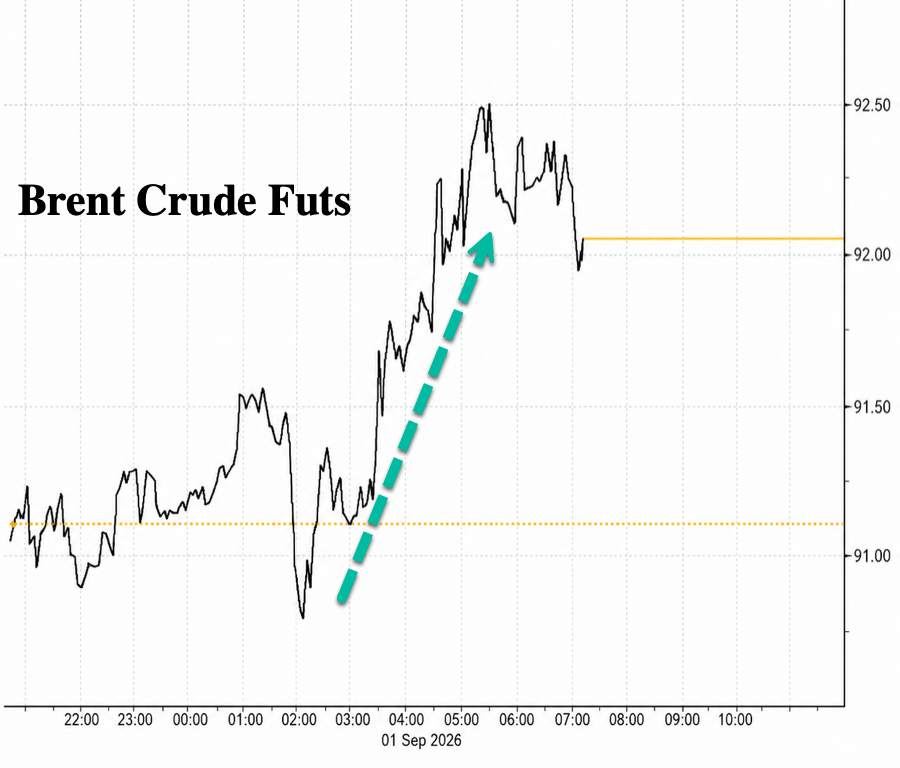
The attacks follow President Trump’s warning Monday that additional strikes against Iran remain possible. Traders are pricing in a further war risk premium, pushing Brent crude futures above $92 a barrel, while US diesel crack spreads have breached the critical $100-a-barrel threshold.
Maritime security consultant Marisks reports that Saudi shipping giant Bahri’s VLCC Sidr was hit northeast of Khasab, Oman. The Sinokor-operated Senegal Prosperity was reportedly struck by three projectiles farther east. Both tankers were exiting the maritime chokepoint.
UK Maritime Trade Operations separately confirmed that a tanker completing an outbound transit of Hormuz reported three projectile strikes but did not identify the vessel.
Brent crude futures ripped higher during Asian and European trading on the news, with the benchmark firmly above $92 as of 0600 ET.
More US Strikes on Table, Trump Warns
“President Donald Trump warned Monday that further strikes are possible, pushing Brent back above $91/bbl and driving another bear-steepening move across global bond markets,” UBS analyst George Redman wrote earlier.
US diesel crack spreads were above $100 as of 0600 ET.
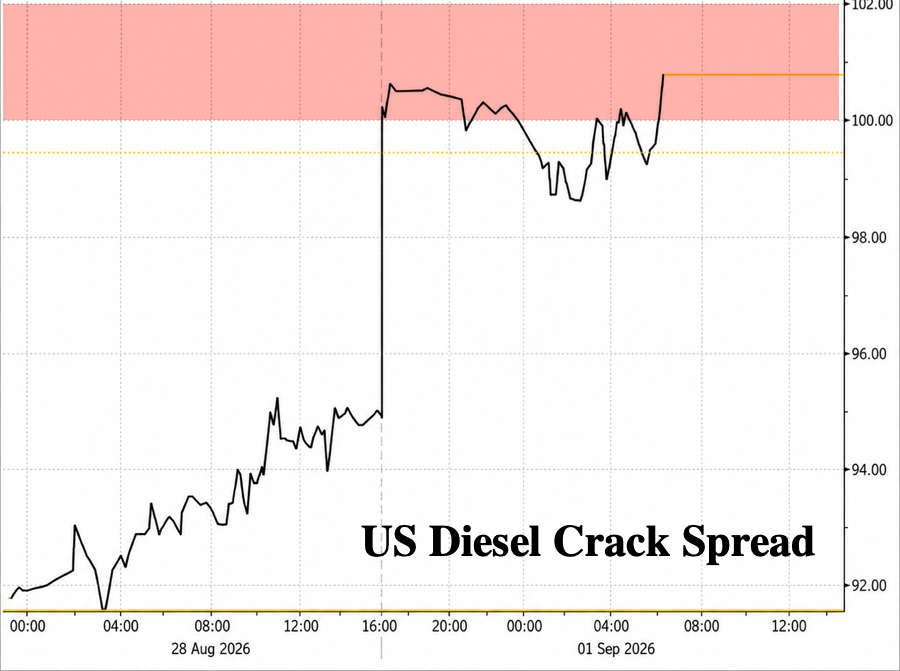
As we’ve extensively detailed, the energy crisis is not necessarily in crude itself but in refined products. Gulf diesel and gasoline shipments have declined amid disruptions in the Strait of Hormuz, while damage to Russian energy infrastructure from Ukrainian one-way attack drones has created a perfect storm in global refining markets in late summer.
‘Diesel at Epicenter of Supply Squeeze’
Goldman’s energy expert Daan Struyven warned in his most recent note that “diesel is at the epicenter of the supply squeeze.”
“Rising strikes on refineries in the Middle East and Russia have further constrained already-stretched global refining capacity, pushing refined-products margins to new highs,” Struyven and Yulia Zhestkova Grigsby wrote in the note, adding, “Diesel remains at the epicenter of the rally.”
Struyven and his team estimate that global refinery runs are down 7 million barrels per day from last year and have averaged nearly 6 million barrels per day below seasonal norms since March, around the time the US launched Operation Epic Fury and Ukraine ramped up one-way drone attacks against Russia’s energy infrastructure.

Meanwhile, there may be some diplomatic traction in the Gulf area, with Iranian President Masoud Pezeshkian saying on state TV: “I state unequivocally that should the US return to its commitments under the aforementioned Memorandum of Understanding, the Islamic Republic of Iran will also take reciprocal action immediately.”
Treasury Secretary Scott Bessent’s “Operation Economic Outcast” is also ramping up as the Trump administration deploys sanctions to pressure Tehran into submission.
More Latest Developments
via Newsquawk…
- Iran’s Foreign Ministry spokesperson Baghaei said Europe cannot claim strategic autonomy while following Washington’s orders, stressing that true autonomy means making independent decisions.
- Pakistan’s Deputy PM and Foreign Minister met with Iran’s Foreign Minister Araghchi in an informal manner in Bishek at the holding room of the SCO Council of Head of States, according to journalist Anas Mallick.
- Gulf Corporation Council condemned Iran’s attacks on Jordan, saying they pose a direct threat to the security and stability of the region, according to Al Jazeera.
- Yemeni armed forces targeted early on Tuesday the bases of Saudi and Emirati mercenaries in Al Makha and Al Khuwakh located in the southwest of the country, according to IRIB.
- Hapag-Lloyd’s (HLAG GY) CEO said it is reasonable to expect the Strait of Hormuz will remain blocked for the foreseeable future.
Tyler Durden
Tue, 09/01/2026 – 12:30