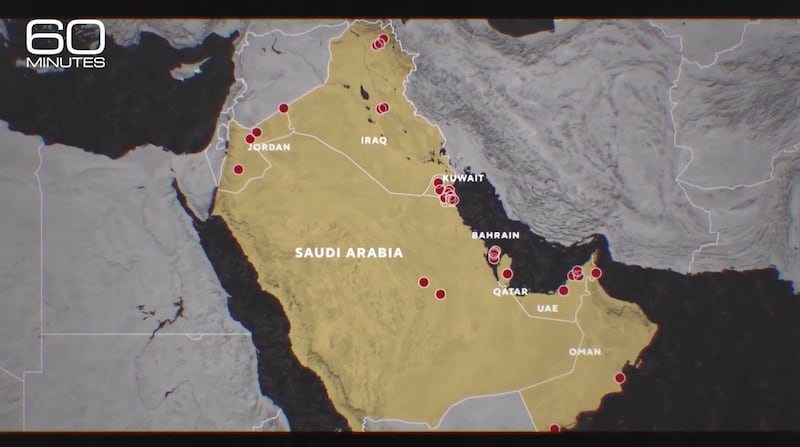
CBS’ “60 Minutes” just ran a visual report which documents the significant and immense damage sustained by American bases after Iran struck at least 31 military locations spanning eight countries, according to its estimation.
The news show also said hundreds of buildings and structures were damaged, amid the Iranian retaliation which took place chiefly in the opening days and weeks of Operation Epic Fury. Iran is now vowing a tenfold response targeting expecially Washington’s Gulf allies should it come under major attack again.

The 60 Minutes exposé is devasting to the White House’s narrative of the Iranian military having been largely ‘obliterated’ – and so President Trump is fuming, having called out 60 Minutes in a blistering Truth Social post on Monday.
“The new people running 60 Minutes are even worse than their predecessors,“ Trump decried. “A recent study on an attack in the early stages of Iran was not correctly stated,” he introduced.
Ironically, the show is under the purview of CBS News editor-in-chief Bari Weiss, who had quickly dismissed the program’s former executive producer and some other correspondents earlier this year, and installed Nick Bilton as the new producer. This marks a rare Trump swipe at Weiss…

According to a CBS preview and description of the segment in question, “An eight-month investigation examines U.S. military failures surrounding the deadliest attack against U.S. troops in the war with Iran. Six American soldiers were killed when an Iranian drone hit an Army command post in Kuwait in the first 24 hours of fighting.” They had received no warnings of the base’s vulternabiliy from military commanders/
Show correspondent Norah O’Donnell in the segment investigates and documents explosive allegations that intelligence warnings were completley missed ahead of the strike.
The segment also includes direct accounts from a surviving soldier turned whistleblower and Gold Star families who lost loved ones in the assault.
In some cases the warning signs should have been obvious, such as in the below…
CBS has apparently even released never-before-seen footage related to Iranian military operations, while featuring eyewitnesses who accuse Pentagon leadership of neglecting to make adequate protections, particularly when it comes to some of the more exposed Gulf bases.
They call out military leadership over ineptitude, neglect, and woeful lack of command readiness. For example, on the Camp Buehring drone strikes in northwestern Kuwait:
“They hit us bad. It was horrible and people didn’t know what happened. They had to abandon the base.”
We’ve previously outlined the findings of 44-page Pentagon Inspector General report, issued in September, which affirmed that literally “hundreds” of buildings and structures at US bases were destroyed in Iran’s counter-attacks.
At least 50,000 American troops had been deployed across the Mideast region ahead of the launch of Epic Fury – with many concentrated at front line Gulf bases (Kuwait, Bahrain, Qatar, KSA) – only to later be “dispersed” to other areas once the Iranians began pummeling US assets.
According to the aforementioned Pentagon IG report:
- More than 50,000 U.S. Service members were deployed throughout the U.S. Central Command (USCENTCOM) area of responsibility (AOR) in support of OEF.
- USCENTCOM dispersed U.S. forces across the AOR, often to new basing locations, with the intent to reduce vulnerability of forces and sustain combat power.
The 60 Minutes report accused the Pentagon and Trump administration of concealing or at least greatly downplaying the true scale of destruction unleashed by Iranian ballistic missiel and drone attacks.
The military analysis journal Amerikanets has previously summarized of Tehran’s strategy in its sweeping and sustained attacks on US regional bases: “The American response has been to pull assets back ever further from Iran, to bases in Israel and Jordan. We’ll call this process debasification.”
“Iran’s debasification strategy takes advantage of the inherent asymmetry between the vastly different force structure and capabilities of Iranian rocket forces and US Axis air forces,” the publication concluded.