Summary
- Shipping disruption: Houthi threats forced two Saudi oil tankers to turn around in the Red Sea as Hormuz traffic slowed sharply after more tanker attacks.
- Escalation in Gulf: Iran claimed strikes on infrastructure in Bahrain, Kuwait, and Jordan, while Kuwait reported a second day of attacks on power and desalination plants.
- Trump vows more to come: The US launched fresh strikes on Iranian targets, Trump vowed retaliation, and Reuters reported a proposed 10-day ceasefire.
- Oil surges: Crude prices hit multi-week highs amid shipping disruptions, with warnings oil could reach $120 if fighting continues.
- Pentagon scrutiny: The New York Times reported the Pentagon withheld information about dozens of US troops injured in Iranian attacks before the deadly Jordan missile strike.
Two tankers carrying Saudi crude make U-turns in Red Sea after Houthi warning
The just-declared (as of Monday) Houthi blockade on Saudi maritime shipping has already begun to witness ill-effects, as reports emerge of two oil tankers having made U-turns while initially en route toward the Suez Canal. The reports say their crews received threats from Houthi militants in Yemen. The emerging details:
Two oil tankers which loaded Saudi crude for China and India made U-turns in the Red Sea and headed toward the Suez following a warning from Yemen’s Houthi militia.
…The group, in an email sent to shipping companies, warned them not to load or discharge cargo at Saudi Arabian ports and said such activity may result in being targeted “in any location”.
Dollar and yields spiking as oil rises…. West Texas Intermediate (WTI) has reached six-week highs on Tuesday.
MAP OF THE DAY: Starting to see some oil tankers either U-turning or slowing down on their approach to the Bab El-Mandeb Strait (near Yemen). First sign that the Houthi treat is having an impact — HOWEVER, many otherS are still going ahead from the Gulf of Aden into the Red Sea pic.twitter.com/7aYhuLz5b9
— Javier Blas (@JavierBlas) July 21, 2026
Iran state media taking note of inflicting pain…
The price of Brent crude oil has crossed the $91 per barrel mark amid rising tensions regarding US escalations in the West Asia region.
Follow: https://t.co/h0eMpifVIe pic.twitter.com/oOuuh20WMF
— PressTV Extra (@PresstvExtra) July 21, 2026
IRGC Says it Attack Amazon’s Main Data Hub in Bahrain
Amid a spate of fresh attacks on Gulf states, the IRGC claimed its cruise missiles destroyed Amazon’s central data infrastructure in Bahrain and also hit US air defense systems. Bahraini, US and Amazon officials issued no response in the immediate aftermath.
The IRGC said its Aerospace Force targeted and “destroyed” the central data infrastructure hub in Bahrain using several cruise missiles. It further stated that “US air defense systems and radar installations in the Bahraini areas of Muharraq and Riffa were also targeted” in the attack.
If accurate this highlights yet again that billions of dollars worth of infrastructure is going up in flames in the Gulf, and that defense against missiles and drones has been waning
Kuwait Water Desalination & Power Plants Attacked for 2nd Consecutive Day
For a second consecutive day, Kuwait is reporting attacks on power-generation and water-desalination plants. The fresh assault caused fires and disrupted electricity generation, amid an emergency response and efforts begin restoring affected units.
Further attacks on Bahrain, Kuwait, and Jordan are also being reported, as well as new IRGC strikes on foreign tankers seeking ‘unauthorized’ transit of the Strait of Hormuz. According to some latest via Al Jazeera:
- A desalination facility and power plants caught on fire and suffered serious damage in Kuwait after new Iranian strikes targeted the crucial facilities, along with areas of Bahrain and Jordan, following a 10th-consecutive night of US bombing.
- “Massive fires” broke out on two tankers that “took an unsafe route” in the Strait of Hormuz, says Iran’s Revolutionary Guard.
On Tuesday Kuwait has confirmed it is dealing with inbound Iranian drone and missile attacks yet again, also with sirens continuing to sound in Bahrain.
Iran Seeks To Hold Hormuz Leverage ‘At All Costs’
Despite daily US saturation strikes on Iran, and in turn Iran’s daily attacks on Gulf states, nothing has really changed in what seems a stalemated situation and quagmire.
Amin Saikal, emeritus professor at Australian National University, has described that “Both sides have really been trying to inflict heavy damage on each other, and they’ve come really to a point of saturation in many ways.” He continued, “Logically, that should really lead them to negotiation. But of course, that is not really happening at the moment simply because the United States wants to gain control over the Strait of Hormuz, and that’s something the Iranians will never give up.”
Saikal called Hormuz “a reward” for Tehran, while pointing out that “Because of this unprovoked war, the Iranians have gained this leverage, and they want to retain it at all costs.”
Still, President Trump is warning that Iran will pay “many times over” for the deaths of American soldiers, and has said he gave his Pentagon leaders directives for carrying this out.

10th Strait Day of Escalation
The tit-for-tat escalation between the US and Iran entered its tenth day as another tanker was struck in the Strait of Hormuz. Meanwhile, the Iran-backed Houthis threatened shipping at a second strategic chokepoint in the southern Red Sea.
US Central Command launched strikes targeting Iranian command and control centers, missile and drone launch sites, and air defenses to “further degrade Iranian military capabilities used to attack commercial shipping in the Strait of Hormuz.”
Pvt. Isabella Gonzales, 19, of Carrollton, Texas, was killed by an Iranian attack on Jordan on July 17, 2026

President Trump wrote on Truth Social, “Every time Iran kills an American soldier, they will pay for that killing many times over!”
Still, Pakistan and Qatar are urging both sides to return to their positions before the latest escalation began on July 9. Iran says it remains open to diplomacy but will not negotiate under attack, while the Trump team has signaled that strikes will continue until Tehran stops attacking tankers and bulk carriers in the critical waterway. Reuters reported that mediators have proposed a 10-day ceasefire.
Hormuz Traffic at Near Standstill as Another Tanker Struck
Shipping flows in the Hormuz have all but slowed, according to new Bloomberg data. As of Tuesday morning, just six vessels have transited the critical waterway. The data doesn’t account for ships turning off transponders.
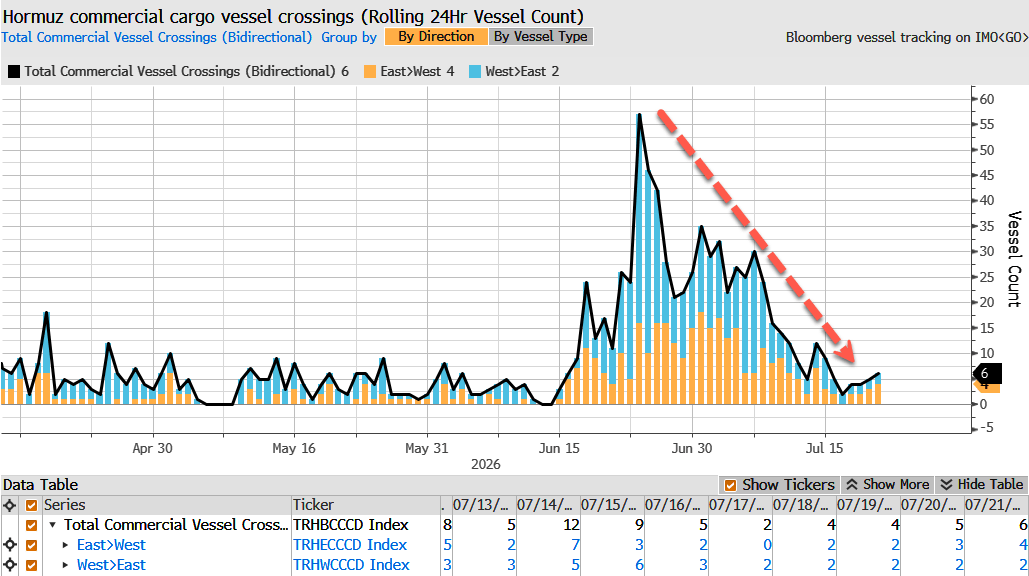
Bloomberg reports that Iran struck another tanker in the strait:
Visible traffic through Hormuz came to a near standstill on Monday following Iranian attacks on vessels over the weekend.
An oil supertanker called the Acheloos and a smaller fuel tanker were both struck in the waterway, according to Dynacom Tankers Management Ltd., the ships’ manager.
Early Tuesday, the UK Maritime Trade Operations said that a tanker had been struck by an unknown projectile in the strait northeast of Oman’s Limah, citing multiple reports, without identifying the vessel. The notice indicates a separate attack to those on the Dynacom tankers.
The flare-up in violence sent Brent crude oil futures surging in recent weeks to over $90 a barrel, with Goldman commodity expert Daan Struyven warning on Monday that oil prices could rally to $120 if there is no de-escalation.
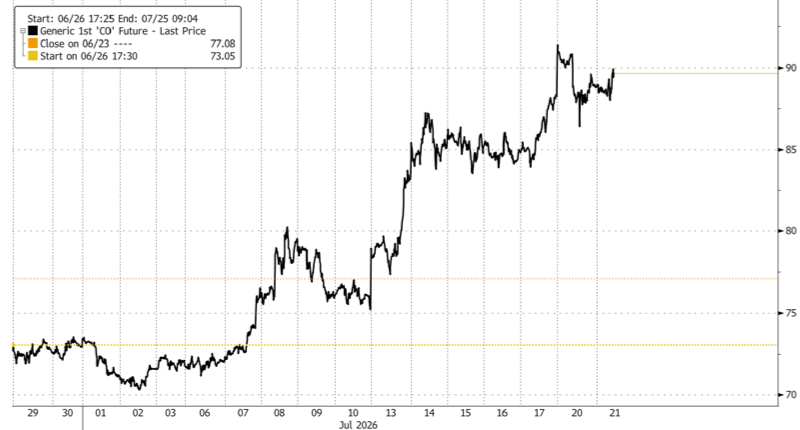
“Escalation in the Middle East and the decline in estimated Persian Gulf flows to below 45% of pre-war levels have pushed oil prices back up,” Struyven said in a note to clients.

Related:
US Consumers Feeling the Pinch
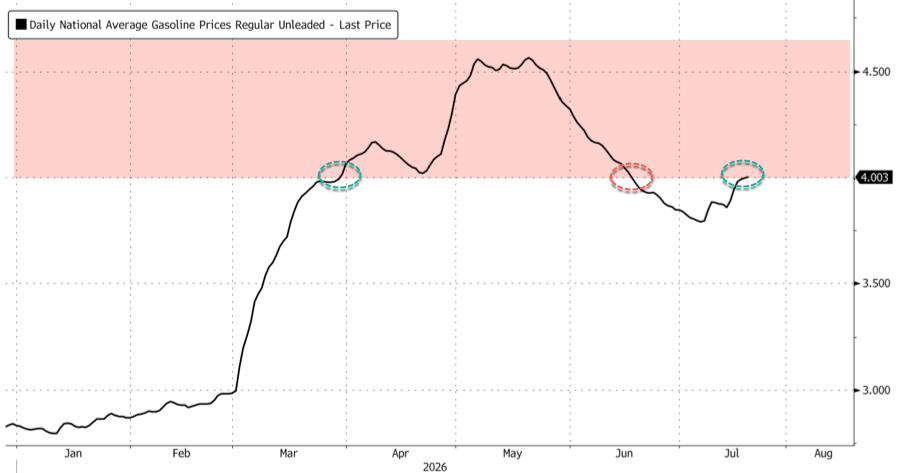
Meanwhile, US consumers are feeling the pinch again at the pump, with the national average for regular 87-octane gasoline topping $4 a gallon once more. This is the politically sensitive line in the sand at which the Trump administration takes notice and consumer behavior begins to shift down at convenience stores, gas stations, and QSRs (quick-service restaurants).
Pattern of Pentagon Concealing US Casualties: NYT
The New York Times reported Monday that the Pentagon withheld information that US troops had been injured in Iranian attacks on Jordan in the week before the missile strikes that killed at least two US soldiers and left one missing.
“Those attacks injured dozens of U.S. service members and damaged several helicopters, according to several U.S. officials, who spoke on the condition of anonymity to discuss operational matters,” the report says. “But the Pentagon did not disclose the earlier strikes, nor the casualties and damage they inflicted.”
The slain soldiers in Jordan were reportedly staying in flimsy prefabricated housing at the time of the deadly ballistic missile attack. US officials described a situation that suggests American forces were essentially sitting ducks, and that not enough has been done to protect the Pentagon’s Mideast bases.
NYT painted a picture of a US admin pattern of concealing the true extent of American casualties. “In statements after airstrikes against Iranian military sites last week, U.S. Central Command said it was retaliating for Iran’s attacks against commercial ships transiting the Strait of Hormuz, never mentioning Iran’s strikes on bases in the region, including in Jordan,” it noted.
Overnight Headlines
courtesy of Bloomberg…
US-Iran Tit-For-Tat
- The US and Iran have exchanged strikes for a 10th consecutive day, with US Central Command targeting Iranian military command centers, launch sites, maritime capabilities, and air defenses.
- Iran has retaliated by attacking US military sites in Kuwait and Jordan.
- Trump vowed Tehran “will pay” after Iran killed three US soldiers.
- According to the Washington Post, US intelligence reports suggest US strikes are unlikely to move Iran.
- Iran’s Khorramabad area in Lorestan Province was attacked earlier today.
Diplomacy & Ceasefire Efforts
- Iran’s Interior Minister Eskandar Momeni began meetings Tuesday with mediators in Pakistan as diplomats sought to salvage a collapsed interim deal.
- Mediators have proposed a 10-day ceasefire between Iran and the US to revive the interim deal, according to an unidentified senior Iranian official cited by Reuters.
- Iran’s president said communication with Supreme Leader Khamenei has increased, per Tasnim reports.
Regional Risks
- The Kaifan, an oil-products tanker owned by Kuwait Oil Tanker Co., was struck by an unknown projectile in the Strait of Hormuz northeast of Oman’s Limah.
- The Houthi militant group in Yemen is threatening to blockade Saudi Arabia and target shipping in the Red Sea, adding to regional maritime risks.
- Southeast Asian nations expressed “serious concern” over the conflict, warning of spillover effects on regional trade, food security, and energy markets.
Energy & Market Impact
- Goldman Sachs says Brent crude could top $120 per barrel by the fourth quarter if Strait of Hormuz disruptions persist, though its base case remains $80 per barrel assuming de-escalation.
- European natural gas futures extended gains, surging more than 20% over the previous seven sessions, as the conflict tightens supply ahead of winter.
- Pakistan and Bangladesh were forced to buy some of their most expensive LNG shipments in years due to supply disruptions from the conflict. Pakistan LNG paid about $21.88 per MMBtu, its highest since 2022, according to traders with knowledge of the matter.
Tyler Durden
Tue, 07/21/2026 – 09:55