Wall Street analysts are finally waking up to Unusual Machines as a pure-play in the effort to anchor America’s sovereign drone supply chain. One-way attack drones and autonomous systems have forever changed modern warfare, forcing the Department of War to quickly fire up a massive procurement supercycle to stockpile these drones.
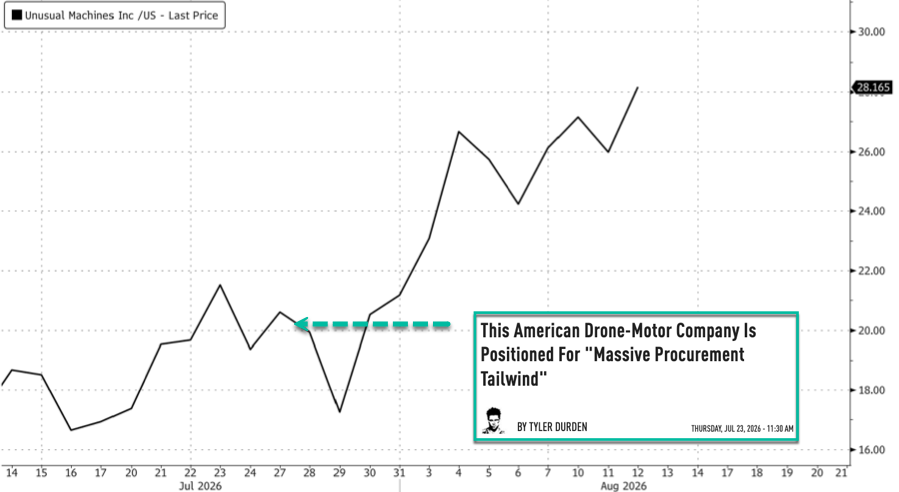
We identified UMAC (read report) in mid-July as an NDAA-compliant drone-component manufacturer positioned to reap the rewards as the US government races to stockpile everything from one-way attack drones to interceptor drones.
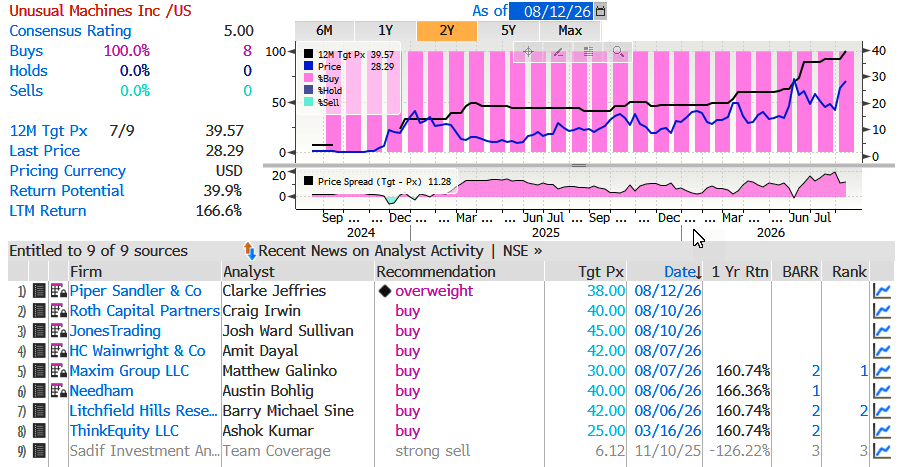
Piper Sandler analyst Clarke Jeffries is the latest to identify UMAC with an “Overweight” rating and a $38 price target, citing the company’s potential in becoming a top domestic drone supplier for the military.

“UMAC is a pure-play drone beneficiary focused on creating an NDAA-compliant source of domestic drone components to fill the multi-billion dollar void in the defense (& commercial) market created by DoW & FCC restrictions against drones and components coming from China,” Jeffries said.
He continued, “While UMAC has made real headway in capturing the potential opportunity with the majority of down-selected Drone Dominance competitors as customers and ~100,000 sq. ft. of domestic manufacturing online by EOY, the company undoubtedly remains very early in their journey (headcount of only 240 today. ) While large scaling risks remain, ultimately the company’s hyper focus on the domestic market and early traction with vendors nets an attractive opportunity in our view. Initiating at OW.
Jefferies outlined UMAC’s key opportunities:
Opportunity #1
De facto supplier for the post-NDAA drone market. The acute near-term opportunity for UMAC is capturing the S-curve for domestically built drone components as small UAS products comply with new NDAA & FCC regulations on domestic material requirements. UAS components including motors, batteries, and drone imaging systems are predominantly manufactured in the China even for existing U.S.-based defense contractors. UMAC’s status as a U.S.-based supplier, especially in base components like motors, creates a privileged position for future UAS production contracts including “Drone Dominance” as the Pentagon mandates supply- chain compliance for future drone programs.
Opportunity #2
What about Commercial? Filling the void left behind by DJI. As the U.S. government moves to cultivate a domestic supply chain for the defense sector, the commercial sector has been swept up in similar protectionist policies to ultimately encourage broader commercial dual-use. To that end, in late 2025 the FCC added DJI (& similar Chinese companies) to the FCC’s ‘Covered List’, that being a register of technology that poses national security risk and therefore is banned from receiving new FCC authorization. While previously approved products remain on sale, this will create a multi-billion dollar market vacuum in the commercial market over the coming years. It remains too early to determine who the heir apparent to DJI is, but we know motors will be needed by whoever becomes the next dominant U.S. commercial drone vendor.
Next-generation opportunities: Counter-UAS & BVLOS.
Longer-term but promising opportunities include: a.) drone interceptors (using drones for defensive applications rather than strike or ISR) which will leverage the same components and b.) BVLOS: FAA currently restricts drones operating ‘beyond visual line-of-sight’ but changes to this rule are currently being debated. If successful it would significantly loosen requirements and enable new air traffic networks, opening the market for ‘Drones-as-a-Service’: e- commerce, food delivery, etc
Bull/Bear Scenarios

2030 Growth Thesis for UMAC

UMAC Is in the Early Innings of Becoming a Major Player in the US Drone Market

UMAC’s Focus Is on Producing Group 1 and Group 2 Drones

Product Portfolio

Scaling Timeline

Drone Market Problem: China Controls 70%

Another Problem: Approximately 90% of Finished UAS Components Are Still Manufactured in China

Nine Years of Legislation Systematically Eliminating Chinese Content From the US Drone Supply Chain

Department of War Target: 200,000 Drones

Competition

Bloomberg data show that all analysts covering UMAC rate the stock a “Buy,” with an average price target of $39.57.
Latest coverage on UMAC from mid-July:
Wall Street is finally figuring out how to profit from the reshoring of America’s drone supply chain and identifying the industry’s top players.
Tyler Durden
Thu, 08/13/2026 – 05:45