66.4 F
Chicago
Tuesday, September 8, 2026
Home Blog Page 1025

Goldman On NatGas: “From US Congestion Concerns To Tight 2026” 

0
Goldman On NatGas: “From US Congestion Concerns To Tight 2026” 

U.S. natural gas futures surged 17.3% last week, the largest weekly gain since early May. Goldman Sachs analysts offered context for the rally, noting that the market narrative has shifted “from U.S. storage congestion fears to tightening 2026 supply.”

A team of Goldman analysts led by Samantha Dart, senior energy strategist, explained that the jump in NatGas prices last week to nearly $3.5/mmBtu was largely due to the roll into the November “winter” contract, which carries stronger heating demand and lower storage congestion risk. 

$3.5/mmBtu resistance.

Dart explained that even beyond the rollover effect, two bullish forces supported the rally:

  • First, while the market seemed to be pricing in concerns that Gulf storage would face a congestion event over the past several weeks, such an event does not seem to have materialized. Henry Hub cash prices have held relatively well in the period, consistent with manageable weekly storage injections (Exhibit 2 and Exhibit 3). The weakest point for cash prices in the period, but which still held above $2.70/mmBtu, was the long Labor Day weekend, when demand softness from the holiday was exacerbated by significantly milder-than-average weather.

  • Second, U.S. liquefaction demand for gas has increased recently, with Venture Global’s Plaquemines’ gas pull now approaching its 3.6 Bcf/d capacity, while gas demand at Cheniere’s Corpus Christi expansion appears to have also stepped up (Exhibit 4). This has taken total U.S. gas demand for LNG exports to over 16.5 Bcf/d this week, the highest level since early August, and likely to rise sustainably above 17 Bcf/d by mid-Oct, when we expect Cove Point to return from maintenance.

  • On net, salt storage, which are the highest deliverability facilities in the U.S., has remained at a manageable level, including an atypical withdrawal last week reported today by the EIA. We note this may be offset next week by a combination of increasing production and reduced pipeline exit flows from the Gulf (largely driven by maintenance events), which could temporarily weigh on U.S. gas prices from current levels. However, we believe we are quickly approaching a period when the market’s focus will more sustainably shift towards 2026 tightness concerns. This is illustrated by the Cal26 strip settling this week above $4/mmBtu for the first time in two months. We maintain our $4.00/$4.60/mmBtu Nov-Dec25/Cal26 Henry Hub forecasts.

Dart’s chartpack:

*pic

Separately, the heating season is just around the corner, with about 42% of U.S. households (the top source, especially in the Midwest and Northeast)using NatGas for heating. 

Here comes the heating season. 

. . . 

Tyler Durden
Sun, 10/05/2025 – 15:45

US Postal Service Mail Carrier Shot By Amazon Driver

0
US Postal Service Mail Carrier Shot By Amazon Driver

By Eric Kullisch of FreightWaves

A U.S. Postal Service worker was shot in the face during an altercation Friday afternoon in Everett, Washington, and a rival package delivery driver is in custody, according to local police and a postal inspector.

The incident took place at the West Mall Place Apartments. The victim was transported to Providence Hospital with a gunshot wound, the Everett Police Department said in a Facebook post. He was transferred to Harbor View Medical Center in critical condition, Seattle TV station KOMO reported

Neighbors said the shooter was an Amazon delivery driver, according to KOMO and social media posts. TV footage showed an Amazon vehicle and USPS van behind police crime-scene tape and the Amazon van being towed away later.

“USPS workers don’t let people in the area when they have the mailboxes open. The Amazon driver didn’t particularly like that, they got into an argument, which escalated to a shoving match, which escalated to the Amazon driver shooting the USPS guy in the freaking eye!!! Then he sat there calmly and waited for the cops to show up and claimed self defense,” a poster named Rich Ryan said on Facebook.

KOMO quoted a U.S. postal inspector as saying the mail carrier was confronted by an individual and the carrier was shot in the face. 

The U.S. Postal Inspection Service and the FBI are also investigating the case. The suspect was booked into Snohomish County jail, KOMO said.

Tyler Durden
Sun, 10/05/2025 – 15:10

“Two Bullets To The Head”: Dem AG Nominee Jay Jones Fantasized About Shooting Republican Lawmaker

0
“Two Bullets To The Head”: Dem AG Nominee Jay Jones Fantasized About Shooting Republican Lawmaker

President Trump on Truth Social called on “radical leftist lunatic” Democratic Virginia Attorney General nominee Jay Jones to step down after leaked text messages surfaced showing him creepily fantasizing about killing a Republican lawmaker and his children. This shocking revelation comes after years of Democrats labeling Trump and MAGA supporters as “fascists,” “Nazis,” and “racists,” even as armed left-wing extremists have ramped up attacks on conservatives, from the attack on a Minnesota Catholic church to the political assassination of Charlie Kirk. 

“It has just come out that the Radical Left Lunatic, Jay Jones, who is running against Jason Miyares, the GREAT Attorney General in Virginia, made SICK and DEMENTED jokes, if they were jokes at all, which were not funny, and that he wrote down and sent around to people, concerning the murdering of a Republican Legislator, his wife, and their children,”  Trump wrote on Truth Social

The president continued, “Abigail Spanberger, who is running for Governor, is weak and ineffective, and refuses to acknowledge what this Lunatic has done. Even Democrats are saying it is “RESIGNATION FROM CAMPAIGN” TERRITORY. Democrat Jay Jones should drop out of the Race, IMMEDIATELY, and the People of Virginia must continue to have a GREAT Attorney General in Jason Miyares who, by the way, has my Complete and Total Endorsement — JASON WILL NEVER LET YOU DOWN!”

Jones’s violent text messages about former Republican House Speaker Todd Gilbert are disgusting and dangerous rhetoric and underscore the broader hate messaging by the Democratic Party, which has spent years creating target profiles on conservatives by labeling them “fascists” and “Nazis.” In other words, the left has normalized assassination culture against their political enemies. 

“Gilbert, hitler, and pol pot.” Jones wrote. “Gilbert gets two bullets to the head.”

Republican candidate for Virginia Governor Winsome Earle-Sears pushed out a new ad…

Virginia Gov. Glenn Youngkin (R) called on embattled attorney general hopeful Jones “step away from this campaign in disgrace“…

Correct. 

Again, Jones’ violent rhetoric is a broader symptom of the Democratic Party’s hate messaging that normalizes the assassination culture of their political enemies. 

And why are Democrats doing this? Because their armed left-wing groups “are planning war against fascists.” Do you see what’s happening?

The rise of left-wing-fueled civil terrorism is already underway. Even Pelosi said Democrats “Won’t Be Responsible” for the years of her party spewing violent rhetoric against Trump. 

*  *  * Meat Customers – order by midnight PST for Monday shipment & Wednesday delivery

Steak Lover’s Bundle

Great American Grill Out

Ultimate Texas Beef & Pasta Box

(10 Lb) Grass-Fed Ground Beef Bundle (on sale)

Carnivore Trio (Beef, Chicken, Pork)

*  *  *

Tyler Durden
Sun, 10/05/2025 – 14:35

Is Nuclear The Key To Powering The Data Center Boom

0
Is Nuclear The Key To Powering The Data Center Boom

Nainish Gupta is director of renewable energy certificate portfolio and regulatory compliance at POWWR.

The Three Mile Island nuclear power plant on the outskirts of Harrisburg, Pennsylvania, is the site of the worst commercial nuclear accident in U.S. history. The 1979 calamity, which released radioactive material into the environment, cast nuclear energy as a dangerous endeavor that few organizations pursued. Now, after years of plants shutting down, nuclear energy is experiencing a renaissance.

Three Mile Island will be restarted in 2027 as the Crane Clean Energy Center, in part to power data centers after a power purchase agreement with Microsoft. Meta also saved a nuclear plant in Illinois that was in danger of closing after signing a 1.1 GW deal. These two major deals signal a growing trend of hyperscalers embracing nuclear power and driving forward expansive new growth.

Three Mile Island

While nuclear offers stable power with low-carbon emissions, the potential for it to truly reshape the energy market and fulfill the promise of a renaissance requires overcoming complex operational, financial and workforce challenges.

Data centers driving the demand

Recent policy support from the Trump administration has accelerated nuclear development at a new speed, but the increased investment has been on the horizon for years. In 2023, under the Biden administration, the U.S. joined more than 20 other countries in a pledge to triple global nuclear energy capacity by 2050 to reach climate goals. Countries have been trying to figure out how to feed a surging demand for energy across the world without hurting the environment, and they’ve turned to nuclear power to fulfill that need.

But what’s different about the surge we’re seeing now is the sheer pace at which companies want to get these plants up and running again. They’re trying to keep up with demand to power the data centers needed to support the explosive growth in artificial intelligence and cloud computing. According to Goldman Sachs, AI alone will drive a 165% increase in power demand for data centers in the next five years.

The demand for this power has created a unique dynamic where tech companies are willing to invest hundreds of millions of dollars in upgrading nuclear facilities that have been offline for years in exchange for long-term power purchase agreements. Unlike traditional utility customers, these companies can sign decades-long contracts that justify the substantial upfront investments required to bring aging nuclear infrastructure back online.

The realities of bringing plants back online

There are 94 operating nuclear reactors in the United States and 18 reactors that are retired or are in the process of retiring. Almost half of the retired/retiring reactors are currently undergoing Nuclear Regulatory Commission evaluation to restart. The rest are older and would be too costly to touch. But even so, the ones that could be restarted have been mothballed for years and require hundreds of millions of dollars in upgrades and a lengthy project timeline to be powered up again.

Think about any building that has been boarded up for at least five years. No matter the condition, repairs, upgrades, and inspections are needed. That need is exacerbated at a highly specialized and sensitive building like a nuclear power plant. Decommissioned facilities need to restore operating licenses, meet regulatory compliance standards, and fix a major vulnerability: the lack of modern cybersecurity standards.

The environment we’re in now of sophisticated cyber threats is a whole new world compared to when some of these older plants last operated. Cyberattacks on U.S. utilities reportedly jumped 70% last year. Major upgrades need to be put in place so the plants aren’t left vulnerable to bad actors.

Another bottleneck is the supply chain. The capacity to produce uranium rods was scaled back during nuclear’s decline, and rebuilding this manufacturing infrastructure will take time. These are not components that can be quickly sourced from existing inventory; they require specialized facilities and rigorous quality controls.

An equally daunting challenge is human capital. Most experienced nuclear power plant operators retired when facilities shut down over the past decade, taking all of that institutional knowledge with them. Training new operators won’t happen overnight. These are highly specialized positions requiring extensive certification and experience with complex safety protocols. The situation is further complicated by competition from other sectors offering better incentives for nuclear engineers, making it difficult for utilities to attract and retain talent.

Why a broader energy mix still matters

Once the industry gets past these obstacles, even the most optimistic nuclear scenarios cannot eliminate the need for a diverse energy portfolio. Though some natural gas and renewable power projects back off during this time, we’ve also seen continued growth. In Texas, the state’s energy fund just approved its first loan to fund a 122-megawatt natural gas power plant that is projected to begin operations by 2027.

A surge of investment in nuclear power does not mean that it will take over all other resources. Different technologies serve different purposes for grid operations. Nuclear provides excellent baseload power, but grids also need flexible generation that can ramp up and down quickly to match demand fluctuations. Solar and wind, despite their intermittency challenges, remain cost-effective for many applications and will continue to play essential roles in the energy mix.

Even where nuclear development is feasible, the long lead time for a plant to become operational means that other technologies must fill the gap during the years-long transition period. Energy security requires multiple sources operating in concert rather than betting everything on a single technology.

Reshaping the energy market and future financing

Data centers have handed nuclear something it’s rarely had: customers willing to pay upfront for guaranteed power over the long haul. Instead of hoping subsidies stick around, companies are putting money behind their need for reliable electricity. It creates a financing model built on genuine market demand. If this proves successful, it could shape the future financing of projects from industries beyond tech companies.

With this demand bolstering the industry, the major concern is that projects to restart nuclear plants will be sped up to keep pace. But they cannot be rushed. Success will require policy support, sustained investment in workforce development, reinforcing the supply chain, and patience to deal with inevitable delays and cost overruns that characterize major infrastructure projects.

The real test will come in the next decade as these ambitious projects move from announcements to actual construction and operation. Nuclear’s capabilities remain promising, but rushing toward unrealistic timelines could undermine the very renaissance it seeks to achieve.

Tyler Durden
Sun, 10/05/2025 – 14:00

Oil Prices Set To Jump After OPEC+ Raises Output By Far Less Than Expected

0
Oil Prices Set To Jump After OPEC+ Raises Output By Far Less Than Expected

OPEC+ will raise oil output from November by 137,000 barrels per day, it said on Sunday, opting for the same fairly modest monthly increase as in October and far less than the 500k+ speculated by the Bloomberg “source” who continues to be short oil and appears to buy every dip. 

The group consisting of the Organization of the Petroleum Exporting Countries plus Russia and some smaller producers has increased its oil output targets by more than 2.7 million bpd this year – equating to about 2.5% of global demand – as it continues the return of 1.65 million barrels a day they cut in April 2023.

The process of unwinding the April 2023 cuts began last month, when they raised their collective target by an initial 137,000 barrels a day with effect from October. The month before they had completed the return of 2.2 million barrels of output, cut in November 2023, a year ahead of schedule. The eight countries will continue to meet monthly, with the next gathering scheduled for Nov. 2.

Following Sunday’s meeting, the new production targets for the eight countries for November are shown in the table below in thousands of barrels a day alongside their limits for August, September and October and their actual production in August, as reported by OPEC’s secondary sources.

The table above does not reflect additional cuts to compensate for earlier over-production that have been made by several countries. Those compensation cuts, most recently revised on Oct. 1, reduce the effective output targets to those shown below.

Brent prices fell below $65 per barrel on Friday, as most analysts predict a supply glut in the fourth quarter and in 2026 due to slower demand and rising U.S. supply. Prices are trading below this year’s peaks of $82 per barrel but above $60 per barrel seen in May.

In the run-up to the meeting, Russia and Saudi Arabia, the two biggest producers in the OPEC+ group, had different views, Reuters sources said.

Russia was advocating for a modest output increase, the same as in October, to avoid pressuring oil prices and because it would struggle to raise output owing to sanctions over its war in Ukraine, two sources said this week. Saudi Arabia would have preferred double, triple or even quadruple that figure – 274,000 bpd, 411,000 bpd or 548,000 bpd respectively – because it allegedly has spare capacity and wants to regain market share more quickly.

OPEC views the global economic outlook as steady and market fundamentals as healthy because of low oil inventories, it said in a statement on Sunday.

Scott Shelton at TP ICAP Group told Reuters that oil prices may rise on Monday by up to $1 per barrel as the November production increase turned out to be modest.

Jorge Leon at Rystad Energy said: “OPEC+ stepped carefully after witnessing how nervous the market had become … The group is walking a tightrope between maintaining stability and clawing back market share in a surplus environment.”

OPEC+ output cuts had peaked in March, amounting to 5.85 million bpd in total. The cuts were made up of three elements: voluntary cuts of 2.2 million bpd, 1.65 million bpd by eight members and a further 2 million bpd by the whole group.

The eight producers plan to fully unwind one element of those cuts – 2.2 million bpd – by the end of September. For  October, they started removing the second layer of 1.65 million bpd with the increase of 137,000 bpd. The eight producers will meet again on Nov. 2.

Tyler Durden
Sun, 10/05/2025 – 13:25

Stablecoin Market Boom To $300B Is ‘Rocket Fuel’ For Crypto Rally

0
Stablecoin Market Boom To $300B Is ‘Rocket Fuel’ For Crypto Rally

Authored by Zoltan Vardai via CoinTelegraph.com,

The record $300 billion stablecoin market capitalization may signal that more investor capital is flowing onchain, which could act as “rocket fuel” for cryptocurrency valuations, according to market analysts.

The total stablecoin supply has reached a new record of over $300 billion on Friday, marking a 46.8% year-to-date growth rate that may outpace the previous year’s stablecoin market growth, Cointelegraph reported.

The record comes at the start of October, historically the second-best month for Bitcoin, reinforcing investor optimism around a potential “Uptober” rally.

“Stablecoin supply may have crossed 300 billion dollars, but this is not capital waiting on the sidelines. It is moving through markets with purpose,” according to Andrei Grachev, founding partner at synthetic dollar protocol Falcon Finance.

“Transfer volumes are in the trillions each month. Velocity metrics show constant activity across networks,” Grachev told Cointelegraph. “They are being used—not just held. This is capital at work, not capital on hold.” 

“Stablecoins are settling trades, funding positions, and giving users dollar access where banks fall short,” he added. 

Source: DeFiLlama.com

Crypto investments are risky and highly volatile. Tax may apply. Understand the risks here

Stablecoins have several use cases beyond investment, including in payments, remittances, merchant payments and as a means of saving. A growing supply may also indicate more stablecoin usage for daily payments or institutional settlements.

$300 billion stablecoin supply may be “rocket fuel” for crypto

The $300 billion milestone may signal a “rebound in digital assets” along with the growing integration of stablecoins in global finance, according to Ricardo Santos, the chief technical officer at stablecoin-based fintech payment company Mansa Finance.

The stablecoin supply’s “expansion is often interpreted as a sign of fresh dollar-equivalent liquidity that can quickly rotate into Bitcoin, Ethereum or altcoins,” he told Cointelegraph. “In this sense, the $300 billion threshold looks like rocket fuel for the next market cycle.”

Santos pointed to stablecoin adoption in countries such as Nigeria, Turkey and Argentina, where residents use US dollar-pegged tokens as “de facto dollars” for everyday transactions.

Stablecoins are also being integrated into payment systems by global financial players such as Visa, further embedding them into mainstream financial infrastructure.

Source: Lookonchain

During the past month, Circle minted $8 billion worth of USDC on the Solana network alone, with $750 million minted on Thursday, according to blockchain data platform Lookonchain’s X post.

“Capital doesn’t stay idle for long,” according to technical analyst and popular crypto trader Kyle Doops, who expects the record stablecoin supply to start flowing into the cryptocurrency market.

Tyler Durden
Sun, 10/05/2025 – 12:50

Russian Attack Targets Military-Industrial Sites In Western Ukraine, Near Poland

0
Russian Attack Targets Military-Industrial Sites In Western Ukraine, Near Poland

Largescale overnight Russian attacks on Ukraine reportedly hit major arms production facilities and the energy infrastructure supplying them, according to a Russian Defense Ministry announcement.

State media has listed targets hit included Sumy, Kharkov, Ivano-Frankovsk, Vinnitsa, Poltava, Chernigov and Odessa regions, with bombardments in Lviv region – not far from Poland – being particularly intense.

Industrial park in Lviv on fire, via X

“At least 25 facilities in the city of Lviv were reportedly hit,” RT writes, which resulted in several regional blackouts.

The Russia military said it struck “Ukrainian military-industrial facilities and the energy infrastructure supporting their operations,” and that “The objectives of the strikes have been achieved. All designated targets were hit.”

The operation involved “land-, sea- and air-based precision-guided weapons, including Kinzhal hypersonic missiles, as well as attack drones” – based on the statement.

A Ukrainian government statement said that five people were killed in the attacks, with most being in the Western city of Lviv, near the border with Poland.

About 65 kilometers from Poland, the Sparrow industrial park is burning after Russia’s attack wave:

“In Lviv, four people were killed and four others injured,” the statement said. “In Zaporizhzhia, one person was killed and 10 were injured after Russia targeted residential areas with drones and aerial bombs. Across all affected areas, residential buildings and critical infrastructure were damaged.”

Remarks from President Zelensky indicated that some 50 missiles and about 500 attack drones were launched at this country.

“The Russians once again targeted our infrastructure – everything that ensures normal life for our people. We need more protection and faster implementation of all defense agreements, especially on air defense, to deprive this aerial terror of any meaning,” he said Sunday.

Russia’s southern Belgorod region has meanwhile continued to come under repeat drone threat from Ukraine, with over 100 drones sent against Belgorod throughout Saturday, the oblast’s governor has said.

Tyler Durden
Sun, 10/05/2025 – 12:15

Watch: Scott Jennings Unloads On Leftists Calling Antifa Attacks “Protests”

0
Watch: Scott Jennings Unloads On Leftists Calling Antifa Attacks “Protests”

Authored by Steve Watson via Modernity.news,

The only sane voice on CNN, Scott Jennings, blasted leftists for repeatedly referring to the terroristic attacks on ICE facilities as “protests.”

“I’m getting pretty sick of Democrats calling it a ‘protest’ when Antifa attacks law enforcement and federal facilities,” Jennings urged.

“It’s a disgrace that we have an American city – Portland – under siege by left-wing radicals and the locals won’t do anything. Enough,” he continued, referring to Portland police.

“Portland has been occupied by Antifa for quite some time,” Jennings stressed, telling the others on the CNN panel “You guys keep calling them protests. These are not protests, these are violent people, they’re attacking law enforcement, they’re attacking federal facilities!”

“Portland has been occupied by Antifa for quite some time,” Jennings stressed, telling the others on the CNN panel “You guys keep calling them protests. These are not protests, these are violent people, they’re attacking law enforcement, they’re attacking federal facilities!”

“The locals won’t do anything about it!” Jennings reiterated.

“That’s an exaggeration,” proclaimed host Abby Philip.

Jennings shot back, “Are you dispute that they’ve attacked the ICE facility?!”

“It’s one city block,” Philip responded.

Jennings continued, “I think what’s happened in Portland is a disgrace. Nobody wants to go there. And yes, parts of the city are ravaged by the protesters. And federal officials believe their facilities are under attack.”

“If there are violent protests happening against a federal facility, they are being ravaged,” Jennings further asserted.

The unrest boiled over again in Portland on Thursday after the arrest of conservative influencer Nick Sortor outside an ICE facility.

Sortor was arrested for disorderly conduct following a confrontation with anti-ICE protesters, who were clearly stoking trouble.

The Portland police claimed that Sortor’s arrest was not politically motivated, stating that “arrests are based on observed behavior and probable cause — not political affiliation or public profile.”

Sortor’s arrest sparked outrage among some conservative circles, with U.S. Attorney General Pam Bondi launching an investigation into the Portland Police Bureau’s actions.

Sortor believes that the police action was retaliatory, especially after he filmed protesters being maced by federal agents, which he claims led to his detainment. 

He argues that the arrest is part of a larger issue where conservative voices are being unfairly targeted, and he has expressed that this will backfire on the authorities involved. 

His claims are supported by allegations that the Portland Police Bureau has failed to arrest or identify individuals who allegedly assaulted other conservative journalists, including Katie Daviscourt, highlighting what he sees as a double standard in law enforcement’s response to different groups.

Daviscourt, a reporter for The Post Millennial, was assaulted by an Antifa militant while covering anti-ICE demonstrations outside Portland’s Immigration and Customs Enforcement facility on September 30. 

The attack occurred when a female activist deliberately struck Daviscourt in the face with a Palestinian flagpole while she was filming the unrest. 

Police were seen letting the violent assailant simply walk away, even as the journalist desperately flagged down a police officer, following the fleeing suspect and pointing her out.

This incident is just one in a series of assaults on journalists reporting on the ongoing unrest in Portland, where local officials have been criticized for downplaying the violence despite repeated attacks on media personnel.

The Trump administration has pointed to the continued violence in Portland and Chicago to justify the deployment of federal troops.

* * *

Your support is crucial in helping us defeat mass censorship. Please consider donating via Locals or check out our unique merch. Follow us on X @ModernityNews.

Tyler Durden
Sun, 10/05/2025 – 11:40

Judge Blocks Trump’s Portland Guard Deployment Amid Antifa Violence; ICE Targeted In Chicago Vehicle-Ramming Attack

0
Judge Blocks Trump’s Portland Guard Deployment Amid Antifa Violence; ICE Targeted In Chicago Vehicle-Ramming Attack

A federal judge has temporarily blocked the Trump administration from deploying roughly 200 Oregon National Guard troops to Portland, halting plans to protect federal assets and personnel amid Antifa-linked attacks on an ICE facility in the southern part of the metro area. Meanwhile, the White House is preparing to send up to 300 Guard troops to crime-ridden Chicago to combat left-wing agitators and assist federal efforts to deport criminal illegal aliens amid attacks over the weekend.

U.S. District Judge Karin Immergut stated on Saturday that there was “no evidence” that protests in the city amounted to a rebellion or significantly hindered law enforcement, and that the White House’s justification was “untethered to the facts,” according to Reuters. The injunction will remain in place until at least October 18, pending further litigation.

“The President’s determination was simply untethered to the facts,” Immergut wrote.

What are the facts, Immergut?

Here are some of the latest:

White House spokeswoman Abigail Jackson told Reuters, “President Trump exercised his lawful authority to protect federal assets and personnel in Portland following violent riots and attacks on law enforcement — we expect to be vindicated by a higher court.” 

The White House filed a notice of appeal to the 9th U.S. Circuit Court of Appeals late Saturday night. 

Portland Mayor Keith Wilson told reporters that his city was peaceful and “this narrative was manufactured.”

Yet local police appear to be protecting domestic terrorists, such as Antifa warriors, while arresting journalists and conservatives:

What Democrats fear…

Oregon’s Democratic Attorney General Dan Rayfield filed the lawsuit after Trump announced plans to deploy troops to Portland to “protect federal immigration facilities from domestic terrorists.”

The state argued the action unlawfully seized control of its National Guard and violated the 10th Amendment, emphasizing that Portland’s protests have been peaceful. Immergut agreed that Oregon is likely to prevail, warning that Trump’s legal approach could allow a president to deploy troops “virtually anywhere at any time,” thereby undermining the separation of civil and military authority.

Meanwhile, leftist Gov. JB Pritzker of Illinois on Saturday warned that President Trump was preparing to send 300 Guard troops to Chicago in the very near term. 

And take a look at the chaos just yesterday in the crime-ridden sanctuary city… 

“Law enforcement under siege in Chicago as agitators hurl rocks, bottles at federal vehicles departing violent protest near scene of apparent coordinated attack on ICE officers in Brighton Park earlier today,” Border Hawk wrote on X. 

Kristi Noem, the Secretary of Homeland Security, wrote on X, “Today in Chicago, members of our brave law enforcement were attacked—rammed and boxed in by ten vehicles, including an attacker with a semi-automatic weapon. I am deploying more special operations to control the scene. Reinforcements are on their way. If you see a law enforcement officer today, thank them.” 

Chaos. 

Headlines:

. . . 

Tyler Durden
Sun, 10/05/2025 – 11:05

Race To The Financial Dung Heap

0
Race To The Financial Dung Heap

Submitted by QTR’s Fringe Finance

As I wrote just weeks ago, I believed (and still do) that any new market collapse could come at the hands of crypto and/or stablecoins, which have in many ways become an essentially unregulated $4 trillion slush-y money market fund reminiscent of 2008.

But watching the headlines coming out of commercial real estate, private credit and subprime auto over the last week or two — and I’m not certain we don’t have a new leader, or leaders, in the nationally televised Race To The Financial Dung Heap™.

Let’s try to make this case as clear and as simple as possible, with examples and charts for people with very short attention spans, like myself.

First, commercial real estate. When the pandemic hit, it didn’t just empty restaurants and stadiums—it hollowed out the very premise of office real estate.

Remote work turned once-bulletproof towers into stranded assets almost overnight, leaving landlords with vacant floors, plunging rents, and billions in debt that no longer penciled out. We still haven’t recovered.

By mid-2025, the U.S. office vacancy rate had climbed to a record 20.7%, according to Moody’s Analytics.¹


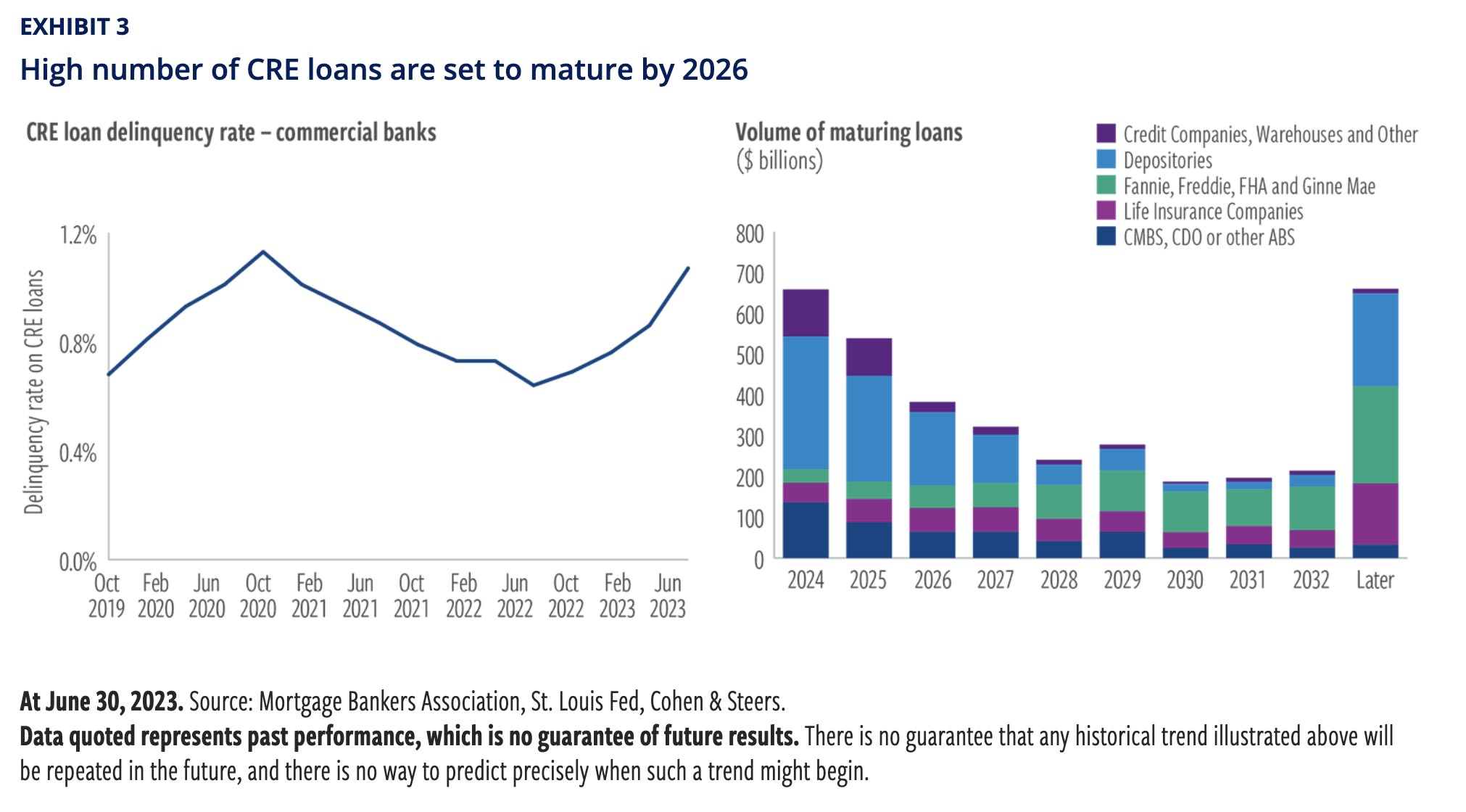
New York was in the middle of converting 4.1 million square feet of offices into housing, the most since 2008.⁴ CMBS delinquency rates had risen for six straight months through August, hitting 7.29% overall and 11.66% for office loans, both records.² ³


Reappraisals continue to be brutal, one headline after another. In New York, the 18-story office tower at 440 Ninth Avenue, near Hudson Yards, was sold in April 2025 for just over $100 million, a 62% plunge from the $269 million it fetched in 2018.


In San Jose, the Sobrato Office Tower changed hands in May 2025 for $63.7 million, down nearly 61% from its $163.1 million assessed value.

Houston saw Chevron unload the former Noble Energy headquarters in June 2025 for $18.2 million, a fire-sale compared with a previous valuation near $130 million.


🔥 50% OFF FOR LIFE: Using this coupon entitles you to 50% off an annual subscription to Fringe Finance for life: Get 50% off forever


In San Francisco, a vacant downtown tower at 199 Fremont Street was sold in July 2025 for $111.3 million, well below the levels comparable buildings had commanded only a few years earlier. And in August 2025, Manhattan’s One Worldwide Plaza was reappraised at $345 million—just 20% of its 2018 valuation—leaving lenders facing potential losses of nearly half a billion dollars.

Banks are not immune. As of the second quarter of 2025, unrealized losses on securities were still near $400 billion.⁵ Regulators had already warned that non-bank CRE lending—the shadow financing that filled the void left by banks—could transmit and amplify shocks across the system.⁶

MSCI data showed distress had climbed to $116 billion by early 2025, the highest in a decade.⁷ Even the multifamily sector, long considered the safest corner, was showing strain.

From there we move to private credit, the $1.7 trillion darling of institutional allocators, which has been running into its own wall. In 2024, the default rate for mid-sized U.S. companies financed by private credit had more than doubled to 8.1%, up from 3.6% in 2023, according to Fitch.⁸


Funds had kept many troubled borrowers alive with covenant waivers, extend-and-pretend refinancings, and payment-in-kind tweaks. But when loans had stayed in breach for multiple quarters, lenders often moved to take the keys.


One day last week I was sitting at a bar on Park Ave. and two younger gentleman from the banking world sat next to me. They looked late 20s/early 30s and started to talk shop, so I joined in, leaning over and asking candidly after their second martini: “What’s it really like out there for CRE and private credit?”

Their affect changed and the answer was visible. One guy just shook his head. The other said, verbatim, “Everyone is in breach of their covenants”.

“What happens when people go to hit the bid when everyone’s marks are all inflated,” I asked the guy closest to me. “We’re going to need a bailout,” he said.

And it’s not just drunk 28 year old junior bankers saying this. Look at this hot-shit PIMCO executive on CNBC a couple days ago, essentially admitting that both public and private credit markets are flashing warning signs: public bonds are seeing high-profile defaults where companies can’t restructure effectively, while in private credit many borrowers are already unable to service cash interest and are resorting to “payment in kind” just to stay afloat.

He says borrowers are being forced to choose between costly but flexible private loans or cheaper public debt that becomes unworkable in distress, highlighting growing fragility across the system. At the same time, asset managers are under fee pressure and leaning on efficiency tools like AI just to manage risk.

Taken together, it points to rising defaults, strained borrowers, and lenders tightening terms—the classic setup for a credit crunch.

There have been clues along the way that this was happening. In 2024, corporate bankruptcies reached their highest level since 2010, and private-credit managers—from Blackstone to midsize players—expanded workout teams aggressively. Compensation packages for senior restructuring professionals ran as high as $1.5 million.¹⁰


Distressed-for-control transactions, in which lenders seize ownership through debt positions, had tripled compared with pre-2022 levels.¹⁰ Liquidity worries surfaced too: by September 2025, some funds were resorting to selling loan portfolios in the secondary market to support reported yields.¹¹


Even the Boston Fed had raised the question of whether private credit’s growth posed systemic risk, pointing out its jump from $46 billion in 2000 to about $1 trillion by 2023.¹² The late September bankruptcy of First Brands, with over $10 billion of debt, off-balance sheet liabilities and questions about whether receivables had been double-pledged, underscored the fragility.¹³


First Brands is, of course, an auto parts maker, which leads this horse directly towards other financial nuclear horse piss water.

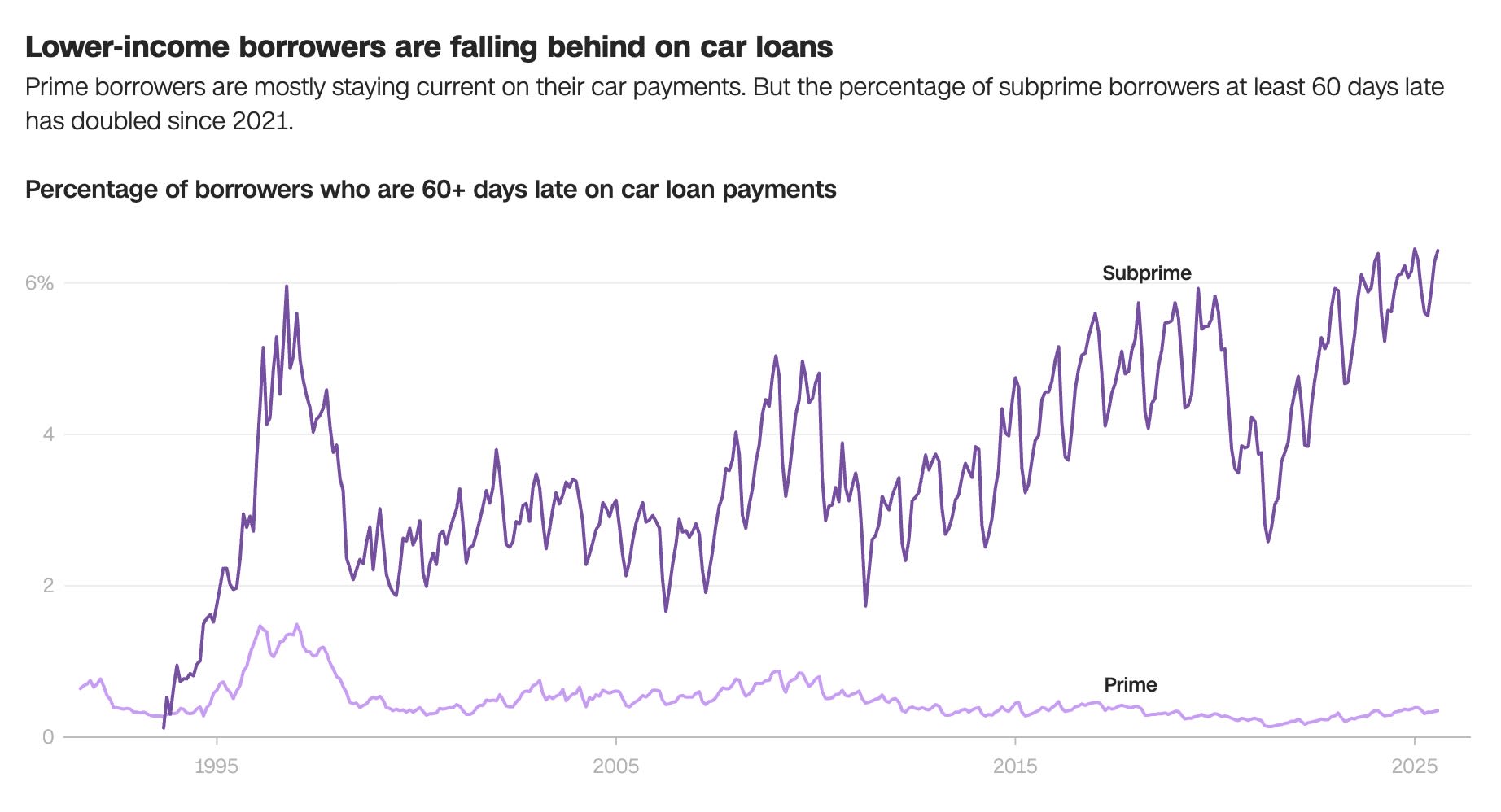
Delinquencies on auto loans 90 days past due reached 5% in the second quarter of 2025, up more than 12% from a year earlier.¹⁶ Net losses in subprime auto ABS were running at 9.44% as of January.¹⁴ Recovery rates were weak because wholesale used-car prices remained high, with the Manheim index still up 2.2% year over year in September.¹⁵

Chart from WolfStreet article, which is also a great read.

Also in September 2025, Tricolor Holdings, a major subprime auto lender focused on low-credit and undocumented borrowers, filed for bankruptcy and said it would liquidate. Federal prosecutors were investigating allegations that the company had pledged the same collateral multiple times to warehouse lenders.¹⁸ ¹⁹ Big banks including Fifth Third, JPMorgan, and Barclays were left staring at hundreds of millions in potential losses.

Earlier in August, another subprime lender, Automotive Credit Corp., had abruptly stopped making new loans.²⁰ The subprime auto ABS market, at roughly $80 billion, is far smaller than subprime housing ever was—but the echoes are unmistakable.

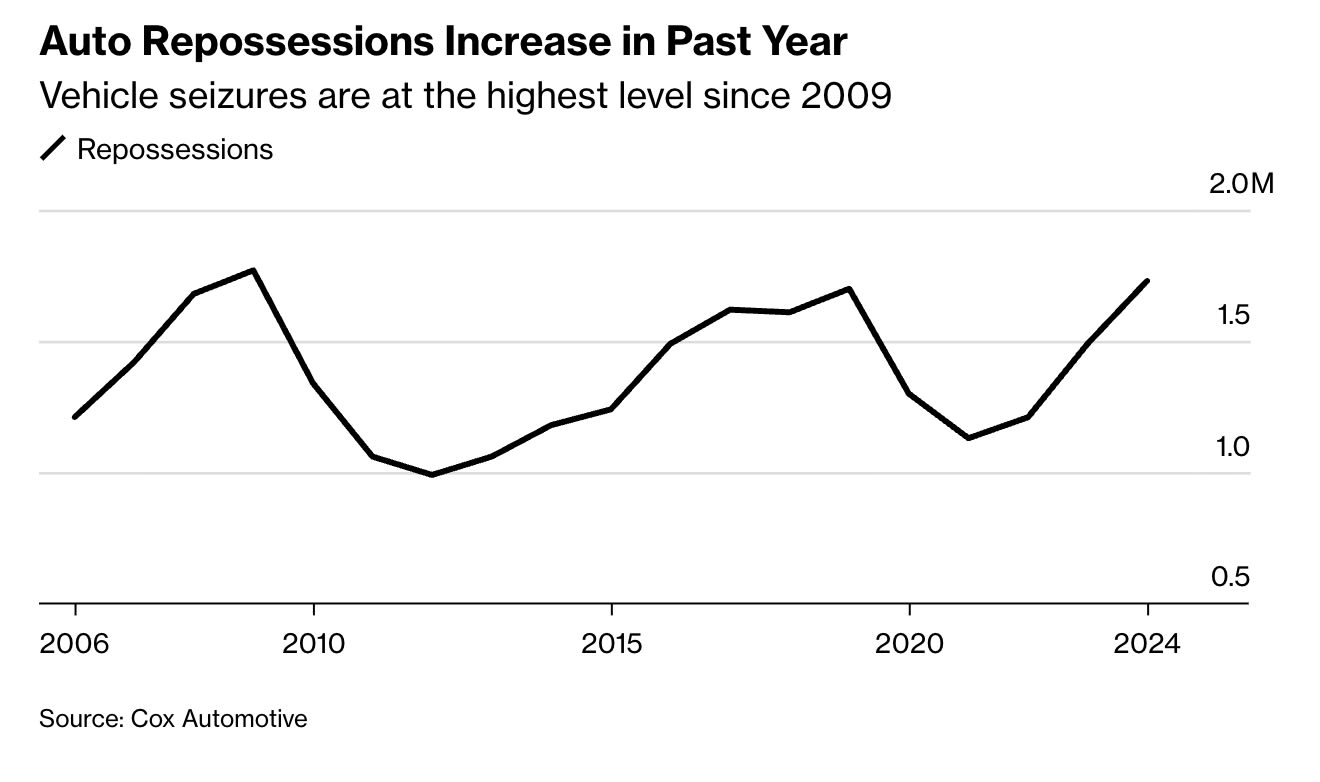
As usual, the easy money of the past 5 years only hid the risks; it didn’t erase them. By 2025, the AAA labels, perpetual funds, and clever underwriting had given way to a harsher reality: empty lobbies, mounting defaults, and repos in the driveway.

As it relates to how I invest personally, this setup makes me want to avoid any names in private credit (i.e. APO, BX, OWL, PRIV and the likes), in regional banking (KRE or any of its components), in the buy now pay later space which I highlighted 2 years ago and was way early on (SOFI, UPST, AFRM, Klarna, etc.) or subprime autos (CACC, CVNA, ALLY, etc.).

Ultimately my friends may get the bailout they talked about that night at the bar. But that would only come after a sharp ‘shit hits the fan’ type deleveraging that sees stock prices fall quickly, prompting the rescue.

  1. Moody’s Analytics, “US office vacancy reaches record high,” July 8, 2025.

  2. Trepp, “CMBS Delinquency Rate Rises for Sixth Straight Month to 7.29%,” Sept. 24, 2025.

  3. Multifamily Dive, “CMBS delinquencies hit 7.29%, a post-pandemic record,” Sept. 16, 2025.

  4. Financial Times, “New York leads office-to-housing conversions,” Sept. 29, 2025.

  5. FDIC, “Quarterly Banking Profile Q2 2025,” Aug. 25, 2025.

  6. Financial Stability Board, “Non-bank CRE financing risks,” June 19, 2025; Bloomberg, “Shadow CRE lending may amplify bank shocks,” June 21, 2025.

  7. MSCI Real Assets, “US commercial real estate distress update,” Aug. 20, 2025.

  8. Fitch Ratings, “Private credit default rate doubled in 2024,” Mar. 3, 2025; Fitch, “Private credit outlook,” May 30, 2025.

  9. Preqin/Brookfield, “Private credit to $1.7 trillion,” 2025; Deloitte, “Private credit survey,” 2025.

  10. Wall Street Journal Pro, Isaac Taylor, “Private-Credit Firms Expand Restructuring Teams Amid Bankruptcy Surge,” Mar. 12, 2025.

  11. Bloomberg, “Private credit leans on secondaries to support liquidity optics,” Sept. 4, 2025.

  12. Federal Reserve Bank of Boston, “Is private credit a systemic risk?,” May 21, 2025.

  13. Financial Times, “First Brands bankruptcy raises red flags for private debt,” Sept. 29–30, 2025.

  14. S&P Global Ratings, “US Subprime Auto ABS Tracker,” Mar. 10, 2025.

  15. Cox Automotive / Manheim, “Used vehicle value index,” Sept. 17–22, 2025.

  16. New York Fed / LendingTree, “Household Debt and Credit Report,” Sept. 23, 2025.

  17. Experian / Auto Remarketing, “Auto finance state of the market,” Aug. 28, 2025.

  18. Bloomberg, Carmen Arroyo, Isabella Farr, Scott Carpenter, “Subprime Auto Lender Collapse Delivers Blow to Risky Debt Market,” Sept. 11, 2025.

  19. Financial Times, “Tricolor bankruptcy and alleged fraud probe,” Sept. 10, 2025.

  20. Auto Finance News, “Automotive Credit Corp pauses new originations,” Aug. 7–8, 2025.


QTR’s DisclaimerPlease read my full legal disclaimer on my About page hereThis post represents my opinions only. In addition, please understand I am an idiot and often get things wrong and lose money. I may own or transact in any names mentioned in this piece at any time without warning. Contributor posts and aggregated posts have been hand selected by me, have not been fact checked and are the opinions of their authors. They are either submitted to QTR by their author, reprinted under a Creative Commons license with my best effort to uphold what the license asks, or with the permission of the author.

This is not a recommendation to buy or sell any stocks or securities, just my opinions. I often lose money on positions I trade/invest in. I may add any name mentioned in this article and sell any name mentioned in this piece at any time, without further warning. None of this is a solicitation to buy or sell securities. I may or may not own names I write about and are watching. Sometimes I’m bullish without owning things, sometimes I’m bearish and do own things. Just assume my positions could be exactly the opposite of what you think they are just in case. If I’m long I could quickly be short and vice versa. I won’t update my positions. All positions can change immediately as soon as I publish this, with or without notice and at any point I can be long, short or neutral on any position. You are on your own. Do not make decisions based on my blog. I exist on the fringe. If you see numbers and calculations of any sort, assume they are wrong and double check them. I failed Algebra in 8th grade and topped off my high school math accolades by getting a D- in remedial Calculus my senior year, before becoming an English major in college so I could bullshit my way through things easier.

The publisher does not guarantee the accuracy or completeness of the information provided in this page. These are not the opinions of any of my employers, partners, or associates. I did my best to be honest about my disclosures but can’t guarantee I am right; I write these posts after a couple beers sometimes. I edit after my posts are published because I’m impatient and lazy, so if you see a typo, check back in a half hour. Also, I just straight up get shit wrong a lot. I mention it twice because it’s that important.

Tyler Durden
Sun, 10/05/2025 – 10:30