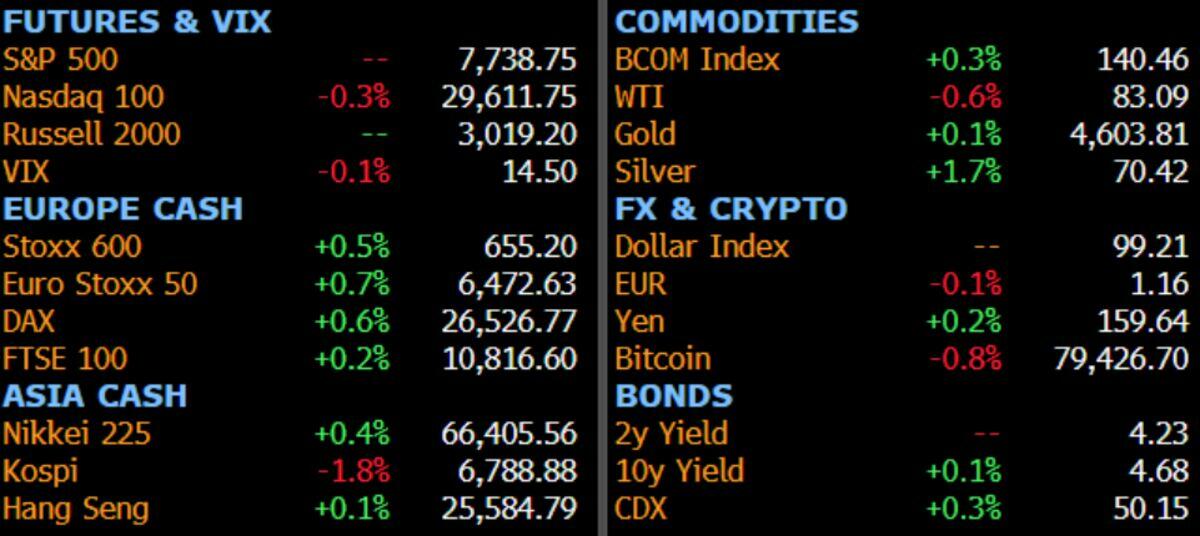
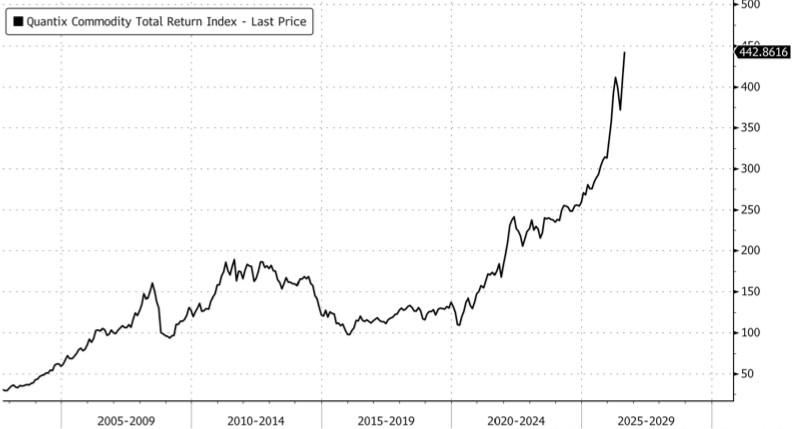
US stock futures are flat and rates rise ahead of today’s main event: Fed chief Kevin Warsh’s Jackson Hole speech at 10am ET (full preview here) as traders seek clarity on his economic outlook and his strategy for lowering inflation back to the Fed’s 2% target. As of 8:00am ET, S&P futures are little changed and Nasdaq 100 futures are lower following the Nvidia-driven rally for the index in the prior session, when however only 30% of the S&P and 1 of 11 sectors closed green as the index continues to be carried by a handful of AI names while the median stock goes nowhere. Pre-market, Mag 7 stocks are mostly higher led by TSLA (+0.6%) and AMZN (+0.3%); NVDA is the laggard (-0.5%). PayPal slumped 16% in premarket trading after Advent and Stripe abandoned their pursuit of the firm. Overnight, headlines were largely quiet with WTI dropping further as the Iran conflict remains quiet. Bond yields are 1-2bps higher (10Y 4.69% and 3Y rates up two basis points to 5.21%) while the dollar and gold barely budged. Brent crude fluctuated. Copper headed for a ninth weekly gain, the longest run since 2020. USD is flat. Commodities are all modestly higher across base metals, precious metals (silver +1.5%) and ags. Today’s US economic data calendar includes August MNI Chicago PMI (9:45 a.m. New York time, several minutes earlier for subscribers), August final University of Michigan sentiment (10 a.m.) and August Kansas City Fed services activity (11 a.m.).

In premarket trading, Mag 7 names are mostly higher: Tesla +0.4%, Alphabet +0.3%, Amazon +0.4%, Meta +0.2%, Apple +0.2%, Microsoft -0.3%, Nvidia -0.3%
- Affirm Holdings (AFRM) climbs 13% after the financial technology company forecast revenue for the first quarter that beat the average analyst estimate. Also, the company and Shopify expanded their global partnership to launch Shop Pay Installments in Australia.
- Autodesk (ADSK) falls 4% as the application software company forecast adjusted earnings per share for the third quarter that missed the average analyst estimate. Citi notes that the company’s sales growth looks to be moderating in the second half of the year.
- Elastic (ESTC) rises 18% after the company boosted its adjusted earnings per share guidance for the full year and posted guidance that beat the average analyst estimate.
- Gap (GAP) gains 14% after the apparel retailer named Michael Francis as head of Old Navy and profit outpaced estimates, offsetting a sales decline at the value chain and lower sales guidance.
- Marvell Technology (MRVL) reported second-quarter results that modestly beat expectations and gave an outlook that is above the analyst consensus. However, shares of the chipmaker are down 7%; the stock had soared more than 180% this year, as of its Thursday close.
- PayPal (PYPL) falls 17% as people familiar with the matter say that a consortium of buyout firm Advent and payment processor Stripe has decided to abandon its pursuit of the fintech pioneer.
- SentinelOne (S) falls 3% as the cybersecurity platform’s forecast for fiscal-year adjusted EPS trails the average estimate.
- Solstice Advanced Materials (SOLS) rises 15% after the company and Element Solutions mutually agreed to terminate their merger pact.
- Ulta Beauty (ULTA) falls about 1% as higher discounts and promotions weighed on the cosmetics retailer’s margins. Analysts said gross margins were underwhelming but noted guidance could be conservative.
In other corporate news Gap jumped in premarket trading after naming a retail industry veteran as head of Old Navy and reporting profit above estimates, offsetting a sales decline at the value chain and lower sales guidance. Tencent released a foundation model it says outperforms rivals Z.AI and Moonshot AI in internal tests. The UAE has given SpaceX’s Starlink a 10-year general satellite services license. Fox responded to a Reuters report that Rupert Murdoch and Lachlan Murdoch are considering a recombination of Fox and News Corp., saying there have been no discussions on the topic since consideration of a possible merger in 2022. Element Solutions and Solstice Advanced Materials mutually agreed to terminate their merger pact.
As described in our Jackson Hole preview (here) Warsh’s address, scheduled for 10 a.m. New York time, is shaping up as a crucial moment for markets as doubts about his commitment to taming inflation have helped push up long-term yields. A divided policy committee and the Treasury’s bond market intervention are further complicating the backdrop.
“Investors are reluctant to increase their exposure just hours before Kevin Warsh’s speech,” said Nabil Milali at Edmond de Rothschild Asset Management. “His recent comments have been so vague that no one knows what to expect today, with some investors anticipating a very hawkish message and others expecting the exact opposite.”
Warsh’s speech could flatten the US yield curve, bolster risk appetite and support the dollar, if he gets it right, according to Bank of America’s Michael Hartnett. “What investors want to see is the framework that the Fed is using to think about the economy to allow markets to better assess incoming data,” said Hugh Gimber, global markets strategist at JPMorgan Asset Management. “That’s the piece that’s been missing at the moment.”
Goldman rates trader George Cole made the following notable remarks ahead of J-Hole:
Obviously the speech is very interesting in the context of the buyback announcement, the Druckenmiller op-ed, and the July meeting, which was a head-scratcher. He seemed to endorse the idea that higher long-end yields were a reflection of the market finally standing on its own feet and getting some vol back after years of central bank repression. I think that’s a somewhat false narrative, but that was the story he gave us — only for Bessent to say the market doesn’t understand the fundamentals, has the price wrong. Philosophically, you can’t claim to want an unpolluted read of market pricing while bullying that same market. So we’d be surprised if he re-runs the July script and celebrates the move higher in long-end yields.
What we’re looking for instead is something vol-reducing: marginally hawkish near term, but fundamentally calming. The market isn’t worried about the Fed’s stance — it’s confused about what the Fed is actually doing.
Three things would help: 1) a clear statement that the policy rate, not long-end yields, is the main transmission mechanism; 2) an acknowledgement that recent data has been encouraging and reaffirms recent FOMC decisions — not forward guidance, but evidence the Fed is reading the data in a familiar, sensible way; and 3) a recommitment to price stability that sounds a bit more like June.
The speech will be more significant for foreign-exchange, gold and bond markets than for equities, said Ulrich Urbahn at Berenberg. History suggests a similar response, with the S&P 500 gaining just 0.4% on average in the week following the gathering, data compiled by Bloomberg show. “A firm message on inflation, fiscal credibility or the need to preserve restrictive policy would tend to lift real and nominal long-end yields, support the dollar and pressure duration-sensitive assets,” Urbahn said.
Bloomberg’s Editorial Board writes that investors demanding clear answers to their many questions from his speech are almost certain to come away disappointed.
“Warsh can and should try to dispel some of the doubts that have arisen since his appointment began in May. But it’ll be a while before he can provide a definitive account of his preferred approach to monetary policy. Having commissioned five task forces of eminent experts to offer advice, he has little choice but to wait until they’ve reported back and he and his colleagues have discussed the findings.” – Bloomberg Editorial
What can’t wait, though, is a commitment to investors that the Fed will freely explain the rationale for its actions going forward. To put it more bluntly, Warsh needs to say: “Message received.”
Elsewhere, Citadel Securities posted a record $7.3 billion of trading revenue for the second quarter, more than triple on a year earlier. A US judge ruled that the Trump administration must lift its ban on Anthropic’s AI technology for federal agencies.
The flood of debt financing for AI capex is causing “indigestion” in fixed-income markets and fueling yields, but that dynamic should result in decent longer-term returns for investors, according to Pimco. Meanwhile, BCA Research chief economist Peter Berezin highlights that hyperscaler depreciation expense is set to jump to over $500 billion by 2030, equal to the expected operating profits of all five companies in 2026.
In other assets, oil exports from the Persian Gulf have recovered to around two-thirds of pre-war levels, according to Goldman Sachs. Copper edged closer to a record high, with three-month futures trading above $14,300 a ton in London, on track for a ninth weekly gain, the longest such run since 2020.
In geopolitics, the US is in talks with Venezuela to take a large stake in its oil fields, which would extend the Trump administration’s influence on the post-Maduro government and the nation’s vast energy reserves. Iran said putting US diplomacy back on track “isn’t impossible.”
The Stoxx 600 is up by 0.5% in a broad rally in European equities, and set for a fifth straight monthly advance ahead of speeches by central bankers at the Jackson Hole economic symposium. Consumer, autos and chemicals sectors are the best performers. Media and real estate are among the few decliners. Here are some of the biggest movers on Friday:
- BMW rises as much as 2.4% and Forvia gains as much as 4.9% as Citi places the stocks on positive watches, saying there may be some room for relief from current low levels as the automotive sector continues to face structural challenges.
- Ackermans shares rise as much as 8.5% as KBC Securities says the investment company had “closed a solid first half.”
- Interparfums shares gain as much as 5.4% as Oddo BHF raises its recommendation on the French firm to outperform from neutral, saying new products should boost revenue.
- Hays gains as much as 6.2% as Panmure Liberum upgrades to buy, boosts its price target to a Street-high and says “for the first time in a long time” there is asymmetric risk profile to the upside on estimates.
- Strabag shares rise as much as 12% after the Austrian construction company boosted its Ebit margin forecast for the full year.
- Recticel gains as much as 6.7% with KBC Securities saying the insulation product manufacturer exceeded first-half consensus adjusted Ebitda expectations by 9%.
- Goodwin shares rally as much as 13% after the engineering company reported record profits in the last financial year and announced plans to return a “substantial part” of any proceeds from selling its Mechanical Engineering division to shareholders.
- Sivers Semiconductors fall as much as 22% after the Swedish electrical component manufacturer reported second-quarter earnings which included a drop in net sales and accelerating operating losses. Shares are still up over 600% year to date.
- Boozt falls as much as 8.5% after an offering of shares by holder Ferd prices at SEK145/share, a 7.05% discount to Thursday’s close.
Asian stocks edged higher, with cyclical sectors among the top gainers, as investors awaited Federal Reserve Chair Kevin Warsh’s speech at Jackson Hole later today. The MSCI Asia Pacific Index was up 0.2% after rising as much as 0.6%. Financials, industrials and materials were among the best-performing sectors on the gauge. Meanwhile, a subgauge of tech shares gave up early gains spurred by optimism over Nvidia’s strong outlook. The MSCI Asia gauge was up 0.4% for the week, on track for a fifth weekly gain in six. The regional benchmark is up 3.1% so far in August, poised for its first monthly increase since May. Still, sentiment remains fragile amid continued concerns over Big Tech spending, geopolitical tensions and elevated oil prices.
“Despite the strong performance of US stock indices yesterday, we saw this morning that risk appetite remained limited in Asian markets, mainly because investors are reluctant to increase their exposure just hours before Warsh’s speech,” said Nabil Milali, a portfolio manager at Edmond de Rothschild Asset Management. “His recent comments have been so vague that no one knows what to expect today, with some investors anticipating a very hawkish message and others expecting the exact opposite.”
In FX, the Bloomberg Dollar Spot Index is little changed; the yen led losses among major currencies, moving closer to 160 against the dollar and heading for its lowest level since the coordinated US-Japan intervention at the end of July. Japan spent a record $96.4 billion over the past month to support the currency, according to data released by the Finance Ministry on Friday.
In rates, treasuries are mostly muted as investors await Warsh’s Jackson Hole address, and hold small losses, lifting yields by about 1bp inside this week’s ranges, with Warsh holding the potential to alter market pricing for a single quarter-point interest-rate increase by year-end and high likelihood of a second by mid-2027. 10-year yield is about 2bps higher on the day near 4.69%, outperforming UK and German counterparts.Yield-curve flattening trend unleashed by last week’s Treasury Department decision to expand buybacks targeting 10- to 30-year sectors has stalled.5s30 spread, about 1bp wider near 80bp, fell below 79bp Thursday to the lowest level since July 29, most recent Federal Reserve decision date, while 2s10s, more than 1bp steeper near 45bp, breached 43bp, lowest since Aug. 7. IG credit new-issue calendar is anticipated to be light through month-end; activity ground to a halt Thursday.
In commodities, oil prices lower with Brent hovering around $89/barrel and WTI around $83, while gold is holding close to $4,600/oz and silver is rallying. Bitcoin is trading below $80,000.
Today’s US economic data calendar includes August MNI Chicago PMI (9:45 a.m. New York time, several minutes earlier for subscribers), August final University of Michigan sentiment (10 a.m.) and August Kansas City Fed services activity (11 a.m.). Fed speaker slate also includes Cleveland Fed’s Hammack at 9 a.m. and Chicago Fed’s Goolsbee at 12:40 p.m.
Market Snapshot

Top Overnight News
- The top US commander for the Middle East said that American forces have cleared Iranian mines from the Strait of Hormuz, after Washington’s allies expressed doubts about similar claims by President Donald Trump.
- Qatar’s prime minister visited Tehran on Thursday in an effort to revive stalled diplomacy six months into the war, as U.S. President Donald Trump said Washington was not currently talking to Iran. RTRS
- Venezuela is considering whether it should quit OPEC, according to people familiar with the matter, potentially delivering a fresh blow to the oil cartel it helped create more than six decades ago. BBG
- Jackson Hole Preview: Warsh to speak at 10am & GS econ expects him to reiterate his commitment to the 2% inflation target, expand on the rationale behind his approach to Fed communication and offer thoughts on some bigger picture topics such as productivity growth or shocks to the global economy that he alluded to at his last press conference. He’s likely to acknowledge the better recent inflation news but is unlikely to provide any policy guidance. Full Preview here
- Howard Lutnick accused Canada of scuttling trade talks by adding last-minute demands, saying PM Mark Carney had political incentives to kill an emerging deal. BBG
- A federal judge issued a temporary restraining order that prevents the Postal Service from inserting itself into the election process while litigation continues: NBC
- Nippon Life Insurance Co., Japan’s largest life insurer, said it is open to becoming a net buyer of government bonds next fiscal year as it finds current interest rates attractive. BBG
- Japan spent a record $96.4 billion over the past month to support the yen, underscoring the authorities’ willingness to deploy increasingly aggressive tactics to put a floor under the currency. BBG
- Tokyo’s key inflation gauge accelerated for a third month even as the government took steps to reduce energy costs, bolstering the case for another Bank of Japan interest-rate increase as market expectations mount for a move in September. RTRS
- Spanish inflation surged to 4.5% in August, more than double the ECB’s target, while France’s 2.7% reading exceeded expectations, strengthening the case for a rate increase next month. BBG
- US President Trump’s administration is mulling a 500mln gallon boost to 2027 biofuel quotas to offset exemptions
A more detailed look at global markets courtesy of Newsquawk
APAC stocks were mostly positive but with gains capped following the varied performance stateside, where all indices rose and the Nasdaq outperformed post-NVIDIA earnings, but almost all sectors were in the red aside from tech, while the attention turns to the Jackson Hole Symposium and Fed Chair Warsh’s keynote speech. ASX 200 was higher with notable outperformance in tech, although consumer stocks and real estate lagged amid the recent increased bets for the RBA to resume its hiking cycle next month. Nikkei 225 rallied as participants digested the latest data releases, including a surprise decline in the Unemployment Rate, while Tokyo CPI matched estimates, with the Core reading remaining beneath the 2% goal. KOSPI bucked the trend amid weakness in South Korean tech giants despite the sector doing much of the heavy lifting across global markets, while there was a report that SK Hynix lagged rivals in NAND process-node transitions, with slower upgrades and reduced NAND capex eroding its cost competitiveness and market share. Hang Seng and Shanghai Comp were kept afloat but with the upside limited amid a slew of earnings releases and with participants also bracing for results from Chinese big banks.
Top Asian News
- S&P affirmed China at A+; Outlook Stable. Said a stable outlook on long term rating reflects the view that China will provide larger fiscal support to keep the economy growing at around 4% over the next two years.
- China’s Ministry of Finance said the country will implement proactive macroeconomic policies in the second half of the year; long term positive fundamentals remain unchanged.
European bourses are entirely in the green, with the CAC 40 the clear outperformer as it rebounds from yesterday’s downside. The main driver of Thursday’s losses was the presidential debate that took place between candidates. The key focus was on how the candidates would approach France’s debt problem; no consensus was agreed on the stage on how to solve the problem, but suggestions ranged from waiving interest payments on ECB-owned debt to cutting welfare spending. Overall, Politico says no candidate pulled off a clear winner and that the presidential race remains open. Sectors highlight the positive bias. Consumer Products & Services top the sector pile, with Autos and Chemicals rounding out the top 3 performers. To the downside is Media, followed by Real Estate and Retail. Key movers include: UK defence names, FT reported that Chancellor Healey will shelve its defence spending target at October’s budget; EssilorLuxottica (+3.3%), announces share buybacks of up to 5mln shares; Strabag (+10.7%), H1 revenue beat and raises its FY26 guidance; Siemens (+1.5%), upgraded to buy at Erste.
Top European News
- UK Chancellor Healey will reportedly shelve defence spending target when presenting October budget, the FT reported.
FX
- G10s lack a bias ahead of the Warsh Jackson Hole speech with **most currencies flat vs the USD. **
- DXY ekes modest gains after surpassing the 200DMA of 99.16 ahead of Fed Chair Warsh’s speech. Performance across majors is lacklustre with most currencies weaker, albeit small in magnitude.
- Into the speech, some analysts have suggested that the market could again be left disappointed; Saxo Bank says the title of the forum suggests that Warsh will deliver thoughts on the potential use of stablecoins for financial system plumbing rather than the Fed’s thoughts on interest rates – Previous Fed chairs have used the forum to signal upcoming policy actions. However, Warsh has begun his term with a bias against issuing any forward guidance, and has made the case that such guidance can shackle officials to their earlier forecasts, and his approach of little guidance will allow markets to interpret the data themselves.
- MUFG says the closest historical comparisons to today’s speech are “probably 2008 or 2016” given the level of uncertainty, which both garnered 0.7% move in EUR/USD – FX options price a 46pip move in EUR/USD today, lower than the historicals that MUFG refers to.
- While OATs saw some weakness at the open, EUR was steady throughout the French Presidential debate. Focus now shifts to Fitch’s rating on France this evening, seen unchanged, and the Socialist party which are set to unveil demands for France’s 2027 budget over the weekend. EUR/USD likely at the whim of the Buck into the highly anticipated Warsh speech, 200DMA c. 10 pips below will likely support the pair for the moment.
- GBP/USD is flat but off worst levels after finding support at 1.3580. A couple updates on the domestic political front. The FT reported UK Chancellor Healey will shelve defence spending targets when presenting the October budget, a move which could save as much as GBP 10bln/year, based on OBR forecasts. It was separately reported that there could be potential modifications to council taxes, though no GBP move was seen on this report.
Fixed Income
- Fixed benchmarks are under very mild pressure this morning, but with price action ultimately muted ahead of the day’s key risk events. USTs (-2 ticks) trade within a narrow 108-16 to 108-20 range, whilst Bunds (-21 ticks) and Gilts (-29 ticks) are hampered by elevated gas prices.
- USTs are trading in an exceptionally thin range this morning as attention remains on two key risk events. Firstly, Fed Chair Warsh is set to speak at 15:00 BST (10:00 EDT). Whether he touches on monetary policy remains to be seen, but even if he doesn’t, there is a risk markets will begin to price in credibility woes once again. At the same time as Warsh, the BLS will release the annual NFP benchmark revision; consensus sees a revision of +200k.
- Over in Europe, EGBs and Gilts have been subject to a few days in the red, as gas prices remain elevated. A lot of that pressure is attributed to fears surrounding low gas storage, and recent punchy rhetoric out of Russia has also not helped the mood.
- For France specifically, OATs have had the first Presidential debate to digest. Ultimately, there was no clear victor, but the confab made evident the stark contrast in views held between parties. This can be evidenced in the 10yr OAT/Bund spread, which remains near recent highs at 85bps, but ultimately fairly stable today.
- OATs (-15 ticks) are faring a touch better vs peers this morning, potentially as leading candidate Le Pen provided further colour on how she would solve France’s debt problem. She noted that spending needed to be cut, arguing that France should not commit more than EUR 5bln to the EU (vs ~EUR 29bln in 2026). She said she would present a EUR 125bln cost-cutting plan before the next budget debate, which will only happen once PM Lecornu submits the 2027 budget bill (end-Sept).
- Italy sells EUR 6.5bln vs exp. EUR 5.75-6.5bln 3.15% 2031, 4.00% 2036 BTP and EUR 2bln vs. EUR 1.5-2bln 1.773% 2034, 1.645% 2035 CCTeu.
- Japan sells JPY 2.15tln 2-year JGBs: b/c 2.97x (prev. 3.63x), average yield 1.708% (prev. 1.483%), Tail in price 0.034 (prev. 0.007).
- Australia sells AUD 800mln 4.25% December 2035 Bonds: b/c 3.88x, avg. yield 5.0539%.
Commodities
- Geopolitical updates have lacked anything tangible, even though rhetoric has been hawkish. US President Trump dismissed immediate negotiations and suggested sanctions and the Hormuz blockade are putting Tehran under severe strain. Washington says the Strait of Hormuz has been cleared of mines and shipping lanes reopened, while Treasury Secretary Bessent is pushing G20 countries to cut Iranian and IRGC revenue flows. Iran, meanwhile, says it is preparing conditions for reopening the Strait, has agreed on a potential corridor with Oman, and warns it could strike US military and economic interests if pressure continues. Despite mediation efforts by Oman and Qatar, the US says no negotiations are currently planned and does not recognise the reported Iran-Oman arrangement.
- Nonetheless, amid the lack of a notable escalation, WTI and Brent futures are subdued intraday, with the former in a USD 82.54-83.78/bbl range and the latter in a USD 87.60-88.61/bbl range. Participants, as usual, are eyeing any tangible updates on escalations/de-escalations. Dutch TTF, conversely, is firmer by around 2.2% at EUR 69.79/MWh, continuing to be buoyed by supply concerns as Europe replenishes winter stock. Note that the contract briefly notched the EUR 70/MWh mark.
- Precious metals are firmer despite a resilient USD against the backdrop of softer oil prices, but following two sessions of weakness. Spot gold resides towards the top of a narrow USD 4,571-4,614/oz range within yesterday’s band between USD 4,564-4,643/oz. Spot silver gains after finding a comfortable footing above its 100 DMA (USD 68.19/oz), with the precious metal back on a USD 70/oz handle in a USD 68.44-70.95/oz range.
- Base metals mostly eke mild gains despite DXY remaining resilient, and with downside capped amid expectations for near-term Chinese stimulus. 3M LME copper resides in a USD 14,277.65-14,345.00/t range at the time of writing.
- Venezuela is reportedly mulling leaving OPEC, according to people familiar with the matter.
- Saudi Aramco reportedly sold around 4mln barrels of Arab Medium and Heavy crudes to Chinese refiners for loading in September at locations just outside Hormuz, Bloomberg reported.
- Chinese State Planner is to raise domestic gasoline prices by CNY 375/t and diesel by CNY 360/t.
- Kazakhstan has restored oil production to normal levels, which were previously reduced due to the attacks on the CPC, according to Interfax.
- Qatar Energy extended the LNG force majeure to Edison (EDNR IM) until November 4th.
- Global Aluminium producer is seeking a premium of USD 310/t for October-December 2026 in talks with Japan (-22% Q/Q), according to source reports.
- Ukraine’s agriculture minister said the country’s winter wheat planting area is expected to decline in 2027.
Trade/Tariffs
- Canada’s ambassador to Washington said Canada cannot accept a US trade deal unless it ensures survival of robust Canadian auto assembly and parts industry, while he stated that Canada’s removal of tariffs on US seafood was done more for technical reasons than as a sign of a quick resumption of negotiations.
Central Banks
- ECB’s Kazaks said that inflation must not be allowed to take root.
- Poll shows 27 out of 31 economists expect the RBNZ to raise the OCR by 25bps to 2.75% at next week’s meeting, while more than two thirds of economists at least one more rate hike after September to lift the OCR to 3.00% or above by year-end
Geopolitics: Iran
- Two regional sources told Axios that in recent days Iran has shown renewed interest in negotiations, Axios reported.
- US President Trump posted that “Iran Is a Failing Nation!”, while he separately commented “I don’t want to meet, they do. In fact, they are begging to make a deal”.
- US Central Command Commander Cooper said the US military successfully cleared sea mines laid in Strait of Hormuz and international shipping lanes are open.
- Iranian Foreign Minister Araghchi said discussions with Qatar’s PM and foreign minister showed diplomacy could be restored, but argued that the US must abandon pressure, build trust, respect Iran’s rights, and honour its commitments.
- Iran’s Parliament Member Kawsari said “Any agreement with Oman is subject to the lifting of the naval blockade.” US messages have reached through Qatar, Oman and Pakistan, but Iran will only enter the operational phase after implementing several paragraphs.
- Yemeni sources reported that Saudi artillery targeted residential villages in the Al-Thabit area of Qatabar, Saada Province, Yemen, Nour News reported.
Geopolitics: Ukraine/China
- Ukraine’s Military said it struck an oil refinery in Yaroslavl, Russia.
- Japan’s Chief Cabinet Secretary Kihara said Japan will respond calmly and appropriately to relations with China and will keep dialogue open.
US Event Calendar
- 9:45 am: United States Aug MNI Chicago PMI, est. 57.9, prior 57.6
- 10:00 am: United States Aug F U. of Mich. Sentiment, est. 51, prior 51
Central Banks
- 9:00 am: Fed’s Hammack on BTV
- 10:00 am: Fed’s Warsh Speaks at Jackson Hole Symposium
- 12:40 pm: Fed’s Goolsbee Speaks on CNBC
DB’s Jim Reid concludes the overnight wrap
Markets put in a very mixed performance yesterday, as investors grappled with several competing trends. On the upside, Nvidia’s results led to renewed optimism around AI, and the resulting bounce in tech stocks pushed the S&P 500 (+0.72%) to its best day in three weeks. But apart from the tech rally there were consistent losses, and Europe’s STOXX 600 (-0.69%) had its worst day in a month thanks to a fresh rise in energy prices, alongside a notable underperformance for French banks. So the mood was more downbeat than the headline numbers suggested, with over two-thirds of the S&P 500 still lower on the day, and long-end bond yields creeping higher.
Before we get on to that however, the market focus today will be on the Jackson Hole symposium, where Fed Chair Warsh is speaking at 3pm London time. This is a significant one, as the speech is often used by Fed Chairs to make big announcements or send policy signals. Indeed, last year saw former Chair Powell acknowledge “the shifting balance of risks”, which set the stage for rate cuts to resume the following month. And with market pricing for the September Fed meeting still in the balance (35% chance of a hike), today’s speech is particularly important.
This year, we don’t know what Warsh is going to talk about, but he said in July that he was undecided “whether it’s going to be a big-picture speech or whether it’s going to be a more traditional set up for all the action we’re going to have between September and December”. So that leaves him a few options for today. According to our US economists, they think that a “big-picture” speech could include a discussion of the Fed’s taskforces, or potentially on AI’s economic impact. Alternatively, the “more traditional” speech might see Warsh do a “cleanup” of the July press conference, and he may wish to counter one market narrative that Fed policy actions could be delayed until the task forces have completed their work. See their full preview (link here) for more details.
With all that to look forward to, we actually heard from several Fed speakers yesterday, which demonstrated the current divide on policy. Some suggested that more restrictive policy was required, including Cleveland Fed President Hammack, who voted for a hike last time. She reiterated that “I think it’s appropriate for us to put some restraint there to help bring inflation back down to target”. Meanwhile, Kansas City Fed President Schmid (a non-voter this year) said “I would probably put myself in that camp” of colleagues who dissented. But Boston Fed President Collins said that “I continue to see rates as mildly restrictive”. And Chicago Fed President Goolsbee said he wanted “evidence that this inflation shock is not going to be persistent”, but he also said “I’m OK with waiting as we’re getting that.”
Against that backdrop, bond yields crept up a bit yesterday, although that had more to do with the rise in oil and gas prices than the Fed commentary. So Treasury yields saw moderate increases across the curve, with the 2yr yield (+2.2bps) up to 4.23%, the 10yr yield (+2.9bps) up to 4.68%, and the 30yr yield (+2.6bps) up to 5.19%. And similarly in Europe, the 10yr bund yield (+1.9bps) closed at 3.25%, less than a basis point beneath its post-2011 high from last week, with 10yr OAT yields (+1.5bps) and BTP yields (+2.0bps) also higher.
Yet even as the bond story was fairly consistent yesterday, equities saw an incredible divergence on both sides of the Atlantic. In the US, the primary driver was Nvidia’s earnings the previous day, with their share price up +8.74% in response. Indeed, it was Nvidia’s best daily performance after an earnings release since May 2024, and it makes a change from the previous 4 quarterly results, when Nvidia fell the following day. Meanwhile, the optimism around AI helped other tech stocks more broadly, with the NASDAQ up +1.57%, whilst the S&P 500 (+0.72%) closed back within 1% of its record high.
However, the strength in tech masked plenty of equity weakness elsewhere. In fact, over two-thirds of the S&P 500’s constituents fell yesterday, with every major sector group falling except information technology (+3.40%), and the equal-weighted S&P 500 fell -0.29%. Meanwhile in Europe, the story was also pretty weak thanks to the latest rise in energy prices, which raised concerns about faster inflation. So the STOXX 600 (-0.69%) saw its worst performance in a month, and there was a particular underperformance for France’s CAC 40 (-1.68%). That came as multiple French banks fell back, with BNP Paribas (-4.79%), Crédit Agricole (-3.97%) and Société Générale (-4.99%) all lower. Those declines came ahead of a French presidential debate yesterday evening that was dominated by the country’s rising public debt.
Otherwise, the generally downbeat mood yesterday wasn’t helped by the latest rise in oil and gas prices, which added to fears about inflationary pressures. For instance, Brent crude was up +2.12% to close at $89.70/bbl, ending a run of 3 consecutive declines. That came as there were still few signs of progress to reopen the Strait of Hormuz. White House Press Secretary Karoline Leavitt said in a Fox News interview that “No negotiations are happening right now, and this will continue until the president feels that maybe they come to the table in a meaningful way”. Meanwhile, the WSJ reported that the Trump administration told mediators it has no interest in returning to the terms of the memorandum of understanding agreed in June.
Overnight in Asia, bond yields have continued to move higher, which follows weaker demand for a 2yr auction in Japan. So this morning we’ve seen Japan’s 2yr yield (+2.0bps) rise to 1.70%, its highest since 1995. That also follows the latest Tokyo CPI print for August, but that was as expected, with headline CPI rising a tenth to +1.9%. Nevertheless, yields have also risen elsewhere, with Australia’s 10yr yield (+2.6bps) up to a post-2011 high of 5.12%, whilst the 10yr US Treasury yield is up another +0.6bps this morning to 4.68%.
Meanwhile for equities, we’ve also seen a mixed performance overnight. That includes a decent decline for the KOSPI (-1.24%), and the CSI 300 (-0.10%) has also lost ground. However, several other indices have made decent gains, including the Nikkei (+0.75%) and the Hang Seng (+0.47%), alongside a modest advance for the Shanghai Comp (+0.08%). Looking forward, US equity futures are little changed however, with those on the S&P 500 down just -0.04%.
Finally, there wasn’t much data yesterday, but the US weekly initial jobless claims were better than expected, falling to just 203k in the week ending August 22 (vs. 208k expected). Otherwise, the US merchandise trade deficit widened to $118.8bn in July (vs. $100.5bn expected), which is the biggest it’s been since March 2025.
Looking at the day ahead, the main highlight will be Fed Chair Warsh’s speech at the Jackson Hole symposium. Otherwise, we’ll hear from the Fed’s Hammack and the ECB’s Schnabel. Then on the data side, we’ll get the flash CPI prints for August from France and Spain, German unemployment for August and Canada’s Q2 GDP. And in the US, we’ll also get the MNI Chicago PMI for August, and the University of Michigan’s final consumer sentiment index for August.