53.9 F
Chicago
Tuesday, October 6, 2026
Home Blog Page 114

New Jersey May Pay Home Battery Owners To Help Grid When Demand Surges

0
New Jersey May Pay Home Battery Owners To Help Grid When Demand Surges

New Jersey officials are weighing a plan that would allow homeowners to use batteries as emergency energy backups and a way to earn extra money. Under the proposal, storage systems installed at customers’ homes could join a virtual power plant program, helping the grid when electricity demand surges and paying participants for taking part.

On July 15, the New Jersey Board of Public Utilities issued a straw proposal for a two-year, technology-neutral VPP. The state’s electric distribution companies would oversee it, and it would need to launch no later than July 1, 2027 Utility Dive reported.

In its transitional form, the Cool Down notes that the program would cover customer-sited batteries as well as other distributed energy resources. Officials are also looking ahead to a market-based, open-access VPP tariff for 2029 and beyond. Where rules allow, participants could combine payments for local grid services with wholesale market revenue from PJM Interconnection.

For NJ residents curious what a battery setup could look like for your own home, it may be worth exploring EnergySage’s free tools to compare home battery storage options and get competitive installation estimates. EnergySage has teamed up with the electrification brand Qmerit to guarantee you get the best price on home battery storage solutions. Those who want a small-scale backup option, Pila is worth checking out. Its plug-and-play batteries are priced at a fraction of what whole-home backup systems cost.

For homeowners, battery storage is one of the best tools for riding out blackouts because it can keep critical equipment such as lights, refrigerators, medical devices, and internet service operating when grid power fails.

Batteries can also trim power bills by saving solar energy or low-cost electricity for use later, and they can help households move closer to off-grid living or rely less on their utilities.

As opposed to large power plants, VPPs let utilities and grid operators draw on many smaller devices at the same time. That can ease pressure on a grid during peak-demand periods and reduce pollution derived from fossil-fuel-based plants.

The BPU said any program should be guided by principles including fair design, technology-neutral rules, equal access for aggregators, and coordination among programs so participants are not compensated twice for the same service, Utility Dive reported.

The straw proposal carries out a directive in Executive Order No. 2, which Gov. Mikie Sherrill issued in January. It called for a VPP program to be created within 180 days and pushed for broader participation by distributed energy resources in the PJM Interconnection capacity market. At a July 30 stakeholder meeting, Tim Fagan, manager for planning and evaluation at Public Service Enterprise Group New Jersey, said the utility is developing a VPP offer that would include an upfront incentive of roughly $5,000 for an 8-kilowatt residential battery.

Participants could cover the remaining installation cost through an on-bill repayment program if they agree to allow a battery to discharge during peak-shaving events, Utility Dive reported.

Andrew Bayne, manager for energy efficiency programs at Pepco Holdings, said Delmarva Power’s Delaware “bring your own battery” pilot is providing participants with an estimated $1,080 per year in performance payments sent by direct deposit instead of bill credits.

Such programs are examining how often batteries can be dispatched, which compensation level is enough to keep customers enrolled, and how straightforward the signup process must be for household participation.

Bayne said utilities still need to know whether “that juice [is] worth the squeeze for the customer — is that $1,000 a year worth it? … These devices behave differently when you call upon them.”

In the latest update, UtilityDive reports that eligible customers of Atlantic City Electric, Jersey Central Power & Light, Public Service Electric & Gas and Rockland Electric could receive up to $200/kW per year over a 10-year term to dispatch energy stored in small-scale batteries during periods of grid stress under the procurement proposed last week by the New Jersey Board of Public Utilities.

The proposal targets up to 150 MW of behind-the-meter energy storage capacity that can reliably discharge during dispatch events called by the four electric distribution companies, which will administer capacity enrolled in their service territories. The BPU will host a virtual stakeholder meeting on Sept. 3 to solicit feedback.

The procurement is the first capacity block of the second phase of the Garden State Energy Storage Program, a statutory framework that requires New Jersey to deploy 2 GW of bulk and distributed energy storage capacity by 2030. The BPU is halfway to meeting that goal after procuring a combined 1 GW of transmission-connected storage in the program’s two-block first phase earlier this year.

In a statement, BPU President Ben Hertz-Shargel tied the Aug. 17 proposal to an executive order signed by Democratic Gov. Mikie Sherrill shortly after taking office on Jan. 20. It directed the BPU to issue solicitations for new solar and storage capacity and to begin developing a virtual power plant program open to third-party energy suppliers.

“The Garden State Energy Storage Program advances Governor Sherrill’s Executive Order No. 2 by growing energy storage deployments in-state to meet growing energy demand while improving affordability and resilience,” Hertz-Shargel said.

Residential and small commercial batteries would be eligible to participate in a temporary, technology-neutral VPP program that will begin next year and run for two years before transitioning into a market-based, open-access VPP tariff in 2029, the BPU said last month in a separate straw proposal. 

The BPU refers to the capacity discussed in last week’s straw proposal as “Distributed Storage Capacity Block 1.” Its primary objective is to reduce peak demand on New Jersey’s electric distribution system through coordinated discharge, which “will help avoid future capacity obligations and system costs, thereby accruing savings to all residential customers,” according to the straw proposal.

The proposal envisions the four electric distribution companies calling dispatch events to mitigate local congestion, distribution-level thermal constraints and other abnormal grid conditions. The BPU said it looked at similar programs in other states and conducted its own gap analysis to arrive at the $200/kW maximum annual incentive, which it said factors in “the private resilience value of residential energy storage systems.”

“This decision reflects [BPU staff’s] assessment that many consumers have some willingness to pay for resilience and thus do not require an incentive high enough to render the net cost of battery back-up power [to] zero,” the BPU said.

Tyler Durden
Thu, 08/27/2026 – 14:40

RFK Jr. Says Pennsylvania Officials May Have Fabricated Measles Deaths

0
RFK Jr. Says Pennsylvania Officials May Have Fabricated Measles Deaths

Authored by Zachary Stieber via The Epoch Times,

Health Secretary Robert F. Kennedy Jr. said on Wednesday that officials in Pennsylvania may have made up deaths that they described as associated with measles.

Health and Human Services Secretary Robert F. Kennedy Jr. at the Hubert Humphrey building in Washington on August 10, 2026. Travis Gillmore/The Epoch Times

The Pennsylvania Department of Health and Pennsylvania Gov. Josh Shapiro said on Wednesday that Pennsylvania had recorded the first deaths related to measles in 35 years.

“The announcement appears to have been premature, and the deaths may even have been altogether fabricated by one of the Governor’s hopeful staffers,” Kennedy wrote in a post on X. “The Lancaster County Coroner says that it has no record of any measles deaths. State law requires that all measles deaths be reported to the coroner.”

Lancaster County Coroner Steve Diamantoni told news outlets and a county commissioner that his office had not handled any deaths from measles. The office did see an infant who died shortly after birth from spleen laceration, and an autopsy determined that the primary cause of death was the laceration, Diamantoni told the Philadelphia Inquirer.

The pathologist who conducted the autopsy did not feel the death was related to measles, the coroner said. The office, which declined to comment to The Epoch Times, is still investigating the cause of the ruptured spleen.

Kennedy also told reporters in an unrelated press conference in Florida that Pennsylvania officials had not provided information about the deaths to the Centers for Disease Control and Prevention.

“We’re trying to figure out … who those deaths were and whether they actually happened,” he said.

Both individuals who died tested positive for measles prior to their deaths and were not vaccinated, according to the Pennsylvania Department of Health. One was an infant, the agency said, pointing to Diamantoni’s comments.

The agency said it uses the term “measles-associated” for deaths “when laboratory or epidemiologic evidence of measles is present, but the disease may not be assessed by the medical certifier or coroner to be the immediate cause of death.”

Dr. Debra Bogen, Pennsylvania’s health secretary, said, “As a pediatrician with more than 30 years of caring for children, I have thoroughly reviewed the case investigation information and sadly can confirm that there were two recent measles-associated deaths in Lancaster County, which were reported to the CDC’s measles response team early Tuesday morning.”

Pennsylvania officials have not disclosed any additional details about the second death beyond the person testing positive for measles and being unvaccinated. Bogen and her department did say that not all deaths are referred to a coroner under Pennsylvania law.

A thin-section transmission electron micrograph (TEM) reveals the ultrastructural appearance of a single virus particle, or “virion”, of measles virus. CDC via Getty Images

State law says that any deaths “known or suspected to be due to contagious disease and constituting a public hazard” shall be investigated by a coroner.

State officials also encouraged people to take the measles, mumps, rubella (MMR) vaccine after announcing the deaths.

“This illness and death from measles is completely preventable,” Shapiro told a briefing in Lancaster on Wednesday.

The minimum age for the MMR vaccine is one year, according to the CDC, although officials in Pennsylvania and some other states allow vaccination as early as six months of age for babies in measles-outbreak areas.

A person walks past a sign at a health center where the measles, mumps, rubella (MMR) vaccine is administered in Lubbock, Texas, on Feb. 27, 2025. Ronald Schemidt/AFP via Getty Images

The deaths were the first associated with measles reported in the United States this year. Three were reported in 2025. Local doctors said those deaths were due to measles, but Kennedy has said the people were already sick, including a girl who was already suffering from mononucleosis.

Lancaster County Commissioner Josh Parsons, a Republican who first highlighted comments from the county coroner, said in a post on X that the information about the infant’s death showed it was with, not from, measles. He also said that state officials should release information on the other death that was described as associated with measles.

“The people of Lancaster County deserve to have transparency over whether there were actually two measles deaths or not,” Parsons said.

Tyler Durden
Thu, 08/27/2026 – 11:40

Stalemate, Not Checkmate

0
Stalemate, Not Checkmate

Bas van Geffen, senior macro strategist at Rabobank

Stalemate, not checkmate

CIA Chief Ratcliffe’s 15-minute dialogue in Moscow was reportedly an elevator pitch warning Russia not to support Iran, and not to attack NATO.

Peace talks between Russia and Ukraine are at a dead end, and Ukrainian attacks on Russian economic infrastructure – including refineries and large online retailers – are increasingly putting pressure on President Putin. So, Moscow is preparing to escalate its assaults on the country. Russian military presence in Belarus is building up, which could reopen a front towards Kyiv.

Moreover, Putin considers Ukrainian attacks as NATO strikes because the weapons were supplied by the alliance. If Putin were to attack any of the Baltic states, NATO either triggers article 5 and attacks Russia, or it doesn’t. Who knows where either option leads. Escalation would spread the US’ resources thin, after reports that its defence industry is already struggling to replenish the missiles fired in the Iran war. But not doing so would effectively undermine NATO, and Europe’s security architecture.

That’s all still a hypothetical that markets can ignore for now, but the Ukrainian strikes are adding pressure to the energy complex. Ukraine forced another outage at the second-largest Russian gasoline producer, and Moscow will extend the diesel export ban through September according to Reuters’ sources. These supply shocks add to the disruptions from the Iran war.

So, several central banks are now flagging tighter policy to stop the energy shock from transforming into broader-based price pressures. Yesterday, Schnabel said that the ECB must raise rates further to prevent second-round effects early on.

The Bank of Japan’s Himino argues for a similar pro-active approach as inflationary pressures are picking up, to avoid that policymakers need to hike more aggressively later. And yesterday’s high Australian inflation print is adding to speculation that the also RBA may need to raise rates again soon – we still have a hike pencilled in for November, but the inflation print could accelerate policymakers’ timeline if it is confirmed by other incoming data.

As we’ve flagged before, time is not on central bankers’ side. The longer the Iran war lasts and the longer disruptions in energy markets persist, the stronger the inflationary impact will be.

The Qatari prime minister will travel to Tehran today to try to revive the dialogue between the US and Iran. However, the US’ change of pace to low-scale military conflict and economic warfare reduces the odds of a quick resolution. The Justice Department is preparing to revive prize courts, to improve the efficacy of the US naval blockade.

Protests and panic buying of food and fuel indicates that the war is starting to take a real toll on the Iranian population. Yet, the US may not succeed in isolating Iran economically without the support of other economic superpowers – including China. China’s ongoing trade relationship with Iran may be just enough for the country to hang on. So, a Ukraine-Russia style stalemate looks increasingly more likely than a checkmate.

This also means that oil markets continue to rely on inventories to fix a flow problem. Our energy strategists have raised their forecasts for Brent and WTI crude. But they believe that this will particularly be a problem in refined products, where refinery throughput is a key constraint.

Tyler Durden
Thu, 08/27/2026 – 11:00

Viral Sensation Ox Alpha Model Revealed As GLM-5.3-Flash, Running Entirely On Chinese Chips

0
Viral Sensation Ox Alpha Model Revealed As GLM-5.3-Flash, Running Entirely On Chinese Chips

China’s Z.AI (Zhipu) confirmed it’s responsible for the viral – and mysterious – Ox Alpha AI model that swept to the top of online usage charts this weekend, pushing its shares up as much as 12% on Thursday. The Beijing-based company said it intends to price use of the model, now called GLM-5.3-Flash, at $0.15 per million input tokens and $0.50 per million output tokens, or units of artificial intelligence work. That puts it alongside DeepSeek in the class of low-cost, very high-efficiency models that are attracting users away from premium-tier offerings from the likes of Anthropic PBC.

As part of the reveal, Zhipu AI launched its latest open-weight model, GLM-5.3-Flash, f/k/a Ox Alpha, saying that the system ran entirely on a cluster of 100,000 domestically produced chips during a high-profile stealth trial.

In other words, not only is China dominating the open-weight model, it will soon dominate the hardware the is used to run it, precisely as we warned a week ago.

Following the news, Zhipu’s shares closed more than 12% higher at HK$1,160 in Hong Kong on Thursday.

“What GLM-5.3-Flash confirms is a pattern that is no longer surprising — Chinese labs shipping near-frontier open models at a fraction of the Western price,” said Dermot McGrath, founder of Shanghai-based consultancy ZenGen Labs.

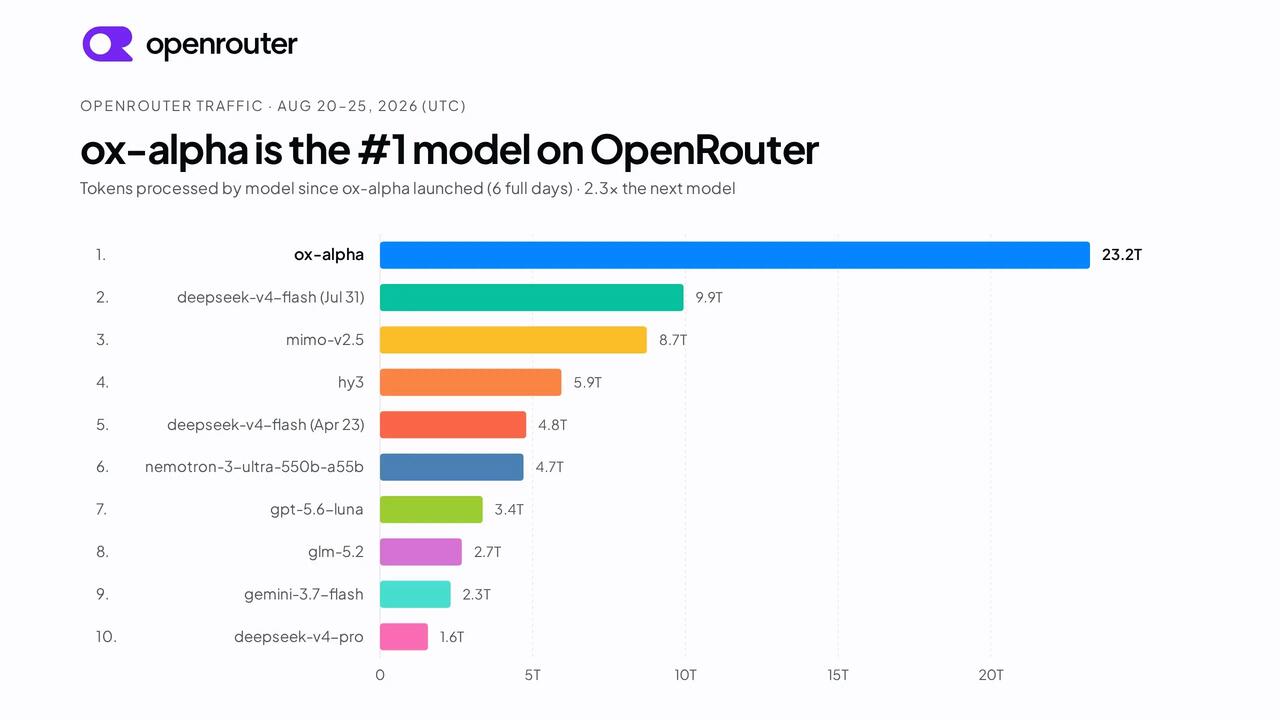
The announcement followed a week of heavy traffic on artificial intelligence model marketplace OpenRouter and agent platform OpenCode, where the model processed 62 trillion tokens before its formal release on Wednesday, according to Zhipu.

On OpenRouter, the system processed more than 23 trillion tokens in its first six days, making it the platform’s biggest launch to date.

Ox Alpha, as it was initially known, emerged over the weekend as an uncredited release on OpenRouter – the biggest launch in that marketplace’s history – and quickly gained traction among curious observers and users. It’s a reasoning model designed for coding and agentic tasks, and it can process text, image and video input, according to its description. The model is not far off from Anthropic’s Opus 4.8 on coding and agentic capabilities, Z.ai said in a blog post.

The deployment marks a significant test of China’s ability to handle large-scale global inference workloads on home-grown hardware, as Beijing seeks to reduce reliance on advanced processors from Nvidia amid tight export controls.

During its preview, Ox Alpha rapidly surged to the top of global usage rankings. According to OpenRouter data on Thursday, the model ranked first among coding systems on the platform, accounting for 10.3 trillion tokens, or nearly 31 per cent of its total weekly volume.
To overcome the lower memory capacity and bandwidth of individual Chinese chips compared with top-tier Nvidia graphics processing units, Zhipu – which operates internationally under the Z.ai brand – said it built a specialized inference engine that split processing stages into independently managed computing pools.

The firm said these architectural adjustments tripled end-to-end serving performance from its initial baseline, bringing hardware efficiency and per-token costs on par with mainstream Nvidia accelerators. The claims have yet to be independently verified.

While Zhipu did not name specific chip suppliers for this cluster, it has previously collaborated with top domestic semiconductor developers, including Huawei Technologies, makes of the increasingly popular Ascend chip, Cambricon Technologies and Moore Threads.

Cambricon said on Thursday it had achieved “Day 0” compatibility to serve GLM-5.3-Flash. Moore Threads said it also achieved “Day 0” support for the new model.

Featuring 320 billion total parameters, GLM-5.3-Flash activated just 18 billion per request to reduce computing overhead, according to Zhipu. It is also the first model in the GLM-5 series to natively process visual information alongside text.

Benchmarking firm Artificial Analysis gave the model a score of 57 on its Intelligence Index, placing it 10th globally and third among open-weight models, trailing Moonshot AI’s Kimi K3 and Alibaba Group Holding’s Qwen3.8 2.4T A95B.

Zhipu is touting aggressive pricing to win over international developers, offering GLM-5.3-Flash at 1/10th the rate of standard GLM-5.3 – dropping to 1/20th under a limited promotion. It claimed the new model cost about 1/40th as much as Anthropic’s Opus 4.8 at comparable intelligence levels.

Despite heavy traffic during the free trial, early developer feedback was mixed. While users praised the model’s ability to debug complex code – a community test showed that it solved 28 per cent of 175 LiveCodeBench problems – others reported occasional hallucinations, dropped tasks and sluggish generation. Artificial Analysis similarly noted that GLM-5.3-Flash’s output speed trailed the industry average.

Zhipu has released the model weights globally and integrated GLM-5.3-Flash across its application programming interface, ZCode platform, and GLM Coding Plan.

The launch coincides with intensified competition in China’s open-source ecosystem.

Separately, on Wednesday, Alibaba released Qwen3.8-Flash-Next, a multimodal preview of Qwen4 that it said activated 6 billion of its 125 billion parameters to similarly drive down inference costs. Alibaba owns the South China Morning Post.

Tyler Durden
Thu, 08/27/2026 – 10:45

Democrats Challenge Trump’s Mail-In Voting Order Despite Recent SCOTUS Ruling

0
Democrats Challenge Trump’s Mail-In Voting Order Despite Recent SCOTUS Ruling

Twenty-three Democratic attorneys general and the District of Columbia filed suit against the U.S. Postal Service on Wednesday, challenging a rule that limits who can receive an absentee ballot in the mail.

They filed the complaint in the U.S. District Court for Massachusetts two days after the Supreme Court allowed President Trump’s executive order on mail-in voting to proceed while the underlying case continues.

The Supreme Court ruled that the states had sued before the order’s implementation, giving them a concrete rule to fight.

“The Court’s disposition of this application does not mean that any measure taken by the Government to implement the Order will necessarily be lawful. On that score, time will tell,” the majority wrote in its order.

The liberal wing of the court dissented.

“Today’s decision does not address whether the President’s attempts to interfere with States’ administration of the November 2026 elections are lawful,” Sotomayor wrote in her dissenting opinion.

“Nor does it suggest that the Executive Branch has any constitutional or statutory authority to implement the President’s directives.”

The Court did leave open a narrower path: a challenge grounded in the Postal Service’s actual rule rather than the order that spawned it. Wednesday’s lawsuit takes that path. 

Trump’s executive order requires the United States Postal Service to match every mail ballot against a federal list of eligible voters before being sent out. While it looks like commonsense election integrity to most, Democratic state officials argue that such a list effectively gives the Trump administration control over who receives a ballot ahead of November, a role the states insist belongs to them. A dozen Republican-leaning states, who filed their own brief in that appeal in support of the federal government, noted that the rule still gives states the role of shaping the final voter lists.

California Attorney General Rob Bonta is leading the suit along with the attorneys general of Nevada, Washington, and Massachusetts. The full plaintiff list runs longer: Arizona, Colorado, Connecticut, Delaware, Hawaii, Illinois, Maine, Maryland, Michigan, Minnesota, New Jersey, New Mexico, New York, North Carolina, Oregon, Rhode Island, Vermont, Virginia, and Wisconsin all joined, along with the District of Columbia. Pennsylvania Gov. Josh Shapiro, a Democrat, also appears as a plaintiff.

The states argue that the Constitution places responsibility for regulating elections with them, a power they say neither the White House nor the Postal Service holds.

“Let’s be clear: The U.S. Constitution gives states the power to regulate elections – not the President and not USPS,” Bonta said in a statement. The complaint seeks a temporary restraining order and a preliminary injunction to block the rule while litigation proceeds, and it describes the rule as a violation of “the Constitution and federal statutes many times over.”

They argue that complying with the order would be costly due to the need to redesign ballot envelopes and to build a data pipeline to USPS from scratch, on a deadline measured in weeks rather than months.

“If not stayed or preliminarily enjoined, the Rule will frustrate or outright prevent Plaintiff States from administering their mail voting programs in November and foreseeably disenfranchise voters who vote by mail,” the complaint reads.

“Donald Trump does not run elections. States do,” California Gov. Gavin Newsom said Wednesday.

“And his latest attack on democracy is proof of how weak he has become. California will continue to lead the way in defending democracy — using every tool at our disposal and every minute in our day. This perilous moment in history demands no less from us.”

White House spokeswoman Lauren Bis called the Supreme Court’s decision “was a major win for the security of American elections,” before attacking radical Democrats who “continue to oppose commonsense measures that protect the security of mail-in ballots and ensure only Americans are electing American leaders.”

Tyler Durden
Thu, 08/27/2026 – 10:25

Trump Considers New Tariffs On Semiconductors – Reports Raise Alarm Could Doom US Dominance

0
Trump Considers New Tariffs On Semiconductors – Reports Raise Alarm Could Doom US Dominance

Politico reports Thursday on what could be another significant setback for US data centers and major damper on American AI aspirations.

The White House is mulling the possibility of introducing new tariffs on semiconductors and a broader range of technology products, including laptops, servers for data centers and gaming equipment – a move tech companies have long been warning against, and which may demonstrate once again that the only thing getting ‘reshored’ is massive inflation for end consumers.

Source: Equinix. Data center located in San Jose, California.

The report notes that “Commerce Secretary Howard Lutnick favors a structure that would tie foreign companies’ relief from the tariffs to investment in US chip manufacturing to juice more domestic production, said four of the people.”

“The administration is also mulling a phase-in period for the new tariffs, the four people said,” the report continues. “The people stressed that the framework could still be substantially revised in the coming weeks or months.”

Jonathan McHale, digital policy chief at the Computer and Communications Industry Association, is quoted in the report as saying. “This data center buildout, in scale and dollars, has been compared to building the transcontinental railroad.”

“Anytime you add to the cost and decrease predictability you make it more difficult to invest, and you are putting that in jeopardy,” he pointed out.

As a reminder under Biden Washington first laid the groundwork with a significant escalation of semiconductor trade barriers. Trump then upped the ante on the campaign trail, floating a shock 100% levies on imported chips while promising a full pass for anyone willing to build their manufacturing on American soil. Then in January the White House slapped a 25% tariff on high-end AI semiconductors.

US sanctions on advanced chipmaking equipment and high-end semiconductors have been aimed at slowing China’s push into cutting-edge chip production.

But as CNBC also points out, Chinese tech firms have reportedly had little trouble bypassing “strict” export bans to get their hands on Nvidia hardware. 

“Industry watchers say access to advanced compute via overseas cloud providers is a key factor in Chinese AI models gaining capability,” CNBC writes Thursday. “US legislation is being discussed to plug this loophole, but hurdles remain before it can have an impact,” it adds.

A fresh White House statement says, “Reshoring semiconductor manufacturing is a top priority for President Trump, whose policies have already secured hundreds of billions of dollars of investments in this key sector,” according to admin spokesperson Kush Desai.

“The Trump administration remains focused on delivering more investments and economic relief for the American people while safeguarding our national security,” the official adds.

Tyler Durden
Thu, 08/27/2026 – 09:45

Imagine A ‘Whites Only’ Hike Through The Countryside…

0
Imagine A ‘Whites Only’ Hike Through The Countryside…

Authored by Steve Watson via Modernity News,

Picture a “whites only” ramble through the Peak District. The press would treat it as a national emergency. Now take look at what is already happening there, with official blessing.

The National Trust has spent years partnering with Muslim Hikers for Ramadan walks and overnight retreats at Ilam Park. The charity’s own channel promotes Enjoy the beautiful Peak District on a Ramadan walk with the Muslim Hikers.

The weekend features a guided hike, congregational prayers, iftar, night prayers and suhoor, with YHA Ilam Hall booked exclusively for the group on National Trust land.

That is sold as inclusion. Reverse the identity and it becomes a hate incident.

Muslim Hikers founder Haroon Mota states “It’s about showing our communities that these places are for us too.”

Other groups drop even that pretence. Peaks of Colour calls itself “a Peak District-based walking club by and for people of colour only.” Founder Evie Muir says the point is to “reclaim space in the outdoors.”

Allies can donate, but they cannot join the walk.

Another group called Wanderers of Colour ran a Peak District climbing festival this August billed as “Europe’s only climbing festival by and for Black and people of colour.”

A whites-only weekend on the same gritstone would not get a listings write-up. It would get a police inquiry.

Then there is this development:

A 2022 DEFRA report complained that rural facilities served “white English culture,” including “traditional pubs, which have limited food options and cater to people who have a drinking culture.”

Muslims from Pakistani and Bangladeshi backgrounds, it said, felt unwelcome because of it. The approved solution is not adaptation. It is a rewritten menu.

National Trust director-general Hilary McGrady spelled out the official line on LBC in March. Ethnic minorities, she said, do not feel the countryside is “a place for them.”

“They don’t necessarily know ‘what am I meant to wear, how do I behave? What’s a countryside code? I’ve never heard of it’.”

The research, she added, “comes back really clearly to say they don’t. So we accept that and we have to respond… because the National Trust is here for everyone.”

Britain’s national parks are already open to anyone who can stay on the path. The Trust’s answer is still to treat the existing rural culture as the problem, while hosting Ramadan residentials at Ilam Hall.

Julian Glover’s 2019 Defra review called national parks “an exclusive, mainly white, mainly middle-class club” and a “‘white’ environment” at risk of becoming “irrelevant to the country that actually exists.”

National Landscapes fell in behind it. The Chilterns promised outreach to Muslims from Luton and marketing in “community languages.” Malvern Hills said “most white English users value the solitude” while “ethnic minority people” prefer “social company.”

Nidderdale pledged a “more diverse cultural interpretation of the countryside.” The Telegraph’s February headline did not distort the papers. It was a drive to make the countryside “less white.”

In 2024 Wildlife and Countryside Link told an all-party parliamentary group: “Cultural barriers reflect that in the UK, it is White British cultural values that have been embedded into the design and management of green spaces.”

It added that “racist colonial legacies continue to frame nature in the UK as a ‘white space’.”

That is the climate in which a people-of-colour-only club is called community and a whites-only ramble would be called extremism.

The Guardian writer John Harris recently praised Peak District paths where a common sight is “women in their 20s wearing hijabs picnicked on giant rocks.” Country walking, he wrote, had been “one of the most monoculturally white pursuits there is.” The new scene is, according to Harris, “a wonderful rejection of the right’s monotone vision of England.”

While the reports fuss over clothing, dogs and menus, the British countryside itself is increasingly being used as a dump.

In November a fly-tip on the River Cherwell near Kidlington piled waste an estimated 20 feet deep and 500 feet long.

In January farmer Katie Davies found a river of rubbish down Bwlch Mountain in Treorchy, visible for miles. “I’m extremely frustrated and upset,” she told the BBC. “It’s just devastating.” The mess “keeps me up at night.”

Natural Resources Wales called fly-tipping “a serious crime.” Over 70 percent of incidents involve household waste moved by unlicensed carriers.

The Kinder Scout trespassers wanted the right to roam. The new version wants branded weekends, race-gated clubs, faith residentials on Trust land, and a countryside redesigned because Defra decided “white English culture” was the defect.

The hills were not meant to be carved up by identity. Octavia Hill, a National Trust founder, wrote that “the need of quiet, the need of air and… the sight of sky and of things growing seem human needs, common to all.” Common to all is the opposite of a programme that sorts walkers by race and creed, then calls the native remainder colonial.

Your support is crucial in helping us defeat mass censorship. Please consider donating via Locals or check out our unique merch. Follow us on X @ModernityNews.

Tyler Durden
Thu, 08/27/2026 – 08:45

Jobs ‘AI’pocalypse No! Initial Jobless Claims Hover Near Record Lows

0
Jobs ‘AI’pocalypse No! Initial Jobless Claims Hover Near Record Lows

The number of Americans filing for unemployment benefits for the first time dropped to 203k last week

The first time initial jobless claims hit this level was in May 2022.

New York and Illinois saw the largest rise in initial claims while California and New Jersey saw the biggest declines…

Continuing jobless claims also dropped, holding below the 1.8 million Americans Maginot Line…

Another week, another confirmation that the ‘low hire, no fire’ economy remains the driving force and the Jobs AIpocalypse remains absent for now.

Tyler Durden
Thu, 08/27/2026 – 08:36

When Wall Street Says Sell, Check Who’s Waiting To Buy

0
When Wall Street Says Sell, Check Who’s Waiting To Buy

 Submitted by QTR’s Fringe Finance

Today let me offer up one of my patented periodic reminders to do your own work.

As many have already pointed out, there was something almost too neat about Citadel’s timing before the Situational Awareness blowup. In late June, Citadel Securities published a market-structure review warning that U.S. equities had become unusually concentrated, that investors were increasingly expressing bullishness through leverage, and that leveraged exposure was piling particularly aggressively into technology and semiconductors. They also warned of a rate hike possibility.

Leveraged ETF assets had reached roughly $218 billion; semiconductor exposure in those products was up 175% since the end of March. Financing was getting more expensive too. It was not a prophecy about one hedge fund, but it was a pretty good description of the tinder.

Then July supplied the match. Situational Awareness, the spectacularly successful AI fund run by Leopold Aschenbrenner, got caught in the semiconductor selloff with a leveraged and concentrated book. Its portfolio fell 67% in July. Margin pressure followed, most of the public-equity portfolio had to go, and the fund that had looked like a genius machine suddenly discovered one of finance’s oldest technological breakthroughs: the margin call. Aschenbrenner did what, in my opinion, all market cowards unable to accept responsibility do: blamed short sellers. (Read: Leopold Aschenbrenner’s Short Seller Fairy Tale)

The interesting bit is who showed up with a checkbook after. Citadel, Ken Griffin’s hedge fund, bought most of Situational Awareness’s roughly $16 billion public-equity portfolio. Some positions were acquired at discounts of more than 10%. Within weeks Citadel had already eliminated more than 80% of the aggregate risk it had taken on, including through nearly 100 block trades worth more than $4 billion. Citadel gained roughly 6% in July while quite a few AI tourists were discovering the difference between conviction and collateral.

To be precise, Citadel Securities and Citadel the hedge fund are separate businesses. There is no evidence that Citadel Securities issued its market-structure warnings because Citadel wanted Situational Awareness’s assets on the cheap. That would be a much more exciting story, unfortunately requiring the minor inconvenience of evidence.

But it’s definitely worth…noting. And that’s what this piece is about. You don’t need a conspiracy theory to notice the lesson. Citadel Securities warned that a particular market structure was fragile. That structure cracked. Forced sellers appeared. Citadel then had the balance sheet and trading machinery to buy what those sellers could no longer hold. The warning and the purchase did not appear to be contradictory. They looked to me to be two different moments in the same trade. But there’s no evidence of that.

Still, that makes it worth remembering now that Citadel Securities is warning about the Treasury market. Its latest note attacks Scott Bessent’s expanded buybacks of long-dated Treasury securities, describing them as “financial repression at the margin.” The argument is that Treasury is trying to lean against long-term yields without addressing the reasons those yields are high in the first place: deficits, inflationary pressure and an economy already running hot enough to make additional easing questionable.


🔥 85% OFF IF YOU SUBSCRIBE TODAY: Anyone who becomes a paid annual subscriber to Fringe Finance today gets 85% off a subscription — a discount they can keep for as long as they wish to remain a subscriber: Get 85% off forever


Citadel’s argument is straightforward. If policymakers prevent the adjustment from happening through lower bond prices and higher yields, the pressure does not politely disappear. It goes looking for another door. Citadel thinks that door may be the dollar: constrain the adjustment in Treasuries, weaken the currency instead, loosen financial conditions, import some more inflation, and congratulate yourself on having successfully moved the fire from the kitchen to the living room.

Read literally, this is a warning against long-duration Treasuries. But after Situational Awareness, I feel like there should be another way to read it. Maybe the most useful question is not whether Citadel is right that bonds are vulnerable. Maybe the useful question is what happens if Citadel is right enough to create the kind of price Citadel would eventually want to buy bonds at…

That is the distinction Wall Street macro commentary regularly obscures. “This market is dangerous” is not remotely the same statement as “this asset will be unattractive at every price.” A 30-year Treasury at one yield can be an awful proposition. The same instrument after a violent liquidation and another hundred basis points of yield is literally a different investment.

Suppose Citadel is correct. Treasury intervention fails to resolve the fiscal problem. Long yields rise and bond funds take losses. Leveraged players reduce positions, risk managers demand smaller books, and everyone who was reaching for duration six months earlier suddenly explains that they were always fundamentally a cash investor. At some point the sellers stop being people with opinions and become people with instructions. That is usually when the interesting buyers arrive.

That was the interesting part of Situational Awareness. The warning “leverage and concentration are dangerous” ultimately led not to “never own these assets,” but to a moment when somebody very sophisticated was delighted to own them at somebody else’s distressed price. This is the way investment-bank macro should be read: not backwards in the childish sense that Goldman says buy, therefore sell, but structurally backwards. If this thesis becomes consensus, what positions does it create? What liquidation could it eventually force? And who gets the much better entry after everybody obeys it?

There is a mildly uncomfortable possibility here. A macro analyst can be completely sincere, analytically correct and still produce a conclusion that eventually becomes most valuable in reverse. “Bonds are vulnerable” can eventually mean bonds are becoming cheap. “The dollar is doomed” can eventually produce a very crowded short. “Credit is too tight” can cause spreads to blow out until lending becomes attractive. Markets are annoying that way. They insist on changing the price after everyone agrees on the story.

You cannot prove that an investment bank secretly believes the opposite of what its strategist publishes, and in most cases that is probably the wrong framing anyway. Giant financial firms do not possess one brain and one position. The research desk, market maker, trading desk, clients and asset-management businesses can all have different exposures simultaneously. Asking “what does Goldman really believe?” is often like asking what all of New York City thinks about lunch.

Who Is Leopold Aschenbrenner, Whose Hedge Fund Melted Down - Business  Insider

But the broader lesson goes well beyond Citadel, Goldman, JPMorgan or any particular investment bank. And the lesson applies to not just macro, but also sell side equity research: trust no one on Wall Street. Not because everyone is lying. That would actually make things easier. The problem is that everyone is talking from somewhere. Everyone has a book, a mandate, a time horizon, clients, incentives, constraints and a definition of risk that may bear almost no resemblance to yours. The billionaire telling you an asset is dangerous may be able to withstand a 40% drawdown that would liquidate you. The bank telling you something is attractive may be simultaneously financing the people selling it. The hedge-fund manager predicting disaster may simply be describing the event that would give him his dream entry price.

And don’t be hypnotized by the number of zeroes involved. Managing $10 billion does not make somebody ten times more correct than somebody managing $1 billion, and working at an institution overseeing trillions does not confer access to the tablets from Mount Sinai. Large institutions possess extraordinary data, talent and market access. They also produced Long-Term Capital Management, the mortgage crisis, Archegos, countless consensus trades and enough catastrophic “research notes” to fill the East River. Capital is evidence that somebody has successfully accumulated or attracted capital…it is not a certificate of omniscience.

The correct response is not cynicism for its own sake. It is independence. Listen to everyone precisely because you trust no one. Go ahead, read Citadel and Goldman. Read JPMorgan, the Fed, the bears, the bulls and the lunatics on X. Hell, read it all. That’s why you’re reading this after all, right? Then, steal their facts, inspect their arguments, understand their positioning where you can, and then make the irritatingly adult decision yourself.

Because the most important question in markets is rarely “Who is right?” It is: right about what, at what price, over what time horizon, with how much leverage, and with whose money? Two investors can hold opposite positions and both make money because their constraints are different. Two investors can believe exactly the same thesis and one can go bankrupt because he borrowed too much to express it.

I read Citadel’s Treasury warning carefully. They may be exactly right about the underlying problem. Long-term yields may need to rise. Treasury buybacks may merely relocate the pressure. The dollar may ultimately have to absorb some of the adjustment. But then read the warning again and ask the question Situational Awareness makes impossible to ignore: if this goes badly enough, who is waiting to buy?

Trust no one. Do your own work. And whenever Wall Street tells you what you should desperately want to sell, at least ask what price would make Wall Street delighted to buy it from you.

Now read:

QTR’s Disclaimer: Please read my full legal disclaimer on my About page here. This post represents my opinions only. In addition, please understand I am an idiot and often get things wrong and lose money. I may own or transact in any names mentioned in this piece at any time without warning. Contributor posts and aggregated posts have been hand selected by me, have not been fact checked and are the opinions of their authors. They are either submitted to QTR by their author, reprinted under a Creative Commons license with my best effort to uphold what the license asks, or with the permission of the author. I cannot guarantee the accuracy of all facts and figures included in this article though I made my best effort to get them right. I have been wrong before and will be wrong again, and encourage you to always double check, do your own research and speak to a licensed financial professional.

This is not a recommendation to buy or sell any stocks or securities, just my opinions. I often lose money on positions I trade/invest in. I may add any name mentioned in this article and sell any name mentioned in this piece at any time, without further warning. None of this is a solicitation to buy or sell securities. I may or may not own names I write about and are watching. Sometimes I’m bullish without owning things, sometimes I’m bearish and do own things. Just assume my positions could be exactly the opposite of what you think they are just in case. If I’m long I could quickly be short and vice versa. I won’t update my positions.

As of May 20, 2026 I am attempting to no longer actively trade as much as I once did (read my story here). My eventual goal is for investing/saving to be mostly done by recurring contributions mostly to sector ETFs and a few select equities, trusted third parties who oversee my accounts, and advisors. Such advisors or funds, through individual equities, options, index funds, mutual funds, ETFs, or other securities, may have positions in, exposure to, or holdings of names mentioned herein that I know nothing about. Basically, via index funds, ETFs and individual equities it is possible I could own, have exposure to, or not own anything at any point. As of the same date, May 20, 2026, in an attempt to lead a healthier lifestyle, I’ve also excluded myself from fantasy sports, sports betting, online and in-person casinos and prediction markets.

And all positions can change immediately as soon as I publish this, with or without notice and at any point I can be long, short or neutral on any position. You are on your own. Do not make decisions based on my blog. I exist on the fringe. If you see numbers and calculations of any sort, assume they are wrong and double check them. I failed Algebra in 8th grade and topped off my high school math accolades by getting a D- in remedial Calculus my senior year, before becoming an English major in college so I could bullshit my way through things easier.

The publisher does not guarantee the accuracy or completeness of the information provided in this page. These are not the opinions of any of my employers, partners, or associates. I did my best to be honest about my disclosures but can’t guarantee I am right; I write these posts after a couple beers sometimes. I edit after my posts are published because I’m impatient and lazy, so if you see a typo, check back in a half hour. Also, I just straight up get shit wrong a lot. I mention it twice because it’s that important.

Tyler Durden
Thu, 08/27/2026 – 08:20

The Greatest Cover-Up In Economic History: How Washington Hid Its Role In The 2008 Crash

0
The Greatest Cover-Up In Economic History: How Washington Hid Its Role In The 2008 Crash

Authored by Kevin Villani via Mises Institute,

The commentary in a recent Wall Street Journal by Senator Phil Gramm and Representative Jeb Hensarling did the nation an immense service by dismantling the persistent myth that private market greed and financial deregulation caused the 2008 financial crisis. As they rightly pointed out, inflation-adjusted mortgage rates during the bubble era were historically high, and financial institutions were suffocating under increasingly strict federal mandates, not running wild in a deregulated vacuum.

Yet, for nearly two decades, the public has been fed a completely fabricated baseline narrative. Having served as the Chief Economist at the Department of Housing and Urban Development (HUD) and later as the Chief Economist at Freddie Mac during critical regulatory shifts, and as an expert in securitization-having structured the first CMO with Larry Fink at First Boston, the first CBO with Mike Milken at Drexel, the first unique MBB with Lou Ranieri at Salomon, and later the first CLO-I watched the true mechanics of this disaster play out from the inside. The reality is uncomfortable for the political class: the real crime of 2008 was not a failure of capitalism, but a catastrophic failure of central planning.

The subprime crisis was deliberately engineered in Washington. Through affordable housing quotas managed by HUD, progressive policymakers systematically weaponized government-sponsored enterprises (GSEs) like Fannie Mae and Freddie Mac. To meet arbitrary, politically-motivated homeownership targets, these institutions were forced to aggressively buy up low-quality, high-risk mortgages.

The mechanics of this distortion were devastatingly simple. To satisfy Washington’s mandates, the GSEs had to continuously lower their credit scoring thresholds, accept zero-down-payment structures, and purchase loans with unverified incomes. This top-down command economy completely erased private market discipline. Private lenders-knowing they could instantly dump these toxic, subprime originations onto the balance sheets of government-backed entities-stopped underwriting for risk and began underwriting for political compliance. By forcing the financial system to accept trillions of dollars in low-quality debt, Washington single-handedly fueled the historic housing bubble.

When the house of cards inevitably collapsed, the economic devastation was staggering. The direct government fiscal costs alone reached an estimated $2 trillion domestically and topped $12 trillion globally in banking interventions and stabilization efforts. But the indirect, structural costs were far worse: a permanent loss of up to $14 trillion in US economic output and the immediate vaporization of over $19 trillion in household wealth.

Faced with a disaster of their own making, policymakers pulled off a multi-trillion-dollar ideological cover-up that may ultimately prove to be far more damaging than the original crime.

To shift the blame entirely onto private capital, Washington weaponized the Financial Crisis Inquiry Commission (FCIC). The commission’s partisan majority report was custom-built to exonerate the state’s progressive interventions. To achieve this, the political class relied heavily on a curated roster of nationally-recognized academic contributors. These individuals perfectly embodied what Nobel laureate economist Friedrich Hayek famously labeled “armchair intellectuals”-theorists with zero actual industry experience whose abstract models merely confused the public and distracted attention from the fundamental, government-driven causes of the collapse.

This academic misdirection, operating in tandem with Marxist-driven street movements like Occupy Wall Street, successfully captured the public imagination. By framing a state-engineered credit crisis as an inherent flaw of the free market, Washington channeled public rage away from regulators and straight onto Wall Street. This manufactured consensus provided the perfect pretext to pass the Dodd-Frank Act-a massive expansion of state regulatory power that heavily penalized the private sector while leaving the government’s destructive, highly leveraged dominance over housing finance completely untouched.

The long-term consequences of this deception are playing out in real time today. We see the latest fruit of the 2008 cover-up in the radical economic platforms of the Democratic Socialists of America (DSA). Because the true history of the crash was erased, a new generation of progressives now uses the false narrative of “market failure” to demand national rent controls, a federal tenant bill of rights, and the aggressive expansion of state-owned “social housing.” They are deploying the exact same rhetoric used by the FCIC majority and the Zuccotti Park occupiers to advocate for the complete central planning of American real estate.

By shielding Washington from accountability, the 2008 cover-up institutionalized systemic moral hazard and permanently crippled market discipline. When central planning fails, the state’s universal response is to demand even more centralized control. Unless we aggressively correct the historical record and expose the armchair intellectuals who enabled this deception, the ongoing ideological cover-up will succeed in setting the stage for a new generation of even more devastating, state-engineered economic collapses.

Tyler Durden
Thu, 08/27/2026 – 08:05