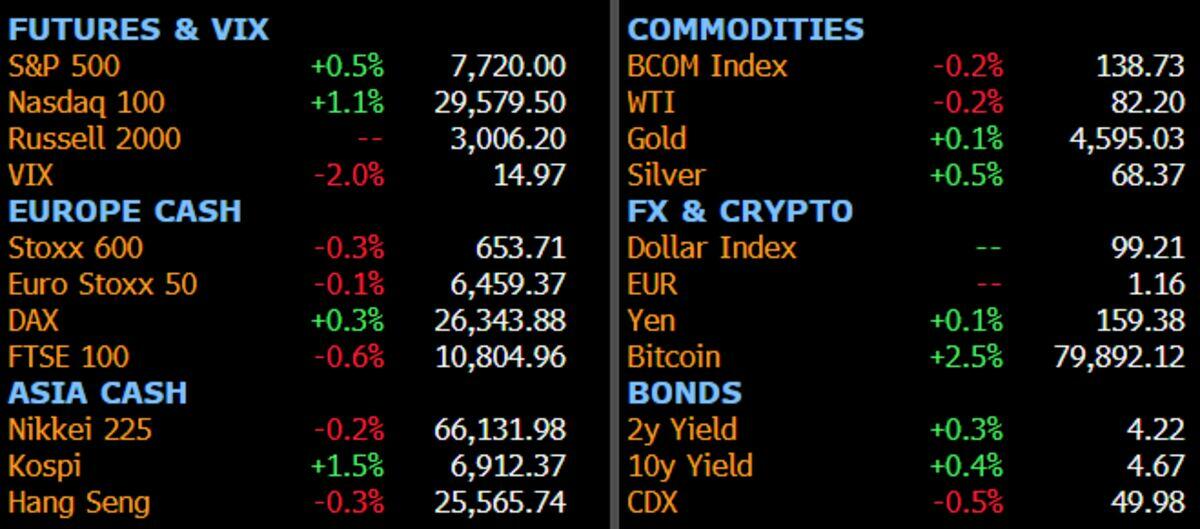
Futures are higher led by Tech as NVDA earnings boost the tape. As of 8:00am ET, S&P futures are 0.5% higher while Nasdaq futures jump 1.1% led by NVDA which is +7.4% in pre-market trading following an unprecedented forecast of 70% revenue growth in 2028, which is boosting Semis (+3%), incl MRVL +5.2% into their print tonight. NVDA helped the market climb a significant wall of worry and is not poised to resume it march higher. Memory is +3.6%, Software is +2.3%, Korea +2.1%, and Low/Unprofitable Tech +1.2% points to a broad-based Tech rally. Yet Only 2 of 7 Mag7 names are higher, NVDA and TSLA. Outside of Tech, most sectors are trading lower ex-Industrials / Utils which are benefitting from a reboot of the AI trade. Our Retail flows remain materially off their highs with behavior shifting from ETFs to single stocks; Mag7 / NVDA most bought, MRNA most sold with gold seeing strong inflows. Bond yields are +1-2bp with USD flat. Cmdtys are mostly lower dragged by Energy and Base Metals; Precious are mixed with gold flat and silver higher. Today’s macro data calendar includes July advance goods trade balance, weekly jobless claims and July inventories (8:30 a.m.) and August Kansas City Fed manufacturing activity (11 a.m.). Fed speaker slate includes Cleveland Fed’s Beth Hammack on CBNC at 10 a.m. and Fox Business at 1 p.m.

In premarket trading, Magnificent Seven stocks are mostly lower even as Nvidia jumps 7.2% after the leader in AI chips gave an outlook for revenue growth that was stronger than expected. Others are mostly in the red: Alphabet -0.4%, Amazon -0.3%, Apple -1.1%, Meta Platforms -0.3%, Microsoft -1%, Tesla +0.4%.
- AI infrastructure stocks broadly gain after Nvidia’s outlook. Intel (INTC) 2%, Advanced Micro Devices (AMD) +1%.
- Software companies are rising following robust results from a number of notable names in the sector.
- CrowdStrike (CRWD) rises 9% after the security software company raised its full-year forecast on key metrics.
- Dollar General (DG) gains 13% after the retailer’s comparable sales for the second quarter topped expectations and management boosted guidance for the year. The stock had been down 7.5% this year through Wednesday’s close.
- Dollar Tree (DLTR) falls 4% as the retailer’s guidance for the third quarter and full year proves underwhelming after the stock’s 38% advance since its 1Q results on May 28. The S&P 500 Index was up 2.1% for the same period.
- Everpure (P) rises 2% after the computer storage company reported second-quarter results that beat expectations and raised its full-year forecast.
- Nutanix (NTNX) climbs 5% after the software company’s fourth-quarter results beat expectations and it gave an outlook that is seen as positive.
- Okta (OKTA) gains 17% after the software company boosted its full-year forecast on key metrics, including adjusted earnings and revenue.
- Salesforce (CRM) is up 10% after the software company raised its full-year forecast and announced an expanded partnership with Anthropic.
- Wendy’s (WEN) plunges 14% after Reuters reported that Nelson Peltz’s Trian Fund Management has no plans to make a bid at this time to take the fast-food chain private.
In other corporate news, a $31 billion venture between Kioxia Holdings Corp. and Sandisk Corp. to ratchet up flash memory production added to the buoyant tone in technology stocks. Security Benefit Life Insurance will restructure its $14 billion stockpile of collateral loans after such assets drew scrutiny from regulators. Caesars Entertainment turned down a bid from investor Carl Icahn to take the company private and instead chose a lower offer from billionaire Tilman Fertitta because it was more comfortable with other terms of his proposal. The owners of the 800-mile Trans Alaska Pipeline System are seeking to renew its federal land authorization more than seven years before it expires, a move that could capitalize on President Trump’s enthusiasm for US oil production.
Nvidia’s 7% pre-market gain following its solid revenue outlook is propelling the Nasdaq future higher by 1.1%, even as the index pulled back from highs after Politico reported the White House is mulling a fresh round of tariffs on chips. Nvidia’s upbeat outlook offered relief to investors concerned about a bubble in the AI economy as CEO Jensen Huang said demand for its artificial-intelligence accelerators continues to expand.
Nvidia’s surprising stab at providing longer-term guidance (70% revenue growth for fiscal 2028, versus consensus around 45%) was taken positively, especially in the context of the number reflecting constrained supply dynamics (imagine how high the forecast could have been without the bottlenecks). The conference call pushed back on the circular deal narrative, while Huang later said “investing in these companies is a once in a generation opportunity. I think the only regret that I have is that I didn’t invest more and sooner.”
Nvidia’s results showed that the AI cycle is primarily constrained by physical bottlenecks such as memory and power, rather than a shortage of end demand, said Amanda Lyons, head of research at Energy Group Capital. “It effectively pushes the cyclical question further out and, crucially, gives investors permission to extend the earnings-growth runway not just for Nvidia, but across the second- and third-order beneficiaries of the AI buildout,” she said.
The VIX Index is below 15 and VVIX below 86, while even one-year Nvidia implied volatility appears cheap – despite its CDS trading at highs and as Chinese competition builds. The risk of AI headline fatigue is setting in. “Given Jensen’s constant visibility this quarter, the myriad of circular deal announcements, and just the mental exhaustion from AI headlines,” this week’s main event remains that of Warsh and the Fed at Jackson Hole, according to Dave Lutz at Jonestrading.
The company is “taking a more active role in removing the capital and infrastructure bottlenecks that could constrain its own growth,” notes Amanda Lyons, head of research at Energy Group Capital. More broadly, she adds that “the AI cycle is still being governed primarily by physical constraints such as memory, packaging, power and data-centre capacity, rather than by any shortage of end demand.”
Nvidia’s performance reflects how it has become the funding trade for AI picks and shovels, even as it acts as the industry’s bank. GAM’s head of global equities Paul Markham notes “the biggest risk to Nvidia here is a cash call, which is that it becomes a victim of its own success in the sense that investors get very, very excited about the Anthropic IPO and sell some Nvidia to fund it.”
With software considered to be perceived victims of AI, a reassuring print from CRM leader Salesforce gives some relief in predicting strong revenue expansion and deepening its partnership with Anthropic. Elsewhere in AI, AWS committed to deploy two million additional Nvidia GPUs across its global infrastructure in 2027-2028.
Attention will now turn to the Jackson Hole Economic Symposium. Kevin Warsh will deliver his first major speech as Fed chair on Friday, giving investors fresh clues on the policy outlook after he faced criticism over a lack of clarity about his views on the economy.
“The market wants a little bit more hawkishness because you have seen some pretty strong numbers coming out on growth and inflation, pointing more toward higher rather than lower rates,” said Caspar Rock at Schroders Wealth Management. “More clarity should give a bit more confidence, and that might perk up the dollar rather than fixed interest markets.”
Earnings growth from core tech names “is crucial given this is the main driver for US markets, and tech investment is the main driver for US growth,” said Geoff Yu at BNY. However, “with strong growth comes the risk of tighter monetary policy, which for now is also the market’s base case.”
Still, some pockets of weakness tempered Thursday’s optimism. HP Inc. tumbled as investors worried about demand for the company’s computers and printers. Meanwhile, Wheat prices hit the highest since July 2023, keeping inflation concerns in focus alongside still-elevated energy prices.
Tech optimism was also not on display in Europe with the Stoxx 600 down 0.3%, as a retreat in consumer stocks outweighed the gains in the technology sector.
Asian stocks advanced for a third day, led by chip stocks after Nvidia Corp.’s bullish sales outlook injected vitality into the AI trade. The MSCI Asia Pacific Index advanced as much as 0.7% before paring. The Nvidia-inspired rally in chip stocks swept across the region, from South Korea to Japan with SK Hynix, Samsung Electronics and Kioxia the biggest contributors. “Nvidia handed SK Hynix and Samsung one of the strongest demand signals they could have asked for,” said Josh Gilbert, an analyst at online trading platform eToro. “When the industry’s most important customer can not get enough memory and prices are still heading higher; the read-through for both stocks is very positive.” Kioxia shares rose 5%, boosted by reports that it will build a new facility in northern Japan. The company confirmed after the market closed that it plans to spend more than ¥5 trillion ($31.4 billion) with Sandisk to ratchet up production capacity across the country. Benchmarks in South Korea and China gained while Japanese stocks fluctuated. Philippines was the worst performer in the region, dropping the most in two months, as a third successive rate hike added to economic headwinds. AI-bellwether Korea also digested its central bank’s decision to raise its benchmark interest rate for a second consecutive meeting to contain inflation.
In rates, treasuries hold small losses as US trading gets under way, lifting yields by 2bp-3bp ahead of the monthly 7-year note auction, following a subpar, tailing 5Y on Wednesday. Yield-curve flattening trend unleashed by last week’s Treasury Department decision to expand buybacks targeting 10- to 30-year sectors is intact; 5s30 spread narrowed to under 79bp, lowest since July 29 (most recent Federal Reserve decision date), 2s10s to under 43bp, lowest since Aug. 10-year yield is about 2bp higher on the day near 4.67% and slightly cheaper vs UK and German counterparts. Oil prices, which in recent sessions have led yields lower, are little changed, inside Wednesday’s ranges.
$44 billion 7-year note auction at 1 p.m. New York time has WI yield near 4.52%, higher than results since May 2024; last month’s 7-year auction tailed slightly after a rally into the bidding deadline. IG credit new-issue calendar is anticipated to be light through month-end; Wednesday saw just one (floating rate) offering priced.
In FX, the Bloomberg Dollar Spot Index is up 0.1% with Aussie dollar extending its week-to-date outperformance versus the greenback.
In commodities, brent crude prices are a touch firmer, having fallen earlier, as traders weigh Hormuz discussions and the Russian escalation on Ukraine. WTI crude oil futures are up 0.2%. Precious metals have trimmed earlier gains with spot gold now up just 0.2%. Bitcoin is up 2.4% and back above $80k.
US economic data calendar includes July advance goods trade balance, weekly jobless claims and July inventories (8:30 a.m.) and August Kansas City Fed manufacturing activity (11 a.m.). Fed speaker slate includes Cleveland Fed’s Beth Hammack on CBNC at 10 a.m. and Fox Business at 1 p.m.
Market Snapshot
Top Overnight News
- Kuwait and Qatar, two of the Persian Gulf’s smaller oil producers, are sending more crude through the Strait of Hormuz, adding to an increase in shipments that are keeping global prices in check. The two countries, which exported a combined 2 million barrels a day of oil before the outbreak of the Iran war, have managed to get shipments back to 70% of pre-conflict levels. BBG
- Qatar’s prime minister will visit Tehran on Thursday in a bid to relaunch diplomacy after the U.S. and Iran traded recriminations over Washington’s promise to increase economic pressure on Tehran by targeting its trade partners for sanctions. Reuters.
- Iraq is offering buyers of its crude the option to collect supplies from outside of the Persian Gulf for the first time since the Iran war began, highlighting resilient exports flowing through the Strait of Hormuz: BBG
- Russia is preparing to escalate attacks on Ukraine after concluding that negotiations for a peace deal have reached a dead end. For now, Russia is weighing an intensification of powerful conventional ballistic missile attacks on Kyiv, including the center of the capital, and infrastructure targets in other Ukrainian cities. BBG
- The Trump administration is weighing a new round of sweeping tariffs on semiconductors, despite warnings from tech companies that the move could doom U.S. hopes of dominating artificial intelligence. Politico
- Nvidia reports blowout quarter, says demand for AI chips is getting even hotter. Shares rallied as the chip giant forecast 70% revenue growth next year and defended its financial support of AI companies. WSJ
- Kioxia Corporation and Sandisk Corporation today announced anticipated significant investments in Japan, totaling over $31 billion (approximately 5 trillion yen) contingent upon government support. The investments through 2032 will continue to strengthen partnership, one of the most successful joint ventures across any industry. The partnership has helped drive decades of NAND flash memory innovation and invested over $50 billion (approximately 9 trillion yen) in Japan over the past 25 years. BBG
- Anthropic PBC has agreed to spend $45 billion to rent AI cloud computing power from Nscale’s flagship data center development in West Virginia, the latest move to secure capacity for its expanding business in advance of going public. BBG
- US Treasury Secretary Scott Bessent’s more activist style of managing the nation’s debt has Wall Street war-gaming a potentially bigger shift in the government’s borrowing strategy over the coming months: BBG
- South Korea’s central bank hiked its policy rate by 25bp to 3%, its second consecutive tightening action, a move that was expected, as the country faces upside risks to both growth and inflation. Nikkei
- Norway’s economy picked up pace last quarter, growing 0.3% and keeping the door open for more monetary tightening. BBG
- Fed’s Cook (voter) denied wrongdoing and vowed to fight US President Trump’s effort to fire her from the Fed. Cook’s lawyer said there is no legally valid reason for ousting Governor Cook from the Federal Reserve board: RTRS
A more detailed look at global markets courtesy of Newqsuawk
APAC stocks were ultimately mixed, but with most indices in the green, after the flat performance stateside, where markets digested the firmer-than-expected headline PCE data and braced for NVIDIA earnings. The AI darling beat on top and bottom lines, although its shares were initially subdued, but were then boosted during the earnings call as the CFO flagged about a 70% revenue growth for the next fiscal year. ASX 200 underperformed amid another barrage of earnings releases and after recent inflation data, which prompted a call by NAB for the RBA to resume hiking rates at the next meeting in September. Nikkei 225 swung between gains and losses with the index fading the initial NVIDIA-spurred euphoria. KOSPI led the advances in the region as chipmakers cheered NVIDIA’s strong results and outlook, while investors were also unfazed by the BoK’s pre-emptive back-to-back rate hike. Hang Seng and Shanghai Comp were mixed amid several earnings releases and slower Industrial Profits, although the mainland was kept afloat after the PBoC conducted both 7-day and overnight reverse repos.
Top Asian News
- Chinese Industrial Profits (YTD) (Jul YY) 17.6% (Prev. 18.7%).
- Australian Private Capital Expenditure for 2026-27 (AUD)(Estimate 3) 200.7B (Prev. 173.4B).
- Australian Private Capital Expenditure for 2025-26 (AUD)(Estimate 7) 210.0B (Prev. 207.6B).
European bourses begin Thursday’s trade with a negative tilt, with the majority of indices in the red, outside of the DAX 40. The primary reason for the upside in the German benchmark is the read-across following upbeat Nvidia and Salesforce earnings. The broad positiveness in chipmakers was also seen overnight, with the KOSPI closing with gains of 1.5%. Sectors highlight the negative bias, with Tech the only sector printing decent gains. To the downside lies Food, Beverages & Tobacco, with Chemicals and Optimised Personal Care rounding out the sector laggards. Key movers include: Pernod Ricard (-6.0%), Q2 revenue missed estimates and guided FY sales growth at the lower end of its range due to soft US market; Delivery Hero (+0.4%), raises its FY26 guidance.
Top European News
- German GfK Consumer Confidence (Sep) -26.6 vs. Exp. -29.6 (Prev. -29.4).
- European M3 Money Supply (Jul YY) 3.4% vs. Exp. 3.4% (Prev. 3.3%).
FX
- Lacklustre price action across the FX space which has all G10 currencies essentially flat against the Buck.
- Nothing to derail the AI Capex narrative within NVIDIA earnings, in which Q2 results were strong and guidance impressed; a release which did not give too much lead to FX markets. Focus now turns to numerous Fed speakers today including the hawkish Hammack and Schmid; thereafter attention will be on Chair Warsh, who is set to speak on Friday at 15:00 BST. DXY flat/modestly firmer with a peak of 99.20 which is just above the 200DMA.
- JPY confirms the general trend seen across G10s with not many surprises from BoJ Deputy Governor Himino whose tone was consistent with pricing of September’s likely 25bps hike, noting in both of his speeches the BoJ needed to “pay more attention to upside inflation risks than before”. USD/JPY range bound within 159.30/40, calendar is light so will likely be dictated by a busy US schedule with just Tokyo CPI scheduled for Friday.
- EUR flat against the Buck with EZ catalysts light ahead of ECB minutes. Price action today will likely be at the whim of the Buck with ECB minutes likely to not surprise. EUR saw some modest weakness of around 10 pips after taking a lead from French stocks ahead of the first French presidential debate at 15:45 BST. Note that the docket features the three favourites, Marine Le Pen who does not appease markets and Jean-Luc Mélenchon, who recently touted France “set fire” to a large chunk of its public debt. EUR/USD slipped from the familiar 1.1650 to a 1.1634 base, before paring that aforementioned downside.
Fixed Income
- Fixed benchmarks are mixed this morning, with USTs (U/C) flat, whilst Bunds (-23 ticks) and Gilts (-21 ticks) are pressured. Earlier action was uneventful, but a report that the US is mulling a new round of tariffs on chips spurred some mild downside in fixed benchmarks.
- USTs attempt to pare back some of the pressure seen on Wednesday following the slightly hotter US PCE report, whereby the headline topped expectations. On the Fed, it may not shift too much for policymakers heading into the September meeting – but a slew of Fed speak is expected in the next few days. Today sees interviews via Schmid and Hammack, whilst Chair Warsh is set to speak on Friday. A tight-lipped approach from the Chair could see markets begin to shift attention back to credibility concerns, and therefore result in the resumption of the debasement trade. From a yield perspective, the US 10yr (4.65%) remains shy of the level which saw the Treasury announce its long-end support (4.7%) – albeit only marginally so. A resumption of debt / credibility concerns could see the 10yr circulate within a 4.75-5% range into the next bout of key US data. On the flip side, a significant breach below the 4.5% mark would likely require a dovish Warsh on Friday (unlikely), and favourable NFP (Sept 4) / CPI (Sept 11) reports.
- Bunds and Gilts are pressured this morning, The downside can, in part, be explained by the ongoing strength in Dutch TTF gas prices. Woes have also been further exacerbated by recent reports that Russian President Putin is to escalate the war in Ukraine, as he sees talks with Ukraine at a dead end.
Commodities
- In geopolitics, Nour News reported that Iran has warned that vessels violating new Hormuz transit rules could face blacklisting alongside their flag. The piece added that penalties could extend to other ships using blacklisted service providers. Interestingly, a headline out of Iranian Press TV suggested that Oman reportedly stopped cooperating with the US to facilitate escorted tanker movements through southern Hormuz. Note: Trump has twice publicly threatened Oman with military action due to its bilateral negotiations with Iran regarding the Strait of Hormuz.
- Meanwhile, some focus returns to Russia-Ukraine after Bloomberg sources suggested Russia is preparing to escalate attacks on Ukraine after concluding that negotiations for a peace deal have reached a dead end.
- WTI Oct and Brent Nov initially extended losses north of USD 1/bbl, but have since clambered off lows – potentially thanks to the Nour News report above. Currently WTI and Brent are posting losses of only USD 0.10/bbl, with the latter currently sitting towards the upper end of a USD 85.32-86.99/bbl range. Elsewhere, Dutch TTF is relatively flat intraday but off highs after dipping under EUR 66/MWh this morning before finding support near EUR 65/MWh and somewhat stabilising around EUR 65.50/MWh.
- Metals are mixed with precious metals taking a breather after yesterday’s losses, although with upside capped as the DXY remains resilient to oil losses. Spot gold trades in a USD 4,593-4,643/oz range, with yesterday’s parameter. Spot silver found early support at its 100 DMA (USD 68.24/oz) and resistance near yesterday’s high (USD 69.95/oz). Base metals are mostly subdued by the resiliency of the buck, but underpinned by ongoing China stimulus hopes, 3M LME copper resides in a narrow USD 14,207.30- 14,323.13/t range at the time of writing.
- Kuwait and Qatar have reportedly increased crude shipments through the Strait of Hormuz to around 1.4mmln BPD, some 70% of pre-conflict levels, according to reports.
- Thai gold dealers said that the Ministry of Finance currently has no near-term plans to impose a gold tax.
Trade/Tariffs
- USTR Greer said the US did not add any new demands at the end of the negotiations with Canada and that the US wanted mutual protection on things like steel and aluminium in trade talks with Canada. Greer also stated that the US won’t just sit down and take it if Canada imposes more retaliation, as well as noting there are no open channels with Canada at the moment.
- The US White House is reportedly considering a new round of tariffs on chips, Politico reports citing sources. The report detailed that one approach under consideration would increase the number of tech products subject to levies. This means that duties would hit chips, and potentially items such as laptops, gaming consoles and servers that fill data centres.
- US Senator Moreno (R) reportedly sent a letter to USTR Greer to open a Section 301 investigation on South Korea over its treatment of Coupang, according to Semafor.
- The US is investigating Apex Logistics over AI chip smuggling to China.
- US President Trump signed a proclamation to increase lean beef imports with the quota increased by 100k tons of beef per month effective September 1st for 90 days, while the proclamation increases lean beef trimmings that are imported with no-above-quota tariff.
Central Banks
- ECB’s Radev said October and December meetings are both live, Econostream reported. Radev stated that waiting until second-round effects are fully visible could mean acting too late, but that there is not enough broad-based evidence to say growth risks are “clearly to the upside”. On neutral, he said that 2.5% is not a “precise dividing line” but “probably around neutral”.
- BoJ Deputy Governor Himino said he believes the BoJ should continue to raise the policy interest rate and adjust the degree of monetary accommodation in accordance with developments in economic activity, prices and financial conditions. He added that the BoJ must be mindful of upside price risk more than ever before and that they will debate policy at every meeting while taking such risks into account. Himino highlighted that if underlying inflation rises to a level above the 2% price target, it would have an adverse impact on the economy. On the currency, the BoJ wants to scrutinise the various effects of a weak Yen on the economy.
- BoK kept rates steady to 3.00%, as expected. Forecasts: Sees 2026 CPI at 2.7% (prev. 2.7%), 2027 at 2.3% (prev. 2.3%); 2026 GDP growth at 3.3% (prev. 2.6%) and 2027 at 2.9% (prev. 2.1%). BoK says rate decision was not unanimous as Board Member Hwang dissented on rate decision, while inflation is projected to remain above target level for a considerable time
- NAB expects the RBA to raise rates by 25 bps to 4.6% in September.
Geopolitics: Iran
- Iran has warned that vessels violating new Hormuz transit rules could face blacklisting alongside their flag, classification society and insurer, and that penalties could extend to other ships using blacklisted service providers, Nour News reported citing an official.
- An Iranian lawmaker said Iran controls the Strait of Hormuz and vessels from the US, France, Britain or other hostile countries to enter the region.
- Pakistani Foreign Ministry spokesperson said Pakistan is not obliged to comply with unilateral sanctions imposed on Iran, while UN sanctions would constitute a different matter.
- Iraqi sources report an airstrike on the main base of separatist terrorist groups in the city of Sorran, located in the Erbil province of Iraqi Kurdistan region, according to Fars News Agency.
- Two explosions were reported in Mokha, Yemen, from missiles fired by the Houthis
Geopolitics: Ukraine
- CIA chief’s recent surprise trip to Moscow was to warn Russia not to attack NATO, according to WSJ.
- Russian Government Spokesperson Peskov said Russia’s response to Ukrainian strikes on Russia’s economic and trade infrastructure will be harsh.
- Russia’s Kremlin said Moscow remains open to participating in negotiations for a Ukrainian settlement, Al Arabiya reported.
- Russian Foreign Ministry said the UK should abandon its hostile position towards Russia, which creates risks of transferring the conflict to a fundamentally new level, IFX reported.
- Russia attacked an industrial facility in the Ukrainian city of Kryvyi Rih, according to Ukrainian authorities.
- EU states resurrect plan to use frozen Russian assets for Ukraine, with Sweden, the Netherlands and Spain pushing to use the funds to solve Kyiv’s funding crisis, according to FT
Geopolitics: Other
- North Korea denounced the US’ decision to sell weapons to South Korea and said US hostility to North Korea is clearly acknowledged, while it will respond swiftly and decisively to hostile actions, according to KCNA.
US Event Calendar
- 8:30 am: Jul P Wholesale Inventories MoM, est. 0.2%, prior 0.2%
- 8:30 am: Aug 22 Initial Jobless Claims, est. 208k, prior 206k
- 8:30 am: Aug 15 Continuing Claims, est. 1792k, prior 1799k
Central Bank Speakers
- 10:00 am: Fed’s Hammack to appear on CNBC
- 1:00 pm: Fed’s Hammack Appears on Fox Business
DB’s Jim Reid concludes the overnight wrap
After a mixed session yesterday, the market mood has turned more positive again overnight following Nvidia’s earnings last night. The chipmaker’s results delivered a moderate revenue beat, with revenue guidance for the current quarter also coming slightly ahead of expectations ($108bn vs $105.2bn est.). Crucially, this was accompanied by a bullish medium-term outlook from the company’s management on the conference call, who expected revenue growth of around 70% in the next fiscal year that starts in January 2027. So this signaled greater optimism that current runaway growth in AI demand would continue into next year.
Nvidia’s shares were up by +4.7% by the end of after-hours trading, after a -1.59% decline in yesterday’s regular session, helping futures on the S&P 500 (+0.48%) and Nasdaq (+0.83%) to decent gains overnight. The tech mood has also been helped by encouraging results from Salesforce, which released a slightly stronger-than-expected sales outlook and a deepening of its partnership with Anthropic, as well as CrowdStrike, whose shares jumped by nearly +10% after-hours. The positive tech sentiment has supported gains in Asia this morning, with the Kospi (+1.49%) leading the way, while the CSI 300 (+0.50%), Shanghai Composite (+0.60%) and Nikkei (+0.18%) are also all in the green, although the Hang Seng (-0.46%) is drifting lower.
Ahead of Nvidia’s results, equities had had a quiet day, with the S&P 500 (-0.02%), Nasdaq (-0.08%) and Mag-7 (-0.13%) all seeing marginal declines. European equities also saw muted moves, with the STOXX 600 (-0.01%) barely changed, while the DAX (+0.08%), CAC (+0.27%) and FTSEMIB (+0.31%) posted small advances.
Before that, yesterday’s main highlight was a hawkish-leaning batch of US data. While July core PCE inflation came in line with consensus at +0.2% mom, the details of the release were more inflationary. The unrounded reading was +0.246%, so just a smidgen from rounding up to +0.3%. That’s stronger than had been implied by the CPI and PPI prints as super core services PCE rose by +0.28% mom. There were also upward revisions to core PCE inflation for the previous three months, leaving the 3- and 6-month annualized rates at 3.0% and 3.5% respectively, so showing little sign of progress on disinflation. And other details of the PCE release were on the stronger side, with personal income rising +0.4% mom (vs +0.2% exp.).
Meanwhile, other US data releases pointed to strong economic momentum. Durable goods orders rose by +1.1% in July (vs +0.5% expected), with capital goods shipment growth (+1.4% mom vs +1.1% exp.) accelerating to an impressive +11.3% yoy. Finally, the second release of the Q2 GDP print saw consumer spending revised higher (from +3.2% to +3.4% annualized). That meant real final sales to private domestic purchasers, a key metric of underlying domestic demand, rose by +4.2% annualized in Q2, their strongest gain since early 2023, even as the Iran energy shock dragged on purchasing power. In all, it was a solid slate of data that’s hard to square with a view that Fed policy is restrictive.
US rates saw some hawkish repricing in response. While pricing of a September Fed hike was pretty stable (up from 36% to 37%), there was greater repricing of Fed expectations further out with 42bps of hikes now being priced by next June (+3.7bps on the day). This left 2yr Treasury yields +3.6bps higher at 4.21%. The sell-off was more modest at the long-end, with the 10yr up +1.8bps and the 30yr a marginal +0.2bps. We’ve seen a sizeable flattening of the Treasury curve since the surprise buyback announcement last Wednesday, with the 2s30s slope down by -15.5bps over this period.
European bond markets saw an even clearer reversal from Tuesday’s rally, with yields on 10yr bunds (+3.3bps), OATs (+4.0bps), BTPs (+5.3bps) and gilts (+4.3bps) all moving higher. We heard from the ECB’s Schnabel, who underlined her position as one of the most hawkish voices on the ECB Governing Council. She told Bloomberg that “further tightening will be necessary”, adding that given “resilient aggregate demand, it is critical to prevent the occurrence of second-round effects early on”. That said, Schnabel did little to push back on current market pricing, saying that markets “seem to understand our reaction function very well”. That comes as OIS markets are pricing 62bps of ECB hikes by next June (+6.5bps yesterday), including the almost fully priced hike for the upcoming September meeting.
Staying in Europe, tonight we’ll see the first French presidential debate ahead of the April 2027 election. The gradual heating up of the pre-election campaign comes as a widening of French sovereign spreads over summer has left France with the highest 10yr yield among the large and medium-sized euro area economies. The French far-left candidate Jean-Luc Melenchon drew attention on Tuesday night as he revived the call to cancel French debt currently held by the Banque de France, though this idea has been dismissed by other politicians across France’s political spectrum including RN’s Bardella.
On the geopolitical front, we saw limited news on Iran, with some of the optimism that emerged the day before fading as Reuters reported, citing Iranian sources, that an agreement with Oman over the Strait of Hormuz has not yet been finalized. Brent crude still ended the day -0.84% lower at $87.84/bbl, but was well off the lows of around $86 early in the European session. This morning Brent is down another -0.48%.
In yesterday’s other notable market moves, both wheat (+6.56%) and corn (+2.70%) prices spiked to their highest level in three years. Strikes between Russia and Ukraine have caused major disruption to both countries’ grain exports over the past several weeks and yesterday’s mood wasn’t helped by a Bloomberg report claiming that Russia’s President Putin is preparing to escalate attacks on Ukraine. The decline in Ukrainian and Russian grain exports has intensified a challenging backdrop for agriculture prices that also includes the emergent El Niño, this summer’s drought in Europe and the disruption to fertilizer exports out of the Gulf.
Elsewhere in Asia, the BoK raised its policy rate for the second consecutive time, hiking from 2.75% to 3.0%. Although the hike was widely expected, the market surprise came from the bank’s upgraded growth projections, with GDP for 2026 now at 3.3% (2.6% prevs) and 2027 at 2.9% (2.1% prevs). Although Korean rates initially came under pressure following the announcement, ten-year futures have since recovered and are trading around 32 ticks higher.
To the day ahead now, US data releases include July advance goods trade balance, wholesale inventories and weekly jobless claims, while in Europe we’ll have Germany September GfK consumer confidence, France July PPI and Eurozone July M3 data. On the central bank side, we’ll get the accounts of the July ECB meeting and the Jackson Hole symposium will get under way, though its main highlights, including Warsh’s speech, will be on Friday. Earnings include Marvell, Workday, Affirm and Dollar Tree. And France will see its first major presidential debate ahead of the April 2027 election.
Tyler Durden
Thu, 08/27/2026 – 07:59